
A headphone amplifier that fails to control a bass driver produces a flabby, one-note thud rather than the tight, articulate low-end that defines a track’s rhythm section. The difference between a clean sub-bass rumble and a muddy mid-bass bloom comes down to output impedance, current delivery, and the amplifier’s damping factor—specs that a standard headphone jack on a laptop or phone simply cannot provide.
I’m Min — the co-founder and writer behind Gadgets Feed. I’ve analyzed hundreds of hours of frequency response measurements and impedance matching data to isolate which bass headphone amplifiers actually deliver the high-current, low-noise performance that demanding listeners require.
This guide cuts through the marketing claims to examine the specific circuitry and power stages that define a truly capable bass headphone amplifier, from portable Bluetooth DACs to reference-grade desktop stacks for critical listening.
How To Choose The Best Bass Headphone Amplifier
Selecting a bass headphone amplifier requires more than just comparing wattage figures. You need to evaluate the amplifier’s ability to deliver instantaneous current during a bass transient without distorting, and its noise floor must remain pitch-black so you never hear hiss between notes. Mismatched impedance between the amp and your headphones robs the low end of its punch, so understanding the relationship between output impedance and damping factor is critical.
Power Output and Current Delivery
A bass-heavy track demands sudden voltage swings as the kick drum hits. An amplifier rated for 200mW into 32 ohms may sound weak while one delivering 1000mW into 32 ohms will control a planar driver’s diaphragm with authority. Look for output power specified into both 32 ohms (for portable headphones) and 300 ohms (for high-impedance studio monitors) to understand the amplifier’s real headroom.
Output Impedance and Damping Factor
The amplifier’s output impedance interacts with the headphone driver’s impedance curve. When output impedance exceeds 1 ohm, the frequency response shifts—bass frequencies often become boosted but uncontrolled. A damping factor of 8 or higher (calculated by dividing the load impedance by the output impedance) ensures the amplifier can stop the driver from overshooting, producing a tight, defined low end rather than a sloppy one.
Noise Floor and Gain Structure
Sensitive in-ear monitors with 112dB/mW sensitivity will expose any background hiss or hash from the amplifier. Multiple gain stages, including a negative gain setting, let you match the amplifier’s output to your headphone’s sensitivity so you never hear a noise floor between tracks. A bass headphone amplifier should be utterly silent during quiet passages to preserve micro-details in the low end.
DAC Integration and Digital Filters
Many amplifiers include a built-in DAC that handles digital-to-analog conversion before the amplification stage. The DAC’s digital filter affects how the amplifier reproduces sub-bass roll-off—a slow roll-off filter preserves more low-frequency energy but can introduce pre-ringing, while a fast filter cuts sub-bass extension slightly for cleaner impulse response. Audiophiles who want full control often prefer a dedicated DAC paired with a separate amplifier.
Quick Comparison
On smaller screens, swipe sideways to see the full table.
| Model | Category | Best For | Key Spec | Amazon |
|---|---|---|---|---|
| Schiit Magni Unity | Desktop Amp | High-impedance studio headphones | 2.5W into 32 ohms; negative gain for IEMs | Amazon |
| iFi xDSD Gryphon | Portable DAC/Amp | Wireless high-res streaming with XBass | 1000mW output; LDAC/aptX Adaptive/DSD512 | Amazon |
| FiiO K13 R2R | Desktop DAC/Amp | Analog warmth and 10-band PEQ | 2400mW balanced; NOS/OS modes; LDAC BT | Amazon |
| iFi Hip-dac 3 | Portable DAC/Amp | Balanced portable use with XBass | 4.4mm balanced; PowerMatch; 8-hour battery | Amazon |
| BOSS KATANA:GO | Instrument Amp | Guitar/bass silent practice | 3D spatial audio; 85+ effects; Bluetooth | Amazon |
| FiiO BTR7 | Bluetooth DAC/Amp | Wireless high-res with PEQ | Dual ES9219C DACs; LDAC/aptX HD; MQA | Amazon |
| MOOER Audiofile | Pedalboard Amp | Budget practice with cab simulation | Class A analog circuit; 159g; true bypass | Amazon |
In-Depth Reviews
1. Schiit Magni Unity

The Schiit Magni Unity represents a fundamental rethinking of how a desktop amplifier handles bass transients. Its discrete current-feedback topology delivers 2.5W into 32 ohms from a single-ended jack, giving it enough headroom to drive 300-ohm studio cans like the DT 1990 Pro to punishing levels without clipping. Three gain settings, including a negative gain for ultra-sensitive IEMs, ensure the noise floor remains inaudible even at maximum volume on low-impedance loads.
What separates the Magni Unity from other budget desktop amps is its modularity. The chassis accepts an internal DAC card added later, so you can start with a pure analog amplifier and upgrade to digital inputs when your source chain evolves. The overcurrent and DC correction systems operate entirely outside the signal path—they never color the sound, they simply protect your headphones from catastrophic failure if a component fails.
Bass response here is authoritative yet articulate. The Magni Unity does not artificially boost the low end; instead it provides the raw current necessary for the headphone driver to accelerate and decelerate instantly. Kick drums hit with a defined attack and no trailing bloom, and sub-bass extension remains linear down to 20Hz within 0.01dB. The preamp outputs also let you integrate the Magni into a speaker system without sacrificing signal integrity.
Why it’s great
- Extremely low output impedance ensures perfect damping factor for tight bass
- Negative gain eliminates noise floor for even the most sensitive IEMs
- Upgradable chassis accepts optional internal DAC module
Good to know
- RCA input only—no balanced input on the base unit
- Not suitable for 220-240V regions; 115VAC only
- No remote control for volume adjustment
2. iFi xDSD Gryphon

The iFi xDSD Gryphon is the most feature-dense portable bass headphone amplifier currently on the market. Its PureWave balanced circuit delivers 1000mW into low-impedance loads, and the integrated QCC5100 Bluetooth chipset supports LDAC, aptX Adaptive, and HWA/LHDC codecs. You can stream high-res wirelessly from a smartphone without perceptible quality loss, then switch to USB-C for PCM up to 768kHz or DSD512 from a desktop source.
The Gryphon’s XBass circuit is not a simple bass boost—it is a proprietary analog filter that adjusts the low-frequency contour to match headphone type. When activated, it adds weight to the sub-bass region without muddying the mid-bass, which is critical for open-back headphones that naturally roll off below 50Hz. The XSpace filter complements this by widening the soundstage, preventing the in-head localization that sometimes plagues closed-back headphones used with portable amps.
Battery life reaches approximately 8 hours in wireless mode, and the Gryphon supports desktop pass-through operation that runs off USB power without draining the internal cell. The military-grade aluminum chassis feels dense and durable, and the SilentLine OLED display shows codec, sample rate, and battery status at a glance. This is the amplifier for listeners who want reference-grade bass control in a truly portable package.
Why it’s great
- XBass analog filter delivers deep, clean low-end without distortion
- Built-in iEMatch optimizes output for sensitive in-ear monitors
- Full MQA decoding and native DSD512 support
Good to know
- Continuous volume knob lacks a physical stop point
- No fast charging—full charge takes several hours
- Heavier and bulkier than simpler portable DAC dongles
3. FiiO K13 R2R
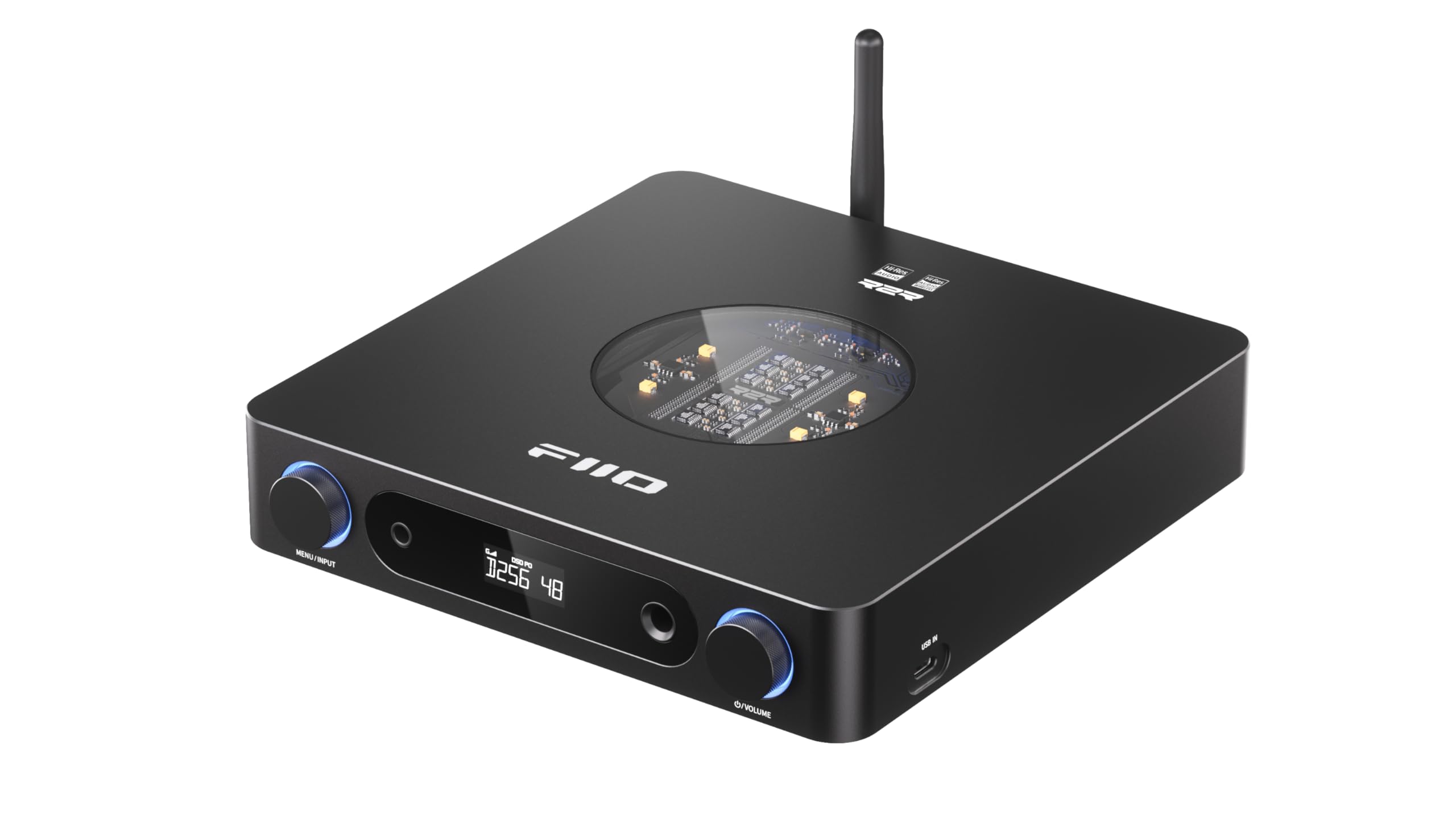
The FiiO K13 R2R introduces a fully differential 24-bit R2R DAC built from 192 precision 0.1% thin-film resistors with 30ppm temperature drift. This architecture produces a distinctly analog tonal character—the low end is full and organic rather than processed and dry. In NOS (Non-Oversampling) mode, the amplifier preserves the original sample rate of the recording, which means the bass hits with the same timing and phase relationship as the master tape.
Delivering 2400mW into balanced loads, the K13 R2R drives planar magnetic headphones like the Hifiman Sundara or Audeze LCD series without breaking a sweat. The 10-band parametric EQ gives you surgical control over sub-bass boost, mid-bass punch, or treble roll-off, with the ability to load Auto EQ presets that correct headphone frequency response to a target curve. The web-based control interface and smartphone app both work reliably for real-time tweaking.
Bluetooth 5.4 with LDAC support means you can stream wirelessly at up to 990kbps, and the dual power supply (analog and digital rails separated) keeps the noise floor extremely low. The K13 R2R also functions as a preamp with both XLR balanced line outs and dual RCA outputs. Users report that the remote control’s volume knob has a slightly wobbly feel, but the core DAC and amplifier performance is genuinely competitive with units costing twice as much.
Why it’s great
- R2R DAC delivers warm, musical bass with excellent timbre
- 2400mW balanced output drives any planar headphone
- 10-band PEQ with app and web control for fine-tuning
Good to know
- Remote control has loud clicky buttons
- Display is small and shows only positive dB values for volume
- Global Gain must be adjusted in PEQ to avoid clipping
4. iFi Hip-dac 3

The iFi Hip-dac 3 occupies the sweet spot between pocketable convenience and genuine audiophile power delivery. Its revised internal power supply components lower the noise floor significantly compared to the previous generation, and the True Native DAC path processes PCM up to 384kHz, DSD256, and MQA without any digital conversion in between. The result is a background so black that micro-details in the lowest octave emerge with startling clarity.
Two headphone outputs—a fully balanced 4.4mm jack and an S-Balanced 3.5mm jack—cover both single-ended and balanced cables. The PowerMatch switch lets you choose between three gain levels, so you can match the amplification to anything from a 16-ohm IEM to a 300-ohm Sennheiser HD 600. The XBass function, inherited from iFi’s larger models, applies a gentle shelf filter that reinforces sub-bass extension without blurring the midrange.
Battery life is rated at 8 hours, which covers a solid day of commuting or desk work. The Hip-dac 3 charges via a dedicated USB-C port separate from the audio data input, so you can keep it powered while listening through a computer or smartphone. The aluminum enclosure feels robust enough for daily carry, and the stealth black finish resists scratching. This is the amplifier to choose if you want balanced bass control on the go without spending premium-tier money.
Why it’s great
- Clean, powerful balanced output drives demanding headphones
- XBass filter adds sub-bass weight naturally
- Separate charging and data USB-C ports
Good to know
- No Bluetooth wireless connectivity
- Battery is not replaceable
- Small size means controls are tightly spaced
5. BOSS KATANA:GO

The BOSS KATANA:GO is a specialized tool designed exclusively for guitar and bass players who need silent practice without sacrificing tone. It plugs directly into the instrument’s output jack and delivers the same digital modeling found in the Katana 100-watt combo amp, including 10 amp types and over 85 effects for guitar, and 3 amp types with over 65 effects for bass. The 3D spatial audio technology creates an immersive soundstage that is unusual for a headphone amp in this form factor.
Bass players will appreciate the dedicated bass mode, which models the low-end response of classic amps like the Super Flat and Extreme. The built-in tuner and 30 programmable channel slots let you store presets for different basses or playing styles. Bluetooth connectivity streams backing tracks from your phone directly into the amplifier, and the companion app allows deep editing of effects chains and EQ curves.
The KATANA:GO does not aim for the same neutral, transparent sound as a reference DAC/Amp. Instead, it offers a curated, character-rich low end that mimic the sound of a pushed tube amplifier. Sub-bass extension is limited compared to a dedicated headphone amplifier driving studio monitors, but for its intended use—late-night practice and silent jamming—the low-end punch is more than sufficient. The built-in rechargeable battery lasts for several sessions on a single charge.
Why it’s great
- Dedicated bass mode with 3 amp types and 65+ effects
- 3D spatial audio enhances practice immersion
- Bluetooth streaming for backing track playback
Good to know
- Best with low-impedance headphones (under 80 ohms)
- Sub-bass extension is not reference-grade
- App required for full tone editing features
6. FiiO BTR7

The FiiO BTR7 is a Bluetooth DAC/Amp that prioritizes wireless fidelity without compromising on bass control. Each channel uses its own ES9219C DAC chip, paired with separate low-pass filters and amplifier stages, creating a fully balanced dual-mono architecture. This topology reduces crosstalk and improves channel separation, which translates into a more defined stereo image of the bass guitar and kick drum placement in the soundstage.
Bluetooth 5.1 supports LDAC at up to 990kbps, aptX Adaptive, and aptX HD, ensuring that wireless transmission does not become the bottleneck for low-frequency detail. In USB DAC mode, the XMOS XUF208 chip handles PCM up to 384kHz and native DSD256 with MQA 8x rendering. The built-in microphone with cVc 8.0 noise suppression allows the BTR7 to function as a hands-free calling device, though this is secondary to its core audio performance.
The 4.4mm balanced output delivers significantly more voltage swing than the 3.5mm single-ended jack, which is critical for driving headphones with high impedance or low sensitivity. Users report that the BTR7 drives 300-ohm Sennheiser HD6XX to satisfying levels with room to spare. The companion FiiO Control app includes a parametric EQ with adjustable frequency bands, Q-factor, and gain, giving you the ability to shape the low-end response to your exact preference.
Why it’s great
- Dual ES9219C chips deliver excellent channel separation for bass imaging
- Parametric EQ in companion app allows precise bass tuning
- Balanced 4.4mm output provides higher voltage swing
Good to know
- Menu system and app interface can be confusing
- Battery life is shorter than older models due to color screen
- Occasional connection drops with multi-device pairing
7. MOOER Audiofile

The MOOER Audiofile is a Class A analog headphone amplifier designed to live on a guitar or bass pedalboard. Its all-analog signal path uses discrete components rather than digital modeling, which means the bass frequencies from your instrument remain warm and dynamic. The built-in analog speaker cabinet simulation adds a smooth low-end resonance that approximates the feel of pushing air through a 12-inch speaker.
Stereo and mono inputs accept both instrument-level and line-level signals, and the true bypass switching means you can leave the Audiofile on your pedalboard without affecting your signal chain when not in use. The unit also functions as a clean boost or buffer, restoring high-frequency energy and low-end punch when your cable runs are long or your signal has passed through many true-bypass pedals.
At 159 grams and roughly the size of a compact stomp box, the Audiofile is the most affordable entry point into high-quality headphone amplification for bassists. It lacks Bluetooth, USB DAC capability, and any adjustable EQ, but its Class A topology produces a genuinely musical low end that budget digital solutions cannot match. A small minority of users have reported reliability issues, so buying from a retailer with a solid return policy is advisable.
Why it’s great
- Class A analog circuit preserves bass warmth and dynamics
- True bypass keeps signal chain clean when not used
- Doubles as a clean boost or buffer for pedalboards
Good to know
- No EQ controls or Bluetooth connectivity
- Some reliability concerns reported by users
- Requires an AC adapter—no battery operation
FAQ
Will a bass headphone amplifier make my headphones sound boomy?
Do I need a balanced cable to get good bass from my headphone amplifier?
Final Thoughts: The Verdict
For most users, the bass headphone amplifier winner is the Schiit Magni Unity because its discrete current-feedback topology delivers tight, authoritative bass control across any headphone impedance, all within a fully upgradable chassis. If you want portable balanced output with XBass analog filtering, grab the iFi Hip-dac 3. And for wireless high-res streaming with parametric EQ control, nothing beats the FiiO BTR7.