
You have a guitar, a microphone, and a small venue or practice space that demands both at once without feedback or muddy tone. The reality is most standard guitar amps lack a dedicated mic input, forcing you to choose between singing or playing through separate gear. An amplifier with a built-in mic channel solves this by giving you independent volume, EQ, and effects control for your voice and instrument from a single box.
I’m Min — the co-founder and writer behind Gadgets Feed. I’ve spent hundreds of hours combing through spec sheets, cross-referencing customer field reports, and analyzing frequency response curves and output stage designs across the budget-to-premium spectrum of these hybrid combos.
This guide breaks down the highest-rated models by real-world use case so you can confidently pick the best amp with mic for solo gigs, busking, or home jamming without second-guessing your purchase.
How To Choose The Best Amp With Mic
Selecting the right combo means balancing your instrument’s tonal needs with a clean vocal path. You need to evaluate channel count, power output, portability, and whether the mic preamp includes phantom power for condenser microphones.
Channel Count and Input Flexibility
A two-channel setup (instrument + mic) is the minimum, but models with four or six inputs let you add a second instrument, a backing track source, or a second vocalist without external mixers. Look for combo XLR/¼-inch jacks — they accept both standard guitar cables and professional microphones without adapters.
Wattage and Speaker Configuration
For bedroom practice, 20-30 watts with a single 8-inch speaker suffices. Small coffee shop gigs demand 40-60 watts and at least a 10-inch driver or dual smaller speakers. Outdoor busking favors 100-watt battery-powered units with neodymium woofers that project without mains power.
Built-in Effects and Tone Shaping
Reverb is the most critical effect for vocals — it adds presence without harshness. Delay, chorus, and overdrive benefit guitar channels. A 3-band EQ (bass, mid, treble) per channel gives you fine control over both your voice and instrument so neither fights the other in the mix.
Quick Comparison
On smaller screens, swipe sideways to see the full table.
| Model | Category | Best For | Key Spec | Amazon |
|---|---|---|---|---|
| Positive Grid Spark Live | Premium | All-in-one band rig | 150W, 4 channels, 33 amp models | Amazon |
| Fishman Loudbox Mini BT | Premium | Acoustic guitar clarity | 60W, feedback suppression, reverb | Amazon |
| Roland Cube Street EX | Premium | Battery-powered busking | 50W stereo, 4 channels, 20h eco mode | Amazon |
| Fender Acoustasonic 40 | Mid-Range | Vocal clarity with acoustic | 40W, dual 6.5″ speakers, XLR input | Amazon |
| Coolmusic BP80 | Mid-Range | Portable battery-powered jams | 100W, 6 inputs, 48V phantom power | Amazon |
| Marshall MG30GFX | Mid-Range | Electric guitar with FX | 30W, 4 channels, digital effects | Amazon |
| Rockville RPM45 | Mid-Range | Small venue PA system | 1800W peak, 2x225W RMS, 4 XLR | Amazon |
| Donner DKA-20 | Budget | Keyboard practice with mic | 20W, 8″ woofer + 2″ tweeter, 2 channels | Amazon |
| Rockville G-AMP 30 | Budget | Home guitar practice with vocals | 30W, 8″ speaker, Bluetooth, mic volume | Amazon |
In‑Depth Reviews
1. Positive Grid Spark Live Smart Guitar Amp

The Spark Live redefines what an all-in-one amp with mic can do. It packs 150 watts of computational audio across four independent channels — Channel 1 alone gives you 33 amp models and 43 effects for guitar, while Channel 2 hosts dedicated vocal, bass, and acoustic processing. The Sonic IQ engine balances full-spectrum sound so your voice and instrument never step on each other, and the optional swappable battery delivers up to eight hours of cord-free performance.
Connectivity is comprehensive: combo XLR/¼-inch inputs on two channels, separate ¼-inch inputs on the other two, USB charge ports, MIDI in/out, and two line-level outputs. The 34.6-pound enclosure can sit flat, tilt back as a monitor, or mount vertically — a practical design for solo buskers or small ensemble rehearsals. Users consistently report very clear sound with strong low end and reliable Bluetooth streaming for backing tracks.
The primary trade-off is the lack of a dedicated auxiliary input, and the companion app for effect reordering has limitations. Some users also noted a hiss on Channel 1 right out of the box, though most feedback praises the loud, clean output and reduced gear load — fitting guitar, vocal mic, and backing tracks in a single trip.
Why it’s great
- Four independent channels with dedicated vocal and instrument processing
- 150W fills small venues without an external PA
- Optional battery provides up to 8 hours of portable power
Good to know
- No dedicated Aux In for external media players
- App-based effects re-ordering lacks full flexibility
- Some units shipped with noticeable Channel 1 hiss
2. Fishman Loudbox Mini BT 60-Watt Acoustic Combo

Fishman’s Loudbox Mini BT is the gold standard for acoustic guitarists who need a transparent vocal channel. Its 60-watt solid-state engine drives a 6.5-inch woofer and a soft-dome tweeter, reproducing fingerpicked nylon strings and open-mic vocals with studio-like neutrality. The feedback suppression circuit is a lifesaver on small stages, letting you push stage volume without the dreaded howl.
The two-channel layout offers independent 3-band EQ, reverb, and chorus per channel, plus a dedicated anti-feedback control. Bluetooth 4.0 streams backing tracks wirelessly, and the XLR mic input has enough clean gain for dynamic mics like the SM58. At 24.26 pounds, it is light enough for one-handed carries to coffee shop gigs or church rehearsals.
Reviewers consistently call it the best-sounding acoustic amp in its class, praising the clarity it brings to classical guitars and vocals alike. The main criticism is the plastic enclosure — it is durable but doesn’t feel as premium as its price suggests. Some users wish for a third channel, but for pure acoustic-vocal duets, this is the benchmark.
Why it’s great
- Anti-feedback circuit allows high stage volume without squeal
- Neutral, full-range tone ideal for acoustic guitars and vocals
- Bluetooth streaming and dual effects engines per channel
Good to know
- Plastic cabinet lacks the road-worthy feel of wood enclosures
- Limited to two channels — no second instrument input
- Priced at the upper end of the mid-range category
3. Roland Cube Street EX 50W Stereo Amplifier
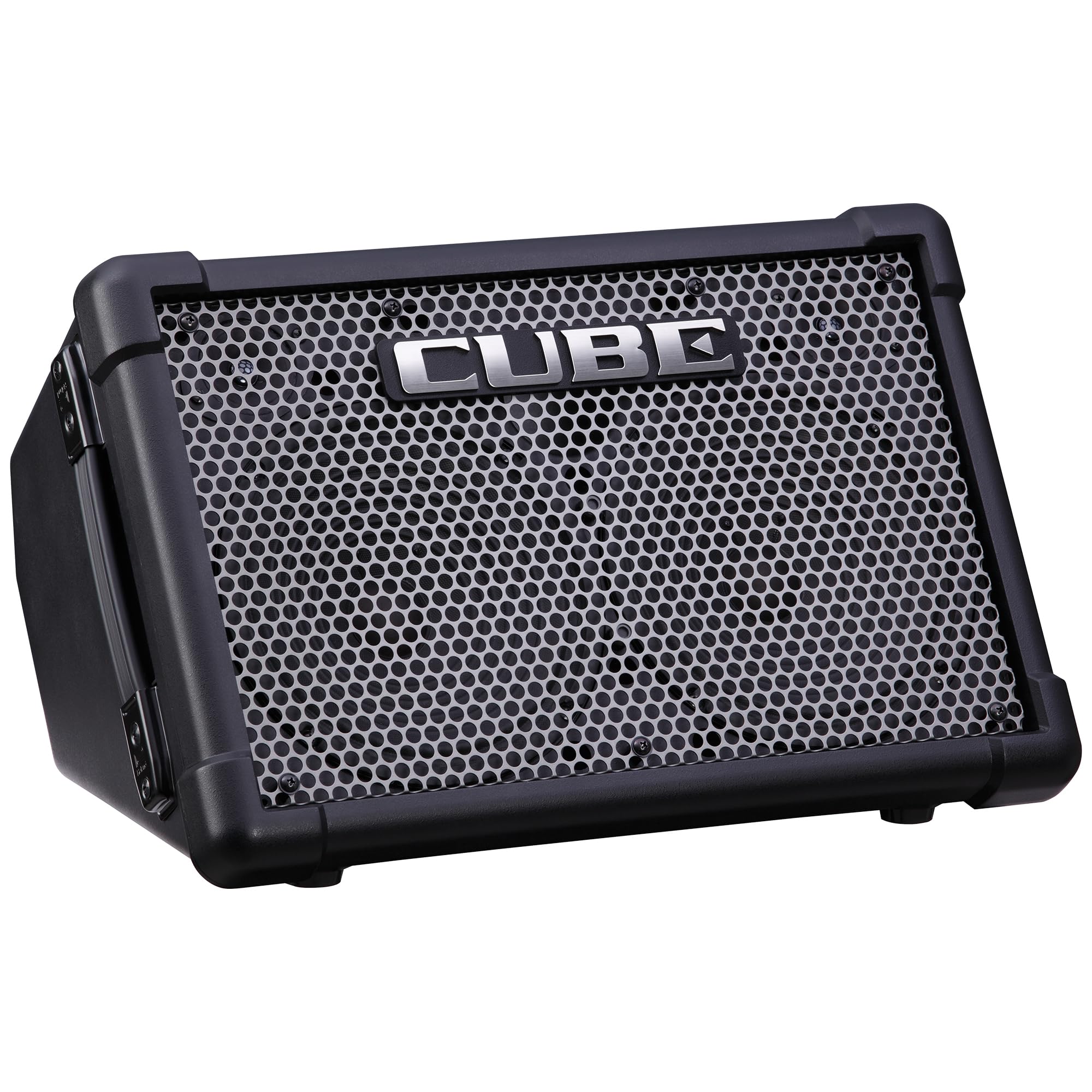
The Roland Cube Street EX is the ultimate battery-powered companion for buskers and outdoor performers who cannot rely on wall outlets. Its 50 watts of stereo power come from eight AA batteries, and three selectable output modes let you choose between 50W (5 hours), 25W (10 hours), or 10W (20 hours) — making it the most power-efficient amp with mic on this list. The lightweight 16.3-pound ABS cabinet with an angled back doubles as a stage monitor or pole-mount speaker.
Four independent channels include two XLR mic inputs with dedicated reverb, plus COSM modeling for electric guitar (Clean, Crunch, Lead) and an acoustic guitar preamp. Stereo line outs let you feed a larger PA when needed, and the i-CUBE Link jack enables direct iPhone/iPad recording via the free CUBE JAM app. The stereo separation from two built-in speakers fills outdoor spaces remarkably well for its size.
Users consistently praise its clean vocal channel and adequate guitar effects, though the frequency response struggles below 200 Hz and has noticeable dips at 2.25 kHz and 7 kHz — meaning bass-heavy material and some vocal sibilance may suffer. The lack of built-in Bluetooth requires an external adapter for wireless streaming, but its battery endurance and portability are unmatched in the premium tier.
Why it’s great
- Up to 20 hours on Eco mode from standard AA batteries
- Stereo output with two speakers for spatial imaging outdoors
- Four independent channels with two XLR mic inputs
Good to know
- Limited low-frequency response below 200 Hz
- No built-in Bluetooth — requires separate adapter
- Vocal channel lacks dedicated effects mix control
4. Fender Acoustasonic 40 Acoustic Guitar Amplifier

The Fender Acoustasonic 40 punches well above its 40-watt rating thanks to dual 6.5-inch full-range speakers with whizzer cones. This configuration reproduces both acoustic guitar body resonance and vocal sibilance with surprising detail — restaurant gigs at half volume cover the room without strain. The lightweight 5-ply plywood cabinet tips the scales at just 10 pounds, making it one of the lightest serious acoustic combos available.
Two combo XLR/¼-inch inputs accept microphones and instruments independently, each with its own reverb control. The lack of a dedicated 3-band EQ per channel is a limitation, but the built-in reverb is warm and natural. The classic Brown and Wheat cosmetics add stage presence, and the 2-year Fender warranty provides peace of mind for gigging musicians.
Customer reviews highlight its exceptional vocal clarity through the mids — a rare strength in this category — and the ability to handle harmonica, acoustic guitar, and a second instrument simultaneously. The downside is occasional quality control reports of hiss, thumping on shutdown, and cosmetic blemishes. For its weight and vocal transparency, it remains a top value pick.
Why it’s great
- Only 10 pounds with dual speakers for impressive vocal clarity
- Two universal XLR/¼-inch inputs with independent reverb
- Classic Fender build quality and 2-year warranty
Good to know
- No per-channel EQ — only reverb and tone controls
- Some units show audible hiss and shutdown thump
- Limited to 40W for larger outdoor venues
5. Coolmusic BP80 Battery Powered Acoustic Guitar Amplifier

The Coolmusic BP80 is a feature-packed battery-powered 100-watt combo that punches far above its price point. Six total inputs — four instrument and two auxiliary — can handle guitar, keyboard, two microphones, and two backing track sources simultaneously. The 8-inch woofer and 3-inch tweeter deliver dynamic, clear sound, and the rechargeable battery runs 6-8 hours on a full 5-hour charge.
Each of the two primary channels has independent 3-band EQ, volume, and effects control, with a 48V phantom power switch on the mic input for condenser microphones. Bluetooth pairing is straightforward, and the headphone output plus DI output make it suitable for silent practice and front-of-house connection. At 21.8 pounds, it is portable enough for street performances or quick coffee shop setups.
Users report flawless performance over a full year of use, with clear vocal reproduction and balanced acoustic guitar tone. The main drawbacks are a subpar exterior finish on some units and a poorly translated manual that leaves certain routing questions unanswered. The battery is not user-replaceable, which could become an issue after years of heavy cycling.
Why it’s great
- Six total inputs support a small band without external mixing
- 100W with battery power for 6-8 hours of outdoor use
- 48V phantom power for condenser microphones
Good to know
- Battery is not user-replaceable
- Exterior finish and manual quality are inconsistent
- Some units arrived with minor cosmetic damage
6. Marshall MG30GFX Combo Guitar Amplifier

The Marshall MG30GFX brings the brand’s legendary rock tone into a compact 30-watt combo with a 10-inch custom speaker. Four channels — Clean, Crunch, OD1, and OD2 — cover everything from shimmering cleans to high-gain distortion, and the onboard digital effects include chorus, phaser, flanger, delay, and octave. The 3-band EQ is aggressive and responsive, letting you sculpt sounds with precision.
While this is primarily a guitar amp, it includes a 3.5mm auxiliary input for backing tracks and a headphone output for silent practice. The mic input is not a dedicated channel — you would need a separate mic preamp or an external mixer to use a vocal microphone properly. This unit is best suited for electric guitarists who occasionally want to play along with tracks.
Reviews consistently call this the best affordable Marshall tone available, praising the Crunch and OD voicings as authentic to the brand’s heritage. The 23.8-pound weight is notable for its size, and some users found the channel volume imbalance (clean quieter than overdrive) and flashing red status light distracting. For pure electric guitar performance with built-in versatility, it excels — but it is not a true dual-purpose vocal amp.
Why it’s great
- Four channels with authentic Marshall crunch and overdrive
- Built-in digital effects reduce pedalboard dependency
- 10-inch custom speaker delivers classic full-range tone
Good to know
- No dedicated mic input — requires external preamp for vocals
- Heavier than comparable 30W combos at 23.8 pounds
- Clean channel volume is noticeably lower than OD channels
7. Rockville RPM45 Powered 4-Channel Mixer Amplifier

The Rockville RPM45 is a powered mixer amplifier designed for small venues that need a PA system rather than a standalone combo. It delivers 1800 watts peak (2x225W RMS at 8 ohms) and features four XLR/¼-inch combo inputs with individual bass, treble, and volume controls. The built-in digital effects processor offers echo, delay, and reverb, plus 48V phantom power for condenser microphones.
The rugged wooden enclosure and fan-cooled amplifier section ensure reliable performance during extended gigs. USB input, RCA Aux input, and RCA Rec output provide flexible playback and recording options. At 19 pounds and measuring just over 5 inches tall, it fits easily into a rack case or sits on a tabletop for small band practices.
Users replacing dead Peavey and Behringer units report flawless operation with clean, loud output across the frequency range. The MP3 player controls are intuitive, and the build quality feels solid with smooth knob action. The primary limitation is that this is a head-only mixer amp — you need to connect external passive speakers, so it is not a self-contained all-in-one solution.
Why it’s great
- Four independent XLR inputs with 48V phantom power
- 1800W peak output drives passive PA speakers with authority
- Rugged wooden enclosure with fan cooling for reliability
Good to know
- Requires external passive speakers — not a standalone combo
- No built-in Bluetooth or wireless streaming
- Limited onboard effects compared to dedicated mixer amps
8. Donner DKA-20 Keyboard Amplifier 20W

Donner’s DKA-20 is a compact 20-watt keyboard amplifier that doubles as an entry-level amp with mic for home practice. It features two channels — each with ¼-inch instrument input — and supports microphone input with up to 48dB of gain for a clean, warm vocal tone. The dual-speaker configuration uses an 8-inch woofer and a 2-inch tweeter with 4-ohm impedance, covering a frequency range of 50 Hz to 20 kHz.
The 3-band EQ (bass, middle, treble) per channel, Gain and Boost controls, auxiliary input, headphone output, and DI output make it surprisingly versatile for its modest price. At 11.7 pounds and roughly the size of a small microwave, it fits easily on a desk or keyboard stand. The solid-state design runs cool and reliably for extended practice sessions.
Customers pair it with Kawai and Yamaha digital pianos and report clean, clear sound with no hum or feedback at normal distances. The volume at level 1 is already surprisingly loud for bedroom use. The limitation is that 20 watts cannot keep up with a drummer or fill a coffee shop — this is strictly a personal practice tool where vocal clarity still matters.
Why it’s great
- Two channels with 3-band EQ and microphone support
- Lightweight and compact for desk or keyboard stand placement
- 48dB mic gain delivers clean vocal tone at low volumes
Good to know
- 20W is insufficient for live performances or band practice
- No Bluetooth or wireless connectivity
- Limited to ¼-inch mic input — no XLR for professional mics
9. Rockville G-AMP 30 Watt Guitar Combo Amplifier

The Rockville G-AMP 30 is a straightforward entry-level guitar combo that adds a dedicated mic input with independent volume control — a rare feature at this price tier. Its 30-watt solid-state amplifier drives a single 8-inch speaker, producing enough volume for bedroom practice and acoustic jam sessions. The built-in Bluetooth receiver lets you stream backing tracks from your phone, making it easy to practice guitar and vocals together.
Clean and overdrive channels with adjustable gain and a simple delay effect give you two distinct voices, and the metal corner protectors plus carry handle make it road-ready despite the budget build. At 14.96 x 7.28 x 14.17 inches, it occupies minimal floor space. The ¼-inch mic input works well with dynamic microphones for basic vocal reinforcement.
Customers praise the feature set — Bluetooth, mic input, footswitch compatibility — for the money, noting that the clean tones are decent and the overdrive is passable for beginners. Some units arrived with cosmetic damage, and the overall sound quality is exactly what you expect from a budget solid-state: functional but not inspiring. For anyone testing the waters of guitar-plus-vocal practice, this is a low-risk starting point.
Why it’s great
- Dedicated mic input with independent volume control
- Bluetooth streaming for backing track practice
- Compact, portable design with metal corner protectors
Good to know
- Budget solid-state tone lacks warmth and clarity
- Only 30W through a single 8-inch speaker
- Some units arrive with cosmetic blemishes
FAQ
Can I use a dynamic microphone like the SM58 with any of these amps?
How do I prevent feedback when using a mic with a guitar amp?
Which amp is best for outdoor busking with vocals and guitar?
Final Thoughts: The Verdict
For most users, the amp with mic winner is the Positive Grid Spark Live because its four-channel architecture, 150W output, and app-based modeling eliminate the need for separate gear in a single portable box. If you want pristine acoustic clarity with feedback protection, grab the Fishman Loudbox Mini BT. And for battery-powered street performances where every ounce matters, nothing beats the Roland Cube Street EX.