
The difference between a project finished on time and one abandoned in frustration often comes down to a single sanding belt that snaps mid-stroke. A 3×21 belt carries the full torque of your sander across a narrow seam, and when that seam gives out, you’re left hunting for a replacement mid-job. Finding belts that actually hold up under aggressive material removal—without delaminating, loading up, or burning through—requires looking beyond the packaging.
I’m Min — the co-founder and writer behind Gadgets Feed. I’ve spent dozens of hours cross-referencing product specs, seam construction methods, abrasive grain types, and hundreds of verified buyer experiences to separate the belts that last from those that leave you stranded at the workbench.
This guide focuses entirely on what separates consumable abrasives from real workshop tools. Whether you’re stripping paint from a deck, shaping knife bevels, or polishing metal to a mirror shine, these selections represent the most reliable 3×21 sanding belts available today based on real-world durability data.
How To Choose The Best 3X21 Sanding Belts
Choosing a sanding belt is not just about grabbing the cheapest multi-pack on the shelf. The wrong belt can overheat your workpiece, load up with resin in seconds, or snap at the seam before you’ve made your first full pass. Understanding a few key construction details will save you both time and money.
Abrasive Grain Type: Aluminum Oxide vs. Zirconia vs. Silicon Carbide
Aluminum oxide is the standard workhorse for wood and general-purpose sanding. It fractures during use to expose fresh cutting edges, but it dulls faster on hard metals. Zirconia alumina is a premium grain that stays sharper under pressure and dissipates heat better, making it the choice for heavy stock removal on metal and stainless steel. Silicon carbide is the hardest of the three and excels on non-ferrous materials, glass, stone, and fine finishing work. For high-grit polishing, silicon carbide is the only option that delivers consistent scratch patterns.
Seam Construction: The Belt’s Weakest Link
Nearly every belt failure happens at the seam. A diagonal lap splice overlaps the belt ends rather than butting them together, creating a stronger joint that resists peeling under tension. Bi-directional tape joints allow the belt to run in either direction without catching or bumping, which extends usability when the belt needs reversing. Resin-on-resin bonding at the seam prevents moisture and heat from breaking the adhesive bond, a critical feature for extended sanding sessions.
Backing Weight and Coat Type
X-weight cloth backing is the standard for 3×21 belts because it offers the right balance of flexibility and tear resistance. Lighter J-weight backings can fold and crease under the platen pressure. Open coat construction means the abrasive grains cover only about 60-70% of the surface, leaving space between particles to prevent clogging—essential when sanding softwoods, paint, or resinous materials. Closed coat belts deliver more cutting action per pass but load up faster on gummy substances.
Quick Comparison
On smaller screens, swipe sideways to see the full table.
| Model | Category | Best For | Key Spec | Amazon |
|---|---|---|---|---|
| Makita 742308-3 | Premium | Industrial-grade wood and metal sanding | Aluminum Oxide, Uni-directional, X-weight backing | Amazon |
| Aolabela Zirconia 21-Pack | Mid-Range | Heavy-duty metal and stainless steel | Blue Zirconia particles, diagonal lap splice | Amazon |
| POWERTEC 10-Pack | Mid-Range | All-purpose woodworking and paint removal | Aluminum Oxide, resin-on-resin bond, direction arrow | Amazon |
| Taokyid 24-Pack | Mid-Range | Heavy volume wood removal and plastic | Aluminum Oxide, bi-directional tape joint, 24 belts | Amazon |
| SACKORANGE 20-Pack | Budget-Friendly | Aggressive rough removal on wood | Aluminum Oxide, open coat, antistatic | Amazon |
| makiwork 15-Pack | Budget-Friendly | Variety grit progression for general jobs | Aluminum Oxide, X-weight, two-way tape joints | Amazon |
| SHUTTLE GENIUS Silicon Carbide | Specialty | High-grit knife sharpening and fine polishing | Silicon Carbide, 600-1000 grit, Y-weight polyester | Amazon |
In‑Depth Reviews
1. Makita 742308-3 3-Inch x 21-Inch Abrasive Sanding Belt, 80 Grit (10/Pk)

The Makita 742308-3 belts are the benchmark against which all other 3×21 belts should be measured. Built with industrial-grade aluminum oxide on an X-weight cloth backing, these belts are designed for high-tension continuous use on uni-directional sanders. Multiple verified buyers report that these belts outlast competitor brands by a factor of 3 to 5 times, with one user noting that other name-brand belts broke within minutes while Makita belts ran for hours without seam failure.
The 80-grit formulation is aggressive enough to strip paint and level hardwood floors, but the resin bond keeps the grain attached under the heat generated by extended passes. Users consistently mention that these belts clog significantly less than cheaper alternatives, especially when removing paint or sanding resinous woods. The Japanese manufacturing tolerances ensure the belt tracks true without wandering, even on older sanders with worn guide rollers.
These are not the cheapest belts per pack, but the usable life per belt dramatically lowers the cost per minute of sanding. For anyone who relies on their belt sander for regular work—whether professional or obsessive hobbyist—the Makita 742308-3 is the logical first choice. A single pack can outlast two or three packs of commodity belts.
Why it’s great
- Exceptional seam integrity; belts last hours without snapping
- Significantly less clogging during paint and resin removal
- Precise tracking on worn sanders with no wandering
Good to know
- Only available in 80 grit per box—need separate purchases for other grits
- Uni-directional design reduces flexibility for reversing belt direction
2. Aolabela 3×21 Inch Sanding Belts 21 Pcs 7 Grits (Blue Zirconia)

The Aolabela set shifts the abrasive material from standard aluminum oxide to blue zirconia particles, which maintain their cutting edges longer under high pressure. This makes them uniquely suited for heavy metal removal, stainless steel deburring, and knife bevel grinding where conventional belts would glaze over and stop cutting. The 21-pack includes three belts each of 40, 60, 80, 120, 150, 240, and 400 grits—a comprehensive progression from brute stock removal to pre-finish smoothing.
The diagonal lap splice seam construction is a critical differentiator here. Verified buyers confirm the belts track fine and do the job, but a recurring note is that overheating from excessive pressure or long continuous runs can still cause seam breakage. Taking periodic cool-down breaks dramatically extends belt life, and the zirconia grain lasts longer than aluminum oxide when overheating is avoided. One buyer used a single pack to sand and refinish 1,200 square feet of hardwood flooring and returned the unopened packs.
The resin bonding system effectively dissipates heat, reducing the risk of grain detachment common with cheaper belts during metal deburring. For woodworkers who occasionally move into metal or for knife makers who need a single versatile pack, this is a compelling mid-range option that bridges material types better than any aluminum oxide pack in this list.
Why it’s great
- Zirconia grain stays sharp longer on metal and stainless steel
- Comprehensive grit progression covers removal through finishing
- Resin bonding dissipates heat and prevents grain shedding
Good to know
- Seam can fail under prolonged heavy pressure without cool-down breaks
- Zirconia is overkill for simple pine or paint removal projects
3. POWERTEC 3 x 21 Inch Sanding Belts, 10PK, 80 Grit Aluminum Oxide

The POWERTEC 110430 belts deliver a rare combination: premium construction details at an accessible price point. The resin-on-resin bonding process creates a moisture and heat-resistant seam that multiple buyers confirm holds up comparably to 3M belts. The inclusion of a direction arrow on each belt is a thoughtful touch that many users appreciate, as it eliminates guesswork during installation on uni-directional sanders.
Made with open coat aluminum oxide on an X-weight clothed backing, these belts resist loading even when sanding paint, fiberglass, or resinous woods. The heat and moisture resistance is not just marketing language—verified reviews mention that preventing clogging with a cleaning stick is the primary way to extend belt life, and these belts tolerate the cleaning process without degrading. They are compatible with a wide range of sanders including Dewalt, WEN, Craftsman, Makita, and Jellas models.
The 80-grit is aggressive enough for heavy stripping work but uniform enough for light shaping. One buyer noted that these belts last well and do not show early seam breakage, which is the most common failure mode for budget-tier belts. If you need one reliable grit size for general workshop use and want to avoid paying the Makita premium, the POWERTEC 10-pack is the smart compromise.
Why it’s great
- Resin-on-resin seam bond resists moisture and heat delamination
- Includes direction arrow for correct uni-directional installation
- Open coat design prevents rapid loading on paint and fiberglass
Good to know
- Only available as single-grit 10-packs per listing
- Does not specify if stearate release agents are used in coating
4. Taokyid 24 Pack 3 x 21-Inch Sanding Belts, 6 Each of 40/80/120/240 Grit

The Taokyid 24-pack delivers the highest belt count in this comparison at a price per belt that undercuts nearly every competitor. Six belts each of 40, 80, 120, and 240 grits provides a solid workflow from aggressive flattening through to intermediate finishing. The bi-directional tape joint allows the belt to be run in either direction, which effectively doubles the usable life by letting you reverse the belt when the abrasive dulls.
Made from premium open coat aluminum oxide with antistatic properties, these belts are designed to resist moisture and heat buildup. The resin-over-resin bonding is the same principle used by more expensive brands, and user reviews confirm the belts hold up well on Ryobi, Porter Cable, and other standard sanders. The belts do load up noticeably when sanding pine, but a rubber cleaning block restores cutting performance quickly.
Where these belts really shine is in volume work—deck sanding, floor refinishing, or any project where you are going to burn through multiple grit progressions. The cost savings over name-brand multi-packs is substantial, and the seam integrity is good enough that most users will wear out the grit before the seam fails. A solid mid-range choice for high-consumption users.
Why it’s great
- Highest belt count in the roundup—24 belts per pack
- Bi-directional joint allows belt reversal for extended life
- Antistatic and open coat design reduces heat and loading
Good to know
- Pine sanding causes faster loading compared to premium brands
- Limited to four grits; no fine finishing options above 240
5. SACKORANGE 20 PCS 3 inch x 21 inch Abrasive Sanding Belts, 5 Each of 40/80/120/240 Grit

The SACKORANGE 20-pack offers the best cost-per-belt ratio of any set in this guide, making it a natural choice for beginners or for jobs that are particularly hard on abrasives, such as removing thick paint or rough shaping of softwoods. Five belts each of 40, 80, 120, and 240 grits give you a complete progression for most woodworking tasks, and the open coat aluminum oxide construction includes an antistatic additive and a washable formulation designed to resist loading.
User reviews are split along an interesting divide. Some long-time woodworkers report that these belts last far longer than expected, with one 20-year veteran calling them the best belts he has ever used. Others note that the belts can wear out quickly and that the seam can rip after only a few minutes of use, particularly under heavy pressure. This inconsistency suggests that quality control varies between batches, which is a common trade-off at this price tier.
For rough removal work where belt life is less critical than cost—cleaning up construction debris, shaping green wood, or removing heavy coatings—these belts perform adequately. The 40-grit is especially aggressive and works well for hogging off material fast. If you are working on a fine furniture piece and need predictable seam integrity, it is worth spending more per belt, but for shop consumables, the SACKORANGE pack earns its place.
Why it’s great
- Extremely low cost per belt ideal for rough work and heavy consumption
- Includes 40-grit for the most aggressive stock removal
- Antistatic and washable formulation helps reduce clogging
Good to know
- Seam integrity can be inconsistent between individual belts
- Grit uniformity varies; best used for rough removal rather than finish work
6. makiwork 3 x 21 Inch 75 x 533 mm Sanding Belts Set, 15-Pack 80/120/150/240/400 Grits

The makiwork set covers five grits from 80 through 400 in a single 15-belt pack, filling the gap between coarse removal and fine finishing that many budget packs ignore. With three belts each of 80, 120, 150, 240, and 400 grit, this set allows a single purchase to take a project from initial shaping through to the sanding stage before finish application. The two-way tape joints are designed for smooth transitions without bumping or catching.
Built from premium aluminum oxide on X-weight clothed backing, these belts fit standard 3×21 sanders and have drawn positive feedback for their consistent quality. Users report that they track properly on mini belt sanders and bench grinders, and the seams hold together well during normal use. The 400-grit belts in particular fill a niche that standard multi-packs often skip, allowing users to reach a finer finish without buying a separate specialty pack.
The main caveat is that the belt width can occasionally vary, and one user noted that checking the width before starting a critical job is prudent. For the price point, these represent a well-rounded starter set that lets a new user figure out which grits they use most before committing to single-grit bulk purchases. A sensible entry-level recommendation.
Why it’s great
- Includes 400-grit fine finishing belts—rare in budget multi-packs
- Smooth two-way tape joints prevent bumping during use
- Covers the widest grit range in a single affordable pack
Good to know
- Some belts may have slight width variations affecting fit
- Only three belts per grit means heavier projects will exhaust individual grits fast
7. SHUTTLE GENIUS 15 Pack 3 x 21 Sanding Belts, Extra Fine Grit 600/800/1000 Silicon Carbide
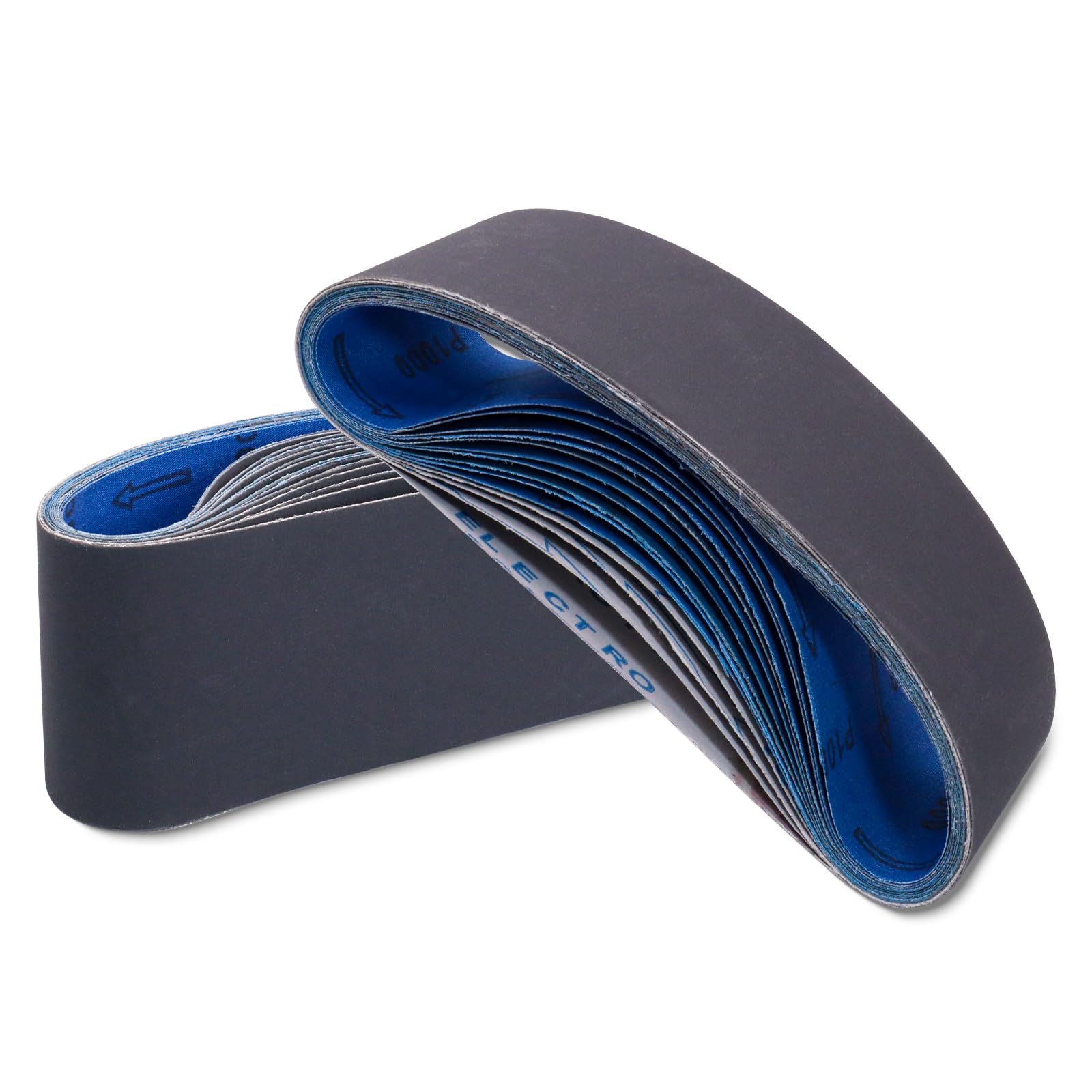
The SHUTTLE GENIUS set fills a specific but critical gap: ultra-fine grits for knife sharpening, stone polishing, and metal finishing. Made from premium silicon carbide rather than aluminum oxide, these belts feature a Y-weight polyester cloth backing that is heavier than standard X-weight, providing the rigidity needed for consistent scratch patterns at high grits. The 600, 800, and 1000 grits (five belts each) allow a progressive sharpening sequence from initial edge refining to final polish.
The flat seam technology with bi-directional tape joints ensures smooth transitions critical for edge work where even a small bump can ruin a bevel. Verified users confirm these belts fit Porter Cable bench sanders perfectly and have successfully sharpened super-hardened blades to a level where they could be finished on water stones. The silicon carbide grain is significantly harder than aluminum oxide, making it the correct choice for carbide tooling and hardened steel.
The only notable drawback reported is a strong odor from the warehouse—likely a byproduct of the silicon carbide manufacturing process. A quick vinegar spray and mask are recommended before first use. For knife makers, gunsmiths, or anyone who needs to bring a polished finish to metal workpieces, these belts are the only high-grit option in this roundup that performs as advertised. A purpose-built solution for a specific task.
Why it’s great
- Silicon carbide grain cuts hardened steel and stone that aluminum oxide cannot
- 600 to 1000 grit progression ideal for knife sharpening and polishing
- Heavy Y-weight polyester backing prevents wrinkling at high tension
Good to know
- Strong chemical odor from manufacturing—ventilate before use
- Too fine for any wood removal; strictly a finishing and sharpening belt
FAQ
What does the direction arrow on a sanding belt mean?
Why does my sanding belt keep snapping at the seam?
Can I use zirconia belts on wood, or are they only for metal?
How do I clean a loaded sanding belt and extend its life?
What is the difference between X-weight and Y-weight backing?
Final Thoughts: The Verdict
For most users, the 3×21 sanding belts winner is the Makita 742308-3 because the industrial-grade construction and seam integrity translate directly into longer usable life and fewer mid-project interruptions. If you want versatile grit progression and the ability to handle both wood and metal, grab the Aolabela Zirconia 21-pack. And for high-volume rough work where cost per belt is the deciding factor, nothing beats the SACKORANGE 20-pack for sheer value.