
A gas-powered pressure washer that’s built in America isn’t a luxury; it’s a statement about longevity, repairability, and raw cleaning force. Unlike import models that cut corners on pump internals or frame gauge, a domestically manufactured unit typically pairs a proven engine platform with a pump designed for service, not replacement. This guide dissects the real specs—GPM, PSI, pump type, and chassis build—that separate a ten-year machine from a disposable one.
I’m Min — the co-founder and writer behind Gadgets Feed. I’ve spent countless hours cross-referencing pump displacement data, engine torque curves, and real user failure reports to isolate the pressure washers that actually deliver on their sticker claims without forcing you into a costly replacement cycle.
Whether you’re stripping decades-old paint from a barn or maintaining a fleet of commercial equipment, the best american made pressure washer combines a reliable powerplant with a serviceable triplex pump and a frame that won’t crack under heavy use.
How To Choose The Best American Made Pressure Washer
A genuine American-made pressure washer is defined by its core components: the engine, the pump, and the frame. Imported units often hide a cheap axial cam pump behind a high-PSI number; domestic-focused brands like Simpson rely on CAT triplex pumps and Honda GX engines that can be rebuilt rather than replaced. The frame material—aircraft-grade aluminum vs. stamped steel—determines whether the unit survives years of job-site abuse or starts wobbling after a few seasons. Focus on serviceable parts and verified GPM, not inflated pressure ratings.
Pump Architecture: Axial Cam vs. Triplex Plunger
The pump is the first component to fail on a budget pressure washer. Axial cam pumps are cheap to manufacture, use fewer moving parts, and are typically found on sub- units. They fail when the cam bearing wears out, and most are unrebuildable. Triplex plunger pumps, like the CAT pumps on the Simpson ALH series, use three separate plungers, ceramic pistons, and oil-bathed bearings. They cost more upfront but can be rebuilt with seals and valves for years of service. If you plan to use a pressure washer weekly, the triplex architecture is the only rational choice.
Flow Rate (GPM) Over Peak Pressure (PSI)
Peak PSI numbers—like 4200 or 4400—are measured at the nozzle with a zero-degree tip and a perfectly tuned engine. In real-world cleaning, the flow rate measured in gallons per minute (GPM) determines how fast you strip dirt. A machine delivering 4.0 GPM cleans roughly twice as fast as a 2.0 GPM unit at the same PSI. Contractors and serious homeowners should prioritize GPM above raw PSI. The best American-built units typically pair a 4.0 GPM flow with a triplex pump, giving you a square-inch cleaning speed that budget units cannot match.
Engine Platform and Serviceability
The engine choice directly affects long-term ownership cost. Honda GX-series engines (GX200, GX390) are the gold standard for commercial-grade gas pressure washers. They feature cast-iron cylinder sleeves, overhead valves, and low-oil shutdown. Parts availability is exceptional, and a GX390 can easily outlast two frames if properly maintained. Cheaper engines—often generic 212cc OHV clones—may start fine for a season but suffer from poor carburetor tuning and limited parts supply. For a machine you intend to keep past a single season, the Honda GX platform is non-negotiable.
Quick Comparison
On smaller screens, swipe sideways to see the full table.
| Model | Category | Best For | Key Spec | Amazon |
|---|---|---|---|---|
| Simpson ALH4240 | Commercial Gas | Professional daily use | 4.0 GPM / CAT triplex pump | Amazon |
| Simpson ALH3228-S | Semi-Pro Gas | Heavy home / light commercial | 2.5 GPM / CAT triplex pump | Amazon |
| Westinghouse WPX4400 | High-Flow Gas | Large area cleaning | 4.2 GPM / triplex brass pump | Amazon |
| Westinghouse WPX3200 | Mid-Range Gas | Standard home use | 2.5 GPM / axial cam pump | Amazon |
| Briggs & Stratton 20700 | Electric Compact | Light residential tasks | 1.2 GPM / induction motor | Amazon |
In‑Depth Reviews
1. Simpson ALH4240
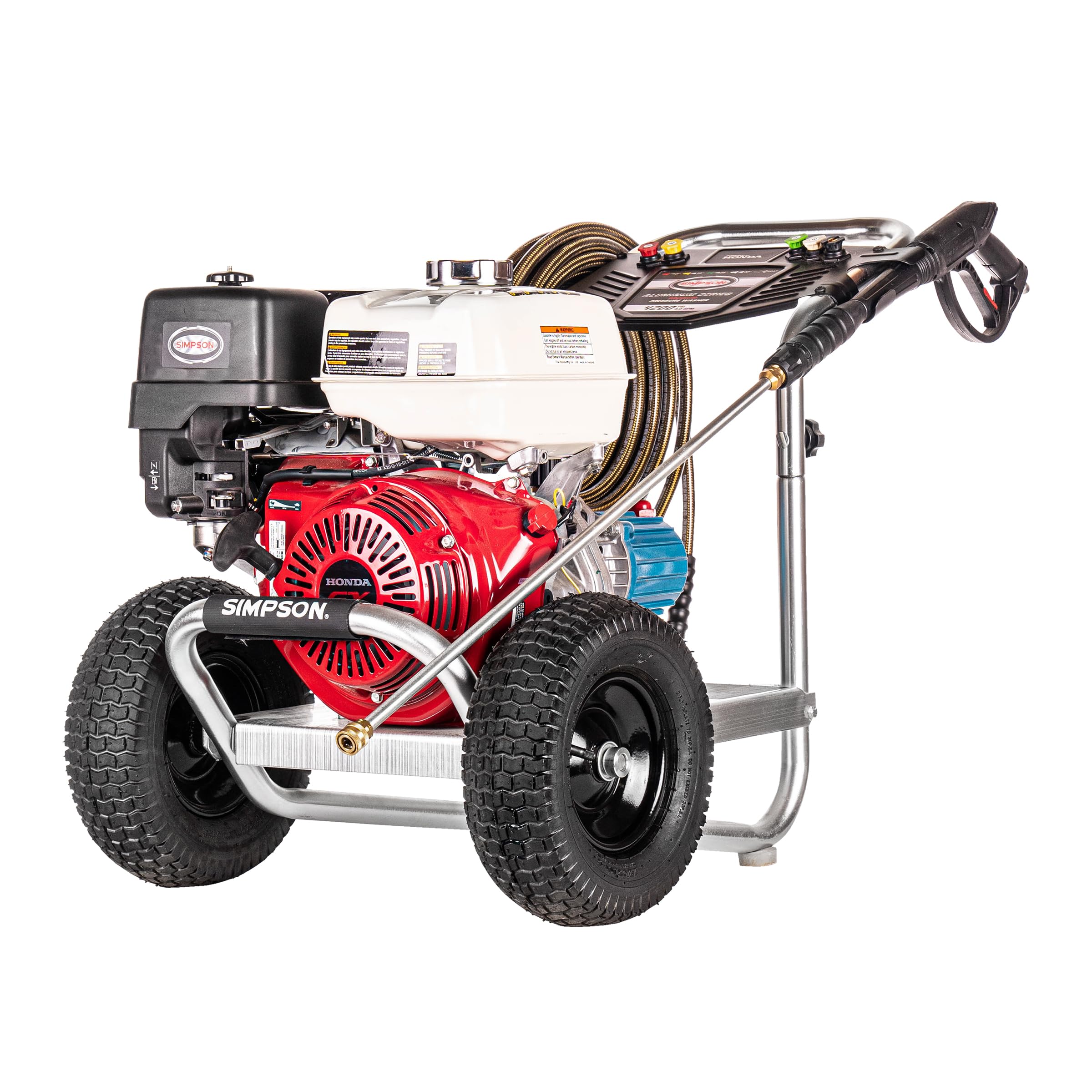
The Simpson ALH4240 is the benchmark for American-focused commercial pressure washer design. It pairs a Honda GX390 engine—arguably the most reliable small engine on the market—with a CAT triplex plunger pump that delivers an honest 4200 PSI at 4.0 GPM. The aluminum frame resists corrosion and keeps the dry weight at 124 pounds, making it transportable without a dolly. The low-oil shutdown on the Honda GX390 protects the engine from operator error, and the thermal relief valve in the CAT pump prevents overheating during extended trigger-off periods.
Real-world cleaning speed is exceptional. At 4.0 GPM, the flow volume strips a driveway clean in roughly half the time of a 2.5 GPM unit. The 50-foot dual-braided hose provides ample reach around cars and fences, though owners note the hose is stiff when cold. The bundled 5-nozzle set covers 0-degree to 40-degree patterns plus a soap nozzle, and the spray gun includes a safety lock-out. The aluminum cart rolls easily on 13-inch pneumatic tires across gravel and grass.
The main compromises are the bulky plastic wand and the stiff high-pressure hose, both of which are easy aftermarket upgrades. A few units have arrived with minor shipping damage due to minimal packaging padding. The Simpson ALH4240 is 49-state compliant but not sold in California. For anyone running a pressure washer for more than 20 hours a year, the Honda/CAT combination justifies the premium investment with decades of rebuildable service.
Why it’s great
- Honda GX390 engine with cast-iron sleeve and low-oil shutdown
- CAT triplex plunger pump is serviceable with readily available rebuild kits
- True 4.0 GPM flow rate cleans large surface areas quickly
Good to know
- Stiff hose can be difficult to coil in cold weather
- Box packaging offers minimal protection during shipping
- Plastic wand feels flimsy relative to the rest of the build
2. Simpson ALH3228-S
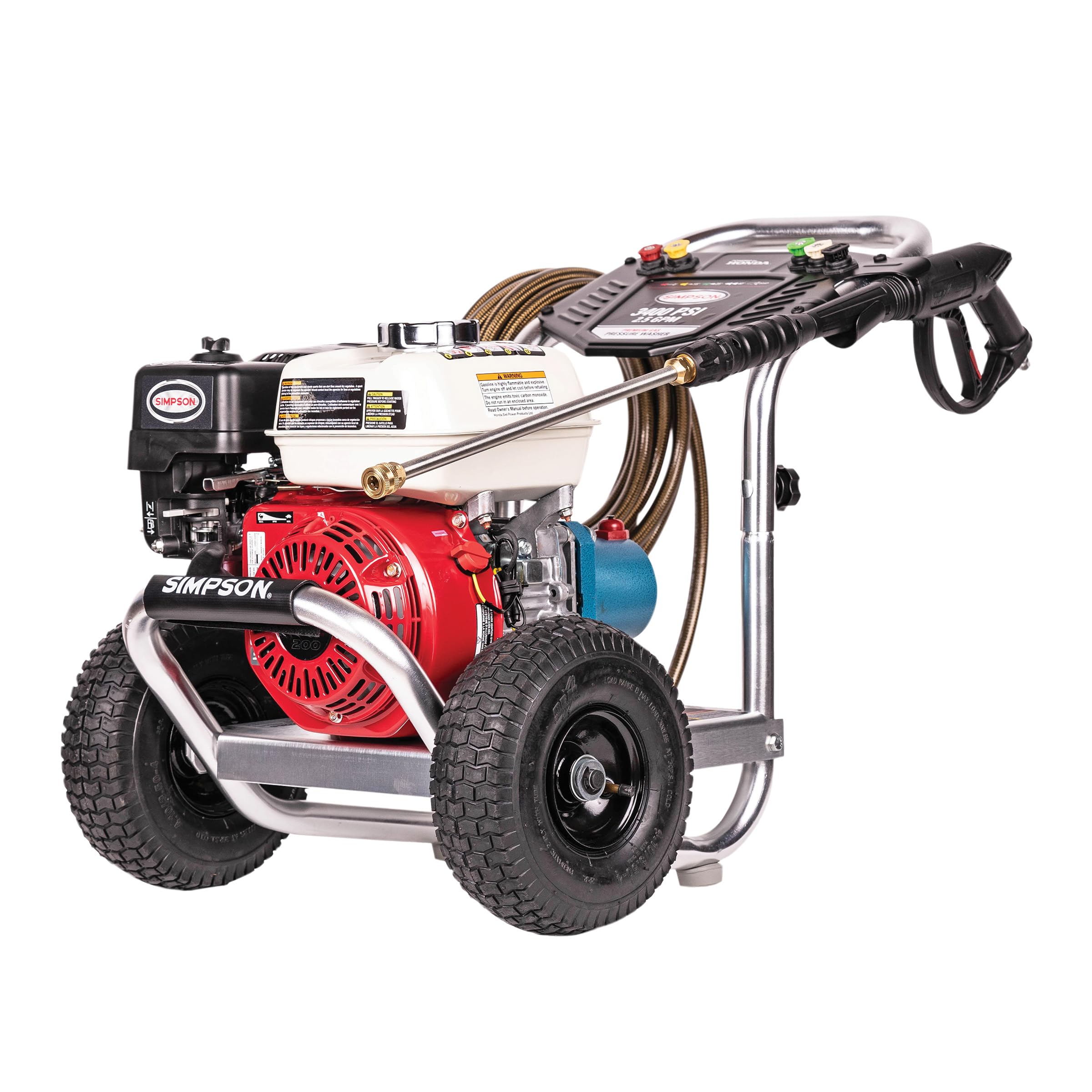
The Simpson ALH3228-S is a lighter commercial option that still carries the core American-quality DNA: a Honda GX200 engine and a CAT triplex plunger pump. It delivers 3400 PSI at 2.5 GPM, which is sufficient for deck restoration, siding cleaning, and medium-sized driveways. The GX200 is a 196cc workhorse with a cast-iron cylinder liner and a three-year limited commercial warranty. The CAT pump includes thermal relief protection, a feature rarely seen on units in this price tier.
The aircraft-grade aluminum frame is lighter than the ALH4240 at 73 pounds, making it easier to load into a truck bed. The 25-foot hose is kink- and abrasion-resistant, and Simpson includes five quick-connect nozzle tips plus a 16-inch steel wand. The spray gun’s safety lock-out prevents accidental discharge. Owners consistently report first-pull starts even after seasonal storage, provided the carburetor is run dry between uses.
Taller users criticise the handle height, and the rubber feet on the frame tend to fail after a season. The pneumatic tires are functional but the axle retention clips can pop off on rough terrain. The ALH3228-S is a genuine 2.5 GPM unit, so it won’t match the speed of a 4.0 GPM machine, but the rebuildable pump and the Honda engine make it a smarter long-term investment than any similarly priced axial-cam unit.
Why it’s great
- Honda GX200 engine with three-year commercial warranty
- CAT triplex pump can be rebuilt instead of replaced
- Aluminum frame is corrosion-resistant and lightweight
Good to know
- Handle height is awkward for users over six feet tall
- Rubber frame feet detach after minimal use
- Wheel axle clips require reinforcement to stay in place
3. Westinghouse WPX4400
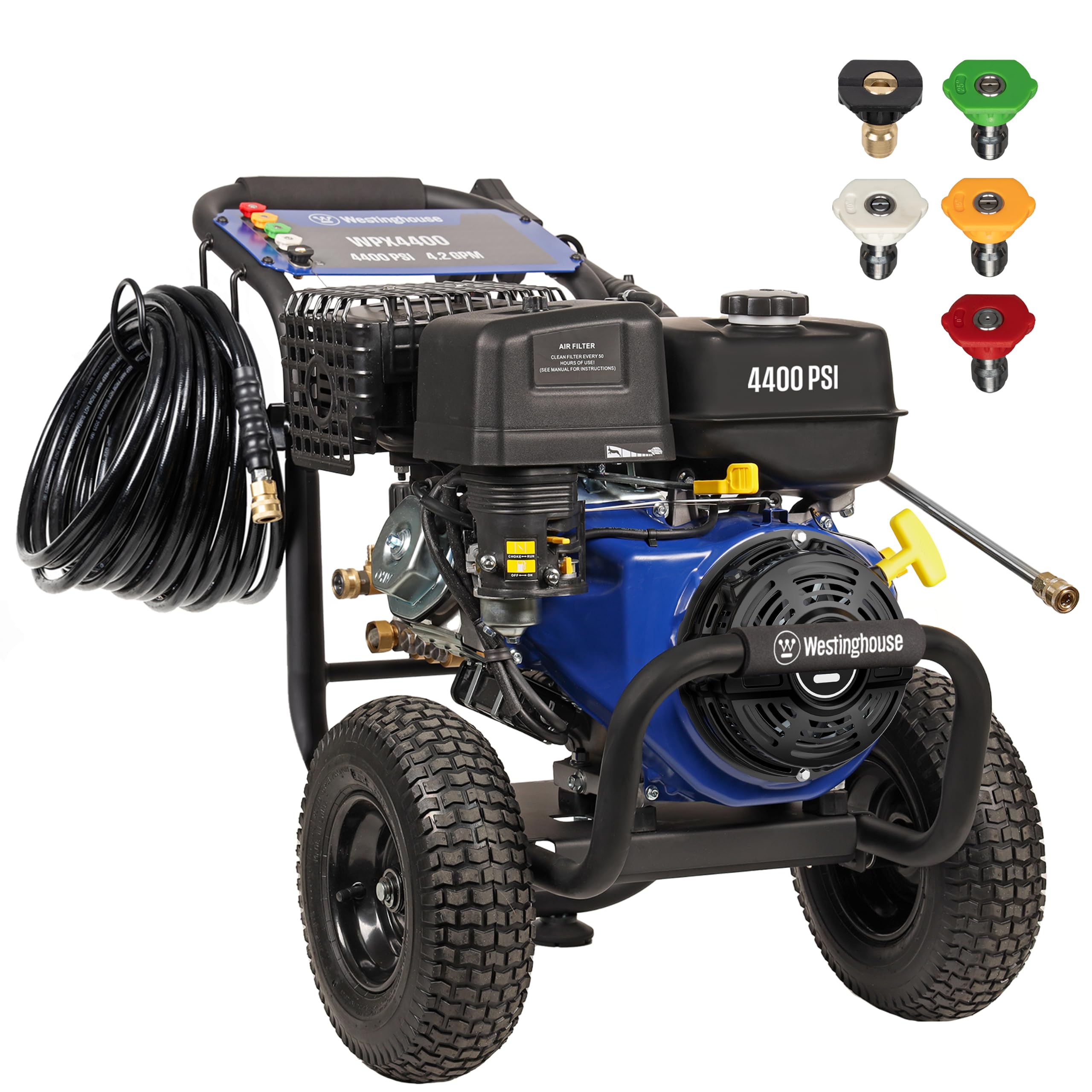
The Westinghouse WPX4400 delivers the highest flow rate in this comparison: 4.2 GPM at 4400 PSI. The engine is a Westinghouse-branded 420cc OHV unit with a recoil start and a 1.7-gallon fuel tank. The pump is a commercial-grade triplex brass-head unit—not a CAT, but still a cut above the axial-cam pumps found on budget gas machines. The steel frame is substantial, and the 12-inch pneumatic tires roll easily over uneven ground. The unit weighs 142 pounds, so you’ll want the wheels on solid footing before moving it.
The 50-foot Super-Flex hose is softer and more manageable than the stiff hoses on the Simpson units, and the M22 fittings are compatible with most aftermarket surface cleaners and foam cannons. The WPX4400 includes a standard 5-nozzle set and a lightweight spray gun. Owners report consistent two-pull starting and smooth idle, though the included manual could be clearer for first-time gas pressure washer users.
Quality control appears inconsistent: some buyers received units with loose hardware or shipping damage, and a few reported that the downstream injector screw arrived stripped. The three-year limited warranty covers service, labor, and parts, and Westinghouse customer service is generally responsive. If you need the highest GPM for large-scale concrete cleaning or agricultural work, the WPX4400 is a strong contender—just inspect the unit thoroughly upon delivery.
Why it’s great
- 4.2 GPM flow rate cleans large areas faster than any competitor here
- Triplex brass-head pump offers better longevity than axial-cam designs
- 50-foot hose with M22 fittings is compatible with professional accessories
Good to know
- Some units arrive with loose hardware or shipping damage
- Engine is a Westinghouse brand, not a Honda or Briggs & Stratton
- Weight of 142 pounds makes it difficult to lift into a truck bed
4. Westinghouse WPX3200
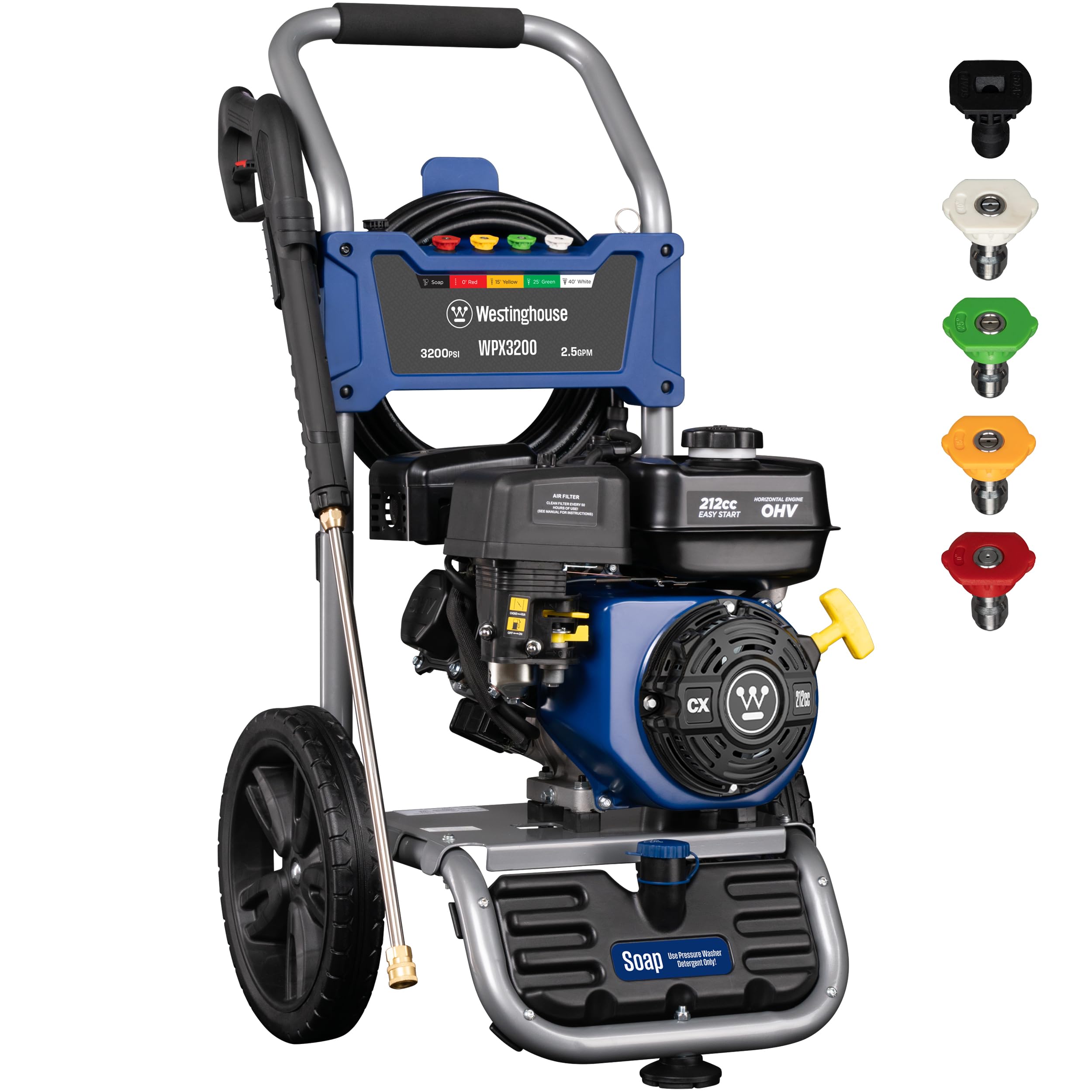
The Westinghouse WPX3200 is a mid-range gas pressure washer that balances price and performance for the homeowner. It delivers a true 3200 PSI at 2.5 GPM from a Westinghouse 212cc OHV engine. The pump is an axial cam unit, which keeps the cost down but limits rebuildability. The steel frame is powder-coated and holds up well under normal residential use. The 12-inch never-flat wheels eliminate the risk of a flat tire on rough terrain.
The half-gallon onboard soap tank is integrated into the frame, and the 25-foot abrasion-resistant hose provides enough reach for most driveways and patios. The five quick-connect nozzles cover the standard angles, and a nozzle cleaner is included. The WPX3200 comes mostly assembled—you add the handle, the wheels, and the oil, and you can be running within 20 minutes. Owners report reliable starting on the second pull and good power for stripping paint from wood siding.
The oil fill cap is awkwardly positioned, and there’s no dedicated storage for the oil cap after filling. A few long-term owners report the axial cam pump fails around the 8-hour mark, though Westinghouse’s three-year warranty covered replacement. The hose can melt if it contacts the muffler, so routing it with a zip tie is recommended. For weekend warrior use, the WPX3200 is a capable machine that won’t break your budget.
Why it’s great
- Real 3200 PSI and 2.5 GPM with consistent pressure output
- Never-flat wheels eliminate flat tire downtime
- Three-year warranty with responsive customer support
Good to know
- Axial cam pump is not rebuildable if it fails
- Oil fill cap location makes topping up difficult
- Hose can melt on the muffler without zip-tie routing
5. Briggs & Stratton 20700

The Briggs & Stratton 20700 is an electric pressure washer designed for homeowners who want gas-like performance without the maintenance. It uses a brushless induction motor instead of a gas engine, running at 2200 PSI and 1.2 GPM. The instant start/stop system means you don’t hold a trigger while moving, reducing fatigue. It’s significantly quieter than any gas unit—around 75 dB versus the 95+ dB of a gas engine—making it suitable for noise-sensitive neighborhoods.
The 25-foot hose and 9-inch wheels make it easy to maneuver around a patio or driveway. The package includes a turbo nozzle wand, detergent foamer, and three quick-connect spray tips. The induction motor doesn’t require air filters, spark plugs, or oil changes, which is a massive convenience advantage over gas units. Owners report that the 2200 PSI electric output matches the cleaning performance of their old 2800 PSI gas units on concrete and brick.
The hose lacks secure storage brackets, and the cord wrap is minimal. A few units have developed pinhole leaks in the hose or failed after a single season, which points to inconsistent quality control. The Briggs & Stratton 20700 is not a replacement for a 4.0 GPM commercial gas unit, but for a homeowner cleaning a car, grill, and patio furniture twice a month, it’s a practical and low-hassle alternative.
Why it’s great
- Brushless induction motor needs zero routine maintenance
- Instant start/stop system reduces fatigue during long sessions
- Turbo nozzle delivers gas-like cleaning on concrete surfaces
Good to know
- No secure storage for hose and cord causes wear over time
- Some units arrive with pinhole hose leaks or premature motor failure
- 1.2 GPM flow rate is slow for large driveways or heavy-duty stripping
FAQ
Is a Honda GX engine worth the premium over a generic 212cc clone?
What does “49-state compliant” mean for a gas pressure washer?
Can I use a pressure washer with a 50-foot garden hose?
Final Thoughts: The Verdict
For most users, the best american made pressure washer winner is the Simpson ALH4240 because the Honda GX390 engine and CAT triplex pump combination is the most serviceable and reliable platform in the class. If you want a lighter unit with the same rebuildable pump architecture, grab the Simpson ALH3228-S. And for high-flow cleaning of large concrete areas, nothing beats the Westinghouse WPX4400 with its 4.2 GPM output and comfortable hose.