
Standard alkaline AAA batteries lose voltage as they drain, causing devices to dim, slow down, or shut off prematurely. Lithium rechargeable AAA batteries solve this by delivering a steady 1.5V output from start to finish, ensuring consistent performance in everything from smart locks to high-drain LED flashlights.
I’m Min — the co-founder and writer behind Gadgets Feed. I’ve spent hundreds of hours analyzing the charging cycles, capacity ratings, and voltage curves across dozens of battery models to find the ones that actually deliver on their promises.
This guide breaks down the top performers based on real-world testing data and technical specs, so you can confidently pick from the best aaa lithium rechargeable batteries available today.
How To Choose The Best AAA Lithium Rechargeable Batteries
Not all rechargeable AAA batteries behave the same. The chemistry inside determines voltage, capacity, and compatibility with your devices. Here are the key factors to consider before buying.
Voltage: 1.5V vs 1.2V — The Real Differentiator
Standard alkaline batteries output 1.5V, but most NiMH rechargeables only deliver 1.2V. Some devices — like certain cameras, flashlights, and motorized toys — require the full 1.5V to operate correctly. Lithium rechargeable AAA batteries maintain a constant 1.5V throughout their discharge cycle, meaning no gradual dimming or early shutdown. If a device feels underpowered with standard rechargeables, switching to 1.5V lithium cells usually solves the issue.
Capacity Measured in mWh vs mAh
Lithium rechargeables often list capacity in milliwatt-hours (mWh) instead of milliamp-hours (mAh). Multiply mAh by 1.5V to compare apples to apples. A 1300mWh AAA battery equals roughly 866mAh — enough for several days of use in a wireless mouse or over a week in a TV remote. For high-drain gear like Bluetooth headphones or portable fans, prioritize higher mWh ratings.
Charging Convenience: USB-C vs Dedicated Charger
Many modern lithium AAA batteries feature a built-in USB-C port, allowing you to charge them directly from a laptop, power bank, or wall adapter. This eliminates the need for a separate charger and makes travel much easier. Some models also come with multi-slot charging cases that double as storage — a practical bonus for households with many battery-powered devices.
Quick Comparison
On smaller screens, swipe sideways to see the full table.
| Model | Category | Best For | Key Spec | Amazon |
|---|---|---|---|---|
| Coast ZITHION-X AAA | Lithium Ion | Universal 1.5V, USB-C | 750 mAh, 1.3h charge | Amazon |
| paleblue AAA | Lithium Ion | Fast 1-hour charging | 600 mAh, USB-C cable | Amazon |
| imuto AAA + AA Set | Lithium Ion | Integrated charging case | 1300mWh, 1600 cycles | Amazon |
| HW USB-C AAA | Lithium Polymer | Budget USB-C option | 1300mWh, 1000 cycles | Amazon |
| Eneloop Panasonic 6-Pack | NiMH | Longest cycle life, 2100 cycles | 800 mAh, pre-charged | Amazon |
| Eneloop Panasonic 8-Pack | NiMH | Bulk pack for households | 800 mAh, 2100 cycles | Amazon |
| EBL NiMH Combo | NiMH | Best value AA + AAA combo | 1100 mAh (AAA), storage box | Amazon |
In‑Depth Reviews
1. Coast ZITHION-X AAA

The Coast ZITHION-X AAA delivers true USB-C Power Delivery (PD) compatibility, meaning you can charge them with any USB-C cable and power brick — not just a proprietary port. The 750 mAh capacity is solid for a lithium-ion AAA, and the 1.3-hour charge time is among the fastest in its class. ZX Optimized Voltage maintains steady 1.5V output, preventing flickering in flashlights and erratic behavior in sensitive gear like wireless door locks.
Each cell replaces up to 500 single-use alkaline batteries, and the leak-resistant internal design protects your devices from corrosion during storage or use. Real-world users report months of run time in TV remotes and over a year in low-drain devices before needing a recharge. The built-in USB-C port simplifies travel — no separate charger required.
For peak performance, pair them with a high-wattage USB-C adapter to hit the 1.3-hour charge spec consistently. They are slightly pricier per cell than basic NiMH options, but the convenience of universal USB-C charging and full 1.5V output makes them worth the investment for daily drivers.
Why it’s great
- True USB-C PD charging — works with any USB-C cable and brick
- Steady 1.5V output ensures full compatibility with all AAA devices
- Fast 1.3-hour recharge from empty
Good to know
- Lower mAh than some NiMH alternatives — 750 mAh per cell
- Requires a USB-C PD adapter for fastest charging times
- Slightly more expensive upfront than NiMH rechargeables
2. paleblue AAA

The paleblue AAA lithium battery charges fully in just one hour — up to 12 times faster than conventional NiMH rechargeables. Each cell uses lithium-ion chemistry, which eliminates the risk of alkaline-style leaks that can ruin expensive electronics. The 600 mAh capacity is modest, but the consistent 1.5V output keeps devices running at full power until the battery is completely depleted.
The included 4-in-1 USB-A to USB-C cable allows simultaneous charging of all four batteries. An LED indicator on each cell shows charging status. Bear in mind that paleblue cells stop outputting power abruptly when depleted rather than fading gradually — so they are not ideal for critical applications like clocks or smoke detectors where a gradual low-battery warning is needed. They work excellently in game controllers, wireless mice, and remote controls.
Paleblue backs these with a limited lifetime warranty (requires online registration). The compact cable is much more portable than bulky traditional battery chargers, making these a top choice for travelers who want to minimize gear.
Why it’s great
- Industry-leading 1-hour full charge time
- Leak-proof lithium-ion design protects devices
- Compact charging cable included — no separate charger needed
Good to know
- 600 mAh capacity is lower than many competitors
- Abrupt power cutoff — no gradual discharge warning
- Not recommended for smoke alarms or critical safety devices
3. imuto AAA + AA Set

The imuto set includes 4 AAA and 4 AA lithium-ion batteries, each rated at 1300mWh (AAA) and 3000mWh (AA) respectively. The standout feature is the integrated charging case that doubles as a storage box — it can charge all 8 batteries simultaneously via a single USB-C input. This eliminates the need for a separate charger and keeps your batteries organized.
With a claimed 1600 recharge cycles and a 12-year shelf life, these cells are built for the long haul. The constant 1.5V output ensures high-drain devices like game controllers and flashlights perform at full capacity. Real users report that the batteries last 6-8 hours in a Roku remote headphone mode, which is impressive for a AAA lithium cell.
One caveat: some units may arrive with residual heat after charging, so let them cool for 30 minutes before use. A small number of users reported a single cell failing after several recharge cycles, though customer support replaced them promptly. Overall, this combo offers the best value for households that need both AA and AAA lithium cells in one purchase.
Why it’s great
- Integrated 8-slot charging case — charges and stores all batteries
- Includes both AAA (1300mWh) and AA (3000mWh) cells
- 1600 recharge cycles and 12-year shelf life
Good to know
- Some units may show residual heat after charging
- Occasional cell failure reported, but customer service responsive
- Charging case is bulkier than individual USB-C batteries
4. HW USB-C AAA
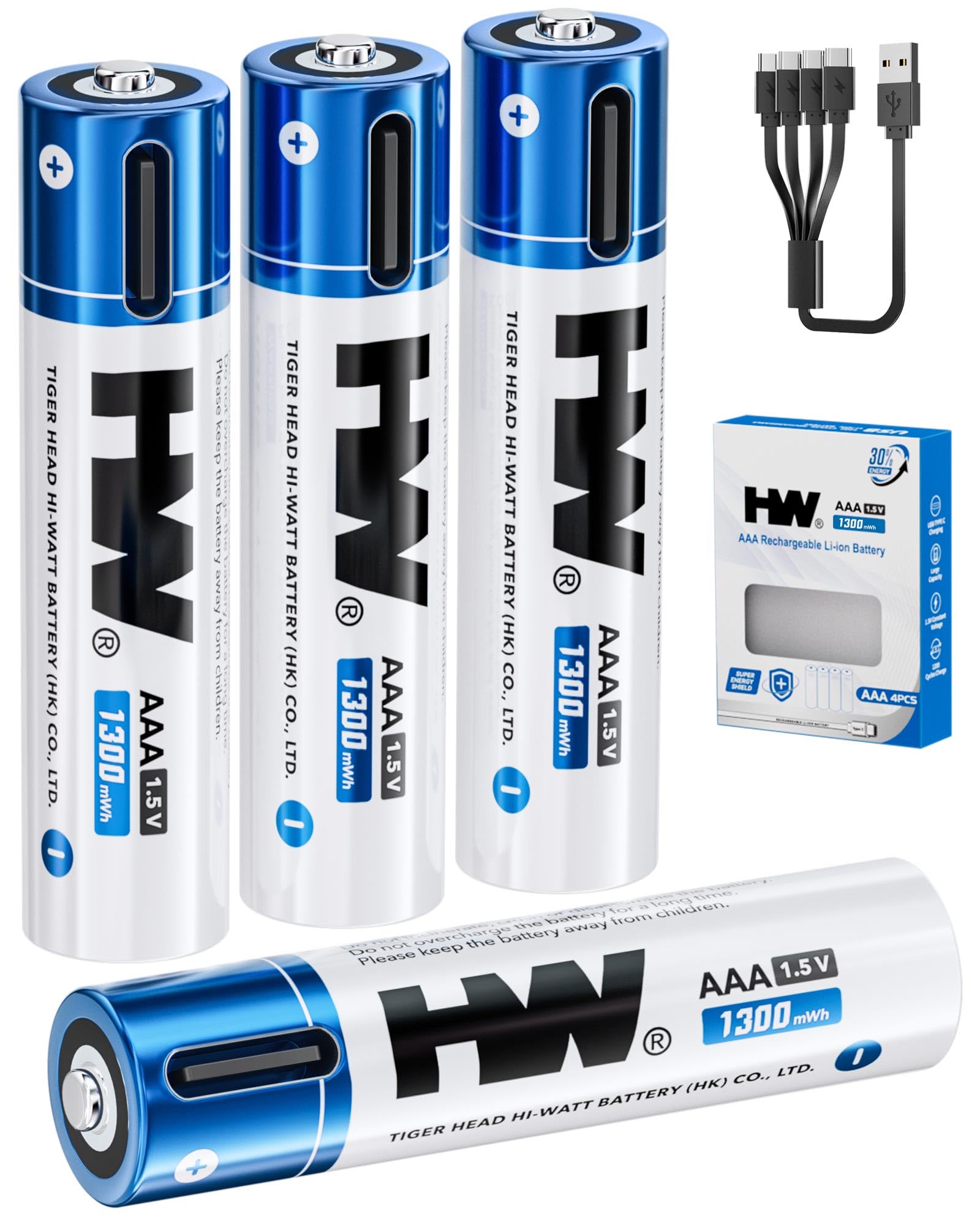
The HW USB-C AAA battery offers a compelling entry point into lithium rechargeables with a 1300mWh capacity (approximately 866mAh) and a built-in USB-C port. The included 4-in-1 USB-A to USB-C cable charges all four cells simultaneously, and the advertised 1.5-hour full charge is competitive at this price tier. Built-in protections cover overcharge, over-discharge, over-voltage, over-current, short circuit, and overheating.
Real-world feedback is positive: users note that while the mAh rating is slightly lower than premium NiMH cells, the convenience of USB-C charging and the steady 1.5V output more than compensate. The batteries are noticeably lighter than NiMH equivalents — 28 grams for the set of four — which is noticeable in portable electronics like wireless mice.
One trade-off is that the charging speed is slower than premium options like the Coast or paleblue. The 1.5-hour charge time assumes ideal conditions; using a lower-power USB-A port extends that. Still, for its price, the HW pack delivers reliable 1.5V performance and the safety of lithium polymer chemistry, making it a smart budget-friendly choice for low-to-medium drain devices.
Why it’s great
- Good 1300mWh (866mAh) capacity at a budget-friendly price
- Comprehensive safety protections built in
- Lightweight lithium polymer cells — 28g for 4-pack
Good to know
- Charging speed varies with USB-A port power output
- Lower effective mAh than premium lithium competitors
- Only 6-month product care warranty
5. Eneloop Panasonic 6-Pack

Eneloop Panasonic AAA batteries set the gold standard for NiMH rechargeables. Rated for 2100 recharge cycles and pre-charged at the factory using solar power, these batteries retain up to 70% of their charge after 10 years in storage. The 800 mAh typical capacity is lower than some competitors, but the real strength is longevity — real users report them lasting years in daily use with flashlights and remotes.
One critical distinction: Eneloops output 1.2V, not 1.5V. This means they may not power certain devices at full strength — some cameras, motorized toys, and high-drain electronics may show low battery warnings or reduced performance. However, in devices designed for NiMH (like many game controllers and flashlights), they deliver exceptional runtime and consistency.
Made in Japan and packaged in the US, these batteries operate down to -4°F, making them a reliable choice for outdoor and cold-weather gear. They are best paired with a dedicated Eneloop smart charger to maximize cycle life and charge speed. For households that prioritize recharge cycles and proven reliability over voltage output, the Eneloop 6-pack remains a benchmark.
Why it’s great
- Industry-leading 2100 recharge cycles
- Pre-charged with solar power — ready to use immediately
- Retains 70% charge after 10 years of non-use
Good to know
- Only 1.2V output — may underperform in some 1.5V devices
- 800 mAh capacity is lower than lithium alternatives
- Requires a dedicated NiMH smart charger (not included)
6. Eneloop Panasonic 8-Pack

The Eneloop Panasonic 8-pack offers the same legendary 2100-cycle NiMH chemistry as the 6-pack but in a larger quantity for households with multiple devices. Each cell delivers 800 mAh typical capacity with a minimum of 800 mAh per battery. Independent testing shows these cells often exceed their rated capacity — one reviewer measured an average of 1,052 mAh across 12 cells, which is 131% of the advertised rating.
The pre-charged cells are ready out of the box, and the low self-discharge chemistry means they hold their charge for years between uses. This makes them ideal for infrequently used devices like emergency flashlights, backup clocks, and seasonal decorations. The NiMH chemistry is also more environmentally friendly to dispose of than lithium-ion when the cells eventually wear out — approximately every 2100 cycles.
Like the 6-pack, these are 1.2V cells and may cause low-battery warnings in strict 1.5V devices. They also perform best with a smart charger that can condition and match cells. If you already own an Eneloop charger or a compatible NiMH smart charger, the 8-pack delivers the lowest per-cell cost for the highest cycle life available in NiMH.
Why it’s great
- Best per-cell value for 2100-cycle NiMH batteries
- Often exceeds rated capacity in real-world testing
- Pre-charged and ready to use — holds charge for years
Good to know
- 1.2V output — not compatible with all devices
- Requires NiMH smart charger for best results
- Bulk pack adds upfront cost despite low per-cell price
7. EBL NiMH Combo

The EBL NiMH combo includes 10 AA (2800mAh) and 10 AAA (1100mAh) batteries plus a storage organizer box — everything a heavy battery user needs in one package. The AAA cells offer a generous 1100 mAh capacity, which is higher than Eneloop’s 800 mAh, though with a shorter cycle life. The enhanced low self-discharge technology ensures 80% capacity retention after 3 years of non-use.
Real-world feedback over several years of use is positive: users report these hold their charge well, with no failures across dozens of cells in high-drain applications like kids’ toys and flashlights. One caveat is that the cells are slightly fatter than standard AAA batteries, which can cause a tight fit in some devices — test fit in your tightest compartment before buying for critical gear.
These are 1.2V NiMH cells, so the same voltage caveat applies: some devices may show low battery warnings. The DBCK steel shell provides explosion protection, and the NiMH chemistry is free from mercury, cadmium, and lead, making for safer disposal. For budget-conscious buyers who need a large quantity of AAA batteries with decent capacity, the EBL combo is the most cost-effective option.
Why it’s great
- High 1100 mAh capacity — above average for AAA NiMH
- 10 AAA + 10 AA + storage box in one purchase
- Good charge retention after 3 years of non-use
Good to know
- 1.2V NiMH — not full 1.5V output
- Cells are slightly larger than standard — may not fit all devices
- Shorter cycle life than premium Eneloop options
FAQ
Will 1.5V lithium rechargeable AAA batteries damage my devices?
Why do some devices not work with NiMH rechargeable batteries?
Can I charge lithium rechargeable AAA batteries in a standard NiMH charger?
Final Thoughts: The Verdict
For most users, the aaa lithium rechargeable batteries winner is the Coast ZITHION-X AAA because it combines true USB-C PD charging, fast 1.3-hour recharges, and reliable 1.5V output in a compact, leak-resistant design. If you want the fastest charging time, grab the paleblue AAA for its 1-hour charge speed. And for the best value combo that includes both AAA and AA cells with an integrated charging case, nothing beats the imuto set.