
A lawn mower blade that spins out of balance at 3,000 RPM doesn’t just cut poorly—it hammers your spindle bearings, strains the engine, and leaves an uneven, ragged stripe across your grass. The cure isn’t guesswork or a bubble level. It’s a dedicated balancer that reads true imbalance to the gram, letting you grind metal exactly where it’s needed and nowhere else.
I’m Min — the co-founder and writer behind Gadgets Feed. I’ve spent countless hours cross-referencing bearing tolerances, pull forces, and machining finishes across the top balancers on the market to separate precision instruments from cheap copies that spin with built-in wobble.
Whether you maintain a single push mower or a fleet of zero-turn machines, this guide puts every serious option on the table. Every recommendation here earns its place as a top contender for the best balancer for lawn mower blades.
How To Choose The Best Balancer For Lawn Mower Blades
Not every cone-shaped metal piece on the shelf actually helps. A balancer is at heart a friction-sensitive bearing assembly—if the bearing itself drags or the spindle isn’t dead-straight, the tool will lie to you. Here’s what separates the accurate from the useless.
Bearing Quality and Spindle Runout
The bearing must spin freely with near-zero friction. Cheap balancers pack loose tolerances that let the spindle wobble, hiding real blade imbalance. Premium units use precision ground races and sometimes offer a lifetime calibration warranty, guaranteeing that the balancer itself introduces no error.
Magnetic Pull Force
Magnets hold the blade centered and prevent drift during the spin test. Weak magnets let the blade shift, producing false readings. Strong magnets—think 120 pounds of pull on a unit like the MAG-1000—lock the blade firmly to the spindle, but can make removal awkward. Aim for 50+ pounds of pull for standard riding mower blades.
Design: Wall-Mount vs. Handheld Cone
Wall-mount balancers free both hands, letting you spin the blade and observe runout without holding the tool. Magnetic-base cones are portable but require a perfectly level steel surface and can tip if bumped. For frequent use, a dedicated wall-mount station pays off in convenience and repeatability.
Quick Comparison
On smaller screens, swipe sideways to see the full table.
| Model | Category | Best For | Key Spec | Amazon |
|---|---|---|---|---|
| Magna-Matic MAG-1000 | Premium | Professional precision | 120 lb magnetic pull | Amazon |
| Oregon 42-047 | Premium | Precision & straightness check | 2.71 lb steel construction | Amazon |
| Maxpower 339075B | Premium | Multi-blade decks | Six-magnet array | Amazon |
| Tecomec Wall Mount | Mid-Range | Smooth replacement for clones | Made in Italy | Amazon |
| SporGain Combo Kit | Mid-Range | One-stop sharpening + balancing | 25mm enlarged handle | Amazon |
| LAMBIS Combo Kit | Mid-Range | Fresh start for blade maintenance | 7 adjustable sharpening angles | Amazon |
| Kimgsoak Combo Kit | Budget | Entry-level sharpening + balance | Zinc alloy balancer | Amazon |
In‑Depth Reviews
1. Magna-Matic MAG-1000 Professional Blade Balancing Instrument

The MAG-1000 is CNC-machined from alloy steel and aluminum in the USA by a company that has been making blade balancers for over 60 years. The bearing is so friction-free that a breath of air can spin the blade—reviewers report the unit is sensitive enough to detect imbalance from a single spit landing on the blade end. That is lab-grade sensitivity without lab-grade fragility.
Its 120-pound magnetic pull locks blades over 30 inches long without slipping, and the all-metal construction means zero plastic components to degrade over time. The manufacturer backs it with a 2-year warranty and a lifetime calibration guarantee—if the balancer ever drifts out of spec, they correct it for free. That kind of commitment signals confidence in the machining tolerances.
One catch: the spindle requires an adapter for blades with non-round mounting holes, which isn’t advertised on the main listing. Plan for that extra step if your mower uses square or slotted center holes. For everyone else, this is the last balancer you will ever buy.
Why it’s great
- Lifetime calibration guarantee from the manufacturer
- 120-pound magnet holds even heavy commercial blades
- Extreme bearing sensitivity reveals micro-imbalances
Good to know
- Requires separate adapter for non-round blade holes
- Overkill for casual seasonal use
2. Oregon Precision Blade Balancer 42-047

The Oregon 42-047 is built from steel and aluminum with smooth bearings and a magnetic wall-mount base. It balances blades reliably to within five degrees of rotation—consistently enough to satisfy professionals who service multi-blade decks. An included straightness rod doubles as a quick bent-blade checker, saving you from mounting a warped blade back onto the spindle.
Reviewers consistently note the unit’s sensitivity: it can detect imbalance fine enough that a brushstroke of metal dust affects the reading. That same sensitivity means you must mount the balancer away from your grinding area, or airborne grit will accumulate on the bearings. A quick wipe-down before each use solves the problem.
The machining comes out of Italy (the same factory that produces Tecomec’s balancer), and Oregon’s 1-year warranty backs the assembly. At roughly the same price point as the Tecomec, this unit includes the straightness rod feature that the bare Tecomec lacks. For professionals who need both balance and straightness checks in one tool, that’s a meaningful advantage.
Why it’s great
- Includes straightness rod for bent-blade detection
- Consistent balance results within 5° of rotation
- Durable steel and aluminum build
Good to know
- Bearings sensitive to metal dust—requires clean mounting
- Needs initial calibration out of box
3. Maxpower 339075B Magnetic Wall Mount Blade Balancer

The Maxpower 339075B uses six separate magnets arranged in a radial pattern to provide more even holding force across the blade face. That multi-magnet design means fewer false stops and better centering on blades with irregular surface texture. The unit mounts to any ferrous wall surface and comes with a built-in bent-blade indicator that reveals warps during the spin test.
Reviews from small-business lawn operators highlight its ability to dial in balance across multi-blade decks quickly. One operator reported cutting vibration noticeably across a 54-inch zero-turn after switching from a cone balancer to this wall-mount unit. The magnets are strong enough that removing the blade after testing takes a firm grip—plan for that if you value quick workflow.
The sharp tip of the cone post has been noted as a safety concern, particularly in mobile toolboxes. A rubber cap or a wall-mounted guard solves the issue, but it’s worth knowing before you install it at eye level. Otherwise, the build quality is solid and the balance detection is precise enough for regular professional use.
Why it’s great
- Six-magnet array provides even blade centering
- Bent-blade indicator integrated into base
- Handles multi-blade decks efficiently
Good to know
- Sharp cone tip poses safety risk when handled
- Very strong magnets make blade removal awkward
4. Tecomec Made in Italy Blade Balancer Magnetic Wall Mount
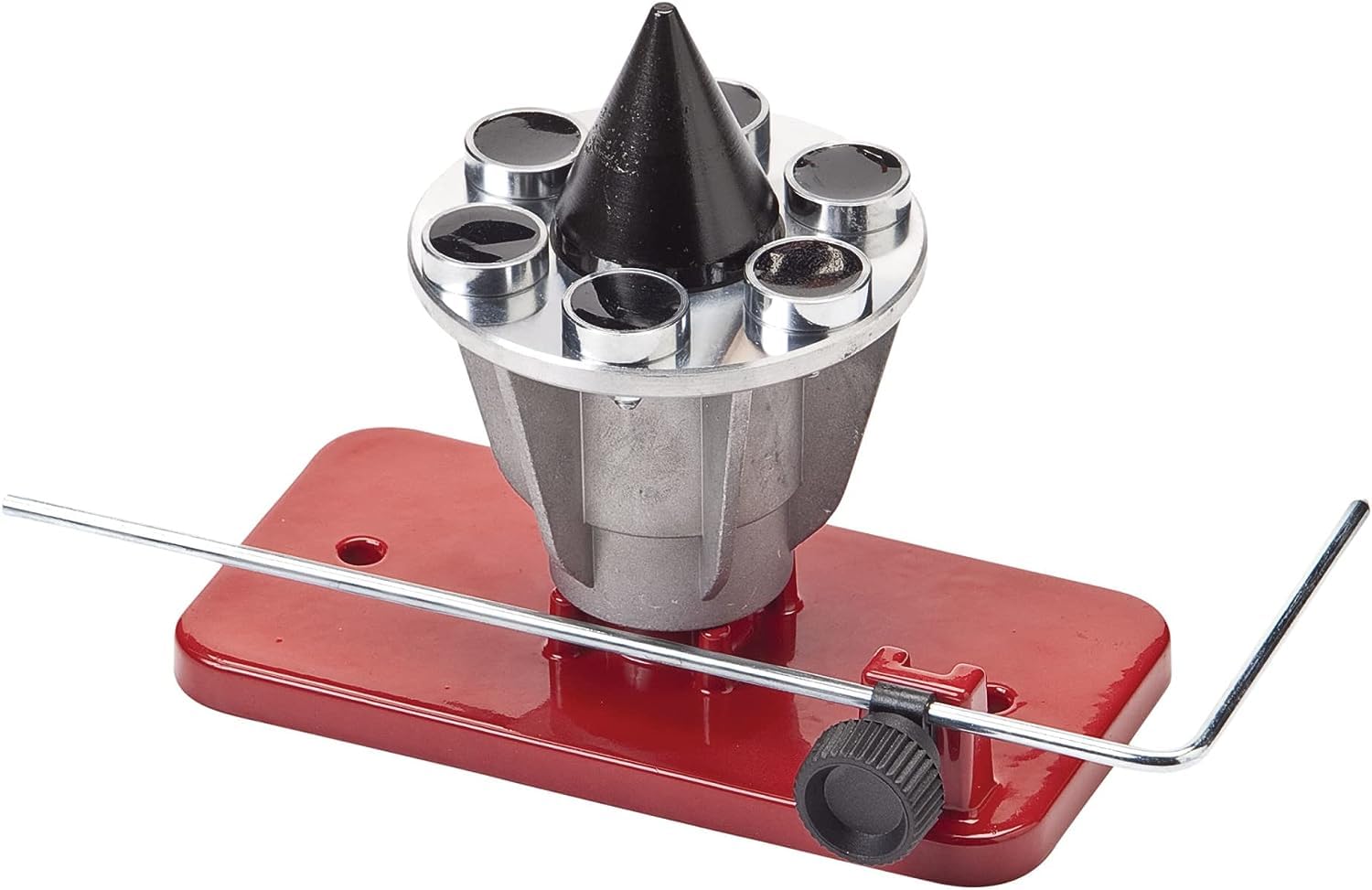
The Tecomec balancer is machined in Italy with noticeably tighter bearing tolerances than the Chinese-made clones that crowd the same price point. Reviewers who have tested multiple units report that the Tecomec spindle runs true with zero play, and the blade spins freely without ever stopping in the same position twice—a reliable indicator of friction-free bearings.
Weighing only 6.3 ounces, this is the lightest dedicated balancer on this list, but the aluminum construction doesn’t feel flimsy. The magnets are strong enough to hold standard riding mower blades securely, though some users note that removing the blade afterward takes a deliberate tug. The magnetic wall mount keeps the base stable during the spin test, and the compact dimensions (roughly 8 inches cube) fit easily into a toolbox drawer.
At a price point below the Oregon and Maxpower units, the Tecomec delivers the same Italian precision without the extra features like a straightness rod. If you already own a straightedge and just need a smooth, repeatable balancer, this is the smart mid-range buy. The main complaint from owners is that the magnetic pull, while adequate, isn’t matched to very heavy commercial blades—stick with the MAG-1000 if you run 30-inch decks.
Why it’s great
- Italian bearings with zero spindle play
- Compact and lightweight for toolboxes
- Significantly better than budget clone alternatives
Good to know
- Magnetic pull may be weak for 30″+ commercial blades
- No straightness check rod included
5. SporGain Lawn Mower Blade Sharpener & Balancer Combo
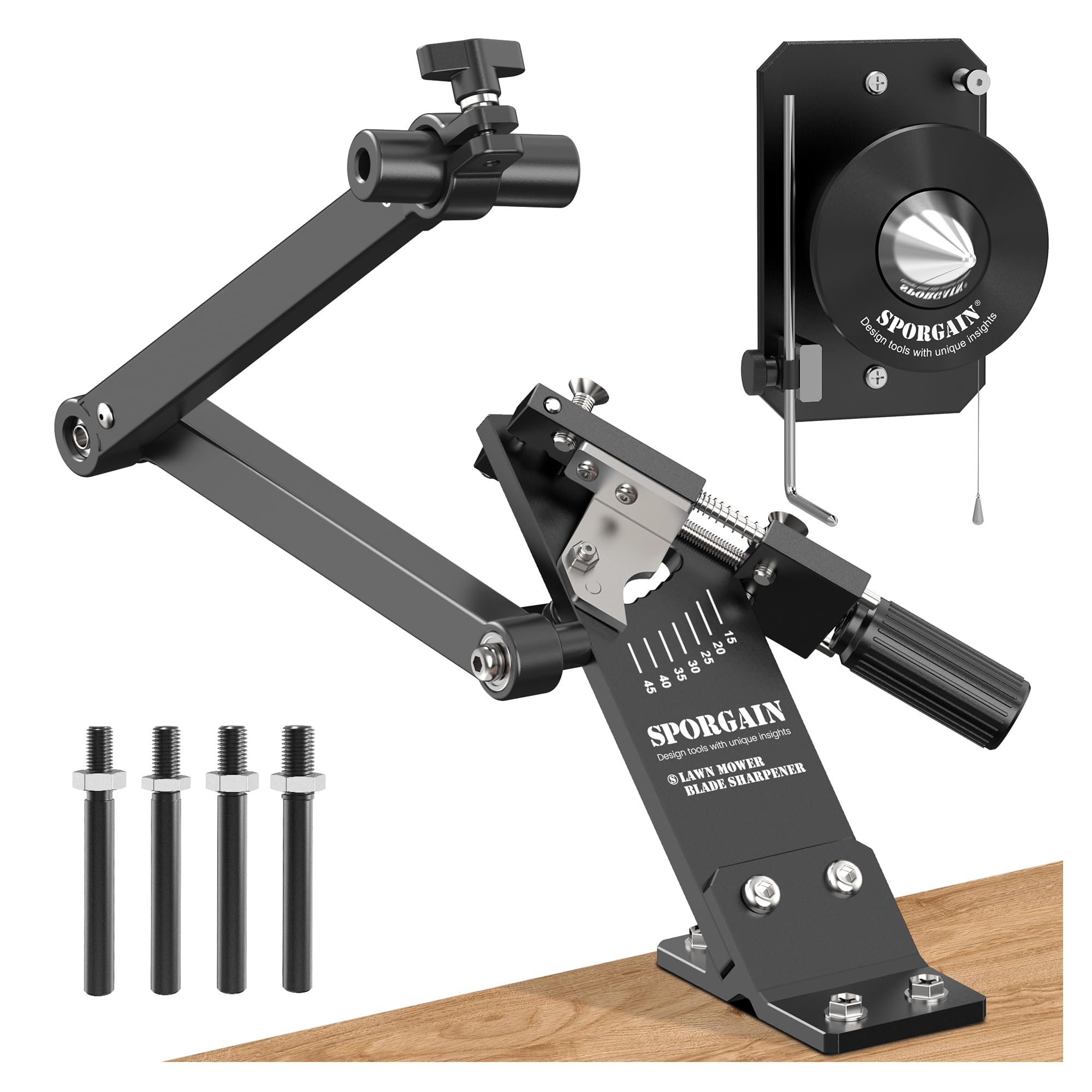
The SporGain combo pairs a sharpening jig with a magnetic balancer in one box, making it the easiest entry point for someone starting from zero. The sharpener uses an enlarged 25mm handle and ball bearings to hold the blade securely while you grind, with stepless adjustment from 15° to 45°. The balancer uses a hidden magnet design that centers the blade without protruding hardware.
Reviewers report the sharpener works well for straight blades, producing consistent angles that reduce the risk of overheating the blade edge. The balancer, however, has drawn mixed feedback—several owners note the bearing is slightly stiff straight out of the box, which reduces sensitivity to minor imbalance. It will catch grossly uneven blades, but fine-tuning may require a second pass with a more sensitive unit.
The build quality is adequate for seasonal DIY use, but the inclusion of some plastic components in the sharpener housing raises questions about long-term durability if you sharpen multiple times per week. For the homeowner who sharpens twice a season and wants one purchase to cover the whole workflow, this kit delivers solid convenience at a mid-range investment.
Why it’s great
- Sharpener + balancer in one purchase
- Stepless angle adjustment for precise edge control
- Enlarged handle provides secure blade clamping
Good to know
- Balancer bearing may be stiff, reducing sensitivity
- Plastic parts may wear under frequent use
6. LAMBIS Lawn Mower Blade Sharpener & Balancer Kit
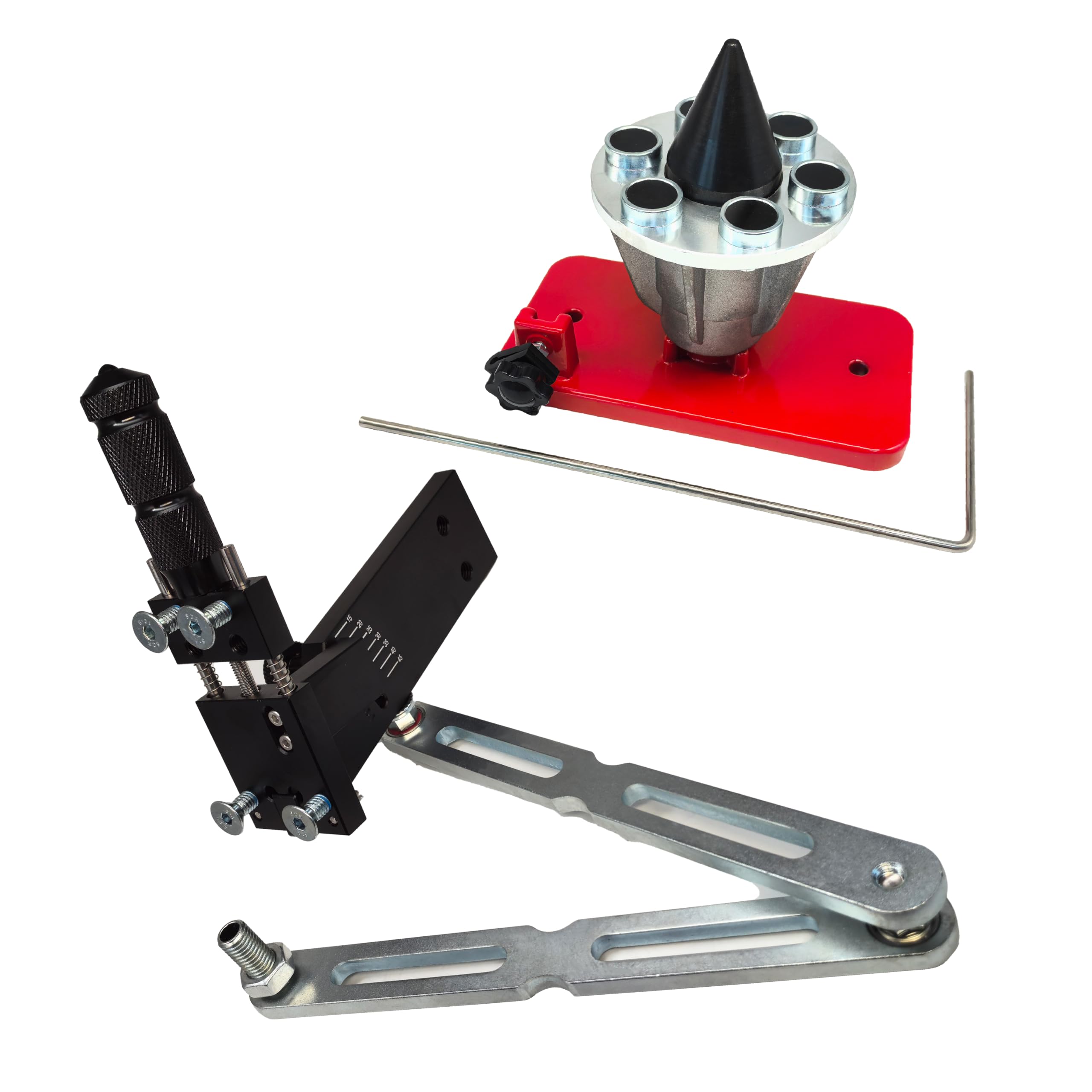
The LAMBIS kit explicitly markets itself as a direct replacement for the Oregon 42-047 balancer and the 5005A models. The sharpener offers seven discrete angle stops between 15° and 45°, letting you lock in a repeatable edge without the guesswork of stepless adjustment. The balancer uses a magnetic cone design intended for wall mounting on a solid vertical surface.
Early reviews are positive: owners sharpened entire sets of blades in around 15 minutes and reported visibly improved cut quality afterward. The magnetic wall mount works best when attached to a sturdy steel post or a steel-backed workbench surface—drywall anchors won’t hold the pull force during blade removal. The balancer’s sensitivity appears adequate for standard rider blades, though no reviewer has tested it against a precision reference unit like the MAG-1000.
At a price that sits in the same mid-range band as the SporGain, the LAMBIS kit trades the stepless handle for discrete click-stop positions. If you prefer repeatability over continuous fine-tuning, the click stops reduce the chance of accidentally drifting the angle mid-sharpening. The balancer itself is a capable complement, though serious users may eventually upgrade to a dedicated unit.
Why it’s great
- Discrete angle stops for repeatable sharpening
- Direct replacement for popular 42-047 balancer
- Fast setup and intuitive operation
Good to know
- Wall mount requires solid steel surface
- Balancer sensitivity not verified against premium units
7. Kimgsoak Lawn Mower Blade Sharpener & Balancer Kit

The Kimgsoak kit is the budget-friendly way to get both a sharpening jig and a balancer in one box. The sharpener is made from high-density aluminum alloy and includes four different guide pins to fit most angle grinders. The balancer is a zinc alloy cone that spins on a simple bearing—no magnetic base, no wall mount, just a stand-alone cone that sits on a level surface.
Owners consistently report that the sharpener works well: setup takes minutes, the guide pins hold the grinder steady, and the results rival factory edges. Several users noted the jig paid for itself after sharpening a single set of blades versus buying replacements. The balancer, while functional, lacks the precision of a magnetic wall-mount unit—it will catch major imbalance but may not reveal subtle differences that matter on high-speed zero-turn decks.
The trade-off for the low entry cost is in the balancer’s simplicity. Without a magnet, the blade can drift off-center during the spin test, and the cone’s bearing runs with more friction than the Italian or American units. For a homeowner who sharpens once a year and just wants to confirm the blade isn’t dangerously out of balance, this kit works. For anyone balancing blades weekly, the extra investment in a dedicated magnetic balancer pays off in accuracy.
Why it’s great
- Complete sharpening + balancing kit at low entry cost
- Multiple guide pins fit most grinder models
- Sharpener produces factory-quality edges easily
Good to know
- Balancer lacks magnetic hold, reducing accuracy
- Not sensitive enough for commercial-grade balancing
FAQ
Can I use a bubble balancer instead of a magnetic wall-mount unit?
How do I know if my balancer bearings are worn out?
Why does my blade spin freely but always stop in the same place?
Final Thoughts: The Verdict
For most users, the best balancer for lawn mower blades winner is the Magna-Matic MAG-1000 because its combination of lifetime calibration, 120-pound magnetic pull, and extreme bearing sensitivity makes it the only balancer you’ll ever need. If you want a complete sharpening and balancing workflow in one purchase, grab the SporGain Combo Kit. And for Italian precision at a mid-range price with a built-in straightness check, nothing beats the Oregon 42-047.