
That first pour of steamed milk into espresso defines the line between a morning coffee and a canvas. Beginners often struggle with a shaky hand, a spout that drips, or milk that’s too frothy to flow. The right pitcher changes everything — the weight in your hand, the angle of the tip, the way microfoam glides into a rosetta rather than splashing into a blob.
I’m Min — the co-founder and writer behind Gadgets Feed. I’ve spent countless hours analyzing the internal volume tolerances, spout geometries, and material gauges of over 40 milk pitchers to understand what actually makes a beginner pour better on the first try versus the tenth try.
This guide compares seven precision entry options that trade marketing fluff for measurable control. If you are shopping for the best barista tools for latte art beginners, the choice comes down to handle vs. handleless, sharp vs. round spout, and whether a kit accelerates the learning curve or just clutters your counter.
How To Choose The Best Barista Tools For Latte Art Beginners
A beginner’s milk pitcher isn’t about prestige — it’s about reducing friction between your intention and the pour. Three variables dominate this decision: spout design, handle configuration, and capacity. Ignore alloy marketing; focus on how the tip shapes the stream.
Spout Profile: Sharp vs. Round vs. Hawk
A sharp spout concentrates the stream into a thin line, ideal for cutting through crema to draw fine lines and layered rosettas. Round spouts produce a wider, faster flow better suited for flooding the base of a latte art cup. The hawk spout — a hybrid with a pronounced V-notch — gives beginners a forgiving margin while still allowing precise wiggle motion. For raw beginners, a medium-sharp spout (not razor-sharp) reduces the risk of shaking-induced line breaks.
Handle or No Handle: Wrist Angle and Grip Fatigue
Handled pitchers offer a familiar, stable grip but lock your wrist into one axis during the pour. Handleless pitchers force a palm-cradle or pinch grip that frees your wrist to rotate naturally — critical for the side-to-side wiggle that draws a tulip. The trade-off is heat: handleless designs require a silicone sleeve or a thick rim to prevent finger burns during steaming. Beginners with smaller hands often prefer handleless for the shorter reach, while those with larger hands benefit from the stability of a traditional handle.
Capacity: Matching Your Drink Volume
A 350 ml pitcher fills a single cappuccino but leaves no room for swirling and blending temperature. A 450 ml to 600 ml pitcher gives the headspace needed to incorporate air without overflow. The golden rule for beginners: the pitcher should hold at least 1.5 times the volume of your final drink. If you make 10 oz lattes, a 600 ml (20 oz) pitcher prevents frantic spill management during steaming.
Quick Comparison
On smaller screens, swipe sideways to see the full table.
| Model | Category | Best For | Key Spec | Amazon |
|---|---|---|---|---|
| Normcore Handleless Milk Pitcher (Round Spout) | Handleless Premium | Palm-grip precision control | 600 ml · 1 mm 18/8 steel · Teflon coating | Amazon |
| Normcore Handleless Milk Frothing Jug (Sharp Spout) | Handleless Advanced | Fine-line rosettas and tulips | 600 ml · sharp spout · silicone grip | Amazon |
| MHW-3BOMBER Espresso Steaming Pitcher | Professional | World-champion spout geometry | 400 ml · crocodile spout · 304 stainless | Amazon |
| MUVNA Milk Frothing Pitcher (White) | Ergonomic Entry | First-time pour confidence | 600 ml · sharp spout · concave base | Amazon |
| IKAPE Espresso Milk Pitcher | Handleless Entry | Learning handleless technique cheaply | 450 ml · hawk spout · silicone sleeve | Amazon |
| Adorever Milk Frothing Pitcher with Pen | Starter Kit | All-in-one beginner bundle | 600 ml · matte finish · latte art pen included | Amazon |
| Gmnuiy 24PCS Espresso Accessories Kit | Complete Set | Full toolkit for new baristas | 350 ml pitcher · 53.3 mm tamper · 16 stencils | Amazon |
In‑Depth Reviews
1. Normcore Handleless Milk Pitcher – Round Spout (600 ml)

Normcore’s handleless design uses a full silicone wrap that covers the middle two-thirds of the body, leaving a bare metal ring at the base for heat sensing. The 1 mm gauge 18/8 stainless steel feels substantial without being fatiguing — 0.56 pounds distributed across a 600 ml capacity that suits 10–12 oz drinks. The Teflon non-stick interior wipes clean with a single pass; milk residue doesn’t bake onto the walls after steaming.
The round spout on this version delivers a moderate stream width that beginners find more forgiving than a razor-sharp tip. During side-to-side wiggle, the stream stays cohesive without sudden widening — a common failure point on cheaper pitchers where the spout’s internal weld seam disrupts laminar flow. The exposed metal base lets you thumb the temperature without tilting the pitcher, a small ergonomic win that prevents over-steaming by feel.
Early adopters report that the rubber grip could be stickier for wet hands, and the handleless format takes about five practice pours to orient your palm correctly. Once you adapt, the wrist rotation freedom makes layered pours feel intuitive rather than forced. This is the pitcher you buy when you want to eliminate the handle variable and focus entirely on flow rate control.
Why it’s great
- Full silicone wrap prevents burns while maintaining tactile heat feedback through exposed base
- 1 mm 18/8 stainless holds temperature stability during long pour sessions
- Teflon non-stick interior resists milk scaling and wipes clean instantly
Good to know
- Rubber grip could use more texture for wet-hand security
- Handleless requires a brief adjustment period for traditional baristas
2. Normcore Handleless Milk Frothing Jug – Sharp Spout (600 ml)
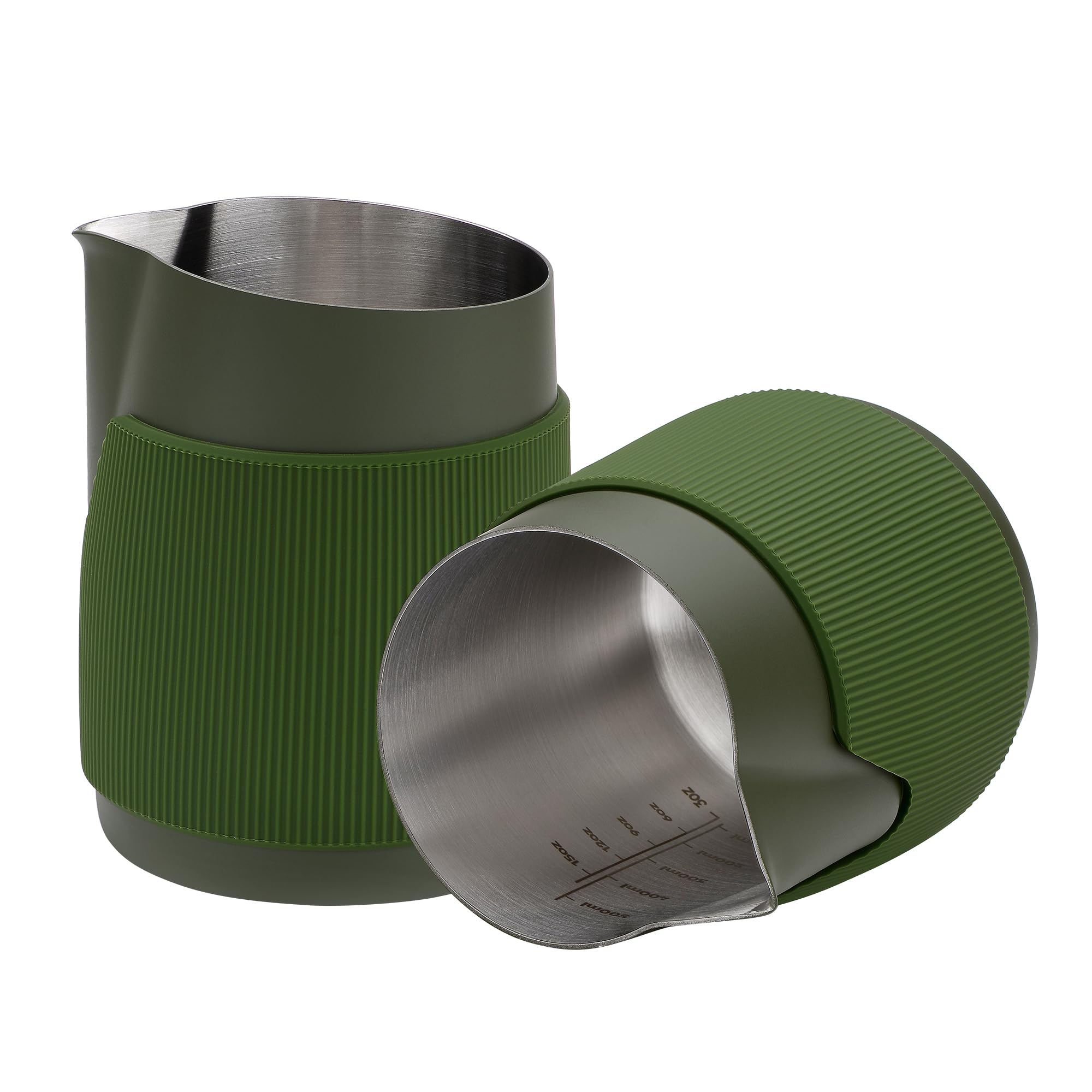
This green variant of the Normcore handleless line swaps the round spout for a sharper, more pointed tip that narrows the stream exit to roughly 2 mm at the apex. The difference is immediate on the pour: where the round version floods the cup base quickly, this sharp spout lets you trace a hairline through crema for detailed rosettas and swan necks. The silicone grip is identical in coverage to the round version, but the exposed metal contact patch at the bottom is slightly larger for easier temperature checks.
At 600 ml with the same 1 mm 18/8 stainless construction, the physical weight and balance mirror the round-spout sibling. The key differentiator is the spout’s internal geometry — the V-notch extends deeper into the body, which channels microfoam at a slower velocity. Beginners who rush their pour will find the sharp spout more punitive; any jerk or hesitation gets magnified in the drawn line. Practice pours with water are recommended before touching espresso.
Early production runs reported paint peeling on the black coating after a few days. Normcore’s customer service replaced defective units, and the green model shown here uses a more durable baked-on finish. For the beginner who plans to commit to advanced patterns within the first month, this pitcher saves an upgrade cycle. The coating does require hand washing to preserve the color.
Why it’s great
- Sharp 2 mm spout apex enables fine-line detail work that cheaper pitchers can’t produce
- Larger exposed metal base improves tactile temperature awareness during steaming
- Same 1 mm steel gauge and 600 ml capacity as the round spout version
Good to know
- Sharp spout magnifies beginner shaking — practice pours are mandatory
- Coated finishes need hand washing to prevent paint degradation
3. MHW-3BOMBER Espresso Steaming Pitcher (400 ml)

MHW-3BOMBER’s pitcher carries the endorsement of World Latte Art Champion Liang Fan — not a marketing afterthought, but a direct input on the spool geometry. The patented crocodile spout uses double-curved diversion grooves that split the milk stream into two laminar layers, recombining them at the tip. The result is a stream that holds its cohesion even when the pour angle deviates by 10–15 degrees, a forgiveness that beginners desperately need.
At 400 ml (13.5 oz), this is the smallest pitcher in the lineup. It’s purpose-built for single flat whites and cortados — not for 16 oz Americano-style drinks. The handle is polished 304 stainless with a slight countercurve that supports both pinch grip and traditional barista grip. The seamless interior (no welded seams inside the spout) reduces milk buildup and makes the stream less turbulent. Users report no paint wear after six months of daily use, indicating a mature coating process.
The smaller capacity means less margin for error during steaming: the milk heats faster and over-steaming happens within seconds if you walk away. However, the precision spout makes this the best tool for learning how microfoam texture interacts with pour speed. The trade-off is that you cannot use this pitcher for larger drinks without a second steaming cycle.
Why it’s great
- Double-curved diversion grooves maintain stream cohesion even with imperfect pour angles
- Seamless interior prevents milk residue buildup inside the spout channel
- World champion input on spout design means the geometry is competition-validated
Good to know
- 400 ml capacity limits you to single small drinks — not ideal for large lattes
- Polished stainless exterior shows fingerprints more readily than matte finishes
4. MUVNA Milk Frothing Pitcher (600 ml)
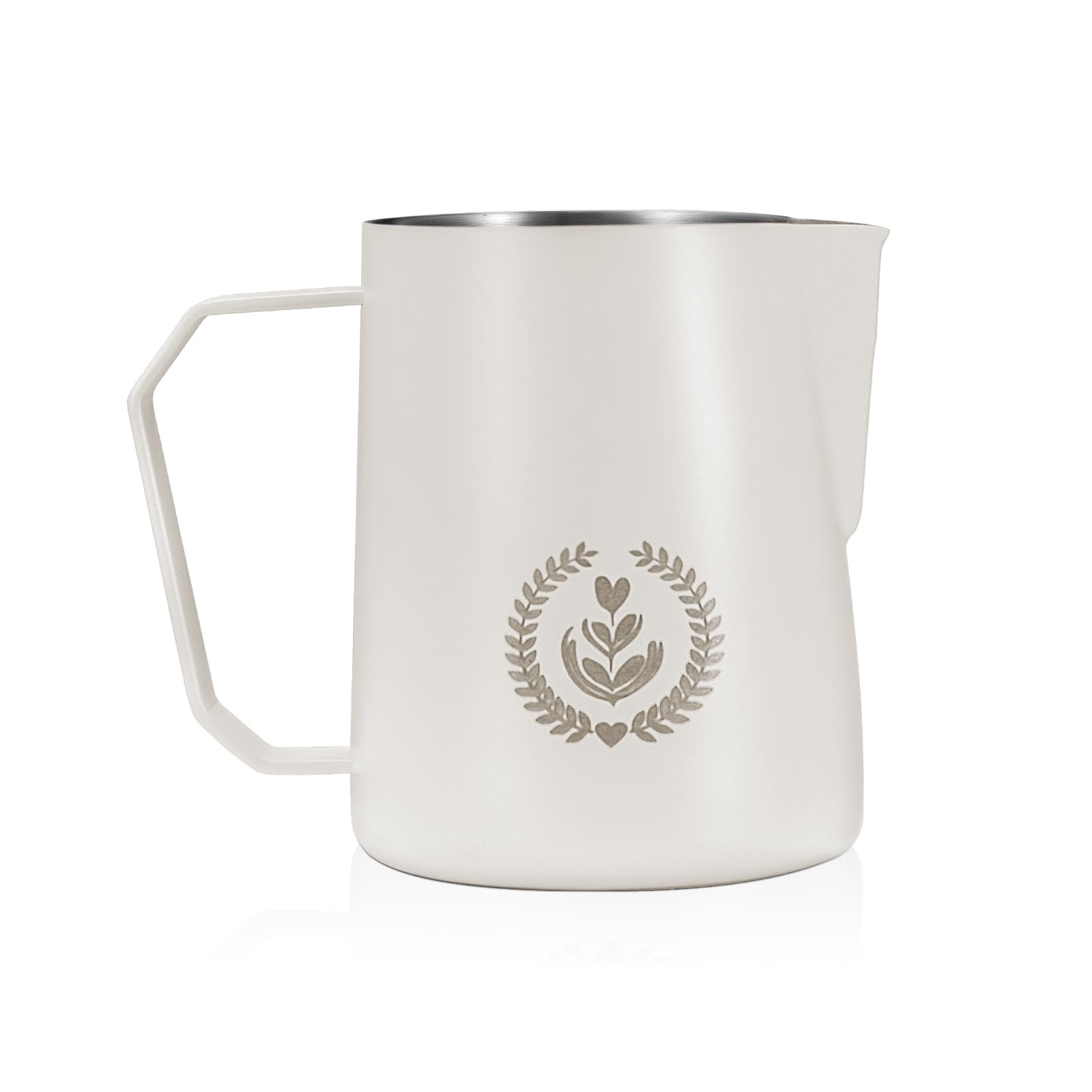
MUVNA positions this white 600 ml pitcher as the entry point with the fewest compromises for under retail. The sharp spout design is surprisingly precise for the price tier — the tip narrows to a sub-3 mm opening that competes with pitchers costing twice as much. The concave cylinder bottom sounds like marketing jargon, but it actually changes how milk circulates during steaming: the inward curve at the base creates a vortex that incorporates air more evenly than a flat-bottomed vessel.
The wide handle spans 4.8 inches across the grip zone, accommodating larger hands without finger pinch. At 0.29 kg, it’s the lightest pitcher in the lineup. That reduces wrist strain during long practice sessions but also means the steel is thinner — likely around 0.7 mm rather than the 1 mm found on Normcore or MHW-3BOMBER. The thin wall heats up faster, which requires a tighter attention span during steaming to avoid overheating the milk.
Surface treatment resists scratches well — early buyers report no visible wear after weeks of daily scrubbing. The white coating does show coffee drip stains more than dark finishes, but a quick wipe with a damp cloth restores the finish. For the beginner who wants a handled pitcher with a genuinely sharp spout and doesn’t want to overspend, this is the anchor pick of the budget tier.
Why it’s great
- Concave base creates a vortex during steaming for more uniform microfoam integration
- Sharp spout delivers clean lines at a price point where most pitchers use blunt tips
- Wide ergonomic handle prevents hand fatigue during extended practice sessions
Good to know
- Thinner steel walls heat faster and reduce margin for error during steaming
- White coating shows coffee stains and requires prompt wiping
5. IKAPE Espresso Milk Pitcher (450 ml)
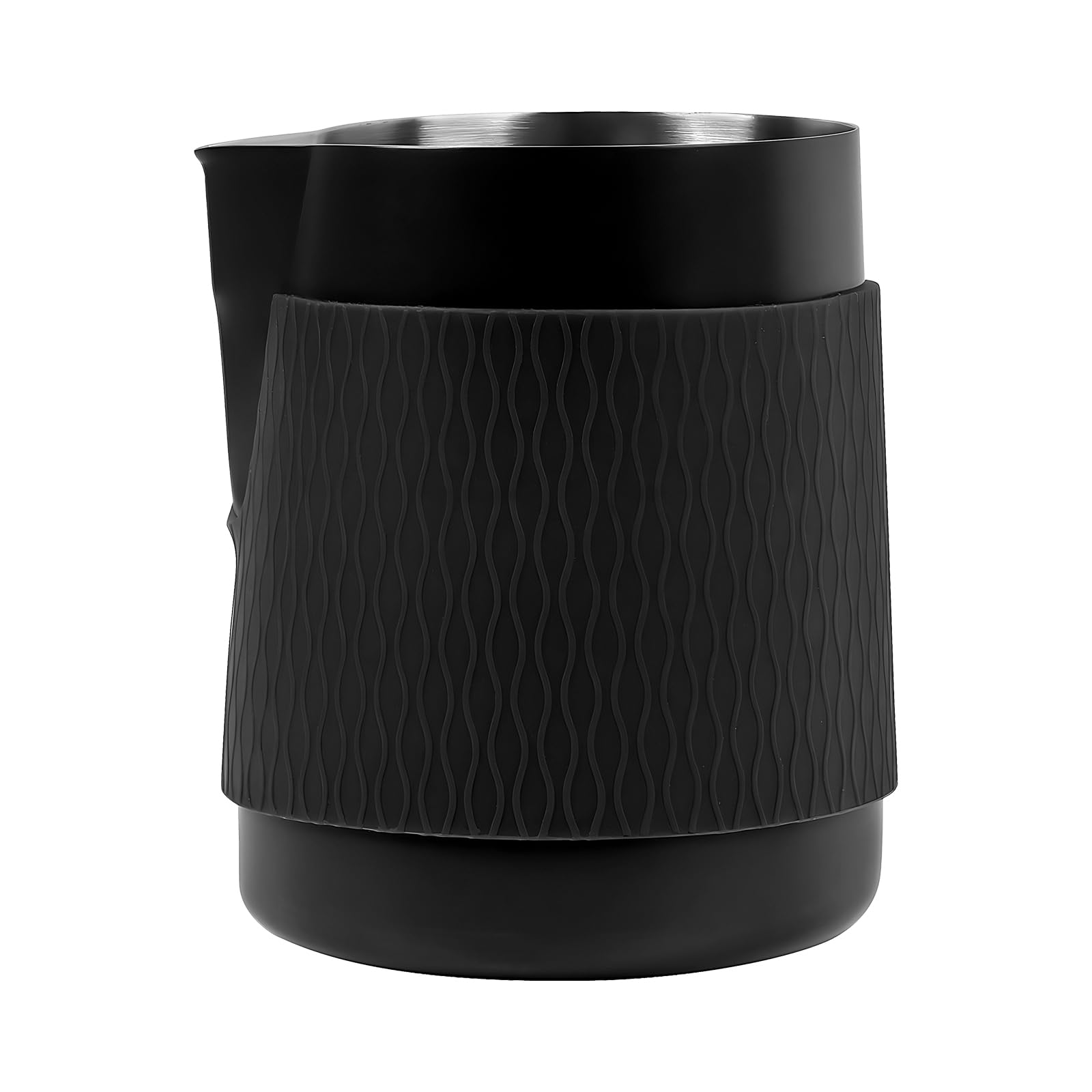
IKAPE’s handleless 450 ml pitcher uses a hawk spout — a wider V-notch than a traditional sharp spout — plus hyperbolic infuser grooves etched into the interior wall. The grooves are meant to break surface tension during steaming, creating a finer microfoam with fewer large bubbles. In practice, this means beginners who struggle with aggressive steaming get a buffer: the pitcher does some of the texturing work for you.
At 0.24 kg, it’s the lightest body in the lineup, which aids wrist mobility but reduces heat retention. The included silicone sleeve acts as both a grip surface and a heat insulator, but it covers the entire upper body, leaving no exposed metal for temperature sensing. You’ll need a separate thermometer or a timer to avoid overheating. The sleeve also traps moisture underneath, and some users report that removing it for cleaning is inconvenient.
The hawk spout design is ideal for the learner who hasn’t developed a consistent pour speed. The wide notch allows milk to flow even when your tilting angle is shallow — you don’t need to tip the pitcher aggressively to start the stream. This reduces the common beginner habit of over-tilting on the first pour, which usually results in a gush of milk rather than a controlled stream.
Why it’s great
- Hyperbolic infuser grooves actively help create finer microfoam with less technique
- Hawk spout allows stream flow even at shallow tilt angles, reducing beginner gushing
- Lightest body in comparison at 0.24 kg for easier wrist rotation
Good to know
- Silicone sleeve blocks tactile heat sensing — requires separate thermometer
- Sleeve traps moisture and requires periodic removal for thorough drying
6. Adorever Milk Frothing Pitcher with Latte Art Pen (600 ml)
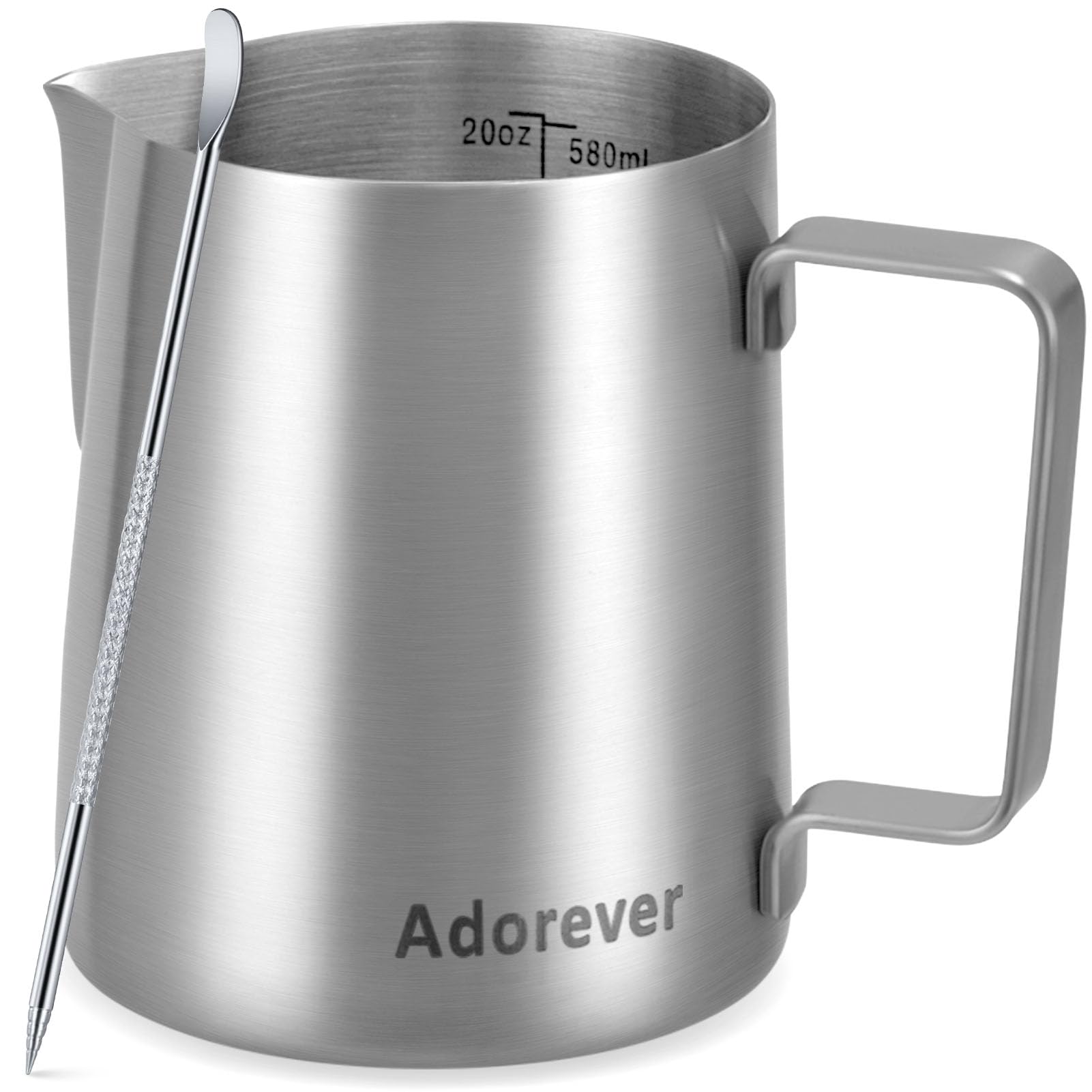
Adorever bundles a 600 ml (20 oz) milk frothing pitcher with a separate latte art pen — a fine-tipped tool that lets you draw details into the foam after the initial pour. The pitcher itself is a sand-polished matte stainless that shows fewer fingerprints than glossy alternatives. The handle joint is welded rather than glued, and the pointed mouth uses a rolled rim that prevents drips when you pause mid-pour to reposition the cup.
Etched volume markings on the interior are laser-printed into the surface rather than painted on, so they won’t fade with repeated scrubbing. The 20 oz capacity is the sweet spot for beginners — large enough to steam milk for a 12 oz drink with room for swirling, but not so large that the pitcher feels unwieldy in a single hand. The included latte art pen is a simple plastic tool with a metal tip; it’s not a professional-grade doodler but it does let you correct mistakes or add accents before the foam sets.
Dishwasher safe according to the manufacturer, but the matte finish may develop water spots in hard-water areas. Users who hand-dry immediately report the finish stays uniform. For the beginner who wants both a solid pitcher and a tool for fixing those first few ugly pours, this bundle eliminates the need to buy accessories separately.
Why it’s great
- Sand-polished matte finish resists fingerprints and water mark visibility
- Laser-etched interior markings won’t wash off unlike painted scale lines
- Included latte art pen allows foam touch-ups without a separate purchase
Good to know
- Matte finish can develop spots if not hand-dried in hard water areas
- Latte art pen is a basic plastic tool — not for professional line work
7. Gmnuiy 24PCS Espresso Accessories Kit
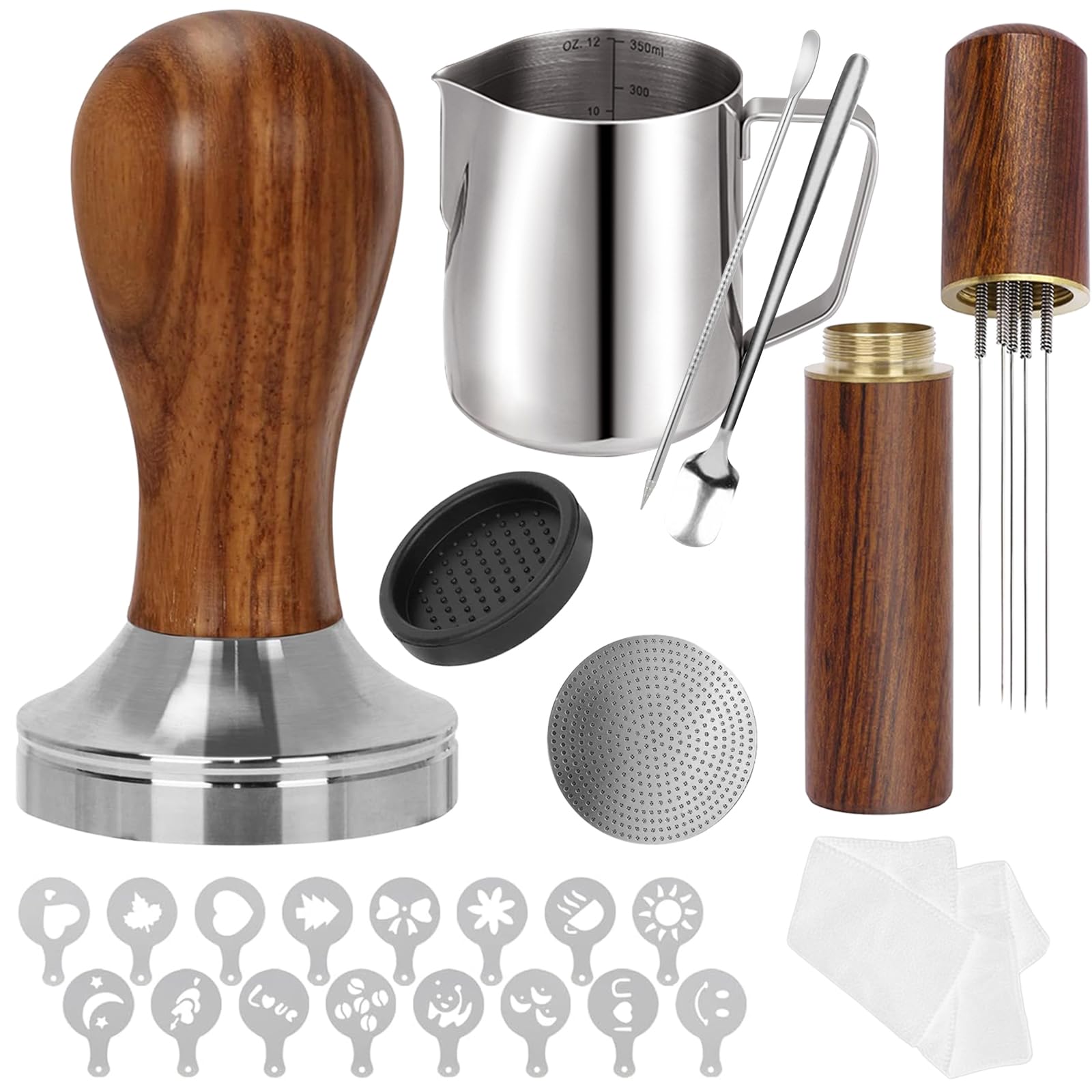
This 24-piece kit is the outlier in the lineup — it’s not just a pitcher but a full 54 mm portafilter ecosystem including a 53.3 mm stainless steel tamper, WDT distribution tool, puck screen, 16 decorating stencils, a stirring spoon, and a barista towel. The included pitcher is 350 ml (roughly 12 oz), which is the smallest capacity in this guide and best suited for single cappuccinos or cortados. The 16 stencils cover basic patterns: hearts, leaves, cats, and geometric shapes that let you dust cocoa or cinnamon into recognizable art without any pouring skill.
The tamper base is food-grade 304 stainless with a solid wood handle — notably, it doesn’t have a spring mechanism, so you get direct feedback on tamp pressure. The WDT tool has thin wire prongs that break up clumps in the grounds before tamping, a step that noticeably improves extraction consistency even with an entry-level espresso machine. The puck screen (53.3 mm) sits on top of the tamped coffee to distribute water and keep the shower screen clean.
For the absolute beginner who owns nothing except an espresso machine, this kit covers the critical workflow gaps: distribution, tamping, steaming, and stencil decoration. The trade-off is that the pitcher is small and the tamper lacks a spring-loaded leveling mechanism found on premium models. However, the value of having every tool in one box outweighs these individual compromises for someone who just wants to start making drinkable art on day one.
Why it’s great
- 24-piece set covers the complete espresso workflow from WDT distribution to stencil finishing
- 53.3 mm solid wood-handle tamper provides direct pressure feedback without spring interference
- 16 decorating stencils enable instant art without any pouring technique
Good to know
- 350 ml pitcher is the smallest capacity here — not suitable for 12 oz lattes
- Tamper lacks spring-loaded leveling mechanism found on dedicated tampers
FAQ
Should a beginner start with a handled or handleless pitcher?
What is the ideal pitcher capacity for a beginner making a standard 12 oz latte?
How do I clean a latte art pitcher without damaging the coating or finish?
Can I use a milk frothing pitcher with a stovetop or microwave?
Final Thoughts: The Verdict
For most users, the best barista tools for latte art beginners winner is the Normcore Handleless Milk Pitcher (Round Spout) because it eliminates handle variability while offering the thickest 1 mm steel in the comparison and a forgiving round spout that doesn’t punish minor shakes. If you want a handled pitcher with an exceptionally sharp spout and a lower entry cost, grab the MUVNA Milk Frothing Pitcher. And for the beginner who needs every tool in one box on day one, nothing beats the Gmnuiy 24PCS Espresso Accessories Kit.