
A flimsy single-camera setup leaves the sides of your vehicle and its vulnerable cabin completely unmonitored, turning a minor parking-lot scrape or a back-seat incident into a he-said-she-said dispute. A capable automotive camera system shuts that down by recording multiple angles simultaneously, giving you undeniable, timestamped evidence from every critical vantage point around and inside your car.
I’m Min — the co-founder and writer behind Gadgets Feed. I’ve spent hundreds of hours cross-referencing lens sensors, processor specs, and real-world user footage to separate systems that genuinely capture plate numbers at night from those that just claim to do so.
A smart buyer prioritizes STARVIS 2 sensors, dual-band WiFi for quick file offloads, and buffered parking mode over sticker features. By the end of this guide, you’ll know exactly which best automotive camera system fits your vehicle, your budget, and your need for true round-the-clock surveillance.
How To Choose The Best Automotive Camera System
Not all dash cams are built for the same mission. A cheap single-channel unit might help with a fender-bender, but a full multi-channel system with premium sensors does the heavy lifting when the incident involves your parked car’s side panel or someone inside the cabin. Focus on four factors that separate real protection from marketing hype.
Channel Counts and Coverage Areas
A 2-channel system (front + rear) covers the two most common collision angles, but it leaves the sides and interior unmonitored. A 3-channel setup adds an interior camera, ideal for rideshare drivers or family trips where back-seat activity matters. The full 4-channel configuration gives you a near-360° view: front, rear, front cabin, and rear cabin. For total peace of mind, prioritize the channel count your daily driving scenario actually demands.
Night Vision Capability and the STARVIS Difference
Standard image sensors wash out license plates under streetlights or oncoming headlights. Sony’s STARVIS 2 sensor technology delivers up to 4x the low-light sensitivity of earlier sensors, capturing full-color footage in near-total darkness. Look for a system that pairs a STARVIS 2 front camera with HDR or WDR processing — this combination is what lets you actually read a plate at 20 mph on a dim road, not just see a blob of light.
Parking Mode: Basic vs Buffered Protection
Basic parking mode waits for a G-sensor impact to start recording, often missing the first few seconds of the event. Buffered parking mode (also called pre-recording) keeps a rolling 10- to 15-second memory loop, so when motion or impact triggers a save, you get the footage from before the hit. This is the difference between seeing a person walk up to your car and seeing only the aftermath. Hardwire kits are required for 24/7 parking surveillance on any system that lacks a battery.
Connectivity and Data Transfer Speed
Older 2.4GHz WiFi modules make downloading a 4K clip painfully slow. Dual-band WiFi (2.4GHz and 5.8GHz) or WiFi 6 cuts transfer times to under a minute for a large file, letting you share evidence directly from your phone without pulling the memory card. Built-in GPS that embeds speed, location, and route data onto the video is essential for insurance claims — make sure the system includes a GPS receiver (either integrated or via the mount).
Quick Comparison
On smaller screens, swipe sideways to see the full table.
| Model | Category | Best For | Key Spec | Amazon |
|---|---|---|---|---|
| Vantrue N5S 4CH | Multi-Channel | Full 360° coverage | 2.7K front + STARVIS 2 all cams | Amazon |
| Vantrue S1 Pro | Dual | High-speed night clarity | 1440p@60fps + STARVIS 2 | Amazon |
| 70mai T800E | Triple | Rideshare and family trips | 4K front + Wi-Fi 6 + super cap | Amazon |
| Pelsee P1 Pro | Dual | AI driving alerts | 4K HDR + ADAS + voice control | Amazon |
| TERUNSOUl 3CH | Triple | Triple-channel value | 4K front + 128GB card included | Amazon |
| FAIMEE 4K+2K | Dual | Budget dual-channel entry | 4K front + 2K rear + 64GB | Amazon |
| Coolcrazy N8 | Dual | Free included 128GB storage | 4K front + STARVIS + 128GB | Amazon |
In‑Depth Reviews
1. Vantrue N5S 4 Channel 2.7K Dash Cam
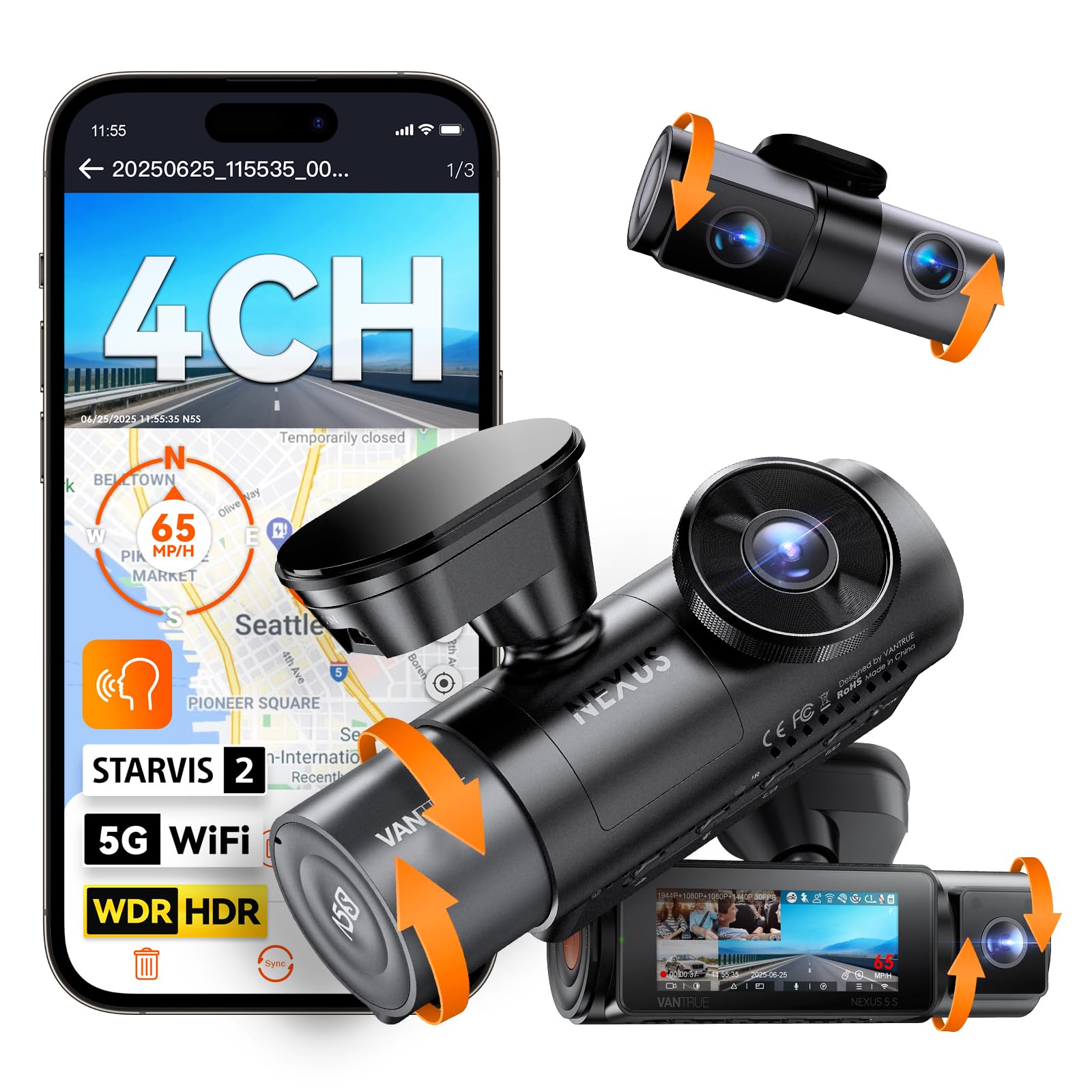
The Vantrue N5S is the closest thing to a complete surveillance system for your car. Its four channels — front at 2.7K, rear at 1440p, and two interior cameras at 1080p — eliminate every major blind spot. Every one of those cameras uses a Sony STARVIS 2 sensor, so the interior cams with infrared lights capture clean footage even inside a pitch-black cabin. The front camera’s IMX675 sensor combined with HDR processing reads plates at 20 mph in challenging light, a benchmark few dual-channel systems can match.
Buffered parking mode is a defining feature here. The N5S keeps a rolling 10-second pre-recording buffer, so when a motion or impact trigger occurs during parking, you see the lead-up to the event — not just the aftermath. The included 5GHz WiFi module streams 4-channel previews directly to the Vantrue app, and the dual-system GPS (GPS + GLONASS) embeds speed and route data onto every file. Up to 1TB microSD support gives you roughly 40 hours of continuous 4-channel recording before looping.
The hardware kit is sold separately, and the adhesive mount installation requires careful placement — it uses 3M tape rather than a suction cup, which is more secure but less forgiving for repositioning. Some users found the rear cabin cable routing tricky with longer vehicles, and the menu system is deep enough to require a quick read of the manual. For drivers who want a single device that covers front, rear, and both cabin zones, the N5S is the most complete system at this level.
Why it’s great
- Four STARVIS 2 cameras deliver unmatched low-light clarity across all angles
- 10-second buffered parking mode captures the moments before an impact
- 2.7K front sensor with HDR reads license plates at speed in dim conditions
Good to know
- Hardwire kit required for 24/7 parking mode — not included in the box
- Adhesive mount is secure but not easy to reposition after installation
- 4-channel recording uses SD card space quickly; a high-endurance 256GB card is recommended
2. Vantrue S1 Pro Dash Cam Front and Rear
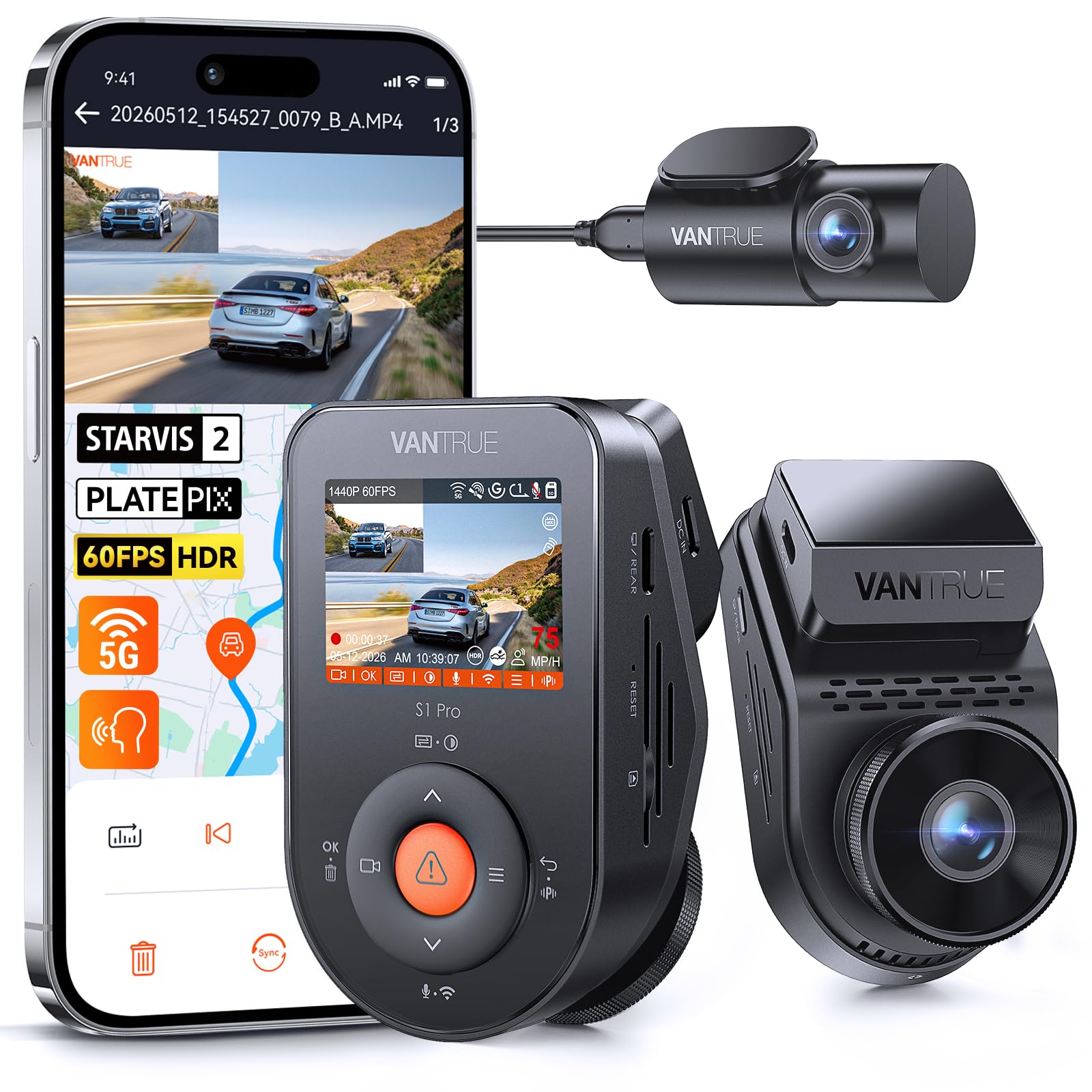
The S1 Pro targets a specific pain point: blurry footage at highway speeds. Recording front video at 1440p and 60 frames per second, this dual-channel system captures two times the motion information of a standard 30fps camera, making plates readable even when you’re passing at 70 mph. The STARVIS 2 sensors on both front and rear lenses work with Vantrue’s PlatePix technology, which uses dual HDR on each channel to balance exposure between bright headlights and dark pavement.
AI safety features set the S1 Pro apart from most dual-channel competitors. The forward collision warning (ADAS) and rear blind spot detection (BSD) provide audible alerts, useful for city driving and lane changes in heavy traffic. The 5GHz WiFi module downloads 4K-equivalent clips quickly, and the built-in GPS receiver logs location, speed, and route — accessible through the Vantrue app or desktop player with a zoom-in function for plate verification. The included CPL filter accessory dramatically reduces windshield glare from rain or direct sun.
The button layout on the camera body has a learning curve — the menu and mode buttons are not labeled in the most intuitive arrangement, and some users had to adjust the G-sensor sensitivity to avoid false emergency locks on rough roads. The mount uses 3M adhesive rather than a suction cup, which is a trade-off for stability over flexibility. Dual-channel operation at 60fps does fill SD cards faster, so a high-endurance 256GB card is a practical upgrade. For drivers who need plate capture at high speed and want AI driving aids in a compact package, the S1 Pro earns its spot.
Why it’s great
- 1440p at 60fps eliminates motion blur on fast-moving plates and signs
- STARVIS 2 sensors on both channels with dual HDR for night clarity
- AI ADAS and BSD provide proactive collision and blind spot warnings
Good to know
- Physical button layout is non-standard and takes time to memorize
- Adhesive mount is permanent — no suction cup for easy transfer between vehicles
- G-sensor may trigger false locks on vehicles with stiff suspension; sensitivity needs adjusting
3. 70mai 4K Dash Cam Front and Rear Inside (T800E)

The 70mai T800E is purpose-built for three-channel coverage: a 4K front camera, a 1080p interior camera, and a 1080p rear camera. The interior cam features switchable infrared recording, letting you toggle IR LEDs on for nighttime cabin visibility or off for daytime clarity. The front camera uses an F1.55 aperture lens that pairs with HDR and 3D noise reduction, producing sharp footage even in the low-contrast conditions of tunnels or dusk. With Wi-Fi 6 on board, file transfers through the 70mai app reach up to 10 MB/s, roughly 5x faster than older Wi-Fi 4 modules.
The built-in 5-mode GPS tracks location via GPS, GLONASS, Galileo, BeiDou, and QZSS, ensuring fast satellite lock even in urban canyons. Voice commands work reliably for hands-free actions like locking video or taking a photo. The super capacitor power system handles temperature extremes from 14°F to 140°F without the swelling or failure risks of lithium batteries, a critical factor for vehicles parked in direct sun. A 64GB SD card is included, and the system supports up to 512GB for extended recording.
The rear camera cable is fixed-length and may require creative routing in larger vehicles like SUVs or trucks. The 70mai app has received mixed feedback regarding connection stability — some users found the live-streaming function finicky on the first pairing attempt. Parking mode requires a separate hardwire kit (UP06 or UP03), which is not bundled. The interior camera’s IR mode is a standout for rideshare drivers, giving clear cabin footage without washing out the scene with visible light. For Uber or Lyft drivers who need documented evidence of both road incidents and passenger interactions, the T800E is the most logical choice in this price tier.
Why it’s great
- Wi-Fi 6 delivers app downloads up to 10 MB/s — much faster than standard dash cams
- Switchable IR interior camera captures clear cabin footage in total darkness
- Super capacitor design withstands extreme heat and cold without battery degradation
Good to know
- Parking mode requires a separate UP06 or UP03 hardwire kit (not included)
- App connection can be unreliable during initial pairing; SD card direct viewing is more reliable
- Rear cable length may be short for larger vans and long-bed trucks
4. Pelsee P1 Pro 4K Dash Cam Front and Rear
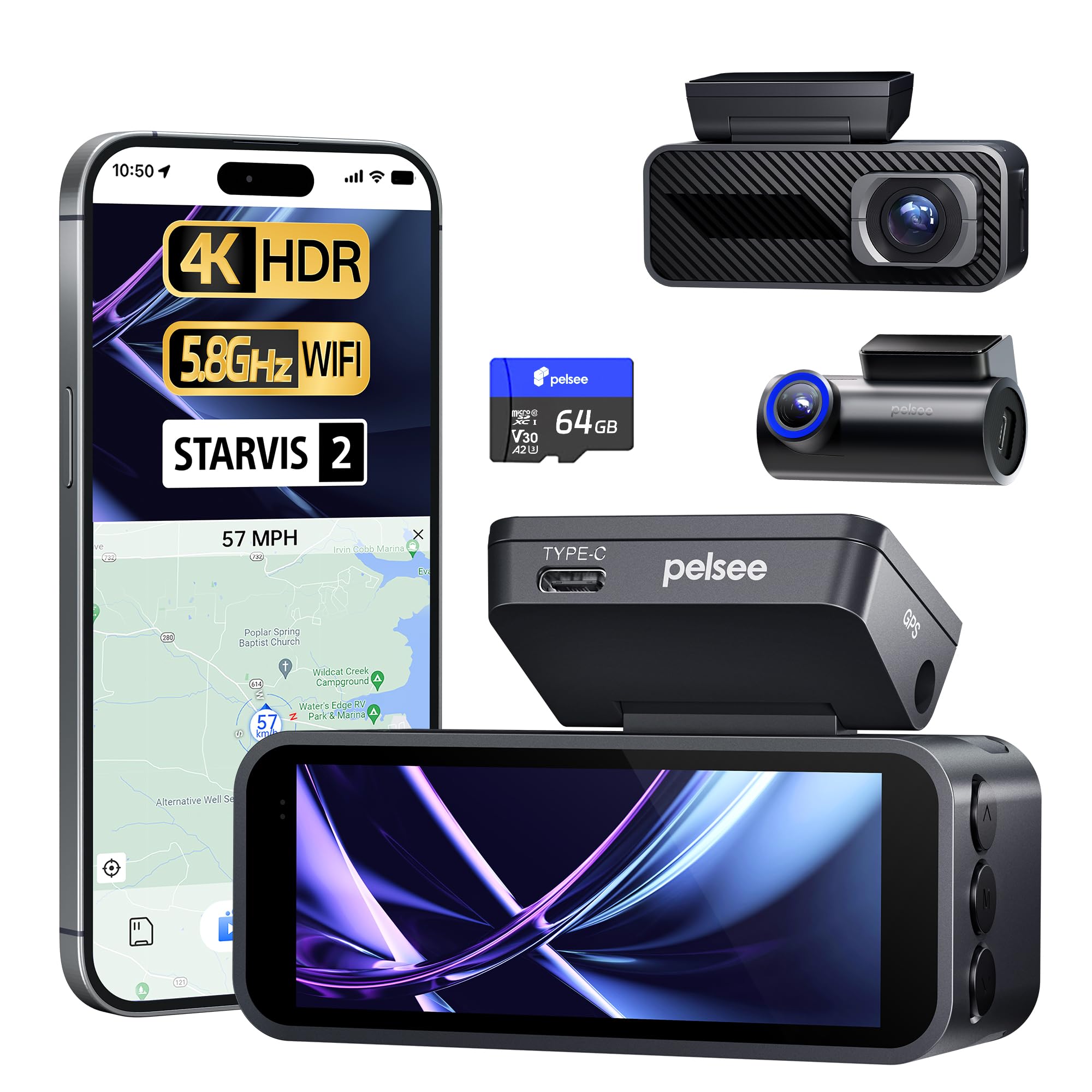
The Pelsee P1 Pro is a rare mid-range system that includes the Sony STARVIS 2 sensor — a component usually reserved for more expensive dash cams. The front camera records 4K with HDR, and the rear camera captures 1080P with WDR, meaning the system actively balances overexposed highlights and shadow details in real time. The enhanced low-light sensitivity from STARVIS 2 produces full-color night footage in starlight conditions, outperforming standard night vision that turns the world grainy and monochrome.
ADAS features — forward collision warning, lane departure alert, pedestrian detection, and front vehicle start reminder — provide real-time audible and visual alerts with a reaction window of 0.8 to 2 seconds. The built-in voice control understands eight commands, including “Lock the video” and “Take a photo,” using noise-canceling microphones that filter out road noise. The 5.8GHz WiFi module enables quick downloads to the Pelsee Cam app, and the GPS receiver stamps speed, coordinates, and timestamps directly onto the video file for easy insurance submission.
The included car charger’s adapter socket may be slightly loose in some vehicles, requiring a replacement with a tighter-fitting unit for consistent power. The 64GB card that comes in the box is adequate for daily commutes, but anyone wanting 24/7 parking mode (which requires a sold-separately hardwire kit) will want to upgrade to a 256GB or 512GB card. The 3.39-inch IPS screen is crisp for live previews and menu navigation, and the electrostatic sticker mounting system leaves no residue on the windshield. For the price, the STARVIS 2 sensor alone makes this a standout.
Why it’s great
- STARVIS 2 sensor at this price point is exceptional for full-color night footage
- ADAS system with forward collision and lane departure alerts improves daily safety
- Noise-canceling voice control works accurately even with the windows down
Good to know
- Included car charger adapter may fit loosely; a better-fitting adapter solves the issue
- Parking mode requires a separate hardwire kit and higher-capacity SD card
- Rear camera cable may be excessively long for sedans, making cable management tricky
5. TERUNSOUl 4K Dash Cam Front, Rear, and Cabin
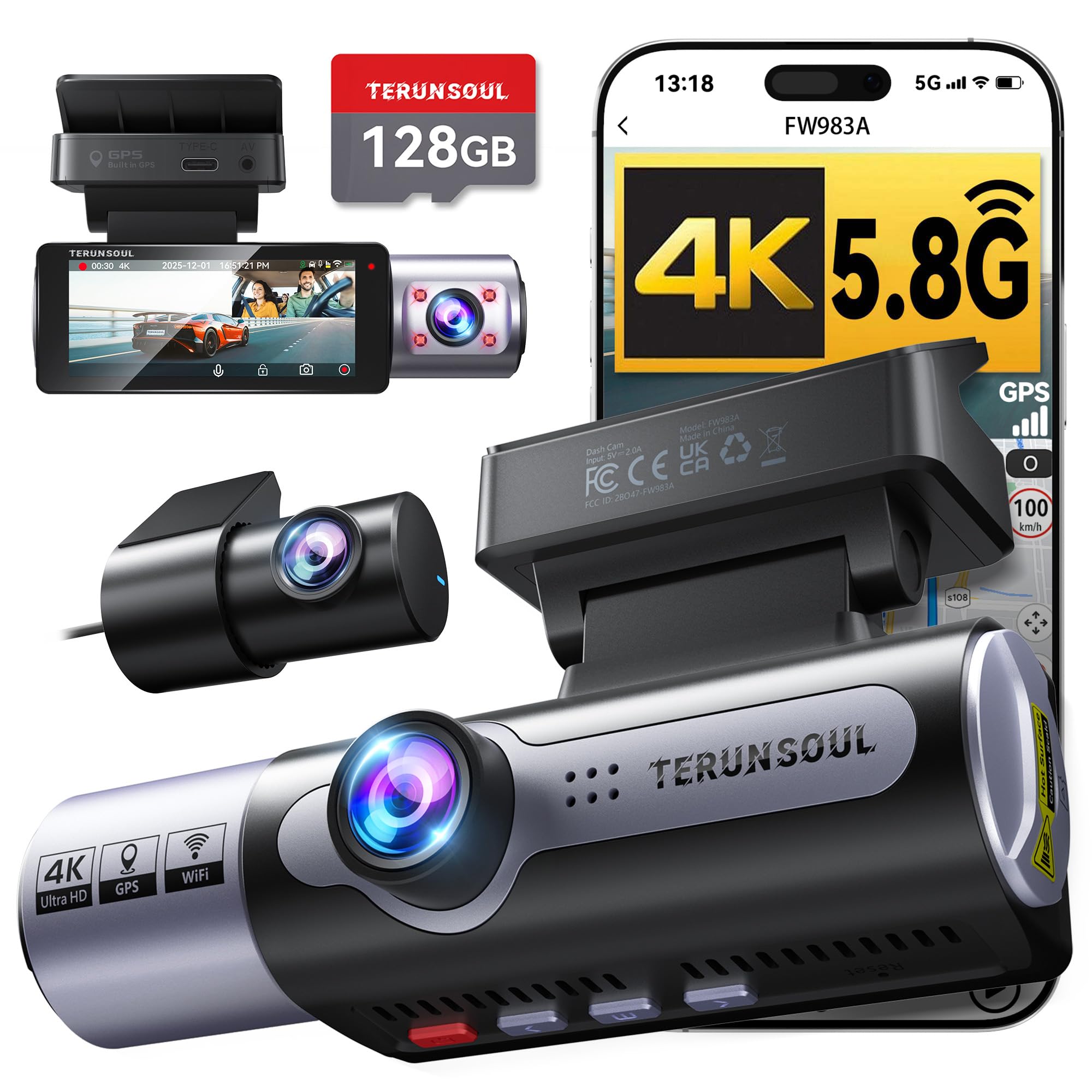
The TERUNSOUl system delivers triple-channel recording — front at 4K Ultra HD, rear at 1080p, and cabin at 1080p — with a 128GB memory card included right in the box. The front camera uses a starlight-grade five-layer lens with an F1.6 aperture, which lets in significantly more light than the common F1.8 lenses found on most competitors. HDR processing on the front sensor ensures that bright sky and dark road surface details are captured simultaneously rather than washing out one or the other. The 170° front and 165° rear and cabin lenses provide near-360° coverage without fisheye distortion.
Built-in high-precision GPS records route, real-time speed, compass heading, and position data directly into the video metadata. The free GPS player software for Windows and Mac lets you overlay the driving path onto a map and zoom in on specific frames to verify plate numbers. The 5.8GHz dual-band WiFi connects to the TERUNSOUl app for live preview, 20 MB/s downloads, and firmware updates over the air. The collision sensor locks footage on impact, and loop recording automatically overwrites the oldest files when the 128GB card fills up — which takes roughly 10 hours of continuous 3-channel recording.
The app requires granting file access and location permissions that may feel excessive to privacy-conscious users, though the camera can be operated entirely independently without the app. The rear camera cable routing, especially through a hatchback’s rubber boot, takes patience and the included pry tool. The mount uses an electrostatic sticker plus adhesive, which is reliable once set but not easily adjustable. For a family that wants 360° cabin coverage right out of the box without buying extra memory or a second camera, this is an excellent turnkey solution.
Why it’s great
- Comes with a 128GB card pre-installed — no additional memory purchase needed
- F1.6 starlight aperture captures more light than standard F1.8 cameras
- 3-channel coverage includes cabin view, ideal for family and rideshare use
Good to know
- App requires extensive permissions; the camera functions fully without the app
- Rear cable routing through hatchback boots is time-consuming
- Mount uses permanent adhesive; placement must be correct on the first attempt
6. FAIMEE 4K+2K Front and Rear Dash Cam
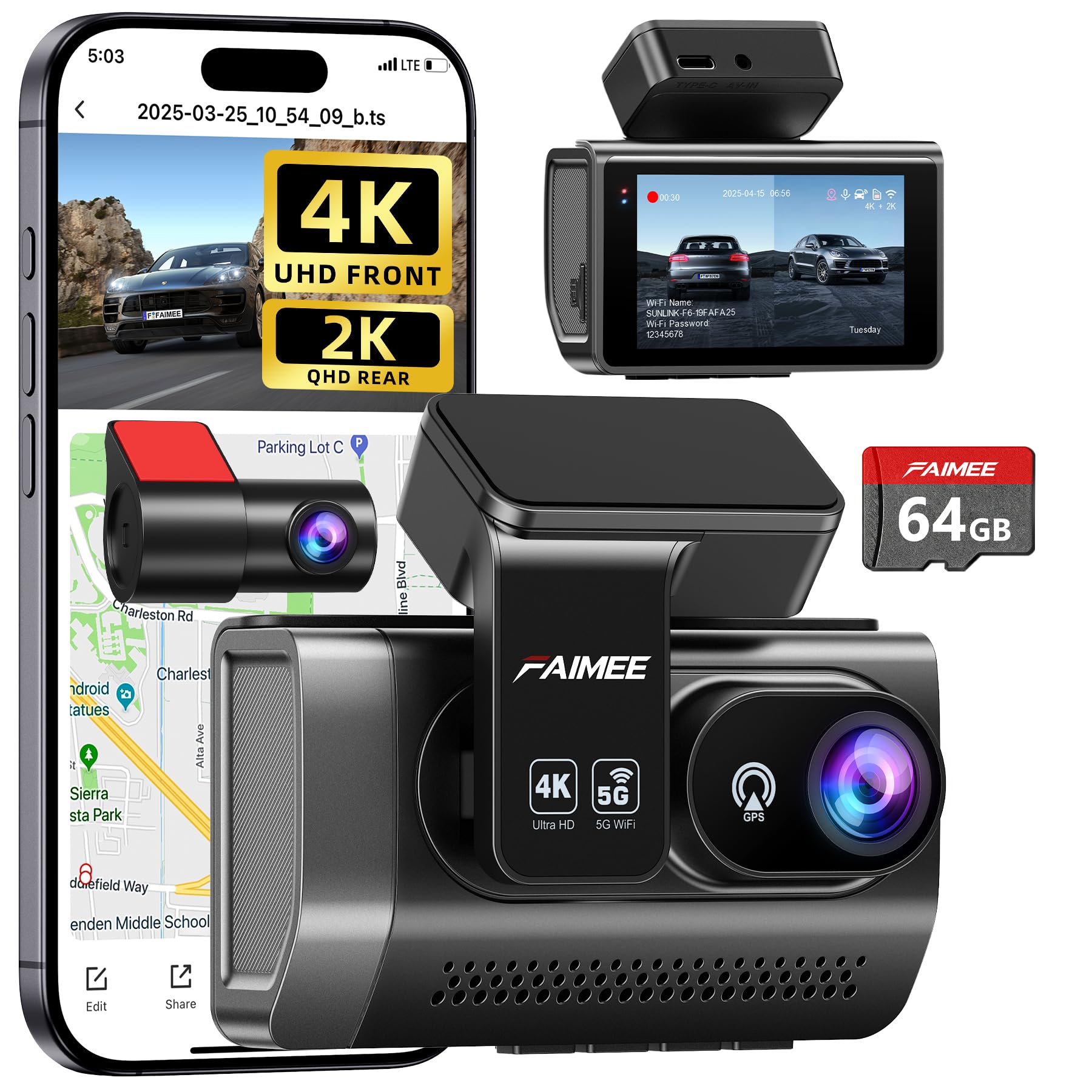
The FAIMEE system punches above its tier by pairing a 4K (3840×2160) front camera with a 2K (2304×1296) rear camera, delivering noticeably sharper rear footage than the common 1080P rear sensors found at this price. The F1.8 aperture lens on the front cam works with WDR and night vision to maintain balanced exposure in high-contrast scenes — such as driving from a bright highway into a dark tunnel. The 170° wide-angle lens covers up to six lanes, reducing the chance that a side-impact incident falls outside the frame.
Dual-band WiFi at 5.8GHz and 2.4GHz provides a stable, fast connection to the FAIMEE app for live view and instant downloads. The built-in GPS logs real-time speed, route history, and location coordinates. Time-lapse parking mode compresses hours of surveillance into a viewable clip, though a hardwire kit (not included) is needed for continuous operation. The included 64GB high-endurance card is ready to use out of the box, with support for expansion up to 256GB. Loop recording and G-sensor emergency lock function are standard here.
The camera body is slightly bulkier than some competitors, which may cause visibility obstruction if placed too low on the windshield. The power cable length is adequate for most sedans but may be short for vans or large SUVs, requiring an extension or creative routing. The user manual is somewhat dense and the initial settings menu requires a learning curve — expect to spend 15-20 minutes dialing in the preferred resolution and recording mode. For a driver who wants 2K rear resolution and reliable dual-band WiFi without jumping to the premium price bracket, this is a solid entry point.
Why it’s great
- Front 4K and rear 2K resolution delivers sharper rear footage than typical 1080p systems
- 5.8GHz dual-band WiFi provides fast, reliable app connection for file downloads
- Time-lapse parking mode compresses surveillance into manageable clips
Good to know
- Camera body is larger than average; placement behind the mirror is essential to avoid obstructing view
- Initial menu setup has a learning curve; budget extra time for configuration
- Power cable may be too short for full-size vans and large trucks
7. Coolcrazy 4K Dash Cam Front and Rear (N8)
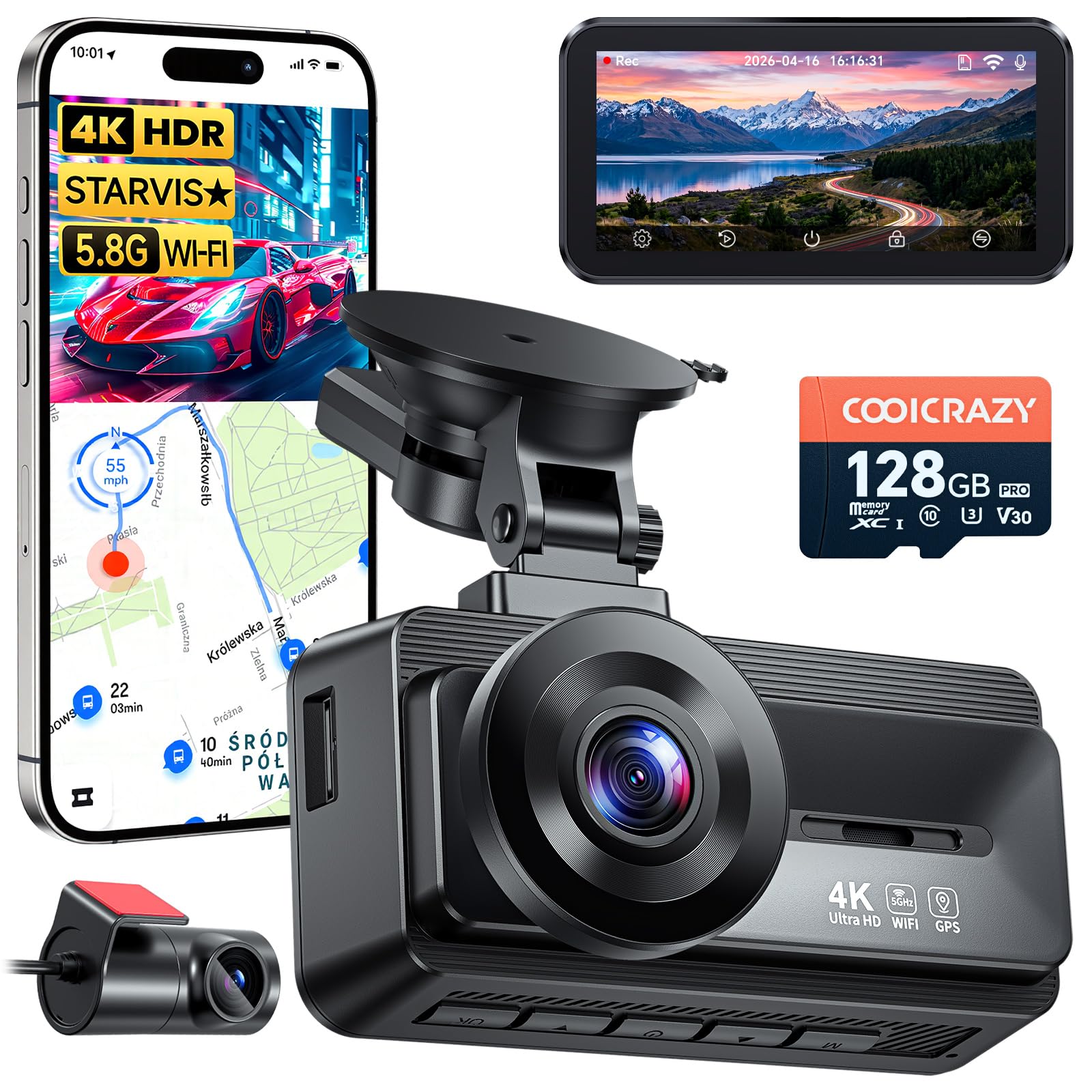
The Coolcrazy N8 positions itself as a complete starter kit: you get a 4K front camera with a Sony STARVIS sensor, a 1080p rear camera, and a 128GB memory card all in the box. The STARVIS sensor is the first-generation Sony low-light technology, not the newer STARVIS 2, but it still provides a meaningful upgrade over generic CMOS sensors in this budget range — expect clear footage under streetlights and in well-lit parking lots rather than total darkness. The 170° front and 150° rear wide angles cover adjacent lanes effectively. Recording at 60fps in 4K keeps motion smooth even at highway speeds.
Built-in GPS locks onto satellites within 20-30 seconds and stamps speed and coordinates directly onto the video. The 5GHz WiFi module connects to the Coolcrazy app for live preview and downloads, though the app interface is more basic than competitors. The G-sensor automatically locks footage during collisions, and the 24-hour parking monitoring (requiring the included hardwire-compatible cable) triggers on impact or motion when the vehicle is parked. The camera body is built with automotive-grade materials rated for high-temperature resistance, important for summer parking.
Some units prompt a microSD card reformat message on every startup, which is an inconvenience rather than a functional defect — a quick firmware update or using a different card brand usually resolves it. The rear camera adhesive can weaken in extreme heat over time; an electrostatic sticker under the adhesive helps maintain grip. The app connection process can be finicky on the first attempt, and some users found it easier to transfer files by removing the microSD card directly. For a first-time buyer who wants 4K recording, STARVIS low-light capability, and a free 128GB card without stretching the budget, the N8 is a solid entry-level system.
Why it’s great
- Includes a 128GB card with a genuine Sony STARVIS sensor at an entry-level price
- Records 4K front at 60fps for smooth, detailed high-speed footage
- GPS locks quickly and embeds speed/coordinates on video files
Good to know
- Occasional “reformat card” prompt at startup may require firmware or card swap
- Rear camera adhesive can degrade in direct summer heat without additional reinforcement
- App connection is less polished; direct SD card file transfer is more reliable
FAQ
How many channels do I really need in an automotive camera system?
Why does buffered parking mode cost more, and is it worth it?
What memory card speed and capacity does a 4K multi-channel system need?
Can I install a hardwire kit myself, or should I hire a professional?
Final Thoughts: The Verdict
For most users, the best automotive camera system winner is the Vantrue N5S 4 Channel because its four STARVIS 2 cameras and buffered parking mode leave no angle unmonitored, day or night. If you want smooth 60fps plate capture with AI driving alerts, grab the Vantrue S1 Pro. And for rideshare drivers needing a Wi-Fi 6 three-channel system with a switchable IR interior camera, nothing beats the 70mai T800E.