
Pulling a new service or feeder run means committing to a conductor thickness that won’t thermally throttle under a 200-amp load. The wrong gauge means voltage drop across a long trench or conduit run, and aluminum is the practical choice when balancing ampacity against cost per foot vs. copper. You need a wire with the correct stranding, insulation rating, and code compliance to pass inspection on the first try.
I’m Min — the co-founder and writer behind Gadgets Feed. I’ve spent hundreds of hours cross-referencing NEC ampacity tables, conductor stranding specs, and real-world user install feedback to separate code-ready wire from undersized pretenders.
Whether you’re wiring a sub-panel, a service entrance, or an inverter bank, you need reliable current delivery without the guesswork. This guide breaks down the best 4/0 aluminum wire options for both residential and mobile power systems.
How To Choose The Best 4/0 Aluminum Wire
Selecting the right 4/0 wire involves more than just matching gauge to breaker size. You must factor in conductor material (aluminum vs copper), insulation type for the environment (dry, wet, or direct burial), the number of current-carrying conductors, and whether you need a pre-assembled cable like SEU or URD or a single conductor for a conduit pull.
Conductor Material: Aluminum vs. Copper
Aluminum 4/0 wire is roughly half the weight of copper for the same gauge, making it easier to pull through long conduit runs. The ampacity of 4/0 aluminum at 90°C is typically 205 amps, while copper at the same gauge and temperature is about 260 amps. For most residential 200-amp services, properly terminated aluminum conductors are code-compliant and cost significantly less.
Insulation Type and Temperature Rating
XHHW-2 is the most common insulation for single aluminum conductors, rated for dry and wet locations at 90°C. SEU cable uses a concentric neutral and is ideal for service entrance masts and meter-to-panel runs. URD cable is designed for direct burial without conduit, using a quadruplex configuration for underground feeder or distribution.
Number of Conductors and Stranding
A 4/0 aluminum wire can be solid or stranded, with stranding counts ranging from 18 to 19 strands. Higher strand counts offer greater flexibility for pulling around bends. You also need to decide between single conductors, triplex (two phase + one neutral), or quadruplex (three phase + one neutral) depending on your system voltage and configuration.
Quick Comparison
On smaller screens, swipe sideways to see the full table.
| Model | Category | Best For | Key Spec | Amazon |
|---|---|---|---|---|
| Nassau Electrical Supply URD Quadruplex 40′ | URD Direct Burial | 200A underground feeder | 290A direct burial ampacity | Amazon |
| Wirenco 4/0-4/0-4/0 SEU Cable 20FT | SEU Service Entrance | Meter to panel upgrade | 205A @ 90°C, 19-strand | Amazon |
| WNI 4/0 Welding Cable 5ft Black + 5ft Red | Battery Cable | Inverter/solar battery banks | 600V, SAE J1127, 100% copper | Amazon |
| TEMCo 4/0 Welding Cable 10ft Black + 10ft Red | Welding Cable | High-amp battery/inverter runs | 440A max, 1950-strand OFC | Amazon |
| Wirenco 4/0 XHHW-2 Aluminum 125FT | XHHW-2 Single Conductor | Long conduit runs in house | 205A @ 90°C, 18-strand | Amazon |
| NOVINO 4/0 Marine Grade Wire 10ft Red + 10ft Black | Marine Grade | Boat/saltwater environments | Tinned copper, UL 1426 | Amazon |
| EWCS 4/0 Welding Cable 15ft Black + 15ft Red | Premium Welding Cable | Large battery bank paralleling | 2014-strand, EDPM jacket | Amazon |
In‑Depth Reviews
1. Nassau Electrical Supply 40′ 4/0-4/0-4/0-2/0 Wake Forest Quadruplex URD Cable

This quadruplex assembly bundles three 4/0 phase conductors with a reduced 2/0 neutral, making it the definitive choice for a 200-amp underground feeder or service. The URD (Underground Residential Distribution) construction is rated for direct burial at a full 290 amps, giving you headroom beyond the standard 200-amp service. At 979 pounds per thousand feet, it’s a heavy-duty assembly that doesn’t cut corners on conductor size.
Real-world testimonials confirm this cable has been handling 200-amp loads continuously for over two years in temperature extremes from -20°F to 100°F with zero issues. The 19-strand phase conductors strike a practical balance between rigidity for burial stability and enough flexibility to shape transitions at the weatherhead. Buying the quadruplex set often saves money compared to sourcing individual conductors and a separate neutral.
Keep in mind that this cable is not intended for conduit use — it’s designed to be trenched directly into the ground. The outer jacket is sunlight-resistant and rated for 600V, covering both 120/240V single-phase and 120/208V three-phase services. If your project requires a full-sized neutral for a 200-amp service, the 2/0 neutral here is code-compliant for residential 200A single-phase, but verify if your local inspector requires a full 4/0 neutral.
Why it’s great
- 290A direct burial ampacity exceeds 200A service requirement
- Proven real-world reliability across extreme temperatures
- Complete quadruplex assembly saves sourcing individual wires
Good to know
- Reduced neutral (2/0) may not pass all local codes for 200A
- Not approved for conduit installation — burial only
2. Wirenco 4/0-4/0-4/0 Aluminum SEU Service Entrance Cable (20FT Cut)

The Wirenco SEU cable delivers a pre-assembled triplex configuration — two 4/0 phase conductors and one 4/0 concentric neutral — exactly what you need to bring power from the meter base to the main disconnect. At 205 amps at 90°C, this cable comfortably supports a 200-amp service while staying within code. The 19-strand construction provides enough flexibility to bend around the meter base and panel knockouts without excessive force.
Users consistently report significant savings versus pricing from local electrical supply houses, with same-day delivery convenience that avoids project delays. The 1.072 pounds per foot weight is expected for SEU cable, and the concentric neutral design simplifies bonding in the meter socket and main panel. The gray outer jacket is weather-resistant for the short exterior exposure between meter and weatherhead.
This cable is not rated for direct burial or wet locations — it’s strictly for dry service entrance applications. The 20-foot length is adequate for most meter-to-panel distances, but longer runs require a different product or a splice. Also note that the concentric neutral is aluminum, which requires anti-oxidant compound at terminations to prevent corrosion at aluminum-to-copper connections.
Why it’s great
- Complete triplex assembly saves field assembly time
- 205A rating provides margin for typical 200A residential service
- Cost-effective vs. supply house pricing with fast delivery
Good to know
- Not for direct burial — keep in conduit or dry interior use
- Aluminum termination requires anti-oxidant compound
3. TEMCo 4/0 Gauge AWG 10 Ft Black + 10 Ft Red Welding Cable

TEMCo’s Easy-Flex welding cable uses 100% oxygen-free copper (OFC) with 1,950 strands of 30-gauge wire, producing a flexibility unmatched by any aluminum building wire. The 0.686-inch nominal outer diameter allows it to fit standard 4/0 lugs while the EPDM jacket resists cuts, abrasion, oil, and flame. Rated for 440 amps max at shorter lengths, this cable handles heavy inverter draws and battery bank interconnects.
Users installing solar battery banks and inverter systems report this cable carries 300A continuously without detectable temperature rise over 5-foot runs. The ultra-fine stranding allows bending to under 3-inch diameters, making it ideal for tight spaces inside battery enclosures or behind RV panels. TEMCo backs this with a 1-year full refund policy, including return shipping, which is rare for commodity wire.
At 14.3 pounds for a 20-foot total length, this copper cable is significantly heavier than aluminum equivalents. The premium pricing reflects the OFC material and USA manufacturing. While the EPDM jacket is rugged, avoid sharp metal edges during installation that could score the insulation.
Why it’s great
- 1950-strand OFC provides extreme flexibility for tight routing
- 440A max rating handles high-current inverter loads
- Excellent customer support with full refund guarantee
Good to know
- Copper is much heavier than aluminum for equivalent ampacity
- Premium price point reflects OFC material cost
4. Wirenco 4/0 AWG XHHW-2 Aluminum Building Wire (125 FT Cut)

This single-conductor XHHW-2 is the standard building wire for pulling through conduit, rated for both dry and wet locations at 90°C. The 125-foot length is ideal for long feeder runs from a main panel to a detached garage, sub-panel, or shop. At 0.238 pounds per foot, aluminum keeps the total pull weight manageable.
Customers report using this wire for new construction panel feeds with fast delivery and consistent quality. The compact stranded 18-strand construction meets UL 44 and ASTM B800/B801 standards. The XHHW-2 insulation is cross-linked polyethylene, which provides excellent moisture resistance for conduit runs in wet trenches or crawlspaces.
Be aware that XHHW-2 insulation is stiffer than SEU jacket or THHN, making it harder to contour around tight bends inside pull boxes or panels. Use an oversized conduit and a pulling lubricant to prevent insulation damage. This is a single conductor — you will need to purchase three conductors for a 120/240V feeder plus a separate ground.
Why it’s great
- 125-foot length covers typical long feeder distances
- XHHW-2 rated for wet locations at 90°C
- Light weight per foot reduces pulling effort
Good to know
- Stiff insulation makes tight bends difficult
- Single conductor — buy three plus ground for full feeder
5. NOVINO 4/0 Gauge Marine Wire 10FT Red & 10FT Black
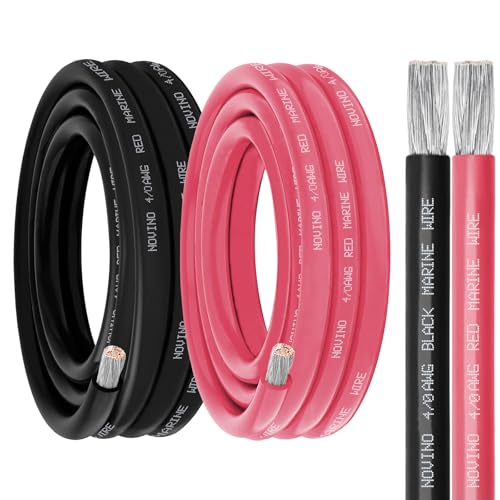
NOVINO’s marine wire uses tinned copper conductors to resist oxidation and galvanic corrosion in saltwater environments, meeting UL 1426 and ABYC standards. The 4/0 gauge carries high current for trolling motor batteries, inverter feeds, or windlass wiring while the thick insulation prevents voltage leakage in damp bilges. Rated at 105°C dry and 75°C wet, it handles engine-room heat.
Boat owners report using this wire to relocate trolling motor batteries from bow to stern with noticeable weight redistribution improvement. The tinned stranding crimps cleanly into tinned copper lugs without corrosion concerns. The insulation jacket remains flexible enough for routing through rigging tubes and under gunnels.
This cable is more expensive than non-marine pure copper due to the tinning process. If your installation is in a dry interior location like a garage or house, non-tinned copper or aluminum will be more cost-effective. The wire diameter listed at 0.2 inches is likely a spec error — actual 4/0 marine wire O.D. is around 0.6 inches.
Why it’s great
- Tinned copper resists saltwater corrosion
- Meets UL 1426 and ABYC marine standards
- Flexible stranding for tight boat routing
Good to know
- Premium price for tinning — overkill for dry indoor use
- Spec sheet O.D. appears incorrect for 4/0 gauge
6. WNI 4/0 Gauge 5 Feet Black 5 Feet Red Welding Battery Cable
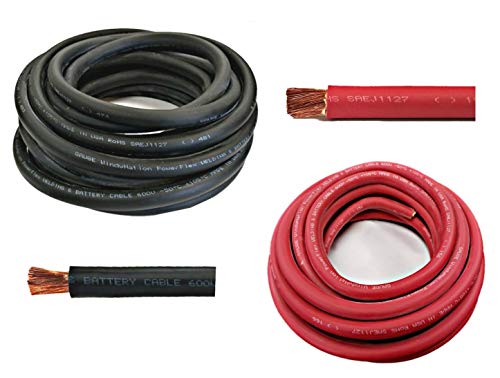
WindyNation’s 4/0 welding cable is a budget-friendly entry point for pure copper 4/0, selling in shorter lengths ideal for battery-to-inverter or battery-to-bus bar connections. SAE J1127 approval ensures it meets automotive-grade standards for vibration and temperature resistance. The EPDM insulation stays flexible from -58°F to +221°F, making it suitable for outdoor and under-hood installations.
Users report this wire stays ice cold under a 300A continuous draw over 5-foot runs, which validates its true 4/0 gauge and pure copper construction. The multi-strand design strips cleanly with a razor for lug crimping. For a 54V lithium battery pack connected to a 10kW inverter, this cable delivered consistent performance without thermal issues.
The 5-foot lengths are short — make sure your inverter-to-battery distance doesn’t exceed that span. If you need longer runs for solar combiner boxes or RV battery banks, consider the TEMCo or EWCS options with longer lengths. The packaging is basic cellophane, which may not survive rough shipping handling.
Why it’s great
- Verified pure copper construction at a competitive price
- Handles 300A continuous without temperature rise
- Flexible EPDM jacket for tight installations
Good to know
- Short 5-foot lengths limit placement options
- Basic packaging may arrive with jacket scuffs
7. EWCS 4/0 Gauge 15 Feet Black + 15 Feet Red Welding Cable

EWCS builds this 4/0 welding cable with 2,014 individual strands of pure electrolytic copper, producing Class K flexibility that rivals braided cable. The 0.720-inch O.D. is among the largest for 4/0 welding cable, and the EDPM jacket resists sunlight, acid, gasoline, and oil. At 22.4 pounds for 30 total feet, this is the heaviest copper option here but also the most durable.
Electricians using this cable to parallel EG4 LiFePO4 battery banks report the jacket feels robust and the wire strips cleanly. The customer support team is known for answering technical ampacity questions directly by phone, which is a level of service unusual for wire suppliers. The 600V rating covers solar arrays up to 48V nominal or 60V maximum system voltage.
The premium price reflects both the USA manufacturing and the generous 30-foot total length. If your project only needs 10 feet total, the WNI or TEMCo options will save money. The cable is stiff due to the thick jacket — plan for a 4-inch minimum bend radius to avoid damaging the insulation.
Why it’s great
- 2014-strand construction provides extreme flexibility
- USA-made with excellent phone-based technical support
- Thick EDPM jacket resists chemicals and UV
Good to know
- Premium pricing — more expensive than comparable 10-foot sets
- Stiff jacket requires larger bend radius during installation
FAQ
Can I use 4/0 aluminum wire for a 200 amp service?
What is the difference between SEU and URD 4/0 cable?
Do I need anti-oxidant compound for 4/0 aluminum terminations?
How many amps can 4/0 aluminum wire carry in conduit?
Can 4/0 aluminum be used for battery cables in an RV or solar system?
Final Thoughts: The Verdict
For most users, the 4/0 aluminum wire winner is the Nassau Electrical Supply URD Quadruplex 40′ because it delivers the highest direct burial ampacity in a complete four-conductor assembly, saving you the time and cost of sourcing individual wires for a 200-amp underground feeder. If you need a meter-to-panel connection for a service upgrade, grab the Wirenco SEU Cable 20FT. And for high-amp battery or inverter runs where flexibility matters most, nothing beats the TEMCo 4/0 Welding Cable 20FT with its 1950-strand oxygen-free copper construction.