
Your car’s HVAC system pulls in outside air, and if the filter is clogged, you are circulating that summer dust, winter smog, and spring pollen right into the cabin. A fresh cabin air filter is the difference between a headache-free commute and a sinus misery session every time you hit the road.
I’m Min — the co-founder and writer behind Gadgets Feed. I analyze hundreds of automotive filtration products across multiple vehicle generations, comparing pleat density, carbon layer composition, airflow drop-off, and real-world fitment data to separate the filters that actually work from the ones that just look like they do.
This guide breaks down the top contenders by fitment coverage, filtration stage count, and measured airflow to help you choose the best cabin air filter for your specific make and model without overpaying at the dealer.
How To Choose The Best Cabin Air Filter
A typical cabin air filter sits behind the glove compartment and traps airborne particles before they enter the passenger compartment. Choosing the wrong one can restrict airflow, strain the blower motor, or fail to block fine dust. Focus on three things — media type, filter depth, and exact model-year fitment — and you will avoid the most common mistakes.
Plain Paper vs. Activated Carbon
Standard particulate filters use pleated non-woven media to capture dust and pollen up to around 5 microns. Activated carbon filters add a granular carbon layer that adsorbs VOCs, ozone, and exhaust gases, plus neutralizes odors like diesel fumes and mildew. If you drive in urban traffic, industrial areas, or off-road, the carbon layer pays for itself in cabin air quality. The trade-off is a slight reduction in peak airflow because the carbon bed adds resistance.
Pleat Count and Media Depth
Higher pleat counts (40 to 60 pleats per filter) provide more surface area and less airflow restriction for the same dirt-holding capacity. A deeper media bed — typically 0.8 to 1.2 inches — extends service life before the filter clogs. Shallow filters (under 0.7 inches) require replacement every 6 months in dusty climates; deep-pleated options can last a full year.
Fitment Precision and Frame Rigidity
A filter that slides loosely into the housing bypasses unfiltered air around the edges, defeating the entire purpose. Look for rigid frames, preferably with a molded foam seal or gasket if the OEM design calls for one. Ignoring the exact part number cross-reference — CF10285, XC11800, CF12150, etc. — is the fastest way to buy a filter that rattles or leaks.
Quick Comparison
On smaller screens, swipe sideways to see the full table.
| Model | Category | Best For | Key Spec | Amazon |
|---|---|---|---|---|
| ECOGARD XC10621C | Activated Carbon | Toyota/Lexus/Subaru owners | 8.5″ pleated depth, carbon layer | Amazon |
| PureFlow PC99594X | 4-Layer Premium | Hyundai/Kia/Genesis | 4-stage filtration, baking soda | Amazon |
| Premium Guard PC8214X | 4-Layer Premium | Ford F-Series / Expedition | 4-stage, 0.6 lb lightweight | Amazon |
| KARCOCA CF11966 | HEPA + Carbon | GM / Chevy / GMC trucks | MERV 13, 3-layer HEPA | Amazon |
| RICHWEI CF10285 | Activated Carbon | Toyota/Lexus budget pick | 8.4″ carbon, 0.73 lb | Amazon |
| RICHWEI CF12150 | Activated Carbon | Ford Super Duty | 8.1″ carbon, 0.41 kg | Amazon |
| ECOGARD XC11800 | Standard Pleated | Subaru Forester / WRX | 9.25″ polyurethane frame | Amazon |
In‑Depth Reviews
1. ECOGARD XC10621C Premium Cabin Air Filter

The ECOGARD XC10621C uses a pleated media core paired with an activated carbon layer specifically sized for the 8.5″-long × 7.2″-wide housing common across Toyota and Subaru platforms. That carbon layer adsorbs ozone and traffic fumes, and it creates a measurable reduction in volatile organic compounds inside the cabin — a feature plain paper filters simply cannot match.
Cross-compatibility covers the 2019-2025 RAV4, 2018-2026 Camry, 2019-2025 Corolla, plus 2020-2025 Outback and 2019-2025 Ascent. Multiple verified buyers confirm zero-gap fitment without the filter bowing or slipping, which matters because loose edges let unfiltered air bypass and render the filter useless.
The frame uses dense polyurethane rather than cheap cardboard, so it holds its shape during installation even in tight glove-box compartments. Some users note the carbon layer adds slight airflow resistance at max fan speed, but the odor elimination — smoke, diesel, mildew — justifies that small trade for daily drivers.
Why it’s great
- Snap-in fit on dominant Toyota/Subaru platforms
- Activated carbon actually neutralizes exhaust and mildew odors
- Rigid polyurethane frame prevents air bypass
Good to know
- Slight airflow reduction on high blower setting
- Not a true HEPA — stops at ~5 micron particulate
2. PureFlow PC99594X Cabin Air Filter
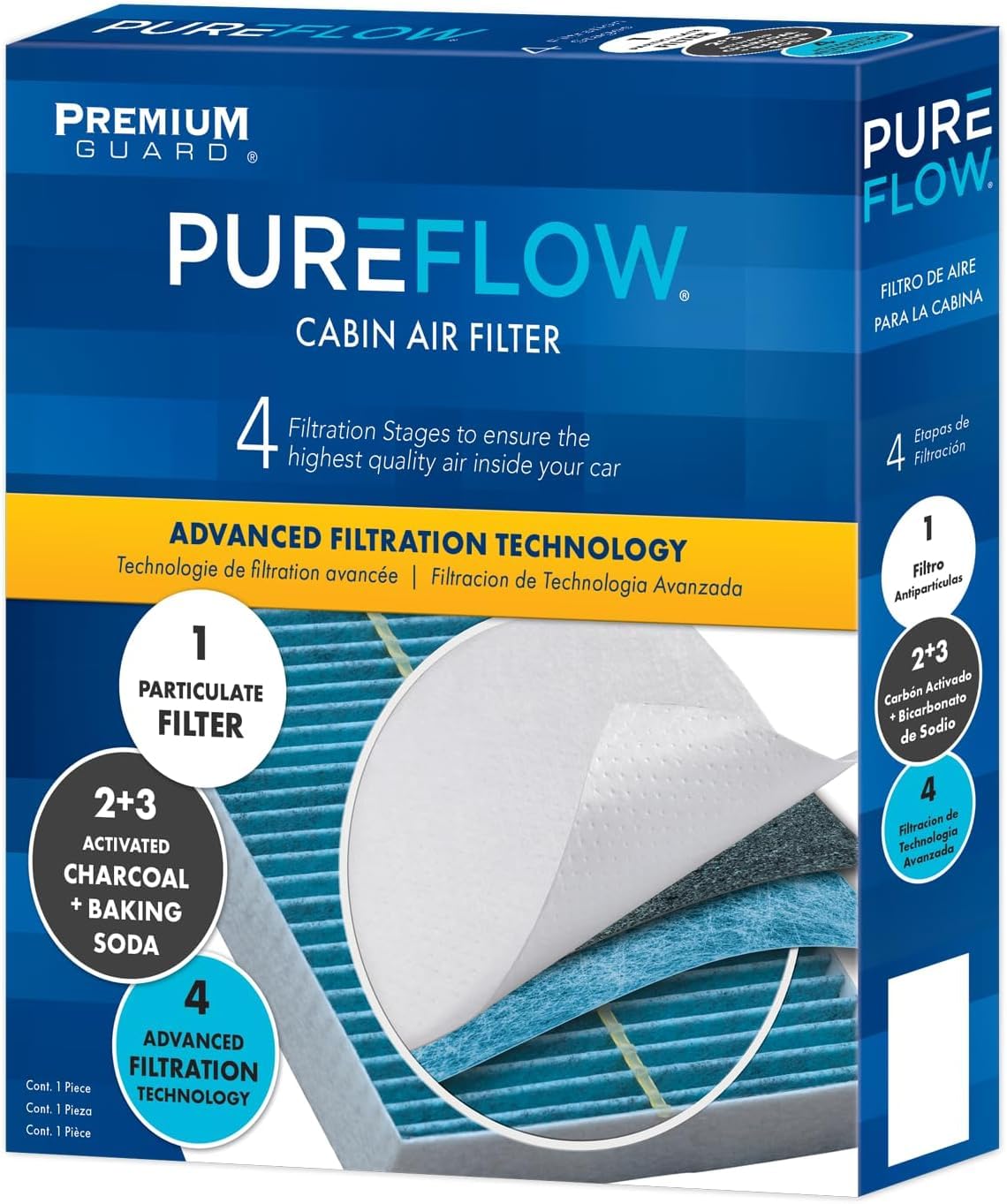
The PureFlow PC99594X stacks four discrete filtration layers — a pre-filter media, a fine particulate stage, activated charcoal impregnated with baking soda, and a final support layer — inside a single 8.9″ × 8.2″ frame. That baking soda infusion is rare at this price segment, and it directly targets persistent odors from pet dander, food spills, and smoke that carbon alone often fails to fully neutralize.
Vehicle coverage centers on the Hyundai and Kia ecosystem: 2022-2025 Tucson, 2021-2025 Elantra and Santa Fe, plus the 2023-2025 Sportage and 2021-2025 Sorento. It also fits the Ioniq 5 and GV60 electric platforms. Multiple owners of 2024-2025 models confirm the fit is exact, which is critical because late-model Hyundai/Kia housings have tight tolerances at the rear corners.
At 6.88 ounces, this filter is lighter than many carbon alternatives because of the media design, which helps maintain higher peak airflow. The four-layer construction catches finer particles than a standard two-stage carbon filter, but the trade-off is that the baking soda scent fades after the first two weeks of use.
Why it’s great
- Baking soda layer handles odors carbon alone cannot
- Precise fit on 2022+ Hyundai/Kia platforms
- Maintains strong airflow despite four layers
Good to know
- Baking soda deodorizing fades within 2-3 weeks
- Limited compatibility outside Hyundai/Kia/Genesis
3. Premium Guard PC8214X Cabin Air Filter

The Premium Guard PC8214X matches the four-stage PureFlow architecture — particulate, activated charcoal, baking soda, support — but scales it to fit the larger 10.2″ × 8.1″ housing in Ford’s F-150, F-250 Super Duty, F-350 Super Duty, and Expedition, plus the Lincoln Navigator. The baking soda carbon layer is specifically calibrated to handle the cab odors common in work trucks: diesel fumes, wet gear, and livestock-related smells.
Coverage runs from 2015-2025 F-150, 2017-2025 Super Duty (250/350/450/550), and 2018-2024 Expedition — a span of three major body generations. Multiple verified F-150 Lightning owners confirm the same filter fits the electric model without modification. The lightweight 6.4-ounce construction means the blower motor sees less backpressure, which directly extends the life of the HVAC resistor pack in older Super Duty trucks.
Some drivers note the initial scented layer is mild and fades quickly, leaving only the carbon and baking soda to handle odors passively. The filter lacks a directional arrow on some production runs, so check the printed side before insertion. For the asking price, this is the strongest all-around filter for any Ford truck owner skipping the dealership.
Why it’s great
- Four-stage media tuned for truck cabin odors
- Spans three Ford body generations in one part number
- Lightweight frame reduces blower motor resistance
Good to know
- Initial fresh scent is short-lived
- Occasional missing airflow-direction printing
4. KARCOCA CF11966 HEPA Cabin Air Filter

The KARCOCA CF11966 combines a melt-blown electrostatic layer, a HEPA-grade particulate media, and a nutshell activated carbon layer into a single 9.4″ × 8.0″ package. The MERV 13 rating means it captures particles as small as 0.3 microns — including diesel soot, brake dust, and mold spores — at 90% efficiency, which is a significant step above standard cabin filters in this price tier.
Compatibility targets General Motors platforms: 2018-2024 Silverado 1500/2500HD/3500HD, 2021-2023 Tahoe and Suburban, 2018-2023 Traverse, plus the Cruze, Malibu, Colorado, and Equinox. It also fits the 2022-2024 Hummer EV pickup. Two plastic pry tools are included in the box, a thoughtful addition for trucks where the housing clips are stiff and easy to snap on cold mornings.
The nutshell carbon layer is noticeably finer than typical bituminous carbon, which improves gas-phase adsorption but clogs slightly faster in high-pollution areas. At this price point, the HEPA-grade media alone justifies the upgrade — especially for drivers with allergies or asthma who spend significant time commuting in stop-and-go traffic.
Why it’s great
- MERV 13 HEPA catches sub-micron particles
- Nutshell carbon layer adsorbs VOCs effectively
- Includes installation pry tools for tight housings
Good to know
- HEPA media clogs faster than standard pleated in heavy dust
- Limited to GM/Chrysler platforms only
5. RICHWEI CF10285 Activated Carbon Cabin Air Filter

The RICHWEI CF10285 offers a pleated filter with embedded activated charcoal beads at a price that undercuts most dealer equivalents by a wide margin. The 8.4″ × 7.6″ frame covers an enormous range of vehicles — Toyota 4Runner, Camry, Corolla, Highlander, RAV4, Tundra, and Sienna from 2005 through 2022, plus Lexus, Scion, Subaru, and even some Jaguar and Land Rover models.
Customers consistently report a noticeable improvement in cabin air smell immediately after installation, particularly in older Toyota models where interior odors from spilled drinks and pet hair accumulate. The activated charcoal traps gases that plain paper filters let through, and the pleated construction maintains decent airflow for the price point.
Some buyers note a 20-25% airflow reduction on the highest blower setting, which is typical for carbon-loaded filters with lower pleat counts. The frame is flexible cardboard rather than rigid polyurethane, so careful insertion is required to avoid compression wrinkles. For the price, this is a cost-effective upgrade for older Toyotas still running the factory paper filter.
Why it’s great
- Covers twenty years of Toyota/Lexus vehicles
- Activated charcoal reduces exhaust and pet odors
- Far cheaper than dealer replacement
Good to know
- Flexible cardboard frame requires careful insertion
- Lower pleat count reduces peak airflow
6. RICHWEI CF12150 Activated Carbon Cabin Air Filter

The RICHWEI CF12150 uses a pleated non-woven media augmented with visible charcoal beads on one side, matching the fitment of Ford’s CF12150, FP72, and DR3Z19N619A part numbers. The 8.1″ × 8.1″ dimensions fit the 2015-2024 F-150, 2017-2024 F-250 through F-550 Super Duty, and the 2018-2024 Expedition, plus the Lincoln Navigator.
Owners report that this filter feels denser than the OEM paper version — the charcoal beads add weight and depth to the media. Multiple buyers on 2017-2020 F-150 models note the carbon layer pulls road diesel smells out of the cabin air, which is a common complaint in states where diesel pickups share highway lanes.
A few installers point out that the filter lacks printed airflow-direction arrows, requiring you to remember which side faces the blower motor. At this price, it fills the gap between cheap OEM-style paper filters and premium multi-stage units, offering reliable carbon protection for any Ford truck owner making their first aftermarket swap.
Why it’s great
- Visible charcoal beads for real odor adsorption
- OEM+ density without excessive airflow restriction
- Covers Super Duty trucks across three generations
Good to know
- No printed airflow-direction indicator
- Cardboard frame less durable than polyurethane
7. ECOGARD XC11800 Cabin Air Filter

The ECOGARD XC11800 is a straightforward pleated-paper filter with a polyurethane frame, designed specifically for the Subaru Forester 2.5L (2019-2024) and WRX 2.4L (2022-2026). The 9.25″ × 9.09″ dimensions fill the Forester housing with a snug fit that prevents edge bypass, and the dense pleats offer a good balance between dirt-trapping capacity and holding capacity over the 12,000-mile service interval.
Subaru owners report the filter installs easily without forcing the glove box, and the included instructions walk through the removal process for first-time DIYers. At this price, it replaces the dealer part at a fraction of the cost while delivering identical particulate capture for pollen, road dust, and leaf debris.
This is a standard-grade filter without carbon, so it will not address odors from diesel exhaust or mildew. If you drive primarily on paved roads and change the filter twice a year, the XC11800 delivers everything you need without over-spending on features you do not use.
Why it’s great
- Exact fit for Forester and WRX housings
- Rigid polyurethane frame prevents bypass
- DIY-friendly with clear installation guide
Good to know
- No activated carbon — odors pass through
- Limited to Subaru and model-year range
FAQ
Should I replace my cabin air filter with a HEPA or carbon model?
How often should a cabin air filter be replaced in a dusty climate?
Does a clogged cabin air filter affect AC cooling performance?
Final Thoughts: The Verdict
For most users, the best cabin air filter winner is the ECOGARD XC10621C because it delivers activated carbon odor protection with an exact polyurethane frame fit across the most popular Toyota and Subaru platforms at a price the dealer cannot compete with. If you want true HEPA-grade particle capture in a GM or Ford truck, grab the KARCOCA CF11966. And for Hyundai or Kia owners who need baking-soda deodorizing power, nothing beats the PureFlow PC99594X.