
Nothing stings quite like the sound of a favorite ceramic mug, a vintage porcelain vase, or a hand-thrown pottery bowl shattering on the floor. The specific challenge with ceramic isn’t just the brittleness—it’s the smooth, non-porous surface that rejects most standard glues, leaving you with a weak joint that fails the first time you lift the repaired piece. You need an adhesive engineered to grip the silica-based structure of ceramic, resist thermal expansion differences, and cure into a bond that can handle daily use.
I’m Min — the co-founder and writer behind Gadgets Feed. My process for this guide involved cross-referencing hundreds of verified buyer reports, analyzing the chemical cure mechanisms of each formula, and isolating the real-world performance data from marketing claims.
Whether you need to fix a hairline crack in a dinner plate or reattach a broken handle on a stoneware mug, finding the right best ceramic glue for repairs means understanding the specific trade-offs between working time, clarity, and temperature resistance.
How To Choose The Best Ceramic Glue For Repairs
Choosing the right adhesive for ceramic starts with understanding the specific type of break, the operating environment (heat, moisture, weight), and whether the glue line needs to be invisible. Not all “ceramic glues” are created equal—some rely on cyanoacrylate instant bonding, others on two-part epoxy cross-linking, and a few on high-temperature sodium silicate chemistry. Matching the glue to the repair scenario is the difference between a permanent fix and a frustrating re-break.
Working Time vs. Cure Speed
Ceramic repairs demand precise alignment, and there is no second chance with an instant-set glue. A 2-minute working time means you have exactly 120 seconds to position every shard before the adhesive locks up. For complex multi-piece repairs or large surface areas, a slow-cure epoxy offering 30 minutes of working time dramatically increases your chance of a perfect fit. Faster is not always better when the pieces are small and your alignment tolerance is near zero.
Bond Clarity and Aesthetics
If the repair is on a decorative piece—a vase, a collectible figurine, a hand-painted plate—the glue line must disappear. Water-thin cyanoacrylate glues wick into micro-cracks via capillary action and cure crystal clear, leaving an invisible joint. Thicker epoxy pastes are structurally stronger but often leave a visible haze or yellowed line. For heirloom ceramics where appearance matters as much as strength, prioritize clarity over brute force.
Temperature and Moisture Resistance
Ceramic items used near stoves, ovens, or in dishwashers require adhesives rated for those conditions. Standard epoxies degrade above 200°F, while sodium silicate formulations withstand 2000°F for firebrick and stove repairs. If the repaired piece will be washed or submerged, confirm the adhesive offers waterproof properties. Food-safety certification adds another layer of requirement for ceramics that contact food or drink.
Quick Comparison
On smaller screens, swipe sideways to see the full table.
| Model | Category | Best For | Key Spec | Amazon |
|---|---|---|---|---|
| LEENEXUS Super Glue for Ceramic | Premium CA | Invisible crack repair | 15-45 sec set time | Amazon |
| Araldite Clear Epoxy | Mid-Range Epoxy | Invisible joining | 5 min set, 3 hr cure | Amazon |
| PC Products PC-7 Epoxy Paste | Premium Paste | Heavy gapping repairs | 24 hr full cure | Amazon |
| Bob Smith Industries Slow-Cure Epoxy | Premium Epoxy | Precision structural work | 30 minute working time | Amazon |
| LET’S RESIN 5 Minute Epoxy | Entry-Level Kit | Quick household fixes | 5 min initial cure | Amazon |
| Lynn Manufacturing Sodium Silicate | Specialty | High-temp ceramic repair | 2000°F rating | Amazon |
| iienjoy Kintsugi Repair Kit | Specialty Kit | Artistic ceramic repair | 30 min slow cure | Amazon |
In‑Depth Reviews
1. LEENEXUS Super Glue for Ceramic
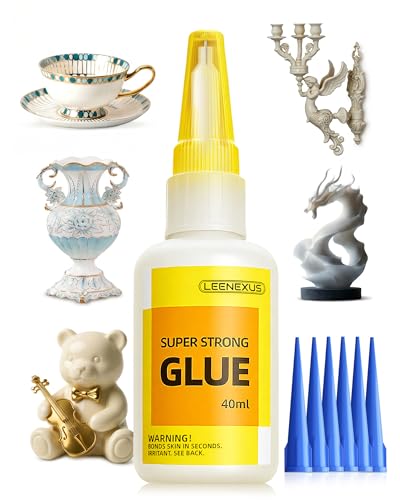
The LEENEXUS Super Glue is formulated as a low-viscosity cyanoacrylate liquid that wicks into hairline cracks by capillary action, creating a micron-thin bond layer that cures invisibly. This is the go-to choice when the aesthetic outcome of the repair matters as much as the bond strength—think heirloom china, decorative vases, or porcelain figurines where a visible glue line would ruin the piece.
The anti-clog design includes a built-in precision cleaning needle and a dual-threaded cap that prevents the nozzle from sealing shut, a common frustration with cyanoacrylate adhesives. With a set time between 15 and 45 seconds, you have just enough time to align the pieces before the bond locks, and the full cure reaches maximum strength after 24 hours. The waterproof, heat-resistant bond withstands hot water contact up to 212°F, making it safe for food-grade ceramic items.
Real-world users report successful repairs on shoe heels, mower tire sidewalls, and cherished porcelain keepsakes. The 40ml bottle provides enough adhesive for multiple repairs, and the six included precision tips allow for controlled application into tight cracks. This is the premium choice for invisible, strong, and lasting ceramic repairs where appearance cannot be compromised.
Why it’s great
- Cures crystal clear with no visible glue line
- Water-thin viscosity penetrates hairline cracks effectively
- Anti-clog nozzle system extends usable life significantly
Good to know
- Ultra-fast set time leaves no room for repositioning
- Not suitable for polyethylene or polypropylene plastics
2. Araldite Clear Epoxy Adhesive

Araldite’s 5-minute clear epoxy delivers professional-grade strength for invisible joins, specifically engineered for jewelry, fine china, and glass repairs where transparency is critical. The two-part syringe format allows for precise 1:1 mixing without measuring cups, and the solvent-free formulation means no harsh chemical smell during application. The cured bond is water, oil, and impact resistant within a temperature range of -30°C to 80°C.
The 5-minute working time is ideal for single-shard repairs where you have enough time to position the piece but not so long that you are waiting for the adhesive to tack. Full cure reaches maximum strength in 3 hours—significantly faster than the 24-hour standard for many epoxies—though the bond continues to mature over the following days. Users have successfully bonded china saucers to near-invisible perfection and repaired outdoor canopy supports where strength was paramount.
One practical consideration is that the 15ml tubes per part are best suited for small-scale repairs rather than large gaps or structural fills. For load-bearing ceramic repairs like reattaching a heavy handle, the epoxy provides sufficient tensile strength, but surface roughening is recommended to maximize adhesion on smooth ceramic glazes. This is a strong, clean, and professional-grade option for delicate ceramic restorations.
Why it’s great
- Cures crystal clear with no yellowing over time
- Solvent-free with minimal odor during application
- Full mechanical strength in only 3 hours
Good to know
- Not food-safe for direct contact with food
- Small tube size limits use to minor repairs
3. PC Products PC-7 Epoxy Adhesive Paste

The PC-7 is a two-part epoxy paste in a thick, non-dripping consistency that makes it ideal for vertical ceramic surfaces and large gap-filling repairs. Unlike liquid glues, this paste acts as both a bonding agent and a structural filler, capable of bridging cracks in a ceramic fountain, filling chips in tile, or repairing broken masonry with ceramic components. The 1-hour working time provides ample opportunity to shape and sculpt the paste before it begins to cure.
Full cure requires 24 hours, after which the material becomes rock-hard, sandable, and paintable. The cured paste can be drilled and tapped, making it suitable for ceramic repairs that need mechanical fasteners. Users report successful long-term repairs on 20-year-old fountains and automotive body panels, with the paste bonding effectively to ceramic, concrete, fiberglass, and metal surfaces. The application temperature range of 35°F to 115°F means it works in most workshop conditions.
The charcoal gray color is a practical consideration—it is not clear, so the glue line will be visible. This product is best suited for repairs where appearance is secondary to strength, or where the repaired area will be painted or covered. For best results on smooth ceramic glazes, roughen the surface with sandpaper before application and use tape to hold pieces in place during the 24-hour cure cycle.
Why it’s great
- Thick paste consistency will not drip on vertical surfaces
- Long 1-hour working time for complex alignment
- Sandable and paintable after full cure
Good to know
- Charcoal gray color leaves a visible glue line
- Requires full 24-hour undisturbed cure for maximum strength
4. Bob Smith Industries Slow-Cure Epoxy
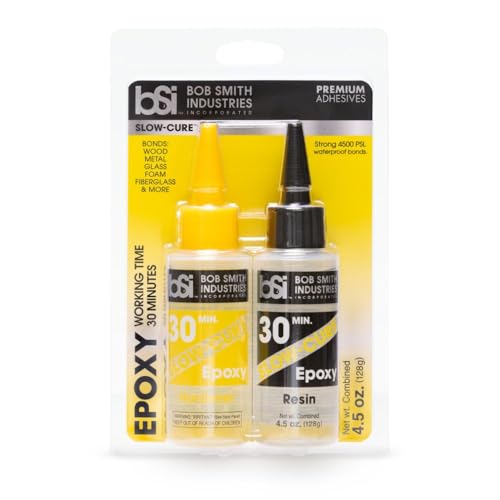
The Bob Smith Industries Slow-Cure epoxy offers a generous 30-minute working window, making it the definitive choice for multi-piece ceramic reassembly where careful positioning and clamping are essential. Once cured, it forms an exceptionally tough, impact-resistant bond suitable for load-bearing joints. The clear formula allows for visible alignment verification during the assembly process, and the waterproof nature ensures durability in damp environments.
Full cure completes in 8 hours, which is faster than many 24-hour epoxies while still providing a long working time. The 4.5-ounce combined bottle size delivers roughly 3 to 4 syringe equivalents of adhesive, offering good value for larger projects. Users report successful applications on knife handles, fiberglass repairs, and structural wood joints. The epoxy bonds effectively to wood, fiberglass, metal, glass, ceramics, and most plastics, making it a versatile workshop staple.
One practical detail is that mixing large batches in narrow containers causes the epoxy to heat up and set faster, reducing the effective working time. For best results, mix only quarter-sized dollops in a shallow dish and stir thoroughly for 2 minutes before application. The epoxy can be thinned with denatured alcohol in a 2:1 ratio for brush-on applications, useful for sealing porous ceramic surfaces before bonding.
Why it’s great
- 30-minute working time allows precise multi-piece assembly
- Impact-resistant bond suitable for structural loads
- Waterproof and clear after cure
Good to know
- Mixing large batches can accelerate cure time significantly
- Requires shallow dish mixing to avoid exothermic heat buildup
5. LET’S RESIN 5 Minute Epoxy Glue
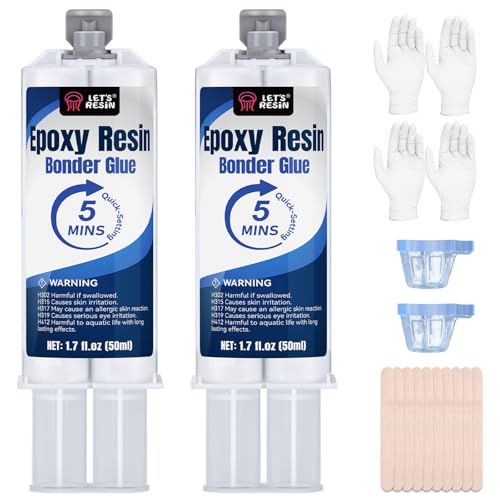
The LET’S RESIN 5 Minute Epoxy Glue comes as an all-in-one kit that includes two epoxy tubes, 20 disposable mixing cups, 10 stirrers, 2 push rods, and 4 gloves—everything needed for immediate ceramic repair without a separate trip to the hardware store. The 2-minute working window and 5-minute initial cure are well-suited for straightforward single-shard repairs where speed matters. Full cure completes in 1 hour, the fastest full-cure among standard epoxies in this comparison.
The push rods ensure a precise 1:1 mixing ratio by volume, eliminating guesswork that can compromise epoxy strength. The high-viscosity formula bonds objects tightly and, once cured, hardens sufficiently for drilling, sanding, and painting. Users report successful repairs on outdoor fountains, plastic garden box legs, and porcelain pieces, with the adhesive holding strongly under regular daily use.
The 5-minute set time is genuine—users confirm it sets up quickly and strongly. However, the fast cure also means you must work efficiently and mix only small batches to avoid waste. The included mixing consumables are generous and allow for multiple repair attempts. For quick household ceramic fixes where you want a complete kit with no additional purchases, this represents excellent value.
Why it’s great
- Complete kit with mixing tools and gloves included
- Fast 1-hour full cure time
- Can be sanded and painted after curing
Good to know
- Short 2-minute working window requires quick assembly
- Plunger tubes may shift during use without consistent pressure
6. Lynn Manufacturing Sodium Silicate 2000°F Adhesive

The Lynn Manufacturing Sodium Silicate solution, also known as water glass or liquid glass, is a specialty adhesive rated for continuous exposure up to 2000°F. This is not a general-purpose ceramic glue but the specific solution for repairing ceramic fiber blankets, firebricks, furnace components, and stove parts where standard epoxies would instantly degrade. The 40% solution has a viscosity similar to maple syrup, allowing brush application on porous ceramic surfaces.
When applied and dried, the sodium silicate cures to a clear, glass-like solid that is chemically bonded to the ceramic substrate. Users report successful restoration of broken ceramic flame guards, where the repaired piece withstood direct blue flame exposure and a brass hammer tap without failure. The adhesive is also water-soluble before curing, so excess can be cleaned with water, but after curing it forms a waterproof seal.
This product is caustic alkaline in its liquid state, requiring gloves and eye protection during application. It works best on clean, tight-fitting breaks where the joint can be pressed firmly together. The dried adhesive conducts electricity, so it should not be used on electrical ceramic components. For anyone repairing kiln furniture, stove parts, or high-temperature ceramic equipment, this is the only technically appropriate choice.
Why it’s great
- Withstands continuous temperatures up to 2000°F
- Cures to a clear, hard glass-like finish
- Effective for firebrick and metal stove repairs
Good to know
- Caustic alkaline requires protective gear during use
- Not suitable for general household ceramic repairs
7. iienjoy Kintsugi Repair Kit
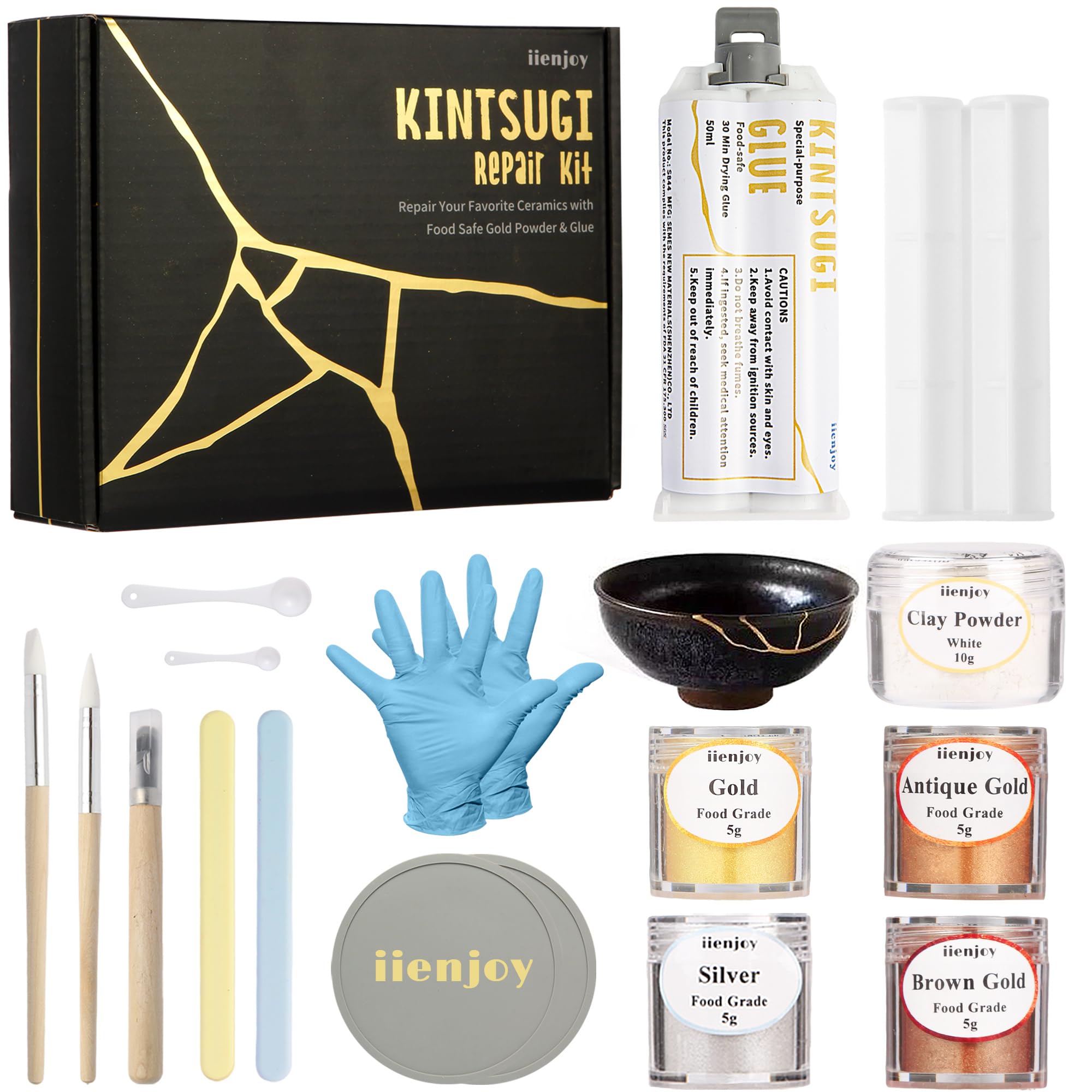
The iienjoy Kintsugi Repair Kit transforms broken ceramic into art by using the Japanese kintsugi technique of highlighting cracks with gold. The kit includes 50ml of food-safe AB epoxy glue, four metallic-colored pigments (including gold), gloves, wooden sticks, and reusable silicone mixing tools. The epoxy provides a 30-minute slow cure time, which is deliberately longer than standard fast-setting epoxies to allow for the meticulous application of metal powders and sculpting of joint lines.
Once fully cured after 24 hours, the repaired ceramic item is food-safe and dishwasher-safe, meeting the requirements for repaired mugs, plates, and serving bowls that will contact food. Users have successfully repaired snapped mug handles, broken vase rims, and cracked plates, with the gold finish adding a decorative element that celebrates rather than hides the break. The silicone tools are easy to clean and reusable, and the resealable caps extend the kit’s lifespan.
Some users note that the included scoops do not perfectly match the recommended glue-to-powder ratio, requiring some experimentation to achieve the desired metallic sheen. The gold pigment provides a decorative rather than metallic look, which is consistent with the kintsugi philosophy. For those who want to combine ceramic repair with creative expression, this kit offers a complete, food-safe solution.
Why it’s great
- Food-safe and dishwasher-safe after full cure
- Creates artistic gold-accented repairs
- 30-minute slow cure allows meticulous application
Good to know
- Pigment-to-glue ratio requires user adjustment
- Epoxy tube may be defective on rare occasions
FAQ
How do I prepare the ceramic surface before applying glue?
Can repaired ceramic items go in the dishwasher?
What is the difference between cyanoacrylate and epoxy for ceramic repair?
Final Thoughts: The Verdict
For most users, the best ceramic glue for repairs winner is the LEENEXUS Super Glue for Ceramic because it delivers invisible, waterproof bonds that are food-safe and heat-resistant, making it suitable for nearly every household ceramic repair scenario. If you need a visible gap-filling adhesive with long working time, grab the PC Products PC-7 Epoxy Paste. And for high-temperature repairs on stoves or firebrick, nothing beats the Lynn Manufacturing Sodium Silicate.