
The feeling is familiar: you’ve had a few drinks, you feel fine, but the nagging question remains — are you safe to drive? Guessing your blood alcohol content based on how you feel is unreliable at best and dangerous at worst. A dedicated alcohol breath tester removes the guesswork, giving you a concrete number before you make a decision that could cost you your license or worse.
I’m Min — the co-founder and writer behind Gadgets Feed. I’ve spent hundreds of hours analyzing sensor technologies, cross-referencing DOT and FDA clearances, and mapping consumer feedback against real-world BAC accuracy to separate the devices that genuinely protect you from the ones that just flash a number.
Whether you need a pocket-sized unit for personal checks or a professional-grade tool for workplace compliance, the right alcohol breath tester depends on sensor type, calibration needs, and how tightly you need to trust the reading.
How To Choose The Best Alcohol Breath Tester
Not all breath testers are built the same. The difference between a fun party gadget and a device you can trust with your driving record comes down to sensor technology, regulatory approvals, and how the unit handles calibration over time. Here are the critical factors to evaluate.
Sensor Type: Semiconductor vs. Fuel Cell
The sensor is the heart of the device. Semiconductor sensors are cheaper and found in budget-friendly models. They react to alcohol but can be thrown off by other compounds in your breath or mouth, requiring careful technique and a clean mouth to get reliable readings. Fuel cell sensors are the standard used by law enforcement. They use an electrochemical reaction that is specific to alcohol, delivering far more accurate and repeatable results. If you need a device you can truly rely on, a fuel cell model is the only choice.
Regulatory Approvals: DOT, NHTSA, and FDA
Look for a breath tester that is DOT and NHTSA compliant and FDA 510(k) cleared. These approvals mean the device has been tested against rigorous standards for accuracy and consistency. A unit without these clearances is not certified for any official use, and its readings should be treated with healthy skepticism. For workplace safety programs or personal accountability, these certifications are non-negotiable.
Calibration and Maintenance
Every breath tester drifts out of spec over time. Semiconductor sensors typically require recalibration or replacement every few hundred tests. Fuel cell sensors need professional wet-gas recalibration every 6 to 12 months depending on usage. Some premium models feature replaceable sensor modules that eliminate the need to ship the unit away. Ignoring calibration is the single fastest way to turn a once-accurate device into a useless prop. Always check the manufacturer’s recommended calibration schedule before buying.
Quick Comparison
On smaller screens, swipe sideways to see the full table.
| Model | Category | Best For | Key Spec | Amazon |
|---|---|---|---|---|
| BACtrack S80 | Pro-Grade | Maximum accuracy for personal use | Platinum Xtend Fuel Cell Sensor | Amazon |
| iSOBER 10 | App-Connected | Accountability with photo verification | Fuel Cell / App Sync | Amazon |
| iSOBER 30 | Fuel Cell | Memory tracking and workplace use | Fuel Cell / 10-test Memory | Amazon |
| AlcoMate AL7000 | No-Calibration | Low-maintenance, high-volume testing | Replaceable PRISM Sensor | Amazon |
| BACtrack Go Keychain (2 Pack) | Keychain | Ultra-portable, always-on-hand | MicroCheck Semiconductor Sensor | Amazon |
| ALCO9 TX6010L | Certified | Budget-certified daily driver | Semiconductor / Audible Alert | Amazon |
| VPOW Breathalyzer | Budget | Entry-level personal check | Semiconductor / 10 Mouthpieces | Amazon |
In‑Depth Reviews
1. BACtrack S80 Breathalyzer

The BACtrack S80 is the benchmark for consumer breath testers, and for good reason. It uses BACtrack’s largest platinum-based Xtend Fuel Cell Sensor — the same type of electrochemical tech trusted by hospitals and law enforcement — delivering readings that consistently match professional equipment. Wirecutter named it the #1-rated breathalyzer after 65 hours of testing that involved getting intoxicated at a police station alongside real law enforcement gear. That level of validation is rare in this category.
The S80 is also DOT/NHTSA approved and FDA 510(k) cleared, meaning it meets the same accuracy standards required for official screening devices. One-button operation keeps things simple, and you can switch between measurement units or set a custom BAC threshold. The unit runs on two AA batteries and comes with a hard carrying case and replaceable mouthpieces. It weighs 5.6 ounces and measures just 4.8 inches long, fitting easily into a glove box.
User feedback consistently highlights its repeatability — testing the same breath sample produces nearly identical results, which is the hallmark of a quality fuel cell sensor. The only catch is that you need to wait 15 to 20 minutes after your last drink for an accurate reading, and annual recalibration is required to maintain that precision. For anyone serious about avoiding a DUI, the S80 is the gold standard.
Why it’s great
- Platinum fuel cell sensor delivers law enforcement-grade accuracy.
- DOT/NHTSA approved and FDA 510(k) cleared for official use.
- One-button operation with customizable BAC thresholds.
Good to know
- Requires a 15-20 minute wait after drinking before testing.
- Needs annual wet-gas recalibration to stay accurate.
2. iSOBER 10 Fuel Cell Breathalyzer

The iSOBER 10 brings accountability into the app era. At its core is a professional-grade fuel cell sensor that measures BAC in the 0.00-0.40% range with a response time of about 10 seconds. What sets it apart is the free companion app (iOS and Android) that logs every test with a time stamp, GPS location, and optional photo verification. You can set a personal BAC warning threshold and share verified results via text or email — a powerful tool for workplace safety programs or personal sobriety tracking.
The device itself is compact at 4.1 x 2.1 x 0.7 inches, operates on two AAA batteries, and features a real-time sensor health check that alerts you if the unit needs servicing before your next test. It also works standalone without the app, so you’re not forced to use your phone. Calibration is recommended every 12 months or 1,000 tests, and the unit is DOT/NHTSA compliant and FDA 510(k) cleared.
User reports indicate strong repeatability — one tester recorded .019, .020, and .019 BAC after a single beer, showing excellent sensor consistency. A small number of users reported variability, which often traces back to not waiting the required time after drinking or improper blowing technique. The photo and location logging feature is a genuine differentiator for anyone needing documented proof of sobriety.
Why it’s great
- Fuel cell sensor with fast 10-second response time.
- App logs BAC, location, time, and optional photo for accountability.
- Real-time sensor health monitoring prevents unreliable tests.
Good to know
- App setup can be slightly finicky for some users.
- Still requires 12-month calibration cycle for peak accuracy.
3. iSOBER 30 Fuel Cell Breathalyzer

The iSOBER 30 delivers the accuracy of a fuel cell sensor in a package that strips away unnecessary frills to focus on what matters: reliable BAC readings with built-in memory. It stores your last 10 results along with the date and time of each test, letting you track trends over days or weeks. That makes it a strong choice for designated driver programs, workplace safety logs, or anyone who wants to understand how their body processes alcohol over the course of an evening.
This unit is DOT & NHTSA compliant and FDA 510(k) cleared, built by the same manufacturer with over 20 years of experience producing law enforcement breathalyzers. Calibration is handled in the US using NHTSA-approved wet-gas equipment, recommended every 12 months or 1,000 tests. The device is remarkably slim at just 0.59 inches thick and weighs only 2.33 ounces, making it one of the most pocketable fuel cell units on the market. It runs on two AAA batteries.
User feedback repeatedly praises its speed — requiring a shorter breath duration than many competitors — and its consistency across tests. The built-in memory is a practical feature that the simpler S80 lacks without stepping into app-connected territory. A small number of users reported confusion about the display, but overwhelmingly the feedback confirms that this unit delivers accurate results that match expectations after a night of drinking.
Why it’s great
- Fuel cell sensor with internal memory for last 10 tests with timestamps.
- Extremely slim and lightweight at under 2.5 ounces.
- US-based recalibration with NHTSA-approved equipment.
Good to know
- No app connectivity for sharing results remotely.
- Requires annual calibration to maintain DOT compliance.
4. AlcoMate Premium AL7000 Breathalyzer

The AlcoMate AL7000 solves one of the biggest annoyances of owning a breath tester: the need to send it away for recalibration. Its patented PRISM (Pre-calibrated Replaceable Intelligent Sensor Modules) system lets you swap the sensor yourself after 200 tests or 12 months. The new module arrives pre-calibrated, so the unit is essentially as accurate as the day you bought it — no shipping costs, no downtime. That makes it a compelling option for workplaces, events, or anyone who expects to run many tests.
Under the hood is a 2nd Gen precision oxide semiconductor sensor that delivers ±0.01 accuracy at 0.100% BAC. While semiconductor sensors are generally less specific than fuel cells, the AL7000’s engineering is robust enough to earn DOT and NHTSA approval. The unit features a clear 4-digit LED display and simple one-button operation. It runs on two AAA batteries and weighs 8.47 ounces, which is slightly heavier than fuel cell competitors due to the modular sensor housing.
Users consistently report the AL7000 produces accurate, repeatable results that align with perceived intoxication levels. The annual sensor swap is straightforward and removes the recalibration hassle entirely. Verify the manufacture date on the replacement sensor when buying. For high-volume testing without recurring calibration fees, this is a uniquely practical design.
Why it’s great
- Replaceable PRISM sensor eliminates recalibration shipping.
- DOT/NHTSA approved with ±0.01 accuracy at 0.100% BAC.
- Ideal for high-volume testing with simple sensor swaps.
Good to know
- Replacement sensors have a limited shelf life; check dates.
- Requires a 30-minute wait after eating or drinking for best results.
5. BACtrack Go Keychain Breathalyzer (2 Pack)
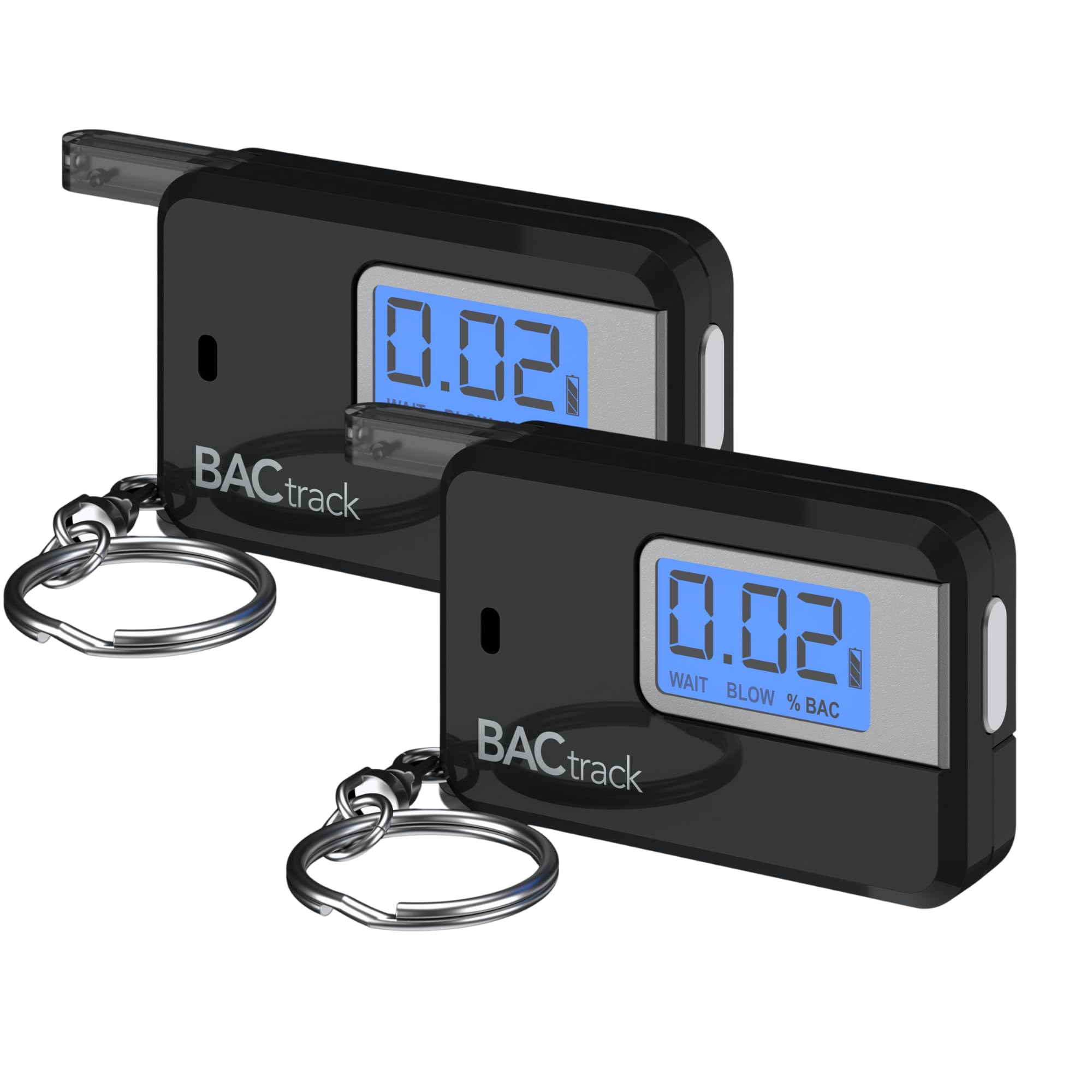
The BACtrack Go is designed for one thing: being there when you need it. It uses BACtrack’s proprietary Advanced MicroCheck Sensor, a semiconductor-based technology that delivers estimated BAC readings in seconds. The clever fold-out mouthpiece ensures only your breath enters the sensor, keeping ambient alcohol vapors from contaminating the reading.
The two-pack gives you one for your keychain and one for a partner’s, or a backup for the glovebox. One-button operation makes it as simple as powering on and blowing. It runs on a single AAA battery and includes a one-year warranty. This is not a DOT/NHTSA-approved device, so treat its readings as estimates rather than forensic evidence. But for a quick “am I over the limit?” check when you’re out, its convenience is unmatched.
User feedback is mixed on absolute accuracy — some report consistent results that match their breathalyzer-equipped car interlock, while others note variability if used too soon after drinking. The key is proper technique: wait at least 10 minutes after your last drink, blow steadily, and perform a couple of warm-up blows if the unit has been sitting. For its size and price point, the Go excels at delivering a useful estimate in a package you’ll actually carry.
Why it’s great
- Ultra-portable keychain design fits on any key ring.
- Two-pack provides a backup or a shared unit.
- Fold-out mouthpiece prevents ambient air contamination.
Good to know
- Semiconductor sensor is less accurate than fuel cell models.
- Not DOT/NHTSA approved; use as a reference, not evidence.
6. ALCO9 TX6010L Breathalyzer
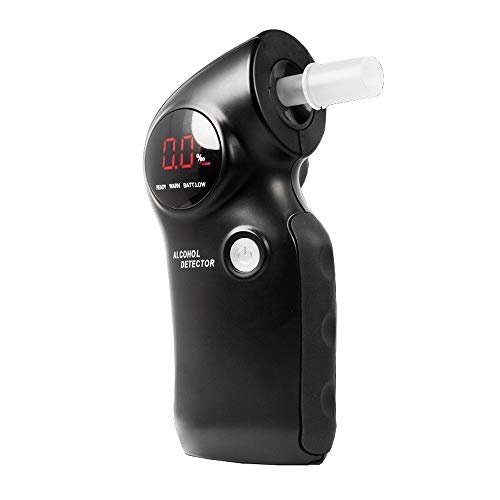
The ALCO9 TX6010L is a rare find in the budget tier: a portable breath tester that actually holds FDA 510(k) clearance and DOT/NHTSA compliance. That alone puts it in a different class than most sub- units. It uses a semiconductor sensor with audible alert functionality — a loud beep sounds when alcohol is detected above your preset threshold. The bright LED display is easy to read in any lighting, and the low battery indicator ensures you’re never caught with a dead unit.
This unit is backed by a manufacturer with 20 years of breathalyzer production experience and distribution across 50 countries. It features one-button operation and runs on standard alkaline batteries. The TX6010L includes a calibration reminder every 6 months or 200 tests, which is important for a semiconductor unit that can drift more quickly than a fuel cell. The device weighs 4.12 ounces and is sized to fit comfortably in a jacket pocket or center console.
User reviews highlight the unit’s usefulness for accountability, with several buyers using it for workplace monitoring or personal sobriety checks. There are occasional reports of inconsistent readings, which is typical for semiconductor sensors when used improperly. The audible alert is a practical feature for quick pass/fail checks without looking at the display. For the price, getting a certified device with a one-year warranty is exceptional value, but you must stay on top of the 6-month calibration cycle.
Why it’s great
- FDA 510(k) cleared and DOT/NHTSA compliant at a budget price.
- Audible alcohol alert for quick pass/fail checks.
- One-year warranty from an established manufacturer.
Good to know
- Semiconductor sensor requires 6-month recalibration.
- Some units may have inconsistent readings without proper technique.
7. VPOW Breathalyzer

The VPOW Breathalyzer is an entry-level semiconductor device designed for casual personal use. It offers a clear digital LCD with blue backlighting, making it easy to read at night or in a dim car interior. The display shows BAC to one decimal place and supports three measurement units: %BAC, ‰BAC, and mg/L. The unit requires three AAA batteries and has an auto-shutoff feature that kicks in 10 seconds after a test to save power.
This model comes with 10 hygienic, washable mouthpieces — a generous inclusion that keeps the device sanitary for repeated use by multiple people. The pocket-sized design weighs 3.52 ounces and measures small enough to stash in a bag or glove compartment. A battery level indicator prevents surprises. The warm-up cycle takes about 15 seconds, and you blow for 3 to 5 seconds to get a reading. There is no DOT/NHTSA approval or FDA clearance here, so treat the results as a rough guideline rather than a definitive BAC measurement.
User feedback is overwhelmingly positive for the price, with many noting that readings feel consistent and coherent for the category. International buyers appreciate the multilingual display and multiple unit options. The main limitation is the lack of regulatory certification, meaning you cannot rely on this for any official or legal purpose. For a quick “should I wait longer?” check at home before heading out, the VPOW serves its purpose without breaking the bank.
Why it’s great
- Includes 10 washable mouthpieces for shared use.
- Backlit LCD display for clear nighttime reading.
- Three unit measurements and auto-shutoff for battery savings.
Good to know
- No DOT/NHTSA or FDA certification; not for legal use.
- Semiconductor sensor accuracy is adequate but not precise.
FAQ
How long should I wait after drinking before testing?
Why do my readings vary between different breath testers?
Can I use a breath tester that isn’t DOT approved for legal defense?
Final Thoughts: The Verdict
For most users, the alcohol breath tester winner is the BACtrack S80 because its platinum fuel cell sensor delivers law enforcement-grade accuracy and repeatability that gives you genuine confidence before you drive. If you want app-based accountability with photo and location logging, grab the iSOBER 10. And for a completely hassle-free experience without recalibration shipping, nothing beats the AlcoMate AL7000 with its replaceable sensor modules.