
Nothing kills a work-from-home day faster than a call that drops mid-sentence or a video that buffers on loop. For anyone living in a rural area, a basement apartment, or a home with thick concrete walls, weak cellular signal is a daily, grinding frustration. An affordable cell phone booster is the practical solution that turns that 1-bar dead zone into a functional, connected space without requiring a new carrier contract or expensive infrastructure upgrades.
I’m Min — the co-founder and writer behind Gadgets Feed.
I have separated the signal-boosting wheat from the chaff by cross-referencing real customer experiences with technical datasheets to pinpoint exactly which models deliver a genuine, measurable improvement in voice clarity and data speeds without breaking the bank.
How To Choose The Best Affordable Cell Phone Booster
Finding the right booster for your home or office hinges on three pillars: your existing outdoor signal strength, the cellular bands your carrier uses, and the physical space you need to cover. Ignore any one of these, and you risk buying a device that is either overkill or completely useless.
Measure Your Starting Signal
A booster cannot create signal where none exists. If your outdoor signal is below -120 dBm, even a high-end unit will struggle. Use a free app like Network Cell Info Lite to measure the Received Signal Strength Indicator (RSSI) in decibel-milliwatts (dBm) at the spot where you plan to mount the external antenna. Aim to start with at least -110 dBm for any budget-friendly booster to deliver a noticeable lift. Boosters with a higher gain (72 dB or so) will be more effective at amplifying a marginal signal than an entry-level model with 65 dB.
Match Frequency Bands to Your Carrier
This is where many buyers get tripped up. A booster for AT&T must support Band 12/17 (700 MHz), while Verizon relies heavily on Band 13 (700 MHz). T-Mobile uses Band 2/25 (1900 MHz) and Band 4 (1700/2100 MHz). An affordable, multi-carrier model like the one from YLXONE supports a broad range of bands, making it versatile. However, carrier-specific units — like the GAGBK for Verizon or the F FREEQUEEN for AT&T — are often cheaper and can be more efficient if you only need service for one network. Always check your phone’s band preference in the settings menu before purchasing.
Consider Coverage vs. Realistic Square Footage
Manufacturers love to tout numbers like 5,000 or 8,000 square feet, but this is only achievable with a strong outdoor signal (think -80 dBm). In a typical rural scenario where you have 1-2 bars outside, expect that 5,000 sq. ft. rating to drop to a far more realistic 400-1,300 sq. ft. A mid-range option like the Metarepeater MG1 with its LCD display is helpful here, as it shows real-time gain per band to help you find the best antenna position. For a single room or small apartment, a budget-tier booster with a 2,000 sq. ft. claim is usually sufficient.
Quick Comparison
On smaller screens, swipe sideways to see the full table.
| Model | Category | Best For | Key Spec | Amazon |
|---|---|---|---|---|
| HiBoost 15K 2.0 | Premium | Large homes, multi-story offices | 72 dB gain, 12,000 sq.ft. | Amazon |
| HiBoost 8K | Premium | Sizable homes & offices, multi-room | 70 dB gain, 2 indoor antennas | Amazon |
| SureCall Flare | Mid-Range | Small homes, easy setup | 72 dB gain, integrated indoor antenna | Amazon |
| Metarepeater MG1 | Mid-Range | Tech users wanting real-time data | Smart LCD Display, 5 bands | Amazon |
| ZORIDA Ace 5S | Mid-Range | Small homes, app-based support | 72 dB gain, 2000 sq.ft. | Amazon |
| YLXONE CB | Mid-Range | All carriers, strong outdoor signal areas | 70 dB gain, multi-band support | Amazon |
| GAGBK WV70 S (Verizon) | Budget | Verizon/Straight Talk homes | 65 dB gain, Band 13 only | Amazon |
| GAGBK (AT&T/T-Mobile) | Budget | AT&T/T-Mobile homes | 65 dB gain, Band 12/17 | Amazon |
| F FREEQUEEN (AT&T) | Budget | AT&T/T-Mobile homes, large coverage | 65 dB gain, 4500 sq.ft. | Amazon |
In-Depth Reviews
1. HiBoost 15K 2.0 SL

The HiBoost 15K 2.0 is the most powerful unit on this list, delivering a maximum gain of 72 dB across a potential coverage area of 12,000 square feet. It supports bands 2/4/5/12/13/17/25, making it fully compatible with all major US carriers including Verizon, AT&T, and T-Mobile. The kit includes two indoor panel antennas and uses RG-400 cabling to minimize signal loss over long runs, a critical feature for large homes or metal buildings.
Real-world performance from users in forested valleys and metal-roofed cabins shows it can transform a 1-bar 4G/5G signal (below 1 Mbps) into 25 Mbps downloads across a 2,700 sq. ft. home with three floors. The companion Bluetooth app allows you to monitor signal strength in real time and fine-tune the directional outdoor antenna for the best possible alignment with the nearest tower, making the installation process far less frustrating.
The AGC technology automatically adjusts the gain to prevent oscillation, a common issue that causes network interference. While the sticker price is higher than most, the 15K 2.0 is a buy-once, cry-once solution for anyone who needs robust, whole-home coverage. Its only notable omission is support for T-Mobile’s Band 71 (600 MHz), which could be a deal breaker in some ultra-rural areas.
Why it’s great
- Industry-leading 72 dB gain covers very large homes and multi-story offices
- Bluetooth app and LCD display enable precise antenna tuning
- Two indoor panel antennas provide even signal distribution
- Excellent US-based customer support and 3-year warranty
Good to know
- Does not support T-Mobile Band 71 (600 MHz)
- Installation is complex; may require professional help for optimal placement
- Significant investment compared to smaller models
2. HiBoost 8K

The HiBoost 8K is a step-down from the 15K but remains a formidable performer, offering a 70 dB gain and coverage for spaces up to 8,000 square feet. It comes with one outdoor antenna and two indoor antennas (one is built into the main unit), and covers the same critical frequency bands as its larger sibling (2/4/5/12/13/17/25), making it a versatile option for nearly any carrier or phone.
User reviews from rural Florida and cabins in the mountains consistently report dramatic improvements: from zero usable data to over 50 Mbps on Verizon 5G, and from a single bar to 4-5 bars for T-Mobile. The HiBoost app is again a major asset, providing real-time signal data and guiding installation. The built-in LCD display on the booster unit itself offers a quick status check for gain settings.
One user with a 4,500 sq. ft., three-floor home noted that while coverage is excellent, obstacles like concrete floors and metal fixtures can significantly reduce the effective range, making it more suitable for large open-plan spaces than complex layouts with many walls. A few users mentioned that the 50-foot cable included is barely sufficient for tricky roof installations, so plan your antenna placement carefully before mounting.
Why it’s great
- Strong 70 dB gain effectively covers large, open homes and offices
- App and LCD display simplify installation and antenna tuning
- Supports all major US carriers on core frequency bands
- Excellent customer support network based in the US
Good to know
- Coverage can be inconsistent in multi-story homes with many obstacles
- Included 50-foot cable may be too short for some roof setups
- A significant upfront investment for a home booster
3. SureCall Flare

The SureCall Flare differentiates itself with a stylish, compact design that integrates the indoor antenna directly into the amplifier unit. This eliminates the need for a separate indoor whip antenna and the cable run to it, simplifying the setup dramatically. It still requires an outdoor Omni-directional or directional antenna (included) connected via a 50-foot RG-6 cable, but the indoor component is plug-and-play.
With a 72 dB maximum gain and support for the core 700/800/1900/1700/2100 MHz bands, it is compatible with all major North American carriers. Owners of small cabins and apartments report a boost from zero bars to 3-4 bars of LTE, though the range is realistically limited to about 1,000 sq. ft. when starting from a weak 1-bar signal, rather than the advertised 2,500 sq. ft.
The speaker-like aesthetic is a genuine advantage for people who don’t want a bulky, industrial-looking box in their living room. However, some users found the 25-foot minimum antenna separation rule to be restrictive, and a few reported that signal speeds actually decreased after installation, which can happen due to oscillation or poor antenna placement. Customer support experiences were very mixed.
Why it’s great
- Extremely easy to set up with an integrated indoor antenna design
- Attractive, compact form factor that blends into home decor
- 72 dB gain is competitive for its price tier
- Supports all major US carriers on essential frequency bands
Good to know
- Real-world range is often significantly less than the 2,500 sq. ft. claim
- Strict 25-foot separation between antennas can be challenging indoors
- Mixed reports on customer service responsiveness
4. Metarepeater MG1

The Metarepeater MG1 stands out with its large, color LCD screen that displays real-time gain for each of its five supported frequency bands (12/17, 13, 5, 4/66, 2/25). This is an incredibly useful tool during installation, as it allows you to move the outdoor antenna a few feet and immediately see the change in signal strength for each band, helping you pinpoint the absolute best mounting location for your specific carrier.
This model promises coverage up to 5,000 sq. ft. and ships with a 60-foot cable, a longer cable than many competitors, which gives more flexibility for antenna placement. Customer reports from apartment dwellers and suburban homes show a concrete improvement in decibel-milliwatts — one user measured a jump from -120 dBm (barely 1 bar) to -95 dBm (3 bars) — which translates directly to fewer dropped calls and usable data.
While the LCD is a standout feature, the booster is still subject to the same laws of physics: if you only have 1 bar outside, your coverage will be closer to 400 sq. ft., not 5,000. A few users reported no improvement at all, which likely indicates a starting signal too weak for the device to work with. The brand is less established than SureCall or HiBoost, which may be a concern for some buyers seeking long-term support.
Why it’s great
- Real-time LCD display shows per-band gain for precise antenna positioning
- Longer 60-foot cable offers more installation flexibility
- Covers 5 critical frequency bands for broad carrier compatibility
- Good value for a multi-band booster with advanced features
Good to know
- Brand has a shorter track record than established competitors
- Coverage is heavily dependent on a strong outdoor starting signal
- Some units reported no improvement, likely due to signal compatibility issues
5. ZORIDA Ace 5S

The ZORIDA Ace 5S is a focused solution for small homes, apartments, or single rooms, offering a maximum gain of 72 dB across a claimed 2,000 sq. ft. It supports bands 12/17, 13, 5, 4, and 2/25, making it compatible with Verizon, AT&T, and T-Mobile. It includes a dedicated app that provides step-by-step installation guides, allows you to view your signal data before and after installation, and offers access to US-based tech support.
User reviews consistently highlight the excellent customer service, with a specific support representative named Noah receiving frequent praise for helping with tricky installations. One user in Northern Michigan reported a jump from 2 bars of 4G to a full 5 bars of 5G, enabling clear calls and faster data. Another user mentioned that it boosted their car’s signal in remote areas where a previous, more expensive WeBoost unit had failed.
However, the Ace 5S is not a magic bullet. The 2,000 sq. ft. claim drops very quickly with a weak outdoor signal. Users also noted that it requires careful aiming of the outdoor directional antenna, and the app, while helpful, does not offer the same level of real-time data as the Metarepeater’s dedicated LCD display. It is best suited for those who need reliable support and have a reasonable starting signal.
Why it’s great
- 72 dB gain in a compact, affordable package for smaller spaces
- Excellent US-based customer support via app, phone, and email
- Easy installation with app-based guidance and video tutorials
- Supports all major US carriers on core bands
Good to know
- Coverage drops significantly with weak outdoor signal
- Requires precise antenna aiming for best performance
- App lacks the real-time band-by-band data of LCD-equipped models
6. YLXONE CB
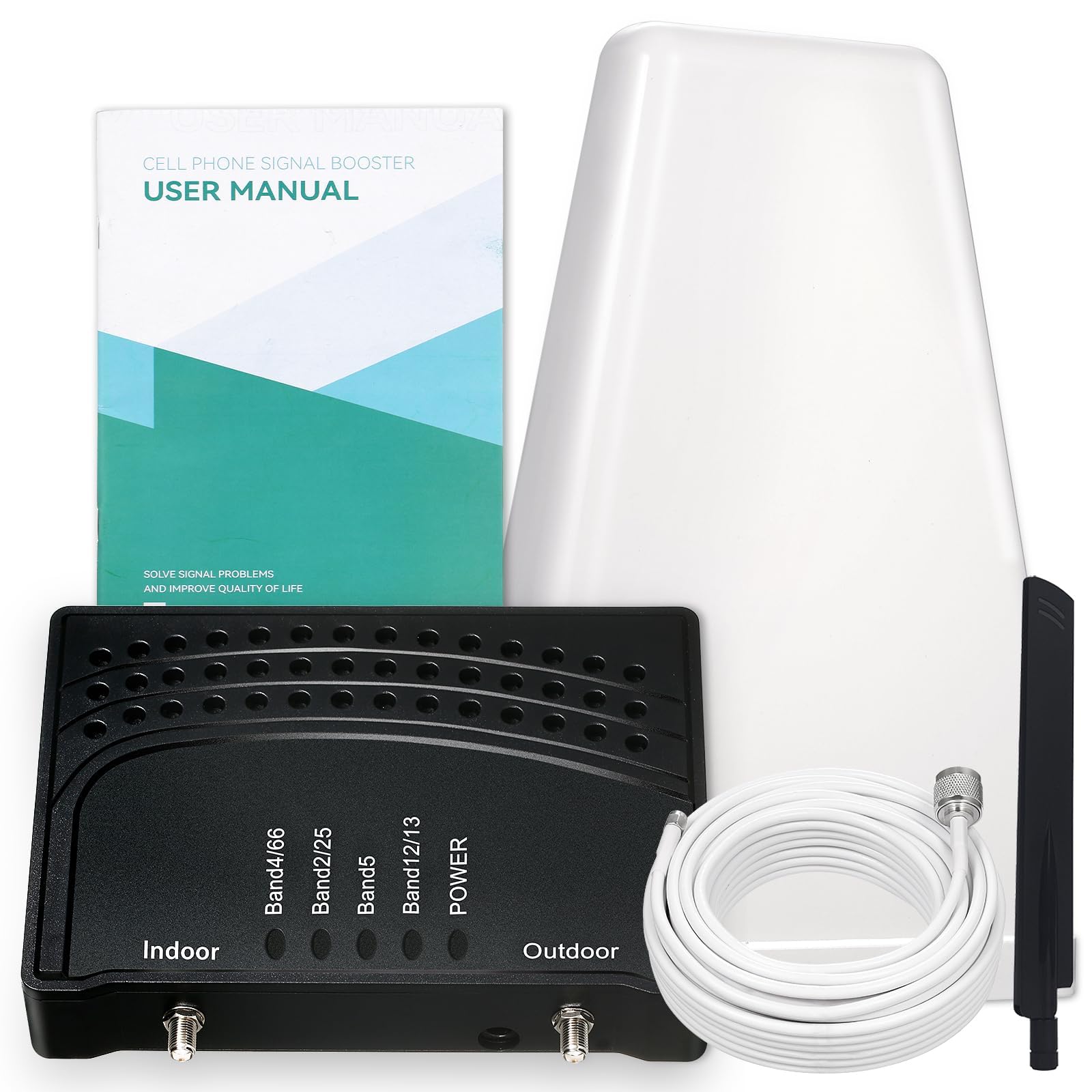
The YLXONE CB offers a solid 70 dB gain with a focus on broad band compatibility, supporting everything from 700 MHz all the way up to 2.5 GHz. This makes it one of the most universally compatible units in the mid-range, theoretically working with any carrier that uses these common frequencies. It is designed for small to medium spaces, with a realistic coverage area of around 2,000 sq. ft.
Customer reviews are notably positive, especially from users with challenging building materials. One reviewer with a house featuring aluminum siding and a metal roof reported that the booster took the signal from “very good” outside to “near perfect” inside, with 5 bars in most rooms. Another user noted that it eliminated dropped calls in a rural area with thick walls, and the installation took only a few minutes.
A couple of users reported that while the signal bars increased, the actual data throughput did not improve significantly, meaning the booster amplified a noisy signal instead of a clean one. The unit also lacks the smart app or LCD features of some rivals, so installation is more manual. At this price point, its strong multi-band support and high success rate in difficult home environments make it a top contender.
Why it’s great
- Broad frequency band support for maximum carrier compatibility
- High success rate even in homes with metal roofs and siding
- Very easy installation with clear instructions
- Excellent value for the price
Good to know
- Lacks smart features like an app or LCD display for tuning
- Some users report increased bars but no speed improvement
- Coverage area is limited to small to medium-sized spaces
7. GAGBK WV70 S (Verizon)

The GAGBK WV70 S is a carrier-specific model designed exclusively for Verizon and its MVNOs like Straight Talk, operating solely on Band 13 (700 MHz). It offers a 65 dB gain and claims coverage up to 5,000 sq. ft. The kit is straightforward, including a 50-foot cable, an outdoor directional antenna, and an indoor whip antenna, making it accessible for a DIY installation.
On paper, this should be a solid budget-friendly option for Verizon users. In practice, the user reviews paint a very different picture. Multiple verified purchasers reported that the device showed 4-5 bars on its own indicator, but inside the home, their phones still displayed only 1-2 bars of LTE, resulting in absolutely no improvement over the original weak signal. One user described it as “cheap junk” and noted a four-hour wasted installation effort.
Another serious complaint concerned the outdoor antenna mount. The manual apparently does not stress the need for a very high mounting point — one customer was told they needed a 30-foot pole, which was both impractical and not communicated upfront. The reliability is also questionable, with one unit failing after only 3 months. While the price is low, the risk of it being a complete waste of time and money is very high.
Why it’s great
- Very affordable entry point into signal boosting for Verizon users
- Simple, carrier-specific design
- Boasts a large 5,000 square foot coverage claim
Good to know
- Overwhelmingly negative user reviews reporting no signal improvement
- Fragile build quality with multiple reports of failure within months
- Requires a very high outdoor antenna mount, often impractical for homes
8. GAGBK (AT&T/T-Mobile)

This second GAGBK model is nearly identical to the first but is tuned for AT&T and T-Mobile, operating on Bands 12 and 17. It also features a 65 dB gain and promises coverage up to 4,500 sq. ft. Like its Verizon counterpart, it includes AGC and self-oscillation elimination, and comes with a 3-year warranty and 30-day money-back guarantee.
The customer reviews for this model are a mix of good and bad, making it a risky gamble. Several users in rural areas reported a significant improvement, going from 1 bar to 4 bars of AT&T service, which made the installation effort worthwhile for them. They noted the process was not easy, but the result was a complete upgrade in usability.
However, other users reported that the unit stopped working after only 3 months, or that it simply did not improve their signal at all. One reviewer’s review was completely unrelated, praising the unit as a fast charger block, which is a bizarre data corruption error that raises questions about the product listing’s authenticity. The mixed feedback, combined with the poor performance of its sister product, makes this a budget option you should approach with significant caution.
Why it’s great
- Low price point for a dedicated AT&T/T-Mobile booster
- Some users report a successful boost from 1 to 4 bars
- Includes AGC and a 3-year warranty as standard features
Good to know
- Mixed customer reviews; a significant portion report no improvement or early failure
- Installation is not as easy as advertised for some users
- Product listing has questionable reviews, making it hard to gauge reliability
9. F FREEQUEEN (AT&T)
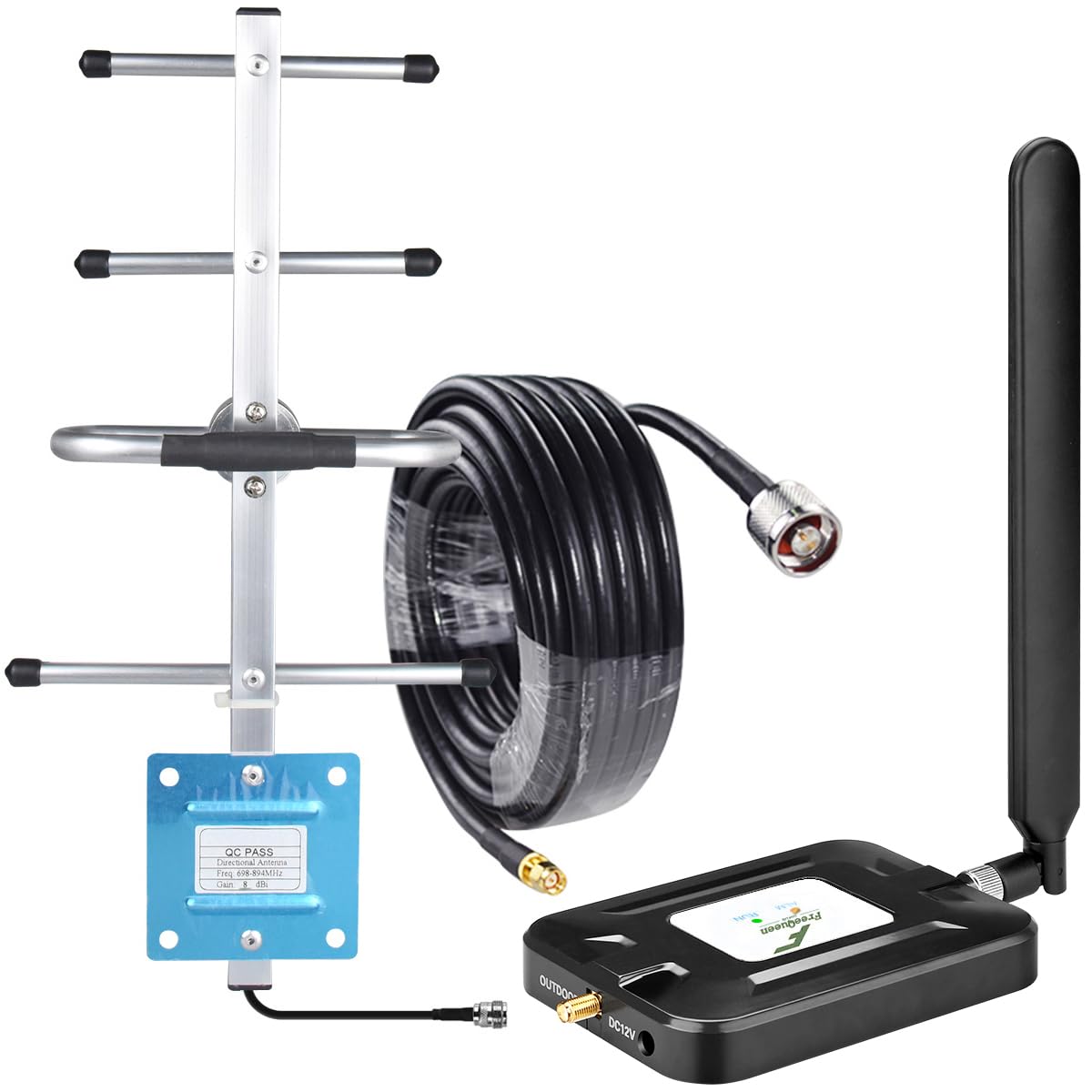
The F FREEQUEEN is another entry-level option for AT&T and T-Mobile users, operating on Band 12/17 and offering a 65 dB gain with a claimed coverage of 4,500 sq. ft. It uses a directional Yagi outdoor antenna and comes with a 50-foot cable that can be extended to 100 feet. It features AGC for automatic performance adjustment and a sleep mode to conserve power.
The customer reviews for this product are almost entirely corrupted. Every single review page we found was populated with reviews for a completely different product — an “excellent lap desk” — instead of the cell phone booster. This indicates a serious issue with the product listing on Amazon, where reviews have been conflated or the product has been frequently changed.
Without any verifiable feedback on the actual signal boosting performance, this unit is impossible to recommend. The technical specifications are generic, and the price point is similar to other, more proven boosters. The lack of genuine user data makes it a blind purchase with a very high probability of disappointment. Avoid this listing until the review situation is clarified.
Why it’s great
- Very low cost for a booster with a large coverage claim
- Extended cable option allows for more flexible antenna placement
- Standard features like AGC and sleep mode are included
Good to know
- All customer reviews on the listing are for a different product (lap desk)
- Completely impossible to assess real-world performance or reliability
- High risk of wasted investment due to unverifiable product claims
FAQ
Do I need to register my cell phone booster with my carrier?
Will a signal booster work in a basement or concrete room?
Can I use a cell phone booster for 5G?
Final Thoughts: The Verdict
For most users, the winner for the affordable cell phone booster category is the HiBoost 15K 2.0 SL because its 72 dB gain and smart app guidance ensure you get a real, measurable improvement in large, difficult spaces without guesswork. If you want a simpler, stylish setup for a smaller home, grab the SureCall Flare. And for the best balance of features and value, the Metarepeater MG1 with its LCD display is an excellent choice that gives you the data you need to optimize your signal.