
A 14 inch diamond blade is the defining consumable for any serious masonry or concrete project — yet picking the wrong one means burnt segments, wandering cuts, and a pile of wasted material on the jobsite. The segment bond, the kerf thickness, and the arbor fit determine whether a blade glides through reinforced concrete or binds and sparks after ten feet. The right choice cuts downtime, extends tool life, and delivers a straight, chip-free edge every pass.
I’m Min — the co-founder and writer behind Gadgets Feed. I’ve spent hundreds of hours analyzing diamond blade metallurgy, segment geometries, and real-world cut rates across dozens of models to separate the consumables that actually hold an edge from those that shed segments mid-job.
Whether you are cutting pavers for a patio, slicing through rebar-infested slab, or scoring asphalt for a driveway tear-out, this guide examines the essential factors of bond hardness, segment height, and arbor compatibility to deliver a clear verdict on the best 14 inch diamond blade for your specific workload.
How To Choose The Best 14 Inch Diamond Blade
Selecting the right blade begins with matching the bond to the material. A soft bond retains diamonds for abrasive materials like asphalt, while a hard bond holds diamonds under the stress of dense cured concrete. Beyond the bond, segment design — segmented, turbo, or continuous — governs whether you prioritize speed or a finish-edge kerf. Arbor size, max RPM, and wet-or-dry capability further narrow the field toward your specific saw platform.
Segment Design: Segmented vs Turbo vs Continuous
Segmented rims use open gullets to clear dust and dissipate heat, making them ideal for fast dry cutting of concrete block, brick, and pavers. Turbo rims add a serrated edge to the continuous rim profile, increasing cut speed while maintaining a relatively smooth finish for tile and stone. Continuous rims produce the cleanest cut edge but generate more heat and are typically limited to wet cutting in tile and engineered stone applications.
Bond Hardness and Segment Height
The bond matrix holds diamond crystals in place. A bond that is too hard for soft abrasive materials will glaze over as the diamonds wear without being replaced. A bond that is too soft for hard materials will shed segments prematurely. Segment height — measured from the steel core to the tip — directly translates to working life; 15mm segments offer roughly 33 percent more usable material than 10mm segments under identical conditions.
Arbor Size and Machine Compatibility
A 14 inch diamond blade almost always ships with a 1-inch (25.4mm) arbor, but many saws require a 20mm or ⅞-inch reduction ring. Loose-fitting reducers can cause vibration and out-of-round rotation, so matched steel rings are preferable to stamped brass or plastic adapters. Always confirm that the blade’s maximum RPM rating meets or exceeds your saw’s no-load speed — a mismatch risks disc burst at speed.
Quick Comparison
On smaller screens, swipe sideways to see the full table.
| Model | Category | Best For | Key Spec | Amazon |
|---|---|---|---|---|
| Diablo DMADS1400 | Premium | High-speed production cuts | 15mm segment / 5500 RPM max | Amazon |
| Delta Boss Hog TURP-140 | Premium | Smooth finish on stone | Turbo rim / 5460 RPM max | Amazon |
| Makita E-01719 | Premium | Gas power-cutter durability | Laser-welded / 12mm segment | Amazon |
| Trabo TB140SM | Mid-Range | Versatile job-site cutting | 1.88 kg / carbon steel core | Amazon |
| ORIXTREME SST15350 | Mid-Range | DIY brick and block work | 15mm segment / 21 segments | Amazon |
| FEWELL FWJS10029 | Value | Paver patios and retaining walls | 15mm segment / 24 segments | Amazon |
| Inwell IN0201350 | Budget | Asphalt and light concrete scoring | 3.55mm kerf / 12mm segment | Amazon |
In‑Depth Reviews
1. Diablo Diamond Segmented Masonry Cut-Off Blade DMADS1400
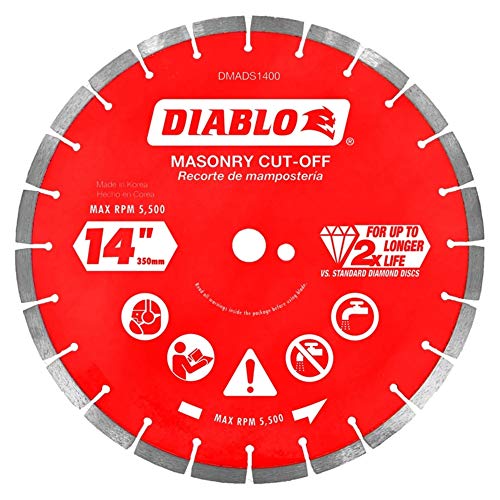
The Diablo DMADS1400 uses taller 15mm segments with a premium diamond concentration bonded to a hardened disc body that absorbs vibration and increases impact resistance. The optimized diamond distribution ensures constant diamond exposure — meaning the cut rate stays consistent through the life of the segment rather than slowing as the blade wears. With a maximum RPM rating of 5,500, this blade handles both high-speed gas saws and electric cut-off machines without warping.
Users consistently report cutting through dense concrete cast pavers and cinder block with minimal applied pressure, and the blade’s ability to handle rebar encounters without losing segments is a defining differentiator in this price tier. The included 20mm bushing provides a snug fit on European-arbor saws, though a handful of users noted the brass reducer can shift under heavy side load if not torqued properly.
The DMADS1400 offers up to 2X longer life compared to entry-level segmented blades, and the dry-cut capability means you can run it on a walk-behind saw without a water supply. For crews cutting multiple pallets of block or scoring sidewalks, this blade significantly reduces per-cut cost through extended segment life and consistent speed.
Why it’s great
- Tall 15mm segments deliver exceptional longevity on abrasive materials
- Hardened disc body reduces vibration for smoother cuts on rebar
- Compatible with 1-inch and 20mm arbors out of the box
Good to know
- Brass reducer ring can loosen if adapter is not fully tightened
- Premium price positions it firmly for professional use
2. Delta Diamond Boss Hog 14 Inch Turbo Premium Blade TURP-140

The Boss Hog TURP-140 uses a turbo rim — essentially a continuous rim with serrated slots — that cuts significantly faster than a standard continuous rim while still producing a much cleaner edge than a fully segmented blade. With a .110-inch kerf thickness and a maximum safe operating speed of 5,460 RPM, the blade is optimized for gas powered cutoff saws and high-torque electric units where maintaining coolant flow for wet cutting is not always practical.
Real-world performance is remarkable on granite and stone veneer: users report cutting through 1.5-inch thick stone dry with zero deflection and no heat buildup, leaving a finish that requires minimal cleanup. The cooling holes along the body dissipate thermal load during extended passes, and the lifetime warranty against warping or segment loss sets a confidence level that few competitors match.
The trade-off is that the turbo rim, while fast, does produce slightly more dust and noise than a true segmented rim, and the blade thickness can create a wider kerf on precision cuts. For masons laying stone veneer or contractors cutting granite countertop blanks, the smooth finish and lifetime guarantee make the Boss Hog a clear go-to.
Why it’s great
- Turbo rim delivers near-continuous finish quality at segmented speed
- Lifetime warranty against warping and segment separation
- Dry cuts on granite and thick stone without excessive heat or glazing
Good to know
- Turbo rim generates more airborne dust compared to wet-cut continuous blades
- .110-inch kerf is slightly thicker than some segmented alternatives
3. Makita E-01719 14″ Diamond Blade, Segmented

The Makita E-01719 uses laser welding to bond 12mm segments to a heavy-duty steel core, a joint design that resists the extreme centrifugal forces and thermal stress generated by high-RPM gas power cutters. The segment slots are engineered to deliver a faster, cooler cut across multiple applications, and the blade is balanced specifically for Makita’s own gas saw lineup — meaning less vibration and a truer cut path out of the box.
Users cutting cured concrete, block, and brick report that the blade takes heavy feed pressure without stalling or glazing, and the laser-weld joint holds even when the blade encounters buried rebar or aggregate. The 4.7-pound weight gives it a solid feel that tracks straight in a walk-behind saw, though the same mass can feel sluggish on smaller handheld units with less torque.
One consistent note across reviews is that the packaging sometimes arrives with cosmetic damage, though the blade itself appears unused. For contractors who trust Makita’s OEM consumables, the E-01719 offers a reliability guarantee that generic blades cannot match — particularly on gas saws where segment detachment is a safety risk.
Why it’s great
- Laser-welded segments resist detachment at maximum gas-saw RPM
- Balanced specifically for Makita power cutters with reduced vibration
- Heavy core tracks straight through rebar and dense aggregate
Good to know
- 12mm segment height is shorter than premium 15mm competitors
- Sometimes ships in open or damaged packaging
4. Trabo 14 Inch Masonry Segmented Rim Diamond Bond Blade TB140SM
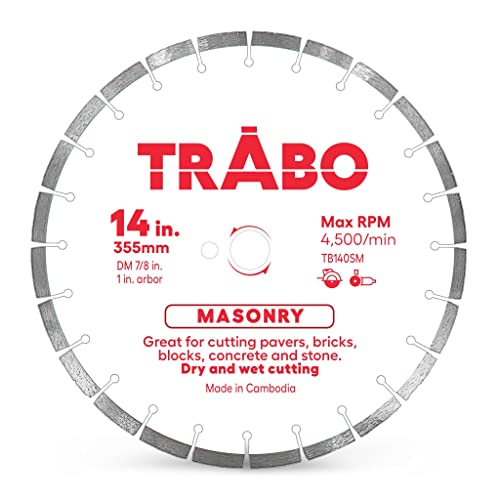
The Trabo TB140SM is a carbon-steel cored segmented rim blade designed for wet or dry cutting of cement, pavers, concrete with rebar, and natural stone. The .120-inch kerf is thin enough to reduce material loss on expensive paving stone yet thick enough to resist deflection when cutting through aggregate. The blade ships with a 1-inch arbor and a ⅞-inch brass reducer ring glued inside the package.
Users have cut engineered quartz, aged asphalt up to 1.75 inches deep, and landscape blocks with no binding or noticeable segment wear after multiple passes. The brass reducer ring, while functional, requires careful seating to avoid wobble at high RPM — several users noted the ring can shift during initial mounting if not pressed fully flush against the arbor flange.
For light to medium-duty work — retaining walls, hardie-backer board, small mortar jobs — the Trabo delivers clean cuts at a execution cost that undercuts most premium blades by a wide margin. It will not match Diablo or Delta on sheer segment life in heavy production, but for the home builder or weekend mason, it represents a strong balance of cost and capability.
Why it’s great
- Thin kerf minimizes material waste on expensive stone and pavers
- Carbon steel core offers good rigidity without excessive weight
- Performs well on asphalt, quartz, and engineered stone
Good to know
- Brass reducer can cause vibration if not fully seated
- Not recommended for thick reinforced concrete or production rebar cutting
5. ORIXTREME 14 Inch Diamond Concrete Saw Blade SST15350
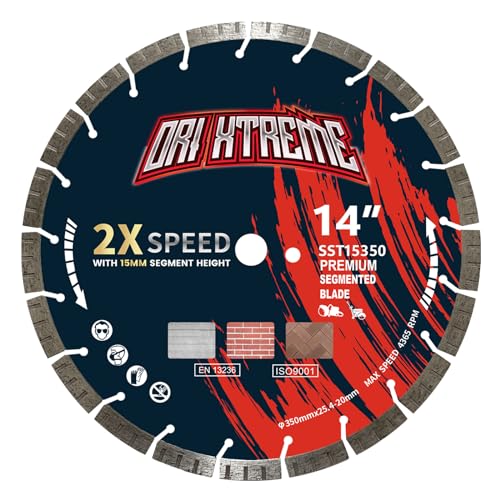
The ORIXTREME SST15350 packs a 15mm segment height onto a 21-segment rim with a premium bond matrix designed for fast cutting speed and long life across concrete, brick, block, masonry, reinforced concrete, and granite. The 0.130-inch thick kerf is relatively standard for a 14-inch blade, but the segment design incorporates ventilation slots to improve airflow, dissipate heat, and remove slurry during wet cutting.
Users report cutting up to 80 passes through 2⅝-inch brick before noticing any degradation in cut speed — a performance level that rivals blades costing significantly more at big-box retailers. The blade is specified for circular saws, masonry saws, table saws, handheld saws, and road cutting machines, though the instruction sheet explicitly warns against cutting asphalt and green concrete, where the bond softens too quickly.
The primary limitation is that this blade is not laser welded; the segments are sintered and brazed, a process that is less resistant to extreme side-loading than a full laser weld. For DIYers cutting block and brick on a table saw, the ORIXTREME offers tremendous segment life per dollar. For professionals hammering through rebar-heavy demolition, a laser-welded blade remains the safer bet.
Why it’s great
- Full 15mm segment height provides excellent total cutting life
- Ventilation slots improve dust clearance and reduce overheating
- Price per cut is very competitive for brick and block work
Good to know
- Brazed segments can fail under extreme lateral force or heavy rebar
- Not suitable for cutting asphalt or green concrete
6. FEWELL 14 Inch Diamond Concrete Saw Blade FWJS10029
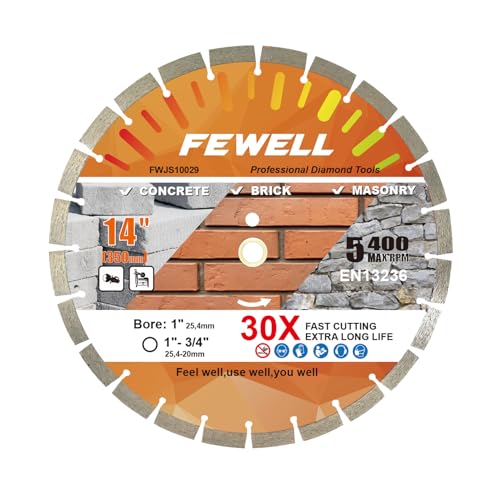
The FEWELL FWJS10029 uses 24 segmented slots across a 15mm-tall rim with a 3.2mm kerf, giving it a higher segment count than most blades in its price bracket. The higher segment density distributes cutting load across more contact points, which can reduce chipping on brittle materials like brick and block. The blade includes a 1-inch to 20mm adapter ring for compatibility with metric-arbor saws.
Users running this blade on a Makita 7-inch grinder (using the lower RPM setting) report clean cuts through concrete steps and bricks with minimal pressure. The 15mm segment height provides enough material for light production runs, and the initial cut speed is comparable to blades costing significantly more. However, the steel core is not hardened — it holds up well under normal use but can warp if the blade is pinched in a deep cut.
For the homeowner cutting two dozen pavers for a patio, the FEWELL delivers straight, reliable cuts at an entry-level price point. The absence of a hardened core means this blade is best reserved for handheld and small-frame saws rather than heavy walk-behind machines where blade binding is more likely.
Why it’s great
- High segment count (24) reduces chipping on brick and block
- 15mm segment height provides strong usable cutting life
- Clean out-of-box cut speed rivals premium blades
Good to know
- Soft steel core can warp under pinching or side load
- Best paired with handheld saws, not heavy walk-behind machines
7. Inwell 14 Inch Diamond Dry or Wet Cutting Blade IN0201350
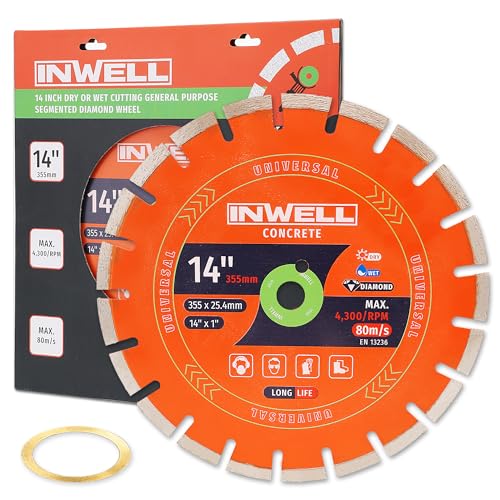
The Inwell IN0201350 is designed specifically for asphalt cutting, with a super-thin 3.55mm kerf that minimizes material waste and reduces drag on low-torque saws. The 12mm segment height uses high diamond content to deliver a lifespan that outperforms standard commodity blades, and the blade is suitable for both dry and wet cutting of asphalt, concrete, and hard stone materials. The included 20mm reducing ring broadens arbor compatibility.
Users cutting granite countertops, pavers, and cinderblocks report that the blade glides through these materials with minimal effort — one user noted cutting two bathroom sink holes in granite without the blade slowing or glazing. The thin kerf does mean the blade is more flexible than thicker competitors, so it can deflect under heavy feed pressure, producing slightly curved cuts in thick material.
For jobs focused on asphalt work or light concrete scoring, the Inwell offers a genuinely useful cutting profile at an economical entry point. It is not built for the brutal cycle of production block cutting, but for the contractor who needs a dedicated asphalt blade that does not break the bank, it is a solid choice.
Why it’s great
- Ultra-thin 3.55mm kerf reduces material waste and drag on saws
- Performs well on asphalt and granite with proper feed technique
- Lightweight 4-pound design reduces arm fatigue in handheld use
Good to know
- 12mm segment height is shorter than mid-range 15mm alternatives
- Thin core can deflect under heavy side load in thick materials
FAQ
Can I use a 14 inch diamond blade on a 7 inch circular saw with an adapter?
How do I know if a blade is suitable for dry cutting?
What does the maximum RPM rating mean for a 14 inch blade?
Final Thoughts: The Verdict
For most users, the best 14 inch diamond blade winner is the Diablo DMADS1400 because its 15mm segmented rim, hardened disc body, and 5,500 RPM rating deliver a consistent cut rate across block, brick, and rebar-infused concrete with segment life that outlasts the competition. If you need a clean finish on stone veneer or granite, grab the Delta Boss Hog TURP-140 for its turbo rim profile and lifetime warranty. And for homeowners or light-duty jobs where value matters most, nothing beats the FEWELL FWJS10029 for straight cuts on pavers and retaining wall blocks.