
Picking a watch for multi-day backpacking trips means balancing navigation accuracy, battery endurance, and ruggedness in a way no other outdoor watch category demands. The wrong choice leaves you with a dead display on day two or an inaccurate route track when the trail gets technical.
I’m Min — the co-founder and writer behind Gadgets Feed. My guides are built from deep market research, cross-referencing real-world battery tests with satellite lock speeds and mapping capabilities across hundreds of product data points.
This curated selection covers solar charging, dual-band GPS, offline topographic maps, and military-grade durability to help you find the absolute best backpacking watch for your next expedition.
How To Choose The Best Backpacking Watch
A backpacking watch must do more than track steps. It replaces your phone’s mapping function, your compass, and your altimeter. Prioritize the specs that keep you on trail when the battery is low and the weather closes in.
GPS Accuracy and Satellite Systems
Single-band GPS struggles under dense tree canopy and between cliff walls. Multi-band GPS (L1+L5) locks onto satellites faster and maintains a stable track in challenging terrain. Look for watches supporting at least five satellite constellations — GPS, GLONASS, Galileo, BeiDou, and QZSS — to ensure coverage in remote valleys.
Battery Life Under Load
The advertised battery life in smartwatch mode is irrelevant for backpacking. What matters is the GPS endurance rating. A watch that delivers 40+ hours of continuous GPS tracking covers a three-day trek without recharging. Solar charging on MIP displays can extend that window significantly in direct sunlight, but AMOLED panels consume more power per hour of map use. Check the GPS-only battery number, not the general use claim.
Offline Mapping and Navigation
Pre-loaded or downloadable topographic maps with turn-by-turn directions allow you to follow a route without a phone signal. Breadcrumb trails, waypoint marking, and back-to-start features are non-negotiable for off-trail travel. Ensure the watch stores maps locally — streaming requires a Bluetooth connection that drains both the watch and the phone battery.
Build Quality and Water Resistance
Military-grade standards (MIL-STD-810H or 810G) certify resistance to thermal shock, humidity, vibration, and salt fog. A 10 ATM water rating handles swimming and accidental submersion up to 100 meters. The bezel material — stainless steel, titanium, or fiber-reinforced polymer — determines how the watch survives rock scrapes and drops without cracking the crystal.
Quick Comparison
On smaller screens, swipe sideways to see the full table.
| Model | Category | Best For | Key Spec | Amazon |
|---|---|---|---|---|
| Garmin Instinct 3 Solar | Premium | Unlimited solar battery & rugged reliability | Unlimited battery life with solar (assumes 3h/day outdoors at 50k lux) | Amazon |
| Amazfit T-Rex 3 Pro | Premium | AMOLED clarity & offline mapping on a budget | 700 mAh battery, 25 days typical, 27 days smartwatch | Amazon |
| SUUNTO Vertical | Premium | Extreme GPS endurance & free global offline maps | Up to 500h in tour mode GPS, 60h in most accurate tracking | Amazon |
| Garmin fēnix 8 47mm | Premium | Top-tier multisport & dive-rated performance | 1.4” AMOLED, 16 days smartwatch, 47h GPS, dive-rated to 40m | Amazon |
| COROS Nomad | Mid-Range | Lightweight design & voice-pin adventure journal | 50h GPS battery, 22 days daily use, pre-loaded global maps | Amazon |
| Polar Grit X | Mid-Range | Ultra-light build with Hill Splitter analysis | 64g weight, 40h GPS (100h with power save) | Amazon |
| CAsio Pro Trek PRG-600 | Mid-Range | Solar-powered analog with durable Triple Sensor | Tough Solar charging, 100m WR, compass/alt/baro/thermo | Amazon |
| Amazfit Active Max | Mid-Range | Bright AMOLED & 4GB onboard map storage | 3000-nit display, 25-day battery, 170+ sport modes | Amazon |
| AMAZTIM T3 Ultra | Budget | Rugged metal build with large AMOLED on a tight budget | 470 mAh battery, MIL-STD-810H, 6-satellite positioning | Amazon |
In‑Depth Reviews
1. Garmin Instinct 3 Solar 45mm

The Garmin Instinct 3 Solar 45mm redefines endurance for a backpacking watch by combining a solar charging lens with multi-band GPS that adapts satellite power via SatIQ technology. This means you get superior positioning in deep canyons while the watch dynamically extends battery life when conditions allow. The 0.9” MIP display remains crisp under direct sun without the power penalty of AMOLED — a critical advantage for multi-day trips where every percentage point counts. Users report 28 days of smartwatch use out of the box, and solar charging further stretches that timeline assuming three hours of outdoor exposure daily at 50,000 lux.
The fiber-reinforced polymer case with a metal-reinforced bezel survives the MIL-STD-810 thermal and shock tests, and the 10 ATM water rating handles river crossings and heavy rain without a second thought. A built-in LED flashlight with variable intensities and strobe modes provides hands-free illumination for setting up camp after dark or reading a map in a tent. Health monitoring includes wrist-based heart rate, advanced sleep tracking, and Pulse Ox — though note that Pulse Ox is not available in all countries. Garmin Pay supports contactless payments, so you can leave your wallet behind on resupply runs.
The Instinct 3 syncs with the Garmin Connect app for detailed route analysis, incident detection, and assistance features that share your live location with emergency contacts. Users praise the customizable data fields, the exceptional battery life that eliminates daily charging anxiety, and the button-driven interface that works with gloves. A few note the learning curve for the operating system and the requirement for the Garmin Connect app to run in the background on your phone. This watch is the most balanced choice for backpackers who want reliable navigation without obsessing over recharging.
Why it’s great
- Unlimited battery life with solar charging under ideal conditions
- Multi-band GPS with SatIQ provides superior accuracy in challenging terrain
- MIL-STD-810 rated and 10 ATM water resistant
Good to know
- Requires Garmin Connect app running in background for phone sync
- MIP display is monochrome — no color maps or AMOLED vividness
2. Amazfit T-Rex 3 Pro
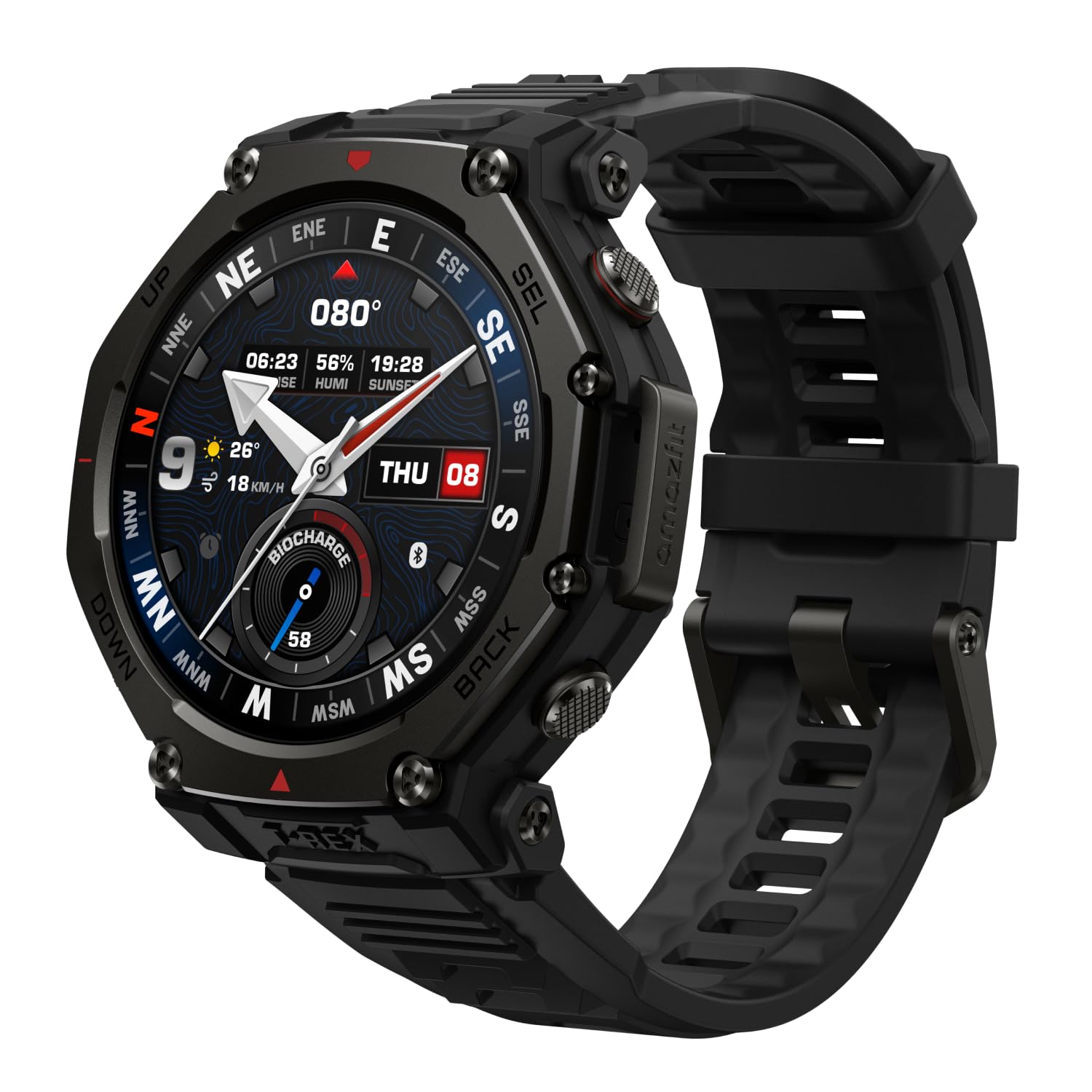
The Amazfit T-Rex 3 Pro packs a 700 mAh battery that delivers up to 25 days of typical use and 27 days in smartwatch mode — the highest capacity I’ve seen in a premium-priced backpacking watch. The 1.5” sapphire AMOLED display hits 3000 nits of brightness, making it readable in direct sunlight while still offering deep contrast for offline map viewing. A titanium alloy bezel and buttons protect the sapphire crystal from impacts, and the watch is 10 ATM water rated with diving certification to 45 meters — meaning it survives everything from a rain-soaked ridge to a swim through a canyon pool.
Offline maps with point-of-interest search, auto rerouting, and round-trip route creation remove the need for a phone when navigating unmarked trails. Dual-band GPS locks onto six satellite systems, maintaining a stable track under heavy tree canopy and between tall rock faces. The built-in two-color flashlight switches between a soft red mode that won’t ruin night vision and a bright white Turbo Mode; an SOS signal offers peace of mind. The BioTracker sensor provides continuous heart rate tracking, and pairing with the optional Helio Strap turns the watch into a 24/7 recovery monitoring system.
Users upgrading from an Apple Watch Ultra 2 or Garmin Fenix praise the intuitive gesture controls, the smooth operating system, and the fast GPS lock times. The Zepp app offers detailed training insights without a subscription. A few reviews note that route recalculation rarely works during active navigation and that wet screens can be difficult to unlock near freezing temperatures. At roughly a third of the price of flagship Garmin models, the T-Rex 3 Pro delivers premium materials without the subscription lock-in.
Why it’s great
- Sapphire AMOLED with 3000-nit brightness for excellent outdoor visibility
- 700 mAh battery supports multi-week trips without charging
- Titanium bezel and sapphire glass offer extreme durability
Good to know
- Route recalculation during navigation is unreliable
- Wet screen can be difficult to unlock near freezing
3. SUUNTO Vertical GPS Adventure Watch

The SUUNTO Vertical pushes GPS endurance to 500 hours in tour mode and 60 hours in the most accurate tracking mode — numbers that easily cover a week-long expedition without touching a charger. The 49mm color display shows free, pre-loaded global maps offline, including contour lines, water features, and landmarks, with navigation tools like breadcrumb trails and point-of-interest markers. Dual-band GNSS provides reliable accuracy in the most demanding conditions: cliff bands, deep valleys, and urban canyon environments where single-band receivers lose lock.
Built in Finland with 100% renewable energy, the Vertical carries over 85 years of Suunto’s compass and instrument heritage. The titanium model adds solar charging that boosts battery life by roughly 30% on sunny days, though users report that solar charging is less effective under tree cover. The watch is lightweight for its 49mm case size, and the sapphire crystal lens resists scratches during rock scrambles. Barometric altitude tracking adjusts for weather changes, and the storm alarm can trigger in advance of incoming systems.
Reviewers highlight the tremendous battery life, the comfortable fit despite the large face, and the detailed offline color maps that eliminate phone dependency. Criticisms center on the short, fragile charging cable, the inability to customize watch faces, and sleep tracking that some users find inaccurate. The oxygen sensor may read 5–6 points low compared to medical-grade devices. Overall, the Suunto Vertical is ideal for backpackers who prioritize maximum GPS runtime and reliable navigation without frequent recharging.
Why it’s great
- Up to 500 hours of GPS tracking in tour mode
- Free global offline maps with contour and water features
- Dual-band GNSS ensures accuracy in extreme terrain
Good to know
- Charging cable is short and fragile
- Sleep tracking and oxygen sensor accuracy have room for improvement
4. Garmin fēnix 8 47mm AMOLED

The Garmin fēnix 8 is the most feature-complete multisport backpacking watch on the market, combining a 1.4” AMOLED display with a stainless steel bezel and a built-in LED flashlight. Battery life reaches 16 days in smartwatch mode and 47 hours in GPS mode — enough for a weekend trek with continuous tracking. The dive rating to 40 meters with leakproof metal buttons supports scuba and apnea activities, so the same watch transitions from alpine ridge to reef exploration. Multi-band GPS with SatIQ technology delivers superior positioning in complex geography, and the 3-axis compass, gyroscope, and barometric altimeter provide triple-redundant navigation data.
Training readiness scores incorporate sleep quality, recovery, training load, and HRV status to tell you when to push harder. The built-in speaker and mic allow phone calls from your wrist when paired to a smartphone, and off-grid voice commands let you access select watch controls without a phone connection. ECG capability can record heart rhythm and check for signs of atrial fibrillation — though this feature is not available in all regions and is for people 22 years or older. Dynamic round-trip routing adds variety to your workouts by offering turn-by-turn directions that adjust to bring you back to the start on schedule.
Users consistently call this the best Garmin yet, praising the vivid AMOLED screen, the long battery life even with frequent GPS use, and the dual compatibility with swimming, weightlifting, running, cycling, and hiking. The built-in flashlight is used daily by many reviewers, and the adjustable font and colors are helpful for those with vision challenges. The main limitation is the premium price — this is a serious investment that pays off for adventurers who want a single watch capable of everything from multi-day treks to recreational diving.
Why it’s great
- AMOLED display with SatIQ for excellent daytime clarity and battery optimization
- Dive-rated to 40m, leakproof metal buttons for underwater activities
- Comprehensive training readiness and health monitoring features
Good to know
- Premium price requires a significant budget commitment
- Phone call functionality is less robust than a dedicated smartwatch
5. COROS Nomad GPS Outdoor Watch
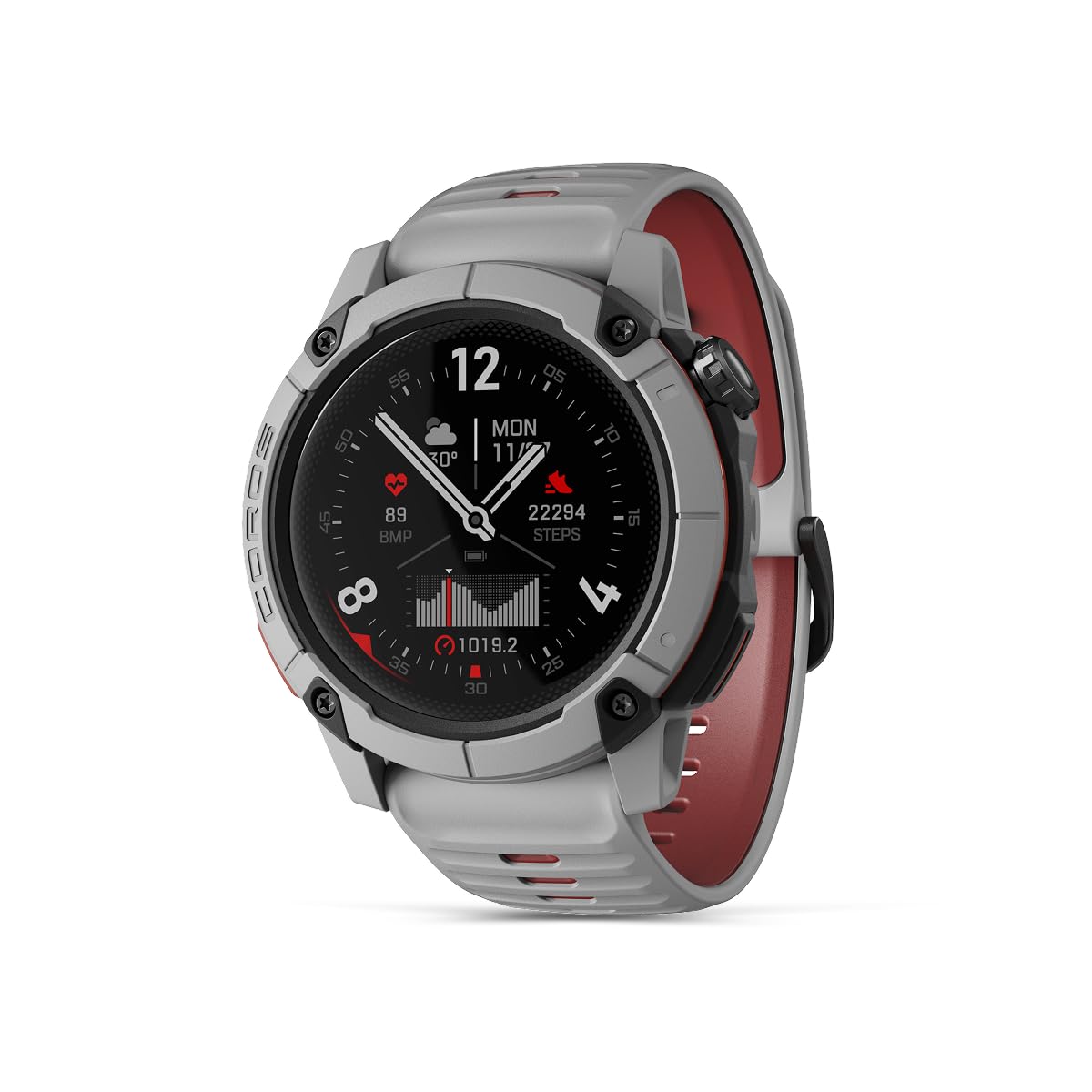
The COROS Nomad targets backpackers who value lightweight design without sacrificing navigation capability. The dual-layer polymer and aluminum alloy bezel keeps the weight manageable while protecting a 1.3” Memory in Pixel (MIP) screen that delivers high contrast in direct sun and deep color saturation in low light. Pre-loaded global topographic maps with street names and back-to-start navigation remove the need to pre-download tiles — everything is stored on the watch out of the box. Battery life reaches 50 hours in GPS mode and 22 days of daily use, which covers most multi-day trips without recharging.
The unique Built-In Adventure Journal sets the Nomad apart: you can record voice notes, tag locations, add photos, and transcribe voice-to-text memos within activities, saving your best trail memories before they fade. Fishing-specific modes provide real-time and forecasted tide data, moon phases, catch logging, and spot marking — a rare feature set for a backpacking watch. Real-time weather and environmental data, safety alerts, and sunrise/sunset times round out the navigation tools. The MIP display means the screen stays on without burning through the battery, which is critical for constant navigation use.
Trail runners and hikers report that the GPS accuracy and mapping features match their needs exactly, with easy .gpx file import and turn-by-turn directions. The heart rate tracker is accurate most of the time, though reviewers note occasional random spikes. The battery performance is excellent — one user saw only a 7% drop over three days with mild-heavy use. Some find the 1.3” display limited for detailed map viewing compared to larger AMOLED options, and the polymer construction may not feel as premium as metal bezels. The Nomad is a focused tool for anyone who wants full navigation and journaling without the weight of a metal-case watch.
Why it’s great
- Lightweight dual-layer polymer and aluminum bezel
- Pre-loaded global maps with turn-by-turn navigation
- Voice-pin Adventure Journal for recording trail memories
Good to know
- 1.3” display is smaller than many premium competitors
- Heart rate sensor can produce occasional random spikes
6. Polar Grit X

The Polar Grit X is the lightest watch in this roundup at 64 grams — about 20–30% lighter than typical outdoor watches — making it ideal for weight-conscious backpackers who count every gram. Despite the low weight, it delivers up to 40 hours of GPS tracking with full heart rate monitoring, extendable to 100 hours with power-saving options. The watch passed MIL-STD-810G military durability tests and is water resistant to 100 meters (10 ATM), so it handles river crossings and heavy storm exposure without issue. A built-in compass and barometric altitude sensor provide the ABC basics you need for off-trail navigation.
The Hill Splitter feature automatically detects uphill and downhill sections during a hike, analyzing your performance on ascents and descents using speed, distance, and altitude data — helpful for pacing yourself on long elevation days. Route import from Komoot enables real-time turn-by-turn navigation, and the Polar Flow platform provides detailed training and route analysis after the trip. Nightly Recharge measures overnight recovery to tell you when your body is ready to push harder the next day, bridging the gap between a fitness tracker and a dedicated backpacking watch.
Reviewers confirm that the GPS and elevation tracking are accurate, and the Hill Splitter provides useful granularity for trail running and mountain biking. The wrist-based heart rate monitor performs well but is less accurate than Polar’s own chest strap — a known trade-off with all optical HR sensors. Some users report shorter battery life than advertised, noting about five days with 2.5 hours of daily GPS use. The plastic case construction feels durable despite not having a metal bezel, and the lightweight design makes it easy to wear 24/7. The Grit X is a strong choice for gram weenies who prioritize lighter gear over flashy AMOLED displays.
Why it’s great
- Weighs only 64g, 20-30% lighter than typical outdoor watches
- Hill Splitter automatically analyzes ascent and descent performance
- MIL-STD-810G certified with 100m water resistance
Good to know
- Wrist-based HR is less accurate than a dedicated chest strap
- Battery life may fall short of advertised figures with heavy GPS use
7. Casio Pro Trek PRG-600 Series

The Casio Pro Trek PRG-600 takes a different approach from the smartwatch crowd: it’s an analog-digital hybrid that runs on Tough Solar power, so you never plug it in. The Triple Sensor Version 3 provides a compass, altimeter, barometer, and thermometer — the core ABC (altimeter, barometer, compass) functions that matter most for backcountry navigation — all accessible with one-touch measurement buttons. The watch is water resistant to 100 meters, uses an STN LCD for better readability, and has a slim 13.4mm profile that fits under jacket sleeves comfortably. Large Arabic numeral hour markers and a high-contrast dial make it easy to read at a glance.
Battery-free operation means no charging cables to lose and no degraded lithium cells after a few seasons. The solar panel tops up the battery using any light source, and the charge indicator eliminates the risk of a dead watch mid-trip. A full auto LED backlight with afterglow illuminates the display in low light, and the auto-illumination feature activates when you tilt your wrist — useful for reading the compass at night. Multi-alarm, stopwatch, countdown timer, and world time with 29 time zones round out the daily utility features. You also get atomic timekeeping in some markets for automatic time correction.
Long-term owners report the watch performs flawlessly after years of daily wear, with solar charging maintaining full power from regular sunlight exposure. The resin band is comfortable, and the 47mm case fits wrists of varying sizes well — one reviewer with a 7.4-inch wrist found it perfect. The watch loses roughly 2 seconds per month, which is excellent quartz accuracy, and setting via the crown takes some practice. It lacks GPS mapping and smart notifications, so it’s best for those who want a rugged, self-powered timepiece for navigation without relying on satellite tracking. The Pro Trek is the set-and-forget choice for minimalist backpackers who prioritize reliability above all else.
Why it’s great
- Tough Solar system eliminates recharging for the life of the watch
- Triple Sensor V3 provides instant compass, altitude, barometric pressure, and temperature readings
- 100m water resistance and slim 13.4mm profile
Good to know
- No GPS or satellite navigation capability
- Auto-light feature can drain battery if left enabled
8. Amazfit Active Max
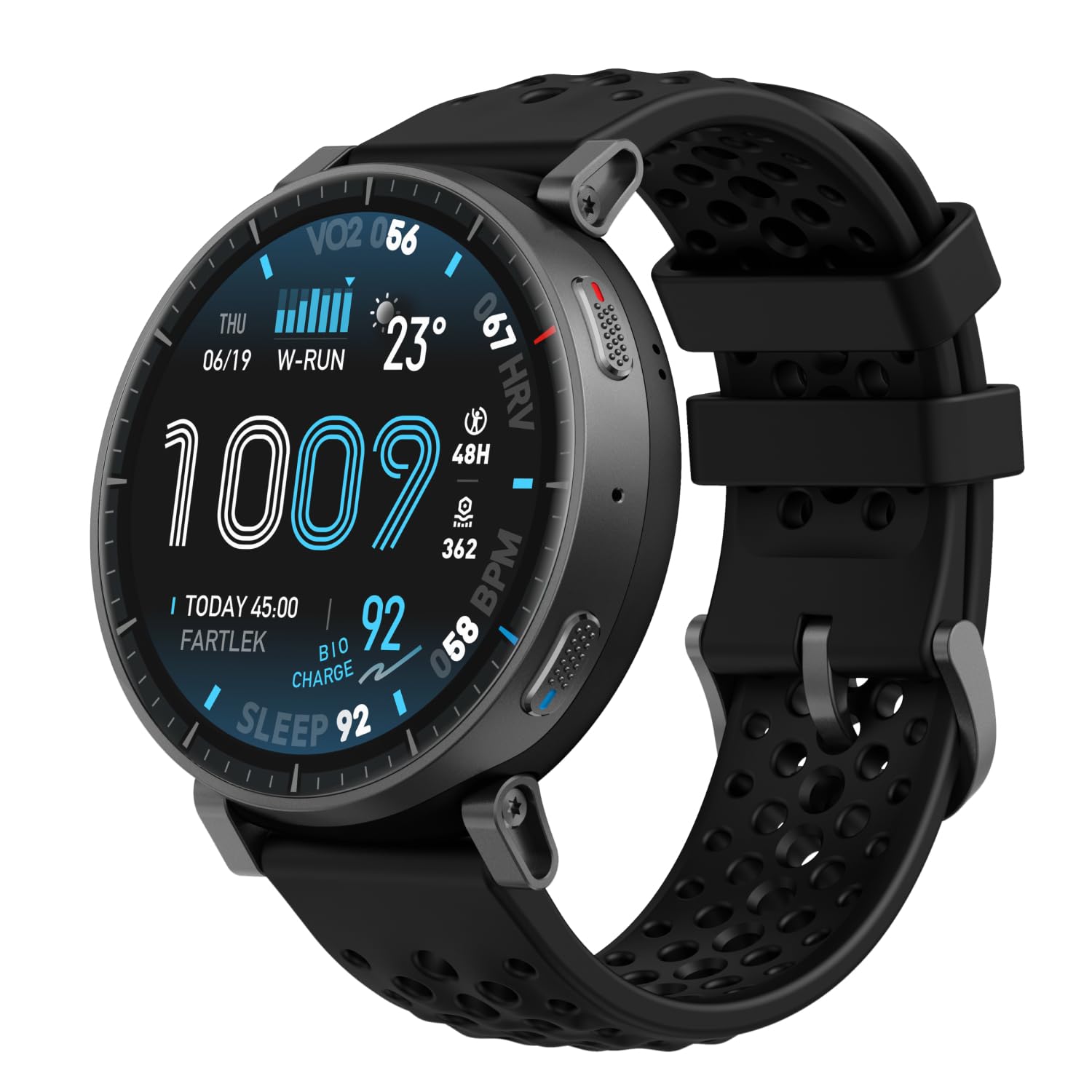
The Amazfit Active Max brings a 3000-nit AMOLED display and 4GB of onboard storage to the mid-range segment — the same brightness as premium flagships but at a significantly more accessible tier. The 1.5” screen stays readable in harsh sunlight, which is critical when you’re checking maps on a ridgeline at midday. Up to 25 days of battery life covers a multi-week trip, and the 170+ sport modes with personalized Zepp Coach running plans suit both casual hikers and serious endurance athletes. Five satellite systems provide fast, accurate positioning, and you can download terrain and ski maps directly to the watch for offline navigation without a phone signal.
BioCharge energy monitoring adjusts your daily readiness score based on workouts and stress levels, helping you decide when to push or rest. Bluetooth calls, Zepp Flow voice replies on Android, and built-in speakers and mic keep you connected on the trail without pulling out your phone. The watch integrates with Google Fit and Apple Health, so your trail data syncs across your existing ecosystem. The magnetic charging base is simple to use, and the silicone band is comfortable for all-day wear, including during sleep tracking.
Users praise the bright, responsive display, the accurate heart rate and SpO2 tracking compared to medical devices, and the seamless integration with fitness platforms. Battery life easily exceeds three weeks for many, and the GPS accuracy is reliable for hiking and running. A few reviewers wish the dial were slightly larger, and the Zepp app’s map lines could be slimmer for better clarity. The Active Max delivers premium-tier AMOLED performance and offline mapping at a mid-range price, making it the top value proposition for backpackers who want high brightness without breaking the budget.
Why it’s great
- 3000-nit AMOLED display rivals high-end smartwatches
- 4GB onboard storage for offline maps and music
- 25-day battery life supports extended backcountry trips
Good to know
- Dial diameter may feel slightly small for some users
- Map lines in Zepp app could be clearer
9. AMAZTIM T3 Ultra GPS Smart Watch
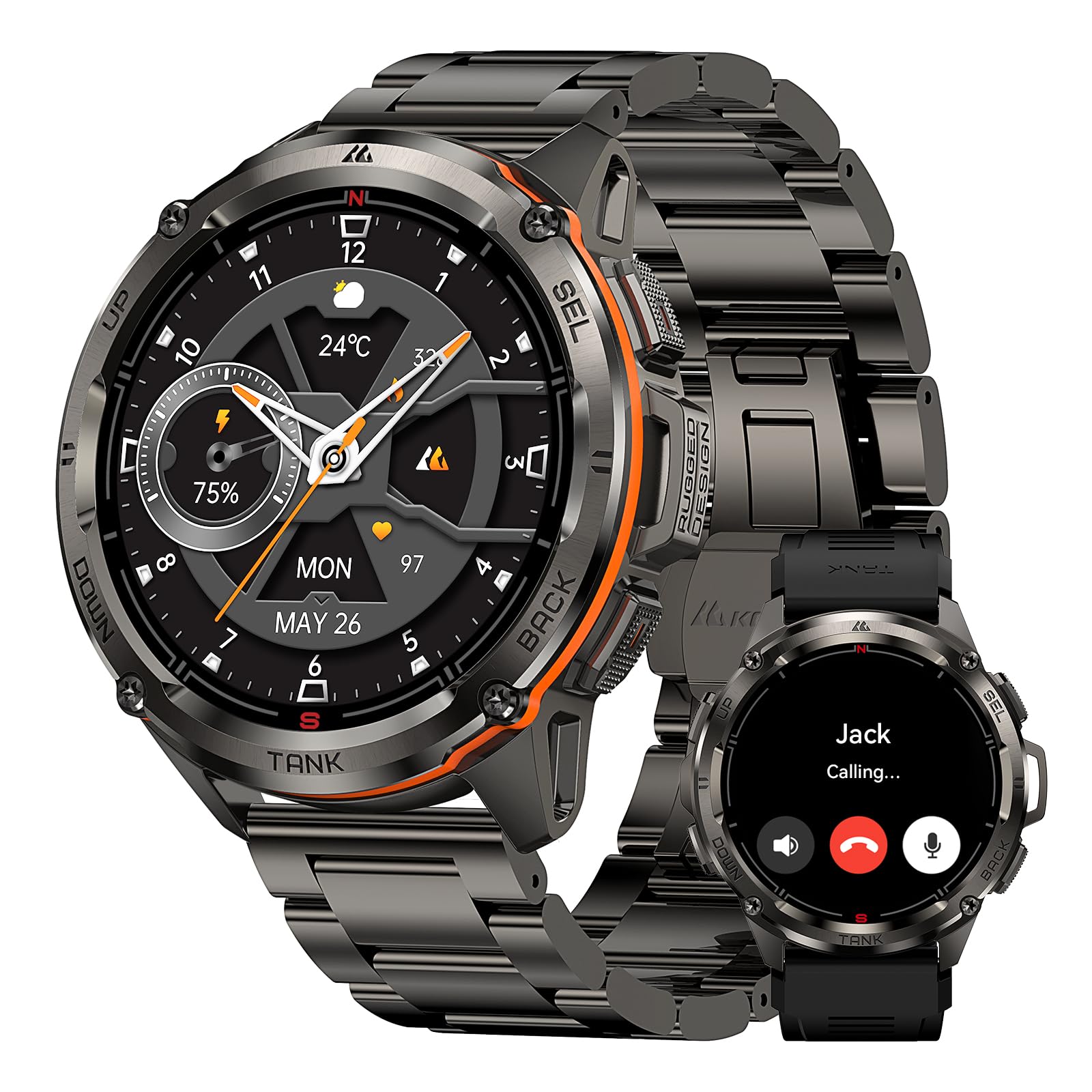
The AMAZTIM T3 Ultra punches well above its price tier with a military-grade stainless steel body certified to MIL-STD-810H, a 1.43” AMOLED display, and a 470 mAh battery that delivers up to two weeks of normal use. The dual-band, six-satellite positioning system locks onto signals 2–3 times faster than single-band 4-satellite watches, achieving GPS fix in 8–45 seconds. A built-in compass, altitude pressurization, and altimeter sensors display your current position, altitude, and air pressure — the core ABC suite for backcountry navigation. The Corning Gorilla screen with Mohs hardness up to 9H resists scratches from rock and debris, and the fully enclosed case design reaches 5ATM waterproofing for submersion to 50 meters.
Health monitoring includes 24-hour heart rate, real-time blood oxygen, and all-day sleep tracking. The 170 exercise modes cover hiking, cycling, climbing, and more, with 6 intelligent sports recognition modes that auto-detect your activity. The watch supports Bluetooth calls, AI voice assistant for hands-free commands, and social media notifications so you stay in touch without pulling out your phone. Over 500 watch face options are available, including specific designs for the Always On Display mode. The pack includes both a silicone band and a stainless steel band — two looks that cover trail and town use.
Users appreciate the rugged build that survives scratches after weeks of daily wear and the bright screen that doubles as a camp lamp. The battery comfortably lasts 12–16 days with moderate use, and charging from empty takes about two hours. Some trade-offs are present: the software feels less polished than Garmin or Amazfit, with occasional Bluetooth disconnection and inaccurate health metrics. Raise-to-wake can be unreliable, and the charging cord is too short to reach an outlet from a nightstand. For the price, however, the T3 Ultra delivers AMOLED clarity, a metal build, and GPS functionality that competitors at this tier simply don’t offer.
Why it’s great
- MIL-STD-810H rated stainless steel body at an entry-level price
- 470 mAh battery lasts up to two weeks on a single charge
- Dual-band 6-satellite positioning for faster GPS locks
Good to know
- Software is clunkier than established brands, with occasional Bluetooth dropouts
- Health tracking accuracy may not match dedicated fitness wearables
FAQ
Can I use a backpacking watch without a phone connection?
How accurate is wrist-based heart rate monitoring during a hike?
What does barometric altitude mean and why does it matter?
How do I choose between solar charging and a larger battery?
Final Thoughts: The Verdict
For most users, the best backpacking watch winner is the Garmin Instinct 3 Solar because it balances unlimited solar-extended battery life with rugged MIL-STD-810 build quality and button-driven navigation that works perfectly with gloves. If you want a vivid AMOLED display with offline mapping at a lower price, grab the Amazfit T-Rex 3 Pro. And for extreme GPS endurance without any dependency on charging, nothing beats the SUUNTO Vertical with its 500-hour tour mode.