
Running conduit in a tight attic or along an exposed wall shouldn’t feel like a bicep workout. Aluminum electrical conduit delivers the mechanical protection your wiring requires without the back-breaking weight of steel, making every pull, bend, and cut significantly easier. The reduced wall design common in aluminum flexible metal conduit (FMC) also cuts faster, letting you trim runs with standard tin snips instead of a hacksaw.
I’m Min — the co-founder and writer behind Gadgets Feed. I’ve spent countless hours analyzing spec sheets, cross-referencing customer field reports, and comparing the actual installed performance of aluminum vs. steel conduit to identify the real winners for both residential and commercial jobs.
This guide breaks down the top-rated options to help you find the best aluminum electrical conduit for your project, from lightweight 3/8-inch runs to pre-wired armored cable assemblies.
How To Choose The Best Aluminum Electrical Conduit
Selecting the right aluminum conduit comes down to three core decisions: the physical trade size based on your wire count, the wall type (reduced vs. full), and the environmental rating you require. Misjudging any of these can make installation harder or leave your wiring unprotected.
Match the Trade Size to Your Conductor Fill
Conduit size is specified by its nominal trade diameter (3/8″, 1/2″, 3/4″), not the actual inside diameter. A 1/2-inch aluminum FMC can comfortably handle up to three 12 AWG THHN conductors for a 20-amp circuit, while a 3/4-inch run allows for four 10 AWG wires or a tighter pull of 12/2 Romex. Always check the NEC fill tables for your specific wire type and number before ordering.
Reduced Wall vs. Standard Wall Aluminum FMC
The “RWA” designation on products like the Woods 55082121 indicates a reduced wall aluminum construction. This makes the conduit even lighter and easier to cut with manual tools, ideal for short, low-traffic residential runs. Standard wall aluminum offers slightly higher crush resistance for commercial or industrial settings where the conduit may be bumped or stepped on.
Flexible Metal Conduit vs. Liquid-Tight Non-Metallic
Standard aluminum FMC (Type FMC per NEC) is intended for indoor, dry locations and provides excellent physical protection against impact. If your run goes outdoors, underground, or near moisture and oil, you need a liquid-tight flexible non-metallic conduit (Type LFNC-B) with an integral PVC jacket that seals out the elements. The two are not interchangeable for wet locations.
Quick Comparison
On smaller screens, swipe sideways to see the full table.
| Model | Category | Best For | Key Spec | Amazon |
|---|---|---|---|---|
| Southwire 12/2 MC Cable 100Ft | Pre-Wired Cable | Shop wiring & branch circuits | 12 AWG, 2 conductors, 20A | Amazon |
| Sealproof 1/2″ Liquid-Tight 100Ft | Liquid-Tight PVC | Outdoor & wet location runs | 100 ft length, UV resistant | Amazon |
| Klein Tools 51607 Bender | Bending Tool | Bending 3/4″ EMT precisely | 0.84″ inner radius (3/4″ EMT) | Amazon |
| Ansgery 1/2″ Liquid-Tight Kit 50Ft | Kit with Connectors | Outdoor AC & equipment hookup | Includes 8 connectors | Amazon |
| Woods 55082021 3/8″ x 25Ft | Reduced Wall FMC | Light-duty indoor protection | 3/8″ trade size, 1.4 lbs total | Amazon |
| Southwire 3/4″ Flex Conduit 25Ft | Standard FMC | Rodent-proofing larger cables | 3/4″ trade size, 2 lbs total | Amazon |
| Woods 55082121 1/2″ x 25Ft | Reduced Wall FMC | General residential 20A circuits | 1/2″ trade size, 2 lbs total | Amazon |
In‑Depth Reviews
1. Southwire 12/2 Aluminum Metal Clad Cable 100Ft
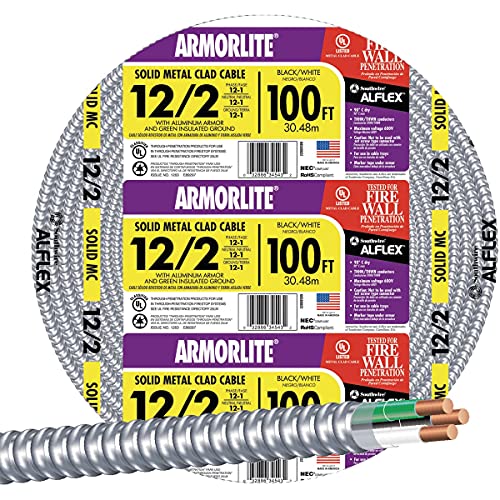
This Southwire 12/2 MC cable bundles two 12 AWG copper conductors inside a continuous spiral aluminum armor, delivering a complete 600V, 20-amp branch circuit in a single pull. The pre-wired assembly eliminates the need to snake individual wires through conduit, saving significant time when wiring shop outlets, barns, or new construction runs.
The aluminum cladding provides the same rodent and impact resistance as standard FMC while keeping the overall weight manageable for a 100-foot spool at 7.8 pounds. Reviewers consistently note it’s the same quality wire found at big-box stores but at a better price, with one customer using it to expand their shop circuits with metal junction boxes.
Keep in mind that MC cable requires specific connectors and proper grounding techniques — the aluminum armor itself serves as the equipment ground, so you’ll need listed MC cable fittings at every termination point. It’s an excellent choice for permanent wiring where you want built-in mechanical protection from the factory.
Why it’s great
- Pre-assembled with two 12 AWG copper conductors saves installation time
- Continuous aluminum armor resists rodent damage in barns and shops
- 600V rated with 20A capacity for general branch circuits
Good to know
- Requires special MC cable connectors and proper grounding terminations
- Heavier and less flexible than bare FMC for tight bends
2. Sealproof 1/2-Inch Liquid-Tight Electrical Conduit Type B 100Ft

When your conduit run must survive direct sunlight, rain, and even direct burial, the Sealproof Type B liquid-tight non-metallic conduit is the clear choice. Made from high-quality virgin PVC, this 1/2-inch gray tubing resists corrosion, oil, acid, abrasion, and metal shavings — everything a standard aluminum FMC cannot handle in wet environments.
At 100 feet per spool and roughly 50% lighter than metallic alternatives, it provides a smooth interior that minimizes friction when pulling conductors. Customers have used it successfully for hot tub wiring relocation, generator transfer switch connections, and protecting drip irrigation lines from pets. It accepts standard PVC cement for fittings that become rock-solid.
Installation is straightforward: cut with a utility knife or PVC cutter, then push onto Type B connectors. The UL listing covers 80°C dry and 60°C wet applications, and the CSA certification extends the range to 75°C. This is a premium solution for anyone needing a trouble-free outdoor installation that won’t corrode over time.
Why it’s great
- Sunlight-resistant and rated for direct burial applications
- Lightweight virgin PVC with smooth interior for easy wire pulling
- UL listed for wet locations with oil resistance
Good to know
- Must use specific Type B liquid-tight connectors
- Not impact-resistant like aluminum FMC in high-traffic areas
3. Klein Tools 51607 Aluminum Conduit Bender Full Assembly

Bending 3/4-inch EMT or 1/2-inch rigid conduit accurately is near impossible without the right tool, and the Klein 51607 is the professional standard. Its cast aluminum head is reinforced for strength yet remains lightweight enough for overhead work, and the patent-pending Angle Setter technology lets you dial in 10-, 22.5-, 30-, and 45-degree bends with consistent accuracy by compensating for springback.
The wide foot pedal provides excellent stability and leverage, reducing fatigue on long bending sessions. Bold cast markings and symbols make alignment for saddle and back-to-back bends quick and error-free. The interior hook surface prevents the conduit from rolling or twisting mid-bend, which is a common frustration with cheaper benders.
Electricians in the field report that this bender pays for itself within the first half-hour of use. While it’s a tool rather than a conduit product, no aluminum conduit installation guide is complete without recommending a proper bender — bent conduit looks professional and passes inspection, while kinked pipe does not.
Why it’s great
- Angle Setter delivers repeatable accurate bends quickly
- Wide foot pedal offers superior stability and leverage
- Reinforced aluminum head is durable yet manageable weight
Good to know
- Designed only for 3/4″ EMT and 1/2″ rigid conduit
- Not suitable for bending aluminum FMC (flexible conduit)
4. Ansgery 1/2″ Liquid-Tight Conduit 50Ft with Connectors

For anyone who needs a complete outdoor-ready solution without hunting down separate fittings, the Ansgery liquid-tight kit bundles 50 feet of 1/2-inch non-metallic flexible conduit with five straight connectors and three 90-degree connectors. This is especially handy for HVAC equipment hookups, machine tools, marine installations, and outdoor lighting where you need waterproof joints right out of the box.
The virgin PVC construction provides a smooth interior that reduces friction during wire pulls, and the 3-mm nominal wall thickness offers good crush resistance for its class. Reviewers have used it successfully for AC relocation projects, pulling 10 AWG 3-wire bundles through the 3/4-inch variant without snagging.
Installation is tool-free: push the conduit onto the ferrule and tighten the dome sealing nut by hand. The fittings create a secure, waterproof seal that protects against rain and direct sunlight. If you’re setting up outdoor equipment or a sub-panel in a damp location, this kit saves the extra trip to the supply house.
Why it’s great
- Includes 8 connectors (5 straight, 3 angle) for a complete setup
- Tool-free tightening with dome sealing nuts saves time
- Smooth PVC interior reduces friction on long wire pulls
Good to know
- PVC construction is less crush-resistant than aluminum FMC
- Fittings are proprietary to this brand’s design
5. Woods 55082021 3/8 in. x 25 ft. Flex Aluminum Conduit

The 3/8-inch trade size is the slimmest standard FMC available, and the Woods 55082021 fills a specific niche: protecting low-voltage wiring, communications cables, and lighting branch circuits where space is at a premium. Weighing just 1.4 pounds for the full 25-foot length, this is the lightest option on the list and incredibly easy to maneuver in tight ceilings and junction boxes.
Reviews highlight its perfect fit for covering exposed wiring in both residential and commercial applications. One customer used it to shield golf cart wiring from rat damage, while another wrapped a replacement cord to stop their Pyrenees puppy from chewing through the insulation. The reduced wall aluminum cuts easily with standard tin snips, and the flexible core allows tight-radius bends without kinking.
Note that the 3/8-inch internal diameter limits how many conductors you can run — it’s best suited for a single 14/2 Romex or a few low-voltage signal wires. For standard 15- or 20-amp branch circuits, stepping up to 1/2-inch is the safer bet.
Why it’s great
- Extremely lightweight at 1.4 lbs per 25-ft roll
- Cuts easily with tin snips for rapid installation
- Compact 3/8″ size fits tight spaces and low-voltage runs
Good to know
- Limited internal diameter restricts wire fill capacity
- Reduced wall is less impact-resistant than thicker options
6. Southwire 3/4″ Aluminum Flexible Metal Conduit 25Ft
Stepping up to 3/4-inch trade size gives you significantly more interior space for pulling multiple conductors or larger cables, and the Southwire 55082321 delivers this in a flexible aluminum alloy that is 66% lighter than steel. The smooth interior lining minimizes snagging, making it a favorite for retrofitting protection around existing wiring.
Customers have creatively used this 25-foot length to solve squirrel and rodent damage by wrapping it around tree trunks to protect electric lines, and as a cat-proof shield for ethernet cables. The corrosion resistance is a major advantage in slightly damp environments where steel conduit would rust over time, and the flexibility allows you to contour the conduit around obstacles without needing a bender.
One reviewer noted that a standard tube cutter struggles with the flexible ridges and can crush the conduit — tin snips or a hacksaw are more reliable for clean cuts. This is a mid-range workhorse suitable for both residential and light commercial applications where you need the larger bore for thicker cables.
Why it’s great
- 3/4″ diameter accommodates heavier wire bundles (10 AWG)
- Corrosion-resistant aluminum outperforms steel in damp areas
- Smooth interior lining reduces friction during wire pulls
Good to know
- Tube cutters can crush the flexible ridges — use tin snips instead
- Flexible core does not hold precise angles like EMT
7. Woods 55082121 1/2″ x 25 Ft Reduced Wall Aluminum Flex Conduit
The Woods 55082121 is the same 1/2-inch reduced wall aluminum FMC you’d find at big-box home improvement stores, typically at a lower price point. It provides NEC-compliant mechanical protection for conductors and cables in indoor dry locations, and the reduced wall design makes it noticeably easier to cut than standard-wall options — cutting 80% faster than steel equivalents.
At 2 pounds for 25 feet, it’s a manageable length for a single run to a receptacle, light fixture, or appliance. Customers consistently note that it’s the exact same product sold at the major chains but with a better price tag. One reviewer used it to protect cables from dog chewing, appreciating how the lightweight aluminum didn’t add unnecessary bulk to the installation.
Like all aluminum FMC, it requires listed connectors suitable for NEC Type FMC, and it should not be used in wet or corrosive outdoor environments without additional protection. For indoor residential wiring projects where you need the flexibility of conduit without the weight of steel, this is the most cost-effective entry point.
Why it’s great
- Same product as big-box stores for a lower price
- Lightweight 2 lbs for 25 ft, cuts 80% faster than steel
- Corrosion-resistant aluminum alloy for indoor use
Good to know
- Not rated for outdoor or wet location use
- Reduced wall is less crush-resistant than standard wall
FAQ
Can I use aluminum FMC outdoors like PVC liquid-tight conduit?
What’s the best way to cut aluminum flexible metal conduit?
How many 12/2 Romex cables can I pull through 3/4-inch aluminum conduit?
Final Thoughts: The Verdict
For most users, the aluminum electrical conduit winner is the Southwire 12/2 MC Cable 100Ft because it provides pre-assembled wire and armor in one pull, saving significant labor on new branch circuits. If you need a weatherproof outdoor solution, grab the Sealproof 1/2″ Liquid-Tight 100Ft for its UV and burial rating. And for the best value on standard indoor runs, nothing beats the Woods 55082121 1/2″ x 25Ft Reduced Wall FMC — the same quality as the big-box stores at a lower price.