
The 18-135mm lens is the ultimate do-it-all zoom for crop-sensor shooters, covering wide-angle landscapes to mid-telephoto portraits without swapping glass. But finding one that stays sharp across the entire range, locks focus fast in dim light, and doesn’t weigh down your bag is a real challenge — most options force a trade-off between reach and image quality.
I’m Min — the co-founder and writer behind Gadgets Feed. I’ve spent countless hours comparing optical formulas, autofocus motor types, and real-world sample variations to separate the standout 18-135mm lenses from the forgettable kit upgrades.
This guide breaks down the key specs, real-world performance, and value tiers so you can confidently choose the best 18-135 lens for your camera system and shooting style.
How To Choose The Best 18-135mm Lens
An 18-135mm lens is built for versatility — it’s your one-lens travel and walkaround solution — but not all copies deliver the same optical sharpness, autofocus speed, or build quality. Here are the three specs that separate a great all-rounder from a mediocre kit replacement.
Optical Construction and ED Glass Elements
The number of Extra-low Dispersion (ED) elements directly dictates how well a lens controls fringing and color aberration, especially at the wide and telephoto extremes. A lens with two or more ED elements, like the Sony 18-135mm f/3.5-5.6 OSS, will produce noticeably cleaner, higher-contrast images than one relying on a single element. Cheaper coatings also roll off contrast in backlit scenes — look for Super Integrated or Ultra Multi-Coating labels for flare resistance.
Autofocus Motor Type: STM vs Micromotor
For stills, a micromotor or DC motor is fast enough, but for video work STM (Stepping Motor) or Linear STM is critical. An STM motor delivers smooth, near-silent focus transitions during recording, while micromotors produce audible whirring and focus “breathing” that ruins clips. The Canon EF-S 18-135mm f/3.5-5.6 IS STM and the Samyang 135mm f/1.8 AF both use silent linear motors tuned for hybrid shooters.
Image Stabilization and Weather Sealing
At 135mm, camera shake is magnified — optical stabilization (often called OSS, VR, or OIS) is not a luxury but a necessity for sharp handheld shots below 1/125s. The Fujifilm XF 18-135mm f/3.5-5.6 R LM OIS WR claims a class-leading 5.0 stops of stabilization, making it usable in overcast or indoor conditions without a tripod. Weather sealing, marked by WR or “Dust/Moisture Resistant,” is essential if you shoot in rain, near coastlines, or dusty trails — a sealed lens like the Pentax DA 18-135mm WR lets you keep shooting when conditions turn hostile.
Quick Comparison
On smaller screens, swipe sideways to see the full table.
| Model | Category | Best For | Key Spec | Amazon |
|---|---|---|---|---|
| Nikon 18-135mm f/3.5-5.6G ED-IF | Budget Zoom | Nikon DX walkaround | 385 g weight | Amazon |
| Pentax DA 18-135mm f/3.5-5.6 WR | Weather-Sealed Zoom | Pentax K outdoor use | Weather-resistant body | Amazon |
| Canon EF-S 18-135mm f/3.5-5.6 IS STM | STM Zoom | Canon DSLR video/hybrid | STM motor, 480 g | Amazon |
| Rokinon 135mm f/2.0 ED UMC | Prime Manual | Astrophotography | f/2.0 aperture | Amazon |
| Samyang 135mm f/1.8 AF | Autofocus Prime | Sony E portrait/astro | f/1.8, Linear STM | Amazon |
| Canon RF 100-400mm f/5.6-8 IS USM | Telephoto Zoom | R-series wildlife | 5.5-stop OIS | Amazon |
| VILTROX AF 135mm f/1.8 LAB | Pro Prime | Sony E portrait/event | Quad Hyper VCM AF | Amazon |
| Sony 18-135mm f/3.5-5.6 OSS | Best Overall Zoom | Sony E APS-C all-around | 2x ED glass, OSS | Amazon |
| Fujifilm XF 18-135mm f/3.5-5.6 R LM OIS WR | Premium Travel Zoom | Fujifilm X outdoor | 5.0-stop OIS, WR | Amazon |
| ZEISS Batis 135mm f/2.8 | Premium Prime | Sony E portrait pro | OLED display, f/2.8 | Amazon |
| Nikon NIKKOR Z 135mm f/1.8 S Plena | Flagship Prime | Nikon Z portrait/astro | f/1.8, Meso Amorphous Coat | Amazon |
In‑Depth Reviews
8. Sony 18-135mm F3.5-5.6 OSS APS-C E-Mount Zoom Lens

The Sony 18-135mm f/3.5-5.6 OSS is the gold standard for Sony E-mount APS-C shooters who want one lens to cover landscapes, portraits, and travel. Its optical formula packs one aspherical and two ED glass elements, which together deliver sharpness that visibly surpasses the 16-50mm kit lens and the older 55-210mm at equivalent focal lengths. The 7-blade circular aperture produces pleasing, non-jagged bokeh when you need subject separation at 135mm.
Optical SteadyShot stabilization is built in, which is critical for handheld video and low-light stills at the telephoto end — Sony users report consistent sharpness down to 1/30s at 135mm. Autofocus is fast and quiet, driven by a linear motor that works silently for video, though the lens can hunt in dim indoor lighting. At 0.45m minimum focus distance, you can get respectable close-up shots with decent background blur.
Weighing just 325g (0.72 lbs), it’s noticeably lighter than the Fujifilm 18-135mm, making it an easy daily carry on an a6000-series body. The biggest trade-off is the variable f/3.5-5.6 aperture — you lose a stop of light at the long end compared to constant-aperture alternatives — but the combination of stabilization, sharp optics, and native Sony integration makes this the most complete walkaround zoom in the category.
Why it’s great
- Sharp across the entire zoom range with very low chromatic aberration
- Effective OSS for handheld telephoto shots and video
- Lightweight enough for all-day carry
Good to know
- AF can struggle in low-contrast or dim conditions
- Noticeable vignetting at 18mm wide open
9. Fujifilm Fujinon XF18-135mmF3.5-5.6 R LM OIS WR
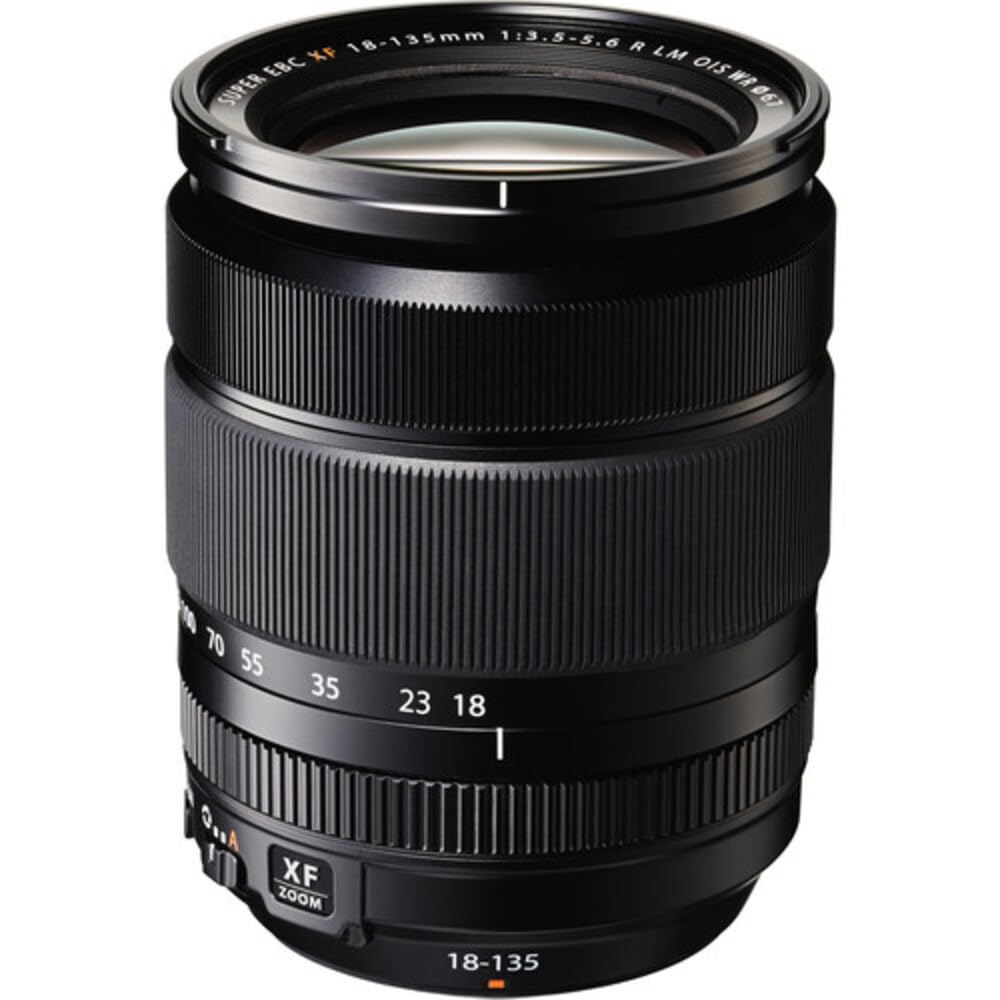
The Fujifilm XF 18-135mm f/3.5-5.6 R LM OIS WR is the definitive travel companion for Fuji X-series shooters who refuse to let rain, mist, or dust stop them. Its weather-resistant construction means you can shoot in a drizzle or near ocean spray without panic — the same can’t be said for most consumer zooms. The 5.0-stop optical image stabilization is class-leading; reviews consistently show four to five stops of real-world correction, making this the lens to leave on your X-T5 or X-S20 when you need to pack light and shoot handheld.
Optically, the lens is sharp in the center at all focal lengths, with corners softening a bit at 18mm wide open. By f/5.6 to f/8, the entire frame sharpens up nicely. Contrast and color are very good, true to the Fuji look. The 7-blade aperture gives pleasing bokeh for a slow variable-aperture zoom — not creamy like a prime, but natural-looking for portraits at 135mm. Minimum focus distance is impressively close, allowing macro-style detail shots.
The autofocus uses a linear motor (LM) that is fast, accurate, and near-silent — ideal for both stills and video. Some users note the included lens hood fits loosely and can rattle, which is a minor annoyance on an otherwise premium build. At 490g it’s heavier than the Sony counterpart, but the combination of WR sealing and 5-stop OIS makes it the most capable foul-weather zoom in the 18-135mm class.
Why it’s great
- Outstanding 5-stop image stabilization
- Weather/dust sealed for outdoor reliability
- Fast, quiet linear motor AF
Good to know
- Heavier than the Sony 18-135mm OSS
- Loose hood fit reported by multiple owners
7. VILTROX AF 135mm F1.8 LAB FE Lens for Sony E Mount
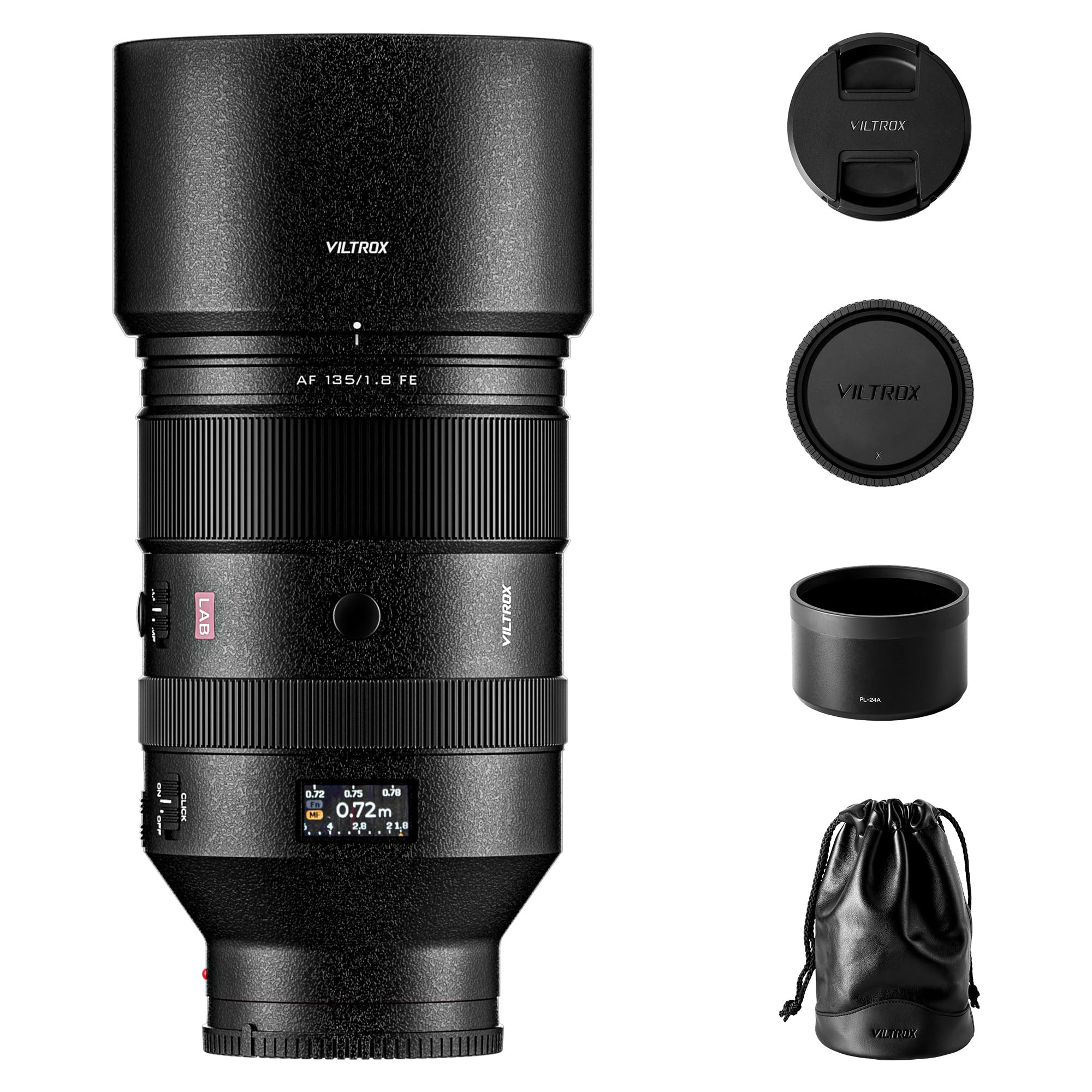
The Viltrox AF 135mm f/1.8 LAB FE is a wake-up call to the third-party lens market — it delivers Sony G-Master level sharpness and bokeh at a fraction of the flagship price. Its optical formula uses 14 elements in 9 groups, including four ED elements and two high-refractive elements, to virtually eliminate purple/green fringing even in high-contrast backlight. At f/1.8, the center is critically sharp, and the 11-blade aperture produces smooth, rounded bokeh with no onion-ring artifacts.
Autofocus is driven by Viltrox’s Quad Hyper VCM motor system, which is both fast and quiet, with reliable Eye/Face Detection tracking on Sony bodies. There’s a de-clickable aperture ring for video, two programmable Fn buttons, and a small OLED display showing aperture and focus distance — genuinely useful in low light. The all-metal, weather-sealed body feels solid and professional, weighing around 800g with a 77mm filter thread.
It’s a pure prime, not a zoom, so you lose the 18-135mm range flexibility — but if the 135mm f/1.8 aperture is what you need (portraits, events, astro, automotive), this lens competes with options costing twice as much. The only real caveat is the lack of built-in image stabilization; you’ll need a body with IBIS for rock-solid handheld shots at 135mm in dim light.
Why it’s great
- Flagship-level sharpness and bokeh at f/1.8
- Excellent build with weather sealing and OLED display
- Fast, accurate Quad Hyper VCM autofocus
Good to know
- No optical stabilization — IBIS body required
- Prime lens — no zoom versatility
11. Nikon NIKKOR Z 135mm f/1.8 S Plena Lens

The Nikon NIKKOR Z 135mm f/1.8 S Plena is, by a wide margin, the finest 135mm lens ever mounted on a Nikon Z camera — and arguably the best portrait lens in the entire Z system. The optical formula combines Nikon’s Meso Amorphous Coat and ARNEO Coat to eradicate flare and ghosting even when shooting directly into harsh light, while four ED elements keep chromatic aberration virtually nonexistent. At f/1.8, the center is tack-sharp, and the bokeh is exceptionally smooth, with rounded specular highlights that stay clean to the edge of the frame.
Autofocus uses a Multi-Focus System with dual STM stepping motors that move in sync for precise, near-silent tracking. On a Z8 or Z9, eye detection is instant and sticky, making this a legitimate choice for fast-moving portrait sessions and events. The manual focus ring can be customized for linear or non-linear response, and the clickless control ring allows smooth aperture adjustments during video. Build quality is top-tier, with a metal barrel and extensive weather sealing.
At 995g (2.19 lbs), it’s not a light lens — it demands a gripped body for balanced handheld shooting. There’s no built-in VR, so you rely on the Z-body IBIS, which works excellently. The Nikon Plena is a massive investment, but if your work demands the absolute best rendering, color fidelity, and flare control at 135mm, there is no compromise here. For most shooters, this is a dream lens, not a daily walkaround zoom.
Why it’s great
- Peerless flare resistance with Meso Amorphous + ARNEO coatings
- Exceptional sharpness and smooth bokeh wide open
- Fast, accurate dual STM autofocus with eye tracking
Good to know
- Very heavy — needs a large body for balance
- Premium price — only for need-it users
10. ZEISS Batis 135mm f/2.8 Lens for Sony E Mount
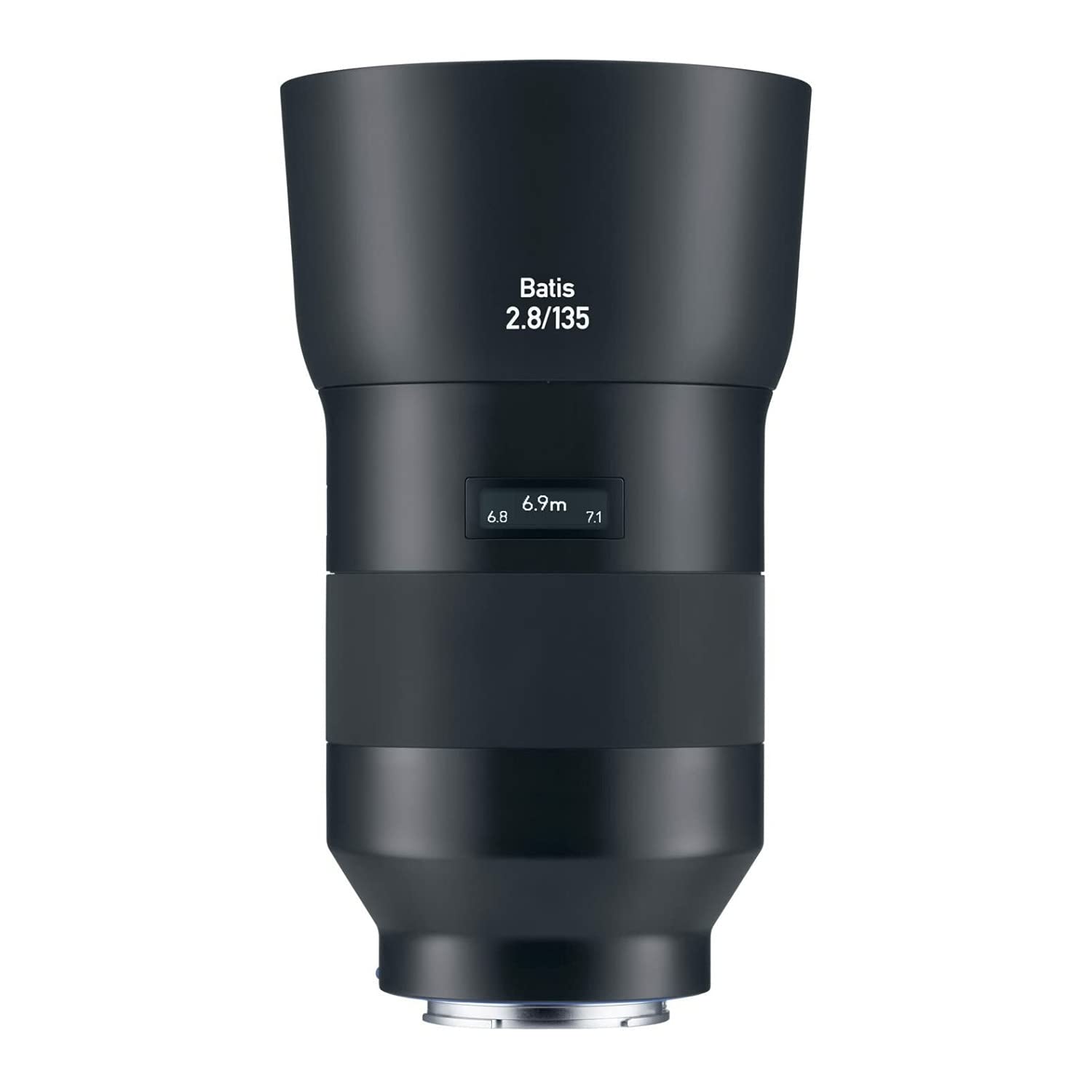
The ZEISS Batis 135mm f/2.8 is a compact medium-telephoto prime that prioritizes portability and color science above outright speed. At f/2.8, it is one stop slower than the Viltrox or Nikon competitors, but it makes up for it with ZEISS’s legendary T* anti-reflective coating, which delivers exceptionally rich, saturated colors and high contrast even in difficult mixed lighting. The 8-element, 5-group design maintains corner-to-corner sharpness at all apertures, with minimal field curvature.
A standout feature is the integrated OLED display on the lens barrel, which shows focus distance and depth of field — particularly useful for manual focusing in astrophotography or studio work. The autofocus is smooth and reliable, though not quite as fast as the latest native Sony lenses. The all-metal, weather-sealed body is robust and durable, and at 614g it’s significantly lighter than the Nikon Plena, making it a good match for A7C or A7R-series bodies without a grip.
The Batis is a specialist tool — it’s not a zoom, and f/2.8 isn’t the fastest aperture in this list, but the ZEISS color rendering, the helpful OLED, and the lightweight build make it a favorite among travel portraitists and street photographers who prize image character over sheer speed. If you want the ZEISS “pop” without the weight of an f/1.4, this is your lens.
Why it’s great
- Excellent ZEISS color and contrast rendering
- Innovative OLED distance/depth-of-field display
- Solid weather-sealed metal build
Good to know
- f/2.8 is slower than f/1.8 alternatives
- Autofocus not as fast as latest native lenses
5. Samyang 135mm F1.8 Full Frame Telephoto Lens for Sony E
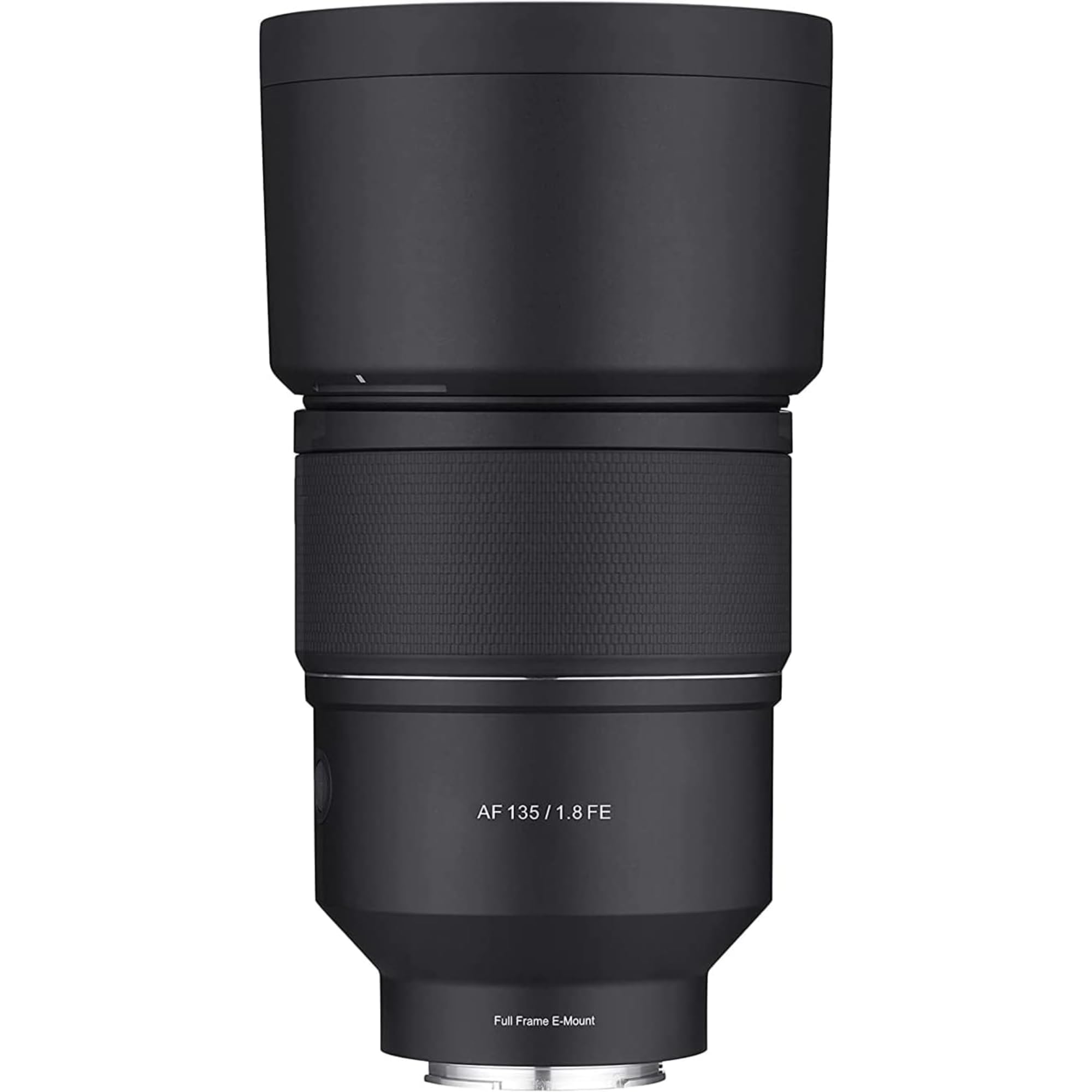
The Samyang 135mm f/1.8 AF for Sony E-mount is a potent portrait and astrophotography prime that offers excellent sharpness, smooth bokeh, and reliable autofocus at a mid-range price. The Ultra Multi-Coating (UMC) optics control flare well, and the f/1.8 aperture gathers enough light for clean star shots without requiring a tracker. The 9-blade aperture creates round, pleasing bokeh balls — important for both portraits and night sky imaging.
Autofocus is powered by a Linear STM motor, which is fast enough for most portrait and event work, with solid Eye AF support on Sony bodies. Some users report occasional focus hunting in very low contrast scenes, but for general use it’s reliable and quiet. The lens includes a Focus Hold button, a Custom Switch, and a Focus Range Limiter, giving you professional-level control without the professional-level price tag. At 772g, it’s lighter than the Viltrox but not by much.
Weather sealing is included, which adds confidence for outdoor sessions. The minimum focus distance of 0.69m allows for tight headshots with dreamy background compression. The Samyang 135mm f/1.8 is a strong contender if you want native Sony autofocus performance and f/1.8 brightness without stepping up to the G-Master price bracket. The main competition is the Viltrox, which offers a slightly more advanced motor and OLED display for a similar price.
Why it’s great
- Very sharp at f/1.8 with minimal chromatic aberration
- Reliable Eye AF and quiet STM autofocus
- Good value compared to Sony native 135mm options
Good to know
- AF can hunt in low light
- Heavier than some competitors
3. Canon EF-S 18-135mm f/3.5-5.6 is STM Lens

The Canon EF-S 18-135mm f/3.5-5.6 IS STM is the definitive one-lens solution for Canon APS-C DSLR owners, particularly those shooting with Rebel, 60D, 70D, or 90D bodies. The STM (Stepping Motor) is the key upgrade over older Canon kit zooms — it delivers smooth, quiet autofocus transitions ideal for video recording, with minimal focus breathing. Optical Image Stabilization provides around 3.5 to 4 stops of shake correction, making handheld telephoto shots viable in overcast conditions.
Optically, the 16-element, 12-group design includes a UD (Ultra-low Dispersion) element and an aspherical element to control chromatic aberration and distortion. Center sharpness is very good from f/5.6 to f/11, and corners are acceptable for a consumer zoom. The 67mm filter thread is common and affordable. The lens is compatible with Canon’s optional PZ-E1 power zoom adapter, which enables smooth zooming during video — a rare feature for this class.
One critical warning: this is an EF-S lens and cannot be mounted on Canon full-frame bodies (6D, 5D, R-series via adapter without cropping). Owners report excellent image quality and reliability after years of use, making it a solid upgrade over the basic 18-55mm kit. For Canon DSLR video shooters who want a single versatile zoom, this is the pick.
Why it’s great
- STM motor for smooth, silent video autofocus
- Good optical IS for handheld telephoto work
- Solid image quality upgrade from kit lens
Good to know
- EF-S only — not compatible with full-frame Canon bodies
- Slower aperture and less reach than RF alternatives
2. Pentax 21977 DA 18-135mm f/3.5-5.6 ED AL (IF) DC WR Lens

The Pentax DA 18-135mm f/3.5-5.6 WR is the Swiss Army knife of the Pentax system — a compact, weather-sealed zoom that covers the essential focal lengths while shrugging off rain, dust, and sand. The WR (Weather Resistant) construction allows you to shoot confidently in damp conditions that would send most consumer zooms back to the bag. The lens also features Pentax’s SP (Super Protect) coating on the front element to repel water and grease, keeping the glass clean in harsh environments.
Optically, the 13-element, 11-group design includes an ED element and an aspherical element, delivering good center sharpness with decent contrast across the range. Corners at the telephoto end are softer, which can actually produce pleasing bokeh for portraits. The 7-blade rounded diaphragm helps maintain natural-looking out-of-focus highlights. Autofocus uses a DC motor, which is quick enough for general use but not silent — there is audible whirring during focusing, noticeable in quiet settings.
The lens is compact at 405g, balances well on K-5, K-3, and K-70 series bodies, and includes a useful Quick-Shift focus override for fine-tuning. It’s an excellent upgrade path from the 18-55mm kit lens, giving you a 27-200mm equivalent range on K-mount bodies. The main downsides are the variable aperture and softer corners at the telephoto end, but for outdoor adventurers who need one weatherproof zoom, the Pentax 18-135mm WR is the clear choice.
Why it’s great
- Full weather resistance for rain, sand, and dust
- Compact and lightweight for an all-conditions zoom
- Good center sharpness with useful Quick-Shift focus
Good to know
- DC motor is audible during video recording
- Softer corners at the telephoto end
1. Nikon 18-135mm f/3.5-5.6G ED-IF AF-S DX Zoom-Nikkor Lens
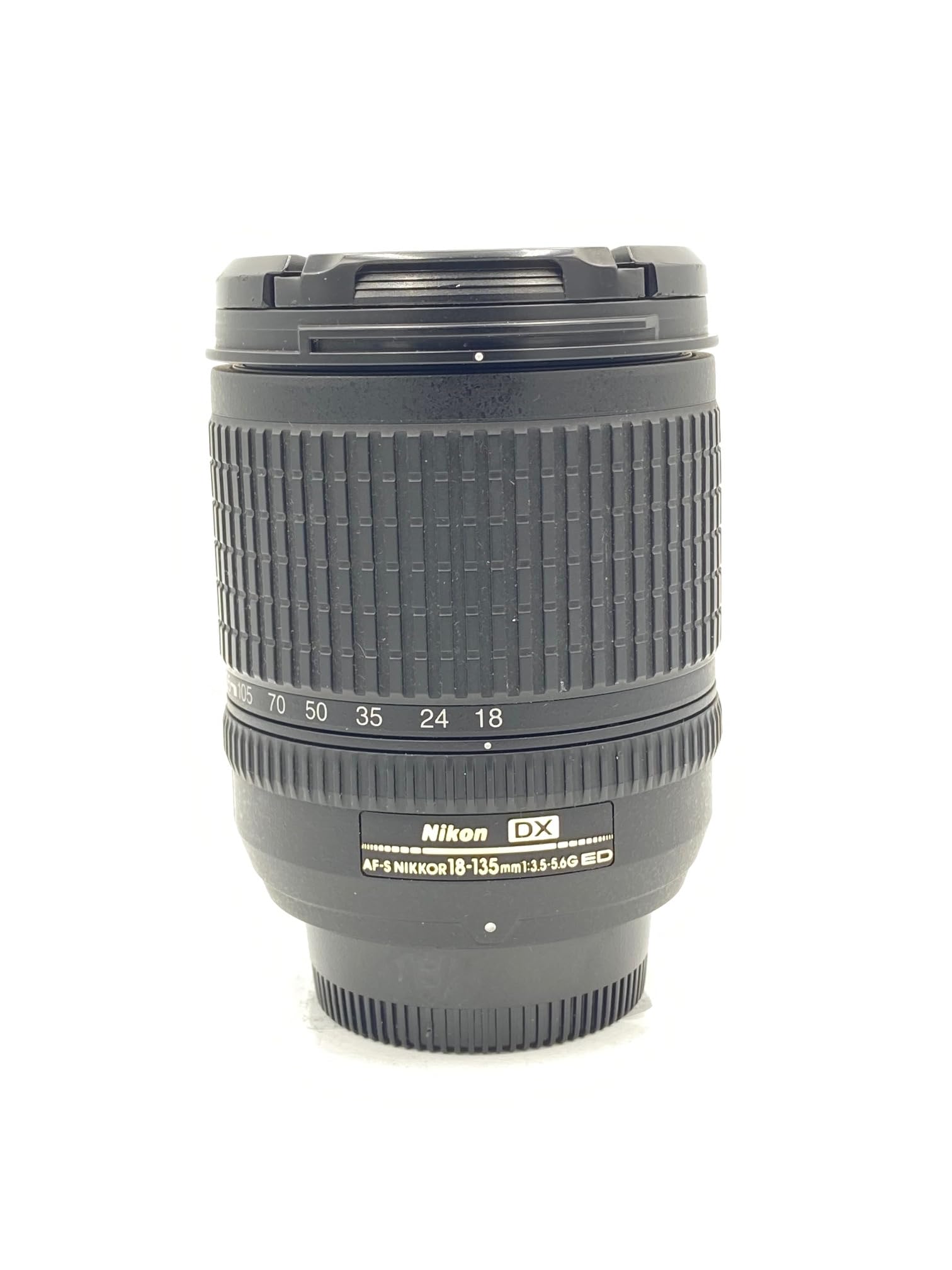
The Nikon 18-135mm f/3.5-5.6G ED-IF AF-S DX is a veteran of the Nikon DX system, offering a 7.5x zoom range that covers 27-202mm equivalent on a full-frame scale — enough for landscapes, street photography, and candid portraits with a single lens. It’s built around an Extra-low Dispersion (ED) glass element that helps control chromatic aberration, resulting in cleaner images than the basic 18-55mm kit lens, especially at the telephoto end. The 7-blade rounded diaphragm produces smoother out-of-focus highlights than older Nikon kit lenses.
Autofocus uses Nikon’s AF-S (Silent Wave Motor) system, which is fast and quiet, suitable for both stills and casual video. The 67mm filter thread is standard and affordable. At 385g, it’s the lightest lens in this roundup, making it an effortless daily carry on a D300, D3100, D5300, or D7200 body. The minimum focus distance of 1.47 feet (0.45m) throughout the entire zoom range is a nice bonus for close-up detail shots.
However, this lens is a budget-tier option with real compromises. There’s no image stabilization (VR), so you’ll need a tripod or high shutter speeds at 135mm. The aperture is slow at f/5.6 on the long end, limiting low-light performance. Some users report the manual focus ring can feel loose and overshoot. For Nikon DX shooters on a tight budget who need a huge zoom range in a lightweight package, this is a capable choice — but the lack of VR and variable aperture means it’s best used in good light.
Why it’s great
- Extremely light at 385g for a 7.5x zoom
- ED glass element reduces purple/green fringing
- Fast, quiet AF-S motor
Good to know
- No image stabilization — tripod needed at telephoto end
- Slow f/5.6 aperture at 135mm limits low-light use
4. Rokinon 135mm F2.0 ED UMC Telephoto Lens for Canon
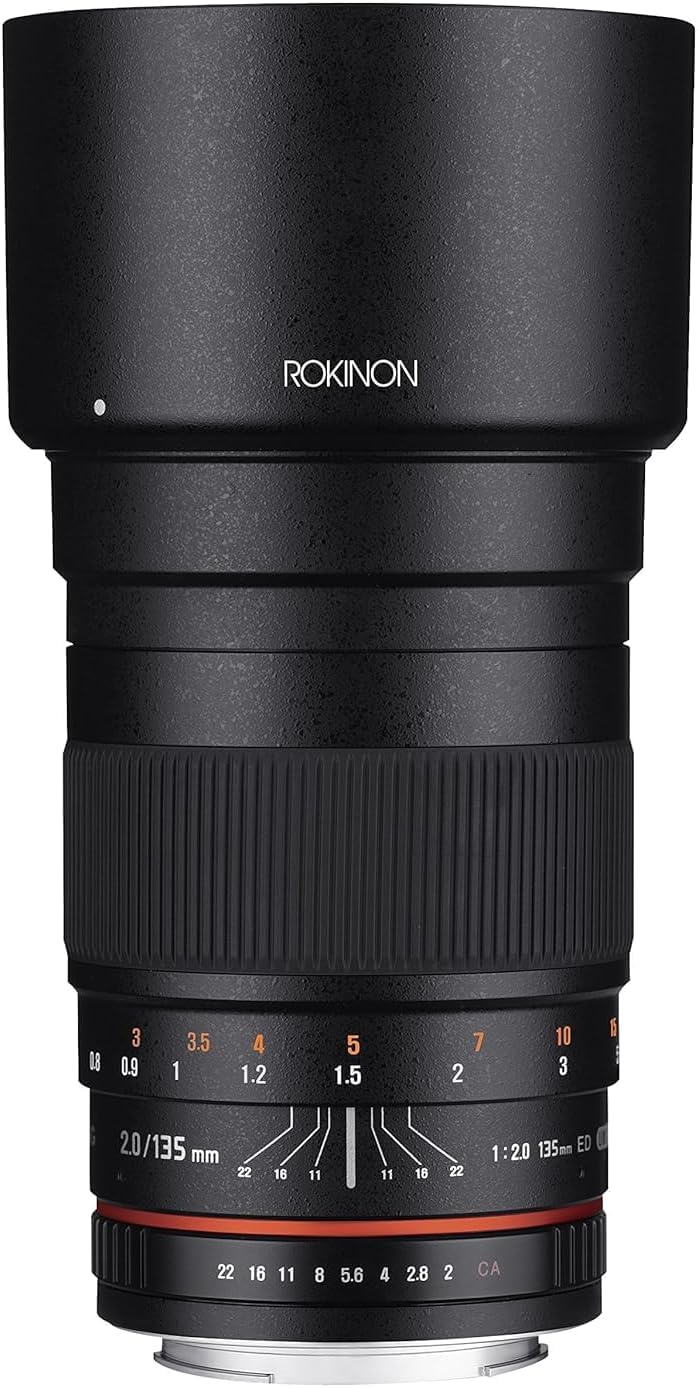
The Rokinon 135mm f/2.0 ED UMC is a manual-focus telephoto prime that has become legendary in the astrophotography community for delivering near-APO-level optical performance at a budget-friendly price. The f/2.0 aperture gathers significant light, and the ED element combined with Ultra Multi-Coating keeps chromatic aberration, coma, and astigmatism in check — even wide open. For wide-field deep-space imaging on a tracking mount, this lens resolves stars cleanly into the corners with minimal color shift across filters.
The build is all-metal with a smooth, damped focus ring that has a long throw for precise manual focusing, which is essential for astro work. The 9-blade diaphragm creates pleasing bokeh for terrestrial use as well. However, major copy variation has been reported — some units are optically excellent, while others have decentered elements or other issues. Since Rokinon doesn’t always offer exchange, it’s recommended to buy from a vendor with a good return policy and test rigorously upon arrival.
For portrait use on APS-C bodies, the 135mm f/2.0 field of view becomes quite tight (approx 200mm equivalent), which can be too close for comfortable head-and-shoulders framing in small spaces. On full-frame, the angle is ideal. There’s no autofocus and no image stabilization, so this lens is strictly for deliberate shooting — tripod-level landscape, astro timed exposures, and studio portrait work where manual focus is acceptable.
Why it’s great
- Excellent coma and chromatic aberration control for astrophotography
- Very fast f/2.0 aperture for light gathering
- Solid all-metal build with smooth focus ring
Good to know
- Manual focus only — not for action or video
- Significant copy variation reported in user reviews
6. Canon RF100-400mm F5.6-8 is USM Telephoto Lens

The Canon RF 100-400mm f/5.6-8 IS USM is a lightweight super-telephoto zoom for Canon EOS R-series mirrorless cameras, offering a 100-400mm range that turns into a 160-640mm equivalent on APS-C RF bodies like the R7. The Nano USM autofocus is fast, near-silent, and smooth — excellent for tracking birds, aircraft, and wildlife. The optical image stabilization delivers up to 5.5 stops of shake correction on its own, or up to 6 stops when paired with an R-series body that has IBIS, allowing sharp handheld shots at 400mm.
Optically, the lens is sharp at the center across the zoom range, with decent resolution at 400mm f/8. The minimum focus distance of 2.89 feet at 200mm and 0.41x magnification at 400mm allows impressive close-up shots of small subjects. The 67mm filter thread is common. The lens is notably compact and lightweight for a 400mm zoom, making it a favorite for hiking and travel birding.
The critical weakness is the slow variable aperture: maximum f/8 at 400mm means you’ll need bright daylight or high-ISO settings to maintain fast shutter speeds. In overcast or woodland conditions, noise becomes an issue. There’s no weather sealing, so this isn’t a lens for heavy rain. For R-series shooters who need a long reach in good light without the weight of a pro telephoto, the RF 100-400mm is a smart, lightweight solution.
Why it’s great
- Excellent stabilization up to 6 stops with IBIS
- Lightweight and compact for a 400mm telephoto
- Fast, quiet Nano USM autofocus
Good to know
- Very slow f/8 aperture at 400mm limits low-light use
- No weather sealing for outdoor durability
FAQ
Is an 18-135mm lens good for portraits?
Does the 18-135mm lens work on full-frame cameras?
What is the difference between STM and DC autofocus motors in 18-135mm lenses?
Final Thoughts: The Verdict
For most users, the best 18-135 lens winner is the Sony 18-135mm f/3.5-5.6 OSS because it combines the sharpest optical design in the class with effective stabilization and a very lightweight body, making it the ultimate one-lens solution for Sony E-mount shooters. If you want weather sealing and extreme stabilization for outdoor adventures, grab the Fujifilm XF 18-135mm R LM OIS WR. And for portrait/astro shooters who can trade zoom range for speed, nothing beats the VILTROX AF 135mm f/1.8 LAB in value and image quality.