
Newspapers turn yellow. Photos fade. Documents become brittle. The culprit is acid migration from the boxes you thought were safe. Not all cardboard is created equal, and the wrong storage box can accelerate the very decay you’re trying to prevent.
I’m Min — the co-founder and writer behind Gadgets Feed. I specialize in breaking down the technical specifications and material science behind consumer storage products, analyzing hundreds of hours of user reports to separate genuinely archival solutions from ordinary cardboard in disguise.
This guide cuts through the marketing to find the true best archival storage boxes that meet museum-grade standards for material safety, structural integrity, and long-term preservation.
How To Choose The Best Archival Storage Boxes
The term “archival” gets thrown around loosely. For true preservation, you need specific material certifications and construction details. Here are the three factors that separate a storage box from a preservation system.
Board Quality: The Acid and Lignin Test
The board stock is the single most important spec. Look for “acid-free” and “lignin-free” on the package. Acid causes paper to yellow and become brittle; lignin is a wood compound that breaks down into acid over time. A true archival box uses a 60-point board (meaning 0.060 inches thick) that is buffered with an alkaline reserve to neutralize any future acid exposure from the contents themselves. Cheaper boxes skip the buffer or use lower-point (thinner) board that can warp or tear.
Construction: Metal Edges and Clamshell Design
Flat board alone crushes under stacking weight. Look for metal edge corners that reinforce the box against compression. The closure mechanism matters too — a clamshell lid with a tight-fitting deep lid prevents light and dust from entering while allowing full access. Boxes with lift-off lids can work, but they often settle slightly crooked over years of stacking. A true clamshell preserves the rectangular shape and even weight distribution.
Size Matching and Intended Contents
An archival box that is too large lets contents slide and bend; one that is too small forces you to fold documents. Match the interior dimensions to your specific media: standard letter documents fit 12.5″ x 10.5″ boxes, while large maps or newspapers need at least 13″ x 18″ interiors. For fragile slide collections, look for a drop-front outer box with internal file cases to keep individual slides separate and supported.
Quick Comparison
On smaller screens, swipe sideways to see the full table.
| Model | Category | Best For | Key Spec | Amazon |
|---|---|---|---|---|
| Gaylord Archival Blue/Grey Clamshell Preservation Box | Premium Clamshell | Museum-grade photo and document storage | 10.25″W x 12.25″L x 3″H, PAT Passed | Amazon |
| Gaylord Archival Newspaper Preservation Box | Oversize Premium | Storing full-size newspapers and posters | 13″W x 18″L x 3″H, Metal Edge | Amazon |
| Lineco Archival Document Storage Box | Versatile Mid-Range | Everyday letter-size document filing | 12.5″ x 10.5″ x 5″, 60pt Boxboard | Amazon |
| Golden State Art Archival Folio Storage Box 11×14 | Budget Folio | Larger prints and flat artwork | 11″ x 14″ x 1.75″, 60pt Board | Amazon |
| Golden State Art Archival Folio Storage Box 9×12 | Compact Folio | Standard photo sizes and small documents | 9″ x 12″ x 1.75″, 60pt Board | Amazon |
| Lineco Archival Slide Storage Box | Specialized Slide | Organizing 35mm slide collections | 15.5″W x 11.5″D, Holds up to 840 slides | Amazon |
| Bankers Box 12-Pack Medium Duty File Storage Boxes | Bulk Utility | High-volume document storage for offices | 25.4″L x 12.9″W, 650lb Stacking Strength | Amazon |
In‑Depth Reviews
1. Gaylord Archival Blue/Grey Clamshell Preservation Box

This box earns its premium status by passing the Photographic Activity Test, the industry gold standard for verifying that storage materials won’t chemically damage photos over decades. The 60-point barrier board is buffered to neutralize future acid migration, and the deep blue-grey clamshell lid fits tightly to block out dust and damaging light.
At 10.25 inches wide by 12.25 inches long and 3 inches deep, it comfortably accommodates magazines, prints, and family photo albums. Users report it holds an entire album’s worth of acid-free sheet protectors without warping, and the clamshell design allows the box to open completely flat for easy browsing of contents.
The main trade-off is the engineered wood construction, which makes the box slightly heavier than fiberboard alternatives. It also lacks metal edge reinforcement, though user reviews across hundreds of units indicate the dense 60-point board resists crushing well under normal shelf stacking.
Why it’s great
- Passes Photographic Activity Test for true museum-grade safety
- Buffered to resist acid migration, protecting your documents for decades
- Deep lid seal keeps out light and dust effectively
Good to know
- Engineered wood construction is heavier than boxboard
- No metal edge reinforcement on the corners
2. Gaylord Archival Blue/Grey Newspaper Preservation Box

Newspapers from the 1930s and 1940s are wider than modern letter-size paper, often exceeding 15 inches across. This box measures 13 inches wide by 18 inches long and 3 inches deep, giving you room to lay full broadsheets flat without folding the fragile edges. The lift-off lid design seals deeply to block dust.
Gaylord Archival uses acid-free, lignin-free paperboard with a pH of 8.0-9.0, buffered to resist the acid migration that turns newsprint brown. The metal edge corners add crucial reinforcement — oversize boxes with long spans are prone to bowing under weight, and these corners prevent the collapse that thinner boxes suffer.
User reports confirm it works well for storing concert posters, vintage maps, and even a valuable gown. The lift-off lid separates entirely from the box, which is a minor inconvenience compared to a hinged clamshell, but the deep lid fit ensures contents stay fully protected from ambient light.
Why it’s great
- Large interior fits full broadsheet newspapers and oversized prints
- Metal edge corners prevent crushing and bowing on long box spans
- Buffered to pH 8.0-9.0 to neutralize acid from aging newsprint
Good to know
- Lift-off lid is separate from the base, less convenient than clamshell
- Best used with acid-free tissue paper or sleeves for multiple newspapers
3. Lineco Archival Document Storage Box with Metal Edge

Lineco is trusted by museums and archives, and this letter-sized box demonstrates why. At 12.5 inches long by 10.38 inches wide and 5 inches deep, it has a generous interior that accommodates not just letter documents but magazines, stamp collections, and small prints. The 5-inch depth is significantly deeper than the standard 3-inch folio boxes, allowing you to store more per unit.
The 60-point gray boxboard is acid-free, lignin-free, and buffered, with metal edge corners for stacking strength. A unique attached nylon string runs along the side of the box, making it easy to pull from a tight shelf. Users report storing grandfather’s newspapers from the 1930s perfectly flat, with the box holding its rectangular shape without sagging.
A critical note from user feedback: this box frequently arrives shipped in a plastic bag rather than a protective carton, leading to corner damage in transit. Ordering one or two is usually fine, but larger orders would benefit from contacting the seller to request box-in-box shipping.
Why it’s great
- 5-inch depth provides more usable volume than standard 3-inch folio boxes
- Attached nylon string makes shelf extraction easy without damaging the box
- Metal edges and 60-point board deliver genuine stacking strength
Good to know
- Shipping in a plastic bag can lead to corner damage
- Box is slightly narrower than some letter-file hangers, check fit
4. Golden State Art Archival Folio Storage Box 11×14

If you have 11×14 prints, oversize greeting cards, or scrapbook pages, this Golden State Art box provides a precise fit without wasted interior space. The outside dimensions of 11 inches by 14 inches with a 1.75-inch depth match the standard print size, so your artwork sits flat without sliding around.
Constructed from 60-point archival boxboard with metal edge corners, the clamshell design includes a thumb-cut for easier opening. The board is acid-free, lignin-free, and manufactured in the USA. Users report storing over 50 various-sized family portraits safely, with the clamshell lid preventing the warping that happens with lift-off designs under humidity shifts.
The main limitation is the 1.75-inch depth, which restricts capacity to roughly 1-2 inches of flat content. If you plan to store bulkier items or multiple thick albums in one box, consider the Lineco or Gaylord options with deeper interiors.
Why it’s great
- Precision fit for standard 11×14 prints prevents content shifting
- Thumb-cut clamshell lid opens easily without prying
- 60-point board with metal corners resists compression
Good to know
- 1.75-inch depth is shallow for bulky items
- Some units arrive with minor cosmetic imperfections
5. Golden State Art Archival Folio Storage Box 9×12
For standard 8×10 photos, 9×12 documents, and greeting cards, this compact box offers a tailored fit without excess interior space. Its outside dimensions are 9 inches by 12 inches by 1.75 inches deep, which matches the common photo print envelope size perfectly.
Like its larger sibling, this box uses 60-point archival boxboard with metal edge corners and a clamshell lid. The acid-free and lignin-free board is made in the USA, and the gray color won’t leach dyes into your contents. Users praise its sturdy construction, with one reviewer noting it safely stored over 50 family portraits without bending.
The shallow 1.75-inch depth works well for flat collections but limits you to thin items. Customer feedback also mentions occasional shipping damage — some units arrive with crushed corners. Given the low per-unit cost, ordering an extra box to account for potential damage is a practical approach.
Why it’s great
- Compact size perfectly matches standard 8×10 photo prints
- Sturdy clamshell design with metal edge reinforcement at a low cost
- Acid-free, lignin-free board provides true archival safety
Good to know
- 1.75-inch shallow depth limits capacity
- Product arrives in soft packaging, risking corner damage
6. Lineco Archival Slide Storage Box

This is a niche solution for a specific pain point: organizing hundreds of 35mm slides that spill out of carousel trays plastic pages. The outer box measures 15.5 inches by 11.5 inches by 3 inches, with a drop-front design that provides easy access to six individual inner file cases stored inside.
Each inner case is made from 40-point unbuffered tan boxboard, which is lignin-free and acid-free. The unbuffered construction matters for slide film — buffered paper can sometimes interact with photographic emulsions over very long periods, so the unbuffered approach is a deliberate safety measure. The outer box has metal-reinforced corners and can hold up to 840 slides total.
Users report consolidating 13 carousel boxes into one compact unit, with labeled dividers making organization straightforward. The main drawback is the per-box cost — for large collections of 4,000+ slides, the total investment becomes substantial, though users consistently rate it as the best alternative to plastic pages or loose slide trays.
Why it’s great
- Consolidates 13 carousel trays into one 15.5-inch box
- Unbuffered acid-free board is safest for photographic slides
- Six inner file cases with dividers for indexed organization
Good to know
- Cost per box is high for large collections
- Unbuffered board means no acid protection for non-photo items
7. Bankers Box 12-Pack Medium Duty File Storage Boxes
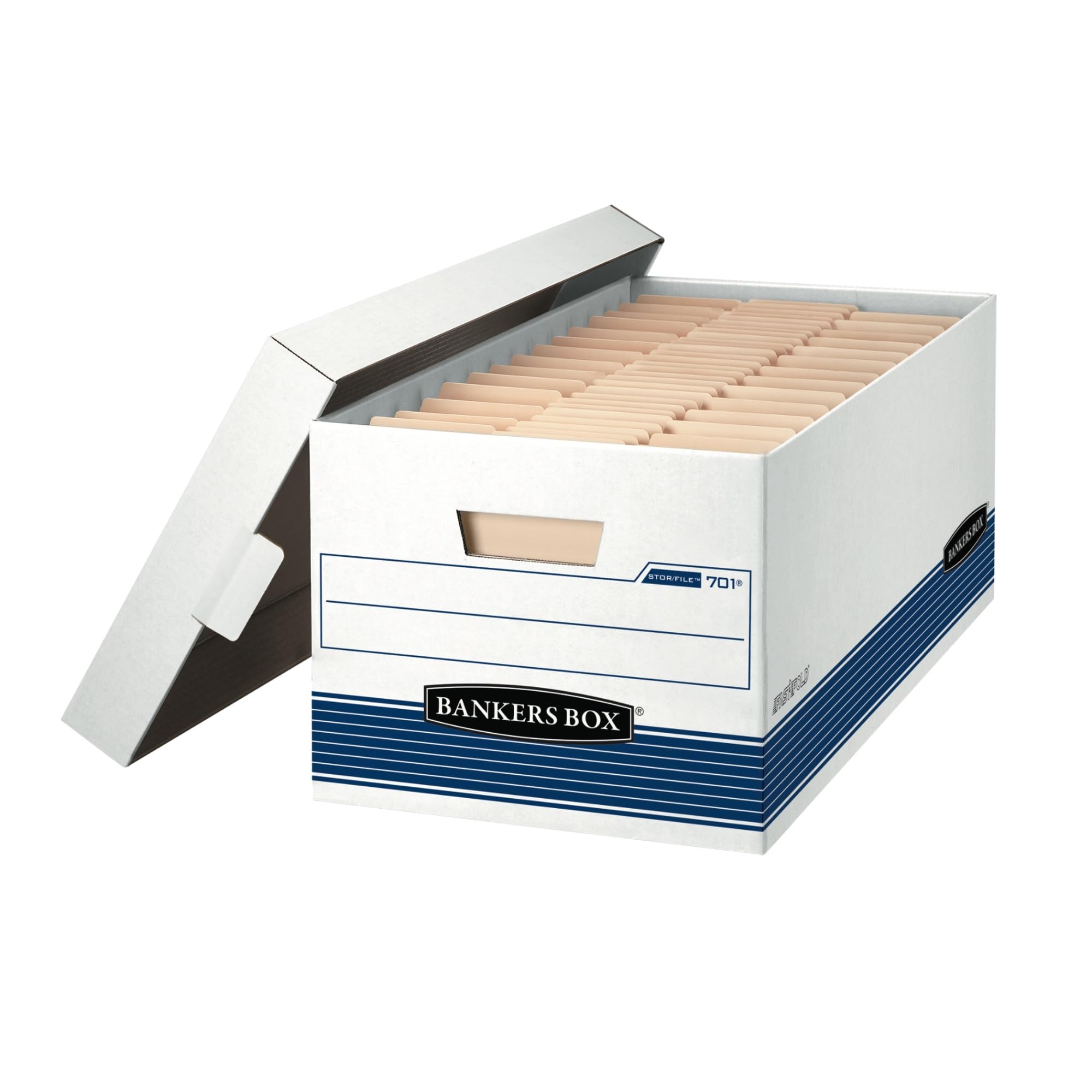
This 12-pack is the volume solution when you need to store large quantities of letter-size documents that are not sensitive to long-term acid exposure — think five-year-old tax returns, archived client files, or seasonal inventory records. The FastFold assembly pops open in seconds without tape, which saves considerable time during large-scale organization projects.
The corrugated construction offers a 650-pound stacking strength, meaning you can stack these boxes ten high without worrying about collapse. The lift-off locking lid keeps contents dust-free during storage. Each box measures 25.38 inches long by 12.88 inches wide by 10.25 inches deep, with built-in reinforced hand holes for carrying.
This is not an archival product in the strict sense — the corrugated board is not acid-free or lignin-free, and it does not have the 60-point density or metal edge reinforcement of true archival boxes. For items you need to preserve for decades, use one of the Lineco or Gaylord entries above. For bulk storage of non-critical documents, this is the most cost-effective option.
Why it’s great
- 12-pack provides the lowest per-box cost for high-volume needs
- FastFold assembly requires no tape or tools
- 650lb stacking strength supports dense shelf organization
Good to know
- Corrugated board is not acid-free or archival-quality
- Not suitable for long-term preservation of sensitive materials
FAQ
Can I store digital prints in a standard archival box?
What’s the difference between a clamshell box and a lift-off lid box?
How often should I replace archival storage boxes?
Final Thoughts: The Verdict
For most users, the best archival storage boxes winner is the Gaylord Archival Blue/Grey Clamshell Preservation Box because it passes the PAT test, uses 60-point buffered barrier board, and provides a tight clamshell seal at a reasonable tier for serious preservation. If you need to store oversize newspapers or artwork, grab the Gaylord Archival Newspaper Preservation Box with its metal edge corners and 13×18 inch interior. And for a specialized slide collection, nothing beats the Lineco Archival Slide Storage Box with its six inner cases and unbuffered board designed for photographic film safety.