
Bagged soil from big-box stores often arrives as a lifeless, sterile base that forces you to add fertilizers from day one. True amended organic soil skips that cycle—it arrives already charged with composted nutrients, worm castings, and minerals that feed roots immediately, not after a week of chemical breakdown.
I’m Min — the co-founder and writer behind Gadgets Feed. My research focuses on deconstructing bagged mixes by their carbon-to-nitrogen ratios, aeration matrix, and microbial density to separate genuine organic blends from glorified peat moss.
Whether you’re refreshing raised beds or potting up heavy-feeding tomatoes, your choice of best amended organic soil determines whether you’ll be reaching for a fertilizer bottle in two weeks or watching roots explode through a ready-to-grow medium.
How To Choose The Best Amended Organic Soil
A bag labeled “organic potting soil” can hide a lot of inert filler. You need to look past the front-label claims and examine what’s actually inside—the base material, the nutrient sources, and the particle size distribution.
Base Medium: Peat Moss vs. Coco Coir
Sphagnum peat moss holds water well but is acidic (pH 3.5–4.5), requiring lime to balance. Coco coir has a near-neutral pH, resists compaction, and rehydrates faster after drying out—but it does not contain inherent nutrients. A premium amended organic soil blends both or picks one based on the intended crop. For water-sensitive plants like succulents, coir-heavy mixes drain better; for moisture-loving vegetables, peat-heavy blends retain longer.
Nutrient Sources: Read the Ingredient List
Authentic organic amendments come from things like worm castings (microbe-rich), kelp meal (trace minerals), fish bone meal (phosphorus), oyster shell (calcium), and bat guano (nitrogen). Avoid bags that only list “compost” without specifying what was composted. If the first ingredient is generic “forest products” or “bark,” the bag is mostly filler with a sprinkle of organic certification dust.
Aeration and Drainage
Compacted soil suffocates roots. Look for perlite, pumice, or vermiculite in the mix—these create air pockets. Some high-end blends also use rice hulls or expanded shale. A 10% to 20% aeration component by volume is ideal for container plants; in-ground beds can handle a higher organic fraction with less perlite.
Quick Comparison
On smaller screens, swipe sideways to see the full table.
| Model | Category | Best For | Key Spec | Amazon |
|---|---|---|---|---|
| FoxFarm Ocean Forest | Premium | All-purpose container plants | 1.5 cu ft / 34 lbs | Amazon |
| Coast of Maine Bar Harbor Blend | Premium | Container veggies & flowers | 16 Qt / lobster & crab meal | Amazon |
| Brut Organic Potting Soil | Mid-Range | Indoor & outdoor all-purpose | 21 Qt / worm castings + Azomite | Amazon |
| Coast of Maine Tomato & Vegetable | Premium | Tomatoes & heavy feeders | 20 Qt / composted manure | Amazon |
| Vermont Compost Fort Vee | Premium | Seed starting & soil blocks | 20 Qt / compost + vermiculite | Amazon |
| Roots Organics Coco Fiber | Premium | Hydroponic & high-yield grows | 1.5 cu ft x2 / low EC coco | Amazon |
| Avalution Coconut Coir Bricks | Budget-Friendly | Custom soil mixing from dry bricks | 36 Qt expanded / pH balanced | Amazon |
In‑Depth Reviews
1. FoxFarm Ocean Forest Potting Soil
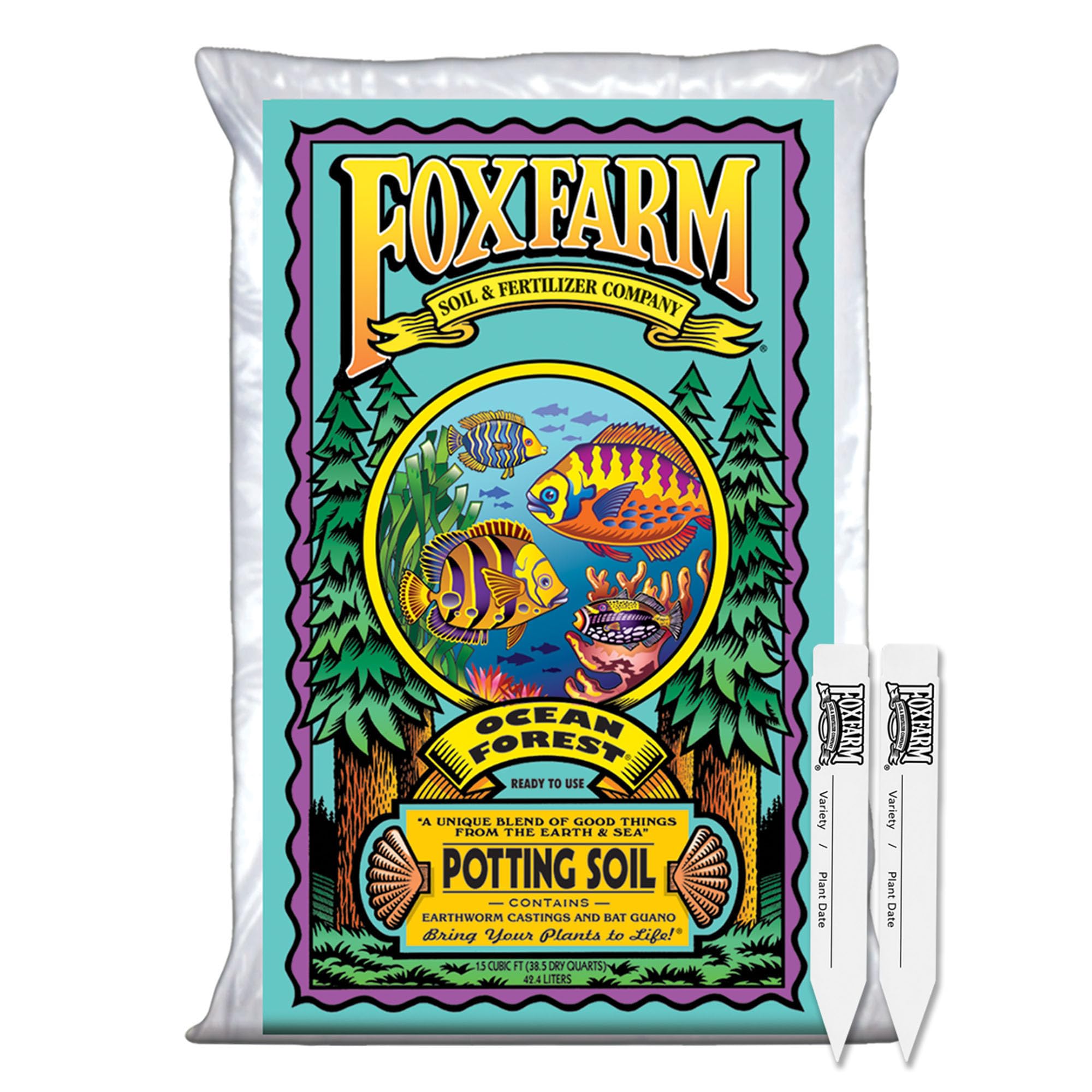
The FoxFarm Ocean Forest bag is the benchmark that other organic soils are measured against. Its blend of aged forest products, sphagnum peat moss, perlite, and sandy loam creates a light, aerated texture that absorbs water immediately—no waiting for the surface to puddle before it sinks in. The fertilizer charge from fish emulsion, crab meal, shrimp meal, earthworm castings, kelp meal, and oyster shell provides a complete nutrient profile for at least 30 days of heavy growth.
At 1.5 cubic feet and 34 pounds, this is a dense, moisture-retentive mix that works straight out of the bag for tomatoes, peppers, and ornamentals alike. Multiple customer reports note that plants started in Ocean Forest visibly outpace identical seeds in generic potting mixes, with deeper root development and darker leaf color within the first two weeks. The sandy loam component is a standout—it provides structural stability that prevents the soil column from collapsing in deep containers.
The only real friction is the price per bag, which has climbed steadily. Experienced growers often recommend blending Ocean Forest with a more neutral base like coco coir or a budget mix to extend the volume while retaining its nutrient punch. If you only buy one premium bag this season, this is the one to grab.
Why it’s great
- Immediate water absorption with no surface runoff
- Complete organic nutrient charge from multiple marine and worm sources
- Sand-based drainage prevents root rot in deep containers
Good to know
- Premium pricing may require blending with a cheaper base for large projects
- Some batches can be overly rich for very sensitive seedlings
2. Coast of Maine Bar Harbor Blend Potting Soil
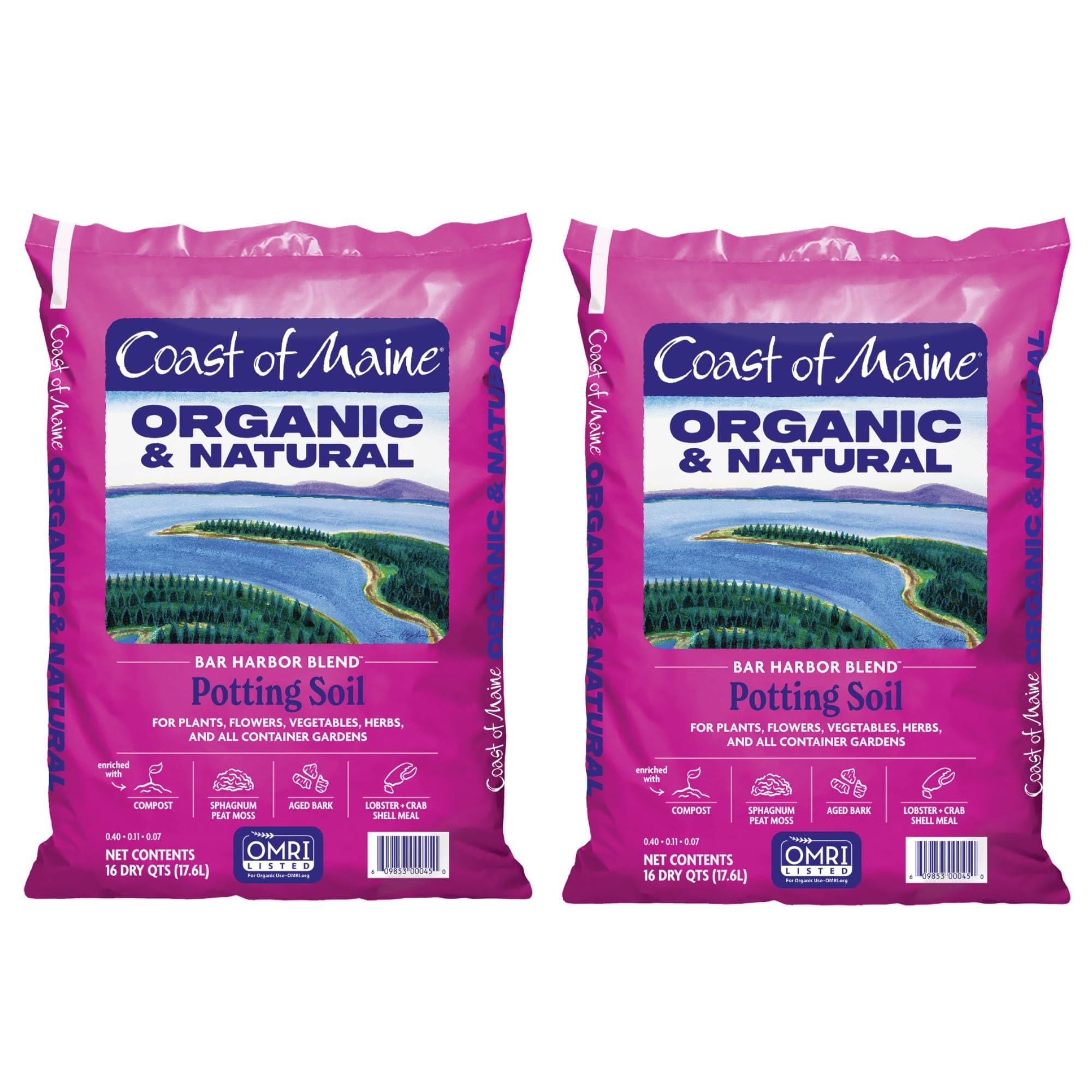
Coast of Maine’s Bar Harbor Blend leverages a unique regional resource: lobster and crab shell meal. These crustacean shells provide a steady-release source of calcium and chitin, which naturally suppresses certain soil-borne fungal pathogens while feeding the plant. The base is sphagnum peat moss and compost, giving the mix a dark, rich color that signals high organic matter content.
Perlite content is generous enough that the bag feels noticeably lighter and fluffier than some competitors. This makes it ideal for hanging baskets and container vegetables where air circulation at the root zone is critical. Customers consistently highlight that the soil has no “weeds” sprouting from it—an indication that the compost was properly heat-treated to kill seeds. The natural slow-release nitrogen from the kelp meal reduces the need for supplemental feeding during the first month.
On the downside, the 16-quart bag is smaller than a standard 1.5-cubic-foot bag, so if you are filling large raised beds you will need multiple units. But for container-specific growers who want a proven, regionally-sourced organic mix with built-in pest suppression, this is a superb choice.
Why it’s great
- Crustacean meal provides natural calcium and organic pest suppression
- Light, fluffy texture with excellent perlite distribution
- No weed seeds or filler bark in the compost fraction
Good to know
- Smaller bag size requires multiple units for large garden beds
- Nutrient density may still need supplemental feeding for very long-season crops
3. Brut Organic Potting Soil
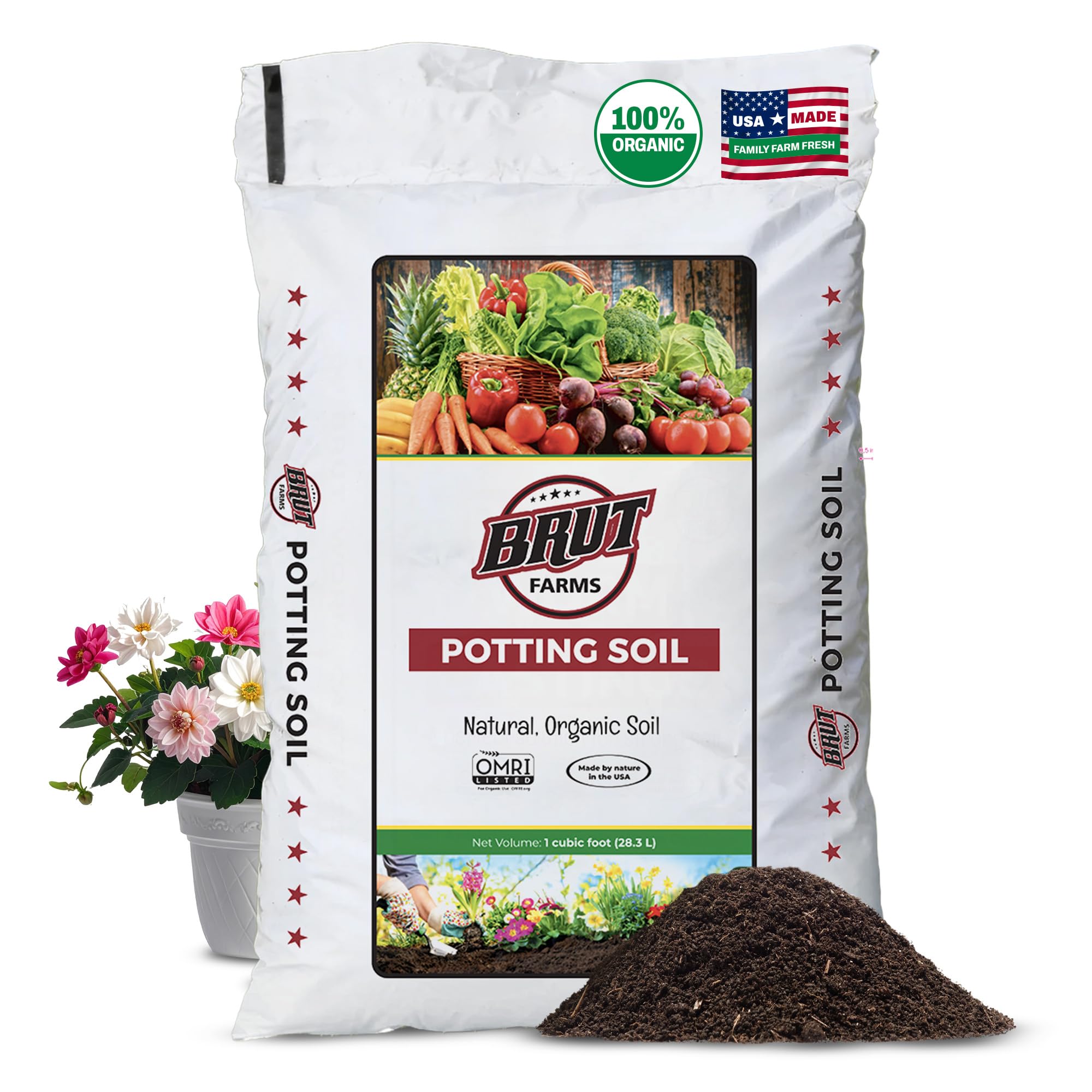
Brut Organic Potting Soil is a filler-free blend that leads with microbe-rich worm castings and trace minerals from Azomite and kelp. The bag lists no sticks, no wood chips, and no artificial additives—a claim that matches what customers actually find when they open it. The particulate size is finer than average, making it pleasant to handle and ideal for small containers and indoor pots where large bark chunks would look messy.
The OMRI listing confirms the organic integrity, and the pH is pre-balanced between 6.3 and 6.5, which is the sweet spot for most vegetables and houseplants. Several home gardeners reported that their raised beds and cherry trees showed dark green growth within days of transplanting, which points to a biologically active mix. The 21-quart volume sits right in the middle of the range, balancing cost per bag with enough material to refresh several large pots.
Where Brut stumbles is the higher per-quart cost compared to larger bulk bags. If you are on a tight budget and need to fill deep raised beds, you may find better value in the dry coco coir bricks below. But if you want a ready-to-use organic mix with zero filler and a proven microbial charge, Brut delivers.
Why it’s great
- Fine, uniform texture with no sticks or bark filler
- OMRI-listed with a proven microbial boost from worm castings
- Pre-adjusted pH saves guesswork for beginner growers
Good to know
- Premium per-quart cost compared to larger bulk alternatives
- Some users report the fine material can compact slightly if overwatered
4. Coast of Maine Tomato & Vegetable Planting Soil
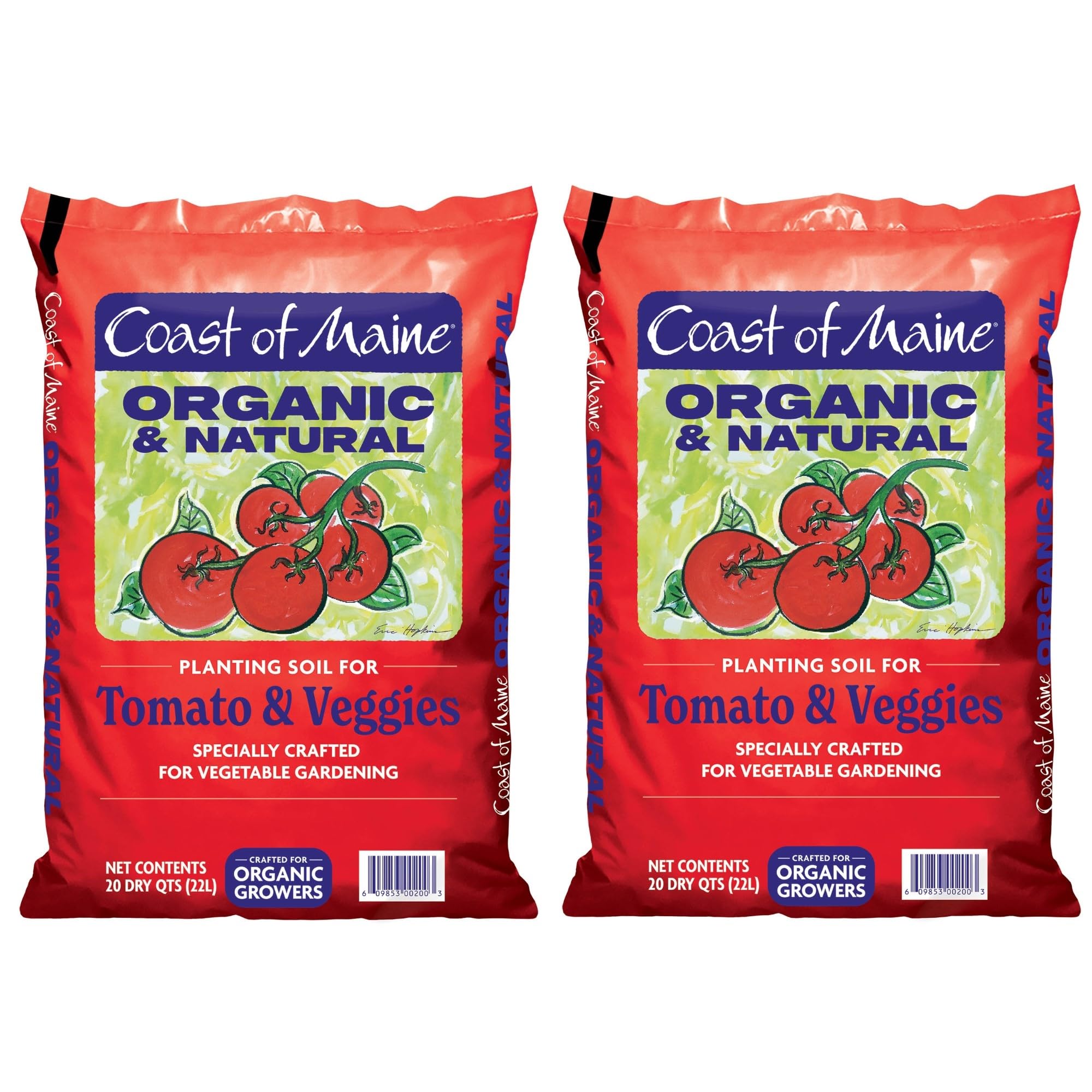
Targeted specifically at fruiting crops, Coast of Maine’s Tomato & Vegetable soil uses composted manure as its primary nutrient engine rather than peat moss alone. This gives it a higher initial nitrogen kick that encourages leafy growth before plants shift energy into fruit production. The addition of sphagnum peat moss balances the density, creating a mix that holds moisture well but still drains freely—a tricky balance that is essential for preventing blossom-end rot in tomatoes.
The bag also contains cedar and aromatic wood particles that act as a natural insect deterrent, a thoughtful addition for outdoor containers where soil-borne pests are common. Customers growing heirloom tomatoes report excellent results, with deep root systems and minimal transplant shock. The soil is lightweight enough for container gardening yet dense enough to provide physical support for staked plants.
Some users have noted fungus gnat issues when the bag is stored warm, which can happen with any compost-heavy mix. A preventative top layer of sand or gravel solves the problem cleanly. For dedicated tomato and pepper growers who want a specialized amendment blend, this is a top-tier choice.
Why it’s great
- Composted manure base provides high nitrogen for leafy growth and fruit set
- Cedar/aromatic wood deters soil insects naturally
- Lightweight mix that still offers physical root stability for tall plants
Good to know
- Compost-heavy mixes can attract fungus gnats if stored incorrectly
- Higher price per quart makes it less economical for non-fruiting plants
5. Vermont Compost Company Fort Vee Organic Potting Mix

Vermont Compost Company’s Fort Vee stands out because it was designed specifically for seed starting and soil blocks, not just generic container growing. The blend includes composted manure and plant materials, blonde sphagnum peat moss, crushed granite and basalt for trace mineral content, blood meal, kelp meal, steamed bone meal, gypsum, and vermiculite. The resulting mix is light, fluffy, and holds its shape perfectly when pressed into soil blocks—a critical property for professional seed starters.
The vermiculite content gives Fort Vee an extraordinary water-holding capacity even in hot, dry conditions. Customers in regions with 90°F summers report that the mix retains moisture longer than typical peat-based soils, reducing watering frequency for new seedlings. The granitic minerals provide a slow-release mineral profile that supports heavy feeders like peppers and squash well past the seedling stage.
The primary limitation is that Fort Vee is optimized for smaller containers and blocks, not for filling deep raised beds or large pots. The particle size is intentionally fine, which means it can compact in large volumes without additional perlite. For a dedicated seed-starting and soil-blocking setup, however, few organic mixes match its precision.
Why it’s great
- Engineered for soil blocks and seed trays—holds its form perfectly
- Crushed granite and basalt provide long-lasting mineral nutrition
- Exceptional moisture retention in high-temperature environments
Good to know
- Fine particle size can compact in deep containers without extra aeration
- Premium cost per quart geared toward small-scale, high-value planting
6. Roots Organics Coco Fiber-Based Potting Soil

Roots Organics takes a coco fiber–centric approach that sets it apart from the peat-heavy blends above. The coco coir is repeatedly washed to achieve an extremely low electrical conductivity (EC), meaning there is no residual salt that can burn sensitive roots. The organic amendment lineup—bat guano, earthworm castings, fishbone meal, feather meal, green sand, mycorrhizae, glacial rock dust, and humic acid—reads like a laboratory-grade fertility prescription.
The 1.5-cubic-foot bags come in a two-pack, giving you 3 total cubic feet of high-performance growing medium. The coco base drains quickly, making it ideal for hydroponic-style container grows where precise moisture control matters. Several customers have switched from FoxFarm to Roots Organics specifically because the coco matrix reduces the risk of overwatering and fungus gnat infestations. The added mycorrhizae colonize the root zone and improve phosphorus uptake, a measurable advantage for flowering and fruiting plants.
The main drawback is the higher up-front cost per bag, though the two-pack partially offsets the sticker shock. A minority of recent batches have contained small rocks or pebbles, which suggests some quality variation in the mineral components. For serious growers who want a coco-based organic mix with tested mycorrhizal inoculants, this is a powerhouse option.
Why it’s great
- Washed coco coir with low EC prevents salt-nutrient lockout
- Complete organic amendment suite with mycorrhizae and humic acid
- Drains fast, reducing overwatering risk for container plants
Good to know
- Occasional rocks or pebbles in the mix indicate inconsistent screening
- Premium price point, though the two-pack improves per-bag value
7. Avalution Premium Organic Coconut Coir Bricks
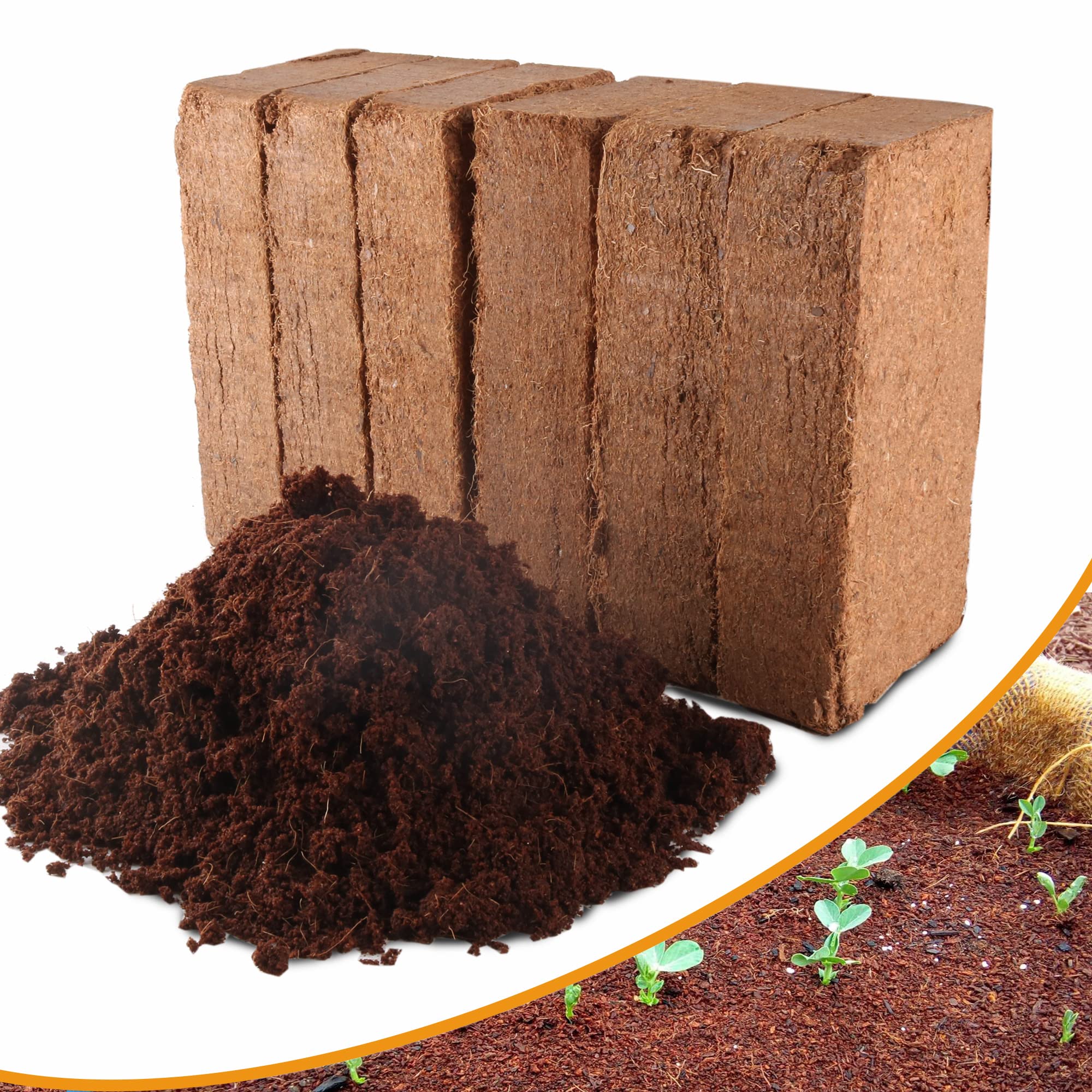
Avalution’s coconut coir bricks offer a fundamentally different value proposition: you buy them dry and compact, then rehydrate them yourself. Each brick expands to roughly 4–5 quarts, so the six-pack yields up to 36 quarts of finished growing medium. The coir is pH-balanced and low-EC, giving you a clean slate to mix with your own compost, worm castings, and perlite.
This is the most budget-friendly entry in the lineup if you already have organic amendments on hand. Customers consistently praise the water absorption—each brick holds 8–10 times its dry weight in water, turning into a fluffy, peat-like consistency after soaking overnight. The zero-additive nature means you control exactly what your plants receive, which is ideal for strict organic growers who want no synthetic residues.
The trade-off is labor and planning: you cannot open a bag and plant immediately. Each brick requires 4–5 quarts of warm water and a few hours (or overnight) of soak time. You will also need to crumble the rehydrated coir and mix in your own nutrient sources—this is not a ready-to-go amended soil but rather a base medium. For growers who treat soil mixing as part of the process, these bricks offer unbeatable value per quart.
Why it’s great
- Extremely cost-effective when calculated per quart of expanded volume
- Zero additives—complete control over your own amendment recipe
- Excellent water absorption and re-expansion with minimal effort
Good to know
- Requires overnight soaking and manual crumbling before use
- Has no inherent nutrients—you must add your own organic fertilizers
FAQ
Can I use amended organic soil directly for seed starting?
How do I store an opened bag of organic potting soil without getting gnats?
Is amended organic soil worth the higher price compared to synthetic mixes?
Why does my bag of organic soil have white flakes or gold sparkles?
Can I reuse amended organic soil from last season?
Final Thoughts: The Verdict
For most users, the best amended organic soil winner is the FoxFarm Ocean Forest because it delivers a complete, proven nutrient profile in a well-aerated base that works out of the bag for vegetables, ornamentals, and containers alike. If you want a specialized seed-starting blend with vermiculite for moisture control, grab the Vermont Compost Fort Vee. And for the most cost-effective approach if you prefer custom mixing, nothing beats the Avalution Coconut Coir Bricks as a clean, pH-neutral base to build your own living soil.