
Dead zones don’t care about your schedule. Miles of highway with zero bars, dropped dispatch calls, and buffering navigation maps are a daily reality for truckers, RVers, and anyone who spends serious time behind the wheel. A dedicated vehicle booster is the only real solution—it grabs the faintest whisper of a distant tower and turns it into a usable connection inside your cab.
I’m Min — the co-founder and writer behind Gadgets Feed. For this guide, I’ve spent dozens of hours analyzing frequency band charts, gain ratings, antenna types, and real-world installation photos across nine different boosters to identify the ones that actually deliver measurable improvements in a truck environment.
Whether you’re hauling coast-to-coast or heading into remote campsites, this review of the best cell phone booster for truck will help you cut through the marketing and pick the unit that matches your rig and your route.
How To Choose The Best Cell Phone Booster For Truck
Not every booster works well inside a steel cab. The key metrics—gain, frequency band support, antenna type, and multi-user capability—determine whether you get a useful signal boost or just a light that glows green. Focus on these factors first.
Antenna Gain (dB) and Antenna Type
Gain is measured in dB and directly affects how far the booster can reach a tower. For a truck, look for at least 50 dB of gain on the amplifier. Omnidirectional antennas work best for moving vehicles because they receive signals from all directions without manual aiming. Directional yagi antennas offer higher gain but require pointing at a specific tower, making them impractical while driving.
Frequency Band Compatibility
Every carrier broadcasts on specific frequency bands. A booster that supports bands 12/17 (700 MHz), 13 (700 MHz), 5 (850 MHz), 4 (1700/2100 MHz), and 2/25 (1900 MHz) covers the vast majority of Verizon, AT&T, and T-Mobile networks. If your carrier uses an uncommon band, verify the booster supports it before buying. Most modern units also support 5G on existing LTE bands, but true mmWave 5G requires a different setup entirely.
Multi-User Capability
If you drive solo, a single-user booster is sufficient. But in a truck with a team or a family RV, every passenger will benefit from a multi-user model. Multi-user boosters distribute the amplified signal across multiple devices simultaneously, though the total throughput is shared. Premium models like the weBoost Drive 4G-X OTR and SureCall Fusion2Go Ultra handle four to six devices without significant degradation.
Quick Comparison
On smaller screens, swipe sideways to see the full table.
| Model | Category | Best For | Key Spec | Amazon |
|---|---|---|---|---|
| weBoost Drive 4G-X OTR | Premium Truck | Semi-trucks & long-haul routes | 17” omnidirectional antenna with mirror mount | Amazon |
| SureCall Fusion2Go Ultra | Premium Vehicle | Maximum uplink power for fringe areas | 50 dB gain, 30 dBi uplink power | Amazon |
| weBoost Drive X | Premium Vehicle | Multi-user connectivity in pickup & SUV | 5G compatible, magnetic roof antenna | Amazon |
| HiBoost C30G-5S-BTW | Premium Vehicle | Heat management & app monitoring | Honeycomb design for 30% better cooling | Amazon |
| Atcall SF-Truck | Mid-Range Truck | Real-time signal monitoring via LCD | Integrated LCD display shows signal strength | Amazon |
| ANNTLENT V50 | Mid-Range Vehicle | Zero cable loss all-in-one design | All-in-one; amp at antenna eliminates coax loss | Amazon |
| GAGBK 6 Band for RV | Mid-Range RV | Budget-friendly multi-band coverage | Supports bands 2/4/5/12/13/17/25/66 | Amazon |
| PRACOA Vehicle Booster | Entry-Level Vehicle | Basic signal lift for cars & small trucks | 65 dB gain, 5-8 mile communication range | Amazon |
| ZORIDA Ace 5S | Entry-Level Home/Vehicle | App-assisted setup for first-time users | 72 dB max gain, covers 2000 sq ft | Amazon |
In‑Depth Reviews
1. weBoost Drive 4G-X OTR (470210)

The weBoost Drive 4G-X OTR is purpose-built for semi-trucks, and it shows in every component. The 17-inch omnidirectional antenna mounts to your mirror bracket using the included 3-way CB antenna mount and mast extension, giving you the height and line-of-sight needed to pull signals from towers that are miles off the interstate. The amplifier delivers consistent multi-user support, meaning your co-driver, tablet, and hotspot all get the same boost without one device hogging the link.
Real-world users report that this unit transforms a “no service” stretch of I-10 into a usable 4G LTE connection, with faster data speeds and fewer dropped calls compared to the car-sized Drive X. The included side exit adapter and weather-resistant antenna stand up to highway speeds, rain, and vibration without loosening. The booster itself draws power from a DC/DC converter that also extends talk time by reducing the phone’s own transmit power draw.
The trade-off is installation complexity—this is not a five-minute magnetic roof job. You’ll need to route the antenna cable through a mirror bracket or fender, secure the mast, and find a spot for the booster inside the cab that keeps it away from metal interference. Once dialed in, it’s the most reliable solution for OTR drivers who can’t afford dead zones.
Why it’s great
- Dedicated truck mirror mount kit provides stable, elevated antenna placement
- Multi-user support keeps everyone in the cab connected
- Weather-resistant antenna holds up at highway speeds
Good to know
- Installation requires routing cables through mirror or fender
- Only supports 4G LTE; no 5G band coverage
2. SureCall Fusion2Go Ultra
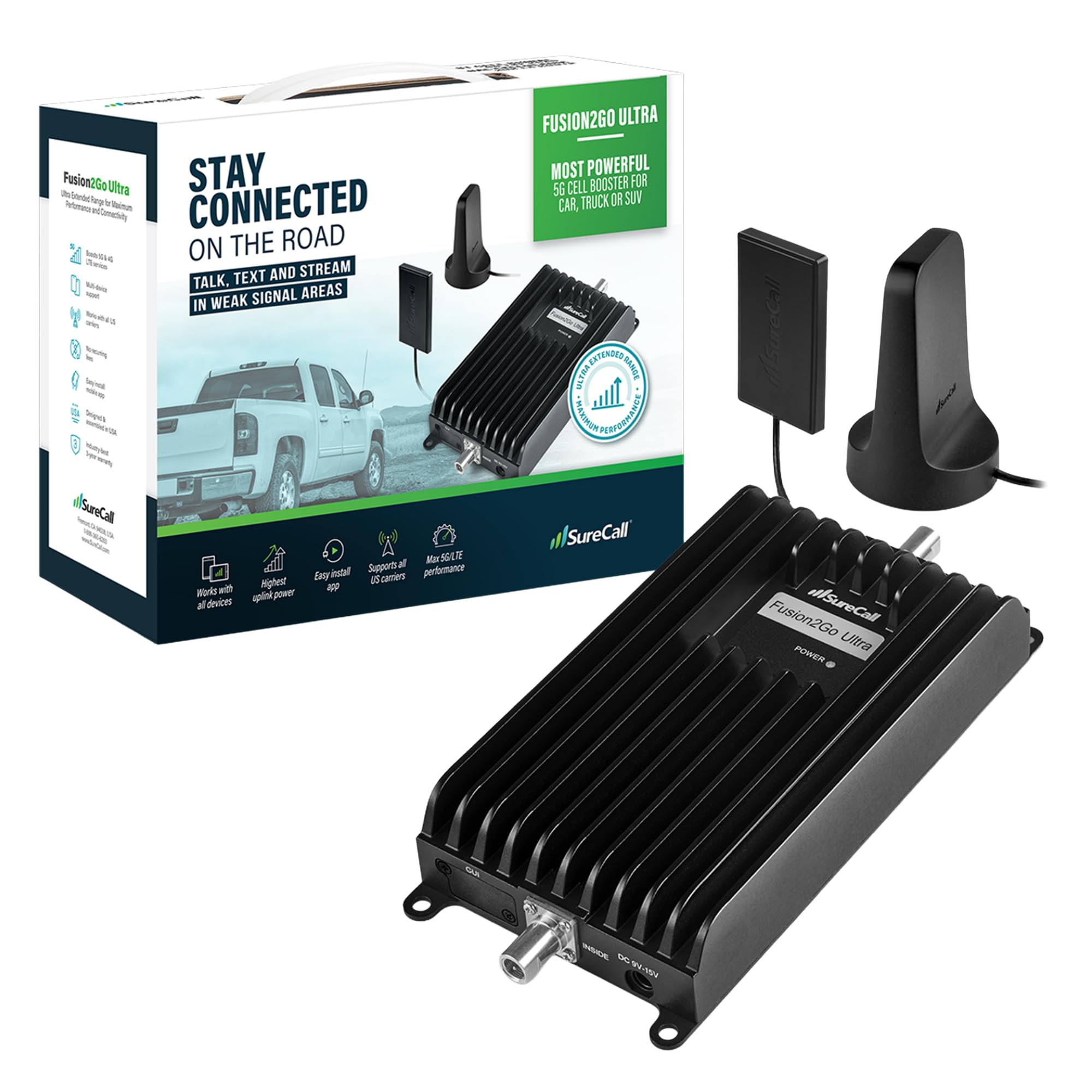
The SureCall Fusion2Go Ultra currently holds the highest uplink power available in a vehicle booster—30 dBi—which directly translates to reaching towers that other units simply cannot lock onto. This is critical in remote mountain passes or long stretches of rural highway where the tower is over the next ridge. The 50 dB amplifier gain ensures that once the signal is captured, it is cleanly amplified without excessive noise floor creep.
Installation is assisted by the free SureCall app, which reads your phone’s signal strength in real time and guides you to the optimal antenna placement on the roof. The magnetic base holds firm at highway speeds, and the interior patch antenna covers the entire cab. Users consistently report a jump from 1 bar to 3 or 4 bars on Verizon and AT&T, with upload speeds improving by roughly 15 Mbps over the unboosted baseline.
The trade-off is cable length—the interior antenna and power cables are on the shorter side, which can be problematic in a full-size crew cab truck. You may need to extend or reposition the booster closer to the center console. The Fusion2Go Ultra also comes at a premium price, but for drivers who need to maintain a reliable connection for work, it is a justifiable investment.
Why it’s great
- Highest uplink power on the market for fringe-area tower reach
- App-assisted placement maximizes real-world signal improvement
- Supports all major U.S. carriers on 5G and 4G LTE bands
Good to know
- Interior and power cables are short for larger crew cab trucks
- Premium price point may be overkill for drivers who stay in strong coverage areas
3. weBoost Drive X (475021)

The weBoost Drive X occupies the sweet spot between serious performance and straightforward installation. Its magnetic roof antenna requires no drilling—you place it on the center of the cab roof, route the cable through a door or window gap, and plug the booster into a 12V outlet. With 33 percent farther gain than the entry-level Drive Sleek, it delivers meaningful improvements in marginal coverage areas without the complexity of a mirror-mount setup.
Multi-user functionality is built in, so every passenger in a pickup or SUV benefits from the boost simultaneously. The unit supports 5G on the lower bands (n2, n5, n12, n25, n41, n66, n71), making it future-proof for current mid-band 5G rollouts. Real-world testing shows it holds a Zoom call through rolling hills where the phone alone drops to 1 bar, and it maintains enough bandwidth for hotspot use on a family road trip.
The downside is that the magnetic antenna’s cable is only about 13 feet, which can be tight for a long-bed crew cab. You may need to keep the booster near the front seats. Also, like all passive boosters, it cannot create signal where absolutely none exists—it requires at least a flicker of outside signal to amplify.
Why it’s great
- Tool-free magnetic roof antenna installs in minutes
- Multi-user support for the whole cab
- 5G compatible across key LTE bands
Good to know
- Magnetic antenna cable may be short for extended cab trucks
- Requires at least 1 bar of outside signal to function
4. HiBoost C30G-5S-BTW
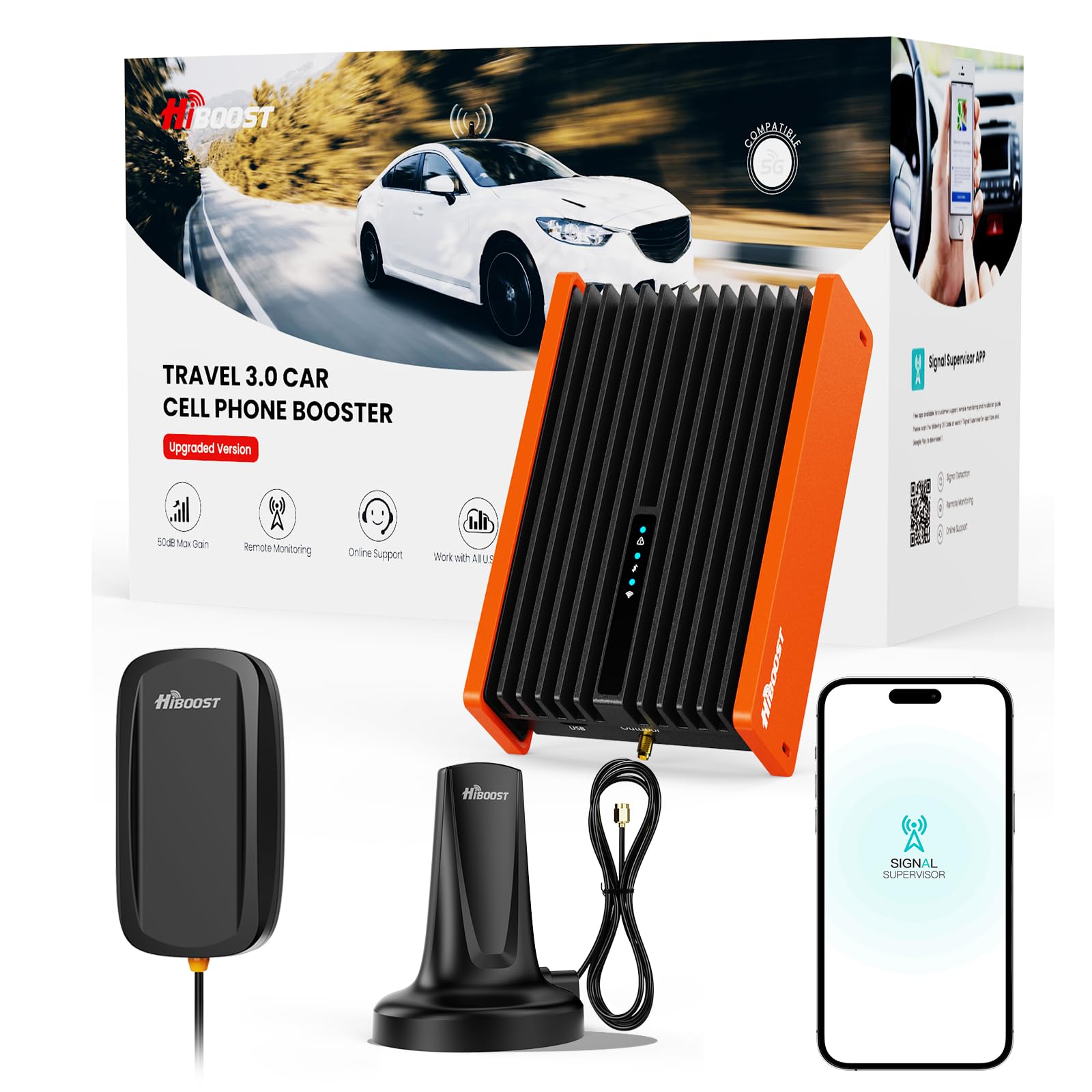
HiBoost differentiates itself with build quality that matters in a real truck environment. The C30G-5S-BTW uses precision-grade 50 Ω RF connectors throughout the signal path, which reduces transmission loss compared to cheaper 75 Ω consumer connectors. The honeycomb briquette housing design increases surface area for heat dissipation by 30 percent—a meaningful advantage when the booster is tucked under a dash in a hot cab during summer months.
The upgraded magnetic roof antenna is rated as dustproof, oilproof, and waterproof, and it includes strong enough magnets to stay put on a steel cab roof during rough roads. The “Signal Supervisor” app provides live signal strength readings and installation guidance, much like the SureCall app, but with a more straightforward interface. Users in a 2024 Ford Super Duty saw the signal jump from 2 bars to 4 bars after following the app’s placement recommendations.
The main downside is that the power cord is reported as short by some users, requiring careful positioning of the booster near a 12V outlet. Additionally, while the unit supports the core carrier bands, it does not cover the newer 5G n77 or n260 mmWave bands, which is typical for this price tier.
Why it’s great
- 50 Ω RF connectors minimize signal loss in the cable run
- Honeycomb housing keeps the booster cool under load
- Rugged magnetic antenna resists dust, oil, and water
Good to know
- Power cord may be too short for some cab layouts
- Does not support mmWave 5G bands
5. Atcall SF-Truck
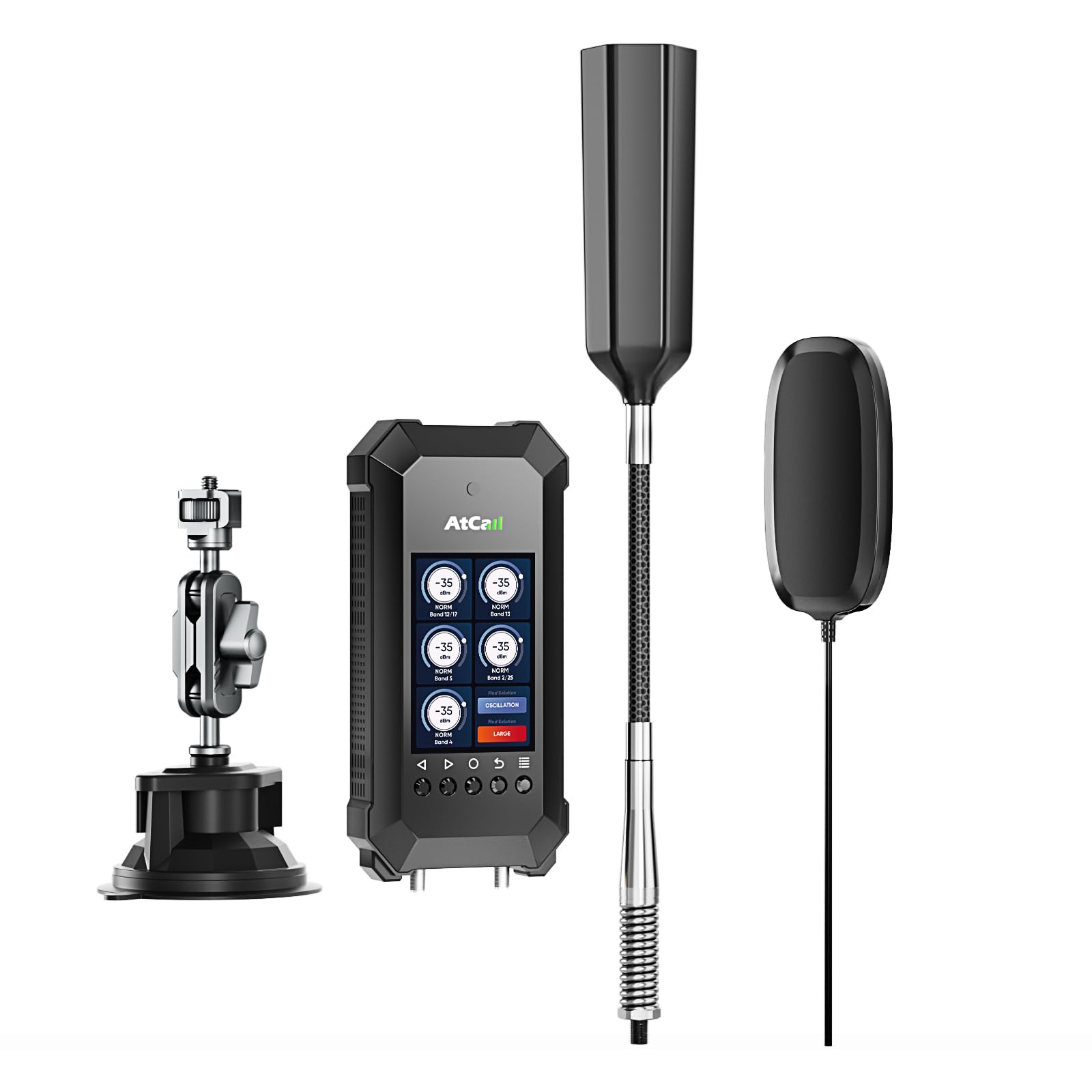
The Atcall SF-Truck stands out by replacing the usual LED status lights with a full LCD monitor that shows real-time signal strength and booster working status. This is genuinely useful during installation—you can watch the dBm number change as you move the antenna, eliminating guesswork. The LCD also helps during a trip: if performance drops, you can glance at the screen to see whether the booster lost sync rather than wondering if you just entered a deeper dead zone.
Designed specifically for truck cabs, the SF-Truck includes two types of mounting brackets that attach directly to the center console. The omnidirectional outside antenna is waterproof, shockproof, and rustproof, with a streamlined profile that reduces wind noise at highway speeds. Users on Verizon report moving from 1 bar with unusable data to 3 bars capable of streaming, and the unit supports all major carriers on bands 2/25, 4, 5, 12/17, and 13.
The catch is that the 50 dB gain is on the lower side compared to the 65-72 dB offerings from competitors. In extremely weak signal areas (below -120 dBm outside), the SF-Truck may struggle to amplify enough signal to make a meaningful difference. It also does not support 5G on higher-frequency bands, limiting its usefulness as carriers refarm spectrum.
Why it’s great
- Built-in LCD monitor shows real-time signal data
- Console mounting brackets designed specifically for truck cabs
- Rugged, weather-resistant omnidirectional antenna
Good to know
- 50 dB gain is lower than many competitors in this range
- No support for higher-frequency 5G bands
6. ANNTLENT V50
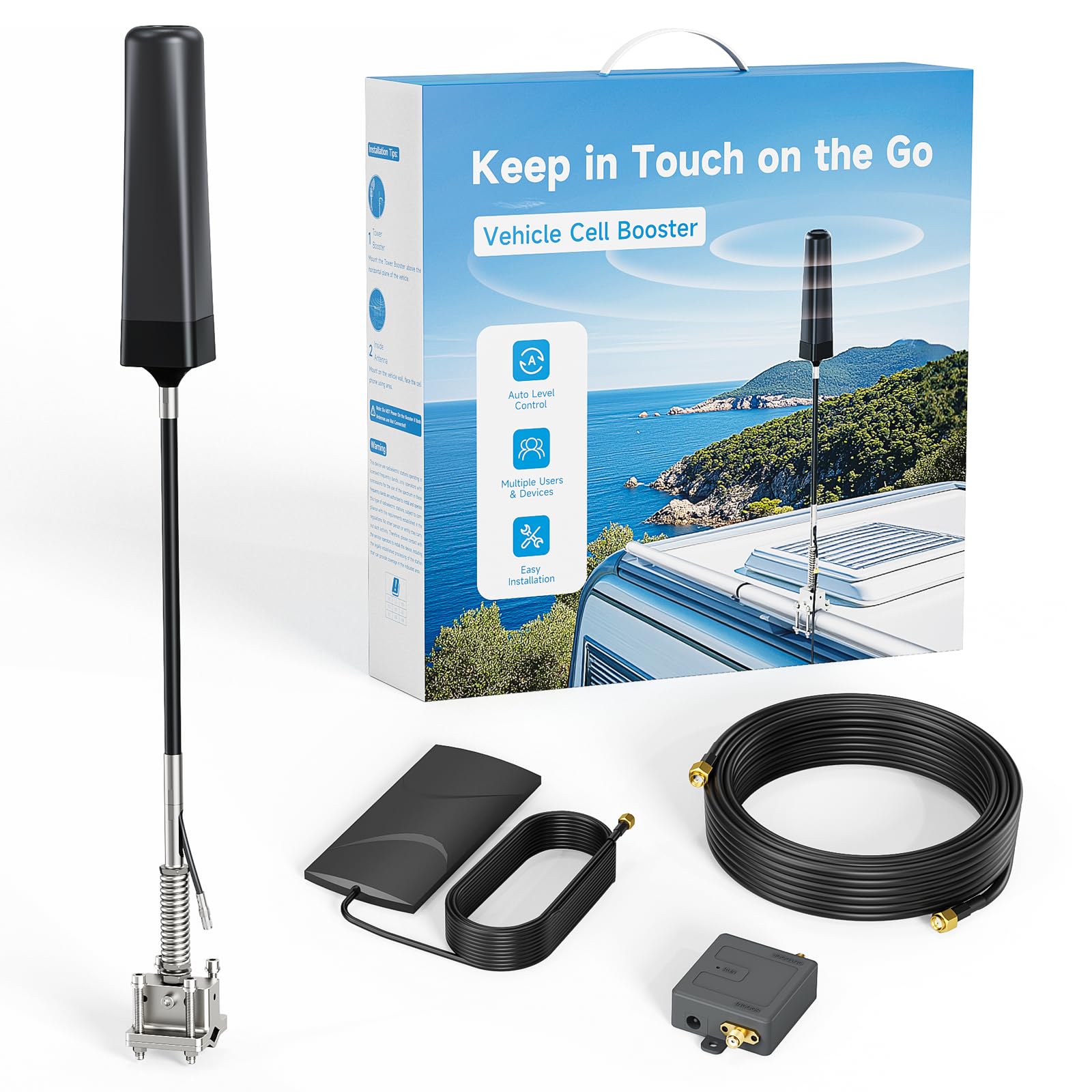
ANNTLENT’s V50 uses an all-in-one architecture that places the amplifier directly at the antenna base, eliminating the coaxial cable loss that typically eats 1-3 dB of signal in traditional split designs. This means the full 50 dB of amplification reaches your phone without degradation, and it also makes installation simpler since there is only one cable to route into the cab—the power cable for the amplifier/antenna assembly.
The smart app helps you find the strongest tower direction and provides real-time signal metrics during placement. Users report RSRP improvements from -120 dBm to -95 dBm after proper installation, which translates to moving from no data connection to usable 4G LTE. The 360-degree tower reception pattern means you don’t have to re-aim the antenna when you change direction, a genuine advantage for a vehicle that is constantly turning.
The main issue reported is that the antenna requires a tall mounting pole (not included) to get above the roofline for best results, and the included window cable pass-through can pinch against modern weather seals. Some users also report that the improvement in strong-signal areas is marginal—the V50 shines brightest in fringe conditions where every dB of preserved signal matters.
Why it’s great
- All-in-one design eliminates cable loss between antenna and amplifier
- Smart app aids placement with real-time signal metrics
- 360-degree reception suits vehicles that change direction frequently
Good to know
- Requires an elevated mounting pole for best performance
- Marginal improvement in areas with already decent signal
7. GAGBK 6 Band for RV
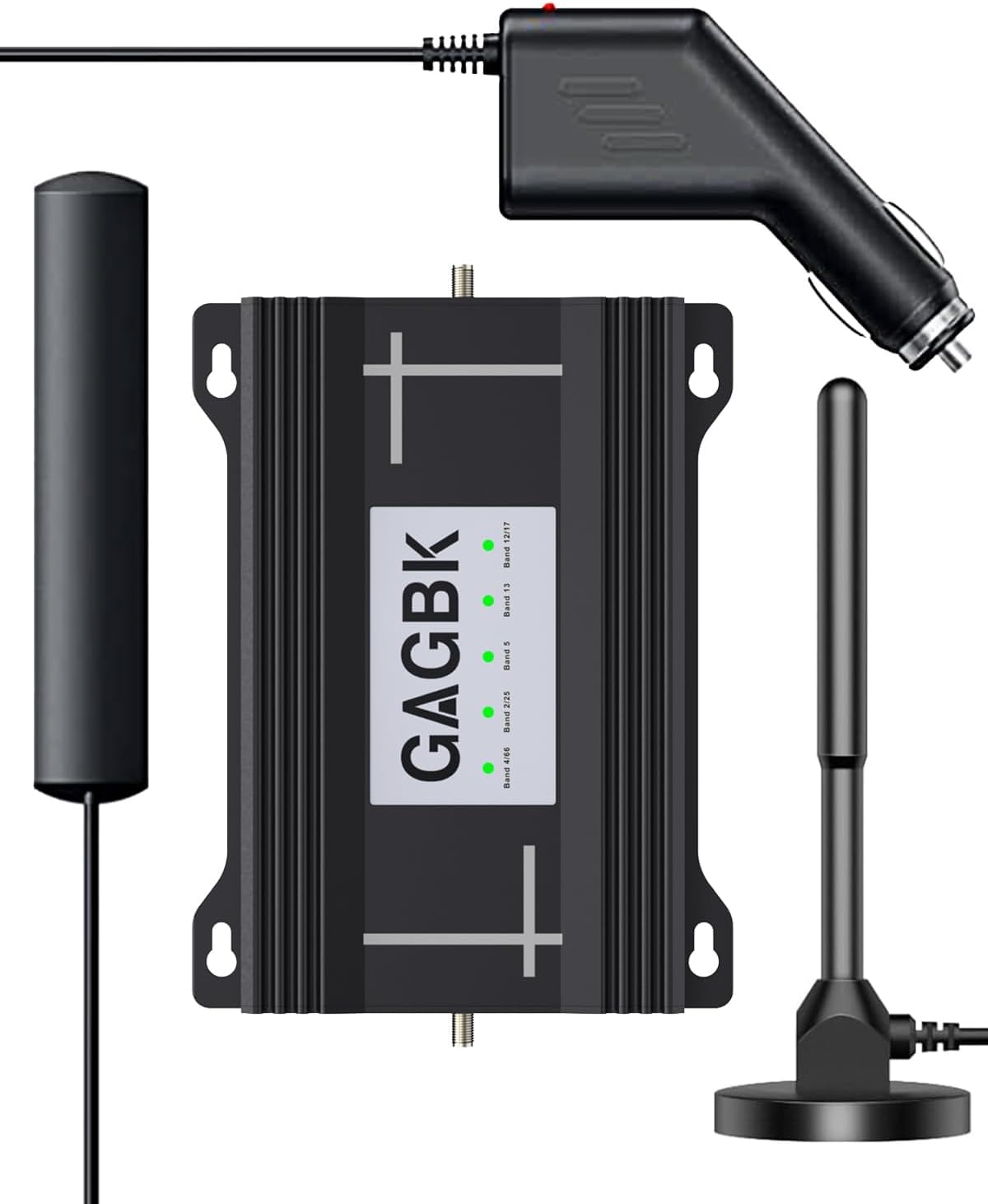
The GAGBK 6 Band for RV offers a compelling feature set at a mid-range price point, including support for bands 2, 4, 5, 12, 13, 17, 25, and 66—one of the widest band selections in this roundup. This breadth matters if you switch carriers or travel across regions where different bands dominate. The 65 dB gain rating is strong enough to pull usable signal from fringe areas where weaker boosters give up.
The kit includes a 12V 3A power adapter, a magnetic outdoor antenna with a 16-foot cable, and an indoor patch antenna with a 10-foot cable. The outdoor antenna’s magnetic base holds securely on steel roofs, and the cables use RG174 coax, which is flexible enough for tight routing around door frames. Users report that the booster reliably eliminates dead zones in a 5-8 mile radius from a cell tower, with automatic gain control adjusting for changing conditions.
The compromises are in build quality feedback—some users note that the indoor antenna’s adhesive mount loses grip in hot cabs, and the instruction manual could be clearer about antenna separation distance. Additionally, while the band support is wide, the actual 5G compatibility is limited to lower-band n2, n5, n7, n12, n25, n41, n66, and n71, which covers most carrier 5G but not the fastest mmWave spectrum.
Why it’s great
- Wide band support covers 2/4/5/12/13/17/25/66 for maximum carrier compatibility
- 65 dB gain handles fringe-area signal recovery well
- Automatic gain control adjusts to changing signal conditions
Good to know
- Indoor antenna adhesive may fail in high heat
- 5G support limited to lower-band frequencies
8. PRACOA Vehicle Booster
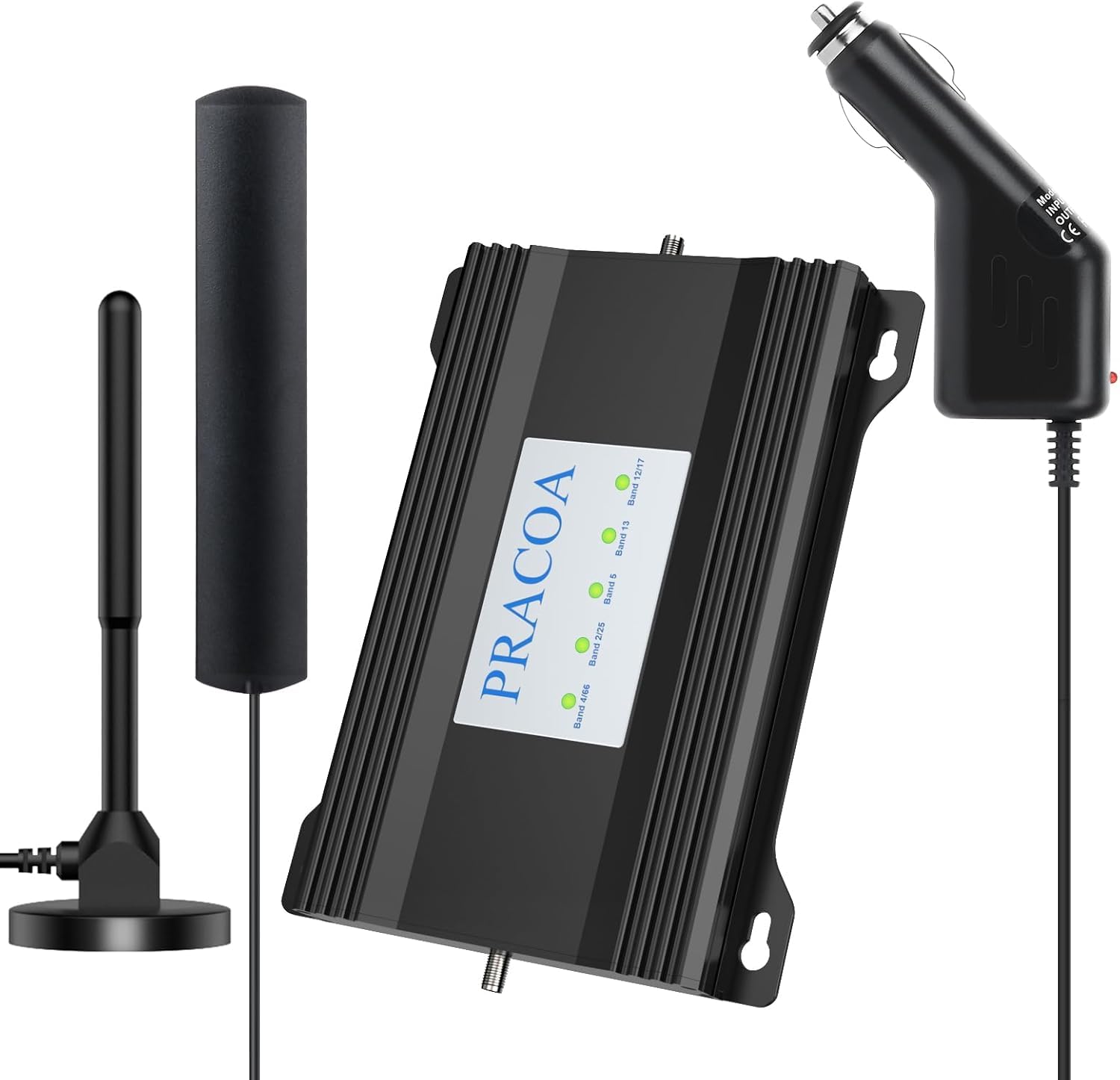
The PRACOA Vehicle Booster is a solid entry-level option that delivers the essentials without unnecessary complexity. Its 65 dB gain magnet-mount antenna and 16-foot cable get the job done for most car, small truck, and SUV applications. The claimed 5-8 mile communication range is optimistic under real-world conditions, but users in rural areas with aluminum siding and weak outdoor signals have reported measurable improvements—going from -112 dBm RSRP to -98 dBm, gaining 4 bars, and seeing 180 Mbps download speeds on T-Mobile n25.
Setup is straightforward: mount the magnetic antenna on the roof, run the cable inside, plug the booster into the 12V adapter, and place the indoor antenna on the dash or center console. The unit supports all major carriers on bands 2/4/5/12/13/17/25/66, and includes automatic gain control, inactivity mode, and oscillation elimination to maintain stability when signal conditions fluctuate.
The trade-off is that the indoor antenna has limited range—users report that phones not within a few feet of the interior antenna see less benefit. The included coax connectors also lack weather sealing, so outdoor installs in wet climates may need additional tape. For the price, it is a dependable starter booster that works best for solo drivers who need a basic lift in moderate fringe areas.
Why it’s great
- Easy magnetic roof mount with 16-foot cable
- Automatic gain control adjusts for changing signal conditions
- Supports all major carriers on core LTE bands
Good to know
- Indoor antenna has limited range; phone must be close
- Coax connectors lack weather sealing for wet climates
9. ZORIDA Ace 5S

The ZORIDA Ace 5S punches above its price tier with a 72 dB max gain rating—higher than many mid-range competitors—and a compact footprint that works in tight spaces. The included app provides 1-on-1 technical support, installation videos, and real-time signal data, which is rare at this budget level. For a small truck cab or a single-room RV setup, the 2000 sq ft coverage claim is more than enough.
The kit uses a directional outdoor antenna with a 49.2-foot cable, giving you flexibility to place the antenna well away from the cab if needed. Users in remote campgrounds report jumping from SOS mode to 3-4 bars on Verizon with 35-40 Mbps download speeds. The unit supports all U.S. carriers on bands 12/17, 13, 5, 4, and 2/25, and it is FCC and IC certified.
The limitations become apparent in vehicle use: the indoor whip antenna is not designed for a moving cab—it works best in a static setup like an RV parked at a campsite. The 72 dB gain is impressive on paper, but the directional antenna requires precise aiming at the tower, which is impractical while driving. For a truck that stays parked for long periods (work site, rest stop), the Ace 5S delivers excellent value.
Why it’s great
- 72 dB max gain outperforms many more expensive models
- App provides guided installation and real-time signal data
- Long 49.2-foot antenna cable allows flexible outdoor placement
Good to know
- Directional antenna must be aimed at the tower—not suitable while driving
- Indoor whip antenna is designed for stationary use, not moving vehicles
FAQ
Will a cell booster work in an area with zero signal outside the truck?
Do I need a booster with 5G support for a truck?
How far apart should the outside and inside antennas be?
Final Thoughts: The Verdict
For most drivers, the best cell phone booster for truck is the weBoost Drive 4G-X OTR because it combines a purpose-built truck antenna mount, multi-user support, and reliable 4G LTE boost that semi drivers depend on. If you want the absolute top performance for fringe-area recovery, grab the SureCall Fusion2Go Ultra. And for a budget-friendly option that works well in a parked RV or work truck, nothing beats the ZORIDA Ace 5S.