
When the grid goes down, the difference between a minor inconvenience and a costly disaster often comes down to one thing: how quickly your equipment switches to battery power. An AC Battery Backup isn’t a luxury for most households—it’s the thin line separating a saved work file from a corrupted hard drive, or a warm refrigerator from a spoiled one. The market is flooded with options that look similar on the surface but diverge sharply in battery chemistry, inverter type, and real-world runtime.
I’m Min — the co-founder and writer behind Gadgets Feed. I’ve spent countless hours analyzing the technical specifications, battery cycles, and real user reports across dozens of models to separate the units that deliver on their promises from those that fold under pressure.
Whether you need to keep a CPAP machine running through the night, bridge a workstation through flickers, or power a refrigerator for hours during an extended outage, finding the right best ac battery backup depends on matching capacity, inverter wattage, and battery longevity to your specific load.
How To Choose The Best AC Battery Backup
Selecting the right backup unit requires understanding three core variables: battery chemistry, inverter type, and total capacity. A unit that excels in one area may falter in another, and knowing which trade-offs matter for your specific use case prevents both overspending and disappointment.
Battery Chemistry: Lead-Acid vs. LiFePO4
Traditional UPS units still use sealed lead-acid (SLA) batteries. They are cheap upfront but degrade after 300-500 charge cycles and typically need replacement every 2-3 years. Lithium iron phosphate (LiFePO4) batteries cost more initially but deliver 3,500 to 5,000 cycles to 80% capacity, translating to a 10-year lifespan. For any unit used regularly (daily power backup, off-grid work, or frequent outages), the total cost of ownership favors LiFePO4 significantly.
Inverter Type: Simulated vs. Pure Sine Wave
Cheaper UPS units output a simulated (modified) sine wave, which is acceptable for basic power supplies but can cause buzzing, overheating, or erratic behavior in sensitive electronics like NAS drives, audio equipment, or variable-speed motors. Pure sine wave inverters replicate the clean power from a wall outlet. If your load includes CPAP machines, medical devices, or high-end electronics, pure sine wave is non-negotiable.
Capacity and Runtime: Watt-Hours and Your Load
Capacity is measured in watt-hours (Wh). A 1,000Wh unit running a 100W load (laptop, monitor, router) will theoretically last 10 hours. Higher loads like refrigerators (150-300W) or space heaters (1,500W) drain capacity much faster. Calculate your critical load by adding the wattage of everything you need to keep running, then look for a unit with at least 2x that watt-hour capacity to account for inverter overhead and battery depth-of-discharge limits.
Quick Comparison
On smaller screens, swipe sideways to see the full table.
| Model | Category | Best For | Key Spec | Amazon |
|---|---|---|---|---|
| Jackery Explorer 1000 v2 | Mid-Range | Versatile home & camping backup | 1,070Wh LiFePO4, 1,500W AC | Amazon |
| Anker SOLIX C2000 Gen 2 | Premium | High-output home backup | 2,048Wh LiFePO4, 2,400W AC | Amazon |
| EF ECOFLOW DELTA 3 Plus | Premium | 10ms UPS with smart app control | 1,024Wh LiFePO4, 1,800W AC | Amazon |
| DABBSSON 2000L | Premium | Semi-solid battery for long runtime | 2,048Wh Semi-Solid LiFePO4, 2,200W AC | Amazon |
| BLUETTI AC200L | Premium | Expandable home & RV power | 2,048Wh LiFePO4, 2,400W AC | Amazon |
| AFERIY P210 | Premium | High-wattage server-level UPS | 2,048Wh LiFePO4, 2,400W AC | Amazon |
| GOLDENMATE 1000VA | Mid-Range | Long-life LiFePO4 UPS for workstations | 153.6Wh LiFePO4, 600W pure sine wave | Amazon |
| CyberPower AVRG900LCD | Mid-Range | Traditional UPS for desktop PCs | 900VA/480W simulated sine wave | Amazon |
| DaranEner NEOZ-192Wh | Budget-Friendly | Ultra-compact emergency & CPAP backup | 192Wh LiFePO4, 300W pure sine wave | Amazon |
In‑Depth Reviews
1. Jackery Explorer 1000 v2

The Jackery Explorer 1000 v2 strikes a near-perfect balance between capacity, weight, and charging speed. Its 1,070Wh LiFePO4 battery provides over 4,000 cycles to 80% capacity, and the 1,500W pure sine wave inverter handles most home appliances, including refrigerators and microwaves. At 23.8 pounds with a foldable handle, it remains genuinely portable for a unit in this class.
Charging from zero to full takes just one hour with the emergency mode enabled via the Jackery App, or 1.7 hours in the default health-optimized mode. The app also offers quiet overnight charging at 30 dB and energy efficiency settings. Real-world tests show it running a refrigerator for over 8 hours and a 1,370W microwave for 5 minutes while only dropping 12% battery.
Three pure sine wave AC ports, two USB-C ports (one at 100W PD), and a 12V car port provide solid connectivity. The main trade-off is that it is not a UPS with automatic switchover below 10ms—it works best as a standby power station you plug in after an outage begins, or as a camping companion.
Why it’s great
- One-hour full charge with emergency mode
- Lightweight 23.8 lb design with handle
- Excellent real-world runtime on refrigerator loads
- Smart app control with quiet overnight mode
Good to know
- Not a sub-10ms UPS—requires manual switching
- Only compatible with Jackery solar panels for solar input
2. Anker SOLIX C2000 Gen 2
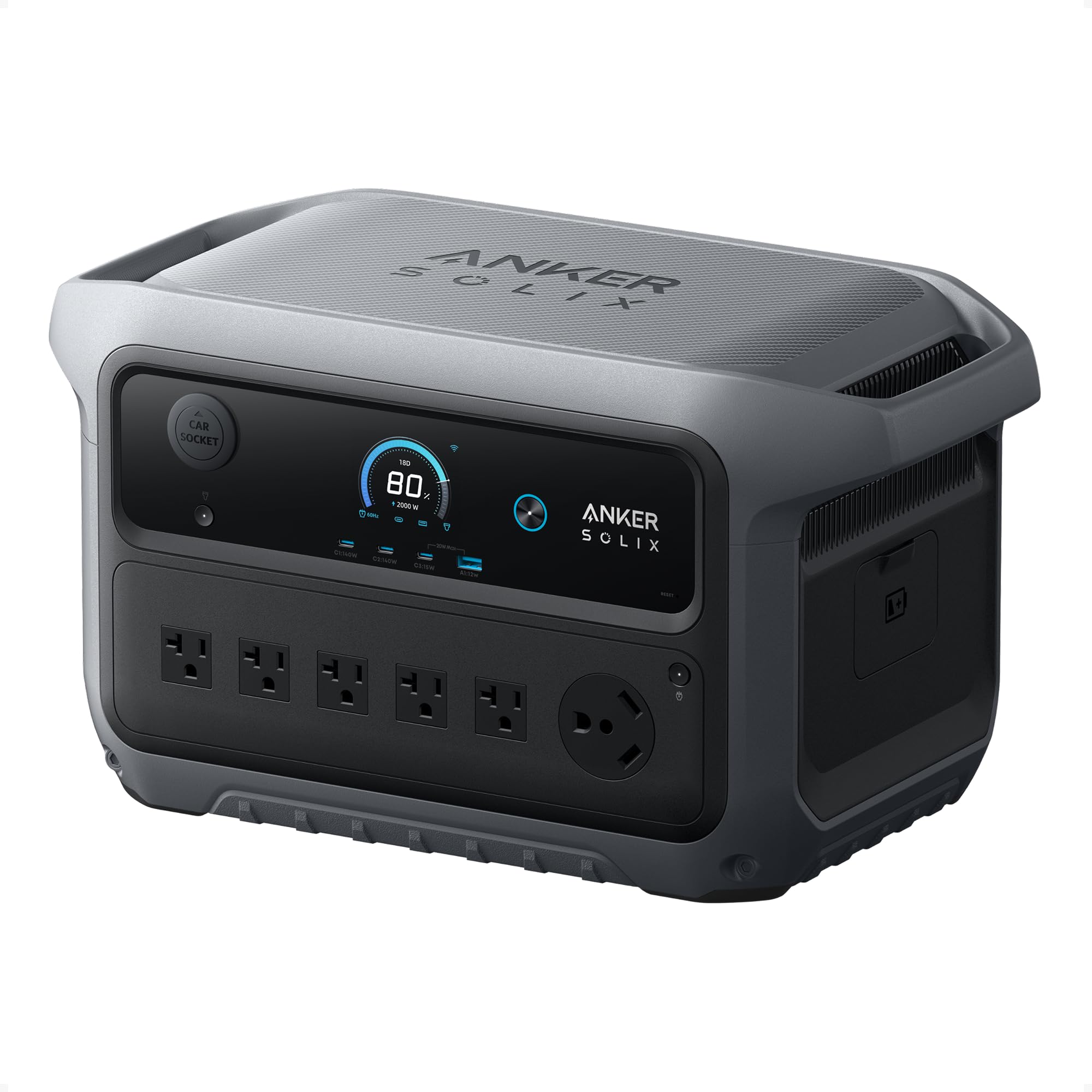
The Anker SOLIX C2000 Gen 2 packs 2,048Wh of LiFePO4 capacity into a surprisingly compact chassis (41.7 lb, 18.1 x 9.8 x 10.1 inches) and delivers a massive 2,400W continuous output with a 4,000W peak. Its standby power draw is just 9W, meaning it can keep a dual-door refrigerator running for up to 32 hours on a single charge—a class-leading efficiency figure.
Recharging is equally impressive: AC input brings it from zero to full in 58 minutes, and the 800W alternator charging option tops it up in 3 hours via your vehicle. The unit also supports expansion batteries, scaling capacity to 4kWh. The companion app provides detailed usage graphs, charge scheduling, and real-time monitoring.
With six charging methods including solar at 800W MPPT, this station is built for both home backup and off-grid adventures. The 2,400W inverter comfortably runs window A/C units, power tools, and kitchen appliances simultaneously. The lack of a paper manual is a minor inconvenience given the app covers all controls.
Why it’s great
- Ultra-low 9W standby for extended fridge runtime
- 58-minute full AC recharge
- 800W alternator charging for vehicle top-ups
- Expandable to 4kWh
Good to know
- Heavy at 41.7 lb despite compact size
- No paper manual included
3. EF ECOFLOW DELTA 3 Plus

The EF ECOFLOW DELTA 3 Plus sets itself apart with true 10ms UPS-level switchover, making it one of the few portable power stations that can protect sensitive electronics like NAS servers, POS systems, and desktop workstations without data loss. Its 1,024Wh LiFePO4 battery is rated for 4,000 cycles to 80%, and the 1,800W inverter (2,400W surge with X-Boost) handles most household loads.
Charging is remarkably fast: AC input at 1,500W reaches 80% in 40 minutes and full in 56 minutes. Dual 1,000W MPPT solar inputs allow for substantial off-grid recharging capability. The app includes storm alerts, scheduled charging, time-of-use modes, and a detailed usage dashboard for precise energy management.
At 27 pounds, it is lighter than its capacity class suggests. Users report running a refrigerator for 12.5 hours on a charge and powering a full SMB rack for over 8 hours. The main drawback is a slightly higher AC idle/phantom draw compared to some competitors, though the fast recharge offsets this in practice.
Why it’s great
- True 10ms UPS switchover for sensitive equipment
- 40-minute 80% fast charge
- Dual 1,000W MPPT solar inputs
- Feature-rich app with storm alerts and TOU modes
Good to know
- Higher AC phantom power draw than some rivals
- App-centric setup may frustrate non-smartphone users
4. DABBSSON 2000L
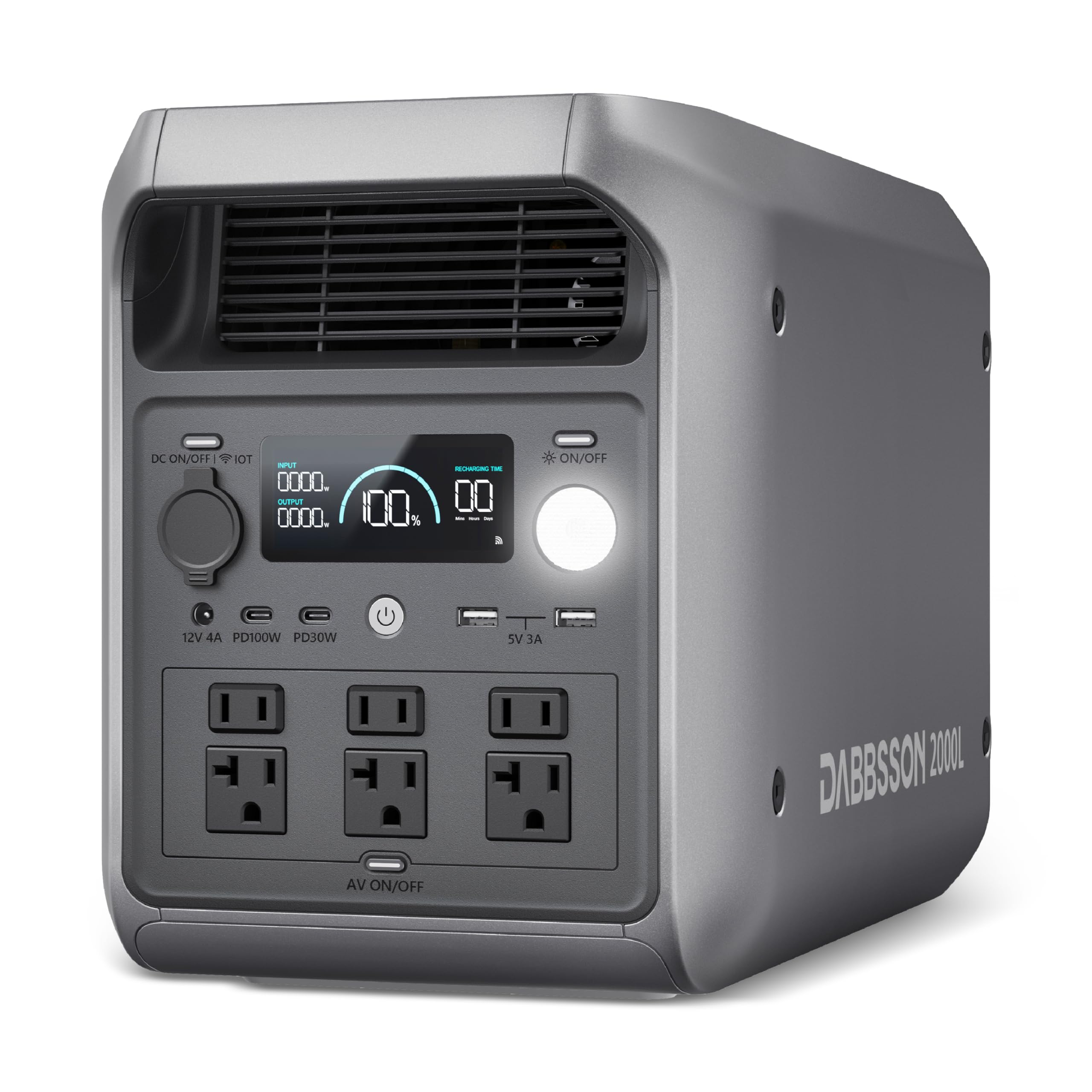
The DABBSSON 2000L introduces semi-solid LiFePO4 cell technology, which offers higher energy density and thermal stability than conventional LiFePO4. This allows a 2,048Wh capacity in a 41-pound chassis while delivering 4,000+ cycles to 80% capacity—roughly 10 years of daily use. The 2,200W continuous (3,300W surge) inverter powers heavy loads like refrigerators, heaters, and power tools.
AC charging is exceptionally fast at one hour for a full charge. Solar input reaches 800W MPPT, enabling off-grid replenishment. The EPS switchover functions in under 10ms, making it suitable for sensitive electronics. The Dabbsson App adds remote monitoring, schedule control, and charge speed adjustments.
Users report running two refrigerators plus freezers for 7.5 hours, and the UL94-V0 flame-retardant housing adds a safety layer uncommon in this price tier. Some units have experienced software issues preventing full charge/discharge, and customer support responsiveness has been inconsistent in isolated cases.
Why it’s great
- Advanced semi-solid LiFePO4 for longer cycle life
- Full 2,048Wh charge in 1 hour via AC
- UL94-V0 flame-retardant housing
- Compact 41 lb design for the capacity class
Good to know
- Some early units had software/firmware bugs
- Customer support response can be slow
5. BLUETTI AC200L

The BLUETTI AC200L is an upgraded version of the AC200MAX, offering 2,400W continuous output (3,600W Power Lifting) and expandability up to 8,192Wh via B300K, B210, or B300 battery packs. Its 2,048Wh base LiFePO4 battery delivers 3,000+ cycles, and the 30A RV output makes it a favorite for motorhome owners.
AC charging at 2,400W reaches 80% in just 45 minutes. Solar input at 1,200W MPPT provides full recharge in 1.7–2.2 hours. The 11-port array includes a 48V/8A DC port for efficient RV battery charging when paired with the D40 voltage regulator. The Wi-Fi and Bluetooth app enables remote monitoring and charge scheduling.
Users successfully run 12,000 BTU A/C units, 1,500W kettles, and full home-entertainment systems. At 61.4 pounds, it is the heaviest unit reviewed here, but the expandability and 30A RV port justify the weight for users needing whole-home or RV backup. The proprietary power cord and large footprint are the main downsides.
Why it’s great
- Expandable to 8,192Wh for whole-home backup
- 30A RV output for motorhome integration
- 45-minute 80% fast AC charge
- 1,200W MPPT solar input
Good to know
- Heavy at 61.4 lb—not for portable use
- Proprietary AC power cord risks downtime
6. AFERIY P210

The AFERIY P210 targets users who need server-grade UPS performance with high wattage. Its 2,400W continuous inverter (4,800W surge) and sub-10ms EPS switchover make it suitable for critical equipment that cannot tolerate power gaps. The 2,048Wh LiFePO4 battery delivers 3,500+ cycles with a 10-year design life.
Noise levels are outstanding: under 30 dB at full load and just 16 dB under normal load—quiet enough for bedroom or office use. The 16-port array includes six AC outlets, two USB-C (100W PD), and a 12V/25A XT60 DC output for high-current devices. The AFERIY App manages energy consumption and automation schedules.
AC charging reaches full in approximately 2 hours, and solar input supports up to 800W. The 7-year extended warranty is longer than most competitors. Some users report display screen issues after solar charging and missing scheduled charging features. The unit is heavy at 54 pounds and has a large footprint.
Why it’s great
- Ultra-quiet operation at 16 dB under normal load
- Sub-10ms UPS switchover for critical gear
- 4,800W surge capacity
- 7-year extended warranty
Good to know
- Heavy at 54 lb
- Occasional display/reset bugs after solar charging
7. GOLDENMATE 1000VA

The GOLDENMATE 1000VA is a traditional form-factor UPS with a modern LiFePO4 heart. Unlike most compact UPS units that still use lead-acid, this one packs 153.6Wh of lithium iron phosphate cells rated for 5,000+ cycles and a 10-year lifespan. Its 600W pure sine wave inverter protects sensitive electronics from dirty power.
Eight NEMA 5-15P outlets split between battery backup and surge-only ports. The LCD panel shows real-time battery level and load status. The built-in BMS and low-noise cooling fan (under 50 dB) keep it suitable for home office or living room placement. A buzzer mute function silences alarms for overnight use.
Runtime tests show a 22W load (router, modem, small switch) running for approximately 40 minutes, which is adequate for safe shutdown but not extended runtime. The lack of USB or network data ports limits remote management, and the closely spaced outlets may conflict with bulky power adapters. The 20ms switchover is standard for this class but slower than dedicated portable stations.
Why it’s great
- LiFePO4 battery with 10-year lifespan
- Pure sine wave output at a competitive price
- Buzzer mute function for quiet operation
- Plug-and-play with eight outlets
Good to know
- No USB or network data ports for remote management
- Outlet spacing too tight for larger adapters
8. CyberPower AVRG900LCD
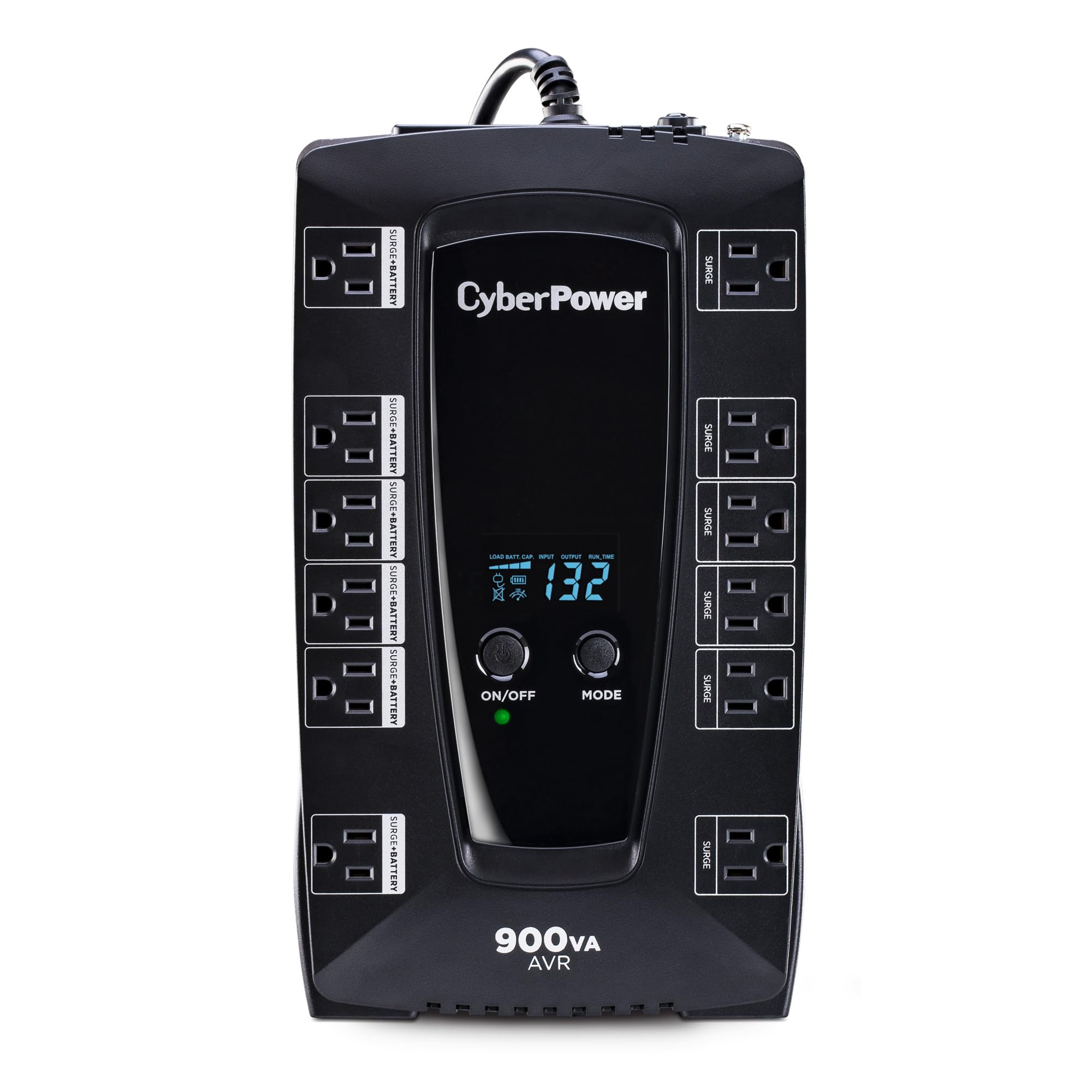
The CyberPower AVRG900LCD is a classic desktop UPS designed for workstation and networking environments. Its 900VA/480W rating provides enough runtime for a desktop PC and monitor to perform a safe shutdown during outages. Automatic Voltage Regulation (AVR) corrects minor power fluctuations without draining the battery, extending battery life.
Twelve total outlets—six with battery backup and surge protection, six with surge-only—offer generous connectivity for a full desk setup. The LCD screen displays input voltage, battery capacity, and load level. The free PowerPanel management software (download required) adds scheduling, power event logging, and automatic shutdown configuration.
Users report a 175-200W load (PC plus two monitors) delivering 18-20 minutes of runtime—sufficient for saving work and shutting down gracefully. The simulated sine wave output is adequate for standard PC power supplies but may cause issues with sensitive audio equipment or variable-speed motors. Some units arrive with a dead battery on delivery, though CyberPower’s support handles replacements.
Why it’s great
- Proven reliability for desktop and networking use
- AVR correction reduces battery wear
- 12 outlets with clear battery/surge separation
- Free PowerPanel management software
Good to know
- Simulated sine wave not ideal for sensitive electronics
- Lead-acid battery lasts 2-3 years before replacement
9. DaranEner NEOZ-192Wh
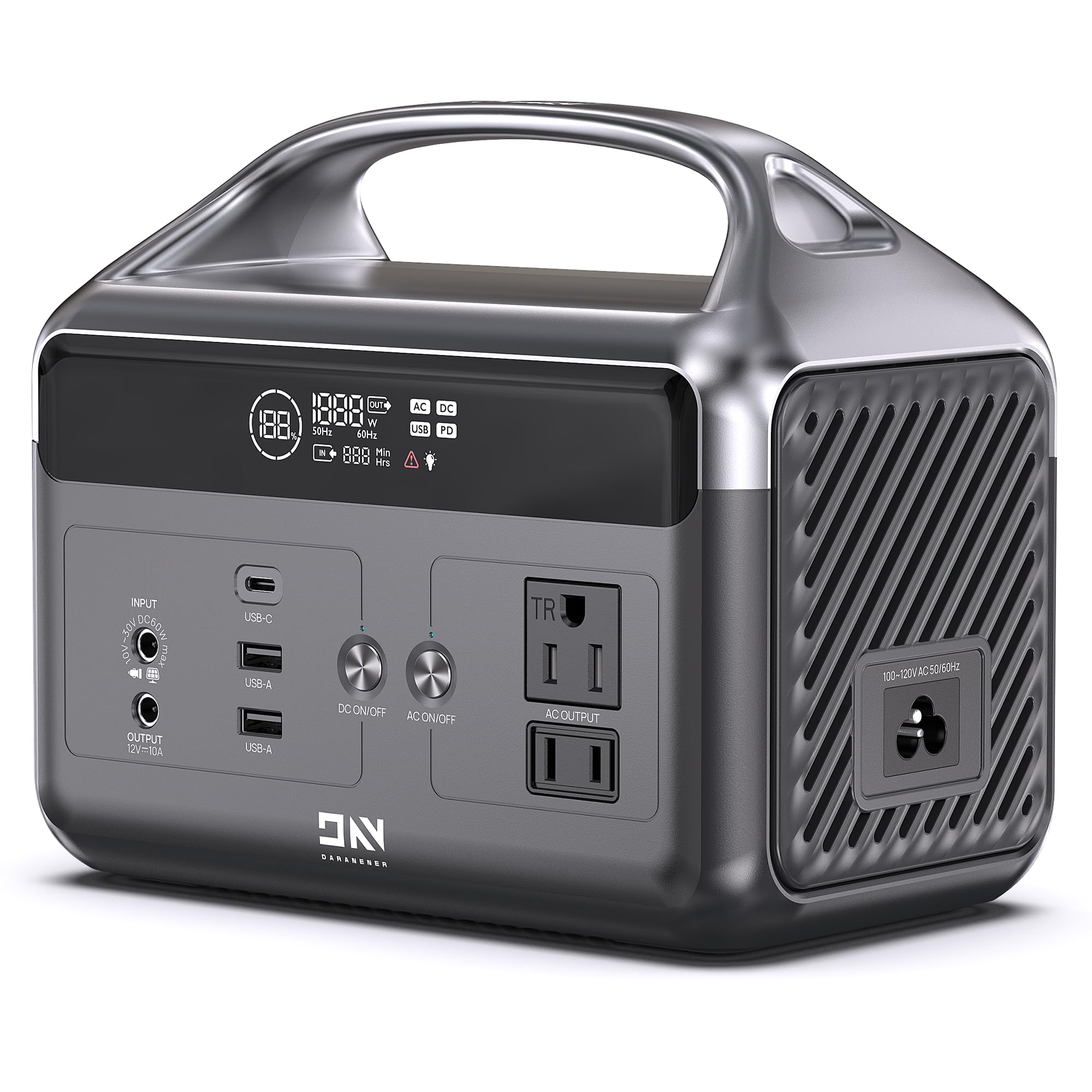
The DaranEner NEOZ-192Wh is a compact entry-level power station that punches above its size. Its 192Wh LiFePO4 battery delivers 3,500+ cycles, and the 300W pure sine wave inverter (600W peak) is perfect for low-power devices: phones, tablets, laptops, CPAP machines, LED lights, and cameras. At 5.73 pounds, it is easily the most portable unit in this list.
Charging is flexible: AC wall input at 100W, car charger, or solar panel up to 60W (MPPT controller built in). The 2x AC outlets, USB-C PD at 60W, and two USB-A QC3.0 ports support simultaneous charging of six devices. The built-in LED flashlight with SOS mode adds emergency utility.
Users report running a CPAP machine for most of the night and a fan for over 6 hours while charging a tablet. Some units have experienced DC-side failure after months of use, though customer support has been responsive with replacements. The power gauge occasionally drifts out of sync with actual battery level, requiring a full discharge cycle to recalibrate.
Why it’s great
- Ultra-portable at 5.73 lb—true grab-and-go backup
- LiFePO4 battery with 3,500+ cycle lifespan
- Pure sine wave output for sensitive medical devices
- 60W USB-C PD for fast laptop charging
Good to know
- 300W limit excludes high-power appliances
- Power gauge accuracy can drift over time
FAQ
Can a portable power station replace a traditional UPS for my desktop computer?
How many watts do I need to run a refrigerator during an outage?
What does pure sine wave mean and why does it matter for my CPAP machine?
How often should I discharge and recharge a LiFePO4 battery backup?
Can I charge a portable power station with solar panels while using it to power devices?
Final Thoughts: The Verdict
For most users, the best ac battery backup winner is the Jackery Explorer 1000 v2 because it delivers an unbeatable combination of portability, fast charging, and reliable LiFePO4 longevity at a reasonable weight. If you need true 10ms UPS protection for sensitive electronics, grab the EF ECOFLOW DELTA 3 Plus. And for whole-home backup with expansion capability, nothing beats the BLUETTI AC200L.