
The wrong cane aggravates wrist strain, transmits jarring shock through your joints, and wobbles on wet pavement, while the right one disappears into your stride, providing silent, stable support exactly where you need it. Choosing between offset handles, foam grips, folding shafts, and weight capacities requires understanding how each spec interacts with your specific gait pattern and daily environment.
I’m Min — the co-founder and writer behind Gadgets Feed. I’ve spent hundreds of hours cross-referencing customer durability reports, comparing anodized aluminum shaft thicknesses against push-button lock reliability, and analyzing how handle geometries distribute force across the palm and wrist in real-world use.
This guide cuts through the market noise to deliver seven carefully evaluated options for the best canes for walking, ranked by real structural integrity, handle ergonomics, and long-term adjustability rather than marketing claims.
How To Choose The Best Canes For Walking
The walking cane market is flooded with identical-looking aluminum sticks that feel radically different after an hour of weight-bearing use. Three critical factors separate a supportive cane from one that causes secondary pain.
Handle Geometry: Offset vs. Crook vs. Ergonomic Palm
An offset handle positions your wrist directly over the shaft centerline, converting your body weight into a straight compression load rather than a bending moment that torques the wrist joint. Crook handles—the classic J-shape—create an offset between your hand and the shaft that forces the wrist into constant extension. Ergonomic palm grips contour to the natural arch of the hand, distributing pressure across the thenar eminence and hypothenar pad rather than concentrating it in the metacarpal heads. For anyone with arthritis, carpal tunnel, or general hand fatigue, an offset or palm-grip handle is medically preferable.
Shaft Material, Diameter, and Locking Mechanism
Anodized aluminum dominates the category because it offers the best strength-to-weight ratio—most canes weigh between 12 and 15 ounces while supporting 250 to 300 pounds. The critical hidden spec is shaft wall thickness and diameter: 7/8-inch shafts with extruded aluminum construction resist lateral bending better than thinner 3/4-inch tubes. Push-button adjustment systems with a secondary locking ring prevent the dreaded cane rattle, where the inner extension tube vibrates against the outer shaft with every step. Twist-lock ferrules are simpler but more prone to loosening over time.
Tip Material, Replacement Compatibility, and Base Width
The rubber tip is the only contact point between you and the ground—its compound durometer, tread pattern, and base diameter directly determine slip resistance. Softer rubber compounds grip better on smooth indoor floors but wear faster on asphalt. A wider tip base (1.5 inches or more) provides a larger support polygon, improving lateral stability. Some manufacturers glue or vulcanize the tip to the shaft, making replacement impossible once the tread wears—prefer models with standard push-fit replacement tips available separately.
Quick Comparison
On smaller screens, swipe sideways to see the full table.
| Model | Category | Best For | Key Spec | Amazon |
|---|---|---|---|---|
| KMINA Ergonomic Walking Cane | Ergonomic | Severe hand arthritis | Anatomical palm grip, foldable, 15 oz | Amazon |
| Vive Offset Walking Cane | Offset Foam | All-day comfort & wrist pain prevention | Offset foam handle, 12 oz, 300 lb capacity | Amazon |
| PCP Butterfly Pattern Cane | Design + Support | Style without sacrificing durability | Offset foam grip, adjusts 32″-41″, 12.8 oz | Amazon |
| NOVA Designer Cane Blue Waves | Lightweight Style | Fashion-forward users (31 patterns) | Offset handle, 13.6 oz, 300 lb capacity | Amazon |
| Carex Ergo Floral Cane | Women’s Offset | Female-specific ergonomics | Offset handle, black floral, 12 oz, 250 lb | Amazon |
| Drive Medical Gel Grip Cane | Gel Comfort | Budget-friendly ergonomic entry | Gel grip, offset handle, 14.4 oz, 300 lb | Amazon |
| DMI Deluxe Adjustable Cane | Budget Basic | Lightweight backup or first cane | Foam grip, 5.1 oz aluminum, 250 lb limit | Amazon |
In‑Depth Reviews
1. KMINA Ergonomic Walking Cane (Right Handed)

The KMINA cane fundamentally rethinks handle ergonomics. Instead of a cylindrical grip that forces your fingers to curl around a narrow tube, the anatomically contoured palm cradles the thenar eminence and distributes weight across the entire palmar surface. Users with rheumatoid arthritis or osteoarthritis report being able to grip without flexing the metacarpophalangeal joints, dramatically reducing pain during extended use. The 15-ounce weight is reasonable for a folding cane, and the push-button adjustment provides six height settings.
The folding mechanism consists of a spring-loaded collar that locks the shaft segments into a rigid column—no flex or play was reported during weight-bearing. The non-slip ferrule has a wider base than standard tips, increasing the ground contact patch for better lateral stability. Customers consistently describe it as the sturdiest folding cane they have used, with no bending under full adult weight. Spanish manufacturing adds a level of quality control rarely seen in this price tier.
The primary caveat is that the palm grip is molded specifically for the right hand—left-handed users must seek the mirror-image variant, and those who switch hands during long walks will find it uncomfortable in the wrong hand. The lack of a wrist strap means the cane will fall if released, though the foldable nature makes it easy to stow when not needed.
Why it’s great
- Anatomical palm handle eliminates finger curling pressure for arthritis sufferers
- Folding shaft packs small for travel or storage without compromising stiffness
- Wider tip base improves lateral balance over standard round ferrules
Good to know
- Hand-specific design only works for declared right or left hand
- No wrist strap or hanging hook included
- Six height settings may not fine-tune for users between increments
2. Vive Offset Walking Cane with Comfort-Foam Handle
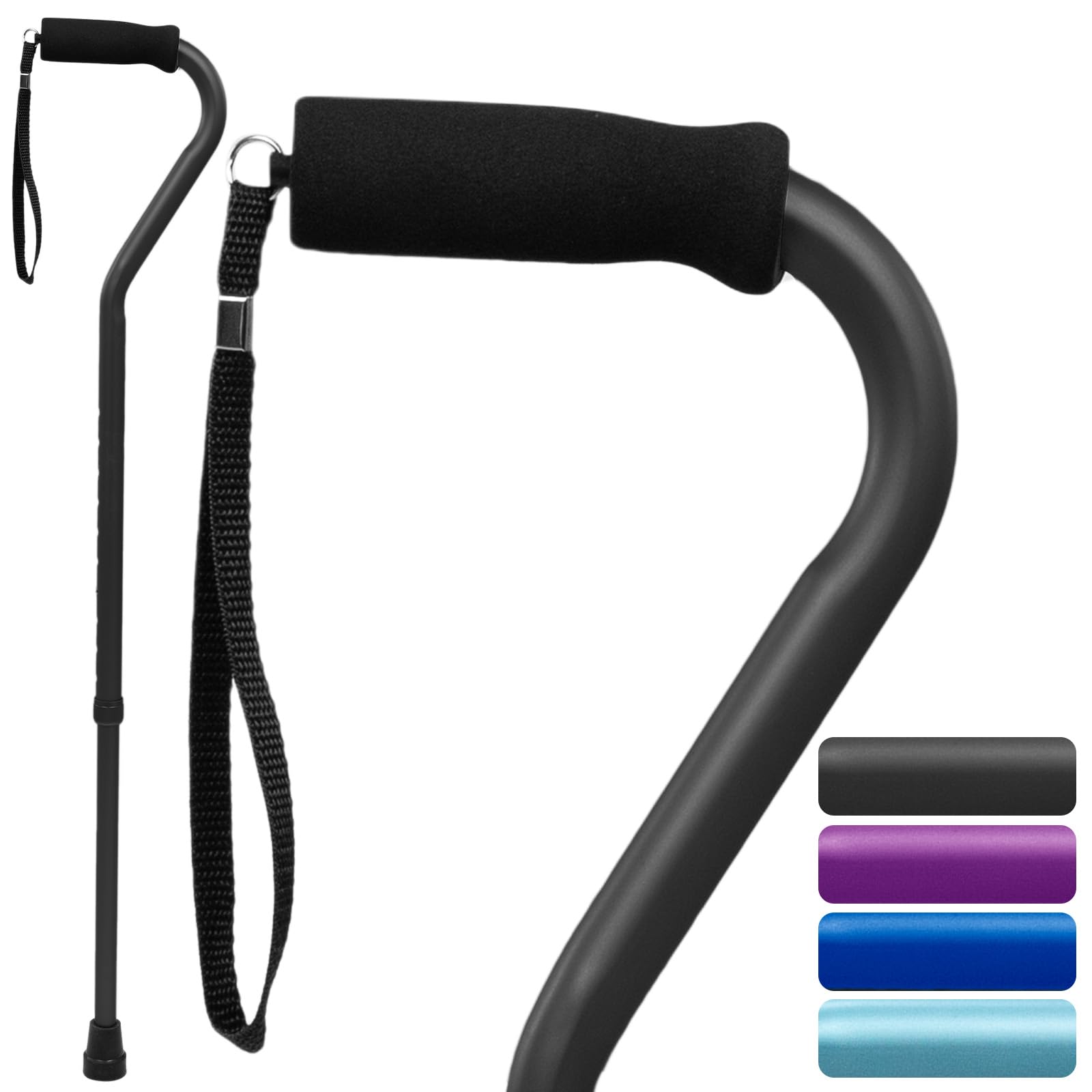
The Vive cane’s defining advantage is its foam handle density and shape. Rather than the thin foam sleeves found on budget canes, the Vive grip uses a substantially thicker, contoured layer that fills the palm and provides a non-slip surface even when hands are sweaty or weakened. The offset geometry centers the weight vector directly over the shaft, which biomechanically reduces wrist extension torque compared to traditional derby or crook handles. The 12-ounce shaft is anodized aluminum with a corrosion-resistant finish.
The push-button adjustment system uses a locking ring that threads down over the extension tube, eliminating the rattle that plagues cheaper canes. The tip is a standard-size rubber ferrule that accepts most replacement tips—important because the original will eventually wear. Users recovering from knee replacement and hip surgery specifically praised the wide base that allows the cane to stand upright when not in use, solving the “where do I put it down?” problem that frustrates many cane users.
The lifetime guarantee is a meaningful differentiator in a category where most manufacturers offer only a 90-day warranty. Some users found the foam grip slightly too large for small hands, and the black color is the only option available, which limits style choices for those wanting a more personalized look.
Why it’s great
- Thick contoured foam grip reduces hand fatigue during all-day use
- Anti-rattle locking ring prevents annoying step-synchronous noise
- Wider tip base allows cane to stand upright on its own
Good to know
- Single color option (black) limits aesthetic variety
- Foam grip may feel bulky for users with smaller hands
- Tip is standard size but not marketed as compatible with quad bases
3. PCP Offset Handle Foam Grip Adjustable Cane, Butterfly Pattern

The PCP butterfly cane proves that a walking cane can be both a medical device and a fashion accessory without compromising structural integrity. The wrap-style decal is applied under a clear protective coating that resists chipping and fading—multiple customers reported receiving compliments weekly during years of use. The offset foam handle follows the same ergonomic logic as the Vive but with a slightly narrower grip profile that suits medium-sized hands better. The 32-to-41-inch adjustment range is the widest on this list, accommodating taller users up to approximately 6-foot-6.
The locking silencer ring is effective at preventing rattle, and the extruded aluminum shaft (7/8-inch diameter) provides noticeably better resistance to lateral bending than thinner budget alternatives. The cane ships with a wrist strap that clips to the handle via a small loop. Customers who have owned the cane for over five years report that the decal remains intact and the push-button mechanism continues to engage positively without sticking or slipping.
The available patterns extend far beyond butterfly—options include celestial, hunter camouflage, peacock, cheetah, cats, and paisley—meaning there is likely a design for any personality. The primary trade-off is that the foam grip, while comfortable for most, is not replaceable if it degrades, and the pattern may fade after extended sun exposure if left in a car window.
Why it’s great
- Wide pattern selection with fade-resistant clear-coat application
- Tall adjustment range (32″-41″) fits users over 6 feet
- Long-term durability reported over 5+ years of daily use
Good to know
- Foam grip is not replaceable when it wears out
- Pattern may fade if left in direct sunlight for extended periods
- Wrist strap attachment loop can feel fragile
4. NOVA Designer Walking Cane, Blue Waves

The NOVA Designer cane offers the broadest pattern library of any cane on this list—31 distinct designs ranging from subtle earth tones to vibrant abstract florals. The offset handle geometry is paired with a foam grip that includes an integrated carrying strap, a practical addition for moments when both hands are needed. The 13.6-ounce weight is slightly heavier than the Vive but still well within the lightweight category, and the 300-pound weight capacity matches the highest rating in this comparison. The anti-rattle lock mechanism uses a threaded collar that compresses the split in the outer tube, effectively silencing the extension segment.
The finish is described as chip-resistant and fade-resistant, with multiple customers noting the visual quality exceeded their expectations based on product photos. The height adjustment spans 28 to 39 inches, accommodating users from 4-foot-11 to 6-foot-4. The slip-resistant rubber tip is standard size and replaceable. Customers who purchased the blue waves design specifically reported pairing it with a six-prong base for added stability, suggesting the shaft threading is compatible with aftermarket quad or tripod bases.
A few users noted that the tip wears faster than expected on rough outdoor surfaces and recommended ordering spare tips proactively. The foam grip, while comfortable, is not as thick as the Vive’s, and users with significant hand weakness may prefer the denser cushioning found on the KMINA or Vive models.
Why it’s great
- 31 pattern options provide unmatched aesthetic variety
- Integrated carrying strap for hands-free moments
- Replacement tip compatible with quad and tripod bases
Good to know
- Rubber tip wears relatively quickly on asphalt and concrete
- Foam grip is thinner than premium competitors
- Adjustment range may not suit extremely tall users over 6’4″
5. Carex Ergo Offset Walking Cane, Black Floral

The Carex Ergo offset cane targets female users with a slender shaft, lighter overall weight (12 ounces), and a black floral pattern that balances elegance with medical utility. The 29-to-38-inch adjustment range covers the typical height span for most women, and the offset handle reduces wrist extension during weight-bearing. The handle material is aluminum with a rubberized coating rather than foam—this creates a firmer, more defined grip surface that some users prefer over the squishy feel of foam, particularly those who need precise control over cane placement.
The push-button height adjustment uses a brass button that engages with positive detent holes in the extension tube. The locking ring tightens against the shaft to eliminate rattle, though some users reported needing to re-tighten periodically. Carex’s 30-year history in the mobility category adds brand confidence—this is a company that specializes in walking aids rather than a general goods importer. The included wrist strap is comfortable and removable.
The main drawback reported by multiple users is that the rubber tip is permanently affixed—either glued or vulcanized—making replacement impossible when the tread wears down. This means the entire cane becomes disposable once the tip fails, which is environmentally wasteful and economically inefficient for a long-term user. A few users also noted that the cane produces a subtle clicking noise during walking, likely from the locking ring interface.
Why it’s great
- Lightweight 12-ounce build with slender shaft suits smaller frames
- Firm rubberized handle provides precise control for experienced cane users
- Black floral pattern offers a stylish medical-device aesthetic
Good to know
- Rubber tip is non-removable and cannot be replaced when worn
- Some users report audible clicking during weight-bearing steps
- Locking ring may require periodic re-tightening
6. Drive Medical Adjustable Height Offset Handle Cane with Gel Grip

The Drive Medical cane is the entry-level price leader that still incorporates the essential ergonomic feature—the offset handle. What sets it apart from absolute budget options is the gel grip insert embedded in the handle, which provides a limited degree of shock absorption and pressure distribution that bare foam or plastic cannot match. The extruded aluminum shaft is a standard 1-inch diameter, and the weight capacity matches the 300-pound limit of premium competitors. The locking ring with metal silencer effectively prevents rattle, addressing a common complaint among first-time cane buyers.
The 28.5-to-38-inch height range covers most adults, and the one-button adjustment is straightforward for users with reduced dexterity. Physical therapists frequently recommend this model as a starter cane because the ergonomics are correct at a price point that removes financial hesitation. The gel grip is noticeably more comfortable than the basic foam handles found on similarly priced alternatives, and the wrist strap provides security when releasing the cane.
The handle shape is notably convex on the top surface—this prevents the cane from hooking over chair arms or counter edges, meaning it will slide and fall whenever leaned against a surface. Long-term users recommend upgrading to a self-standing model if the cane is used daily. Additionally, this model was discontinued by the manufacturer, so availability may fluctuate and spare parts may eventually become scarce.
Why it’s great
- Gel grip insert provides meaningful shock absorption at an entry-level price
- Physical therapist-recommended offset handle design
- Anti-rattle locking ring with metal silencer keeps operation quiet
Good to know
- Handle shape prevents hooking on chair backs—cane falls when leaned
- Discontinued by manufacturer; availability may be inconsistent
- Gel grip may degrade over time compared to solid foam handles
7. DMI Deluxe Adjustable Cane with Comfort Grip Handle

The DMI Deluxe cane strips away every non-essential feature to hit the lowest possible price while maintaining basic functionality. The aluminum shaft is the lightest on this list at just 5.1 ounces (due to thinner wall construction), and the weight capacity of 250 pounds is adequate for many users but 50 pounds lower than the 300-pound standard. The foam grip is comfortable initially, but long-term customers have noted that the foam density and thickness have been reduced in recent manufacturing batches compared to older versions.
The classic derby/crook handle shape—a gentle J-curve—is less ergonomic than a true offset handle because the wrist must assume a slight extension angle during weight-bearing. However, for users who only need the cane for occasional balance assistance rather than full partial-weight-bearing, this geometry is acceptable. The locking ring prevents rattle effectively when tightened, and the slip-resistant rubber tip is standard size and replaceable.
Customers with arthritis specifically recommended this cane for its foam handle padding, even while noting the handle is less ergonomically advanced than offset alternatives. Several users buy two units—one for the house and one for the car—because the low price makes a backup cane financially trivial. The primary trade-off is durability: the thinner aluminum wall and 250-pound capacity mean this cane is not built for heavy or daily use by larger individuals, and the grip foam may compress relatively quickly.
Why it’s great
- Extremely low weight (5.1 oz) is ideal for occasional or backup use
- Foam grip padding helps users with arthritis-related hand pain
- Low cost allows buying multiple units for car/house rotation
Good to know
- 250 lb capacity is 50 lb less than offset-handle competitors
- Crook handle shape requires wrist extension during use
- Foam grip thickness has been reduced in recent manufacturing runs
FAQ
What is the difference between an offset handle and a derby handle for walking canes?
How do I determine the correct cane height for my body?
Can I replace the rubber tip on my walking cane when it wears out?
Final Thoughts: The Verdict
For most users, the best canes for walking winner is the KMINA Ergonomic Walking Cane because its palm-contoured handle eliminates the finger-curling pressure that makes standard grips painful for arthritis sufferers, and the folding design adds genuine everyday practicality. If you want the best foam grip for all-day comfort and anti-rattle construction, grab the Vive Offset Walking Cane. And for maximum aesthetic variety combined with reliable offset-handle ergonomics, nothing beats the PCP Butterfly Pattern Cane.