
Your RV’s 12-volt house system runs on the foundation of series-wired 6-volt deep-cycle batteries. Choosing between flooded lead-acid, sealed AGM, and the new generation of LiFePO4 isn’t just about upfront cost—it dictates how many nights you can boondock, how heavy your rig sits, and whether you’ll be checking water levels at 6 AM.
I’m Min — the co-founder and writer behind Gadgets Feed. I spend my time dissecting battery specification sheets, cross-referencing user longevity reports, and weighing the real-world trade-offs between amp-hour ratings, cycle life, and physical footprint so you don’t have to chase a dead battery at a campsite.
This guide breaks down nine distinct options, from multi-pack SLA deals to premium self-heating lithium systems, to help you confidently select the best 6 volt rv battery for your specific power demands and budget.
How To Choose The Best 6 Volt RV Battery
Selecting a 6V battery for your RV isn’t about picking the highest voltage or the biggest box. The three pillars of the decision are battery chemistry, usable capacity, and physical dimensions. Your choice determines how long your lights, furnace fan, and fridge run before you need shore power or a generator.
Chemistry: Flooded vs. AGM vs. LiFePO4
Flooded lead-acid 6V batteries are the budget entry point but require regular distilled water top-ups and venting to avoid corrosive gas. AGM (Absorbent Glass Mat) batteries are sealed, vibration-resistant, and offer faster recharge rates with zero maintenance. LiFePO4 lithium batteries are the premium tier, delivering over 3000 cycles to 80% depth of discharge, half the weight of lead-acid for the same usable energy, and built-in Bluetooth monitoring—but demand a compatible charger and a much larger upfront investment.
Capacity: Amp-Hours (Ah) and Usable Energy
A 6V 225Ah battery wired in series with a second identical battery creates a 12V 225Ah bank. The catch is that lead-acid batteries should only be discharged to 50% depth of discharge to avoid damage, giving you 112.5 usable Ah per pair. LiFePO4 batteries can safely discharge to 80-100%, meaning a 206Ah lithium battery delivers 165-206 usable Ah. Always calculate your daily power consumption in watt-hours and size your bank to provide two to three days of autonomy.
Form Factor: Group Size and Terminal Type
The standard footprint for most high-capacity 6V deep-cycle batteries is the GC2 (Group GC2) size, which is roughly 10.2 inches long, 7.1 inches wide, and 9.9 inches tall. Measure your RV’s battery compartment before purchasing. Terminal configuration also matters: SAE posts work with standard cables, while M8 or T16 threaded terminals offer more secure connections for high-amperage inverters.
Quick Comparison
On smaller screens, swipe sideways to see the full table.
| Model | Category | Best For | Key Spec | Amazon |
|---|---|---|---|---|
| Weize GC2 240Ah | AGM Deep Cycle | Golf Carts & RV Banks | 240Ah / 67 lbs / SAE+M8 | Amazon |
| VMAX XTR6-235 (Qty 2) | AGM Pro | Extended Boondocking | 235Ah / 1.62kWh each | Amazon |
| VMAX6-225 GC2 | AGM Deep Cycle | Solar & RV House Power | 225Ah / 77 lbs / M8 | Amazon |
| Go Power GP-AGM-224-6V | AGM Solar | Off-Grid Solar Systems | 224Ah / 1.4 mOhm | Amazon |
| NPP NP6-225Ah | SLA Deep Cycle | Budget-Conscious RVs | 225Ah / 65 lbs / T16 | Amazon |
| OPTIMA 6V REDTOP | Starting AGM | Antique Vehicle Starting | 800 CCA / 18.5 lbs | Amazon |
| Mighty Max ML12-6F2 (10-Pack) | SLA Small App | Kids Rides / UPS Backup | 12Ah / 4.1 lbs each | Amazon |
| SOK 12V 206Ah LiFePO4 | Lithium Premium | Full-Time RV Living | 206Ah / 130A cont. | Amazon |
| VATRER POWER 12.8V 460Ah | Lithium Mega | Max Capacity Solar | 460Ah / 300A BMS | Amazon |
In‑Depth Reviews
1. Weize GC2 6V Golf Cart Battery
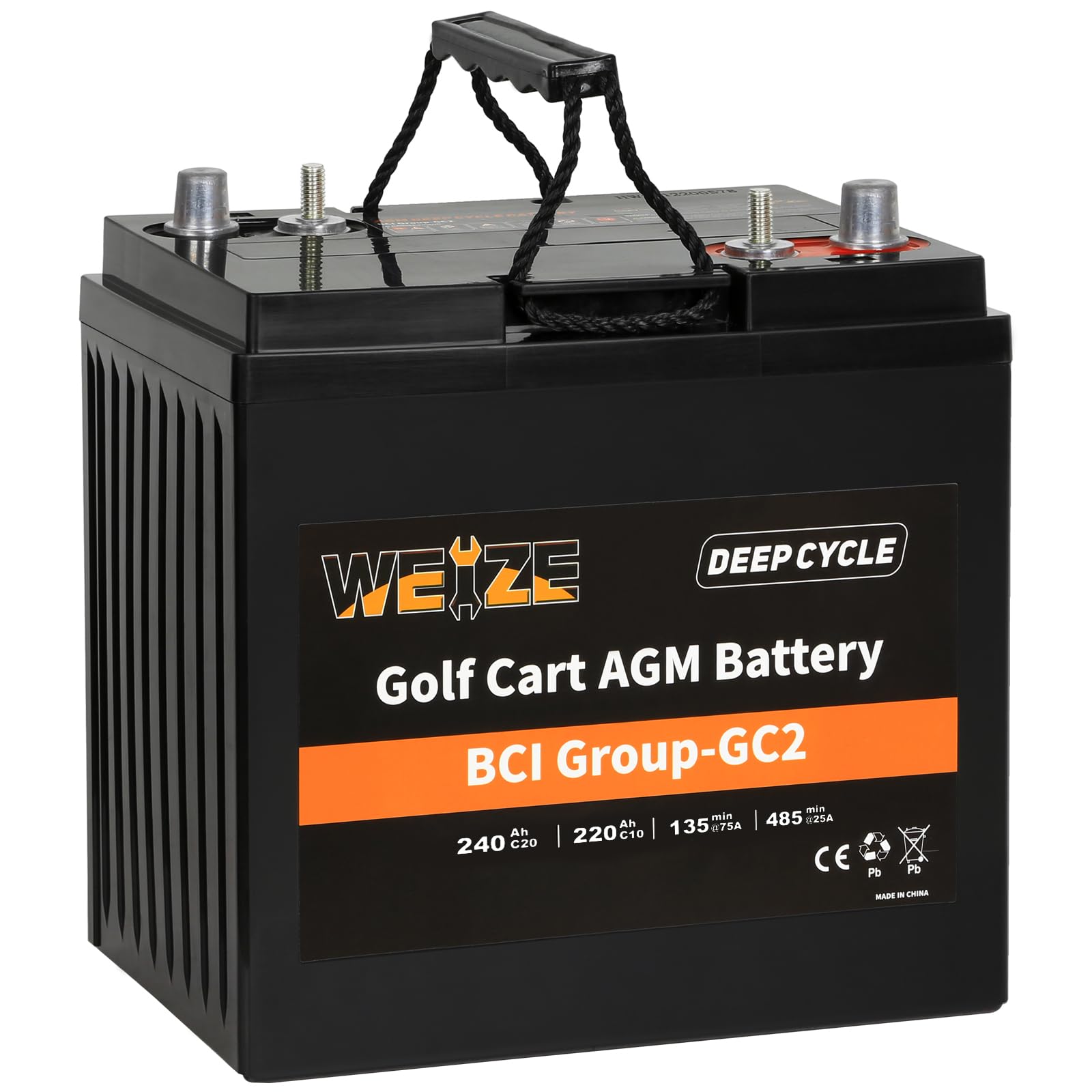
The Weize GC2 delivers a potent 240Ah capacity in the standard GC2 form factor, using a hybrid AGM-GEL electrolyte that combines low internal resistance with deep-cycle resilience. Its 10.24 x 7.09 x 10.79-inch frame and dual SAE post/M8 terminal options make it a drop-in upgrade for most golf carts and RV battery trays. The 67-pound weight reflects the dense lead plate construction that gives it a longer shelf life and lower self-discharge than conventional flooded batteries.
User feedback from RV owners running 12-volt series banks confirms that the Weize holds voltage under sustained inverter loads and recharges efficiently with solar. The double separator configuration reduces internal shorting risk on rough terrain, a common pain point for travel trailers. With a 2-year warranty and virgin lead grid plates, this battery undercuts many competitors on price per amp-hour while maintaining AGM build quality.
One caveat is that these require a lithium-compatible charger if you plan to mix them with LiFePO4 batteries down the line—AGM and lithium charging profiles differ significantly. But for a pure lead-acid bank, the Weize GC2 offers the highest nameplate capacity in its price bracket, making it the most versatile pick for mid-range RV power.
Why it’s great
- 240Ah capacity is class-leading among GC2 AGMs at this price tier
- Dual terminal system (SAE + M8) supports multiple wiring configurations
- Maintenance-free sealed design with strong vibration resistance
Good to know
- Heavy at 67 pounds—requires a two-person install in tight compartments
- Best paired with a charger that has an AGM-specific profile
2. VMAX XTR6-235 6 Volt 235Ah (Qty 2)

The VMAX XTR6-235 is a purpose-built deep-cycle AGM that packs 1.62 kWh of energy per battery with a reserve capacity of 500 minutes. When wired in series as a 12V bank, two units deliver 235Ah of robust, vibration-resistant power that users consistently report lasting upwards of seven years on a proper float charger. The GC2 footprint and 78-pound per-unit weight are standard, but the XTR line uses military-spec lead alloys and a reinforced grid paste that handles the repetitive deep discharges of full-time RV living.
Customer logs from dry-camping motorhome owners show a dramatic improvement over standard flooded batteries: runtime jumped from 6-8 hours to 12 hours at 50% depth of discharge before the inverter shutdown threshold. The AGM construction eliminates all water-checking drama and allows the batteries to be mounted in sealed compartments without venting concerns. Multiple verified purchasers noted zero capacity degradation after two years of heavy cycling, which is exceptional for lead-acid.
The main drawback is the premium sticker, which rivals entry-level lithium pricing for a lead-acid product. Also, a handful of users reported warranty claim difficulties with the seller, so purchasing from an authorized Amazon vendor like bargainshore is critical. For those who want AGM simplicity with lead-acid durability and aren’t ready to switch to lithium charging infrastructure, the VMAX XTR6-235 pair is a long-term investment that returns exceptional daily usable energy.
Why it’s great
- 500-minute reserve capacity translates to half-day boondocking without solar
- Users report 7+ year lifespan in properly maintained RV systems
- True deep-cycle design with heavy-duty plates for repeated 80% DoD use
Good to know
- Very heavy at 78 lbs each—plan your battery tray loading
- Warranty support may require persistence; document your purchase
3. VMAX6-225 GC2 AGM Deep Cycle Battery

The VMAX6-225 is a 225Ah AGM battery built to a military-grade specification, using custom alloys that withstand vibration and repeated deep cycling better than off-the-shelf SLA units. It measures 9.5 x 7.3 x 11 inches and uses an 8mm M8 screw-in post terminal, which provides a more secure connection under high current draw from inverters than standard SAE posts. Float service life is rated at 5-8 years, and the non-spillable construction earns DOT and IATA approvals for air and ground transport.
Users wiring dual units for 12V RV house banks consistently praise the VMAX for outperforming banks of four standard 12V marine batteries. One full-time boondocker reported that two VMAX6-225 units lasted 2.5 years off-grid with daily cycling, still holding strong voltage. Solar recharging is particularly efficient with AGM chemistry, with a 200W panel array topping up the bank to 12.7V within 5-6 hours of partial sun. The lower initial cost compared to lithium makes it a favorite for first-time RV solar builders.
The battery arrived with a manufacturing date three months prior in some user cases, indicating good stock turnover. However, the 77-pound weight and lack of integrated handles mean you’ll need to plan your lift carefully. For RV owners who want a dependable, mid-cost AGM bank with proven longevity, the VMAX6-225 delivers exactly that with no charging profile drama.
Why it’s great
- Military-grade lead construction provides excellent cycle life vs. standard AGM
- M8 threaded terminals deliver consistent high-current connection for inverters
- Widely praised for solar charging efficiency and voltage stability
Good to know
- No integrated handle makes lifting into a tray more awkward
- Warranty requires purchase from an authorized seller like bargainshore
4. Go Power GP-AGM-224-6V

The Go Power GP-AGM-224-6V is explicitly designed for solar and inverter applications, with a C20 hour rate of 224Ah and an internal resistance of just 1.4 milliohms—low enough to accept charge rapidly from solar charge controllers. The sealed AGM construction includes integrated carrying handles, a welcome ergonomic touch for the 65-pound weight class. Its dimensions (10.24 x 7.09 x 9.96 inches) align with standard GC2 trays, and the battery can be paired in series to replace a single 12V deep-cycle unit.
Independent capacity testing by users showed the battery met or slightly exceeded its 224Ah rating when discharged at a constant rate to 11.0V, delivering slightly more watt-hours than the spec sheet claims. Customers using the battery in travel trailers and campers reported that it charges efficiently from 200W solar panels, maintaining fridge and lighting loads for multiple overcast days. Go Power backs the unit with a 2-year warranty, which is better than the typical 1-year coverage for AGM batteries in this range.
The most common negative feedback involved a small number of early failures before the one-year mark, though these appear to be outliers in the data. As with all AGM batteries, the Go Power unit demands a charge controller programmed for AGM absorption and float voltages—using a generic SLA setting will shorten its lifespan. For solar-first RV setups, this battery offers the best balance of certified capacity and solar charging acceptance at a mid-range price.
Why it’s great
- Low 1.4 mOhm internal resistance optimizes solar charge acceptance
- Integrated carrying handles simplify installation in battery bays
- Rated capacity verified by user load testing at C20 discharge rate
Good to know
- A small number of units reported early failure; document your purchase date
- Requires an AGM-specific charge profile in your solar controller
5. NPP NP6-225Ah AGM Battery
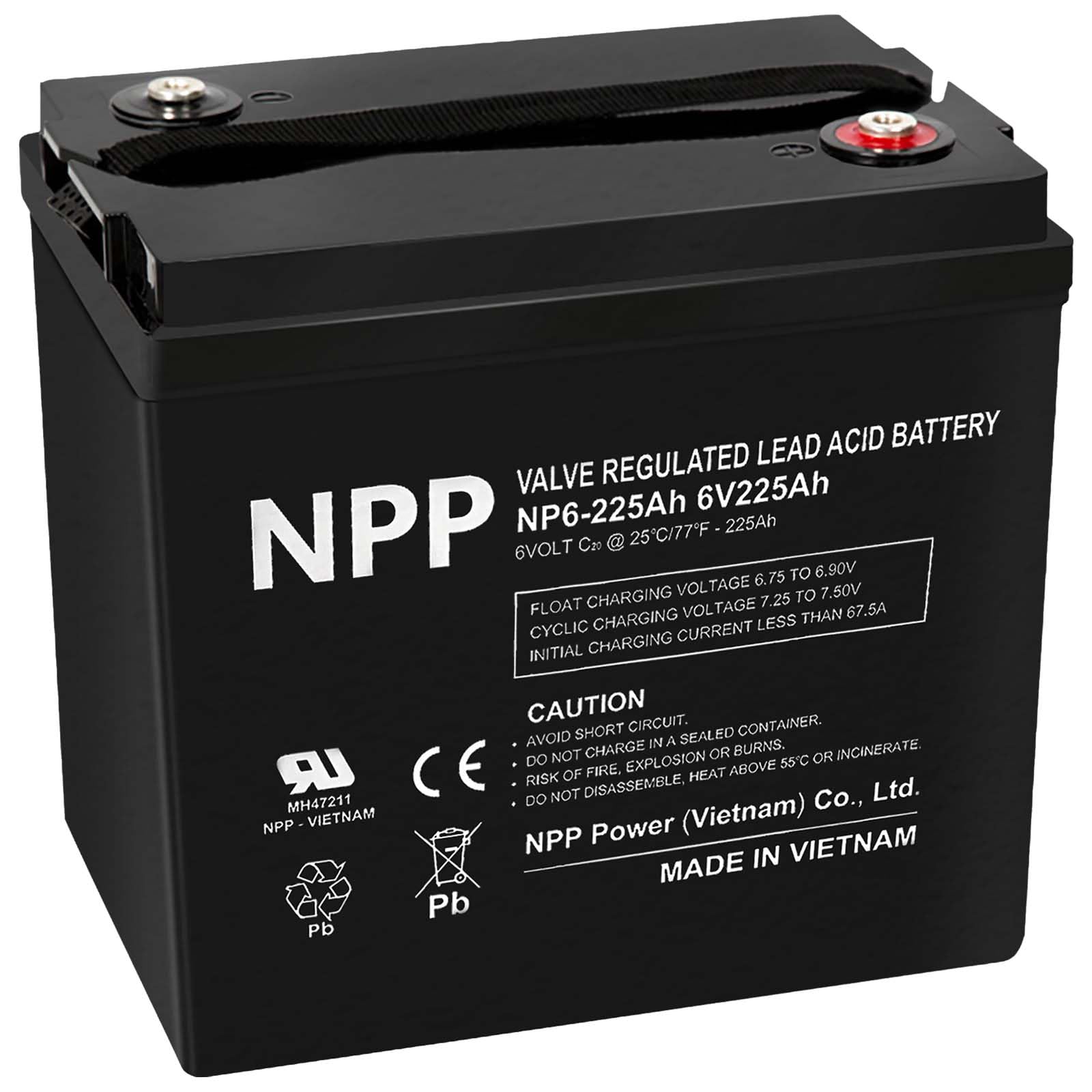
NPP’s NP6-225Ah is a sealed lead-acid (SLA) battery that uses AGM technology to deliver 225Ah at the 20-hour rate, with a T16 (M8 equivalent) threaded terminal for secure high-current connections. The battery weighs 65 pounds and measures 10.24 x 6.65 x 9.69 inches, making it slightly narrower than standard GC2 batteries—an advantage if your RV battery tray is tight side-to-side. NPP is a large global manufacturer with UL, CE, and ISO certifications, sourcing virgin lead for its grid plates.
RV users running dual NPP batteries in series report adequate power for lights, furnace blowers, and 12V refrigerator compressors over several days of boondocking, especially when paired with 200W solar. The battery’s flexible series/parallel configuration allows for scaling up to a larger bank without voltage mismatch issues. A few users noted reversed polarity from the factory, causing a blown fuse—easily fixed by swapping cables, but worth checking before fully installing.
The main point of concern is longevity: one verified owner reported failure after two years of use, unable to hold charge through the night on basic loads. This outcome is not universal—many users have had excellent results—but it suggests that the NPP may not handle aggressive daily deep cycling the way premium AGMs do. For weekend RVers or those with robust solar recharging, the NPP is a solid quantity pick. For full-time off-grid use, consider stepping up to a VMAX or Weize unit.
Why it’s great
- Slightly narrower profile fits tighter battery compartments than standard GC2
- T16/M8 terminals ensure a mechanical lock under inverter loads
- Global manufacturer with multiple safety certifications
Good to know
- Some units arrived with reversed polarity; inspect before final wiring
- Mixed long-term reliability reports—may not suit daily deep-cycling needs
6. OPTIMA 6V REDTOP High Performance

The OPTIMA 6V REDTOP is a SpiralCell AGM starting battery, not a deep-cycle battery—a critical distinction. It delivers an impressive 800 cold cranking amps (CCA) and 100 minutes of reserve capacity from a compact 18.5-pound package (10.06 x 3.63 x 8.13 inches). The SpiralCell design wraps 99.99% pure lead plates into a spiral, which provides 15 times the vibration resistance of flooded batteries and three times the lifespan in starting applications.
This battery is the gold standard for antique and classic 6-volt vehicles—Model A Fords, vintage VW Beetles, and farm tractors. Users replacing 600 CCA stock batteries with this REDTOP report that 6V engines crank as fast as modern 12V systems, even with lights on. The sealed, no-leak construction is a major plus for cars that sit on trickle chargers inside garages for months. Verified owners report seven-year service life when maintained with a proper AGM-compatible float charger.
The REDTOP is not suitable as the sole house battery bank for an RV because it is optimized for short, high-current bursts, not sustained deep discharges. Using it for deep-cycle loads will drastically shorten its lifespan. Its 50Ah C20 capacity is also far below the 200Ah+ that RV house banks require. Keep this battery for engine starting and pair your house load with one of the deep-cycle options above.
Why it’s great
- 800 CCA cranks 6V engines with modern 12V speed and reliability
- Extremely compact and lightweight at 18.5 lbs
- Proven 7+ year lifespan on float chargers in classic car applications
Good to know
- Designed for starting, not deep-cycle house loads
- Custom hold-down bracket needed due to smaller physical footprint
7. Mighty Max Battery ML12-6F2 (Pack of 10)

The Mighty Max ML12-6F2 is a small-format 6V 12Ah sealed lead-acid battery in a pack of ten, designed for low-power applications like kids’ ride-on cars, UPS backup units, and Streamlight LiteBox replacements. Each battery measures just 5.94 x 2.01 x 3.94 inches and weighs 4.1 pounds, with F2 (0.187-inch) quick-connect terminals. The UL-certified SLA AGM construction is spill-proof and can be mounted in any orientation.
Users have successfully revived old Tripp-Lite UPS units and replaced Streamlight rechargeable flashlight batteries with the ML12-6F2, noting that the 12Ah rating matches the original Yuasa MPX-50. The F2 terminal may require an F2-to-F1 adapter for some equipment, but the dimensions fit standard battery trays perfectly. For the price of a single high-capacity 6V battery, you get ten of these—an excellent value for distributed small-power needs.
This pack is not intended for RV house battery banks. 12Ah per unit is far too small for powering a fridge or furnace blower. Even ten units wired in series-parallel would only produce 12V 120Ah, and the wiring complexity would be impractical. This purchase is for toys, backup systems, and portable devices, not for your travel trailer.
Why it’s great
- Ten-pack provides excellent per-unit cost for multiple small devices
- UL-certified SLA AGM with 1-year warranty per battery
- Compact size fits UPS, power wheels, and flashlight replacements
Good to know
- 12Ah capacity is unsuitable for RV house battery banks
- F2 terminal may need an adapter for older F1 equipment
8. SOK Battery 12V 206Ah LiFePO4
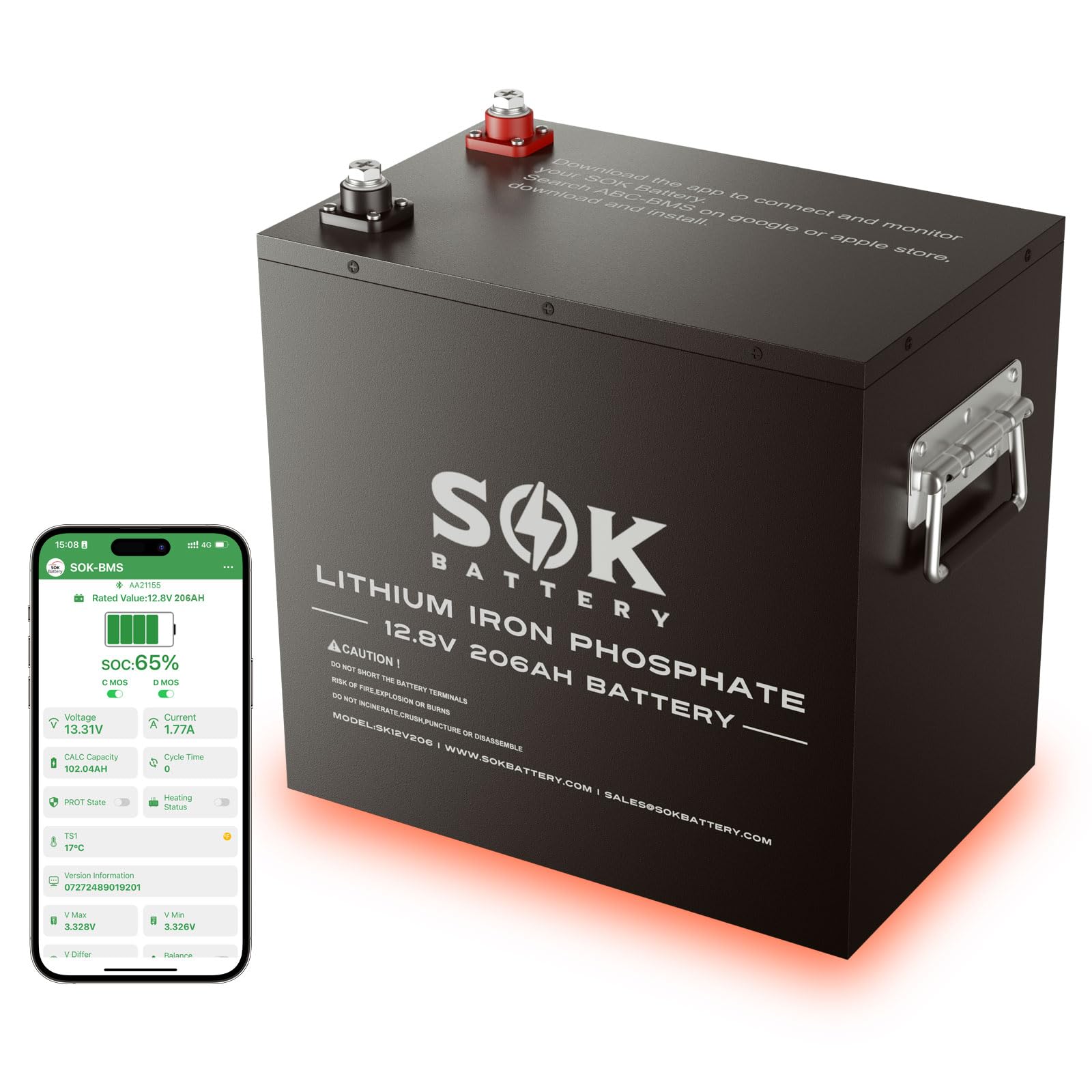
The SOK 12V 206Ah LiFePO4 battery is a premium drop-in replacement for lead-acid house banks, packing double the capacity of standard 100Ah lithium units into a 50-pound metal-clad case (11.9 x 7.9 x 11.1 inches). It features a built-in self-heating pad that activates when temperatures drop below 32°F, using the incoming charging current to warm the cells so they can accept a charge down to -4°F. The 6mm thick SPCC steel case provides robust physical protection and passive cooling.
The integrated smart BMS handles 130A continuous discharge (170A peak), automatic cell balancing, and all standard lithium protections. Bluetooth monitoring via the ABC-BMS app gives real-time voltage, current, and state of charge data. The battery supports 8000-12000 cycles to 80% depth of discharge, translating to over a decade of daily use. The detachable metal cover allows owner-serviceable BMS and cell replacement, a rarity in consumer lithium batteries that significantly extends product lifespan.
This battery operates at 12V natively and cannot be wired in series for 24V systems. For RV owners looking to add 206Ah of usable lithium capacity with worry-free cold-weather performance, the SOK delivers best-in-class build quality and user-replaceable internals. The upfront cost is higher than AGM banks, but the cycle life and weight savings justify the price for full-time travelers.
Why it’s great
- Self-heating function enables charging below freezing without cell damage
- Owner-serviceable design allows BMS and cell replacement
- 8000+ cycle rating with Grade-A LiFePO4 cells ensures decade-long service
Good to know
- Cannot be connected in series for 24V/48V systems—12V only
- Requires a lithium-compatible charger or solar controller for optimal charging
9. VATRER POWER 12.8V 460Ah LiFePO4
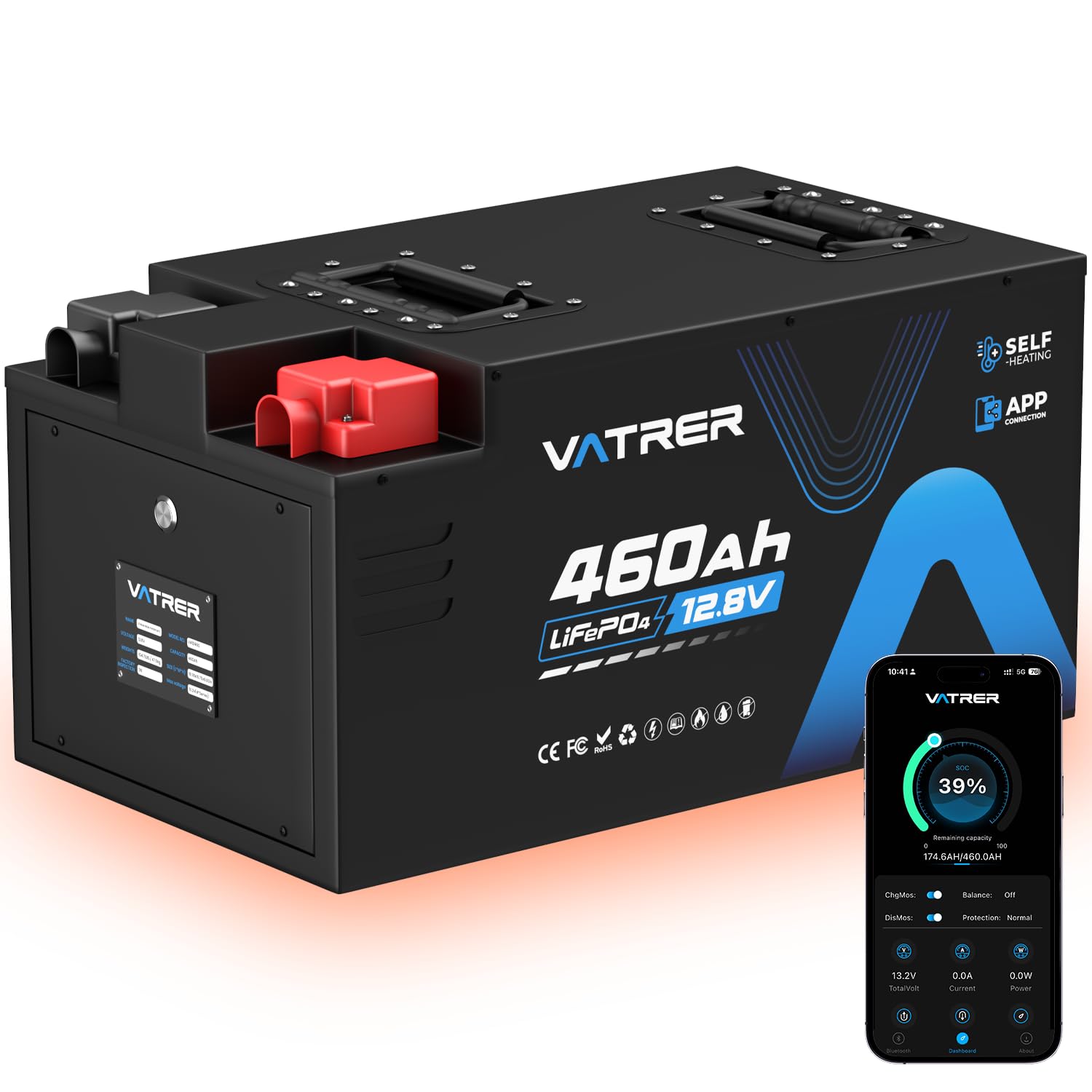
The VATRER POWER 12.8V 460Ah LiFePO4 battery is a massive single-unit energy solution that replaces five 100Ah batteries with a single package measuring 18.78 x 10.75 x 9.92 inches and weighing 104.7 pounds. With 5880Wh of usable energy and a 300A continuous BMS, it can handle high-draw appliances like RV air conditioners, microwaves, and electric ovens. The self-heating function activates when charging below 41°F, ensuring cold-weather reliability.
Bluetooth monitoring through a dedicated app provides real-time data on voltage, current, temperature, and cycle count. The battery supports expandable parallel and series configurations up to 4P4S, allowing a maximum system of 51.2V 1840Ah with 94.2kWh usable energy for larger off-grid setups. Users report fast charging from 600W solar arrays, running desktop computers overnight, and running campers for multiple days with minimal solar input. The SPCC metal case and physical main switch add operational safety and convenience.
The trade-off is pure size and handling: at over 100 pounds, this battery requires a very large, reinforced battery tray and ideally two people to install. It is also a 12.8V nominal battery, so wiring into a 12V system is straightforward, but series configurations for 24V/48V require careful planning. For RV owners who want absolute maximum capacity in a single battery footprint and have the space and strength to handle it, the VATRER 460Ah is the ultimate plug-and-play solution.
Why it’s great
- 460Ah capacity replaces an entire bank of 5 standard 100Ah lithium batteries
- 300A BMS handles high-power RV appliances like air conditioners
- Expandable to 51.2V 1840Ah for large solar system upgrades
Good to know
- Extremely heavy at 104.7 lbs—requires reinforced tray and careful handling
- Not recommended for series/parallel mixing with non-heating VATRER models
FAQ
Can I pair a 6V battery with a 12V battery in my RV?
How long will a 6V 225Ah AGM battery power my RV fridge?
Should I buy LiFePO4 or AGM for my first RV battery bank?
Final Thoughts: The Verdict
For most RV owners, the best 6 volt rv battery is the Weize GC2 240Ah because it offers the highest amp-hour capacity at a mid-range price with proven AGM reliability. If you want the longest lifespan and user-serviceable internals for full-time off-grid living, grab the SOK 206Ah LiFePO4. And for boondockers needing absolute maximum runtime without switching to lithium charging infrastructure, nothing beats the pair of VMAX XTR6-235 for raw reserve capacity.