
That chalky, faded gelcoat staring back at you from the dock is the single most visible sign that your boat has been fighting the sun and salt. Reversing that damage isn’t about elbow grease alone—it takes the right tool with the correct orbit, pad compatibility, and enough torque to cut through oxidized fiberglass without burning the clearcoat underneath. A dedicated marine-grade buffer changes the entire equation, turning hours of arm-aching labor into a controlled, predictable process.
I’m Min — the co-founder and writer behind Gadgets Feed. I’ve spent countless hours cross-referencing motor wattage, orbit mechanisms, pad size constraints, and marine-specific customer feedback to isolate the seven models that genuinely belong in a boat owner’s arsenal.
After analyzing real-world performance across hundreds of hours of gelcoat detailing sessions, these picks represent the most reliable path to a deep, water-beading finish when you’re searching for the best boat buffer for your specific hull size and skill level.
How To Choose The Best Boat Buffer
Selecting a marine buffer comes down to matching the tool’s orbit type and power delivery to your boat’s gelcoat condition and your experience level. The wrong choice can mar a finish or leave oxidation untouched.
Dual Action vs. Rotary: The Gelcoat Safety Question
A dual-action (DA) buffer oscillates the pad in a random orbit, which dramatically reduces the risk of burning through the gelcoat on fiberglass hulls. Rotary buffers spin in a fixed direction and demand far more skill to avoid creating holograms or heat damage. For most boat owners, a DA polisher provides the best balance of correction ability and safety.
Motor Power and Torque Retention
Gelcoat oxidation is stubborn. A buffer with a 1000W or higher motor maintains pad rotation speed under heavy downward pressure, preventing the tool from bogging down. Models with digital torque management or high-amp motors (4.5 amps and up) sustain consistent pad speed through the entire compound cycle.
Variable Speed Range and Pad Size
A broad speed range (from 2500 OPM up to 6500+ OPM) allows you to apply wax at low speeds, compound at medium speeds, and finish-polish at high speeds with different pad types. Pad diameter matters: 6-inch pads offer better maneuverability on curved hull sections, while 7-inch pads cover flat topsides faster.
Quick Comparison
On smaller screens, swipe sideways to see the full table.
| Model | Category | Best For | Key Spec | Amazon |
|---|---|---|---|---|
| Shurhold 3101 | Dual Action | Marine Starter Kits | 2500-6500 OPM | Amazon |
| Meguiar’s MT300 | Dual Action | Torque Consistency | Digital Torque Management | Amazon |
| DEWALT DWP849 | Rotary | Professional Daily Use | 12 Amp Motor | Amazon |
| BATOCA 6 | Dual Action | Value Kit Bundles | 700W/3800 OPM | Amazon |
| Adam’s Polishes 9mm | Dual Action | Lightweight Correction | 5.5 lbs / 1000W | Amazon |
| LDHTHOPI 1800W | Rotary | Budget Rotary Power | 1800W/3100 RPM | Amazon |
| OPAVIOC Jewelry Polisher | Bench Grinder | Small Metal Details | 1750-8500 RPM | Amazon |
In‑Depth Reviews
1. Shurhold 3101 Dual Action Random Orbital Buffer Polisher Starter Kit

The Shurhold 3101 arrives as a complete marine detailing kit with a 16oz bottle of Pro Polish Wax, a 6.5-inch foam pad, a microfiber towel, and a carrying bag, making it the turnkey solution for any boat owner tackling chalky gelcoat for the first time. Its dual-action random orbit prevents pad burns even on the curved fiberglass of a center console hull.
Real-world feedback from boat owners confirms that an 18-foot Bayliner hull went from dull to deep shine in roughly two hours using the included wax, with water beading holding up for months in Florida saltwater conditions. The rubberized body and adjustable handle provide a secure grip when you’re leaning over the gunnel, and the 20-foot cord eliminates the need for a separate extension cable when working on a trailer.
The power delivery is smooth, but the speed dial requires a deliberate push-and-slide motion to shut off—an intentional design that prevents accidental cutouts mid-stroke. For the owner of a 20 to 30-foot boat who wants a single purchase that includes everything needed for gelcoat restoration, this kit is the most cohesive option available.
Why it’s great
- Complete starter kit with pad, wax, towel, and bag
- Dual-action orbit is safer for gelcoat than rotary buffers
- 20-foot cord reduces reach limitations on boats
Good to know
- Power switch takes practice; not a standard toggle
- Included pad works well but wears faster under heavy compounding pressure
2. Meguiar’s MT300 Variable Speed Dual Action Polisher

Meguiar’s MT300 brings digital torque management into play, electronically sensing when the pad is under load and adjusting power to maintain a consistent 6500 OPM. This is a decisive advantage when working on heavily oxidized fiberglass where the pad naturally slows down as compound dries and drag increases.
The soft-start technology gradually ramps up the pad speed when you pull the trigger, eliminating the compound-splattering burst that cheap buffers throw across the hull. At 5.4 pounds, the body is light enough for overhead work on a T-top, and the billet counterweight keeps vibration low enough that hand numbness over a long compounding session is minimized—though full-speed operation still transmits noticeable chatter.
A boat owner used the MT300 with Meguiar’s Marine/RV three-step system to restore severely oxidized fiberglass on a used RV, and the torque management allowed him to lean into deep oxidation without stalling the pad. The same reviewer noted that the tool made decal-safe edge work much easier than a rotary. It requires a separate backing plate and pads, which adds an initial cost, but the consistent speed control justifies the expense for serious detailers.
Why it’s great
- Digital torque management keeps pad speed steady under load
- Soft-start prevents splatter on startup
- Lightweight and well-balanced for overhead hull work
Good to know
- Backing plate and pads sold separately
- High vibration at full speed can cause hand fatigue over long periods
3. DEWALT Variable Speed Polisher DWP849

The DEWALT DWP849 is a variable-speed rotary buffer built for professional-grade abuse, not a weekend warrior’s toy. With a 12-amp motor that delivers consistent torque even under heavy compounding pressure, it chews through severe gelcoat oxidation that would stall lower-powered DA machines. The trigger speed control gives the operator precise throttle modulation from zero to full RPM.
Professional boat detailers who use this tool daily for 8+ hours report that a simple maintenance schedule—cleaning the vents, blowing out carbon brush dust, and replacing brushes every three months—keeps the unit running beyond a year of commercial use. The weight sits around 9.5 pounds, which is substantial; the two-position side handle helps manage the load when working on vertical hull sides.
Critically, the DWP849 is a forced rotary machine, not a dual-action. This means the learning curve is steeper, and there is genuine risk of burning through gelcoat if the pad lingers in one spot. Experienced users compensate with a light touch and constant pad movement. For the boat owner who wants pro-level cut speed and is comfortable with rotary technique, this is the most durable option money can buy.
Why it’s great
- 12-amp motor delivers unmatched torque for heavy oxidation
- Proven daily durability with basic brush maintenance
- Trigger speed control offers infinite RPM modulation
Good to know
- Rotary action requires skill to avoid burning gelcoat
- Heavy weight (9.5 lbs) will fatigue arms over full-day sessions
4. BATOCA 6 Dual Action Random Orbital Car Polisher
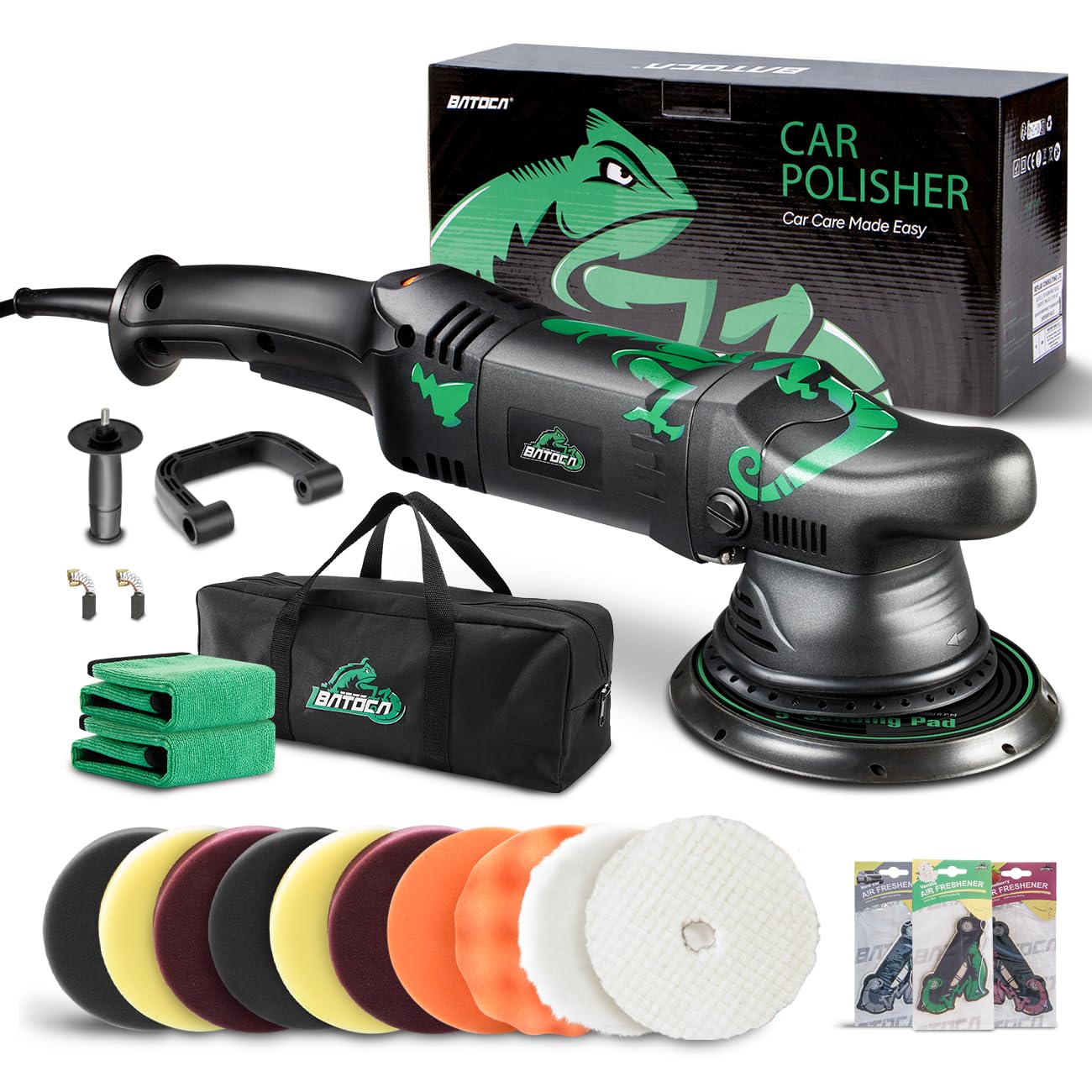
The BATOCA 6 DA polisher packs a 700W copper-wire motor into a kit that includes six foam pads, wool pads, sanding papers, a microfiber towel, a tool bag, and even spare carbon brushes—everything except the boat. The 6-inch pad size is ideal for navigating the tight curves around a boat’s windshield frame, cleats, and strakes.
Experienced detailers note that the included foam pads are stiff out of the box and require a break-in cycle before they conform properly to compound. Once bedded in, the eccentric orbit design applies wax deep into the gelcoat pores, leaving a finish that reviewers say made a neglected car look brand new after 8 cumulative hours of work across three vehicles.
The speed dial offers six settings between 1000 and 3800 OPM, and the ergonomic D-handle reduces forearm fatigue during long sessions. For the boat owner on a moderate budget who wants a full accessory bundle and the safety of a dual-action mechanism, this kit delivers solid performance without demanding a premium investment.
Why it’s great
- Complete kit with multiple pad types and spare brushes
- 6-inch pad fits tight boat contours well
- Dual-action orbit is beginner-friendly and prevents paint damage
Good to know
- Included foam pads need break-in before optimal performance
- 700W motor may bog on severely oxidized gelcoat at high pressure
5. Adam’s Polishes 9mm Dual Action Car Polisher

The Adam’s Polishes 9mm DA polisher weighs just 5.5 pounds but houses a 1000W motor that generates 6500 OPM at maximum speed. This combination of low weight and high power makes it the most fatigue-resistant option for large hull work, especially when compounding a 30-foot cabin cruiser’s topsides for hours at a time.
The 9mm orbit throw provides a tighter oscillation that displaces compound evenly across the gelcoat, which reduces the risk of creating high-spot burn marks that wider-throw tools can leave. Concave rubber contact points along the housing absorb vibration, and the 16-foot cord gives decent reach on most trailer-sized boats. A first-time user reported polishing a 2021 Jeep Wrangler in 4.5 hours with no prior experience and achieved swirl-free results.
While the motor is powerful, the backing plate and pads are not included in the base package, and the pad selection must be purchased separately. For the marine detailer who prioritizes comfort over a bundled kit, the Adam’s Polisher offers the best power-to-weight ratio in this lineup.
Why it’s great
- Exceptional power-to-weight ratio at 5.5 lbs / 1000W
- 9mm orbit provides even compound displacement on gelcoat
- Rubber vibration dampening reduces hand fatigue
Good to know
- Backing plate and pads sold separately
- 16-foot cord may need extension for larger vessels
6. LDHTHOPI Buffer Polisher 1800W

The LDHTHOPI 1800W rotary buffer brings an enormous power rating to the entry-level price bracket, with a six-speed dial that ranges from 750 to 3100 RPM. The anti-scald protective cover is a thoughtful inclusion for marine use, where compound residue can heat the housing during long polishing runs on a hot dock.
The kit includes seven polishing pads in a color-coded system—coarse wool for oxidation removal, medium pads for swirl correction, and fine pads for final finishing—plus sandpaper and foam pads. A buyer used this unit successfully to cut and buff a pickup truck, and another built an epoxy table with it, which speaks to its versatility beyond boat gelcoat alone.
The trade-off is that this is a rotary buffer, so new users must be disciplined to avoid burning the gelcoat. The self-locking switch is convenient for sustained operation, and the two detachable handles offer ergonomic flexibility, but the tool’s 1800W motor spins fast enough that a moment of inattention can leave a permanent ring. It is best suited to confident DIYers or those who plan to use it for non-marine projects as well.
Why it’s great
- Extremely high 1800W power for heavy cut compound work
- Includes 7 pads, sandpaper, and foam pads in the box
- Anti-scald cover protects hands during long sessions
Good to know
- Rotary design requires skill to avoid gelcoat burn
- ABS plastic housing feels less durable than metal-bodied tools
7. OPAVIOC Jewelry Polisher Bench Grinder Buffer

The OPAVIOC bench grinder polisher is a different category of tool—a compact, stationary buffer designed for small metalwork like polishing stainless steel flatware, jewelry, or marine metal fittings. Its variable speed range extends from 1750 to 8500 RPM, which provides very fine control for delicate hardware polish work that a large DA or rotary buffer cannot reach.
A marine metal restorer used 3M Marine Metal Restorer with this unit and achieved a mirror finish on stainless steel parts that had lost their luster to saltwater corrosion. The six included 4-inch cotton wheels and two fiber wheels handle everything from rust removal on pliers to final buffing on polished bronze cleats. The machine sits at only 13 inches wide and weighs 7.2 pounds, so it stores easily in a garage corner.
This is not a tool for gelcoat restoration. The 320W motor lacks the torque to drive a large pad across a hull, and the small spindle shafts are not compatible with standard 6-inch or 7-inch marine foam pads. Its value is strictly limited to cleaning and polishing the metal fixtures, rails, and propellers on a boat. Keep it as a dedicated detail bench tool, not a primary hull buffer.
Why it’s great
- Excellent for polishing stainless marine hardware and metal fittings
- Wide variable speed range from 1750 to 8500 RPM
- Compact bench design takes up minimal workshop space
Good to know
- Not usable for hull gelcoat polishing or compounding
- Assembly instructions are unclear; video guides help
FAQ
Can I use a car buffer on my boat gelcoat?
Is a dual-action polisher safer than a rotary for a beginner?
What size pad is best for a boat hull?
Final Thoughts: The Verdict
For most users, the best boat buffer winner is the Shurhold 3101 because it delivers a complete marine-ready kit with a safe dual-action orbit and an included wax compound specifically formulated for gelcoat. If you want digital torque management that holds speed under heavy compounding pressure, grab the Meguiar’s MT300. And for professional-grade durability on severe oxidation where speed matters over ease-of-use, nothing beats the DEWALT DWP849.