
That orange-brown flaking creeping along your truck’s frame rail, your trailer hitch, or the underside of your classic car’s fender isn’t just cosmetic decay — it’s a structural liability. A rust spot left untreated burrows into the metal, creating weak points that can turn a weekend project into a full-blown restoration bill. The right inhibitor doesn’t just paint over the stain; it chemically neutralizes the corrosion and seals the surface against moisture, oxygen, and road salt.
I’m Min — the co-founder and writer behind Gadgets Feed. This guide is the product of many hours spent cross-referencing chemical formulations, application methods, and real-world outcomes from the automotive restoration community and industrial maintenance fields.
Whether you’re treating a frame rail or sealing a rusty toolbox, finding the right best automotive rust inhibitor starts with understanding which chemistry matches your specific metal’s condition and your project’s environment.
How To Choose The Best Automotive Rust Inhibitor
Not every rust product works the same way. Some chemically convert iron oxide into a stable black layer, while others create a physical moisture barrier. The condition of your metal, where it lives (exposed to sun and rain versus inside a frame rail), and whether you plan to paint over it will dictate which formula is right.
Converter vs. Barrier vs. Inhibitor
A rust converter uses tannic or phosphoric acid to react with existing rust, turning it into an inert, paintable surface. It is ideal for areas where you can’t sandblast every pore. A barrier product — like a rubberized undercoating or cavity wax — simply seals moisture out. An inhibitor, like CorrosionX, bonds at the molecular level to displace water and stop corrosion before it starts, making it best for preventive maintenance on clean metal.
Application and Surface Reach
A brush-on liquid is perfect for open panels and tractor fenders, but it cannot reach inside a boxed frame rail. For internal cavities, you need an aerosol with an extension wand (like Eastwood’s or 3M’s) that directs the coating deep into seams. Pay attention to the dry time and whether the product requires a topcoat — some formulas are final finishes, while others need paint for UV resistance.
Heat and Chemical Resistance
If you are treating engine bay components, brake lines, or exhaust-adjacent metal, the inhibitor must withstand temperatures above 200°F. Standard undercoating will soften and drip. Look specifically for heat ratings (like the 350°F tolerance on the MuzeFansi converter) if the part lives near heat sources.
Quick Comparison
On smaller screens, swipe sideways to see the full table.
| Model | Category | Best For | Key Spec | Amazon |
|---|---|---|---|---|
| Eastwood Internal Frame Coating | Aerosol | Internal frame rails and cavities | 14 oz aerosol with 360° wand | Amazon |
| 3M Cavity Wax Plus | Aerosol | Self-healing cavity protection | 18 fl oz, non-hardening wax | Amazon |
| POR-15 Rubberized Undercoating | Aerosol | Sound deadening and underbody seal | 22 fl oz, satin finish | Amazon |
| CorrosionX Rust Inhibitor | Aerosol | Dielectric protection and penetrating lube | 16 oz, dielectric >39kV | Amazon |
| Gempler’s Rust Converter | Liquid | Large surface area conversion | 1 quart, covers 125 sq ft | Amazon |
| MuzeFansi 2-in-1 Rust Converter | Liquid | Budget-friendly converter and primer | 35 oz, heat resistant to 350°F | Amazon |
| Meuvcol Rust Converter | Liquid | Complete kit with applicators | 35 oz, matte finish | Amazon |
In‑Depth Reviews
1. Eastwood Internal Frame Coating Aerosol

The Eastwood Internal Frame Coating is a dual-action formula that both prevents new rust and chemically converts light surface oxidation inside boxed frame rails. The 14-ounce aerosol comes with a specialized extension wand that sprays a 360-degree pattern, coating all four interior walls of a chassis rail in one pass. This eliminates the need for a separate rust converter and a topcoat inside tight spaces.
The finish dries to a gloss black that is waterproof and adheres aggressively to bare, prepped steel. Customer feedback confirms it coats evenly even when you cannot see the surface, though the lack of a rigid support for the hose means the tube can flail if not controlled — taping it to a straightened coat hanger solves that issue quickly. The fumes are potent, so a well-ventilated area or respirator is non-negotiable.
For anyone restoring a truck, SUV, or Jeep with exposed internal frame cavities, this is the most targeted solution. The can covers roughly 50 square feet, which is enough for a full frame on a mid-size vehicle. If you need to do multiple frames, consider buying the gallon version with a spray gun instead.
Why it’s great
- 360-degree wand coats internal cavities without rotating the can
- Combines converter and preventer in one application
- Fast drying with strong adhesion to bare metal
Good to know
- Hose lacks rigid support; requires a DIY guide for precision
- Very strong fumes demand full ventilation
2. 3M Cavity Wax Plus Aerosol Spray
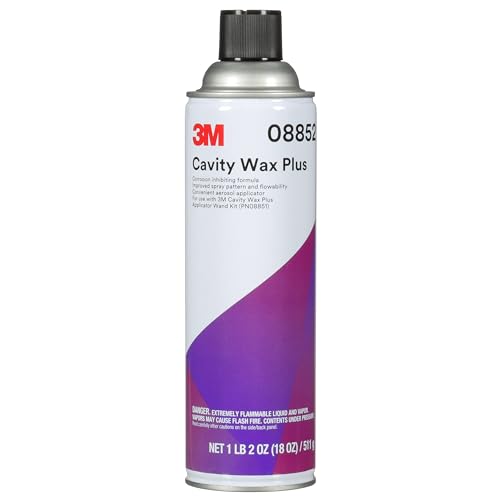
The 3M Cavity Wax Plus is the gold standard for protecting hidden structural seams. Its non-hardening formulation remains pliable indefinitely, meaning it will never crack, chip, or peel away from the metal as the vehicle flexes. This self-healing property allows the wax to reflow into gaps or scratches that develop over time, maintaining a continuous moisture barrier deep inside door sills, rocker panels, and frame box sections.
You need the separate 3M applicator wand kit to direct the spray into tight cavities, but the aerosol itself dispenses a thin, penetrating mist that creeps into lap joints and spot-weld gaps. Two coats applied a few hours apart yield the best coverage. The translucent amber finish leaves a waxy surface that does not attract dust or gum up fasteners, unlike some heavy undercoatings.
The main drawback is cost — at this price point per can, it is not a budget product. But for a classic car or a daily driver you plan to keep for years, the longevity of the protection justifies the investment. One can goes a surprisingly long way if you use the wand with discipline.
Why it’s great
- Self-healing wax reflows to cover scratches and gaps
- Non-hardening — will not crack or flake with chassis flex
- Thin penetration reaches deep into spot-weld seams
Good to know
- Requires the 3M wand kit (sold separately)
- Premium cost per can compared to standard undercoatings
3. POR-15 Rubberized Undercoating

The POR-15 Rubberized Undercoating delivers a thick, satin-black barrier that excels at two jobs: sealing out moisture and dampening road noise. The rubberized formula sprays on heavy, building up a cushion that absorbs vibration from wheel wells and underbody panels. Coverage is roughly 20 to 25 square feet per can at the recommended coat thickness, which translates to about seven to eight cans for a full pickup bed and extended cab floor.
Best results come when you apply it over POR-15’s Rust Preventive Coating as a base layer. The rubberized topcoat then provides the abrasion resistance and sound deadening that the hard base layer lacks on its own. Users report that the spray is thick enough to drip if laid on too heavy, and spraying upside down for overhead body panels requires careful technique.
This is the right choice for a full underbody restoration where both corrosion protection and cabin quietness matter. The 22-ounce can size is practical for a multi-can project, and the finish holds up well against road salt spray and gravel impact.
Why it’s great
- Excellent sound deadening for wheel wells and floors
- Thick rubberized film resists abrasion and salt
- Works as the final topcoat in the POR-15 system
Good to know
- Builds up heavily; easy to create drips
- Hard to spray upside down for overhead areas
4. CorrosionX Rust Inhibitor

CorrosionX is an industrial-grade dielectric compound with a military pedigree — it is qualified by the U.S. Navy as an Advanced Corrosion Preventive Compound. Instead of sealing moisture out with a hardened shell, it molecularly bonds to metal, displacing water and creeping into microscopic pores that paint cannot reach. The 16-ounce aerosol delivers a thin, self-healing film rated to withstand over 39,000 volts, making it safe for battery terminals, sensors, and circuit boards.
Beyond electrical protection, it acts as a penetrating lubricant that frees corroded bolts and protects tow hitch receivers, trailer cables, and boat trailer springs. It clings tenaciously to vertical surfaces without running, and the self-healing property means that if a rock or road debris scratches the film, the surrounding fluid flows back to cover the exposed metal.
The trade-off is that it stays wet — it is not a paintable finish. For open body panels where you want a hard, top-coatable surface, a converter product fits better. But for hidden hinges, electrical connections, and any metal that must stay movable and corrosion-free, CorrosionX is unmatched.
Why it’s great
- Dielectric film protects electronics up to 39,000+ volts
- Penetrates deep into threads and pores to free seized parts
- Self-healing layer re-forms after scratches
Good to know
- Oily finish is not paintable or top-coatable
- Overspray must be wiped quickly from glass or paint
5. Gempler’s Rust Converter (1 Quart)
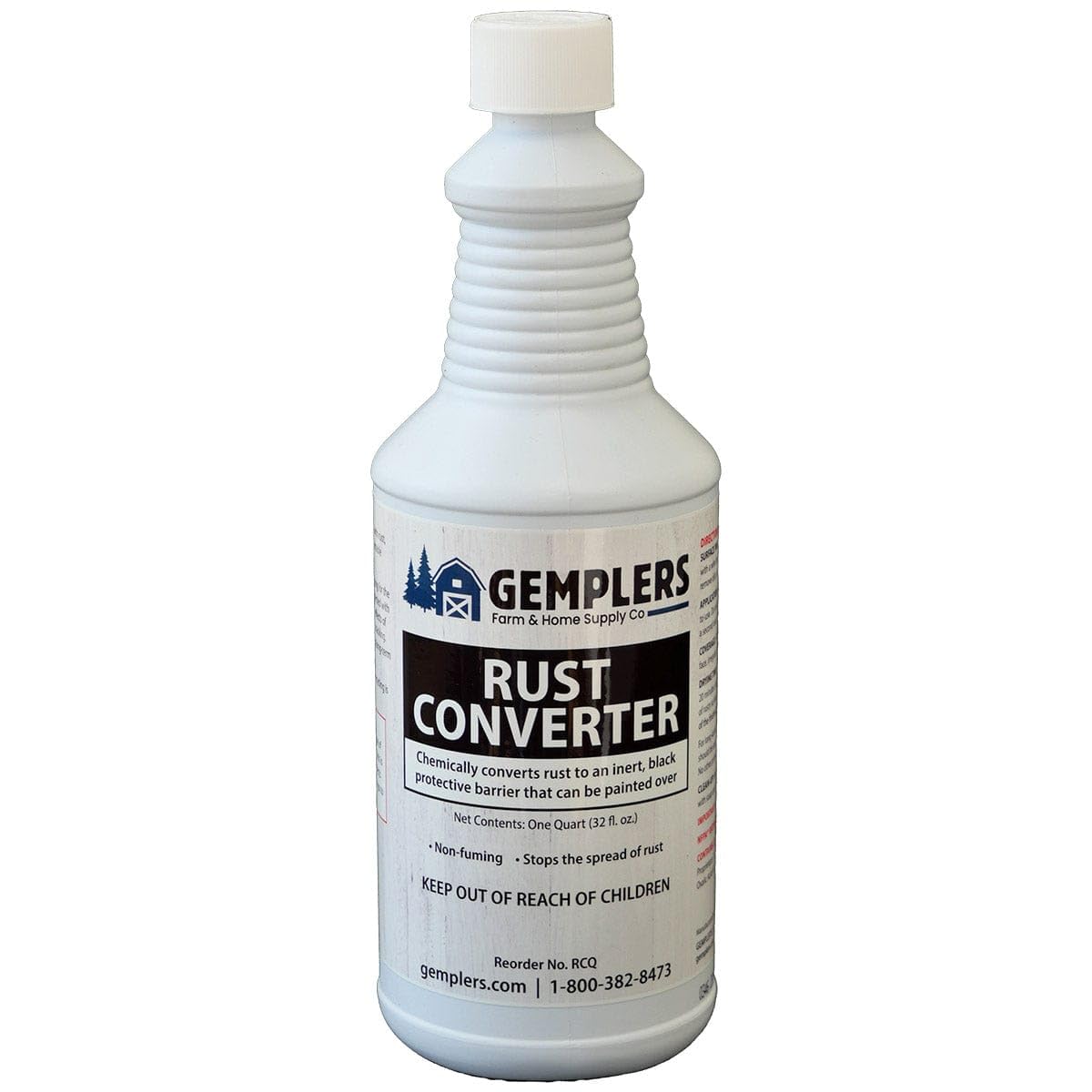
Gempler’s Rust Converter stands out for its sheer coverage — one quart covers 125 square feet, making it the most efficient option for treating large expanses like sheet metal roofs, livestock trailers, or heavy equipment. The water-based formula converts iron oxide into a stable black ferric tannate layer through a chemical reaction, and it dries to a gloss finish in under 30 minutes. A second coat can be applied within 20 minutes, which keeps big jobs moving.
The converter is thick enough to brush on without running, even on vertical panels, and it can be left unpainted if it is not exposed to direct weather. For outdoor use, a topcoat is recommended to protect the converted layer from UV degradation. Users have reported lasting results for years in damp environments, including on 1950s-era plumbing that had active rust issues.
If you are covering acres of rusty metal or want a single-bottle solution for an entire farm, Gempler’s gives you the most surface area per dollar. The trade-off is that the reaction does not strengthen weakened metal — it simply prepares the surface for painting or sealing.
Why it’s great
- 125 sq ft per quart — extreme coverage for large projects
- Dries quickly for multi-coat applications in one session
- Thick consistency allows clean brush control on vertical surfaces
Good to know
- Does not structurally reinforce weakened rusted metal
- Needs a topcoat for prolonged UV exposure outdoors
6. MuzeFansi 2-in-1 Rust Converter & Metal Primer

The MuzeFansi 2-in-1 combines a rust converter with a metal primer in a single water-based, low-VOC liquid. Applied directly to rusted or clean metal, it converts the corrosion while simultaneously laying down a paintable black base coat. The 35-ounce container offers generous volume for the price, and the formula withstands heat up to 350°F, which makes it suitable for engine bay components, brake dust shields, and exhaust brackets.
Water cleanup is a genuine convenience — brushes and drips wash out with soap and water rather than requiring solvent. Users report excellent adhesion on truck frames prepped with a wire wheel, drying to a flat black finish that accepts paint without sanding. Heavy flaking rust should be scraped before application, but the converter handles light surface rust with no prep beyond cleaning off grease and debris.
For those on a tighter budget who need a dual-use product for a weekend project, this delivers solid results. Just be aware that the liquid must be used within 72 hours of opening, so plan your work in one concentrated session.
Why it’s great
- Heat resistant to 350°F for engine bay and brake areas
- Water-based formula with low VOCs and easy cleanup
- Acts as both converter and primer in one application
Good to know
- Must be used within 72 hours of opening
- Heavy flaking rust requires scraping before application
7. Meuvcol 2 in 1 Rust Converter & Metal Primer
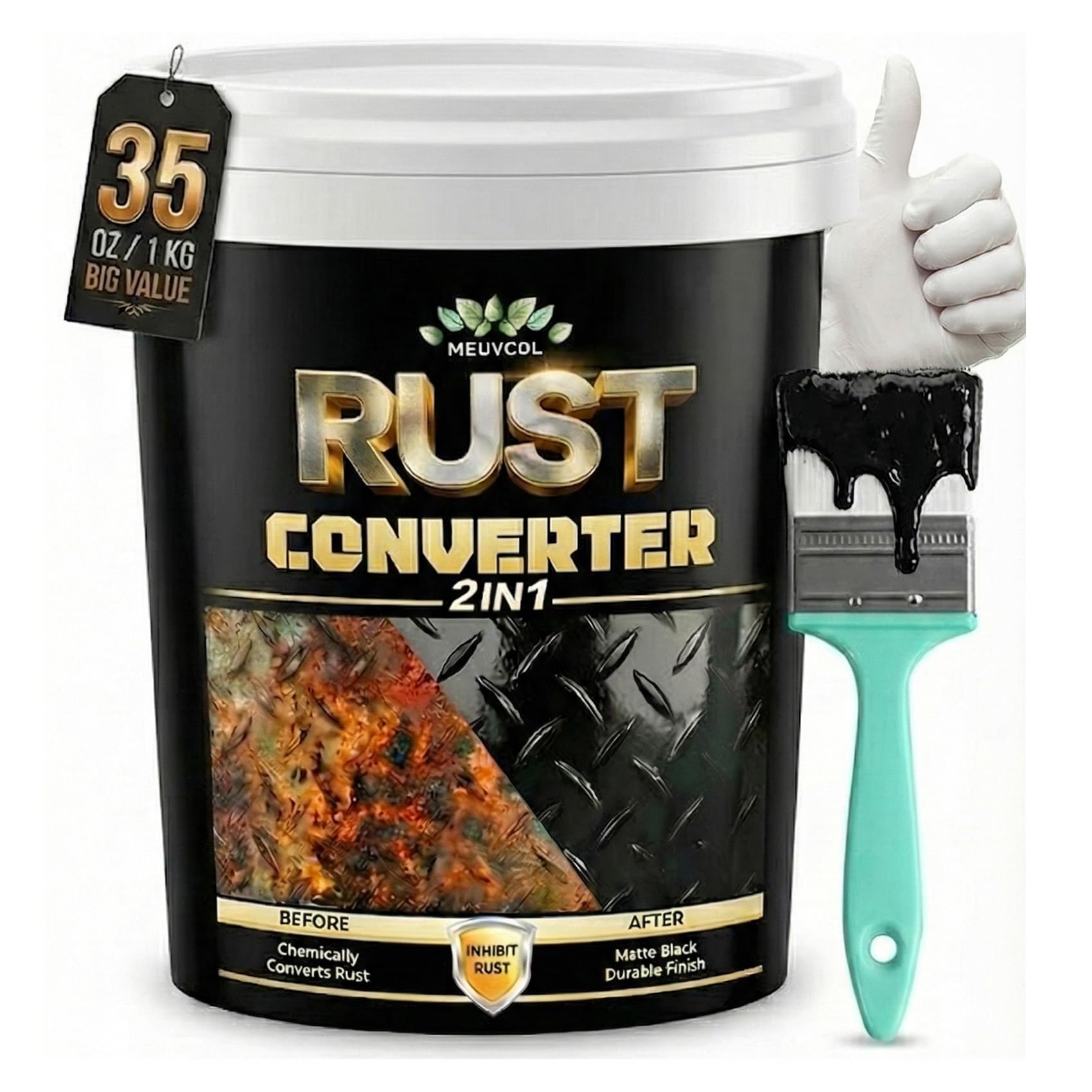
The Meuvcol converter comes as a complete all-in-one package with the 35-ounce can, a brush, gloves, and a printed manual — everything a first-time user needs to treat rust without a separate trip to the hardware store. The formula itself is a single-component rust encapsulator that seals out water, chemicals, and salt, leaving a durable matte black finish that can be painted over if desired.
Customers have praised the brush-on application for its smooth coverage and thick coating on RV underbellies, trailer frames, and truck chassis. The matte finish hides imperfections well and provides a uniform appearance across treated and untreated metal. Some users note a strong odor during application, so working in an open garage with a fan running is advisable.
While the included brush is basic and may not survive a second use, the kit approach removes friction for a first-time user. If you are just starting a rust repair project and want one box with everything you need to apply, the Meuvcol kit simplifies the procurement process significantly. The 35-ounce volume is enough for several underbody sections or a full set of steel wheels.
Why it’s great
- Complete kit includes brush, gloves, and manual
- Thick matte black finish for uniform coating
- Seals out water, salt, and chemicals effectively
Good to know
- Strong fumes require good ventilation during application
- Included brush is basic and single-use grade
FAQ
Can I apply a rust converter over paint?
How long does a cavity wax like 3M’s last before needing reapplication?
Can I use a rust converter on a rusty gas tank?
Final Thoughts: The Verdict
For most users, the best automotive rust inhibitor winner is the Eastwood Internal Frame Coating because it uniquely combines rust conversion, prevention, and targeted cavity delivery in a single aerosol wand system. If you want self-healing protection for hidden box sections, grab the 3M Cavity Wax Plus. And for large open surfaces on a budget, nothing beats the coverage of the Gempler’s Rust Converter.