
A personal breathalyzer is the single best tool to separate the night’s fun from a morning of regret, but the market is flooded with unreliable novelties that are more toy than tool. Choosing the wrong unit means risking false confidence—or a frighteningly inaccurate reading that could lead to a DUI. The right device, however, provides actionable, defensible data that empowers smarter decisions before you ever turn the key.
I’m Min — the co-founder and writer behind Gadgets Feed. My analysis here is grounded in hundreds of hours spent cross-referencing sensor technologies, evaluating FDA clearance documentation, and dissecting real-world user reports across the entire BAC testing spectrum.
This guide breaks down the essential specs, certifications, and real-world performance data you need to cut through the hype and find the best breathalyzer for protecting your license and your safety.
How To Choose The Best Breathalyzer
Selecting a breathalyzer is not about picking the one with the flashiest design; it’s a decision about sensor integrity and certification. A bad reading can have life-altering consequences, making the underlying technology and official approvals your primary concern. Focus on the components that ensure repeatable, verifiable results.
Sensor Technology: Fuel Cell vs. Semiconductor
This is the single most important spec. Fuel Cell sensors, powered by an electrochemical reaction specific to ethanol, offer superior accuracy, specificity, and stability. They are the technology used by law enforcement. Semiconductor sensors, while cheaper, are prone to drift, require more frequent recalibration, and can be fooled by mouth alcohol or other substances. For any serious use, a Fuel Cell sensor is non-negotiable.
Certifications: FDA Clearance and DOT/NHTSA Compliance
FDA 510(k) clearance means the device has been reviewed by the Food and Drug Administration and found to be substantially equivalent to a legally marketed predicate device. This is a significant step up from general marketing claims. DOT & NHTSA compliance indicates the device meets specific screening standards used by the National Highway Traffic Safety Administration. Look for explicit statements of both for the highest confidence.
Calibration and Sensor Lifespan
No consumer sensor is immune to drift. A manufacturer’s recommended calibration interval—typically every 6 to 12 months for semiconductors, or every 12 months for fuel cells—is a key indicator of long-term reliability. Some premium models offer user-swappable sensor modules that eliminate the need to ship the unit back for service, drastically reducing downtime and ensuring accuracy over the device’s entire life.
Quick Comparison
On smaller screens, swipe sideways to see the full table.
| Model | Category | Best For | Key Spec | Amazon |
|---|---|---|---|---|
| BACtrack S80 | Premium | Professional-grade accuracy | Xtend Fuel Cell Sensor | Amazon |
| AlcoMate AL7000 | Premium | No-calibration convenience | PRISM Swappable Sensor | Amazon |
| iSOBER 10 | Mid-Range | App-connected accountability | Fuel Cell Sensor | Amazon |
| iSOBER 30 | Mid-Range | Built-in result memory & clock | Fuel Cell Sensor | Amazon |
| BACtrack C6 | Mid-Range | Portable & smartphone integration | BluFire Fuel Cell Sensor | Amazon |
| AlcoMate AL2500 | Value | Budget-conscious law enforcement spec | Oxide Semiconductor Sensor | Amazon |
| ALCO9 TX6010L | Budget | Basic personal accountability | Semiconductor Sensor | Amazon |
In‑Depth Reviews
1. BACtrack S80

The BACtrack S80 is the benchmark that other personal breathalyzers aspire to, and for good reason. Its core advantage is the largest platinum-based Xtend Fuel Cell Sensor available in a consumer device, the same professional-grade technology used by law enforcement and clinical settings. This ensures readings are highly specific to ethanol and resistant to interference, delivering a level of consistency that cheaper semiconductor units simply cannot match.
Officially designated as an approved alcohol screening device by the US DOT and NHTSA, and cleared by the FDA 510(k) process, the S80 carries the certifications that matter for legal defensibility. Users consistently report its accuracy correlates very closely with police-grade equipment after the recommended 20-minute wait period following a drink. The one-button operation and included carrying case make it simple to keep at the ready.
The primary requirement is an annual recalibration to maintain that high level of precision, a small price for the peace of mind it provides. While priced at a premium, the S80’s track record and independent endorsement from sources like The Wirecutter make it the definitive choice for anyone who treats this purchase as a serious safety investment rather than a party gadget.
Why it’s great
- Professional-grade Xtend Fuel Cell sensor provides the highest accuracy available.
- DOT/NHTSA approved and FDA 510(k) cleared for maximum credibility.
- Simple one-button operation and robust build quality.
Good to know
- Requires annual recalibration to maintain peak accuracy.
- Premium price point reflects its professional-grade components.
2. AlcoMate Premium AL7000

The AlcoMate Premium AL7000 solves the single biggest annoyance of breathalyzer ownership: maintenance. Its patented PRISM (Pre-calibrated Replaceable Intelligent Sensor Modules) technology allows you to swap in a fresh sensor module at home after 200 tests or 12 months, completely eliminating the need to mail the unit in for recalibration and endure downtime. This makes it an exceptionally practical choice for high-traffic environments.
It achieves an accuracy rating of ±0.01 at 0.100% BAC using a 2nd Generation precision oxide semiconductor sensor, backed by DOT & NHTSA approval. While a semiconductor sensor is theoretically less stable than a top-tier fuel cell, the replaceable module design directly addresses the primary failure mode of semiconductors. The 4-digit LED display is bright and easy to read in any environment.
The key trade-off is the ongoing cost of replacement modules, but when you factor in the time and shipping costs of traditional calibration, it often balances out or even saves money over the long term. Some users have noted that replacement sensors can be pricey, and you must ensure you are buying a fresh unit. For repeat users, this design is a smarter long-term investment than a fixed-sensor alternative.
Why it’s great
- Patented PRISM sensor module eliminates the need for factory recalibration.
- DOT & NHTSA approved with ±0.01 accuracy at 0.100% BAC.
- User-swappable sensor keeps performance like new with simple maintenance.
Good to know
- Ongoing cost for replacement sensor modules every 200 tests.
- Semiconductor sensor, not Fuel Cell technology.
3. iSOBER 10

The iSOBER 10 brings a modern, data-driven approach to personal breath testing. It houses a professional fuel cell sensor—the same type used in premium models—but adds a powerful layer of accountability through its free iSOBER app. The app captures not just your BAC reading, but also a timestamp, GPS location, and a photo, creating a log that can be shared via text or email for personal probation or workplace compliance.
With a response time of roughly 10 seconds and a measuring range of 0.00 to 0.40% BAC, it is both fast and comprehensive. The sensor health check feature provides real-time monitoring, giving a “ready” status before each test so you know the unit is functioning correctly. Its dual-mode design lets you use it as a standalone device or paired with a smartphone, offering flexibility for different scenarios.
The main point of friction for some users is the initial app pairing process, which a minority found finicky. However, once connected, the automatic logging of results with location and photo data is a standout feature for those who need a verifiable record of sobriety. Considering its fuel cell sensor and app integration, it sits at a very competitive value point in the mid-range market.
Why it’s great
- Professional fuel cell sensor for dependable accuracy.
- App logs BAC with time, location, and photo for tamper-proof records.
- Sensor health check ensures the device is ready before each use.
Good to know
- App pairing can be slightly tricky during initial setup.
- Requires annual calibration, typical for fuel cell devices.
4. iSOBER 30

The iSOBER 30 is a step up from the iSOBER 10, built with the same essential fuel cell accuracy but augmented with a non-connected memory function. It stores your last 10 BAC results along with their date and time on the device itself, allowing you to track trend data without needing a smartphone. This is ideal for professional settings where phone usage is restricted, or for users who prefer a simpler, offline experience.
It carries the same DOT/NHTSA compliance and FDA 510(k) clearance as its sibling, and is designed by a manufacturer with over 20 years of experience in the law enforcement market. The fuel cell sensor provides the stability and specificity you need for reliable self-monitoring. Its compact dimensions (1.73″ width) make it easy to slide into a pocket or bag alongside its included hard case.
The built-in clock and memory feature is a simple but powerful upgrade for tracking how your BAC changes over an evening. The primary downside is the lack of a companion app for seamless data export, but this is by design for those who want a more focused tool. For a mid-range fuel cell device, it strikes an excellent balance between professional-grade internals and practical, real-world usability.
Why it’s great
- On-device memory stores 10 test results with date and time stamps.
- DOT & NHTSA compliant with a professional fuel cell sensor.
- No reliance on a smartphone for data logging.
Good to know
- No smartphone app interface for data export.
- Requires factory recalibration annually or after 1,000 tests.
5. BACtrack C6 Keychain Breathalyzer
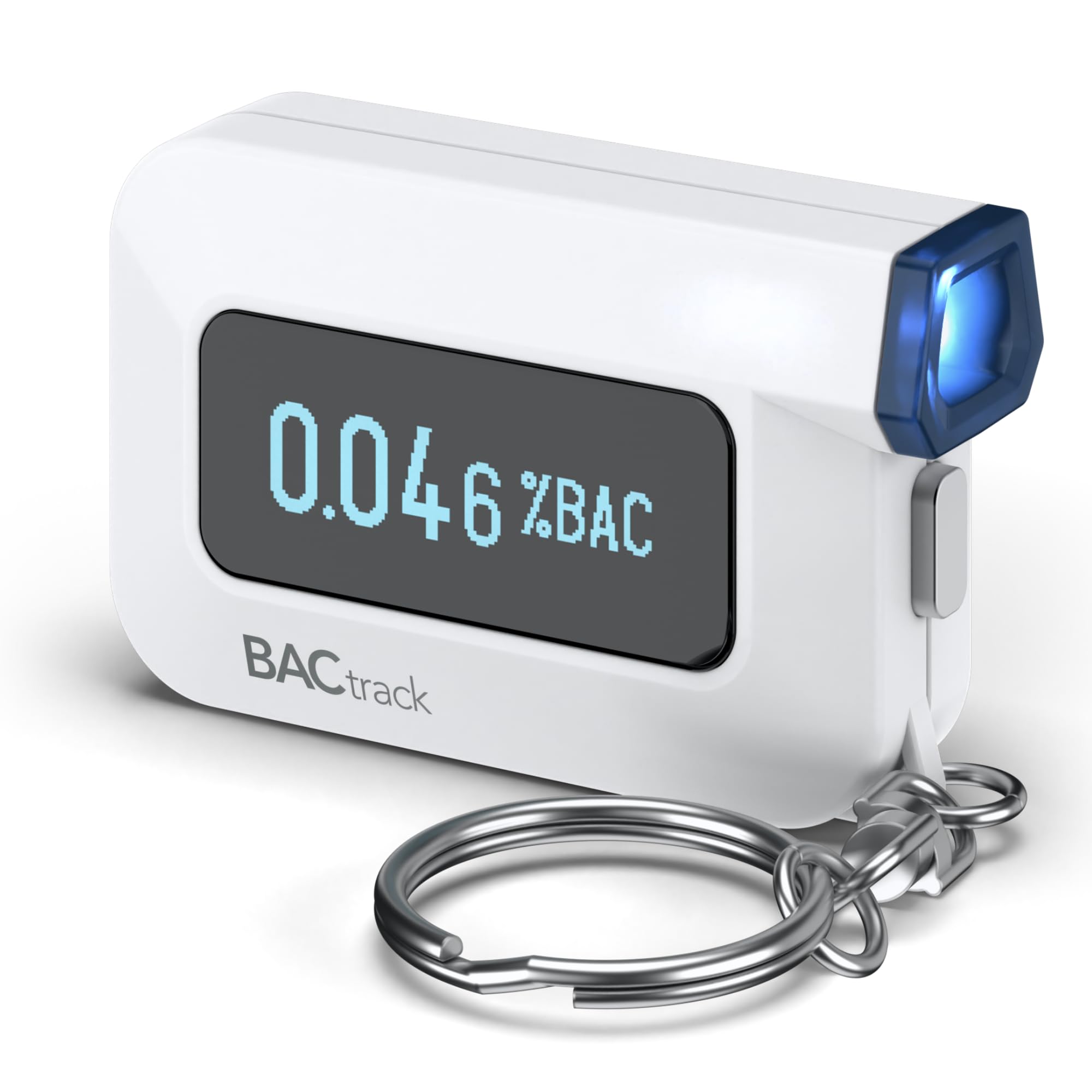
The BACtrack C6 proves that portability doesn’t have to mean sacrificing sensor integrity. Despite its keychain-friendly size, it is powered by BACtrack’s patented BluFire Fuel Cell Sensor, delivering the same type of electrochemical specificity found in the brand’s larger units. This is a critical advantage over the tiny semiconductor chips found in most other pocket-sized breathalyzers.
Its optional wireless connectivity to the BACtrack app adds a layer of utility that is rare in this form factor. The app can log your test history over time, and the ZeroLine feature estimates when your BAC will return to 0.00%, a powerful tool for planning. The device can also be used in standalone mode, giving you a fast, direct BAC readout on its integrated display.
The trade-off for its small size is the relatively shorter sensor lifespan and the need for careful calibration maintenance. Some users have reported inconsistencies when testing too soon after drinking, a real-world limitation of its smaller fuel cell element. However, as an always-present tool for personal awareness, its convenience factor is unmatched, and the fuel cell technology puts it far ahead of other keychain models.
Why it’s great
- BluFire Fuel Cell sensor provides professional-grade accuracy in a tiny package.
- Optional app sync for logging and ZeroLine BAC estimation.
- Extremely portable keychain design for daily carry.
Good to know
- Smaller sensor may be less durable over the long term.
- Best accuracy requires waiting 15-20 minutes after the last drink.
6. AlcoMate AL2500

The AlcoMate AL2500 occupies a unique space as a DOT & NHTSA approved device that uses a precision oxide semiconductor sensor. This approval gives it a level of official credibility that most other sub- units completely lack. For those on a tighter budget who still want a legally recognized screening tool, this is a compelling entry point.
Its mouthpiece-free design makes it hygienic for shared use across a group, and the 3-digit LED display is easy to read. The single-button operation is about as simple as it gets: press and wait for the warm-up cycle, then blow for a consistent reading. Many users find its performance correlates well with their expected BAC level, making it a functional tool for group events or personal check-ins.
The limitation is inherent in its sensor type. Oxide semiconductor sensors are more susceptible to drift over time and less specific to ethanol than fuel cells, which can lead to variation between tests. It also lacks a swappable sensor, meaning it will need to be sent in for calibration. For casual, non-critical use where a general range is acceptable, it is a strong value pick.
Why it’s great
- DOT & NHTSA approved at a very accessible price point.
- Mouthpiece-free design is hygienic for multiple users.
- Extremely simple single-button operation.
Good to know
- Semiconductor sensor is less accurate and stable than fuel cell.
- Requires factory recalibration and has no swappable sensor module.
7. ALCO9 TX6010L
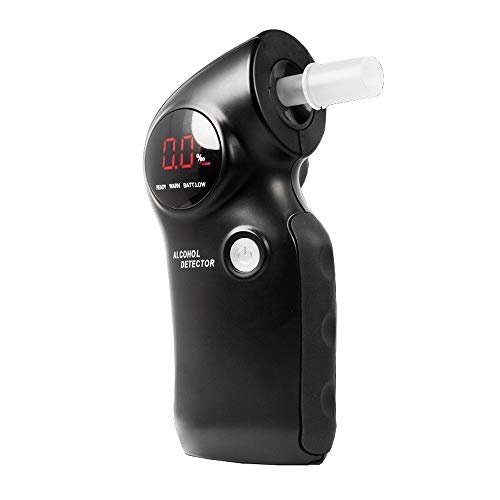
The ALCO9 TX6010L is a straightforward, entry-level breathalyzer that focuses on basic functionality: it provides a digital BAC reading and an audible alcohol alert with a simple one-button press. Its FDA 510(k) clearance and DOT/NHTSA compliance provide a baseline of official recognition that many budget units skip entirely.
Designed with a semiconductor sensor, its primary role is as a basic accountability tool. It is best used to get a general sense of your own level rather than as a precise, decision-making instrument. The company offers a calibration reminder every six months or 200 tests, which is an essential practice for maintaining any level of accuracy with this sensor type. It is backed by a manufacturer with two decades of industry experience.
The main takeaway from user reviews is that, while it works for some, it is prone to inconsistency. Multiple reviews cite readings that varied significantly within short timeframes, highlighting the inherent challenge of lower-cost semiconductor technology. For the very budget-conscious who need a basic indicator, it is functional, but serious users should prioritize an upgrade to a fuel cell based model.
Why it’s great
- FDA 510(k) cleared and DOT/NHTSA compliant at a very low entry cost.
- Audible alcohol alert provides instant pass/fail feedback.
- Simple, accessible tool for building personal awareness.
Good to know
- Semiconductor sensor is prone to drift and inconsistent readings.
- Requires every-6-month calibration, typical for this sensor type.
FAQ
How often do I need to calibrate my breathalyzer?
Can I use a breathalyzer to prove I am under the legal limit to drive?
Why do I need to wait 15-20 minutes after drinking to get an accurate reading?
Final Thoughts: The Verdict
For most users, the best breathalyzer winner is the BACtrack S80 because it combines the most accurate Xtend Fuel Cell sensor with essential DOT/NHTSA and FDA certifications, offering total confidence in its results. If you want a device that never needs factory recalibration, grab the AlcoMate Premium AL7000 and its swappable PRISM sensor modules. And for a portable keychain companion that still uses professional fuel cell technology, nothing beats the BACtrack C6.