
Measuring live AC current without cutting into a wire used to require a licensed electrician or a power-down. The split-core current transformer changed that, giving DIY energy monitors, HVAC techs, and automation builders a non-intrusive way to tap into the magnetic field around a conductor. But not every clamp delivers the same accuracy, burden resistor tolerance, or physical fit inside a crowded breaker panel.
I’m Min — the co-founder and writer behind Gadgets Feed. I analyze dozens of industrial and hobbyist current sensors, cross-referencing datasheets, customer teardown photos, and real-world application reports to separate the reliably engineered units from the ones that can cook your microcontroller input pin.
Whether you are monitoring a clothes dryer, interlocking two pumps, or building a whole-home energy dashboard, finding the right hardware is critical. This guide focuses on the best alternating current sensor for both precision metering and simple on/off detection across seven proven contenders.
How To Choose The Best Alternating Current Sensor
Picking the right AC sensor is less about brand loyalty and more about matching three variables: the physical size of your wire, the signal type your monitoring system expects, and whether you need a digital “current present” switch or a measurable analog proportional to the load.
Burden Resistor: The Hidden Decider
A raw current transformer (CT) outputs a current proportional to the line current. Without a burden resistor across the output terminals, that current can produce a dangerously high voltage that may damage an ADC pin on an Arduino or ESP32. Some sensors like the SCT-013-030 include a built-in burden resistor, giving you a safe voltage output. Others, like the PZCT-02, expect you to add your own. Verify your sensor’s output type before wiring it up.
Mechanical Fit: Inner Diameter and Envelope
Bulk cable in a service panel often exceeds 16mm. A clamp with a 16mm inner diameter may not fit around a 4/0 AWG service entrance conductor. Check the product’s stated ID, then cross-reference with a review photo showing the clamp on a real wire. If your application is inside a tight gutter box or breaker panel, a compact profile with side-exit leads (like the nodehawk 100A) saves frustration.
Relay Output vs. Raw CT Output
If your goal is simply to detect whether a motor, compressor, or pump is running, a self-powered current sensing relay saves you from writing code and assembling signal-conditioning hardware. These devices (like the CS-TS0 or M3050) close a dry or solid-state contact when current exceeds an adjustable threshold. They are ideal for interlocking two pieces of equipment or triggering a ventilation fan.
Quick Comparison
On smaller screens, swipe sideways to see the full table.
| Model | Category | Best For | Key Spec | Amazon |
|---|---|---|---|---|
| PZCT-02 | Split-Core CT | Budget energy metering | 100A / 100mA output | Amazon |
| SCT-013-030 | Split-Core CT | Microcontroller projects | 30A / internal burden | Amazon |
| SCT-013-000 | Split-Core CT | Whole-building monitoring | 100A / current output | Amazon |
| CS-TS0 | Sensing Relay | Self-powered switch | 1-50A / 200ms response | Amazon |
| M3050 | Sensing Relay | Adjustable threshold relay | 0-30A / 1ms response | Amazon |
| nodehawk 100A | Split-Core CT | Industrial metering | 100A / 24mm ID | Amazon |
| YWBL-WH | Sensing Relay | HVAC and pump control | 5-200A / self-powered | Amazon |
In‑Depth Reviews
1. nodehawk AC Current Sensor Transformer 100A

This split-core transformer from nodehawk distinguishes itself with a cavernous 24mm inner diameter that swallows even chunky 1/0 AWG cables without forcing a power-down. The robust hinge-and-latch mechanism snaps closed securely, and zip-tie anchor points on the housing let you fix it in place inside a vibrating industrial panel or a stationary meter box.
Rated at 100A with an accuracy class between 0.5 and 1, it pairs naturally with ammeters, energy meters, and PLC analog input modules. One verified buyer confirmed it came within 1% of a reference meter using a 0.1-ohm burden resistor. The 1-meter flying leads are sturdy, though the unit lacks a built-in burden resistor, so you must supply one externally for direct ADC reading.
At roughly 2.5 inches tall, it is bulkier than the SCT-013 clamps, but the extra plastic translates to better electrical isolation from high-voltage main circuits. For scenarios like substation retrofits or post-construction metering where disconnecting the load is impractical, this CT provides the most forgiving physical fit and solid repeatability.
Why it’s great
- Generous 24mm ID fits thick service cables easily.
- Robust latching hinge stays closed under vibration.
- Consistent accuracy within 1% with appropriate burden resistor.
Good to know
- Requires external burden resistor for voltage output.
- Physical size may feel oversized for small branch circuits.
- One unit shipped with mismarked turns ratio (200:2 vs. 100:5).
2. JANSANE SCT-013-000 100A Non-invasive AC Current Sensor

The SCT-013-000 is the 100A sibling in JANSANE’s popular family, and it follows the same recipe: a ferrite split core terminated in a 1-meter cable with a 3.5mm phone plug. Unlike the -030 variant, this unit ships without an internal burden resistor, so you get a raw current output that requires external loading to produce a safe voltage for an Arduino or Raspberry Pi ADC.
DIY energy monitors love this sensor for whole-building consumption tracking. Users report clean analog signals when the burden resistor value is correctly calculated for their ADC reference. One reviewer used it to detect washer start/stop by reading the analog voltage on a Pico W, while another calibrated it for furnace blower speed detection rather than exact amperage measurement.
Critically, the product images show a YHDC-branded unit, but multiple buyers confirm the delivered sensor carries no branding and exhibits lower build quality. The clamp itself works, but you must factor in the resistor calculation step. If you prefer plug-and-play voltage output, the SCT-013-030 is the safer choice; if you need 100A range and don’t mind soldering a resistor, this one saves money.
Why it’s great
- 100A rating suits whole-house and heavy-load monitoring.
- Familiar 3.5mm jack format works with standard breakout boards.
- Plenty of community code examples for Arduino and ESP32.
Good to know
- No internal burden resistor; must be added externally.
- Units may not match the YHDC branding shown in product photos.
- One reviewer received a 100A/1V variant not meeting expectations.
3. JANSANE SCT-013-030 30A Non-invasive AC Current Sensor

This 30A variant is the darling of the maker community for one straightforward reason: it includes an internal burden resistor that outputs a voltage proportional to the AC current, so you can connect it directly to an analog input without external components. The 3.5mm jack mirrors the SCT-013-000 format, but the scaling circuit inside the plastic housing handles the voltage conversion for you.
Users consistently report accurate readings after a simple calibration point, often using a known 100W incandescent bulb. The 30A maximum comfortably covers most residential branch circuits, including clothes dryers, water heaters, and HVAC compressors. One builder uses it with an ESP32 to detect when the dryer cycle ends, reading the magnetic field of the hot wire without any direct electrical connection.
A few complaints note that the delivered unit does not match YHDC branding shown in the listing, and one buyer described the plastic quality as poor compared to genuine YHDC parts. But functionally, the built-in burden resistor eliminates the most common failure point in CT-based Arduino projects. For beginners or anyone wanting a reliable out-of-box signal, this is the easiest sensor to integrate.
Why it’s great
- Internal burden resistor saves build complexity.
- 30A range suits most residential branch circuits.
- Calibrates accurately with a simple 100W bulb test.
Good to know
- Build quality may not match branded YHDC units.
- 30A maximum limits use on main feeder lines.
- 3.5mm plug is not weatherproof for outdoor enclosures.
4. M3050 AC Current Sensing Relay (nodehawk)

The M3050 is a self-powered current sensing relay that uses the magnetic field of the conductor to both power its internal circuit and drive a normally open MOSFET output. The unit requires zero external power, drawing enough energy from the sensed line itself to close the relay when current exceeds the potentiometer-set threshold (0-30A AC range).
Its millisecond response time is notably faster than the CS-TS0’s 200ms latency, making it suitable for timing-critical automation tasks. One builder uses it to trigger a booster pump only when the main well pump draws current; another installed it inside a furnace panel to switch a 24V solenoid valve. The self-extinguishing ABS shell and 2000V isolation withstand voltage add a layer of safety for crowded enclosures.
The rated load is just 0.3A at 240V, so you must use this relay to drive a secondary contactor if your load exceeds 72W. The adjustment potentiometer is tiny and the LED logic is reversed (ON = output active, not idle), which can confuse first-time users. But once dialed in, the M3050 provides clean, repeatable switching with no power supply wiring.
Why it’s great
- Self-powered; no DC supply or batteries needed.
- Adjustable trigger threshold from 0 to 30A AC.
- Fast millisecond response for near-real-time detection.
Good to know
- Output rated only 0.3A; needs external contactor for heavy loads.
- Red LED indication is opposite of intuitive (ON when triggered).
- Tiny potentiometer is fiddly to adjust without a screwdriver.
5. Miniature Current Switch CS-TS0

The CS-TS0 is a no-frills current-operated switch that closes a set of solid-state contacts when it detects any AC current between 1 and 50 amps on the monitored conductor. Like the M3050, it is entirely self-powered, using the induced energy from the CT core to drive the switch — no 5V rail, no battery, no microcontroller required.
HVAC and industrial control technicians have adopted this unit for equipment interlocking. One user installed it inside a WaterFurnace geothermal unit to control a 120V circulation pump by sensing the compressor wire. Another uses it to prevent a chemical feed pump from running dry — when the well pump stops drawing current, the CS-TS0 opens the circuit to the chemical pump. The 200ms response time is adequate for pump and fan interlocks but too slow for precision timing.
The contacts are solid-state (Triac), not dry mechanical relays, so they will leak a small current even when open and are polarity-sensitive if you use them for DC loads. The unpotted electronics also mean the CS-TS0 should be mounted inside a weatherproof enclosure if used outdoors. At its price point, it delivers functional simplicity for on/off detection without requiring any programming.
Why it’s great
- Zero external power needed; harvests energy inductively.
- 1-50A sensing range covers most motor and pump circuits.
- Compact footprint fits inside standard junction boxes.
Good to know
- Triac output is not a dry contact; small leakage current exists.
- 200ms response is too slow for time-critical switching.
- Not UL/ETL listed; best suited for unregulated DIY or industrial use.
6. PZCT-02 Split Core Current Transformer

The PZCT-02 is the most affordable split-core CT in this roundup, and it serves a specific niche: users who already understand burden resistors and want a miniature form factor for tight spaces. The 16mm inner diameter is the smallest of the clamps here, and multiple buyers report it actually measures smaller than advertised, failing to fit around service lines and even 4-gauge HVAC wires in some cases.
The output is 100mA at 100A primary (1000:1 ratio), which produces about 1V RMS across a 10-ohm burden resistor — assuming the resistor is truly 10 ohms. One detailed buyer review measured the actual burden resistor at 55 ohms, which would push the output voltage to about 6V from a 100W bulb, risking damage to 5V logic ADC pins. This batch inconsistency makes the PZCT-02 unreliable for precision work without verifying every unit.
For the lowest possible entry cost into split-core CT experimentation, and if you already have a multimeter and loose resistors on your bench, the PZCT-02 can work. But the high rate of defects — broken hinges, mislabeled turns ratios, and undersized ID — means it is a gamble. Most buyers will be better served spending a few dollars more for the SCT-013-000.
Why it’s great
- Lowest entry cost for a 100A-rated split-core CT.
- Compact body for extremely tight panel spaces.
Good to know
- High unit-to-unit variation in burden resistor value (10 ohm vs. 55 ohm measured).
- 16mm ID may not actually fit 16mm cables; several buyers report undersized opening.
- Multiple reports of breakage upon arrival and loose hinge mechanism.
7. YWBL-WH AC Current Sensing Switch 5-200A
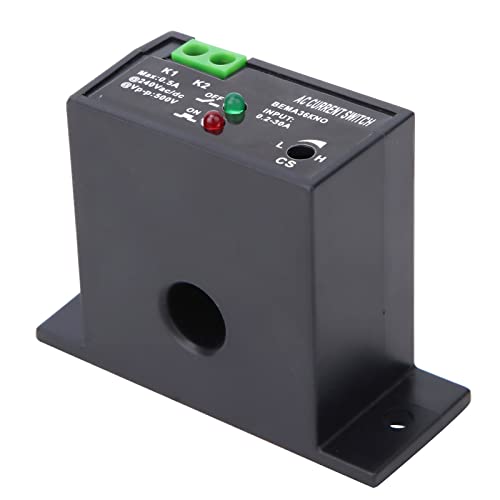
The YWBL-WH sensing switch pushes the detection window wider than any other relay in this list, covering 5 to 200 amps AC. This makes it the only self-powered option suitable for monitoring the main panel feeder or a large commercial motor starter without additional CTs. Like the M3050 and CS-TS0, it uses electromagnetic induction to power its own circuitry and switch a normally open output.
Buyers have used it successfully for furnace humidifier solenoid activation and as a general presence detector for large loads. One electrician noted it handled a 12A relay load for several weeks without issue, though he cautioned that long-term reliability at the rated 0.3A load limit is unproven. Another report showed a unit failing permanently after two days, refusing to open the contacts — a failure mode also observed by a second buyer.
The included documentation is minimal, making setup a trial-and-error process for first-time users. The IP30 rating means it is not splash-proof, so keep it inside a dry electrical panel. When it works, the YWBL-WH provides the broadest ambient detection range in a single self-powered package, but the reliability reports suggest buying a spare if your application is mission-critical.
Why it’s great
- Unmatched 5-200A detection range for main feeders.
- Self-powered from the monitored line; no auxiliary supply.
- Compact screw-terminal format for panel installation.
Good to know
- Multiple reports of units failing within days in normally open state.
- Minimal documentation makes configuration frustrating.
- IP30 rating unsuitable for wet or outdoor environments.
FAQ
Can I use a current transformer directly with an Arduino analog input?
How do I calibrate a split-core CT for accurate amperage measurement?
What is the difference between a current transformer and a current sensing relay?
Why does my self-powered relay not work below a certain current?
Can a CT be used on a DC circuit?
Final Thoughts: The Verdict
For most users, the best alternating current sensor winner is the nodehawk 100A CT because it combines a wide 24mm inner diameter with robust construction and excellent accuracy once paired with an external burden resistor. If you want a ready-to-go voltage output for an Arduino or ESP32 project, grab the JANSANE SCT-013-030. And for a simple self-powered on/off switch to interlock pumps or compressors without any programming, the M3050 sensing relay is the most versatile and reliable option.