
Every content creator faces the same fork in the road: keep relying on a smartphone for video and photos, or finally invest in a dedicated camera that separates you from the crowd. The jump in image quality, autofocus reliability, and creative control is enormous, but so is the risk of overpaying for features you will never use. This guide cuts through the noise to show you exactly where your money matters most.
I’m Min — the co-founder and writer behind Gadgets Feed. I’ve spent hundreds of hours dissecting the technical specifications, real-world performance data, and user feedback across the most compelling options in this space to separate the genuine value plays from the overhyped contenders.
Whether you are a vlogger, a streamer, or a small business shooting product photos, finding the right tool without breaking the bank is the entire game. This guide to the best affordable camera for content creators is built around that exact mission.
How To Choose The Best Affordable Camera For Content Creators
The biggest mistake new creators make is chasing the highest megapixel count or the most expensive full-frame body without considering what actually improves their final output. For content creators — whether you shoot YouTube videos, Instagram Reels, or professional streamer content — the trifecta is autofocus reliability, usable video features (like 4K recording and a flip screen), and a lens ecosystem that won’t drain your wallet. Prioritize these over raw resolution numbers.
Sensor Size: APS-C is the Sweet Spot
A larger sensor collects more light, which directly translates to better low-light performance and more natural background blur. Full-frame sensors are the gold standard, but they come with a premium price tag. For budget-conscious creators, an APS-C sensor offers a massive leap over a smartphone while keeping body and lens costs in check. The Sony Alpha ZV-E10, Nikon Z30, and Canon EOS R100 are all built around excellent APS-C sensors that deliver professional-looking results without the full-frame price.
Autofocus Capability: The Make-or-Break Feature
Nothing ruins a take faster than soft focus on a talking head. Phase-detection autofocus (PDAF) points on the sensor provide fast and reliable tracking, while contrast-detection-only systems hunt and pulse noticeably in video. Look for cameras with face and eye detection that works in video mode — this is non-negotiable for solo creators who can’t check focus during recording. Models like the Sony Alpha a6400 and the Canon EOS R8 have class-leading dual-pixel or real-time tracking that you can trust completely.
Video Specifications That Actually Matter
Don’t get lost in the marketing maze of “4K.” A camera that shoots uncropped 4K from a full sensor readout (over-sampled from 5K or 6K) will look dramatically sharper than one that line-skips or heavily crops the sensor. Also consider frame rate: 24fps is standard for cinematic looks, but 60fps gives you smooth slow-motion options. For color grading, a 10-bit log profile (like S-Log or C-Log) unlocks professional flexibility, but 8-bit is perfectly fine for creators who just want good out-of-camera color.
Quick Comparison
On smaller screens, swipe sideways to see the full table.
| Model | Category | Best For | Key Spec | Amazon |
|---|---|---|---|---|
| Sony Alpha a6400 | Mirrorless | Fastest AF & burst shooting | 425 phase-detect points | Amazon |
| Canon EOS R8 | Full-Frame | Best value full-frame starter | 24.2 MP, 4K 60p oversampled | Amazon |
| Sony Alpha 6700 | Mirrorless | Top-tier APS-C hybrid shooter | 26 MP, 4K 120p, AI AF | Amazon |
| Sony a7 III | Full-Frame | Pro-level stills & video hybrid | 24.2 MP BSI, 10 fps | Amazon |
| Nikon Z50 II | Mirrorless | Creator with dual-lens kit | 20.9 MP, 4K 60p, dual lenses | Amazon |
| Canon EOS RP | Full-Frame | Lightest full-frame entry point | 26.2 MP, Dual Pixel AF | Amazon |
| Sony Alpha ZV-E10 | Mirrorless | Vlogger-focused ease of use | 24.2 MP, oversampled 4K | Amazon |
| Nikon Z 30 | Mirrorless | Compact streaming & vlogging | 20.9 MP, flip screen | Amazon |
| Panasonic LUMIX G85 | Mirrorless | In-body stabilization on a budget | 5-axis IBIS, 4K 30p | Amazon |
| Canon EOS R100 | Mirrorless | Absolute beginner entry-level | 24.1 MP, Dual Pixel CMOS AF | Amazon |
| DJI Osmo Pocket 3 | Handheld Gimbal | Ultra-portable 4K vlogging | 1-inch CMOS, 3-axis stab. | Amazon |
In‑Depth Reviews
1. Sony Alpha a6400 Mirrorless Camera

The Sony a6400 remains the benchmark for autofocus speed in the mid-range category. Its 0.02-second acquisition time and 425 phase-detection points covering 84% of the sensor mean it locks onto a subject instantly and refuses to let go, even during rapid movement. For a content creator shooting b-roll or talking heads, that reliability alone justifies the investment.
The 24.2MP APS-C sensor delivers sharp 14-bit RAW files and oversampled 4K video that looks crisp on any platform. The Real-Time Eye AF for humans and animals works in both stills and video — a feature that higher-end cameras can’t always match in this price bracket. An 11 fps continuous burst with AF tracking makes it a hybrid powerhouse for product shots and action content.
The tilting 180-degree flip screen is perfect for front-facing vlogging, though the menu system is famously dense and the touchscreen implementation is limited. There is no in-body stabilization, so you will want a stabilized lens or a gimbal for handheld walking shots. The a6400 also lacks a headphone jack, but a hot-shoe adapter solves that for serious audio work. Overall, it is the smartest all-rounder investment in this list for creators who want speed and precision above all else.
Why it’s great
- World-class autofocus with real-time eye tracking
- Excellent 24.2MP image quality and oversampled 4K
- Compact, lightweight design with a flip-up screen
Good to know
- No in-body image stabilization
- Rolling shutter is noticeable in 4K
- Complex menu system
2. Canon EOS R8 Mirrorless Camera Body

The Canon EOS R8 is essentially an R6 Mark II sensor and processor crammed into the lightest full-frame RF mount body Canon makes. The 24.2MP sensor with DIGIC X delivers uncropped 4K 60p oversampled from 6K, producing some of the sharpest video footage at this price level. The Dual Pixel CMOS AF II with 1053 zones covers the entire frame and uses deep learning to track people, animals, and vehicles.
For creators stepping up from a smartphone or a crop-sensor camera, the full-frame low-light performance is a revelation. You get cleaner shadows and natural bokeh even with a standard zoom. The 40 fps electronic shutter with full AF tracking is absurdly fast for capturing fleeting moments in product demos or action shots. The inclusion of Canon Log 3 and HDR PQ gives color graders a 10-bit log workflow on a budget.
The biggest compromise is the small LP-E17 battery — expect around 350 shots or about an hour of 4K video before needing a swap. There is no IBIS, so you depend on lens stabilization, and the single UHS-II card slot limits redundancy for paid work. The camera can also overheat after about 30 minutes of 4K 60p recording. Nevertheless, for the video quality and autofocus performance, the R8 is an extraordinary full-frame entry point.
Why it’s great
- Outstanding 6K oversampled 4K video quality
- Excellent full-frame low-light performance
- Fast 40 fps e-shutter with reliable subject tracking
Good to know
- Small battery with limited runtime
- No IBIS; relies on lens stabilization
- Single SD card slot
3. Sony Alpha 6700

The Sony Alpha 6700 represents the current peak of the APS-C mirrorless category. Its 26MP back-illuminated Exmor R sensor paired with the BIONZ XR processor and a dedicated AI chip delivers autofocus that borders on pre-cognitive. The Real-time Recognition system identifies subjects faster and more accurately than any previous Sony APS-C camera, making it a dream for vloggers and run-and-gun creators.
Video capabilities are equally impressive: 4K 60p oversampled from 6K in 4:2:2 10-bit, plus 4K 120p at a slight crop for high-frame-rate slow motion. The inclusion of S-Log3 and S-Cinetone color profiles gives you cinematic color science right out of the box. The in-body stabilization is decent — enough to smooth out minor handheld movements — but a gimbal is still recommended for walking shots.
The downsides are familiar to Sony users: a complex menu structure that takes time to learn, the absence of a built-in flash, and a small body that can feel cramped with larger full-frame lenses. The high-ISO noise performance is also not class-leading compared to full-frame alternatives. But for pure APS-C hybrid performance, the 6700 is the most capable and future-proof option available to budget-conscious creators.
Why it’s great
- AI-powered autofocus that tracks anything
- Excellent 10-bit 4K video with log profiles
- Compact and robust build with good battery life
Good to know
- Menu system is complex
- No built-in flash
- IBIS not sufficient for smooth walking shots
4. Sony a7 III with 28-70mm Lens

The Sony a7 III is the camera that democratized full-frame mirrorless. Despite being released in 2018, its 24.2MP back-illuminated sensor with 15 stops of dynamic range and ISO 50-204,800 sensitivity still competes with cameras costing twice as much. The full-frame sensor delivers shallow depth of field and low-light performance that APS-C cameras simply cannot match, making it ideal for creators who shoot in dimly lit environments.
The 693 phase-detection points and 425 contrast-detection points cover 93% of the sensor, providing fast and reliable autofocus even in challenging conditions. The 10 fps mechanical or silent shutter with AE/AF tracking is more than adequate for most content. The battery life is also exceptional — the NP-FZ100 lasts for around 710 shots per charge, easily outlasting most competitors in a full day of shooting.
Negatives include the lack of a fully articulating touchscreen (only tilting), a complex menu system, and 4K video that is limited to 8-bit 4:2:0 internally (though it does have full pixel readout with no pixel binning). The kit 28-70mm f/3.5-5.6 lens is decent but not optically inspiring — budget for a prime or a better zoom to unlock the camera’s true potential. For creators who want full-frame capabilities at a mid-range price, the a7 III is still a serious contender.
Why it’s great
- Excellent full-frame image quality and dynamic range
- Outstanding battery life
- Fast and reliable autofocus with wide coverage
Good to know
- 8-bit internal video; limited for advanced grading
- Only a tilting screen, not fully articulating
- Kit lens is average
5. Nikon Z50 II with Two Lenses

The Nikon Z50 II is a creator-first crop-sensor camera that emphasizes ease of use without sacrificing capability. The 20.9MP DX-format sensor might have fewer pixels than some competitors, but its larger-than-smartphone sensor delivers lifelike colors and excellent detail. The real selling point is the Picture Control system: 31 built-in presets let you dial in a specific look — vintage, moody, vibrant — in real-time and share straight to social media with no post-processing.
The autofocus system is robust, with 231 phase-detection points and a dedicated bird and airplane mode for nine distinct subject types. It automatically detects people, dogs, cats, birds, and vehicles, making it incredibly easy to trust the camera to keep your subject sharp. The 4K 60p video is solid, and the in-camera 120p slow-motion in Full HD adds creative flexibility without external gear.
The included dual-lens kit (16-50mm VR and 50-250mm VR) is one of the best values in this category — you get wide-angle to telephoto coverage with optical image stabilization in both lenses. The camera also features a built-in flash and Night Portrait mode for natural-looking flash photos. The downside is that the 20.9MP sensor is slightly behind competitors in pure resolving power, and the Nikon Z DX lens ecosystem is still expanding. For a creator who wants great out-of-camera results and doesn’t want to spend on additional lenses right away, this kit is hard to beat.
Why it’s great
- Excellent dual-lens kit value (16-50mm + 50-250mm)
- Built-in color presets for instant social-ready results
- Reliable subject detection autofocus
Good to know
- 20.9MP sensor lags behind 24MP+ competitors
- Z DX lens selection is still limited
- Video features are basic compared to Sony/Canon
6. Canon EOS RP Body

The Canon EOS RP is the lightest and smallest full-frame camera in the EOS R lineup, making it an exceptional travel companion for creators who prioritize portability. The 26.2MP sensor paired with the DIGIC 8 processor delivers Canon’s signature color science — warm, pleasing skin tones straight out of camera — which is a huge time-saver for creators who don’t want to spend hours color grading.
The Dual Pixel CMOS AF with 4779 selectable positions provides fast and accurate autofocus in both stills and video, and the vari-angle touchscreen is perfect for high-angle or selfie-style shooting. Compatibility with RF lenses and older EF/EF-S lenses (via a mount adapter) gives you access to an enormous lens library without immediately breaking the bank. The night and low-light performance is a significant step up from any APS-C camera in this list.
The main compromises are in video: 4K is limited to 24fps with a 1.6x crop, and there is no 10-bit log recording. The autofocus in 4K is contrast-detection only (not the Dual Pixel system used in 1080p), which can hunt in challenging conditions. The LP-E17 battery also has modest endurance. If video is your primary focus, the R8 above is a better choice, but for a hybrid photo-video creator looking to step into full-frame on a tight budget, the RP remains a compelling option.
Why it’s great
- Excellent full-frame image quality and color science
- Lightest and most compact full-frame body available
- Vari-angle touchscreen for versatile shooting angles
Good to know
- 4K video has a significant crop and contrast AF only
- No in-body stabilization
- Battery life is below average
7. Sony Alpha ZV-E10 Body
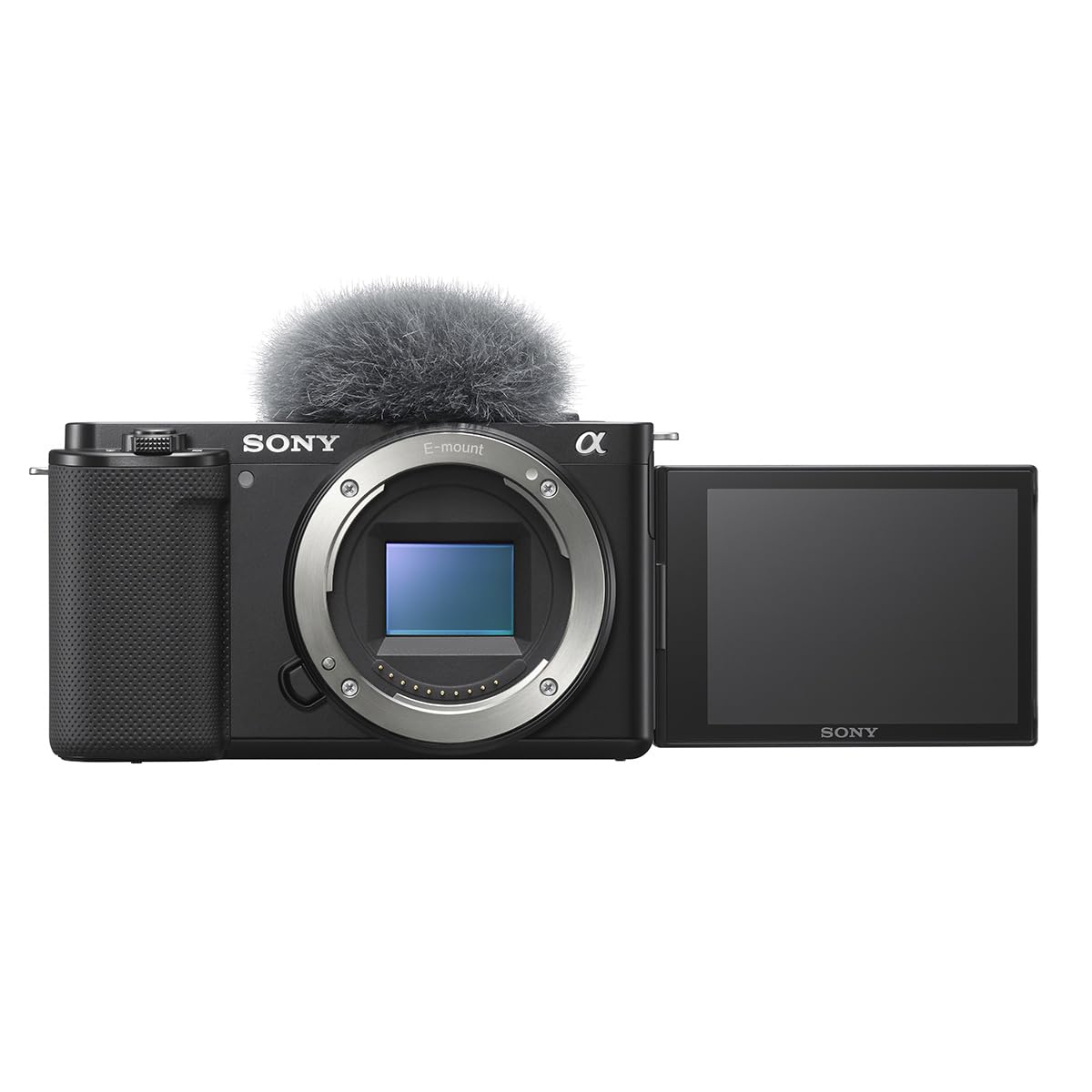
The Sony ZV-E10 was designed from the ground up for vloggers and content creators, and it shows in every control. The dedicated Background Defocus button instantly switches between a blurred background and a sharp scene, the Product Showcase Setting smoothly transitions focus from your face to an object held up to the lens, and the large 24.2MP APS-C sensor delivers excellent 4K video oversampled from 6K with full pixel readout — meaning no line-skipping artifacts.
The BIONZ X processor enables fast and reliable Real-Time Eye AF and object tracking, so you can move freely in front of the lens without worrying about focus. The camera also supports S-Log and HLG for advanced color grading, which is rare at this price point. The built-in directional microphone with a windscreen is surprisingly good for run-and-gun recording, and the USB streaming capability makes it a plug-and-play webcam for live streaming.
The ZV-E10 does have significant caveats: the 4K 30p mode suffers from a heavy crop that makes wide-angle shots difficult, and there is no in-body stabilization, so handheld footage will shake without a gimbal. The rolling shutter is severe in 4K, making fast pans look wobbly. The battery life is also poor — expect around 25 minutes of 4K recording per charge. Despite these compromises, for a focused vlogger who understands these limitations, the ZV-E10 is a purpose-built tool that punches above its weight.
Why it’s great
- Creator-first features: defocus button, product showcase mode
- Excellent oversampled 4K video quality
- Supports S-Log/HLG for color grading
Good to know
- No in-body stabilization
- Heavy rolling shutter in 4K
- Poor battery life
8. Nikon Z 30 Body

The Nikon Z 30 is purpose-built for the creator who lives in front of a webcam or streams live content. It is Nikon’s most compact mirrorless camera, and its key differentiator is the plug-and-play USB-C streaming: connect one cable to your computer and stream at Full HD 60p without any additional software or capture cards. For 4K streaming, it outputs a clean signal over HDMI.
The 20.9MP APS-C sensor handles 4K 30p with excellent detail, and the autofocus with eye tracking for people and pets works seamlessly across both stills and video. The flip-out touchscreen selfie monitor with a red REC light makes it impossible to miss when you are recording. The camera is also compatible with Nikon’s entire NIKKOR Z lens lineup, giving you plenty of room to grow creatively as you add higher-quality glass.
The biggest omission is the lack of an electronic viewfinder — you compose entirely on the rear screen, which can be difficult in bright outdoor conditions. There is no IBIS, so handheld video is shaky, and the low-light performance is decent but not exceptional compared to larger sensor competitors. The camera also lacks a headphone jack for monitoring audio. For the streamer or classroom content creator who needs a simple, reliable camera that excels at live video, the Z 30 is a focused and effective solution.
Why it’s great
- Plug-and-play USB-C streaming in Full HD 60p
- Flip-out screen with red REC indicator
- Compact and lightweight design
Good to know
- No electronic viewfinder
- No in-body stabilization
- No headphone jack for audio monitoring
9. Panasonic LUMIX G85 with 12-60mm Lens

The Panasonic LUMIX G85 is an older model that remains relevant for one reason: its class-leading 5-axis in-body image stabilization. In a list where most budget options lack IBIS, the G85’s dual stabilization (in-body + lens-based) delivers remarkably smooth handheld footage and sharp low-light stills without a tripod. The 16MP Micro Four Thirds sensor lacks a low-pass filter, extracting near-4K resolution from its smaller sensor — a clever design choice that boosts fine detail.
The G85 captures 4K 30p video and features Panasonic’s 4K Photo system, letting you extract 8MP stills from video bursts at 30 fps. The Post Focus feature lets you change the focus point after you’ve taken the shot — a genuinely useful tool for product photography. The magnesium alloy body is weather-sealed, a rarity at this price, meaning you can shoot in light rain or dusty environments without worry.
The 16MP resolution is lower than the 24MP sensors found in most competitors, which limits cropping flexibility for stills. The autofocus system uses contrast detection only (DFD technology), which can hunt and pulse in low-light 4K video — it is not as reliable as Sony or Canon phase-detection systems. The G85 is also noticeably heavier and bulkier than its peers. However, for a budget-conscious creator who shoots handheld and needs smooth video without a gimbal, the G85’s stabilization is a genuinely unique advantage.
Why it’s great
- Excellent 5-axis in-body stabilization
- Weather-sealed magnesium alloy body
- Useful 4K Photo and Post Focus features
Good to know
- Only 16MP sensor limits cropping
- Contrast-detect AF hunts in low light
- Heavier and bulkier than competitors
10. Canon EOS R100 with 18-45mm Lens

The Canon EOS R100 is the most affordable way into Canon’s RF mirrorless system, and it delivers exactly what its price suggests: a simple, accessible entry point for creators who are just starting their journey. The 24.1MP APS-C sensor with the DIGIC 8 processor produces good image quality with natural bokeh, and the Dual Pixel CMOS AF with 143 zones and human/animal eye detection provides reliable autofocus for photos and video.
The camera is impressively compact — it is the smallest and lightest body in the EOS R series — making it easy to slip into a bag for everyday carry. The RF-S 18-45mm kit lens provides a versatile standard zoom range for general shooting. It shoots 4K at 24 fps, Full HD at 60 fps, and HD at 120 fps for basic slow-motion effects. The 6.5 fps burst rate is adequate for casual action shots.
The R100 makes significant cuts: the LCD is a fixed non-touch screen, meaning you cannot flip it around for selfies or navigate menus by touch. There is no electronic viewfinder (the screen is your only way to frame), which can be difficult in bright sun. The 4K video has a substantial crop factor, effectively zooming in your footage. The autofocus in 4K is also slower than the Dual Pixel AF used for photos. If your budget is extremely tight and you just want to get started with a real interchangeable-lens camera, the R100 is the way in — but you will quickly outgrow its limitations.
Why it’s great
- Most affordable entry into the Canon RF system
- Compact and lightweight body
- Good image quality for the price
Good to know
- Fixed non-touch screen — no selfie flip
- No electronic viewfinder
- 4K video has heavy crop and slow AF
11. DJI Osmo Pocket 3 Creator Combo

The DJI Osmo Pocket 3 completely redefines what “affordable” can mean for a creator by packing a 1-inch CMOS sensor and a true 3-axis mechanical gimbal into a device that fits in your palm. The 4K 120fps video is stunningly smooth thanks to the physical stabilization, and the 2-inch rotatable touchscreen automatically switches between horizontal and vertical orientation — a game-changer for creators who post to both YouTube and TikTok.
The ActiveTrack 6.0 system keeps you centered in the frame even while moving, and the included DJI Mic 2 transmitter delivers professional-quality wireless audio that syncs directly with the camera. For a solo creator, the Osmo Pocket 3 eliminates the need for a separate gimbal, external microphone, and tripod — it is an all-in-one content machine. The Creator Combo adds a wide-angle lens, battery handle, tripod, and carrying bag, making it a complete kit out of the box.
The key limitations are the fixed focal length (no optical zoom — you are stuck with the wide-angle prime), a 9.4MP effective still resolution, and the fragility of the exposed gimbal mechanism. The battery is built-in and lasts about 166 minutes per charge, but it cannot be swapped easily. It is not a camera for professional photography or studio work. However, for a vlogger, traveler, or social media creator who values portability and stabilization above everything else, the Osmo Pocket 3 is an unmatched tool that can replace an entire camera bag.
Why it’s great
- Integrated 3-axis gimbal for perfectly smooth video
- 1-inch CMOS sensor and 4K 120fps video
- All-in-one kit reduces need for external accessories
Good to know
- Fixed wide-angle lens — no zoom
- Fragile gimbal requires careful handling
- Low still resolution (9.4MP)
FAQ
Is IBIS necessary for a content creator camera?
Should I buy a full-frame camera or stick with APS-C on a budget?
What is the minimum video spec I should look for in 2024?
Can I use a smartphone instead of buying a dedicated camera?
Final Thoughts: The Verdict
For most users, the best affordable camera for content creators winner is the Sony Alpha a6400 because it delivers the fastest, most reliable autofocus system in the category, a proven 24MP sensor, and oversampled 4K video — all in a compact body that has a vast lens ecosystem behind it. If you want full-frame low-light performance without jumping to pro pricing, grab the Canon EOS R8 for its exceptional 6K-oversampled 4K and Dual Pixel AF II. And for the vlogger who values portability and stabilization above all else, nothing beats the DJI Osmo Pocket 3 Creator Combo, which packs an entire gimbal rig into your pocket.