
A faulty ambient temperature sensor in your car doesn’t just leave you staring at a blank display or a wildly incorrect reading — it kills your ability to trust the dashboard, making every drive a guessing game about whether the road conditions are truly freezing or just your imagination. Replacing that sensor restores a fundamental layer of driving awareness that most owners don’t realize they’re missing until the first cold morning without it.
I’m Min — the co-founder and writer behind Gadgets Feed. I’ve spent hundreds of hours analyzing OEM part specifications, measuring accuracy tolerances, and cross-referencing customer experience data across dozens of aftermarket and specialty temperature sensors to separate the ones that actually deliver reliable readings from those that just flash a number.
Whether you need a direct OEM replacement for a Mercedes-Benz or a universal digital monitor that tracks cabin and battery voltage simultaneously, this guide will help you pick the right ambient temperature sensor for car based on real-world accuracy, installation ease, and compatibility.
How To Choose The Best Ambient Temperature Sensor For Car
Not every sensor that claims to read outside air temperature will actually work with your car’s wiring harness or dashboard module. The critical difference between a seamless fix and a frustrating project comes down to three specific factors: the sensor’s output type, its physical mounting design, and its temperature measurement range relative to your vehicle’s climate.
Output Type and Communication Protocol
Most modern vehicles expect a digital signal from the ambient sensor, not a simple resistance change. A sensor that outputs a digital signal rather than an analog voltage ensures that your car’s computer interprets the temperature correctly. If your vehicle is designed for a specific OEM part number like 0005428418, using a sensor with the same digital protocol is the only way to get a non-erratic reading without triggering a check engine light.
Measurement Accuracy and Temperature Range
The best sensors maintain accuracy within 1 degree Celsius across an extreme range that covers both desert heat and arctic cold — ideally -40°C to 150°C. A wider range ensures the sensor works reliably regardless of engine bay heat soak or exposure to direct sunlight. Sensors that only cover a narrow band of temperatures, like 10 to 170 degrees Fahrenheit, are better suited for cabin monitoring rather than direct outside air replacement.
Mounting and Physical Compatibility
Whether you need a flange mount that bolts up to your bumper or grille area, a wired probe that tucks behind the dashboard, or a stick-on solar-powered unit, the physical form factor determines whether the installation is a five-minute plug-and-play or a custom fabrication job. Checking the part interchange list against your vehicle’s OEM numbers removes all guesswork about connector shape and housing dimensions.
Quick Comparison
On smaller screens, swipe sideways to see the full table.
| Model | Category | Best For | Key Spec | Amazon |
|---|---|---|---|---|
| SensorPush HTP.xw | Premium Bluetooth | Remote logging and alerts | ±0.1°F accuracy, 100m range | Amazon |
| Mean Mug 13518-12019A | OEM Replacement | Direct Mercedes-Benz fit | ±1°C, -40~150°C range | Amazon |
| Kakalote Solar Clock | Solar Dashboard | Clock plus temp display | Solar-powered, vibration sensor | Amazon |
| DROK Dual Temp/Voltage | Cigarette Lighter | Cabin temp and battery voltage | 10-170°F, 12V/24V input | Amazon |
| Proster Dual Channel | Handheld Multimeter | Diagnostic HVAC and surface temp | Dual K-type, T1-T2 differential | Amazon |
| bayite DC 12V Controller | Relay Thermostat | Cooling fan and enclosure control | 10A relay, -4~230°F probe | Amazon |
| AcuRite 00888A3 | Wired Indoor/Outdoor | Budget wired in-car/garage use | 10-ft cable, min/max memory | Amazon |
In‑Depth Reviews
1. SensorPush HTP.xw Smart Temperature Sensor

The SensorPush HTP.xw is the most accurate environmental monitor on this list, boasting a temperature accuracy of 0.1 degrees Fahrenheit and a humidity reading that stays within 0.02% of professional-grade instruments. It records air temperature, relative humidity, heat index, barometric pressure, dew point, and VPD continuously, storing 30 days of data on-board and unlimited data in the app for detailed analysis.
The Bluetooth range reaches 100 meters line-of-sight, and with the optional G1 WiFi Gateway, you get remote access and cloud storage. Owners report these units running flawlessly for over three years on a single CR2477 battery, making it perfect for monitoring your car’s interior or trunk conditions during long-term storage or extreme weather.
Setup takes seconds using the intuitive app, which displays graphs, exports CSV data, and sends push notifications if temperatures exceed a preset threshold. While it’s not a direct OEM replacement for your dashboard display, it is the best solution for anyone who wants complete data logging and remote alerts for their vehicle’s environment.
Why it’s great
- Professional-grade accuracy (±0.1°F)
- Long 1-2 year battery life in typical conditions
- Bluetooth range up to 100m with excellent app support
Good to know
- WiFi Gateway sold separately for remote access
- No in-dash display; relies entirely on smartphone app
- Not designed as a direct OEM replacement sensor
2. Mean Mug 13518-12019A Outside Air Ambient Temperature Sensor

This Mean Mug sensor is a direct, precision-engineered replacement for Mercedes-Benz and Maybach vehicles, cross-referencing OEM part numbers including 0005428418, 0075421318, 26086, and 80733054280. It uses a flange mount design that clips into the factory location without any tools, and its digital output communicates directly with your car’s computer to restore the outside temperature reading on your dashboard.
Its measurement accuracy is rated at ±1 degree Celsius across a range of -40 to 150 degrees Celsius, which means it handles engine bay heat soak and extreme winter cold without drifting. Owners report that it instantly fixed faulty readings showing impossible values like 185 degrees Fahrenheit and cleared the corresponding check engine light after installation.
The sensor is built from plastic and has a relatively lightweight feel at 0.02 kilograms, which some users note as less sturdy than the original, but the overwhelming consensus is that it installs easily and works perfectly. If you own a compatible Mercedes, this is the simplest path to a factory-correct temperature reading.
Why it’s great
- Direct OEM replacement for multiple Mercedes models
- Extreme temperature range (-40 to 150°C)
- True plug-and-play installation without tools
Good to know
- Plastic housing may feel less robust than OE
- Limited compatibility mostly Mercedes/Maybach
- Some users needed to clear a check engine light after install
3. Kakalote Solar Powered LCD Car Clock with Temperature
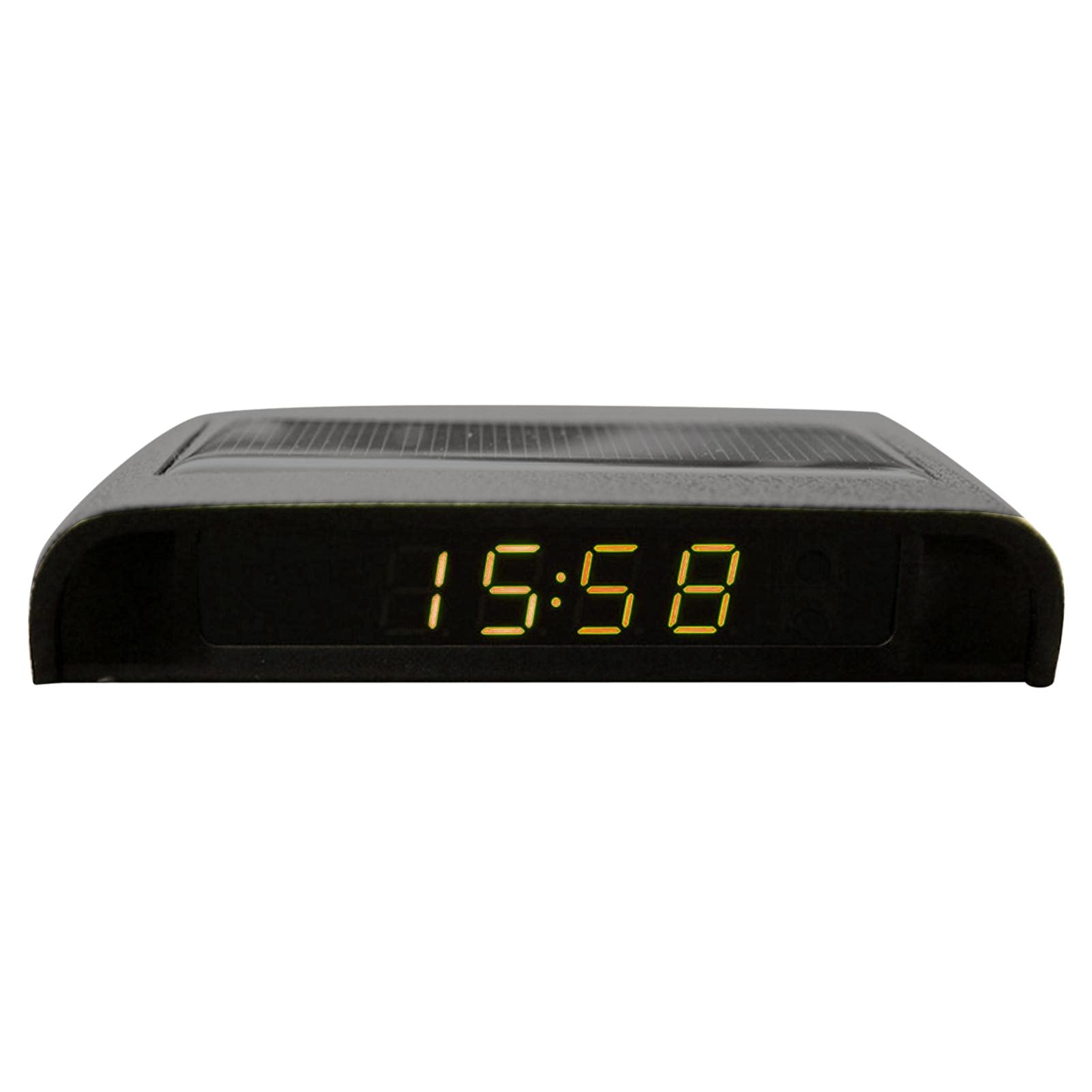
The Kakalote combines a sleek stick-on dashboard clock with a built-in temperature sensor and ambient light display. It uses a high-quality solar panel to charge its internal lithium battery, eliminating the need for a wired connection to your car’s electrical system. The device turns on automatically using a vibration sensor when it detects the car moving, and it powers off when parked to preserve battery life.
Its shading hood design prevents daytime glare from washing out the display while also stopping the LED glow from reflecting onto the windshield at night. The brightness adjusts automatically — bright enough to read in direct sun, yet soft enough not to distract after dark. Owners report that a single charge lasts over a week with typical daily driving, and the micro-USB port provides a backup charging option during winter months when solar gain is low.
One notable quirk is that the temperature display is fixed to Celsius only on some units, and the clock lacks an AM/PM indicator despite the manual stating otherwise. The included double-sided tape is also weak and should be replaced with 3M automotive tape for a secure hold. Despite these minor frustrations, its solar operation and clean aesthetic make it a popular choice for adding a temperature readout to any vehicle.
Why it’s great
- Solar-powered with micro-USB backup
- Vibration sensor for automatic on/off
- Adjustable brightness prevents windshield glare
Good to know
- Temperature may be stuck in Celsius
- No AM/PM indicator on some units
- Included tape is weak; upgrade to 3M tape
4. DROK Car Thermometer with Voltage Display
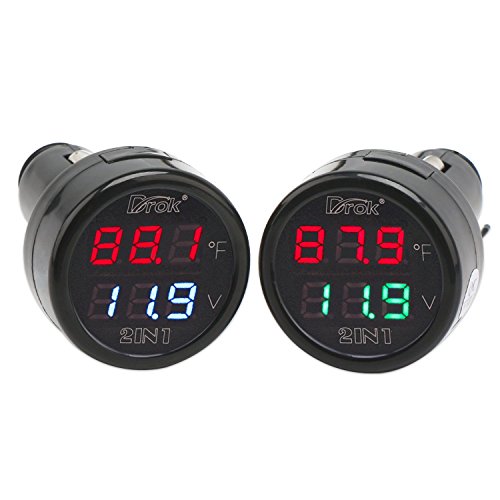
The DROK dual-display unit plugs into your 12V or 24V cigarette lighter socket and simultaneously shows cabin temperature on one screen and battery voltage on the other. Its external temperature sensor is mounted on a flexible lead, allowing you to bend it away from direct sunlight or heater vents for a more accurate reading of the air around the driver area.
A built-in fuse protects your car’s electrical system from shorts, and the LED display remains easy to read even in dim light. Each unit measures temperatures in Fahrenheit from 10 to 170 degrees, which is sufficient for cabin monitoring but not suitable for extreme engine bay heat. Customers regularly use these to track alternator charging performance alongside cabin AC cooling output.
Some owners have noted that the voltage reading can run about 0.4V low straight out of the box, requiring a mental calibration step. The unit is otherwise very dependable, and the pack includes two gauges so you can monitor two vehicles simultaneously. It’s a practical, no-installation tool for drivers who want real-time battery health and inside temperature at a glance.
Why it’s great
- Dual display for temperature and voltage
- External sensor improves cabin temp accuracy
- Built-in fuse for electrical safety
Good to know
- Voltage may read ~0.4V low out of box
- Limited temperature range (10-170°F)
- No engine bay or outside air capability
5. Proster Dual Channel Digital Thermometer

The Proster is a handheld dual-channel thermocouple thermometer that supports K, J, T, E, N, R, and S type probes, making it an incredibly versatile diagnostic instrument for a car enthusiast. It comes with two K-type thermocouple probes and can measure temperatures from -50 to 300 degrees Celsius with an accuracy of 1.5%, and a resolution as fine as 0.1 degrees below 1000 degrees.
The dual-channel design allows you to monitor two separate temperature sources at the same time, and its T1-T2 differential function automatically calculates the difference — an invaluable feature for checking radiator inlet versus outlet temperatures, HVAC supply versus return air, or heat exchanger efficiency. The backlit LCD screen is large and clear, showing T1, T2, and their combined readout simultaneously.
Owners report that the meter is accurate within 0.5 degrees Celsius of lab-calibrated instruments straight out of the box, and that both included probes agree within 0.2 degrees of each other. The interface is intuitive, with tactile buttons and a solid build quality. The only downsides are a short auto power-off timer and a brief backlight duration, but for the price and capability, it is an exceptional diagnostic tool for any automotive project.
Why it’s great
- Dual channel with T1-T2 differential function
- Supports seven thermocouple types
- Out-of-box accuracy within 0.5°C of lab gear
Good to know
- Auto power-off and backlight timer not adjustable
- Included thermocouples are basic-grade
- Not designed for permanent vehicle installation
6. bayite DC 12V Digital Temperature Controller

The bayite temperature controller is a DC 12-volt relay-based thermostat designed to switch loads on and off based on a set temperature. It uses a waterproof NTC 10K sensor probe with a 3-meter cable that can measure from -4 to 230 degrees Fahrenheit, making it ideal for controlling radiator cooling fans, ventilation fans in an electronics enclosure, or a Peltier cooler in a car camping setup.
The relay is rated for 10 amps at 110V (1100W max resistive load), which is adequate for most automotive-grade fans. The device includes high and low temperature alarms, compressor delay protection, and a temperature calibration function. Users have successfully wired it as a ground-side switch for electric radiator fans, finding it far more reliable and less voltage-sensitive than typical automotive thermostatic switches.
Programming is simple — press set, adjust the target temperature, press set again, then set the differential. The display reads to 0.1 degrees Fahrenheit, and the unit retains its settings when power is cut. It outlasted three automotive thermostats in one truck installation, and owners appreciate its digital precision and sub- cost for a purpose-built relay controller.
Why it’s great
- 10A relay for switching fans and coolers
- Waterproof probe with 3-meter cable
- Retains settings when power is disconnected
Good to know
- Requires external relay for high-current fans
- Programming sequence is somewhat convoluted
- Not a direct sensor replacement for OEM dash displays
7. AcuRite 00888A3 Indoor/Outdoor Digital Thermometer

The AcuRite 00888A3 is a simple, wired digital thermometer designed for typical household indoor/outdoor use, but it has found a loyal following among car owners who repurpose it for vehicle applications. It features a weather-resistant 10-foot cable that can be routed through a door seal or grommet to place the sensor outside, while the display unit mounts on the dashboard, console, or wall with the included bracket.
The display shows the current temperature in Fahrenheit or Celsius and has a push-button backlight for low-light reading, though the backlight is notably dim. The unit logs minimum and maximum temperatures since it was last reset, which is useful for checking overnight lows or peak cabin heat after parking in the sun.
Many owners have successfully installed this in their cars by routing the probe under the hood and mounting the display with Velcro. Users report accuracy within 0.1 to 0.2 degrees Fahrenheit, and the thermometer has a reputation for being reliable and long-lasting. The trade-off is that it is not a permanent, automotive-grade component — the display won’t match your dashboard’s aesthetics, and the backlight is weak — but it delivers outstanding utility for a very low entry cost.
Why it’s great
- Long 10-foot probe cable for flexible routing
- Accurate to within 0.1-0.2°F
- Min/max memory for tracking extremes
Good to know
- Backlight is very dim
- Not designed for automotive-specific mounting
- Probe may pick up engine heat if not routed carefully
FAQ
Why does my car’s outside temperature sensor show a reading that is clearly wrong?
Can I use any universal temperature sensor as a direct replacement for my car’s ambient sensor?
Does the location of the ambient sensor affect the accuracy of the reading?
What temperature range should I look for in an automotive ambient sensor?
Final Thoughts: The Verdict
For most users, the ambient temperature sensor for car winner is the Mean Mug 13518-12019A because it offers a direct OEM replacement fit for Mercedes-Benz vehicles at a fraction of dealer cost, with a ±1°C accuracy across a full -40°C to 150°C range. If you want complete data logging and remote alerts for your car’s interior, grab the SensorPush HTP.xw. And for a simple solar-powered clock and temperature display without wiring, nothing beats the Kakalote Solar Clock.