
An AV amplifier under $1000 occupies a peculiar sweet spot. It is the price tier where you stop buying a black box with features and start buying a component that genuinely defines your system’s character — the warmth of its amplifier stage, the precision of its room correction, and the latency of its HDMI 2.1 handshake. The wrong unit can leave you cycling input cables in frustration; the right one will let a 4K Blu-ray and a PlayStation 5 coexist without a single menu headache.
I’m Min — the co-founder and writer behind Gadgets Feed. I’ve spent many hours dissecting the thermal behavior, firmware stability, and raw preamp output of every model in this crowded space, mapping how each manufacturer’s feature trade-offs actually play out in a real living room with bookshelf speakers, a subwoofer, and mixed-generation video sources.
If you are shopping for a dedicated home theater hub that does not require a second mortgage or a degree in network engineering, this guide isolates the five units that actually earn their spot on your shelf. This is the definitive breakdown of the best av amp under $1000.
How To Choose The Best AV Amp Under $1000
The sub-$1000 AV receiver market is a battlefield of firmware maturity, HDMI 2.1 compliance, and room calibration algorithms. Getting the wrong one usually means degraded 4K/120 performance or a finicky eARC handshake that forces you back to optical audio. Here is how to filter the real contenders from the tempting bargain traps.
HDMI 2.1 Bandwidth and Gaming Features
Every unit at this price claims “HDMI 2.1,” but the actual bandwidth varies widely. True 48Gbps ports support 4K/120 with 10-bit HDR and VRR simultaneously; 40Gbps ports work but may hit chroma subsampling limits on PC inputs. Look for at least two dedicated 48Gbps inputs if you plan to run both a PS5 and an Xbox Series X through the amp. Also confirm Auto Low Latency Mode (ALLM) and Variable Refresh Rate (VRR) are listed as supported, not just “compatible.”
Room Correction and Bass Management
Budgets under $1000 rarely include premium room EQ like Dirac Live (the Onkyo TX-RZ50 is the notable exception), but Audyssey MultEQ XT and YPAO R.S.C. still shape how your subwoofer integrates with the mains. A receiver that lets you adjust crossover frequencies per channel independently is worth a significant premium — it fixes muddy mid-bass from mismatched bookshelf and floorstanding speakers.
Power Output Consistency
Manufacturer wattage figures are typically measured at 1kHz with one channel driven. Real-world performance matters more: a unit that delivers 70W–90W per channel into 8 ohms with all channels driven simultaneously (low distortion) will drive most tower speakers to reference levels in a medium room. Units that run hot under load — exceeding 90°F at the chassis top — risk thermal shutdown and component aging.
Quick Comparison
On smaller screens, swipe sideways to see the full table.
| Model | Category | Best For | Key Spec | Amazon |
|---|---|---|---|---|
| Onkyo TX-RZ50 | Premium | Serious 7.1.4 builds | Dirac Live + THX Certified | Amazon |
| Sony STR-AN1000 | Premium | Sony ecosystem integration | 360 Spatial Sound Mapping | Amazon |
| Denon AVR-S970H | Mid-Range | Versatile 7.2 hub | 90W x 7 with phono input | Amazon |
| Yamaha RX-A2A | Premium | Music-focused 5.1.2 | Surround:AI + YPAO R.S.C. | Amazon |
| Onkyo TX-NR6100 | Mid-Range | THX Certified value | 210W/ch dynamic power | Amazon |
| JBL MA710 | Mid-Range | Phono-ready 7.2 | 110W x 7 with MM phono | Amazon |
| Denon AVR-S770H | Mid-Range | Reliable entry-level 7.2 | 75W x 7 with HEOS | Amazon |
| YAMAHA RX-V6A | Mid-Range | MusicCast multi-room | 7.2 with 8K/60 HDMI 2.1 | Amazon |
| Pioneer VSX-935 | Budget | Cost-effective 7.2 | HDMI 2.1 with 8K | Amazon |
| Marantz NR1510 | Budget | Compact 5.2 setup | 4-inch slim chassis | Amazon |
In‑Depth Reviews
1. Onkyo TX-RZ50 9.2-Channel AV Receiver

The TX-RZ50 is the only receiver in this price bracket that ships with a full license for Dirac Live, a room correction system that radically tightens bass and flattens frequency response across multiple listening positions. It delivers 120W per channel across 9.2 channels, with pre-outs for a full 7.1.4 Atmos layout — a configuration usually reserved for amplifiers costing twice as much. The THX Select certification guarantees that the amplifier stage introduces zero audible noise at reference volume.
HDMI connectivity includes three 40Gbps inputs that handle 8K/60 and 4K/120 with VRR and ALLM, making it the safest bet for anyone mixing a PS5, a Panasonic UB820, and a streaming box into one chain. The unit runs cooler than its predecessor TX-NR models, averaging about 85°F at the top panel during extended movie playback, which reduces thermal stress on the DSP board.
The main trade-offs are a slightly sluggish HDMI handshake when switching sources and an Onkyo app that feels less polished than Denon’s HEOS. Some users have reported WiFi card failures on early production units, so verify the manufacturing date or buy from a retailer with a solid return window. For the combination of Dirac Live, THX certification, and 9.2-channel processing, the TX-RZ50 sets the standard that nothing else under $1000 can match.
Why it’s great
- Full Dirac Live license included for professional-grade room EQ
- Pre-outs allow external amplification for a 7.1.4 ceiling speaker layout
- THX Select certification guarantees clean power delivery at reference levels
Good to know
- HDMI handshake can lag by 2–3 seconds when switching inputs
- Zone 2 HDMI not controllable through the Onkyo app
- Early units had WiFi card defects — verify serial number range
2. Sony STR-AN1000 7.2 CH AV Receiver

Sony’s STR-AN1000 uses its proprietary 360 Spatial Sound Mapping to create a convincing overhead sound field without actual ceiling speakers — a real advantage for renters or anyone unwilling to cut drywall. The Digital Cinema Auto Calibration IX measures the position and distance of every speaker in the array, then applies phase and level adjustments that produce unusually coherent surround pans in Dolby Atmos mixes. At 165W per channel into 6 ohms, it has the headroom to drive demanding 4-ohm tower speakers without distortion.
HDMI connectivity is robust: six inputs and two outputs, all with 48Gbps bandwidth for 4K/120 and 8K/60 passthrough. The unit integrates natively with Sonos systems and supports Google Chromecast, Apple AirPlay 2, and Spotify Connect out of the box. The S-Center sync feature uses your Sony TV’s speakers as a center channel, which noticeably improves dialogue clarity for anyone using a 3.1 setup without a dedicated center speaker.
Downsides include the lack of a phono input for turntables and a known issue where Apple TV 4K Dolby Vision passthrough fails — users must connect the Apple TV directly to the TV and use eARC for audio. The front display is small and the remote lacks a backlight, both minor annoyances in an otherwise refined package. If your sources are all Sony and you want seamless 360 Spatial Sound, this is the most cohesive solution in the sub-$1000 market.
Why it’s great
- 360 Spatial Sound Mapping creates virtual height channels without ceiling speakers
- 48Gbps HDMI 2.1 ports support full 4K/120 and 8K/60 bandwidth
- Works with Sonos certification for multi-room integration
Good to know
- No phono input for turntables
- Apple TV 4K Dolby Vision passthrough requires a direct TV connection
- Front display is small and remote is not backlit
3. Denon AVR-S970H 7.2 Channel AV Receiver

The Denon AVR-S970H delivers 90W per channel across seven channels — a meaningful step up from the entry-level S770H — and adds a dedicated phono input for vinyl enthusiasts. The Audyssey MultEQ XT room correction handles crossover synchronization and distance calibration effectively, though it lacks the granular post-correction editing that higher-end Denon models offer. The on-screen setup assistant is the most beginner-friendly in the category, walking through speaker assignment, HDMI CEC configuration, and subwoofer trim in under 15 minutes.
The unit runs noticeably cooler than the previous generation S960H, averaging 80°F at the top panel during sustained 5.1 playback. That lower thermal profile extends the lifespan of internal capacitors and reduces the need for active fan cooling. HDMI 2.1 support includes three 48Gbps inputs with ALLM and VRR, making it fully compatible with current-gen consoles and PC GPUs at 4K/120 with 10-bit HDR.
One limitation: powered Zone 2 uses the rear surround amplifier channels, reducing the main zone to 5.2 if you want audio in a second room. The HEOS app works well for streaming, but Bluetooth cannot relay HEOS sources — a small gotcha. For a balanced mid-range receiver that handles music, movies, and turntables without any glaring weakness, the S970H is the most versatile Denon under $1000.
Why it’s great
- 90W per channel with all channels driven simultaneously provides real headroom
- Built-in phono preamp for direct turntable connection
- Runs cool at 80°F under load, extending component longevity
Good to know
- Powered Zone 2 reduces main zone to 5.2 channels
- Bluetooth cannot stream HEOS sources, only direct device audio
- Audyssey MultEQ XT lacks post-correction manual EQ editing
4. Yamaha RX-A2A AVENTAGE 7.2-Channel AV Receiver

The RX-A2A represents Yamaha’s AVENTAGE line, which uses a rigid fifth foot on the chassis to reduce vibration-induced jitter in the DAC stage — a subtle but audibly beneficial feature for stereo music playback. Surround:AI analyzes real-time audio content and adjusts the surround mix to emphasize dialogue during quiet scenes and widen the soundstage during action sequences. YPAO R.S.C. with multipoint measurement gives you a flatter frequency response across multiple seats than the basic YPAO in the RX-V6A.
HDMI connectivity includes three inputs that support 8K/60 and 4K/120 passthrough, though only at 40Gbps bandwidth — adequate for gaming but not quite the full 48Gbps spec. The phono input is present, and the unit ships with a three-year warranty, longer than most competitors. The MusicCast multi-room system is among the most stable wireless platforms at this price, with consistent gapless playback and quick source switching.
Known issues include an occasional no-signal bug with Sony X90L TVs that requires a power cycle, and the lack of analog video inputs (no composite or component), which may matter for retro console users. The MSRP of $1000 pushes it beyond the budget for some; at its street price around , it is a very strong music-first receiver. For dedicated two-channel listening within a 5.1.2 Atmos setup, the A2A’s DAC performance and vibration-dampened chassis put it ahead of every similarly priced unit.
Why it’s great
- AVENTAGE chassis with fifth foot reduces vibration for cleaner analog audio
- Surround:AI automates surround optimization based on scene content
- Three-year warranty is longer than the industry standard
Good to know
- HDMI 2.1 ports cap at 40Gbps, not the full 48Gbps
- Intermittent no-signal issue reported with Sony X90L TVs
- No composite or component video inputs for older game consoles
5. Onkyo TX-NR6100 7.2 Channel THX Certified AV Receiver
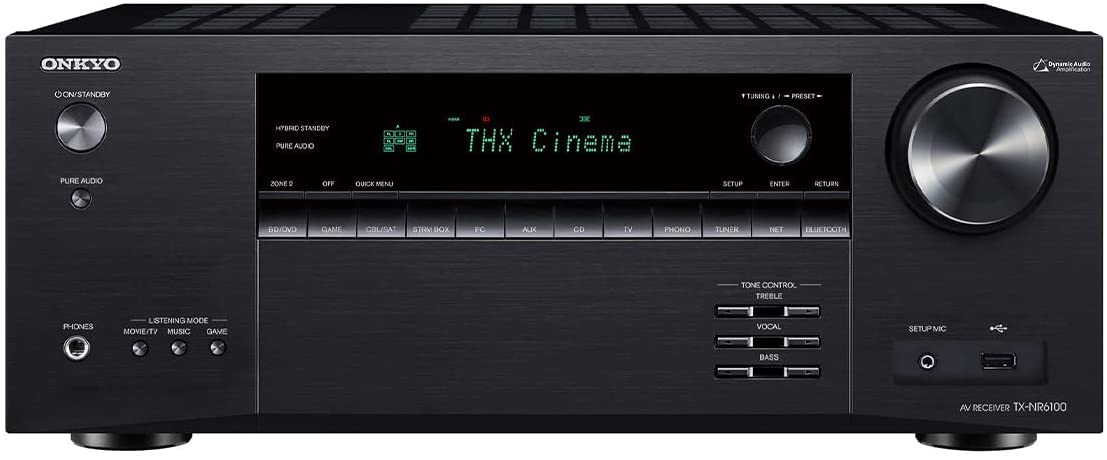
The Onkyo TX-NR6100 is the most affordable THX Certified Select receiver on the market, meaning it passed thousands of tests for distortion, noise floor, and power consistency across all channels. It delivers 210W per channel dynamic power into 6 ohms (single channel driven), but more importantly, it maintains clean output across all seven channels simultaneously — something many units at this price cannot claim. The 5.2.2-channel Dolby Atmos and DTS:X decoding is identical to the more expensive TX-RZ50, but you get AccuEQ room calibration instead of Dirac Live.
HDMI 2.1 connectivity includes three 40Gbps inputs that handle 4K/120 with VRR and ALLM, fully compatible with PS5 and Xbox Series X. The unit supports Zone 2 video switching, letting you watch a different 4K source in a second room — a feature uncommon at this price. The unit also runs cooler than the previous Onkyo TX-NR7100, which had a reputation for fan noise under heavy load.
The remote is not backlit, which makes dark-room navigation frustrating. Also, inputs 4 through 6 are limited to 4K/60, so you need to assign your 8K/120 sources to inputs 1 through 3. Some users report HDMI handshake delays when switching between Dolby Vision and SDR content. If you want THX certification without spending TX-RZ50 money and can tolerate AccuEQ instead of Dirac Live, this is the strongest value proposition in the mid-range tier.
Why it’s great
- THX Select certification at a price usually reserved for non-certified units
- Discrete Zone 2 video output for independent 4K sources in two rooms
- Full 4K/120 and VRR support for PS5 and Xbox Series X
Good to know
- AccuEQ room correction is less sophisticated than Dirac Live or Audyssey MultEQ XT
- Remote lacks backlighting for dark room use
- Only three HDMI inputs support 40Gbps; the rest are limited to 18Gbps
6. JBL MA710 7.2 Channel 8K AV Receiver

The JBL MA710 brings a fresh chassis to the sub-$1000 space with a slim 4.3-inch profile that fits easily into shallow media consoles. It delivers 110W per channel across seven channels, enough to drive moderately efficient floorstanding speakers like the Polk ES60 or JBL’s own Stage series to satisfying levels. The moving magnet phono input is a welcome inclusion for vinyl listeners, and the unit supports both Apple AirPlay 2 and Google Chromecast for multi-room streaming.
HDMI connectivity includes six inputs and one output, all with eARC support, though the HDMI 2.1 bandwidth is capped at 40Gbps — fine for 4K/120 gaming but not full 8K/60. Dolby Atmos and DTS:X decoding support 5.1.2 or 7.1 configurations. The initial setup requires a firmware update that takes about 10 minutes over Wi-Fi, and the on-screen menu is clean enough that most users can finish configuration without the manual.
Key drawbacks include a remote that is not backlit — a recurring theme in this category — and an auto-shutoff default of 20 minutes that must be changed in the settings menu. Some users report that the MA710 does not downmix DTS-HD Master Audio to 2.1 for setups without a center channel, a limitation for stereo-only users. For a compact, phono-ready 7.2 receiver with solid streaming support, the JBL MA710 is a strong contender, provided you plan for a 5.1.2 or 7.1 configuration with a center speaker.
Why it’s great
- Slim 4.3-inch height fits shallow AV cabinets
- Moving magnet phono input for direct turntable connection
- Dual wireless streaming via AirPlay 2 and Google Chromecast
Good to know
- Does not downmix DTS-HD Master Audio to 2.1 for stereo-only setups
- Remote lacks backlighting and auto-shutoff default is only 20 minutes
- HDMI 2.1 ports are 40Gbps, not the full 48Gbps standard
7. Denon AVR-S770H 7.2 Ch Home Theater Receiver

The Denon AVR-S770H is the entry point for anyone moving up from a soundbar. It delivers 75W per channel across seven channels — sufficient for a 5.1.2 Atmos setup with bookshelf speakers in a medium-sized living room. The HEOS multi-room platform is one of the most stable wireless ecosystems at this price, with support for Spotify, TIDAL, Pandora, and Amazon Music HD. Dolby Height Virtualization lets you simulate overhead effects without installing ceiling speakers, a useful bridge until you are ready to cut holes.
HDMI 2.1 support includes three 48Gbps inputs with 4K/120passthrough, VRR, and ALLM, making it fully compatible with the latest gaming consoles. The Audyssey MultEQ room calibration handles basic distance and level adjustment, though it lacks the more sophisticated frequency-domain correction of MultEQ XT. The on-screen setup assistant is Denon’s best — it walks through speaker configuration, HDMI CEC settings, and subwoofer trim in about 10 minutes.
The primary complaints revolve around firmware: some users report random volume drops to zero and occasional no-picture output that requires a power cycle. These issues appear less common in later production batches, but early adopters had a rougher experience. For a reliable 7.2 hub that supports current gaming consoles and HEOS streaming at a budget-friendly price, the S770H is a solid foundation, but check for the latest firmware version at purchase.
Why it’s great
- Three 48Gbps HDMI inputs support full 4K/120 and VRR for gaming
- HEOS multi-room streaming is stable and supports hi-res music services
- Dolby Height Virtualization creates overhead effects without ceiling speakers
Good to know
- Early firmware had random volume drops and no-picture output bugs
- Audyssey MultEQ lacks frequency-domain correction, only handles level and distance
- 75W per channel is adequate for bookshelf speakers but may struggle with power-hungry towers
8. YAMAHA RX-V6A 7.2-Channel AV Receiver

The Yamaha RX-V6A is built around the MusicCast multi-room ecosystem, which lets you group the receiver with MusicCast speakers in up to 10 zones for synchronized or independent playback. The amplifier stage uses Yamaha’s high slew rate design, which delivers faster transient response than most receivers at its price, resulting in noticeably crisper percussion and sharper dialogue edges. Dolby Atmos with Height Virtualization and DTS:X are both supported, though the unit is capped at 7.2 channels — no ceiling channels without sacrificing rear surrounds.
HDMI connectivity includes seven inputs and one output, with three inputs supporting 8K/60 and 4K/120 at 40Gbps bandwidth. The eARC implementation is functional: the AVR auto-switches to the correct input when the TV turns on, but it does not auto-power-on from standby. Voice control via Alexa and Google Assistant works reliably once linked. The YPAO room calibration is straightforward and produces good results for most rooms, though it lacks the multipoint refinement of the RX-A2A’s YPAO R.S.C.
The main complaints center on the dated on-screen menu system, which feels cluttered compared to Denon’s graphical assistant, and the lack of a true 48Gbps HDMI port — 40Gbps is adequate for 4K/120 with 10-bit HDR but may limit chroma options for PC users. Some users report that 4-ohm speakers demand more current than the RX-V6A can comfortably supply at reference volume. For a multi-room powerhouse with strong transient speed, the RX-V6A is a compelling choice if you plan to expand into MusicCast speakers.
Why it’s great
- MusicCast multi-room ecosystem supports up to 10 zones
- High slew rate amplifier delivers fast transient response for clear dialogue and percussion
- Voice control with Alexa and Google Assistant works reliably after setup
Good to know
- On-screen menu is cluttered and feels dated compared to competitors
- HDMI 2.1 ports are 40Gbps, not the full 48Gbps standard
- Demanding 4-ohm speakers may hit current limits at reference volume
9. Pioneer VSX-935 7.2 Channel Network Receiver
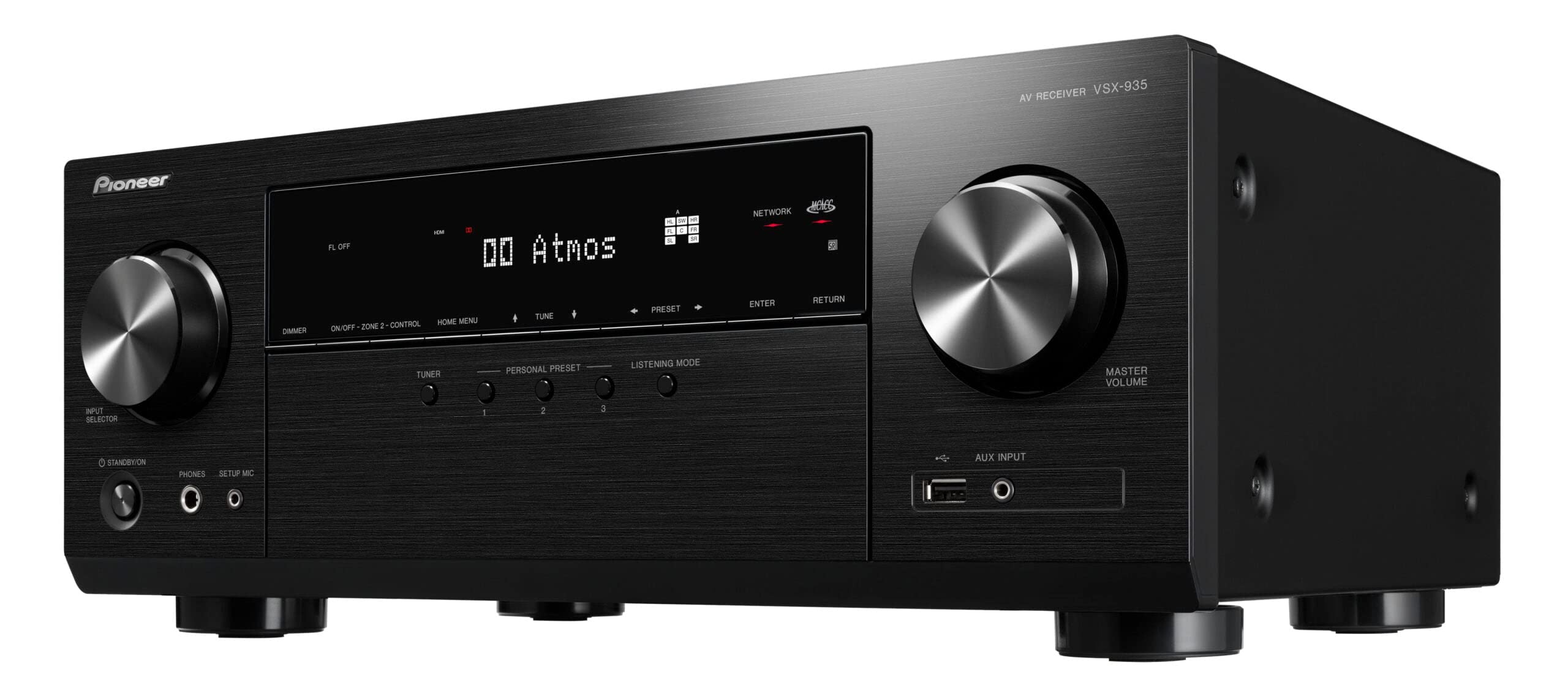
The Pioneer VSX-935 is the most affordable receiver in this guide that still includes HDMI 2.1 with 8K passthrough on all six inputs. It delivers clean 7.2-channel amplification at a power level that comfortably drives most bookshelf and center channel speakers, though it lacks the headroom for demanding 4-ohm towers at reference levels. Dolby Atmos Height Virtualization creates a convincing overhead effect from a standard 5.1 layout, making it a practical entry point for Atmos without ceiling speakers.
The unit’s built-in streaming supports Spotify, TIDAL, and Amazon Music HD over Wi-Fi, and the Bluetooth implementation works for casual listening but has a reputation for unreliable two-way pairing — the Bluetooth is buried in the menu system with no dedicated button. The auto-calibration microphone works for basic speaker distances but is less sophisticated than Audyssey or YPAO; many users report better results entering manual measurements.
Build quality is decent for the price, though some early units arrived with dead displays or intermittent sound from the secondary zone port (easily fixed by toggling the Zone 2 setting). The interface is functional but dated, with small text on the front display. If your priority is getting HDMI 2.1 into a system on a strict budget and you are comfortable with manual speaker calibration, the VSX-935 is a functional workhorse that leaves room in the budget for better speakers.
Why it’s great
- All six HDMI inputs support 8K/60 and 4K/120 passthrough
- Dolby Atmos Height Virtualization works without ceiling speakers
- Lowest price point among HDMI 2.1-equipped receivers
Good to know
- Bluetooth pairing is unreliable and buried in the menu system
- Auto-calibration is imprecise — manual measurement yields better results
- Some units arrived with dead displays or Zone 2 audio issues out of the box
10. Marantz NR1510 Slim 5.2 Channel AV Receiver

The Marantz NR1510 is a 5.2-channel receiver packed into a chassis just 4 inches tall, making it the best option for media consoles with minimal vertical clearance. It delivers 50W per channel across five channels, sufficient for efficient bookshelf speakers in a small to medium room, though it lacks the power for large floorstanding towers or reference-level home theater. The built-in MM phono preamp lets you connect a turntable directly, and the HEOS streaming platform provides access to Spotify, TIDAL, and Amazon Music HD.
HDMI connectivity includes six inputs and one output, all supporting 4K/60 with HDR10, Dolby Vision, and HLG — but there is no HDMI 2.1, so 4K/120 and 8K passthrough are not available. This limits the NR1510 to users who do not need next-gen gaming features. The setup assistant guides through speaker configuration, and the graphical interface is clearer than Yamaha’s but less polished than Denon’s. The unit also integrates with Control4 and Josh smart home systems for custom installation environments.
The main limitation is the 50W power output, which may leave you wanting more headroom for dynamic movie soundtracks. Marantz also recommends leaving ventilation space above the unit, as the slim chassis runs hotter than full-size receivers — the top panel can reach 90°F during extended playback. For a compact 5.2 receiver that fits tight spaces and supports vinyl, streaming, and 4K video, the NR1510 is a niche champion, but it is not a general-purpose home theater powerhouse.
Why it’s great
- Only 4 inches tall, fits shallow media consoles and AV racks
- Built-in MM phono preamp for direct turntable connection
- Integrates with Control4 and Josh smart home automation systems
Good to know
- 50W per channel is underpowered for large floorstanding speakers
- No HDMI 2.1 support — limited to 4K/60 without gaming features
- Slim chassis runs hot; requires adequate ventilation above the unit
FAQ
Can I use a 7.2 AV receiver with only two speakers?
Do I need eARC if my TV already has HDMI ARC?
Final Thoughts: The Verdict
For most users, the best av amp under $1000 winner is the Onkyo TX-RZ50 because it bundles Dirac Live room correction and THX certification at a price where competitors offer neither, while providing pre-outs for a future 7.1.4 upgrade. If you want Sony’s 360 Spatial Sound Mapping and a cohesive ecosystem with a PlayStation 5 or Sony TV, grab the Sony STR-AN1000. And for a balanced mid-range hub that handles turntables, gaming, and multi-room music without a single major compromise, nothing beats the Denon AVR-S970H.