
That first squeeze of a fresh oil paint tube holds promise, but too often the reality falls short—muddy blends, chalky tints, or a color that fades to nothing within a year. The difference between an average piece and a luminous, archival painting often comes down to one critical choice: the pigment load and binder formulation inside that tube.
I’m Min — the co-founder and writer behind Gadgets Feed. I have spent hundreds of hours cross-referencing pigment strength, lightfastness ratings, oil absorption curves, and real-artist feedback on every major brand’s line of artist oil paint.
This guide cuts through the marketing noise to compare pigment density, body consistency, and color accuracy across the market. If you are searching for the best artist oil paint for your next canvas, this deep-dive will help you match the right formulation to your technique.
How To Choose The Best Artist Oil Paint
Not all tubes are created equal. A single white from one brand can behave like stiff butter, while another brand’s white is fluid and oily. Understanding a handful of technical specs will prevent expensive mistakes and ensure your paintings hold up over decades.
Pigment Load and Tinting Strength
The real value of a paint is not in the volume of the tube but in how much actual pigment is packed into the binder (usually linseed or safflower oil). A high pigment load means a little goes a long way. This tinting strength determines how much of a color you can mix into white before the hue disappears. Cheaper paints bulk up the tube with filler and excess oil, requiring far more paint to achieve the same intensity and leading to frustratingly weak mixtures.
Lightfastness and Archival Performance
Lightfastness is the paint’s resistance to fading when exposed to UV light. The American Society for Testing and Materials (ASTM) assigns ratings from I (Excellent) to V (Very Poor). For any painting intended to last, stick to ASTM I or II pigments. A beautiful color is useless if it fades to a washed-out ghost within a few years on your wall.
Body and Consistency
Oil paints are categorized by their body: stiff (holds a peak, ideal for impasto), long or buttery (smooth and spreadable for general painting), and soft or fluid (runs easily, good for glazing). Choosing the wrong body for your technique—like trying to paint a textured impasto landscape with a soft paint—will fight you every stroke of the way. High-quality brands clearly state the body of their paint on the label.
Quick Comparison
On smaller screens, swipe sideways to see the full table.
| Model | Category | Best For | Key Spec | Amazon |
|---|---|---|---|---|
| Gamblin Artist Oil Color Titanium White | Premium | High-pigment mixing white | 150 ml / buttery body | Amazon |
| MyArtscape 24-Color Oil Paint Set | Mid-Range | Budget-friendly color variety | 24 x 21 ml / high saturation | Amazon |
| Daler-Rowney Georgian 10-Tube Set | Mid-Range | Student/beginner studio set | 10 x 38 ml / fast dry 4-5 days | Amazon |
| Williamsburg Flake White 37 ml | Premium | Traditional ropy texture white | 37 ml / ASTM I lightfastness | Amazon |
| Winsor & Newton Winton 10-Color Set | Premium | High-quality student/pro grade | 10 x 21 ml / even consistency | Amazon |
| Williamsburg Signature Colors 11ml Set | Premium | Handcrafted professional set | 9 x 11 ml / very fine grind | Amazon |
| Gamblin Introductory Set | Premium | Complete pro starter kit | 6 x 37 ml / includes panel | Amazon |
In‑Depth Reviews
7. Gamblin Artist Oil Colors Introductory Set

This is the set that art instructors consistently recommend, and for good reason. The Gamblin Introductory Set delivers a curated selection of six 37 ml tubes—Cadmium Yellow, Cadmium Red, Ultramarine Blue, Phthalo Green, Yellow Ochre, and Ivory Black—along with a generous 150 ml Titanium White and a pre-primed birch wood panel. The paint body is consistently buttery and stiff, ideal for both brush and palette knife work, holding peaks beautifully for impasto technique.
What sets Gamblin apart is the pigment-to-medium ratio. These paints contain no fillers or extenders, so you get maximum tinting strength from every squeeze. Artists report that even heavily thinned washes retain strong color, and the colors mix cleanly without turning muddy. The lightfastness across the set is ASTM I, ensuring archival permanence. The birch panel is a thoughtful touch for immediate plein air work or testing.
The main trade-off is the initial investment. However, considering you receive a full 150 ml of Titanium White (which you will burn through fastest) and real cadmium pigments rather than cheaper substitutes, the cost-per-gram of usable paint is competitive. This set eliminates the guesswork for someone ready to move beyond student-grade supplies.
Why it’s great
- Highest pigment-to-medium ratio with no fillers
- Includes 150 ml Titanium White and a painting panel
- Consistent buttery body ideal for impasto and knife work
Good to know
- Premium price point for a starter set
- Limited to six core colors, requires additional mixing knowledge
1. Gamblin Artist Oil Color – Titanium White (150 ml)
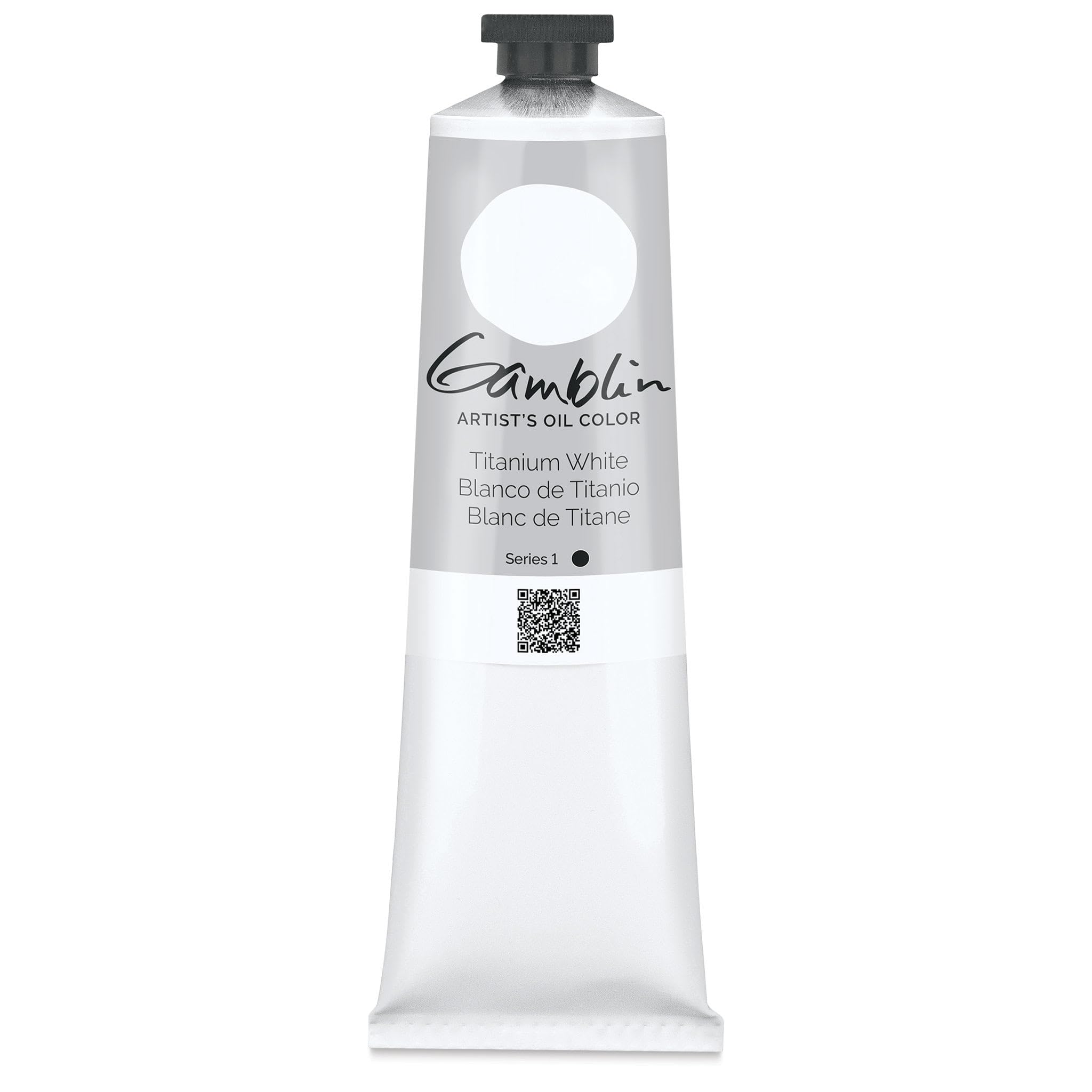
If you buy only one tube of oil paint in your life, make it a high-quality white. The Gamblin Titanium White in the 150 ml format is the gold standard for mixing. Its buttery, stiff body holds crisp edges and stands up to heavy brush and knife manipulation without collapsing into a greasy puddle. This is the white that underpins a vast range of techniques, from thin glazes to thick impasto highlights.
The pigment load in Gamblin’s white is noticeably higher than in many student lines. When you mix it with a Cadmium Red or Ultramarine, you need far less white to achieve a pastel tint, which means your mixtures stay cleaner and more saturated. The oil absorption is well-calibrated—the paint is stiff without being tacky or drag-heavy on the brush. Artists consistently rate this as their go-to white for reliability.
The sole caveat is the size. At 150 ml, it is a commitment to a single color. But white is typically the most-used color in any oil painter’s palette, often consumed at 3-4 times the rate of other hues. Buying in bulk saves significant cost over multiple smaller tubes. For any painter who works in volume or values consistent mixing results, this is the white to stock.
Why it’s great
- Exceptional pigment load for clean, strong tints
- Buttery body holds brush and knife marks beautifully
- Economical per-milliliter cost in the 150 ml format
Good to know
- Large tube may be too much for infrequent painters
- Single color purchase requires building a palette separately
5. Winsor & Newton 1490697 Winton Oil Paint 10-Color Set

Winsor & Newton’s Winton line represents a rare balance: professional-grade pigment handling at a price that students and serious hobbyists can justify. This 10-color set includes 21 ml tubes of Titanium White, Cadmium Yellow, Yellow Ochre, Cadmium Red, Alizarin Crimson, Ultramarine, Phthalo Blue, Viridian Hue, Yellow Green, and Burnt Sienna. The consistency is even and buttery, holding brushstrokes well while remaining fluid enough for smooth blending and knife work.
What elevates Winton above other student-tier lines is the color formulation. Winsor & Newton individually formulates each color to maximize the natural properties of its specific pigment, rather than using a one-binder-fits-all approach. This means the Phthalo Blue handles differently from the Burnt Sienna, the advantage being that each behaves optimally for its pigment chemistry. Lightfastness is strong across the set, with most colors rated ASTM I or II.
The 21 ml tube size is adequate for learning and small-to-medium canvases, but heavy users will quickly exhaust the more popular colors, particularly the white and earth tones. The set does not include a brush or palette, so factor in those separate purchases. For a painter seeking a reliable, predictable paint that won’t fight unpredictably on the canvas, this kit is a smart step up.
Why it’s great
- Color-specific formulation optimizes each pigment’s handling
- Excellent lightfastness and aging resistance
- Smooth, even consistency works for brush and palette knife
Good to know
- 21 ml tubes run out faster for high-volume painters
- No brush or palette included in the set
6. Williamsburg Artist Oil Colors Signature Colors 11ml Set

Williamsburg, now owned by Golden, produces paint that is still largely handmade in small batches. This Signature Colors set of 9 x 11 ml tubes is a gateway into a world of uniquely historical and high-chroma pigments. The set includes colors like Unbleached Titanium, Venetian Red, and Yellow Ochre Pale, each ground to a very fine particle size that yields extraordinary luminosity in thin films and rich depth in thicker applications.
The body of Williamsburg paint varies by pigment—some are ropy and long, others are stiffer—reflecting the natural character of each pigment rather than standardizing them into a uniform texture. This requires some adaptation but rewards the painter with colors that feel alive and responsive. The Unbleached Titanium, for example, has a creamy, slightly grayish-buff tone that is superior for skin tones and neutral tints compared to a bright white. Color mixing is transparent and clean, with no muddying from fillers.
The 11 ml tubes are small and come at a premium price. These are not economical for covering large areas but are ideal for building a specialized palette of unique, low-volume colors. The packaging is minimal yet effective. For the painter who obsesses over color nuance and appreciates the craft of paint-making, this set is a treasure.
Why it’s great
- Handcrafted with very fine pigment grind for superior luminosity
- Unique historical colors with high chroma and transparency
- Each pigment retains its natural body character
Good to know
- Small 11 ml tubes are expensive per-milliliter
- Inconsistent body between colors requires adaptation
4. Williamsburg Artist Oil Colors Flake White 37 ml

Flake White (lead white) is the traditional white of the Old Masters, and Williamsburg’s rendition honors that heritage. This 37 ml tube contains basic lead carbonate (PW 1) ground to a very fine consistency, producing a paint that is ropy and long—meaning it pulls into strings rather than forming a stiff peak. It has a warm, almost pearlescent sheen that Titanium White cannot replicate, making it indispensable for rendering flesh tones and soft atmospheric transitions.
The semi-opaque coverage of this Flake White allows for layered, ethereal effects in glazes. When mixed with colors, it modifies the hue in a subtle, warm manner rather than the chalky, cold shift typical of Titanium White. The ASTM I lightfastness rating assures archival stability. Williamsburg’s manufacturing process ensures the lead carbonate is thoroughly dispersed and the grind is defect-free, which eliminates the gritty inconsistency found in some lesser flake whites.
The obvious downside is toxicity—lead white requires careful handling, no airborne dust, and no ingestion. It is not suitable for children or painters who work in poorly ventilated spaces. Additionally, the 37 ml tube is small for a white, though this is standard for lead whites due to their density and cost. This is a specialist’s tool for specific classical techniques, not an everyday mixing white.
Why it’s great
- Authentic ropy body and warm sheen for classical techniques
- Exceptional for subtle flesh tones and glazing
- Very fine, defect-free grind with high lightfastness
Good to know
- Lead content is toxic—requires safe handling and ventilation
- Expensive and small tube; not a general-purpose white
3. Daler-Rowney Georgian 10-Tube Studio Set

Daler-Rowney’s Georgian line is a reliable student-grade paint that punches above its tier in volume. This 10-tube set provides 38 ml per tube—a generous amount compared to the typical 21 ml or 37 ml sets. The color selection includes Titanium White, Cadmium Yellow, Yellow Ochre, Cadmium Red, Alizarin Crimson, Ultramarine, Viridian, Burnt Sienna, Raw Umber, and Ivory Black. The triple-milled archival paint has a smooth, buttery texture that blends evenly and performs well with both brush and knife.
A standout feature is the drying time. Georgian oil paints are formulated to dry faster and more evenly across the palette, reaching a touch-dry state in roughly 4-5 days. This is a boon for students and hobbyists who work in layers and don’t want to wait a week between sessions. The consistency is uniform across all colors, simplifying the learning process. The paint is also low-odor, making it less offensive in shared spaces.
The compromise is in pigment concentration. When mixing, especially with Titanium White, you may find you need more paint to achieve the same tinting strength as a premium brand. The colors are decent but lack the luminosity and depth of higher-end lines. This is a paint designed for practice, learning, and volume work rather than gallery-quality final pieces.
Why it’s great
- Large 38 ml tubes provide excellent value per-volume
- Fast and even drying time (4-5 days) for layered painting
- Smooth, buttery consistency ideal for students
Good to know
- Lower pigment load reduces tinting strength in mixes
- Colors lack the depth and luminosity of premium brands
2. MyArtscape Oil Paint Set, 24 Colors
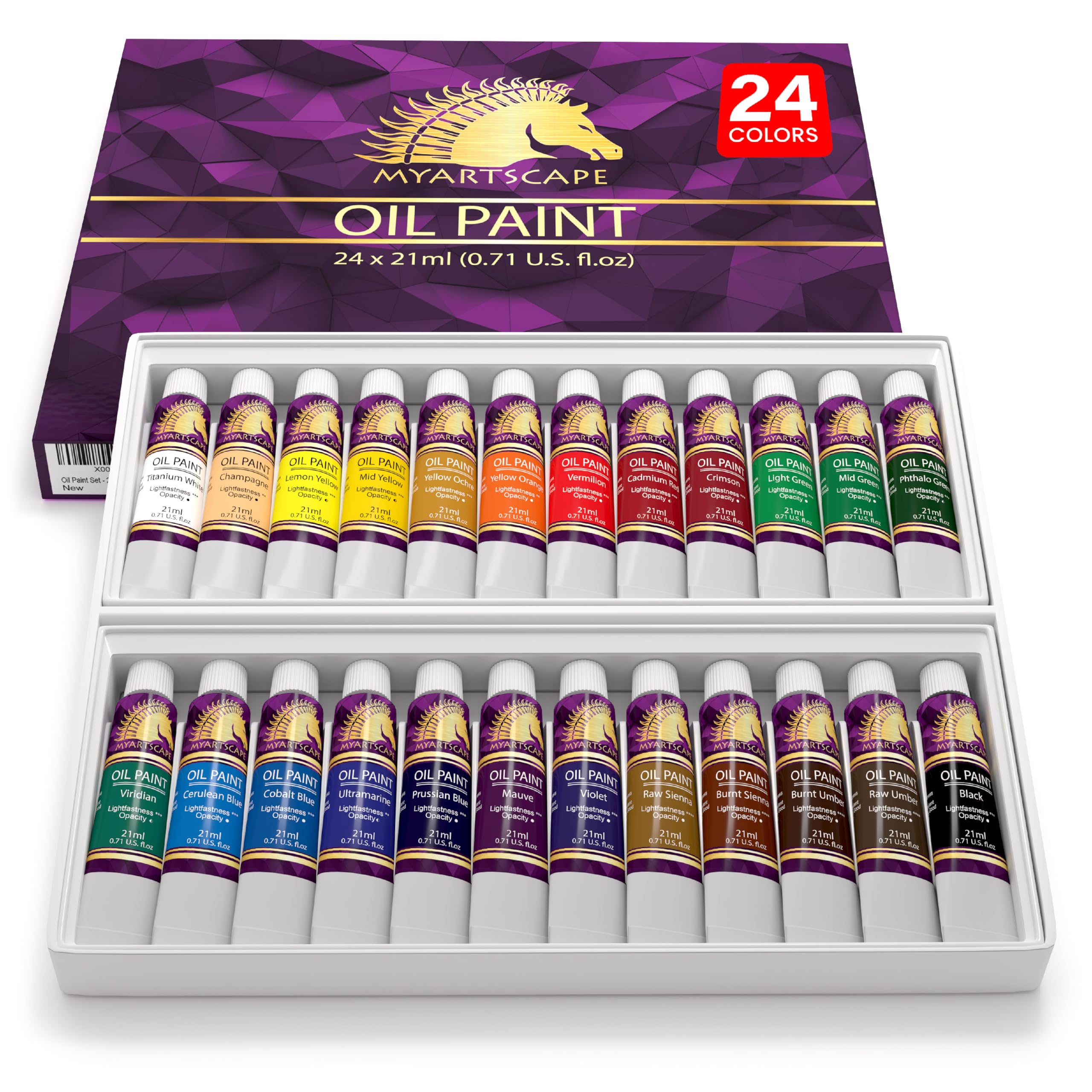
For the painter on a tight budget who still wants a full spectrum of colors without mixing every hue, the MyArtscape 24-color set is a compelling entry point. Each of the 24 tubes contains 21 ml of paint, totaling over 500 ml of paint for the set. The colors are rich and vibrant, with a glossy finish that requires little additional medium to achieve a strong sheen. The texture is creamy and smooth, making initial brushwork forgiving and easy to blend.
Where this set excels is in its variety—24 distinct colors including multiple blues, greens, earth tones, and a decent selection of warm and cool primaries. This allows a beginner to start painting immediately without needing deep color theory knowledge. The paint covers well and dries to a consistent gloss. The 1-year replacement guarantee adds a layer of confidence for first-time buyers.
The obvious trade-off is in pigment quality and lightfastness. While the set claims high lightfastness, individual pigments are not ASTM-rated, and the binder-to-pigment ratio is lower than professional lines. Colors may fade over time, especially in direct sunlight. The 21 ml tubes are also smaller than the Daler-Rowney set. For practice paintings, studies, or learning color mixing, this set delivers extraordinary value, but it is not archival-grade material for serious works.
Why it’s great
- 24-color palette provides immediate variety without mixing
- Creamy, glossy finish and good blending behavior
- Exceptional value for the volume of paint included
Good to know
- Pigment quality and lightfastness are not ASTM certified
- 21 ml tubes are smaller; heavy users will run out quickly
FAQ
What does the “body” of an oil paint mean for my painting technique?
Can I mix student-grade oil paints with professional-grade ones?
How many milliliters of paint do I need to start a painting?
Final Thoughts: The Verdict
For most users, the best artist oil paint winner is the Gamblin Introductory Set because it delivers a flawless combination of maximum pigment load, a versatile buttery body, a generous 150 ml white tube, and a birch panel to start painting immediately—all backed by American manufacturing and consistent ASTM I lightfastness. If you want a huge spectrum of colors at a budget-friendly price, grab the MyArtscape 24-color set. And for classical glazing techniques and unmatched luminosity in subtle transitions, nothing beats the Williamsburg Flake White.