
The moment you haul your boat for the season, the truth is revealed: a crusty, slimy, barnacle-encrusted bottom that robs your hull of speed, fuel efficiency, and resale value. For fiberglass boat owners, the choice of bottom paint is the single most consequential decision you’ll make between haul-outs, directly determining how many hours you’ll spend scrubbing versus how many you’ll spend on the water.
I’m Min — the co-founder and writer behind Gadgets Feed. I’ve spent hundreds of hours analyzing marine coatings, cross-referencing technical datasheets, and reading through real-world user experiences to separate marketing hype from true antifouling performance in the demanding marine environment.
Whether you trailer your boat weekly or leave it moored in high-fouling saltwater all season, finding the right bottom paint for fiberglass boats is the difference between a clean hull and a season of frustration.
How To Choose The Best Bottom Paint For Fiberglass Boats
Selecting the right antifouling paint for your fiberglass hull isn’t about picking a color you like—it’s about matching the paint’s chemistry to your specific water type, boating frequency, and storage habits. Make the wrong choice and you’ll be scrubbing growth or repainting every season.
Ablative vs. Hard Paint
Ablative paints wear away slowly as your boat moves through water, continuously exposing fresh biocide. This makes them ideal for frequent use and prevents heavy buildup over multiple seasons. Hard or epoxy-based paints form a permanent film that does not wear away—they rely on biocides leaching out and are better suited for boats that sit in the water for extended periods without moving.
Copper Content and Copper-Free Alternatives
Copper is the primary biocide in most bottom paints. Higher cuprous oxide percentages (30-40%+) offer stronger protection against barnacles and slime in high-fouling saltwater. However, for aluminum hulls, outdrives, and trim tabs, copper-free formulas prevent destructive galvanic corrosion. Some regions also restrict copper, making biocide-free alternatives a legal necessity.
Water Type and Boating Habits
Saltwater demands the most aggressive antifouling protection, while freshwater and brackish water have different fouling organisms—quagga mussels in the Great Lakes, zebra mussels in inland waters. If you trailer your boat and rinse it after each use, a softer ablative paint works well. If you moor for weeks at a time, a hard, high-copper paint is the safer bet.
Quick Comparison
On smaller screens, swipe sideways to see the full table.
| Model | Category | Best For | Key Spec | Amazon |
|---|---|---|---|---|
| Pettit Paint Vivid | Hard Paint | Saltwater mooring, visible areas | 400 sq ft/gal, hard film | Amazon |
| TotalBoat Spartan | Ablative | Multi-season high fouling | 38% cuprous oxide | Amazon |
| TotalBoat Krypton | Copper Free | Aluminum hulls, outdrives | 500 sq ft/gal coverage | Amazon |
| Pettit Paint Hydrocoat | Ablative | Water-based easy cleanup | 700-1200 sq ft/gal | Amazon |
| Fasco Epoxies | Epoxy | Jet skis, airboats, abrasion | Two-part epoxy with PTFE | Amazon |
| TotalBoat JD Select | Ablative | DIY water-based application | 500 sq ft/gal, low VOCs | Amazon |
| Interlux Aqua-One | Ablative | Brackish and fresh water | Water-based, easy cleanup | Amazon |
| Interlux Bottomkote NT | Hard Paint | Freshwater protection | 3-year freshwater performance | Amazon |
| Interlux Trilux 33 | Non-Copper | Outboard motors, aluminum | Quart, Biolux technology | Amazon |
In‑Depth Reviews
1. Pettit Paint Vivid

Pettit Paint Vivid is the gold standard for boaters who demand a pristine, clean appearance from their bottom paint without sacrificing antifouling power. This hard paint formula produces a glossy, smooth film that resists slime and algae better than softer ablative paints, making it the go-to choice for visible hull surfaces like the waterline and transom where aesthetics matter. With a coverage rate of 400 square feet per gallon, it lays down a durable, long-lasting coating that can stay effective for multiple seasons without needing a full repaint.
Long-term Chesapeake Bay users report over 20 years of reliable performance in brackish water, with the white version maintaining its clean color far better than the softer ablative paints used on the bottom. The hard film means the paint does not wear away, but you can leave the boat out of water for extended periods without losing antifouling properties—a key advantage for owners who store their boats on land. Application requires two days of drying time but the paint stores well between seasons, reducing waste.
The trade-off is its higher cost per gallon compared to ablative alternatives, and the hard finish means you can’t simply pressure-wash away layers—when it’s time to recoat, you’ll need to sand or blast the old paint. Its slow drying time demands patience, but boaters who have used this product for a decade or more consistently report that the protection justifies the effort.
Why it’s great
- Proven 20+ year performance in brackish and saltwater
- Gloss finish stays whiter than softer alternatives
- Can be left out of water without losing effectiveness
Good to know
- Slow drying time—requires up to 2 days before launch
- Hard paint requires sanding before recoating
2. TotalBoat Spartan
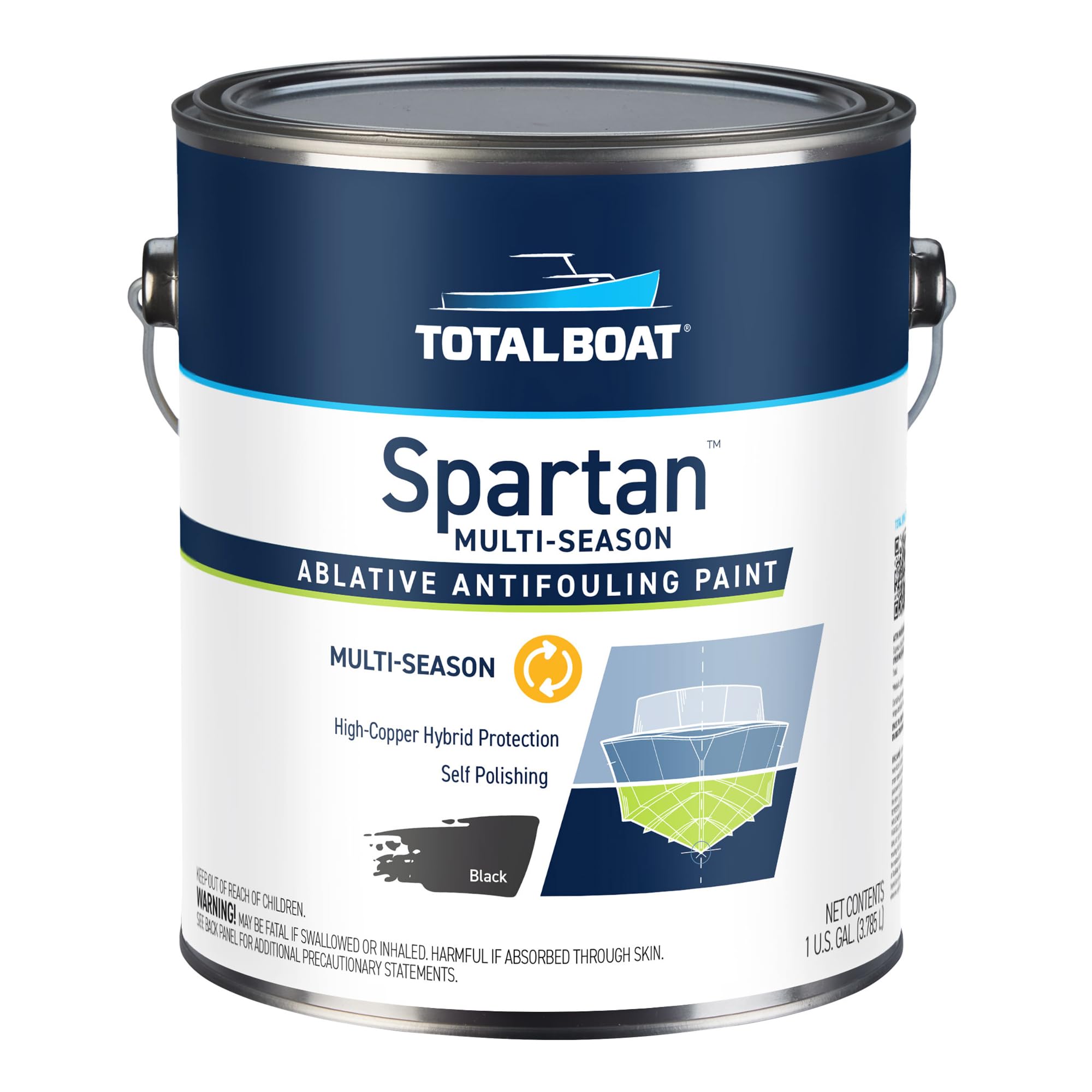
TotalBoat Spartan packs a massive 38% cuprous oxide content into an ablative formula designed for multi-season protection in the harshest fouling conditions. This paint is engineered for boats that sit in salt or brackish water for months at a time—the high copper load means barnacles and slime simply cannot establish a foothold. The advanced copolymer ablative technology ensures continuous protection whether the boat is at anchor or underway, and the burnishable finish allows skippers to polish for a racing-smooth surface that improves fuel efficiency.
User reports confirm that after 6 months in high-fouling Florida saltwater, hulls came out remarkably clean with minimal growth. The paint dries quickly and can be applied by brush, roller, or spray, giving DIY owners flexibility. One of its strongest features is the ability to haul and relaunch without repainting—simply scuff the surface lightly to reactivate the antifouling properties. This saves substantial labor and material costs over multiple seasons.
Where Spartan falls short is in extreme warm-water environments above 80°F. A Florida-based reviewer noted that while the paint sheds growth better than cheaper alternatives, some hard fouling still required monthly scraping in summer months. Additionally, the availability of thinner and accessories is not included with the purchase, adding roughly in ancillary costs for a proper job.
Why it’s great
- 38% cuprous oxide for exceptional barnacle defense
- Multi-season performance reduces repaint frequency
- Burnishable for a racing-smooth fuel-efficient finish
Good to know
- May require monthly scraping in very warm, high-fouling waters
- Thinner and supplies sold separately
3. TotalBoat Krypton
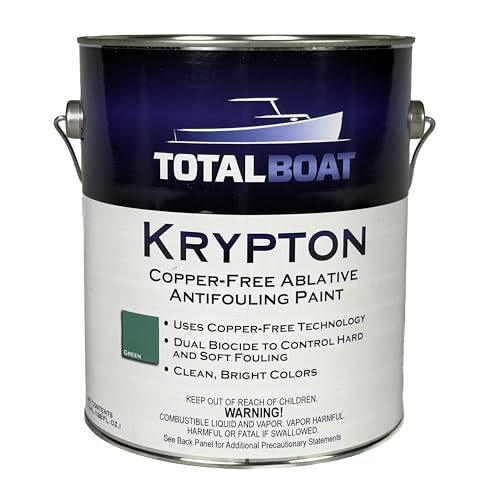
TotalBoat Krypton solves a critical problem for aluminum boat owners: how to get powerful antifouling protection without triggering galvanic corrosion. This copper-free formula replaces copper with alternative biocides that are fully safe for outdrives, trim tabs, and aluminum hulls, while still delivering single-season protection against barnacles, weeds, algae, and slime in fresh, salt, and brackish water. The absence of copper also means colors are far more vibrant—green, blue, white, red, and black—so your bottom can actually match your hull design.
One Sailing magazine test showed Krypton had the least fouling growth after two years among copper-free paints tested, with almost no slime accumulation. DIY users consistently praise its smooth application—it goes on easily by brush or spray, covers imperfections with an eggshell finish, and provides coverage of 500 square feet per gallon. For Volvo Penta DP-S drives, one reviewer noted excellent adhesion to zinc chromate primer with no compatibility issues.
The main caveat is shipping damage—the gallon cans come only in a cardboard box without foam padding, and several users reported dented cans despite sealed lids. If possible, purchase locally to avoid this risk. Additionally, the paint does not perform as well as high-copper paints in extremely severe fouling environments, but for most recreational boaters in typical conditions, the protection is more than adequate.
Why it’s great
- Zero copper eliminates galvanic corrosion on aluminum
- Vibrant color options not available with copper-based paints
- Top-ranked by Sailing magazine for antifouling performance
Good to know
- Shipping packaging is minimal—cans may arrive dented
- Copper-free formula less potent than high-copper paints in extreme fouling
4. Interlux Aqua-One

Interlux Aqua-One is the perfect entry point for fiberglass boat owners who want effective antifouling protection without dealing with toxic solvents and complicated cleanup. This water-based ablative paint is incredibly easy to apply—it cleans up with soap and water, has low odor, and dries quickly between coats. Designed for salt, brackish, and fresh water, it wears away gradually as the boat moves, minimizing buildup and eliminating the need for heavy sanding between seasons.
Users report that Aqua-One holds up particularly well in brackish and saltwater environments, often lasting longer than competing brands in the same price range. The gallon covers an entire 27-foot boat with ease, and the water-based formula means you can apply it indoors or in poorly ventilated boat yards without worrying about harmful fumes. One reviewer noted that after an entire season in brackish water, the bottom required minimal scrubbing compared to previously used ablative paints.
The primary downside is that the paint settles heavily—users must stir thoroughly with a drill mixer to redistribute the metal content evenly. Failure to do so results in uneven wear and reduced protection. Additionally, while it is marketed for saltwater, its performance in extreme high-fouling tropical waters is noticeably weaker than high-copper alternatives, making it better suited for temperate regions and freshwater.
Why it’s great
- Water-based with soap and water cleanup
- Low odor for safe indoor application
- Long-lasting performance in brackish water
Good to know
- Heavy settling requires thorough mixing before use
- Less effective in severe tropical fouling conditions
5. Fasco Epoxies Super Slick 2000

Fasco Epoxies Super Slick 2000 occupies a unique niche that no other bottom paint fills: it is a two-part epoxy formulated specifically for airboats, jet skis, and aluminum hulls that routinely contact grass, mud, sand, and debris. Rather than relying on biocides alone, this coating uses PTFE and advanced friction-reducing additives to create an exceptionally hard, armor-like surface that reduces drag and protects against abrasion. The 1:1 mix ratio is simple for DIY owners, and the resulting film is as slick as Teflon—one reviewer described it as “slicker than snot.”
The epoxy formulation sets up into a hard plastic-like sheet that can withstand repeated impacts with rocks and logs without chipping, making it the go-to choice for shallow-water running and jet boat operators. On jet skis and personal watercraft, a single quart can cover the entire bottom hull four times, with users reporting noticeable improvements in water glide and fuel efficiency. The real-world durability is proven—users who run outboard jets over logs confirm the coating doesn’t peel or wear through.
The catch is that surface preparation is absolutely critical. The epoxy must be applied to bare, etched aluminum or thoroughly sanded fiberglass—any loose paint underneath will cause the coating to delaminate in sheets. Additionally, the pot life is only 15-20 minutes, meaning you must mix only what you can apply in a single session, which can lead to waste if you overestimate. This paint is specifically for high-wear applications, not general antifouling on a mooring sailboat.
Why it’s great
- Extremely durable epoxy resists abrasion from sand and debris
- PTFE formula reduces drag significantly
- Single quart covers a PWC bottom four times
Good to know
- Surface prep is critical—any loose paint causes delamination
- Pot life is only 15-20 minutes; mix small batches
6. TotalBoat JD Select
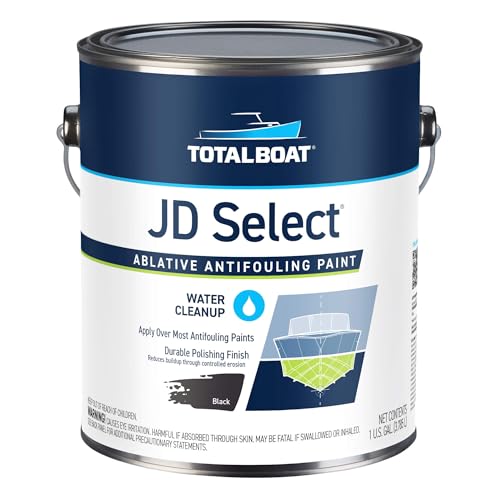
TotalBoat JD Select strikes an impressive balance between cost, performance, and user-friendliness, making it the strongest value proposition in the mid-range tier. This water-based ablative paint uses a unique hybrid film that keeps barnacles, weeds, and slime at bay for a full season while cleaning up with just soap and water. The low-VOC formula produces virtually no toxic fumes, allowing application in marinas and boat yards with strict environmental regulations, and there is no maximum dry time before launching.
DIY owners consistently praise the coverage—a single gallon easily does two coats on a 33-foot boat with a large fin keel, and the flat black finish looks professional when properly applied. The paint dries for recoat in roughly one hour at 52°F, allowing the entire job to be completed in a single afternoon. Performance-wise, users in the Sea of Cortez confirm it holds up well in challenging saltwater conditions, though long-term testing is still ongoing.
The most common complaint involves shipping damage. The paint arrives in a cardboard box with no internal padding, and several users reported leaking cans upon arrival. While the paint itself is excellent for the price, you may want to source it locally if Amazon packaging doesn’t improve. Also, as with all water-based paints, it does not match the raw potency of high-copper solvent-based alternatives in extreme fouling zones.
Why it’s great
- Water-based with low VOCs and easy cleanup
- Hybrid film provides full-season protection
- One gallon covers two coats on a boat up to 33 feet
Good to know
- Shipping packaging is insufficient—cans may leak
- Less potent than high-copper paints in extreme fouling
7. Interlux Bottomkote NT

Interlux Bottomkote NT is the budget-conscious freshwater boater’s secret weapon. This hard, semi-gloss paint is specifically formulated for fiberglass hulls and delivers exceptional longevity in freshwater environments, with one user reporting minimal growth (only about 5% algae and quagga mussels) after three years in the water. The hard paint film does not wear away like ablatives, so you get consistent protection season after season without reapplying annually.
The paint applies easily with a 3/8-inch nap roller, though you must use a cartridge respirator—the solvent smell is strong and a dust mask won’t cut it. Coverage is excellent: a single gallon did two coats on a 27-foot Bayliner with enough paint left for a third coat if needed. The low viscosity means it flows like water, so you must work quickly to avoid drips. Boaters who compared prices found Amazon offered significantly better pricing than West Marine, with secure packaging that included taped lids and clips.
The downsides are limited to its freshwater orientation—this paint is not designed for aggressive saltwater fouling, and its hard nature means you cannot simply pressure-wash away growth without potentially damaging the film. The strong solvent odor also demands proper ventilation and protective gear during application. For freshwater trailered boats and Great Lakes mooring, however, this is an exceptional value.
Why it’s great
- Proven 3-year protection in freshwater
- Excellent coverage—enough for multiple coats on a 27′ boat
- Priced much lower than local marine stores
Good to know
- Strong solvent odor requires cartridge respirator
- Not optimized for saltwater antifouling
8. Pettit Paint Hydrocoat

Pettit Hydrocoat stands out for its exceptional coverage range of 700 to 1,200 square feet per gallon—far more than any other paint on this list. This water-based ablative paint is designed for boaters who want the ease of soap-and-water cleanup without compromising on protection. The formula is multi-season capable, meaning you can haul, pressure-wash, and relaunch without immediately needing a fresh coat, saving both time and money in the long run.
Long-time users on Long Island Sound report years of reliable performance, noting that Hydrocoat keeps the bottom clean even in challenging estuaries with heavy marine growth. The water-based formula is ideal for DIY owners who are nervous about solvent toxicity—a cartridge respirator is still recommended, but the paint won’t overwhelm you with fumes. The paint dries to a glossy finish that cleans up more easily than flat paints if you do pick up growth.
The main concern is inconsistent durability at the waterline. One user who professionally applied two coats over a properly barrier-coated hull found that the paint completely disappeared from the waterline area after just five months in the water. This suggests that Hydrocoat may be less suitable for boats that sit at a fixed waterline rather than being regularly scrubbed. Additionally, it is not algae-proof—users report that some brushing is still required to keep the bottom completely clean.
Why it’s great
- Massive coverage of up to 1,200 sq ft per gallon
- Water-based with simple soap and water cleanup
- Multi-season performance reduces repaint frequency
Good to know
- Waterline area may wear away quickly in some conditions
- Still requires manual brushing to maintain cleanliness
9. Interlux Trilux 33

Interlux Trilux 33 is the perfect solution for outboard motors, trim tabs, and any underwater metal component that requires powerful antifouling without the risk of galvanic corrosion. This non-copper paint uses Biolux technology to block slime and soft growth without damaging aluminum or steel surfaces. The semigloss finish produces a clean, professional appearance on outboard legs and stern drives, and the paint is suitable for fiberglass, wood, steel, and primed aluminum hulls as well.
DIY builders appreciate the visible quality of the paint—one custom boat builder noted that it was immediately apparent that this was a premium product from the moment it was applied. The paint goes on smoothly and provides consistent coverage with a single quart, making it an economical choice for outboard motors and smaller hulls. Users report excellent performance in seawater on outboard gear, with the non-copper formula completely eliminating the black staining that copper paints leave on aluminum surfaces.
The biggest risk with Trilux 33 is shipping damage rather than paint performance. Multiple users reported that the quart can arrived in a plastic bag only—no bubble wrap, no foam, no padding—resulting in dented cans, bent rims, and leaking paint that could not be resealed. If you purchase this paint, you may want to inspect the can immediately upon arrival or source it from a local retailer. Additionally, the quart size is only practical for outdrives and smaller boats; larger hulls will require multiple quarts.
Why it’s great
- Biolux technology blocks slime without copper
- Safe for aluminum outboards and steel components
- Semigloss finish looks professional on visible gear
Good to know
- Shipping packaging is dangerously minimal—may leak
- Quart size limits use to outdrives and small hulls
FAQ
Can I apply bottom paint over old paint on my fiberglass hull?
How long does bottom paint last on a fiberglass boat in saltwater?
Final Thoughts: The Verdict
For most users, the bottom paint for fiberglass boats winner is the Pettit Paint Vivid because its hard, glossy film provides unmatched antifouling protection while keeping visible hull surfaces looking professionally clean for seasons on end. If you want high-copper ablative performance for serious saltwater mooring, grab the TotalBoat Spartan. And for jet skis and airboats that grind through sand and mud, nothing beats the abrasion-defying Fasco Epoxies Super Slick 2000.