
A slow leak turning into a shoulder stop on a busy highway is every driver’s nightmare, yet tens of millions of vehicles on the road today roll without any real-time tire pressure data. An aftermarket tire pressure monitoring system closes that blind spot, giving you live pressure and temperature readings for every wheel without requiring a factory-installed system or a trip to the dealership.
I’m Min — the co-founder and writer behind Gadgets Feed. I’ve spent hundreds of hours analyzing TPMS specifications, cross-referencing pressure accuracy claims, battery life data, and alarm logic across dozens of kits to identify the ones that actually deliver reliable real-world protection.
This guide breaks down the sensors, displays, and alarm features that separate a genuinely useful system from a dashboard ornament. Finding the right aftermarket tire pressure monitoring system means understanding signal range, pressure thresholds, and power options before you buy.
How To Choose The Best Aftermarket Tire Pressure Monitoring System
An aftermarket TPMS bridges the safety gap on vehicles without factory sensors, but the market is flooded with kits that differ dramatically in sensor accuracy, display quality, and alarm reliability. Focusing on a few specific specs separates a system that earns its dashboard space from one that creates more noise than protection.
Pressure Range and Accuracy
Most passenger car kits max out at 87 PSI, while RV and heavy-truck systems push to 144 PSI or higher. A sensor accuracy rating of ±1.5 PSI is the baseline for trustworthy readings — anything wider risks false alerts or missed slow leaks. Confirm the kit’s range matches your vehicle’s tire inflation spec, especially if you tow or run off-road setups with variable pressure requirements.
Alarm Threshold Logic
The best kits offer automatic baseline calibration that sets the reference pressure upon installation, then triggers alarms at factory-defined percentages above and below that baseline — typically +25% for high pressure and -15% for low pressure. Look for systems with at least four distinct alarm modes: high pressure, low pressure, high temperature, and rapid air leakage. Fast-leak detection is the single most valuable feature for highway safety because it catches blowouts before the steering wheel pulls.
Display Power and Readability
A solar-charging display reduces cable clutter and ensures continuous operation, but only if the solar panel is efficient enough to keep the battery topped up even in indirect light. USB-C backup charging is essential for vehicles with tinted windshields or parked in garages. Anti-reflective coating and auto-brightness are not luxuries — direct sunlight washes out cheap LCDs entirely, and a dim display at night can be dangerously distracting.
Quick Comparison
On smaller screens, swipe sideways to see the full table.
| Model | Category | Best For | Key Spec | Amazon |
|---|---|---|---|---|
| Masoll M13+MZS3 | Mid-Range | Set-and-forget daily driving | 0-87 PSI, auto-calibration, solar + USB-C | Amazon |
| Masoll M14+MZS2 | Mid-Range | RV and trailer safety monitoring | 0-87 PSI, 6 alarm modes, solar + USB | Amazon |
| Tymate TM12 | Mid-Range | Multi-axle towing setups | 0-144 PSI, 50ft range, supports 12 sensors | Amazon |
| Tymate TM3 | Mid-Range | Plug-and-play color display | 0-87 PSI, 6 alarm modes, adaptive backlight | Amazon |
| GEARWRENCH GWTPMSR4PK | Premium | Shop-level universal OE replacement | 315/433 MHz dual-frequency, 100% ID cloneable | Amazon |
| Autel MX-Sensor 4-Pack | Premium | Professional-grade programming and cloning | 315/433 MHz, 2-year battery, 11g sensor weight | Amazon |
| Schrader SCHRFK4S | Premium | OE-spec retrofit for classic cars | 433 MHz sensors, 25% under-inflation alert | Amazon |
In‑Depth Reviews
1. Masoll M13+MZS3 Tire Pressure Monitoring System

The Masoll M13 kit earns top billing for its genuinely “set it and forget it” intelligence. After you inflate tires to the correct pressure and install the pre-paired external sensors, the system automatically adopts that value as the reference baseline. The alarm triggers at 15% below and 25% above that reference, which means zero manual threshold configuration — a major advantage for anyone who does not want to dig into a menu at every tire rotation.
The solar-charging display uses a high-efficiency panel paired with overheat and overcharge protection, and several real-world users reported no USB charging required in four months of daily use. The LCD includes anti-reflective treatment and auto-brightness, though some reviewers noted the screen washes out slightly in direct summer sun until the cabin cools. Pressure readings consistently matched within 1 PSI of a digital gauge across multiple verified reviews.
Sensor battery life is rated at two years with replaceable CR1632 cells, and the IP67 waterproof rating ensures they survive puddles and pressure washes. The 0–87 PSI range covers passenger cars, SUVs, and pickup trucks, but trailers longer than 38 feet will need Masoll’s optional signal booster. For a single-vehicle daily driver or a tow rig under that length, this kit delivers the most balanced package of accuracy, automation, and power management.
Why it’s great
- True plug-and-play auto-calibration, no manual alarm setup
- Solar panel keeps display charged for months without cable intervention
- Readings within 1 PSI of reference gauge
Good to know
- Screen visibility drops in strong direct sunlight
- Trailers beyond 38 ft require a separate signal booster
- Sensor battery replacement requires CR1632 cells, not coin-cell common
2. Masoll M14+MZS2 RV Tire Pressure Monitoring System

The Masoll M14 builds on the same automatic baseline logic as the M13 but adds a dedicated RV focus with six distinct alarm modes: high pressure, low pressure, high temperature, fast leakage, sensor low voltage, and sensor signal loss. Fast-leak detection is the standout here — one verified review reported the system alerted to a right rear trailer tire losing air at highway speed around the 3,000-mile mark, likely preventing a blowout and rim damage.
Installation still takes roughly five minutes because the four sensors arrive pre-programmed to their labeled positions. The display offers selectable PSI/Bar and Celsius/Fahrenheit units, plus auto sleep/wake triggered by vibration so the unit does not drain the battery when parked. Users on 21-foot toy haulers and 38-foot travel trailers confirmed reliable signal reception without a booster, though the manufacturer recommends one for longer rigs.
The solar panel keeps the monitor charged in most conditions, and a USB cable provides a backup when sunlight is insufficient. A minor complaint from several owners is that the display appears washed out in extreme heat until the vehicle’s air conditioning cools the cabin, and the plastic housing feels noticeably less dense than premium alternatives. For the price, however, the combination of six-alarm coverage and trailer-tailored range makes this a strong mid-range pick for RV owners.
Why it’s great
- Six-alarm coverage catches fast leaks before tire damage occurs
- Pre-programmed sensors install in under five minutes
- Vibration-activated sleep mode preserves display battery during storage
Good to know
- Display legibility suffers in high cabin temperatures
- Plastic build feels less robust than premium kits
- Booster recommended for trailers exceeding 38 feet
3. Tymate TM12 RV Tire Pressure Monitoring System
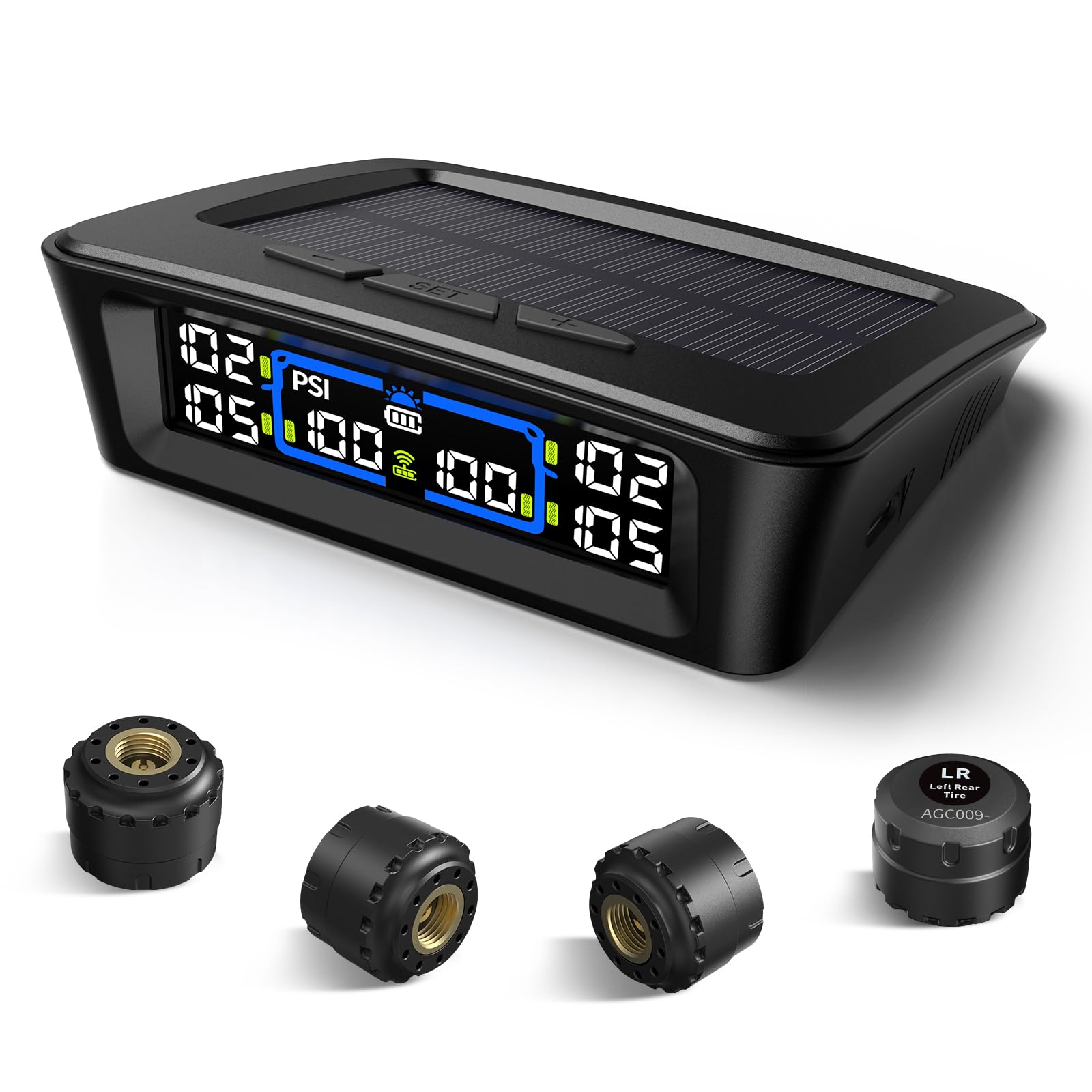
The Tymate TM12 is the only kit in this roundup that pushes to 144 PSI, making it the obvious choice for heavy trucks, large RVs, and any application where tire pressures exceed standard passenger-car limits. The system supports up to 12 sensors across four zones: vehicle front, vehicle rear, trailer front, and trailer spare. The display cycles through readings in split-screen mode so you can see six tires at once without toggling manually.
Signal range is rated at a reliable 50 feet, extendable to over 100 feet with Tymate’s optional repeater, which matters when towing a long trailer where the rear axle sits far behind the cab. Six alarm modes mirror the Masoll M14 setup, and the auto-calibration works identically — install at reference pressure, and alerts trigger at +25% / -15%. Verified users on F250s towing 24-foot trailers reported no signal dropouts even without the repeater.
The display charges via USB-C or solar, though the solar output is lower than some competitors, and the manual advises full USB-C charging before first use. A notable flaw reported by multiple buyers is the inability to turn the display off manually — it only sleeps automatically, which can be frustrating if you want to silence it in a parked RV. One reviewer measured a 10 PSI discrepancy compared to a separate gauge, though most found the accuracy acceptable. Overall, the TM12’s pressure ceiling and multi-zone architecture justify its mid-range price for heavy-towing users.
Why it’s great
- 144 PSI maximum covers heavy trucks, RVs, and high-pressure trailer tires
- Four-zone display handles up to 12 sensors for complex towing setups
- 50-foot range works for most tow vehicles without a repeater
Good to know
- Display cannot be manually switched off in parked mode
- Solar charging efficiency is lower than dedicated solar-focused kits
- Occasional pressure accuracy inconsistency reported
4. Tymate TM3 RV Tire Pressure Monitoring System
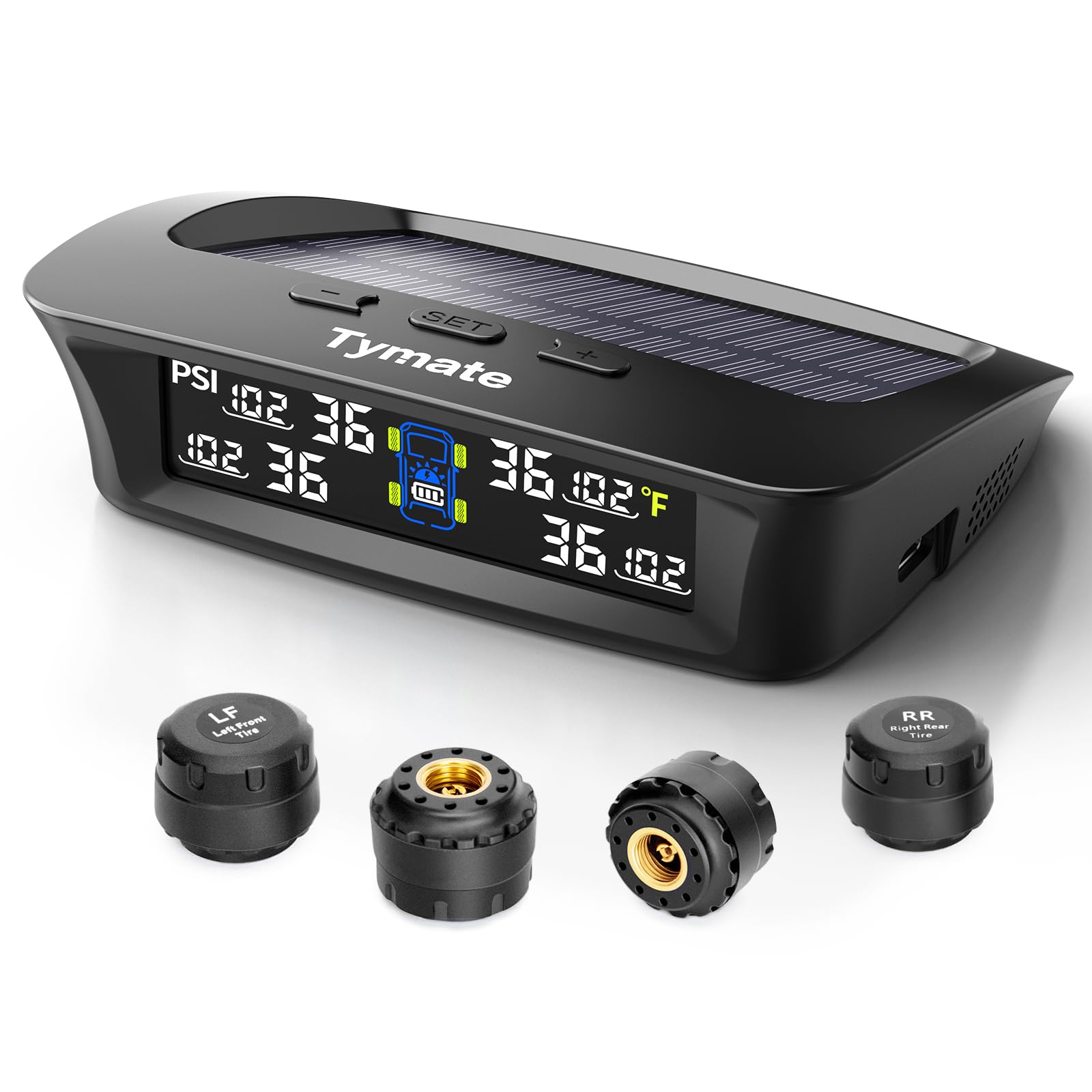
The Tymate TM3 sits as the budget-friendly entry in the Tymate lineup, but it does not skimp on the alarm feature set. It offers the same six alarm modes as the TM12 — high/low pressure, high temperature, rapid leak, sensor low battery, and signal loss — plus the automatic baseline calibration that eliminates manual threshold entry. The updated color LCD display is noticeably brighter and more saturated than previous-gen Tymate screens, with an adaptive backlight that adjusts for night driving without blinding glare.
Sensor accuracy is rated at ±3 PSI, which is slightly wider than the ±1.5 PSI offered by Masoll competitors, but real-world reviews on u-haul trailers and mid-size RVs reported no false alarms and consistent tracking. The IP67 waterproof external sensors use CR1632 batteries with a claimed two-year lifespan, and they arrived pre-paired to the monitor — attach each sensor to the labeled wheel and data appears within minutes of starting the vehicle.
Charging options include solar automatic charging plus USB-C and cigarette lighter ports, though the cigarette lighter adapter is not included. One minor annoyance across multiple reviews: the display requires manual power-off when parked because the auto-sleep function is inconsistent. The 0–87 PSI range limits use to passenger vehicles and light trailers, and Tymate recommends a repeater for trailers over 36 feet. For casual towers and daily commuters who want a readable color display without overpaying, the TM3 offers the best spec-to-dollar ratio in this list.
Why it’s great
- Bright color LCD with adaptive backlight, excellent daylight visibility
- Full six-alarm system with auto-calibration rivals pricier competitors
- Triple charging options: solar, USB-C, and 12V cigarette lighter
Good to know
- Pressure accuracy of ±3 PSI is wider than Masoll’s ±1.5 PSI
- Cigarette lighter adapter not included
- Auto-sleep function inconsistent, requires manual shutoff
5. GEARWRENCH GWTPMSR4PK Universal Programmable TPMS Sensor 4-Pack
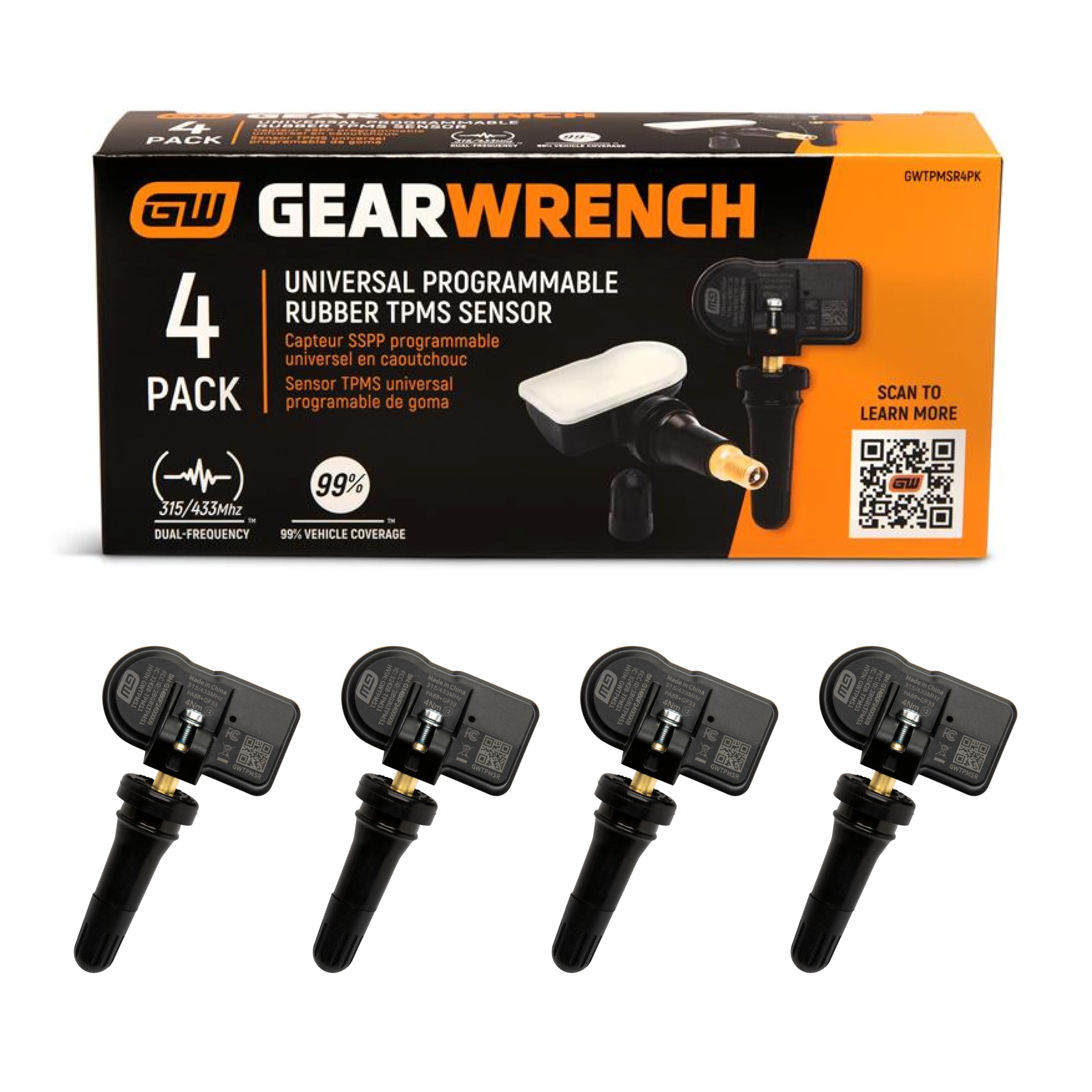
The GEARWRENCH GWTPMSR4PK is a different breed — it is a universal OE-replacement sensor kit, not a full display-and-sensor bundle. These sensors are designed for shops or DIY owners who already have a TPMS programming and diagnostic tool. Each sensor operates at both 315 MHz and 433 MHz frequencies in a single unit, covering 99% of global vehicles. The 100% ID cloning capability means you can replicate the original sensor ID from the factory unit, eliminating the need for a vehicle relearn procedure after installation.
Build quality is anchored by rubber snap-in stems that are lighter and easier to install than metal-stem alternatives, though rubber is inherently less durable over decade-long periods. The sensors provide OE-level precision for pressure, temperature, and battery readings, and they pair seamlessly with GEARWRENCH’s own programming tools. Verified users reported zero warning lights or signal dropouts on secondary wheel sets for track days and winter tires.
A practical consideration: many tire shops refuse to install customer-supplied parts, so factor in whether you have the tools and willingness to program and install these yourself. The 4-pack price is competitive with single-brand OE sensors, but you need the programming hardware upfront. For fleet managers, serious DIYers, or anyone maintaining multiple vehicles, the dual-frequency cloning flexibility makes this the most versatile sensor-only solution available.
Why it’s great
- Single sensor covers both 315 MHz and 433 MHz frequencies
- 100% ID cloning avoids dealer-level relearn procedures
- OE-level accuracy with lighter rubber snap-in stems
Good to know
- Requires a separate programming tool, not standalone
- Rubber stems have shorter lifespan than metal alternatives
- Many shops will not install customer-supplied parts
6. Autel MX-Sensor Set of 4 (TPS218)
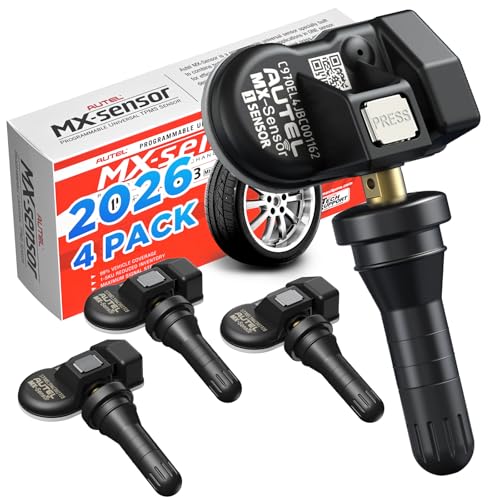
The Autel MX-Sensor is the de facto standard in professional TPMS service. Like the GEARWRENCH set, these are universal sensors that require an Autel programming tool — the TS408S, TS508WF, ITS600, or compatible diagnostic scanner — but they offer unlimited reprogramming cycles so no sensor ever becomes e-waste after a single use. The dual-frequency 315/433 MHz design covers 99% of direct-TPMS vehicles from American, Asian, and European manufacturers.
At only 11 grams per sensor, the MX-Sensor is lighter than almost any competitor, which reduces the mass on the tire valve and minimizes centrifugal balance effects. The press-in design with interchangeable rubber and metal valve stems allows a single SKU to replace hundreds of OEM part numbers. Autel claims a 24-month or 24,000-mile warranty and SAE J1205/J1206 certification, supported by verified reviews showing flawless operation on Subaru WRX, BMW 645Ci, and Ford F250 platforms over multiple years.
The catch is ecosystem lock-in — these sensors can only be programmed by Autel TPMS tools, not by generic scan tools. If you already own or plan to buy an Autel tool, this is the most flexible and future-proof sensor investment. The 100% cloning feature allows ID duplication so vehicles that require relearn procedures can skip that step entirely. For shops and serious DIYers who want one sensor to rule them all, the MX-Sensor remains the benchmark.
Why it’s great
- Unlimited reprogramming eliminates sensor waste between vehicles
- 11g weight minimizes valve-stem stress and balance issues
- Press-in design with dual stem types replaces hundreds of OEM SKUs
Good to know
- Locks into Autel programming tool ecosystem only
- Requires a separate TPMS tool; not a plug-and-play retrofit kit
- Not compatible with 12V/24V commercial vehicles or Bluetooth-based TPMS
7. Schrader SCHRFK4S TPMS Retrofit Kit
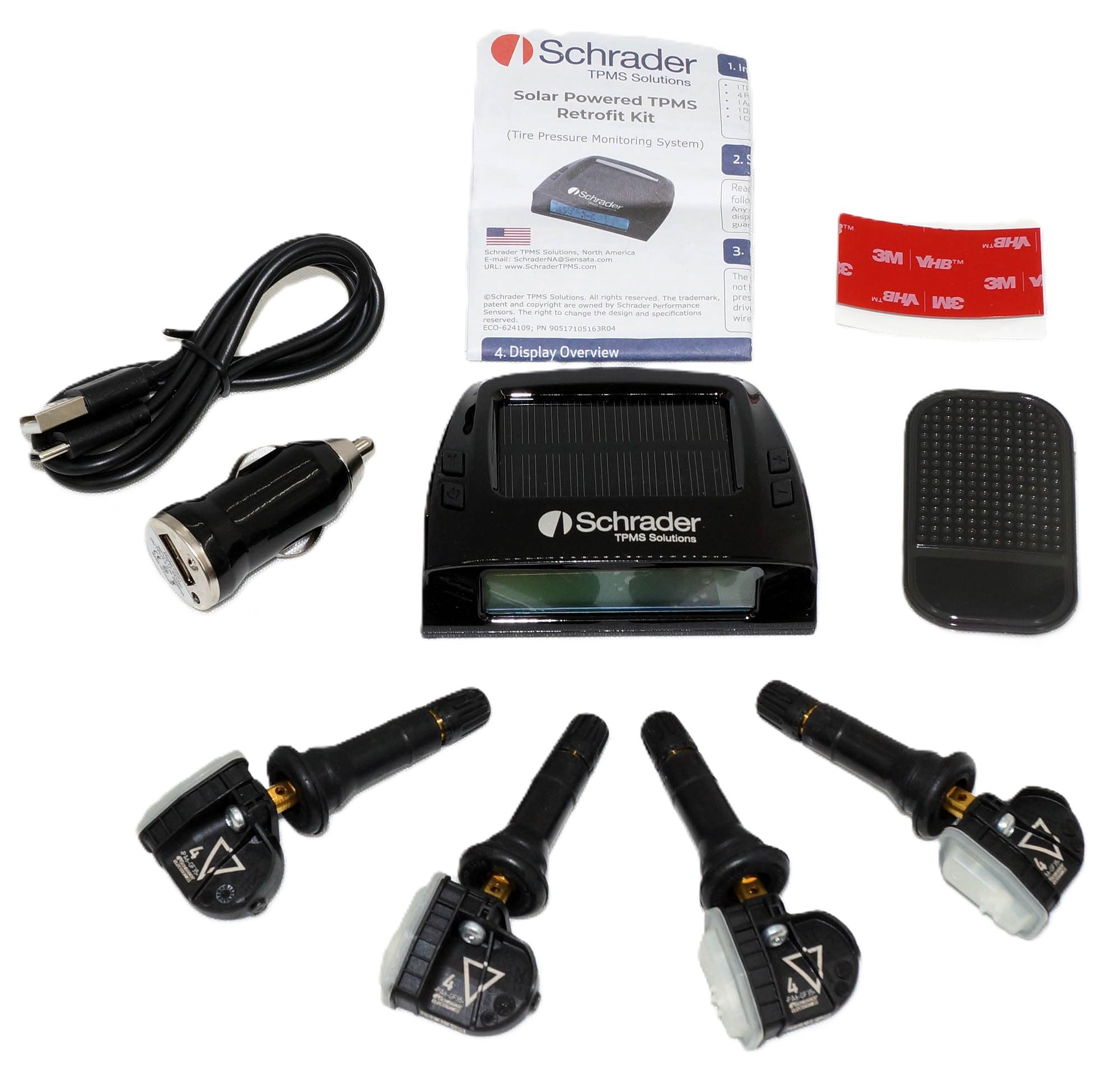
Schrader is the original equipment supplier for many automakers, and the SCHRFK4S retrofit kit brings that factory-grade engineering to pre-2008 vehicles and classic cars that left the assembly line without TPMS. The kit uses 433 MHz external sensors that are functionally identical to those found on GM trucks and SUVs, and they are lightweight enough not to affect wheel balance. The display unit supports both solar and USB charging, showing pressure and temperature for all four tires plus an optional spare sensor (sold separately as part 29086).
Installation is straightforward: mount the sensors on the valve stems, place the display on the dash, and drive. No wiring, no programming, no pairing — the sensors communicate automatically with the receiver. Verified owners reported successful operation on a 2000 Jeep Grand Cherokee, a 2009 Crown Victoria, and even an 18-foot car trailer where the range comfortably covered the rear axle distance. The alarm triggers at 25% below the reference pressure, which is the industry standard for under-inflation warnings.
The display’s brightness is a common criticism — it is functional but not vivid, and several users wished it were available in a 52mm round gauge form factor for vintage dashboard integration. Battery life on the display unit has been reported as exceeding three years with normal use, and the sensor batteries (102535 cell) are user-replaceable. This kit does not include fast-leak detection or high-temperature alarms, so it is less feature-rich than the modern Chinese-manufactured competitors, but the brand reliability and OE pedigree make it the first choice for collectors who prioritize longevity over flash.
Why it’s great
- OE-quality 433 MHz sensors identical to factory GM TPMS
- True plug-and-play: no programming or pairing required
- Proven display battery life exceeding three years in real use
Good to know
- No fast-leak or high-temperature alarm modes
- Display brightness is dim compared to modern color LCD units
- Spare tire sensor sold separately
FAQ
How do external TPMS sensors stay attached without leaking air?
Can I use a TPMS designed for 87 PSI on a truck that runs 100 PSI in the rear?
Why does my TPMS display show a higher pressure after driving for 30 minutes?
Do I need a signal repeater for a long RV or fifth-wheel trailer?
What is the difference between 315 MHz and 433 MHz sensors?
Final Thoughts: The Verdict
For most users, the aftermarket tire pressure monitoring system winner is the Masoll M13+MZS3 because it combines intelligent auto-calibration, reliable solar charging, and pressure accuracy within 1 PSI at a price that undercuts nearly every competitor with similar features. If you tow regularly and need a higher 144 PSI ceiling and multi-zone support, grab the Tymate TM12. For collectors restoring classic cars who demand OE-level reliability without feature bloat, nothing beats the Schrader SCHRFK4S.