
Keeping corals and demanding plants alive in a reef tank comes down to one thing: delivering the right amount of photosynthetically active radiation (PAR). Without a dedicated meter, you are essentially blind to whether your light fixture is too weak, too strong, or unevenly distributed across the aquascape. A precise tool removes the guesswork and replaces it with data you can act on immediately.
I’m Min — the co-founder and writer behind Gadgets Feed. After analyzing sensor specifications, user calibration methods, and real-world accuracy comparisons across dozens of aquarium PAR measurement devices, I’ve broken down exactly how to match the right meter to your reef tank setup.
Whether you are dialing in a new LED array or mapping PAR zones for SPS placement, this guide to finding the best aquarium par meter will help you invest in the right tool for your corals.
How To Choose The Best Aquarium PAR Meter
Not all PAR meters are built for the wet, corrosive environment of a saltwater aquarium. The key differentiators are waterproofing, sensor accuracy, and data logging depth. Before you pick one, understand the three factors that matter most.
Waterproof Rating and Build Quality
The sensor head must survive being submerged in saltwater repeatedly. Look for an IP68 rating on the sensor itself, which guarantees protection against continuous immersion. A plastic housing that rusts after a few uses defeats the purpose of measuring underwater PAR.
Sensor Accuracy and Spectral Range
A high-quality quantum sensor should measure within the 400–700 nm range with minimal drift. Cheaper meters may use a broader or narrower band, or rely on a lux conversion that is inaccurate under modern LED fixtures. Check whether the meter uses a dedicated PAR sensor or a filtered lux sensor.
Data Logging and Mounting Accessories
Mapping PAR across multiple points in your tank requires saving dozens of readings. A meter that logs 100+ points and includes a telescopic pole or tripod mount makes the job practical. Without long cables and a stable mount, you will struggle to reach the bottom corners of a deep reef.
Quick Comparison
On smaller screens, swipe sideways to see the full table.
| Model | Category | Best For | Key Spec | Amazon |
|---|---|---|---|---|
| DANOPLUS KIB0414 | Mid-Range | Budget-friendly reef mapping | IP68 sensor + telescopic pole | Amazon |
| DANOPLUS DP-380 | Mid-Range | Indoor grow light measurement | Two cables (4.9ft + 12ft) | Amazon |
| VidalKraft VK131 | Mid-Range | Integrated DLI tracking | DLI function + 100 readings | Amazon |
| VBR-Aqua IP68 | Mid-Range | RGB spectrum breakdown | Separate R/G/B PAR display | Amazon |
| VBR-200 | Premium | Automated PAR dimmer control | Dimmer + environmental sensors | Amazon |
| PHOTOBIO LGBQM2 | Premium | Horticultural reliability | 99 readings + protective case | Amazon |
| De-Power AH-Aquarium | Premium | Advanced full-spectrum + UVA | 320–750nm + UVA sensor | Amazon |
| Apogee DLI-500 | Premium | Research-grade DLI logging | 99-day DLI + USB-C | Amazon |
| Apogee MQ-500 | Premium | Laboratory-standard accuracy | Waterproof aluminum sensor | Amazon |
In‑Depth Reviews
1. DANOPLUS KIB0414 Waterproof PAR Meter

The DANOPLUS KIB0414 combines an IP68 waterproof quantum sensor with a solid telescopic pole, making it one of the most practical reef-ready meters available. The sensor sits on a 79-inch cable, allowing you to reach deep into a display tank without wetting the main unit. Measurement range tops out at 4000 μmol/m²/sec, covering everything from low-light soft corals to high-intensity SPS zones.
Users report readings within 20–30 μmol of an Apogee reference, which is solid for a mid-range meter. The internal memory stores 100 readings, so you can map out your entire aquascape in one session. Calibration requires a simple multiplication factor to match Apogee numbers, but many hobbyists confirm the relative consistency is good enough for coral placement decisions.
A few buyers noted that the metal parts on the pole can rust in saltwater if not rinsed thoroughly after each use. The rubber O-ring on the pole joint also needs periodic inspection to avoid leaking. For the price, this is the most accessible entry point into real PAR measurement for reef tanks.
Why it’s great
- IP68 sensor withstands full submersion
- Record 100 readings for tank-wide mapping
- Low-cost alternative to research-grade meters
Good to know
- Pole may rust if not rinsed after saltwater use
- Requires multiplication factor to match Apogee
2. DANOPLUS DP-380 PAR Meter

The DANOPLUS DP-380 includes both a 4.9-foot coiled cable and a 12-foot straight cable, giving you flexibility to measure canopy tops, deep corners, or hanging fixtures without repositioning the main display. The sensor operates within the standard 400–700 nm range and reads up to 4000 μmol/m²/sec. Users who bought this for indoor aquariums found the long cable especially useful for tall planted tanks.
Data logging holds 100 groups, which is enough for a full lighting audit. The sensor has a 1/4-inch tripod screw mount, so you can attach it to a camera stand for stable readings over long monitoring periods.
On the downside, the display screen brightness was criticized by several users who found it hard to read under direct grow lights. The plastic housing also feels lightweight, which can make the meter feel less substantial than premium alternatives. It is still a durable performer for the price.
Why it’s great
- 12-foot cable reaches hard-to-access spots
- 1/4-inch tripod mount for stable measurements
- 100-group data logging
Good to know
- Screen is dim under bright lights
- Lightweight plastic body feels less premium
3. VidalKraft VK131 Quantum PAR Meter

The VidalKraft VK131 stands out because it calculates Daily Light Integral (DLI) directly, saving you the extra math. DLI represents the total photosynthetic photons hitting the coral over 24 hours, expressed in mol/m²/d. This is a more actionable number than a single PPFD spot reading for reef keepers who run photoperiods longer than 8 hours.
The meter comes with two cables — a 5-foot coiled cable for quick checks and a 12-foot straight cable for hard-to-reach areas. The sensor covers 400–700 nm with ±10 nm tolerance, which is typical for this price tier. Users found the DLI setup straightforward, requiring only the desired photoperiod to be entered.
Build quality is the primary weakness: the casing is made of thin, lightweight plastic that feels fragile compared to more rugged meters. A few buyers mentioned that the unit feels like a toy despite the surprisingly good DLI feature. It works well for indoor planted tanks but may not survive rough handling.
Why it’s great
- Built-in DLI calculation for photoperiod management
- Two cable lengths included
- Large display with simple menu
Good to know
- Plastic casing feels cheap
- Not IP-rated for submerged use
4. VBR-Aqua IP68 PAR Meter

The VBR-Aqua is specifically engineered for reef tanks, featuring a waterproof IP68 sensor and a 3-foot telescopic rod. Its standout trick is displaying the PAR contribution of red, green, and blue channels separately. Since blue light drives coral growth and coloration, knowing the blue PAR value helps optimize spectrum tuning for SPS and LPS corals.
Users report readings within single digits of a Apogee across multiple tank types, which is remarkable for the price. It logs 400 data points and tracks DLI for up to 28 days, giving you extensive historical data. The unit runs for about 100 hours on three AAA batteries, or you can plug in an adapter for continuous monitoring.
There is a consistent complaint about the telescopic rod O-ring letting water leak into the pole, causing buildup inside. Some users zip-tied the sensor cable to the outside of the pole to bypass the issue. Other than that, the accuracy and feature set make this a strong contender for the serious reefer on a budget.
Why it’s great
- Separate R/G/B PAR channel reading
- 400-point data logging + 28-day DLI
- Accuracy close to Apogee at fraction of cost
Good to know
- Telescopic rod O-ring may leak
- Ripples in water can cause reading fluctuations
5. VBR-200 PAR Meter with Light Dimmer Control
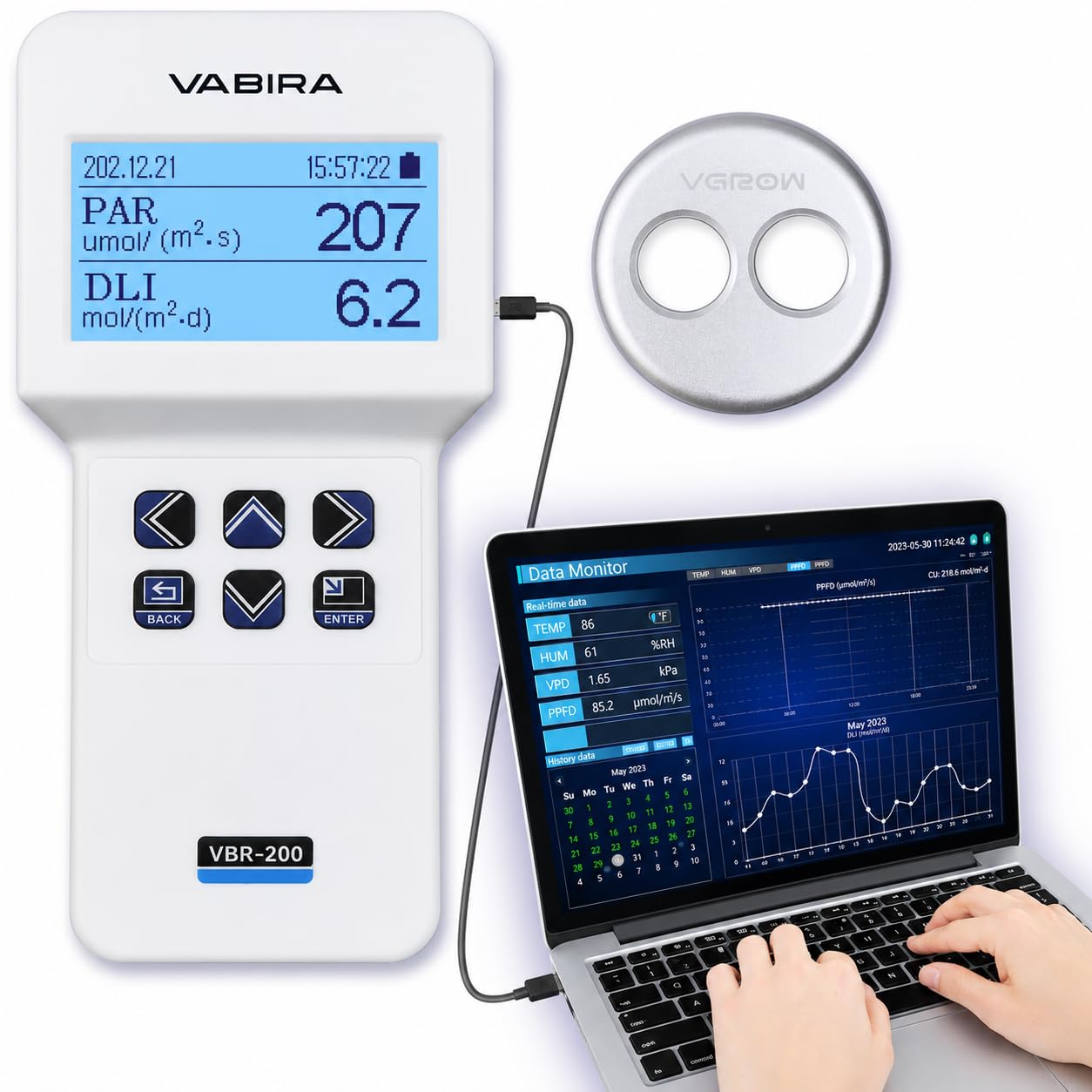
The VBR-200 is a complete environmental controller disguised as a PAR meter. It measures PPFD, DLI, VPD, temperature, humidity, LUX, and CCT, but the killer feature is the built-in light dimmer control. It reads real-time PAR and automatically adjusts a connected grow light to maintain a target level, compensating for changing sunlight in greenhouses or supplemental lighting scenarios.
For reef aquarium use, the auto-dimmer is less applicable, but the all-in-one sensor array makes it a powerful tool for managing light and environment in a single interface. The sensor is durable and users report accuracy that matches more expensive meters when compared side by side. Data can be exported to a Windows PC for historical analysis.
A potential issue is that the PAR calculation may rely on a combination of lux and color temperature rather than a dedicated quantum sensor. Some buyers question absolute accuracy, but relative consistency is high. The extra features justify the price for those who need environmental logging beyond just PAR.
Why it’s great
- Automated light dimmer maintains target PAR
- Measures LUX, CCT, VPD, temp, and humidity
- Historical data export via PC software
Good to know
- May use sensor fusion instead of quantum sensor
- Auto dimmer not designed for submersed operation
6. PHOTOBIO LGBQM2 Advanced Quantum Sensor PAR Meter

PHOTOBIO’s LGBQM2 is a compact, reliable PAR meter built for horticulture but equally capable in aquarium lighting audits. It includes a remote quantum sensor, a short coiled cable, and a 12-foot straight cable, plus a hard protective carrying case. The unit stores up to 99 readings and shows instant PPFD values on a clear display.
Customers consistently praise the fast stabilization time — it locks onto a reading within seconds, which speeds up mapping large tanks. The sensor is compatible with all modern LED fixtures, metal halide, and HPS, so it works across mixed lighting setups. The protective case keeps the sensor and cables organized during transport.
The main limitation for reef keepers is that the sensor is not fully waterproof. It can handle incidental splashes but cannot be fully submerged for direct underwater measurement. It also lacks separate RGB channel breakdown or DLI calculation, making it less specialized than aquarium-focused meters.
Why it’s great
- Fast stabilization — reads in seconds
- Rugged protective case included
- Broad compatibility with all grow light types
Good to know
- Sensor is not submersible
- No DLI or RGB channel data
7. De-Power AH-Aquarium PAR Meter (320–750nm)
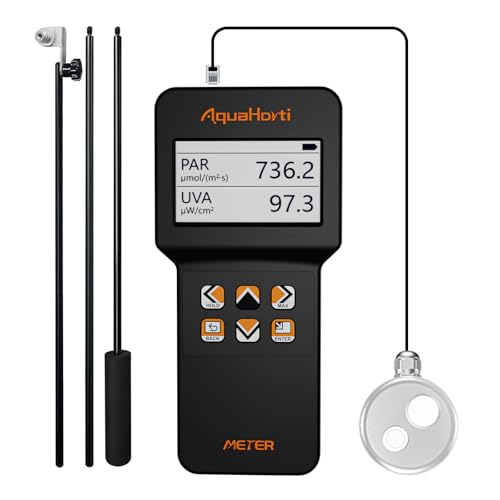
The De-Power AH-Aquarium extends spectral coverage beyond standard PAR meters by measuring 320–750 nm, including UVA (320–400 nm). It uses a Japanese PAR sensor IC inside a waterproof housing. The display shows PAR and UVA irradiation intensity separately, plus a dedicated blue channel readout for LED aquarium lights, which is critical for understanding coral photosynthesis.
This meter records 99 PAR and UVA data points, which is sufficient for drawing a distribution map of your tank. It comes with a 3-foot telescopic rod designed for underwater use. Users found the reading accuracy consistent and appreciated the UVA feature for monitoring potential overexposure that can stress reef organisms.
The price has increased significantly since launch, and some buyers feel the jump reduces the value proposition. The meter also needs stable water conditions with minimal flow for accurate readings. The UVA reading requires ambient temperature above 25°C for best accuracy, which is typical for reef tanks anyway.
Why it’s great
- Full-spectrum 320–750nm including UVA
- Japanese PAR sensor chip for accuracy
- Blue channel PAR display for coral tuning
Good to know
- Price has increased considerably
- Requires stable water and warm temperature for UVA
8. Apogee Instruments DLI-500

The Apogee DLI-500 is the gold standard for DLI measurement, designed and refined by Dr. Bruce Bugbee. It measures PAR (PPFD), DLI, and photoperiod from 400–700 nm with research-grade accuracy. The unit logs DLI data for up to 99 days in 0.2-hour increments, which is essential for reef keepers who want to correlate coral growth with cumulative light exposure over months.
The sensor is IP65-rated, making it water-resistant but not fully submersible. It can be placed on any surface or mounted with standard camera equipment. Data downloads via USB-C, and the included protective case, soil stake, and batteries make it ready to deploy immediately. Apogee supports the meter with a four-year warranty and US-based customer service.
A notable quirk is that the battery cover can be difficult to fit, causing frustration for some users. The meter also costs significantly more than most competitors, placing it in the premium tier reserved for serious hobbyists or commercial setups. If absolute precision is required, this is the meter to choose.
Why it’s great
- 99-day DLI logging in 0.2-hour increments
- Designed by Dr. Bruce Bugbee — top-tier accuracy
- USB-C data download + four-year warranty
Good to know
- Battery cover can be difficult to install
- Premium price — not for casual hobbyists
9. Apogee Instruments MQ-500

The Apogee MQ-500 Full-Spectrum Quantum PAR Meter is the benchmark that other meters are measured against. Its sensor head is machined from aluminum and fully potted, making it completely waterproof and rugged enough for years of submerged reef tank use. The tangle-free cable allows you to move freely across the tank while viewing the high-contrast display.
Scientists and serious hobbyists prefer the MQ-500 because its readings do not drift over time — a problem that can affect budget meters by over 50%. It handles instantaneous spot checks and logging mode for extended monitoring. The four-year warranty and US-based support provide confidence for a long-term investment.
The biggest barrier is cost — it is the most expensive option on this list. Some users also report that the battery cover can be difficult to secure, and the included case is a soft pouch rather than a hard shell. For the reef keeper who demands laboratory-grade accuracy and plans to keep using the same meter for years, the MQ-500 remains the ultimate choice.
Why it’s great
- Waterproof aluminum sensor — no drift over time
- Preferred by scientists for accuracy
- Four-year warranty and US support
Good to know
- Highest price on the market
- Soft case instead of hard protective case
FAQ
What is the difference between an aquarium PAR meter and a lux meter?
Can I use a PAR meter designed for hydroponics in a saltwater aquarium?
How much PAR does a typical SPS coral need?
Final Thoughts: The Verdict
For most users, the best aquarium par meter winner is the DANOPLUS KIB0414 because it delivers IP68 waterproofing, a 37-inch telescopic pole, and 100-point data logging at a price that doesn’t break the bank. If you want separate RGB channel readings for advanced coral tuning, grab the VBR-Aqua. And for research-grade accuracy that will never drift, nothing beats the Apogee MQ-500.