
That phone flopping against your hip with every stride isn’t just annoying—it throws off your cadence and can lead to chafing that sidelines you for days. A running belt should disappear from your awareness the moment you start moving, not demand constant adjustment every half-mile.
I’m Min — the co-founder and writer behind Gadgets Feed. I’ve spent hundreds of hours analyzing runner feedback and comparing belt designs to identify which adjustments, pocket layouts, and materials actually deliver a bounce-free, forget-it’s-there fit.
Whether you’re training for a marathon or just want to carry your phone on a daily jog, finding the right best adjustable running belt is about matching your specific carry needs to a belt that stays put without irritating your skin.
How To Choose The Best Adjustable Running Belt
An adjustable running belt lives or dies on three things: how snugly it conforms to your waist, how much it moves during a run, and whether the pocket layout actually fits what you need to carry. A belt that ticks all three boxes will feel invisible; one that misses any will have you reaching to adjust it every few minutes.
Waist Fit and Strap Adjustability
Look for a belt that covers your waist range with room to spare on both ends—if your measurement is right at the upper or lower limit of the stated range, the belt will either be too tight or too loose. Elastic belts with no sliding adjustment tend to stay put better than webbed straps, but if you need a precise custom fit, a buckle or toggle system gives you more control.
Pocket Capacity and Expansion
The pocket must expand to hold your phone without creating a visible bulge that pulls the belt down. A pocket that lies completely flat when empty but stretches to 2 inches deep can handle a modern flagship phone plus a key fob. If you carry gels or a soft flask, look for dedicated loops or compression straps to distribute the weight evenly around your waist.
Material and Moisture Management
Neoprene and nylon blends resist sweat absorption and dry quickly, preventing the belt from becoming heavy and sagging during long runs. A moisture-wicking inner layer against the skin reduces chafing, while a water-resistant outer fabric protects your phone from rain or splashes.
Quick Comparison
On smaller screens, swipe sideways to see the full table.
| Model | Category | Best For | Key Spec | Amazon |
|---|---|---|---|---|
| Fitletic Hydra 16 | Hydration | Long runs with two 8oz bottles | 2 x 8oz BPA-free bottles, 8×4 inch pocket | Amazon |
| Fitletic Ultimate II | Race-Ready | Marathon training and race day | 2 gel loops, integrated bib toggles | Amazon |
| SPIbelt Performance | All-Around | Daily runs with phone and gels | 9 x 4 x 2 inch expandable pocket, 4 gel loops | Amazon |
| Salomon Pulse Belt | Ultra-Light | Minimalist trail runs | 0.79L volume, 62 grams weight | Amazon |
| WATERFLY Waist Pack | Multi-Pocket | Travel and everyday carry | 7 pockets, 39-inch strap, 9.88 oz | Amazon |
| Simptech Sling Bag | Versatile | Crossbody/waist switching | 25-inch strap, 3 pockets, water-resistant nylon | Amazon |
| SPIbelt Diabetic | Medical | Carrying insulin pump and supplies | 6.5 x 3 x 2 inch pocket, tubing pass-through hole | Amazon |
In‑Depth Reviews
1. Fitletic Hydration Running Belt with Water Bottles for Men & Women – Hydra 16

The Hydra 16 is the belt you reach for on long runs when you need hydration without carrying a handheld bottle. Two quick-flow 8oz BPA-free bottles sit in hip holsters that the manufacturer’s patented design keeps from bouncing—and real runners confirm that claim with thousands of five-star reviews. The main pocket measures 8 x 4 inches and includes an inner organizer for cards and ID, while two external gel loops and integrated race bib toggles make it race-day ready straight out of the package.
The belt is made from a blend of polyester, nylon, and spandex with a neoprene-like feel that conforms to your waist without digging in. The buckle closure stays locked during movement, and the reflective accents add visibility for early morning or evening runs. At 0.3 kilograms fully loaded, the weight distributes evenly enough that you won’t notice it after the first mile.
Some users note that the gel loops are too narrow for thicker gels like SiS or Maurten, and the initial chemical smell from the neoprene can take a wash or two to fade. But for the runner who wants one belt that handles everything from six-mile training runs to full marathon distance with hydration built in, this is the comprehensive package.
Why it’s great
- Two 8oz bottles stay secure with no bounce
- Pocket fits large phones including Samsung S23 Ultra with OtterBox case
- Integrated race bib toggles and reflective details
Good to know
- Gel loops are too small for thicker non-GU gels
- May have a strong plastic smell out of the box
2. SPIbelt Performance Running Belt for Adults

The SPIbelt Performance is the gold standard for runners who want a low-profile belt that expands to swallow a phone, passport, keys, and four energy gels without looking bulky. The pocket expands to 9 x 4 x 2 inches when loaded but lies completely flat when empty, and the 1-inch wide soft elastic belt fits waists from 28 to 44 inches with no sliding buckle to dig into your stomach. The four external gel loops give you race-day fuel access without unzipping anything.
The nylon/spandex material is water-resistant enough to survive a light rain or a sweat-soaked run, and the no-bounce claim holds up even with a large phone and a set of keys in the pocket. At just 0.06 kilograms, the belt is light enough to forget you’re wearing it, and the zipper closure is smooth and reliable across hundreds of miles. The company’s reputation—woman-owned, designed in the USA by runners—adds confidence beyond the spec sheet.
Some users report that the inner moisture liner can degrade after a month of heavy use, and the zipper is loud enough to hear during quiet morning runs. If you carry a smaller phone or want a more minimalist setup, the standard SPIbelt might be a better fit, but the Performance version gives you the max carrying capacity in the most discreet package.
Why it’s great
- Generous 9-inch pocket holds even Pro Max sized phones
- Four gel loops for easy race-day fueling
- One-inch elastic belt prevents chafing and stays put
Good to know
- Inner moisture liner can wear out over time
- Zipper is somewhat loud when opening and closing
3. Fitletic Ultimate II Running Pouch with Gels

The Ultimate II strips away hydration to focus on the core runners’ essentials: phone, keys, gels, and a race bib. The main compartment fits an iPhone 16 Pro Max with enough room for a thin case, while the neoprene construction resists sweat absorption and keeps the pocket from sagging. Two external gel loops hold standard GU-sized gels, and the integrated race bib toggles let you pin your number directly onto the belt without safety pins poking through.
The elastic belt is wide enough to distribute pressure across your lower back without digging in, and reflected tabs improve visibility in low light. At a mid-range price point that undercuts many hydration belts, you get the same build quality as the Hydra 16 without paying for bottles you may not need. Runners who carry an insulin pump have also repurposed the hidden pockets for medical supplies, noting that the belt stays comfortable even during all-day wear.
The pocket space is tight: if you carry a large phone plus a wallet and keys, the fit is snug, and the gel loops are a tight squeeze for thicker gels. But for the runner who wants a dedicated race-day belt that doesn’t compromise on fit or features, the Ultimate II delivers disproportionate value for its price tier.
Why it’s great
- Fits large phones like iPhone 16 Pro Max
- Gel loops and race bib toggles included
- Neoprene resists sweat damage over months
Good to know
- Pocket space is limited for multiple items
- Gel loops are too small for thicker gel packets
4. Salomon Pulse Belt

Salomon brings its trail-running pedigree to the Pulse Belt, a minimalist design that prioritizes weight savings and packability. At just 62 grams and 0.79 liters of volume, this is the belt you reach for when every gram matters on a fast trail run or a road race where you want to carry only the absolute essentials: a phone, a gel, and a key. The 38 x 11.5 x 1 cm dimensions mean the belt sits low and flat against the hips without riding up.
The front opening is a single narrow slit that you load everything through—a design choice that keeps the belt streamlined but requires you to pack strategically. The elastic construction stretches to accommodate a large phone, and the belt stays in place even during pace pickups and technical descents. Hand-wash care keeps the materials from degrading. For runners who have worn out earlier versions, the Pulse has been a repeat purchase even years later.
Some users report that the belt rides up the torso during longer runs, and the single-opening design can make it difficult to access your phone mid-run without taking the belt off. If you need multiple pockets or quick-draw access, this minimalist approach may feel limiting, but for the weight-conscious runner, the Pulse Belt is the lightest way to carry essentials.
Why it’s great
- Extremely lightweight at 62 grams
- Low-profile design stays flat against the hips
- Durable enough for repeat purchase years later
Good to know
- Single narrow opening makes packing and access tricky
- May ride up during longer runs for some body types
5. WATERFLY Fanny Pack Waist Packs
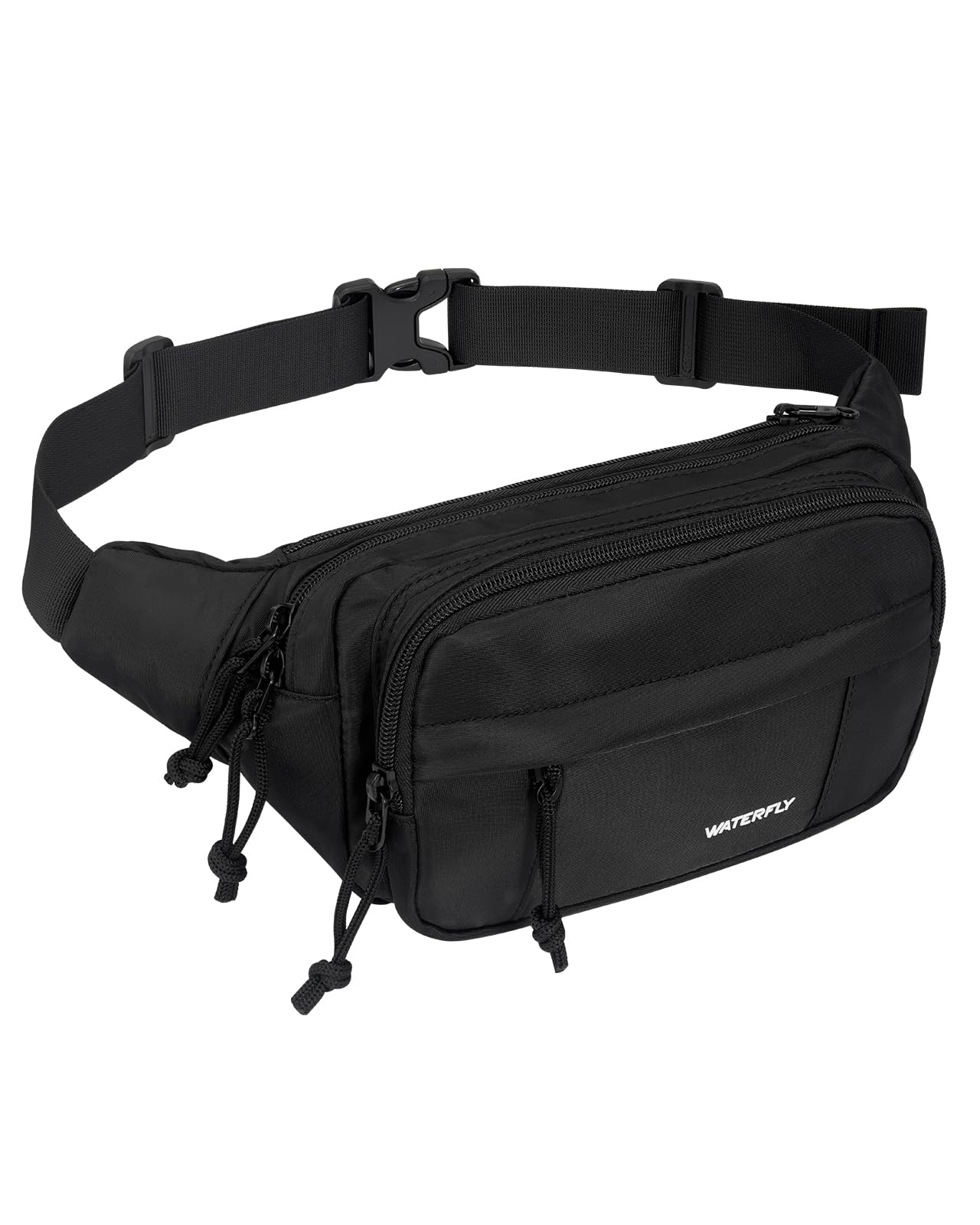
The WATERFLY is the belt that doubles as a full-featured waist pack for day hikes, travel days, and daily commutes. With seven separate zippered pockets and two internal mesh pockets, the organization here rivals a small daypack. The largest pocket comfortably holds a 16oz water bottle or a large smartphone, and the 39-inch adjustable strap fits waists from 31.5 to 49.2 inches, accommodating both slender runners and those who wear the belt over layers.
The nylon material is water-resistant and machine-washable, while the SBS zippers are smooth and durable even after months of daily use. The pack can be worn on the hips or slanted across the chest, which makes it functional beyond running—concerts, festivals, theme parks, and travel all benefit from the hands-free organization. At 9.88 ounces, it’s heavier than pure running belts, but the added storage is a trade-off many multi-sport users appreciate.
This is not a dedicated running belt: the bulk of seven pockets can bounce if overstuffed, and the non-elastic strap lacks the bounce-free engineering of SPIbelt or Fitletic. For hardcore runners who want a belt that disappears, this is overkill, but for anyone who wants one pack that handles running, hiking, and travel, the WATERFLY is an exceptional value.
Why it’s great
- Seven pockets offer unmatched organization
- Fits standard 16oz water bottles
- Machine-washable and water-resistant nylon
Good to know
- Heavier and bulkier than dedicated running belts
- Non-elastic strap can allow bouncing when overfilled
6. Simptech Sling Bag Fanny Pack

The Simptech Sling Bag markets itself as a 5-in-1 design that switches between crossbody sling, running belt, and chest pack. The 25-inch adjustable strap fits waists from 24 to 43 inches, and the water-resistant nylon material keeps your phone and wallet dry in light rain. The dual-pocket layout includes a scratch-resistant inner divider to protect your phone screen from keys or a power bank, and the compact profile is small enough to wear under a jacket.
Real-world users praise the belt for kids and teens who need a hands-free way to carry an EpiPen or phone while biking, and adults use it in the OR for holding notebook, pens, and ID without bulk. The crossbody option is especially handy for theme parks where you want quick access to your phone for photos without taking a bag off. At a budget-friendly price, you get reinforced stitching and smooth zippers that survive daily abuse.
The strap cannot be cinched as tightly as dedicated running belts, and the pocket is too small for larger phones with thick cases or for carrying a water bottle. For serious runners doing distance, the bounce-free engineering of the Fitletic or SPIbelt is a better match. But for casual joggers, gym-goers, and travelers who want one tiny bag for everything, the Simptech is a smart, affordable choice.
Why it’s great
- Switches between crossbody and waist carry
- Water-resistant nylon with scratch-resistant divider
- Excellent for kids, teens, and light carry
Good to know
- Pocket is too small for large phones with thick cases
- Strap cannot cinch as tightly as dedicated running belts
7. SPIbelt Diabetic Running Belt for Adults

The SPIbelt Diabetic is purpose-built for carrying an insulin pump, glucose meter, test strips, syringes, and fast-acting glucose while running, sleeping, or going about daily life. The 6.5 x 3 x 2 inch pocket expands to accommodate a Tandem t:slim X2 or similar pump, and a reinforced pass-through hole lets tubing exit without crimping or restricting flow. At just 2.47 ounces, the belt is light enough that you can sleep in it without discomfort.
The elastic belt fits waists from 25 to 47 inches with a sturdy buckle that stays adjusted, unlike some belts that slowly loosen during activity. The expandable, low-profile pocket is discreet under clothing, and the no-logo band means nobody has to know you’re wearing a medical device.
The buckle placement was moved to the front left near the pouch in recent production, which some side sleepers find digs into their torso during rest. The pocket is also a tight squeeze for larger pumps like the Parkinson pump, and the tubing access hole can be difficult to thread for users with dexterity challenges. But for the specific job of securing an insulin pump during active use, no other belt on this list comes close.
Why it’s great
- Designed specifically for insulin pumps with tubing pass-through
- Low-profile and discreet under clothing
- Light enough to wear while sleeping
Good to know
- Buckle placement can be uncomfortable for side sleepers
- Tight fit for larger insulin pumps
FAQ
Will a running belt fit an iPhone 16 Pro Max with a case?
What does the gel loop count mean for race day?
Final Thoughts: The Verdict
For most users, the best adjustable running belt winner is the Fitletic Hydra 16 because it combines hydration, phone storage, gel loops, and race bib toggles in one bounce-free package for long-distance runners. If you want a lighter belt that disappears during races, grab the SPIbelt Performance. And for carrying an insulin pump or medical supplies while staying active, nothing beats the SPIbelt Diabetic.