
That moment of impact happens in a split second, and if your car’s built-in camera—or worse, a cheap knockoff—delivers smeared, unreadable footage, you might as well have nothing. An aftermarket dash cam built around a STARVIS 2 sensor and true 4K recording is the only way to ensure license plates, road signs, and driver behavior are captured with forensic-grade precision, whether you’re driving at noon or midnight.
I’m Min — the co-founder and writer behind Gadgets Feed. My deep-dive research into this guide involved cross-referencing Sony sensor generations, Wi-Fi throughput benchmarks, parking-mode power draw, and real-world user failure rates across dozens of hours of spec analysis to separate the truly reliable units from the spec-sheet hype.
After sorting through seven of the most compelling candidates on the market, I can confidently point you toward the best aftermarket dash cam for every driving scenario, from daily commuters to rideshare pros and tech-first owners who want the absolute best imaging hardware available today.
How To Choose The Best Aftermarket Dash Cam
An aftermarket dash cam is a long-term investment in liability protection. The wrong choice — low bitrate, no HDR, or a dying lithium battery — leaves you with unusable footage exactly when you need it most. Focus on three core pillars: sensor capability, recording channels, and power management for parking mode.
The Sensor Is Everything: Why STARVIS 2 Matters
The Sony IMX678 and IMX675 STARVIS 2 sensors represent the current ceiling of consumer dash cam imaging. They offer roughly four times the low-light sensitivity of older CMOS sensors, which means they can read a license plate in a dimly lit parking garage or on a rainy highway at night. Without STARVIS 2 or an equivalent class of sensor, your nighttime footage will look grainy and unreadable.
A secondary spec to check is the aperture — F1.55 or F1.7 are common on premium units. A wider aperture gathers more light but can introduce more lens flare from oncoming headlights. The best implementations pair that wide aperture with HDR (High Dynamic Range) processing, which balances the highlights and shadows simultaneously so plates don’t get blown out by headlight glare.
How Many Channels Do You Actually Need?
A single-channel dash cam only covers the road ahead — it leaves you vulnerable to rear-end hit-and-runs, side collisions, and break-ins from the cabin. A 2-channel (front and rear) system covers your most common accident scenarios and is the baseline most serious buyers should start from. A 3-channel system adds an interior cabin camera, which is essential for rideshare drivers (Uber, Lyft) who need to document passenger behavior, and for families who want to monitor back-seat activity. A 4-channel system, like the Vantrue N5, adds a rear cabin camera to cover the trunk and side windows, providing full 360-degree coverage for fleet vehicles or those who park in high-risk urban areas.
Every additional channel demands more processing power and storage. If you choose a 3- or 4-channel unit, ensure it has a dedicated dual-core processor and supports at least 512GB of expandable storage — otherwise, you’ll run out of recording time on a long trip or overwrite critical footage before you have a chance to review it.
Parking Mode and Power Management
The most common failure point on a dash cam is its battery. Cheaper units use lithium-ion cells that swell and die within a year, especially in hot climates. The better option is a super capacitor, which handles temperatures from 14°F to 140°F without degradation and lasts significantly longer. However, a super capacitor cannot power parking mode on its own — you’ll need a hardwire kit that connects to your fuse box and provides constant power. The smartest hardwire kits include a voltage cutoff that stops power draw before your car battery drains below starting voltage. If you plan to use parking mode, factor the cost and installation of a hardwire kit into your total budget — typically – for the kit and an hour of installation time.
Quick Comparison
On smaller screens, swipe sideways to see the full table.
| Model | Category | Best For | Key Spec | Amazon |
|---|---|---|---|---|
| 70mai T800E | 3‑Channel | Budget-friendly 3‑channel coverage | 4K front + 1080p interior + 1080p rear, 64GB SD card included | Amazon |
| Pelsee P1 Pro | 2‑Channel | Full-color night vision at a mid-range price | 4K front + 1080p rear, STARVIS 2 sensor, 64GB card included | Amazon |
| ROVE R2-4K Dual PRO | 2‑Channel | Dual STARVIS 2 resolution on a budget | 4K front + 2K rear, IMX678 + IMX675, 128GB card included | Amazon |
| REDTIGER F17 Elite | 3‑Channel | Full-color cabin night vision for rideshare | 4K front + 2.5K rear + 1080p interior, dual STARVIS 2, 128GB card | Amazon |
| VIOFO A229 Pro | 3‑Channel | Top-tier 3-channel reliability and build | 4K front + 2K rear + 1080p interior, HDR on all 3 channels | Amazon |
| Vantrue N5 | 4‑Channel | 360° coverage for fleets and urban parking | 2.7K front + three 1080p cameras, 4‑way recording | Amazon |
| VIOFO A329S | 2‑Channel | Highest video fidelity with 4K 60fps front | 4K 60fps front + 2K rear, dual STARVIS 2, Wi‑Fi 6, up to 4TB SSD | Amazon |
In‑Depth Reviews
1. VIOFO A329S 4K 60FPS Dash Cam Front and Rear
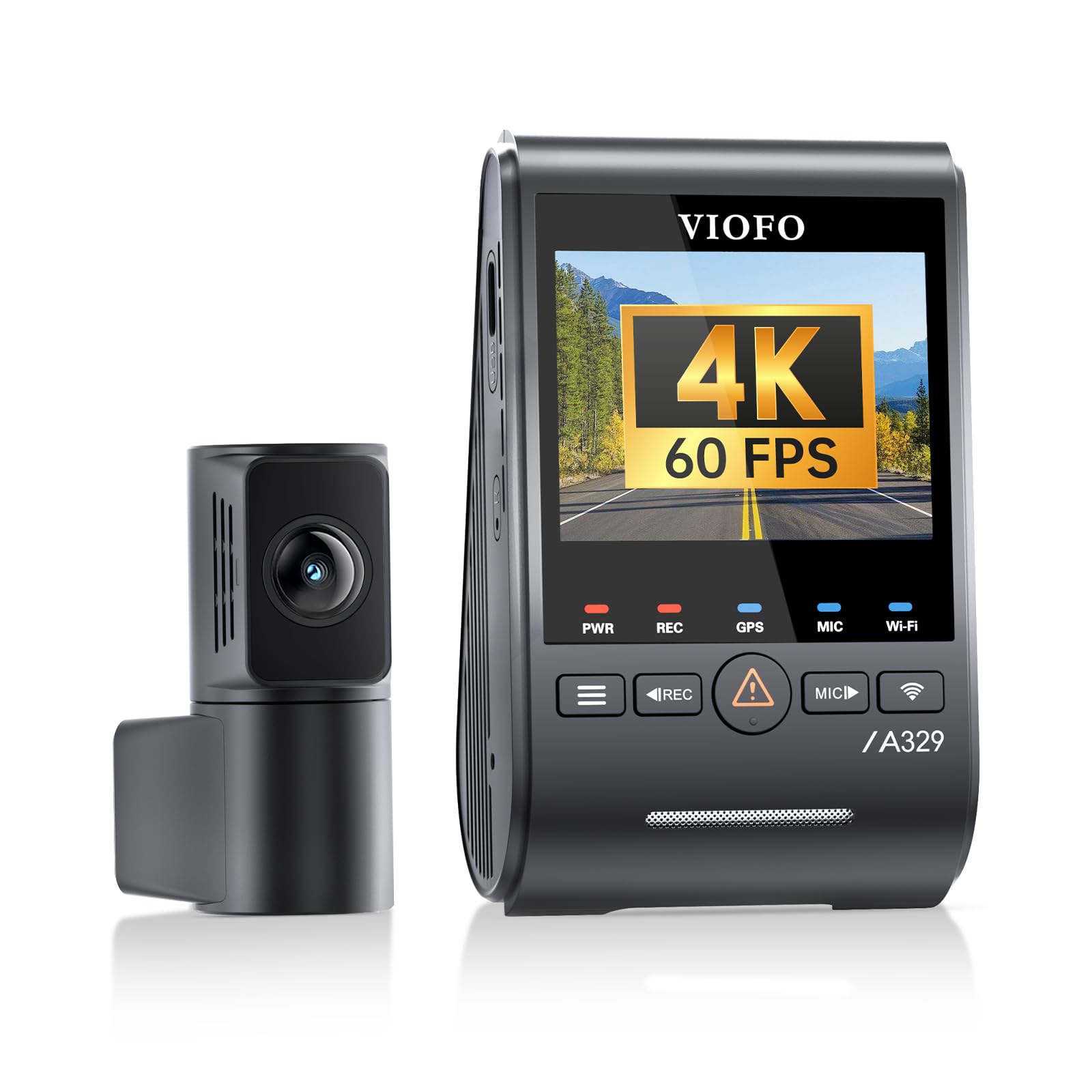
The VIOFO A329S sets a new benchmark for image quality in the consumer dash cam space by being the first mainstream unit to offer 4K recording at 60 frames per second on the front channel. That extra temporal resolution is not a marketing gimmick — it dramatically reduces motion blur from passing cars, making license plate reads possible even in fast-moving highway traffic. The rear camera captures at 2K, and both channels use Sony STARVIS 2 sensors (IMX678 up front, IMX675 in the rear), ensuring low-light performance matches the high-frame-rate daytime clarity.
On the connectivity side, the A329S ships with Wi-Fi 6, which pushes file transfer speeds to around 30 MB/s — you can download a one-minute 4K clip in under ten seconds. The unit also supports external SSDs up to 4TB via its Type-C port, effectively eliminating the need to manage storage on long trips. An included CPL filter cuts windshield glare, and the slim 2.8mm coaxial rear cable makes for a clean, interference-free installation that’s easy to tuck into headliner trim.
The real value lies in its parking mode architecture. The A329S supports a power-saving impact-detection mode that draws negligible current until a collision is detected, then springs into action with full recording. Pair it with the VIOFO HK6 hardwire kit (sold separately) for geofencing control that skips recording at home and work. It’s the most future-proof, feature-dense 2-channel system on the market right now, and its video quality will stay competitive for years.
Why it’s great
- 4K at 60fps front channel eliminates motion blur for reliable plate capture
- Wi-Fi 6 speeds up wireless transfers to roughly 30 MB/s
- Accepts up to 4TB external SSD for weeks of continuous recording
Good to know
- No SD card or SSD included in the box
- HDR is not available when front is set to 4K 60fps — you must choose between frame rate and dynamic range
- Requires VIOFO-specific hardwire kit for parking mode
2. ROVE R2-4K Dual PRO Dash Cam Front and Rear
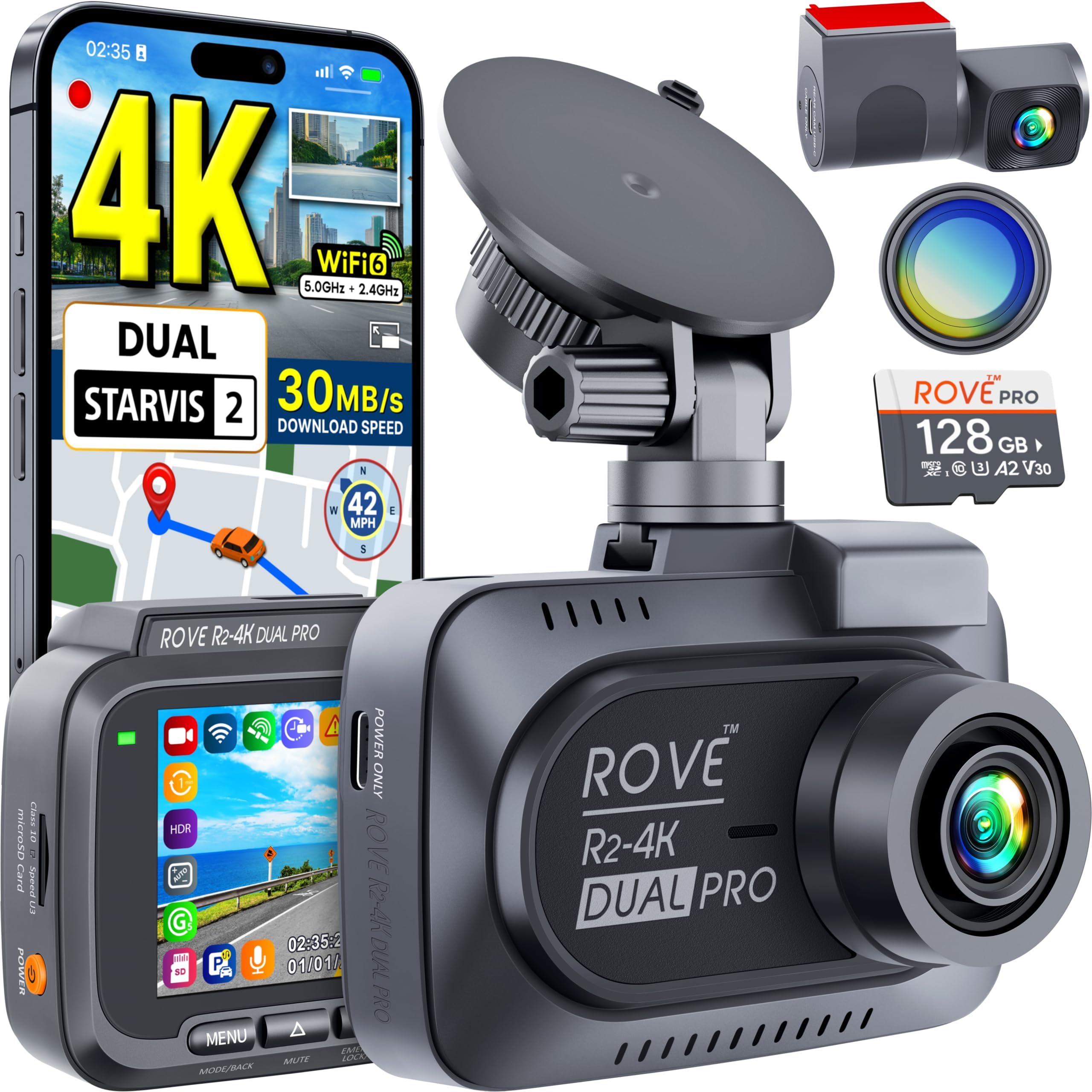
The ROVE R2-4K Dual PRO delivers a combination of sensor hardware and included accessories that is difficult to beat at its price tier. It runs Sony STARVIS 2 sensors on both channels — the IMX678 for the front camera and the IMX675 for the rear — which is an uncommon spec at this price point. The front records at true 4K, while the rear bumps up to 2K, a meaningful step above the 1080p rear cameras found on many competing units. The wide F1.7 front aperture and F1.55 rear aperture give it an edge in dimly lit highway scenarios.
ROVE also packs the box with a CPL filter to reduce windshield reflections, a detailed hardwire guide, and a high-endurance 128GB microSD card that is pre-tested for sustained 4K write speeds. The included Quad-Mode GPS integrates with the free ROVE GPS Player software on a computer, allowing you to overlay trip data — speed, route, and timestamp — directly onto the video for insurance or fleet management purposes. Its 24-hour parking mode offers three choices: time-lapse, motion detection, and collision detection, each configurable through the onboard menu.
The Wi-Fi 6 implementation on the R2-4K Dual PRO is genuinely fast, sustaining transfer rates up to 30 MB/s, which makes it practical to offload full 4K clips to a phone without removing the memory card. Some users have reported a rare firmware quirk where the rear camera can freeze after extended idle periods, but ROVE’s US-based customer service is notably responsive and has resolved these cases quickly. For anyone who wants dual STARVIS 2 performance without stepping into the + bracket, this unit is the clear recommendation.
Why it’s great
- Dual STARVIS 2 sensors (IMX678 + IMX675) for exceptional low-light clarity
- Includes a 128GB microSD card and CPL filter in the box, saving you up to
- Wi-Fi 6 transfers are fast enough to download 4K clips wirelessly in seconds
Good to know
- Adhesive mount only — no suction cup option for easy transfer between vehicles
- Rare rear camera freeze after extended idle has been reported by some users
- Hardwire kit for parking mode is sold separately
3. VIOFO A229 Pro 3 Channel 4K HDR Dash Cam

The VIOFO A229 Pro distinguishes itself by applying HDR processing to all three recording channels simultaneously — front, rear, and interior — a capability that very few 3-channel dash cams can claim. Standard dash cams toggle HDR on or off globally, which means you might sacrifice rear-channel detail to get better front-channel exposure. The A229 Pro doesn’t make that compromise. The front camera uses the Sony IMX678 STARVIS 2 sensor, the rear uses the IMX675, and the interior camera uses a dedicated STARVIS sensor with four infrared LEDs that activate automatically in pitch-black cabin conditions.
HDR across all channels matters most in transitional lighting environments — think tunnels, dusk, or parking garages with mixed sodium-vapor and daylight. In those conditions, the A229 Pro holds license plates readable two car lengths ahead, even when the subject is moving at speed. The cabin camera, with its IR illumination, records sharp black-and-white footage in complete darkness, making it a strong choice for rideshare drivers who need a clear record of passenger behavior inside the vehicle.
The VIOFO ecosystem is another advantage: the HK4 hardwire kit is tried and tested across thousands of installations, and the VIOFO app (though basic) provides reliable configuration and live preview. The A229 Pro ships without a memory card — VIOFO strongly recommends their own high-endurance microSD cards to prevent compatibility issues with 3-channel HDR recording. For the buyer who values verified reliability over raw specs, this unit delivers consistent, journal-grade footage across every angle, every time.
Why it’s great
- HDR processing active on all three channels simultaneously, not just the front
- Infrared cabin camera captures sharp black-and-white footage in total darkness
- Well-documented hardwire ecosystem with proven HK4 kit for parking mode
Good to know
- No SD card included — you must buy separately, and VIOFO recommends their own brand
- Interior camera cable length is long for a close-mounted cabin camera, requiring extra tucking
- GPS module may fail after several months; VIOFO support has been responsive but the pattern exists
4. REDTIGER F17 Elite 4K Dash Cam 3 Channel
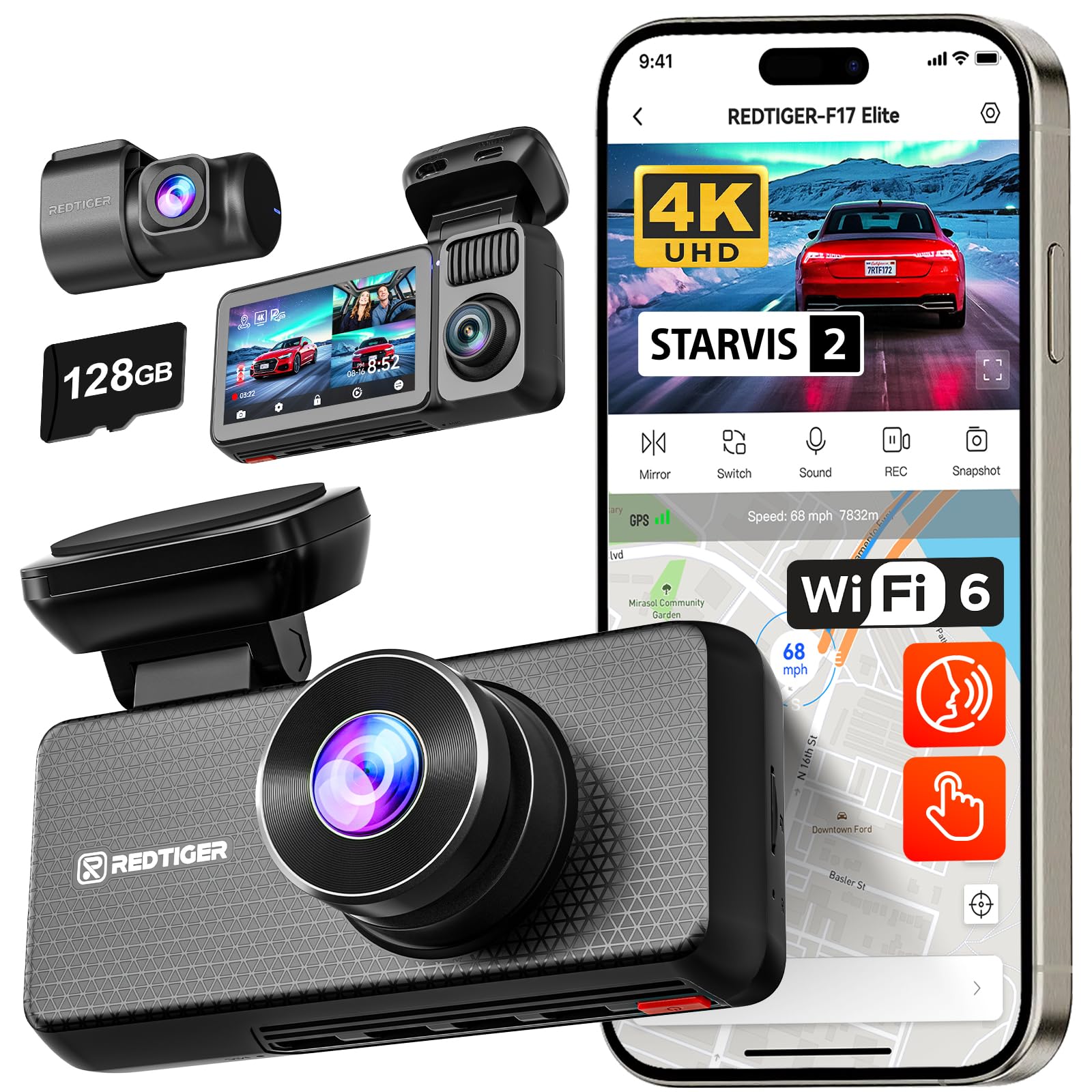
The REDTIGER F17 Elite uses dual STARVIS 2 sensors (IMX678 front, IMX675 rear) to deliver a 3-channel recording system that prioritizes full-color night vision for both the front and cabin cameras. Where most interior dash cams fall back to grainy infrared or switch to black-and-white in low light, the F17 Elite’s image processing pipeline maintains color fidelity in the cabin even in dim urban or garage environments. That’s a meaningful differentiator for Uber and Lyft drivers who need to identify passenger clothing, accessories, or physical interactions clearly on video.
The unit includes a 128GB microSD card out of the box, supports both touchscreen and voice control, and connects via 5.8GHz Wi-Fi 6 for rapid file downloads. The F17 Elite’s parking mode is also full-color, using the same STARVIS 2 sensors to capture vivid detail instead of washed-out monochrome. The sticky adhesive mount is the only mounting option — REDTIGER doesn’t offer a suction cup alternative — which means removing and reinstalling the camera in a rental or between vehicles is not practical.
One wrinkle: several early-adopter reports indicate the screen has a 3-minute auto-off timer by design with no always-on override. That’s fine for recording since the camera keeps capturing, but it can be disorienting if you’re trying to make menu adjustments while parked and the screen fades. The F17 Elite also uses a proprietary microSD card format that costs more than standard cards if you need a replacement beyond the included 128GB. For dedicated rideshare drivers who want color-accurate evidence in every lighting condition, this unit justifies its premium-tier pricing.
Why it’s great
- Full-color night vision on both front and cabin cameras, not just black-and-white IR
- 128GB microSD card included and pre-installed — ready to use out of the box
- Touchscreen interface combined with responsive voice commands for hands-free operation
Good to know
- Screen auto-off timer maxes at 3 minutes; no permanent display option available
- Proprietary SD card format costs more than standard high-endurance cards
- Adhesive-only mount — no suction cup for easy camera transfer between vehicles
5. Vantrue N5 4 Channel WiFi 360° All Sides Dash Cam

The Vantrue N5 is the only dash cam in this roundup that records four distinct video streams simultaneously: front, front cabin, rear cabin, and rear. This 4-channel architecture covers the driver’s blind spots on all sides, including the trunk area and side windows, which is crucial for fleet operators, work truck drivers, and anyone who parks in high-risk urban areas where break-ins often happen through side glass rather than just the front or rear. The system uses a dual-core processor to manage the load, splitting the resolution across a 2.7K main front channel and three 1080P auxiliary channels.
The STARVIS 2 sensor on the front camera, combined with infrared LEDs on both interior cameras, provides usable footage in near-total darkness for the cabin — though the main channel remains color, not black-and-white. The app is functional for review and configuration, but it is not the smoothest on the market; several users note that the collision-triggered event folder can be inconsistent in accurately grouping clips. The 18-month warranty and a track record of customer service replacing units even beyond the one-year mark add peace of mind.
There is a notable downside: the N5’s parking mode can drain the car battery if the system is left parked for multiple days without a drive to recharge it. Users report the battery dying after roughly four days of continuous parking monitoring. A hardwire kit with adjustable voltage cutoff (sold separately) is mandatory if you intend to use this in long-term parking mode. For commercial use where side-window and trunk coverage is non-negotiable, the N5 fills a role no other product here can match.
Why it’s great
- Four-channel coverage records front, both cabin zones, and rear for truly 360-degree protection
- STARVIS 2 front sensor with infrared cabin cameras for low-light performance across all angles
- Magnetic quick-release mount lets you detach the camera without unplugging cables
Good to know
- Parking mode draws enough power to drain a standard car battery in about 4 days
- No memory card included; supports up to 512GB which you must purchase separately
- Adhesive mounts only; a suction cup mount must be bought separately
6. 70mai 4K Dash Cam Front and Rear Inside (T800E)

The 70mai T800E offers a complete 3-channel recording system — 4K front, 1080P interior, and 1080P rear — at a price point that undercuts most dual-channel systems. That makes it an intriguing entry point for value-conscious buyers who want full cabin coverage without spending significantly more. The interior camera includes a switchable infrared mode; you can toggle IR on for complete darkness recording or turn it off to capture natural-color cabin footage during the day. It also comes with a 64GB microSD card in the box, so it functions out of the box without a separate accessory purchase.
Connectivity is handled via Wi-Fi 6 and a 5-mode GPS receiver, and the 70mai app provides access to live preview and video downloads. The super capacitor power supply means it can handle temperature extremes from 14°F to 140°F without the swelling or failure issues common to lithium-battery dash cams. The T800E also supports up to 512GB SD cards for expanded storage, though the included 64GB card is serviceable for daily commuting in loop-recording mode.
The catch is that the overall build quality and image processing do not measure up to the premium units from VIOFO or REDTIGER. The app can be finicky — several reviewers note unreliable Wi-Fi connection during the initial setup — and the voice control, while functional, offers a more limited command set than the competition. It also uses an adhesive mount with no suction cup alternative. For the driver who wants a 3-channel setup on a strict mid-range budget and is willing to tolerate occasional app quirks, the T800E is a solid compromise.
Why it’s great
- Three channels (4K front + 1080P interior + 1080P rear) at the lowest price in this roundup
- Super capacitor handles extreme heat and cold without battery degradation risks
- 64GB microSD card included means no immediate accessory purchase is needed
Good to know
- Wi-Fi app connection can be finicky during initial pairing; may require multiple attempts
- Voice command set is more limited than VIOFO or REDTIGER systems
- Adhesive-only mount makes it difficult to move the camera between vehicles
7. Pelsee P1 Pro 4K Dash Cam Front and Rear
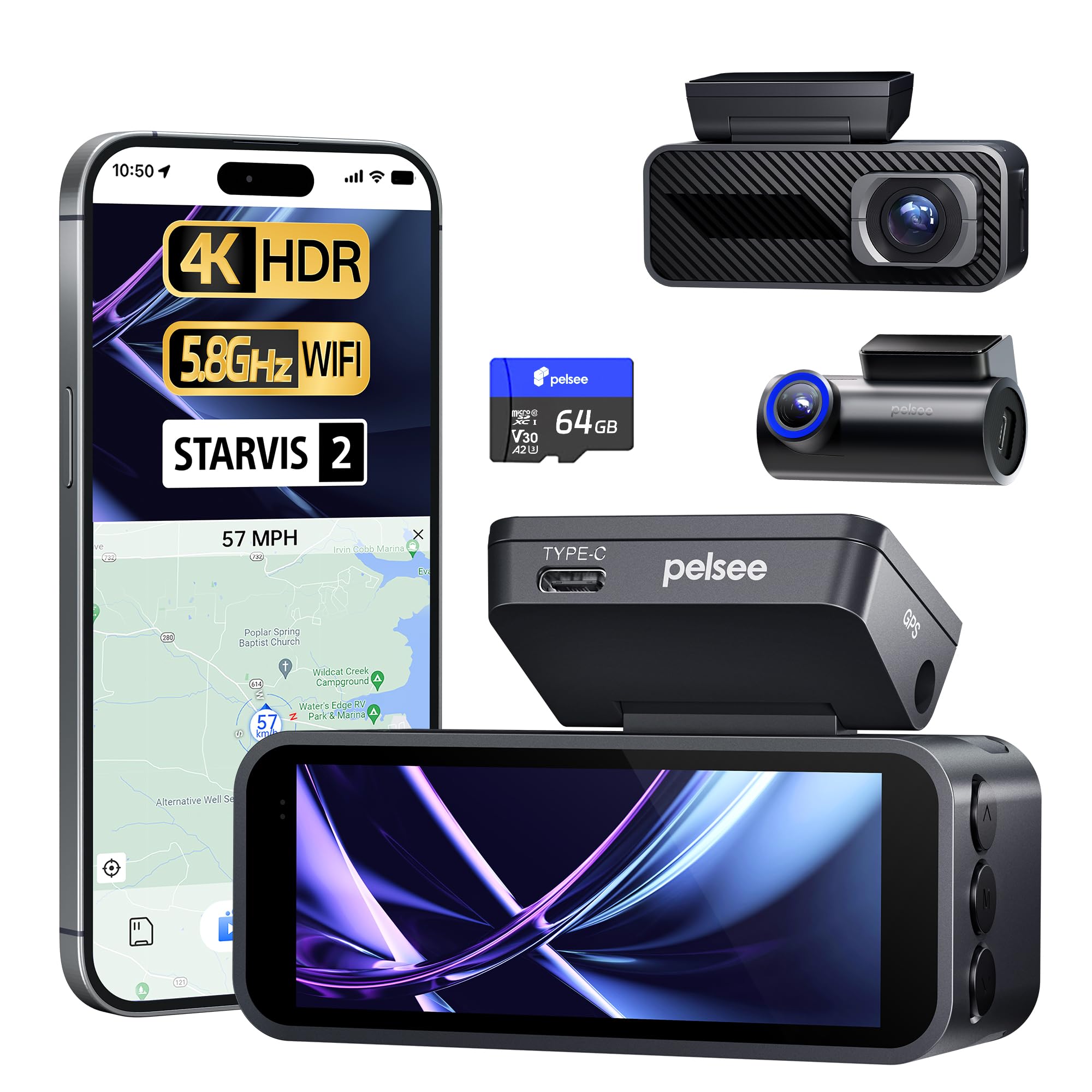
The Pelsee P1 Pro brings a Sony STARVIS 2 sensor to the budget tier, making it the most affordable way to get genuine 4K low-light performance without stepping into a premium bracket. It pairs the front STARVIS 2 sensor with AI-assisted full-color night vision that outputs color footage in starlight-level conditions — a capability usually reserved for cameras costing twice as much. The rear camera records at 1080P with WDR, and the system syncs both channels at a steady 25fps.
Smart driving assistance features are a notable inclusion at this entry-level price: the P1 Pro includes forward collision warnings, lane departure warnings, pedestrian collision alerts, and a front-vehicle start reminder. While these ADAS features are not as refined as those in built-in driver-assistance systems, they add a helpful layer of situational awareness on long highway drives. The 3.39-inch IPS screen is larger than most competitors and provides a crisp live view, though the auto-off logic is aggressive — the display dims quickly to avoid distracting the driver.
The 5.8GHz Wi-Fi connection works well for quick clip downloads, and the Pelsee Cam app is straightforward. The built-in GPS overlays speed, location, and coordinates onto the video file. The adhesive mount is secure, but like many budget units, there is no suction cup option. The included 64GB card is adequate for daily use but will fill quickly on a multi-day road trip. For the budget-conscious buyer who refuses to compromise on nighttime plate readability, the P1 Pro is the entry-level pick.
Why it’s great
- STARVIS 2 sensor delivers true low-light 4K at an entry-level price
- Full-color night vision stays color even in starlight, not switching to black-and-white
- ADAS alerts (forward collision, lane departure) add safety value at no extra cost
Good to know
- 64GB card fills quickly on long trips; upgrading to a larger card costs extra
- Adhesive-only mount means the camera cannot be easily swapped between vehicles
- Screen auto-off is aggressive and cannot be set to stay permanently on
FAQ
Can an aftermarket dash cam drain my car battery if left in parking mode?
What is the real difference between a single-channel and a 3-channel aftermarket dash cam?
Is a dash cam with 4K 60fps worth the price premium over a standard 4K 30fps unit?
Do I need a CPL filter for my aftermarket dash cam?
Final Thoughts: The Verdict
For most users, the best aftermarket dash cam winner is the VIOFO A329S because it combines a future-proof 4K 60fps front sensor, genuine Wi-Fi 6 transfer speeds, and an expandable storage system that supports up to 4TB SSDs — making it the only unit in this roundup that truly eliminates the need to ever manage memory cards again. If you want the absolute best 3-channel coverage with HDR on every angle, grab the VIOFO A229 Pro. And for 360-degree side-window and trunk coverage that no other dash cam on this list provides, nothing beats the Vantrue N5.