
The average cable subscriber pays over a year for channels they can get for free through the air. An OTA TV antenna isn’t retro tech — it’s the smartest cord-cutting move you can make, pulling in crystal-clear 1080p and even 4K broadcast signals from local towers without a monthly bill. The catch? Reception quality varies wildly between models, and the wrong antenna leaves you with pixelated freeze frames.
I’m Min — the co-founder and writer behind Gadgets Feed. I’ve spent countless hours analyzing signal ranges, frequency bands, amplifier specs, and real-world user reception data across dozens of antennas to separate the models that actually lock onto distant towers from the ones that fall short.
Whether you live five miles or fifty miles from broadcast towers, finding the right antenna depends on range, directionality, and frequency support. This guide breaks down the essential specs so you can confidently choose the best ota tv antenna for your home and never pay for local channels again.
How To Choose The Best OTA TV Antenna
Selecting an antenna isn’t about picking the one with the highest number on the box. Your local terrain, tower distance, and home construction materials matter far more than a claimed mile range. Focus on these three factors first.
Directional vs. Omnidirectional Design
A directional (Yagi-style) antenna focuses its reception in one narrow beam, making it ideal for suburban and rural areas where all broadcast towers cluster in the same general direction. Omnidirectional antennas pull signals from 360 degrees, which works well in urban environments where towers surround you — but they trade raw range and gain for that convenience.
UHF vs. VHF Frequency Support
Most broadcast channels now live in the UHF band (channels 14–51), but many markets still carry major networks like ABC on VHF-Low (channels 2–6) or VHF-High (7–13). If your antenna doesn’t include proper VHF elements — specifically long dipole rods or loops — you’ll miss those channels entirely. Always verify the antenna explicitly lists VHF support, not just UHF.
Amplifier Gain and Signal Overload
An amplifier boosts weak signals, but too much gain within 15 miles of a tower can overload the tuner, causing pixelation or total signal loss. Some premium antennas include smart gain control that adjusts amplification per frequency band, preventing overload on strong channels while still boosting weak distant ones. If you live close to towers, look for an antenna with a switchable or intelligent amplifier, or skip amplification entirely.
Quick Comparison
On smaller screens, swipe sideways to see the full table.
| Model | Category | Best For | Key Spec | Amazon |
|---|---|---|---|---|
| Antennas Direct Element | Premium Outdoor | Rural fringe areas, long range | 60+ mile range, 35.5″ wide | Amazon |
| Channel Master Omni+ 50 | Omnidirectional | Urban areas with towers in multiple directions | 50+ mile range, 360° reception | Amazon |
| RCA ANT751Z | Mid-Range Outdoor | Attic installations, strong VHF/UHF mix | 75 mile range, 2 lbs weight | Amazon |
| Televes DiNova Boss Mix | Smart Premium | Signal fluctuation areas, 4G/5G interference | Smart gain control, 29 dBi VHF | Amazon |
| 1byone Outdoor 360° | Omnidirectional | RV/camping, quick outdoor setup | 100+ mile range, 39ft coax cable | Amazon |
| Five Star Multi-Directional | Multi-Directional | Medium-range multi-directional needs | 200 mile range, 40ft RG6 cable | Amazon |
| Antennas Direct ClearStream Eclipse | Indoor Paper-Thin | Renters, apartments, light cord-cutting | 50+ mile range, 0.04″ thin | Amazon |
In‑Depth Reviews
1. Antennas Direct Element

The Antennas Direct Element is a seriously capable uni-directional Yagi that outpaces conventional designs in its class. Its wide 35.5-inch span and deep 44.5-inch length pack dedicated VHF and UHF reflector elements, allowing it to lock onto signals 60+ miles away without requiring an external amplifier in most setups. Real-world users report pulling in stations from 70 to 80 miles with a line amplifier, and the snap-together assembly requires zero tools.
The beam width is wider than typical Yagis at roughly 55 degrees off-axis, meaning it can snag stations slightly off-center without losing signal depth. This matters when your broadcast towers don’t line up perfectly in a straight line. Weighing only 2.6 pounds with all-weather mounting hardware, it handles wind loads well on a mast or in an attic.
One notable detail: the Element includes a built-in lightning arrestor, a safety feature many antennas skip. It’s rated for 4K/8K and NextGen TV compatibility, so it works with ATSC 3.0 tuners. For rural and suburban homes where towers cluster in one direction, this is the most reliable performer on this list.
Why it’s great
- Wide beam width captures off-axis signals
- No tools or assembly required for setup
- Excellent weak-signal performance with optional LNA
Good to know
- Large footprint may not suit tight attic spaces
- Requires precise aiming for maximum range
2. Televes DiNova Boss Mix 144286

The Televes DiNova Boss Mix is the smartest antenna here, featuring proprietary TForce Intelligent Gain Control that automatically adjusts amplification per frequency band. This solves the classic amplifier problem — too much gain on strong channels causing overload, too little on weak ones causing pixelation. It delivers up to 29 dBi on High VHF and 34 dBi on UHF, and it dynamically balances output to keep a stable signal.
The build quality is exceptional: a weather-resistant ABS radome with Zamak mounting components, made in Spain. It integrates FM, LTE, 4G, and 5G filtering above 608 MHz to block cell tower interference, a growing issue as 5G densifies. Users report pulling in stations 90 miles away in clear conditions, and the directional UHF microstrip array with seven elements focuses tightly on broadcast towers.
It includes a 12V dual-output power inserter and J-mount bracket, so everything you need except fasteners is in the box. No assembly is required. The low-profile white housing blends with residential exteriors and complies with HOA aesthetics. For those dealing with signal fluctuation, cell interference, or needing a premium attic install, this is the most future-proof option available.
Why it’s great
- Intelligent gain control prevents tuner overload
- Built-in 4G/5G filtering clears interference
- No assembly required, premium weather-resistant housing
Good to know
- Premium price reflects advanced electronics
- Mounting fasteners not included
3. RCA Compact Outdoor Yagi ANT751Z

The RCA ANT751Z is a compact Yagi that delivers surprisingly strong UHF and VHF performance from a small package. Its easy-lock fold-out UHF reflector and snap-lock elements make attic installation straightforward — no tools beyond a screwdriver for mounting. At just 2 pounds, it’s light enough to mount on an attic joist without reinforcement.
Real-world users consistently report 80–100% signal strength on major networks like ABC, NBC, CBS, FOX, and PBS when within 30 miles of towers. One user achieved 79 channels in the Dallas area with 80–85% signal on all major networks without adding an amplifier. The VHF-Low support is a key differentiator — many compact antennas skip it, but the ANT751Z handles channels 2–6, which ABC still broadcasts on in many markets.
The included RCA Signal Finder app helps align the antenna by showing tower directions, though the antenna itself lacks the premium build of higher-end options. It requires mandatory grounding (wire, clamps, and grounding block sold separately), and coax cable is not included. For a mid-range budget, this is a proven workhorse that pairs well with TiVo or HDHomeRun for whole-home DVR.
Why it’s great
- Excellent VHF-Low and VHF-High reception
- Lightweight and easy attic installation
- Works without amplifier in most suburban setups
Good to know
- Grounding kit and coax cable not included
- Not ideal for extreme weather exposure outdoors
4. Channel Master Omni+ 50

The Channel Master Omni+ 50 is built specifically for urban environments where broadcast towers surround your home from multiple directions. Its omnidirectional design eliminates the need to aim the antenna — just mount it and scan. The design separates UHF (omnidirectional) and VHF (rotatable dipole) elements, giving you flexibility to rotate the VHF dipole toward the VHF tower while the UHF element pulls from all sides.
Users report significant signal strength improvements, going from 60% to 95% signal quality and 70% to 98% SNR when switching from smaller indoor antennas. In flat terrain like Florida, users within 35 miles of towers pull in 53 stations without issues. The antenna includes a mounting bracket for wall, mast, or existing satellite mounts, and it works indoors or outdoors.
The 28.75-inch length and 9-inch width are moderate, and the unit weighs well under most outdoor antenna loads. It does not include a mast, and the claimed 50-mile range is realistic for non-fringe suburban areas but won’t reach 70+ miles like directional Yagis. For urban and suburban users who want a clean, no-aim install, this is the most reliable omni option available.
Why it’s great
- No aiming required — pulls from all 360 degrees
- Separate UHF omni and rotatable VHF dipole
- Works with preamp for further signal improvement
Good to know
- Lower maximum range than directional alternatives
- Not ideal for rural fringe areas
5. 1byone Outdoor TV Antenna 360°

The 1byone Outdoor 360° antenna packs an unusually long 39-foot RG6 coaxial cable into the box — rare at this level — plus a built-in pre-amplifier with 4G/LTE filtering. The omnidirectional design receives signals from all directions, making it a solid choice for RV use, marine applications, or homes where tower direction is unknown. The included amplifier is switchable via the power inserter, so you can turn it off if you’re close to towers and experiencing overload.
User reports are mixed on waterproofing: while many get 58+ channels in urban settings, some experienced water ingress after two years of outdoor exposure, damaging the preamp. The 1byone antenna is moisture-proof and flame-retardant by material, but outdoor installs benefit from sealing the connector junction and adding drainage holes to the housing. For attic use, this issue disappears entirely.
The Smart pass amplifier technology claims 100+ mile range, but real-world performance is strongest within 30–40 miles. It includes a 2-year warranty, and the installation is tool-free with a simple pole mount. For buyers on a budget who need omni-directional pickup and a long cable included, this offers excellent value if installed in a protected location.
Why it’s great
- Includes 39ft RG6 cable and pre-amplifier
- Tool-free installation with included accessories
- 4G/LTE filter reduces cell interference
Good to know
- Waterproofing concerns for long-term outdoor use
- Max effective range is closer to 40 miles
6. Five Star Multi-Directional 4V HDTV

The Five Star 4V antenna uses a unique multi-directional design with double receiver elements that aim to capture signals from two opposite directions simultaneously. This works especially well if towers are split — say, some north and some south of your home. The package includes a 40ft RG6 coaxial cable, mounting pole, and optional installation kit, giving you almost everything needed for a complete install.
Users within 30–40 miles of towers report excellent results, with one user modifying the antenna to point opposite directions toward Dayton and Cincinnati, obtaining 75 channels and strong signal through multiple splitters. The included USB-powered amplifier boosts weaker UHF stations significantly, though one user noted the claimed 200-mile range is optimistic — effective range is closer to 50–75 miles with the amplifier engaged.
The assembly instructions are poor, but the construction is straightforward enough to figure out visually. The antenna is weatherproof and designed for roof, attic, chimney, or eave mounting. For the price, the included hardware package — cable, pole, and amplifier — makes this a strong contender for budget-conscious buyers who need multi-directional coverage without buying extra components.
Why it’s great
- Dual receiver elements for multi-directional pickup
- Generous included accessories: cable, pole, amplifier
- Good signal strength within 30-40 mile range
Good to know
- Claimed 200-mile range is not realistic
- Assembly instructions are unclear
7. Antennas Direct ClearStream Eclipse
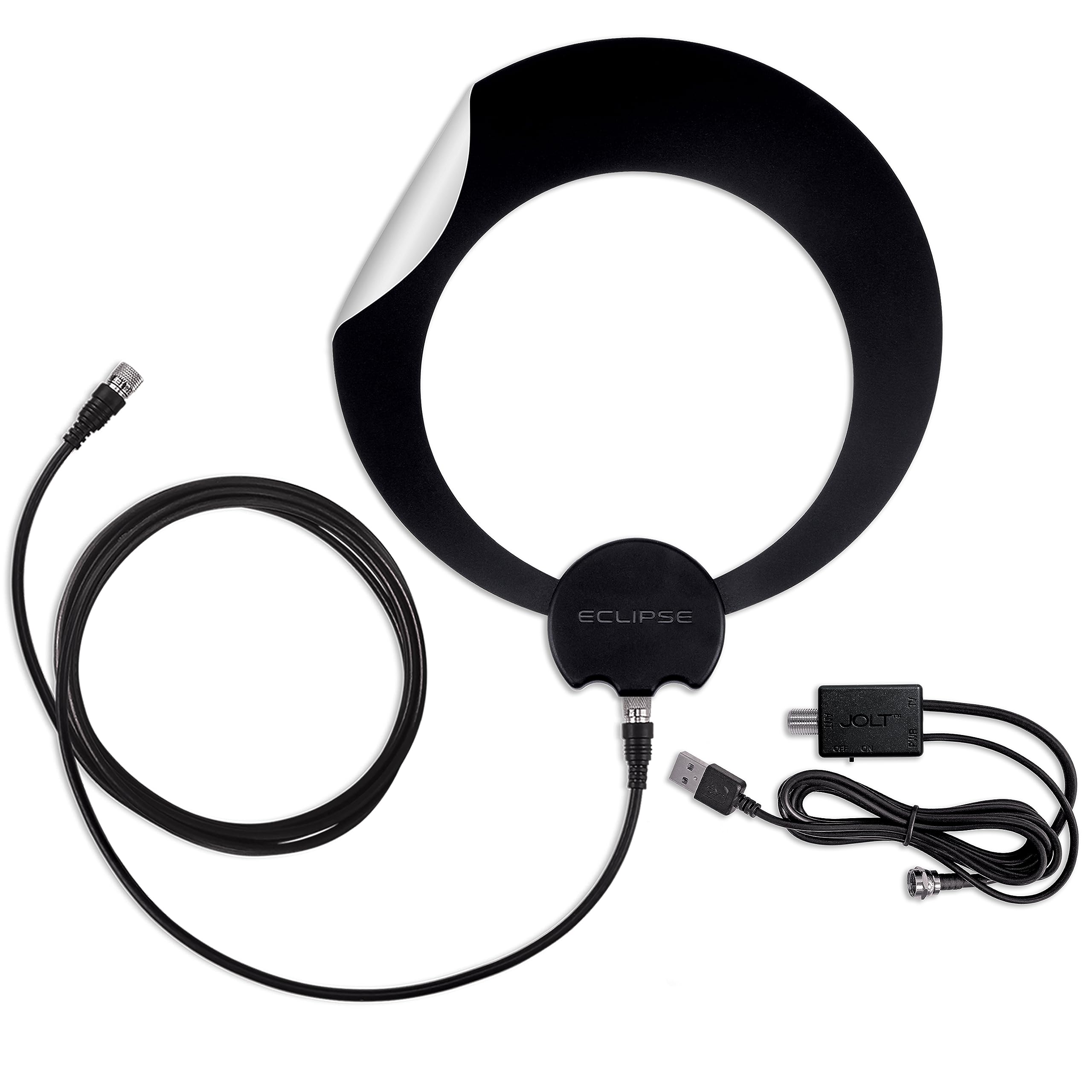
The ClearStream Eclipse is a paper-thin indoor antenna at just 0.04 inches deep, designed for renters or apartment dwellers who cannot mount anything outdoors. Its signature patent loop element is reversible and paintable, so you can match it to your wall color. The included Jolt Switch is an in-line 18 dB USB amplifier that you can toggle on or off in real time — a simple way to test whether amplification helps or hurts in your location.
The amplifier is required for this design to reach its rated 50+ mile range, and users report mixed results depending on building construction. One user achieved great reception on a second-floor wall 35 miles from towers, while another within 10 miles barely picked up signals through dense walls. The coaxial connection is standard, not USB, so signal quality matches traditional antennas — the USB only powers the amplifier.
Compatibility includes NextGen TV, 4K, 8K, and 1080p. The reversible design means the black side can face the room while the white side faces the wall, or vice versa. For a zero-profile indoor solution that doesn’t scream “antenna,” the Eclipse works well in favorable conditions, but it cannot compete with outdoor or attic-mounted Yagis for range or reliability in challenging terrain.
Why it’s great
- Ultra-thin, reversible, and paintable design
- Jolt Switch amplifier lets you toggle gain on/off
- NextGen TV and 4K/8K compatible
Good to know
- Indoor-only; building materials drastically affect reception
- Amplifier is necessary for rated range
FAQ
Can I use an OTA TV antenna with an indoor amplifier if I live 50 miles from towers?
Do all OTA TV antennas support ATSC 3.0 NextGen TV?
Why does my OTA TV antenna pick up different channels at night compared to daytime?
Final Thoughts: The Verdict
For most users, the best ota tv antenna winner is the Antennas Direct Element because it combines powerful directional Yagi gain with wide beam width and easy assembly at a reasonable price. If you need smart gain control and 4G/5G filtering for a signal-challenged location, grab the Televes DiNova Boss Mix. And for urban users who want no-aim convenience, nothing beats the Channel Master Omni+ 50.