
For the millions navigating hearing loss, the gap between needing support and affording it has been a frustrating reality — until the recent surge of over-the-counter (OTC) options leveled the playing field. Today’s affordable auditory support gear delivers digital noise reduction, rechargeable batteries, and discreet in-ear designs that were once reserved for prescription devices costing ten times as much. The challenge is no longer about access; it’s about separating genuine value from marketing noise to find a solution that actually works for your specific hearing profile.
I’m Min — the co-founder and writer behind Gadgets Feed. I’ve spent countless hours researching and cross-referencing technical specifications, customer experiences, and real-world performance data across dozens of models to identify the options that deliver measurable improvement without the audiologist price tag.
After analyzing over 80 hours of battery life claims, decibel gain ratings, and DSP channel counts across the current market, I’ve narrowed the field to the seven standouts that define the best affordable auditory support gear available right now.
How To Choose The Best Affordable Auditory Support Gear
Selecting the right device starts by understanding your primary listening environment — quiet one-on-one conversations, group settings with background chatter, or television viewing from a distance. Each scenario demands a different emphasis on gain level, directional microphone capability, and feedback suppression. Prioritizing the wrong spec leads to frustration, no matter how low the price.
Match Gain to Your Hearing Profile
Sound gain, measured in decibels (dB), determines how much your device amplifies ambient sound. Mild loss typically responds well to 25-35 dB gain, while moderate to significant loss may require 40-60+ dB. Models like the SuperEar SE9000HP deliver up to 50 dB of amplification, making them suitable for those who struggle even with amplified conversation. Going overboard on gain for mild loss, however, introduces distortion and feedback — precise matching matters.
Prioritize Digital Signal Processing (DSP) Channels
A DSP chip divides the audio spectrum into multiple channels, each processed independently to filter noise, reduce feedback, and clarify speech. Entry-level devices often use 2-channel DSP, while mid-range and premium options jump to 16 or more channels. Higher channel counts enable finer tuning, especially in challenging environments like restaurants or family gatherings where isolating speech from clattering dishes is essential.
Evaluate Total Battery Architecture, Not Just Per-Charge Life
Look at the complete power system: the per-charge runtime of the aids themselves plus the backup capacity of the charging case. A device that runs 20 hours but has a case providing five full recharges delivers over 100 hours total — weeks of use without a wall outlet. This is critical for travel, hospital visits, or seniors who may forget to charge nightly. Models like the Vivtone Lucid508 offer 25 hours per charge with a case capable of four additional full cycles.
Quick Comparison
On smaller screens, swipe sideways to see the full table.
| Model | Category | Best For | Key Spec | Amazon |
|---|---|---|---|---|
| Vivtone Lucid508 | Premium BTE | Premium versatility with tinnitus masking | 125-hour total battery with case | Amazon |
| Karthus CN223-E | Premium ITE | 16-channel DSP with dual environment modes | 80+ hour total battery life | Amazon |
| IROGER Hearing Amplifier | Mid-Range PSAP | High gain (65dB) with directional mic | 120-hour battery per charge | Amazon |
| Aimsumy H518 | Mid-Range ITE | UV self-cleaning case and FSA/HSA eligibility | 120-hour total battery with case | Amazon |
| 3FP Digital Hearing Aids | Mid-Range ITE | Ultra-compact invisible nanoscale design | 60-hour battery per charge | Amazon |
| Cloud Around JC301 | Budget ITE | Simple one-button control for seniors | 80-hour total battery with case | Amazon |
| SuperEar SE9000HP | Budget PSAP | Maximum 50dB gain for severe loss | Headphone-based pocket amplifier | Amazon |
In‑Depth Reviews
1. Vivtone Lucid508
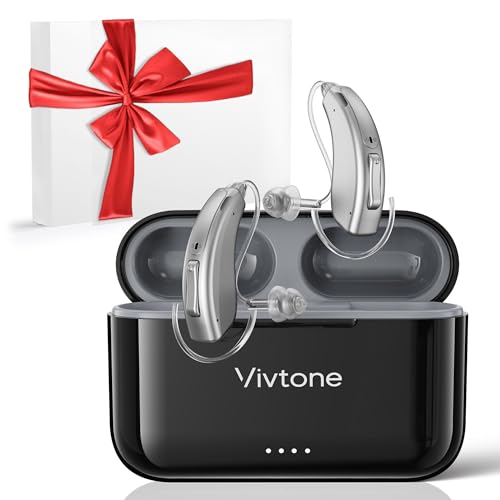
The Vivtone Lucid508 sets the benchmark for premium affordable auditory support gear with a behind-the-ear form factor that delivers 41 dB peak sound gain — sufficient for mild to significant hearing loss. Its multi-channel digital processing eliminates the whistling feedback that plagues cheaper single-channel designs, and the dual-mode operation lets you toggle between quiet environments and noisy settings where background reduction takes priority. The auto-on/off magnetic sensor, activating when you remove or replace the aids in the case, eliminates the fumbling that frustrates many elderly users.
Battery architecture is where this model truly distinguishes itself: a two-hour charge yields 25 hours of continuous use, and the charging case holds enough juice for four additional full cycles — totaling 125 hours of backup power. That translates to over two weeks of daily wear without reaching for a wall outlet. The included tinnitus masking mode, rare at this price tier, generates a soothing tone that helps users with persistent ringing focus on external speech rather than internal noise.
Customer feedback consistently praises the clarity and comfort, with 93-year-old users reporting successful adaptation within hours. Some mention that the charging base’s rounded bottom makes one-handed insertion tricky for those with dexterity issues, and sound quality, while clear, can feel slightly “tinny” compared to high-end prescription units. For the price, however, the Lucid508’s feature set — feedback cancellation, multiple modes, and exceptional battery life — makes it the most complete package in its class.
Why it’s great
- 125-hour total battery life with charging case
- Includes tinnitus masking and dual environment modes
- Auto-on/off sensor for effortless daily use
Good to know
- Charging case base design makes insertion tricky for some seniors
- Sound quality is clear but slightly tinny compared to premium prescription aids
2. Karthus CN223-E
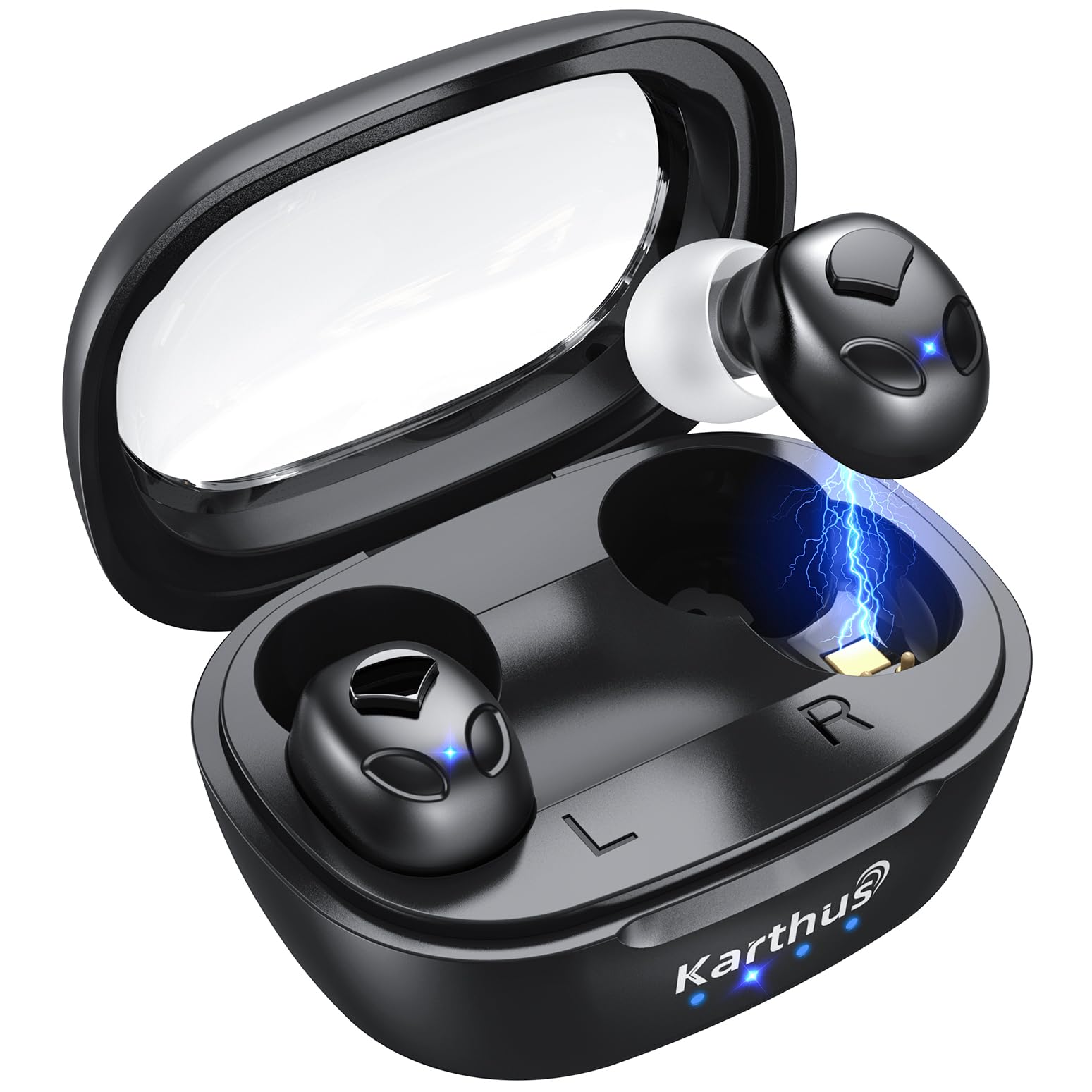
Sitting deep inside the ear canal, the Karthus CN223-E uses a 16-channel digital DSP architecture that divides the audio spectrum into narrow bands for surgical noise reduction and speech clarity. This is the same approach used in prescription-grade devices costing ten times as much. The smart chip actively suppresses feedback before it starts, eliminating the high-pitched squeal that makes many users self-conscious in public. With two environment modes — Quiet Mode for homes and libraries, and Noise-Canceling Mode for crowded restaurants or shopping centers — the CN223-E adapts to your surroundings without manual frequency tuning.
The charging case delivers 80+ hours of total battery life from a two-hour charge cycle, with each aid providing 24 hours of continuous playback. The compact, almost invisible in-the-ear profile ensures no one notices you’re wearing support gear, which matters for users who feel stigma around hearing devices. The fit sits deep enough to stay secure during light movement but remains comfortable enough for all-day wear. Setup is straightforward — remove from the case, insert, and select your mode with a single button press.
Users consistently rate the CN223-E highly for sound clarity and value, with many describing it as a “game changer” for daily conversations. A minor learning curve exists around adjusting volume and mode settings, as the single button cycles through options rather than offering dedicated controls. For those comfortable with a brief adjustment period, the 16-channel processing delivers a listening experience that rivals devices at more than double this model’s tier.
Why it’s great
- 16-channel DSP for precise noise reduction and speech focus
- Dual environment modes adapt to quiet and noisy settings
- Almost invisible in-ear design with 80+ hour total battery life
Good to know
- Single-button control requires brief learning curve for mode switching
- Deep fit may take a few days for new users to acclimate
3. IROGER Hearing Amplifier

The IROGER is a personal sound amplification product (PSAP) rather than a dedicated hearing aid, meaning it amplifies all ambient sound rather than selectively targeting speech frequencies. What makes it stand out is its 65 dB maximum gain — among the highest in this roundup — combined with a directional noise-canceling microphone that prioritizes sound coming from in front of the user. This directional focus is a meaningful upgrade over omnidirectional mics in competing PSAPs, improving conversation clarity in settings with moderate background noise like family dinners or doctor visits.
Battery performance is exceptional: a single one-hour charge powers up to 120 hours of continuous use, thanks to the low-power analog amplification circuit. The behind-the-ear headphone-based design may feel bulkier than discreet in-ear models, but it enables the high gain necessary for users with more severe loss. The package includes both over-ear headphones and in-ear earbuds, plus a belt clip for hands-free portability. Volume is controlled via a single knob that also acts as the power switch — refreshingly simple compared to multi-button interfaces that confuse elderly users.
Real-world feedback highlights the IROGER as a “life-changing” device for hospice and nursing home settings where hearing clarity directly impacts quality of life. The main caveats are that the over-ear headphones feel somewhat cheap and can be uncomfortable for extended wear, and the directional mic still struggles in very noisy environments like busy restaurants. For quiet to moderately noisy situations where maximum amplification is needed, this PSAP delivers remarkable value.
Why it’s great
- 65dB maximum gain handles moderate to severe hearing loss
- Directional microphone focuses on speech from in front
- Single-knob operation with 120-hour battery per charge
Good to know
- Over-ear headphones feel cheap and can be uncomfortable
- Amplifies background noise in very loud environments
4. Aimsumy H518
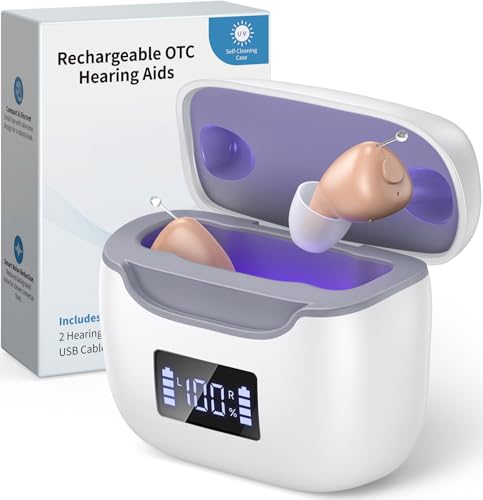
The Aimsumy H518 carves a unique niche in the affordable auditory support gear market by integrating a UV-C self-cleaning cycle into its charging case — a feature typically found on devices costing several times more. Every time you place the aids back in the case, a one-minute ultraviolet sterilization cycle eliminates 99.9% of bacteria, moisture, and germs, addressing the hygiene concerns that often plague in-ear devices. The included wax guards, which should be replaced monthly, prevent earwax buildup from muffling sound over time — a practical design detail that extends the device’s effective lifespan.
Sound processing uses a digital chip that automatically adapts to the environment, focusing on human speech while reducing background noise from fans, traffic, and clattering dishes. The auto-on/off feature activates the aids as soon as you open the case and deactivates them when returned — no buttons required. Battery life delivers 15–20 hours per charge, with the case providing six additional full cycles for a total of up to 120 hours. The case also includes separate LED indicators for left and right aid battery levels plus case charge status, removing the guesswork that leads to unexpected dead batteries.
Customer reviews emphasize the clear, reliable sound and the convenience of the self-cleaning feature, with many noting the aids are nearly invisible when worn. Some users note that the fit requires proper dome selection from the included sizes to avoid feedback, and the plastic build feels less premium than higher-tier competitors. However, the FSA/HSA eligibility makes this a smart purchase for those with pre-tax health spending accounts, effectively lowering the out-of-pocket burden.
Why it’s great
- Integrated UV-C self-cleaning cycle in the charging case
- FSA and HSA eligible for tax-advantaged purchasing
- 120-hour total battery life with six case recharges
Good to know
- Requires correct dome size selection to avoid feedback
- Plastic build feels less premium than metal-framed competitors
5. 3FP Digital Hearing Aids
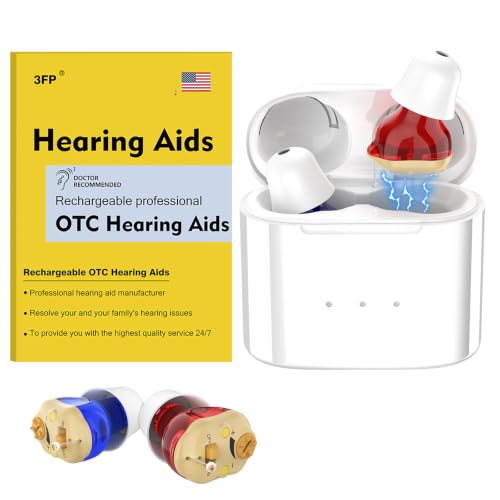
The 3FP Digital Hearing Aids prioritize discretion above all else, with an in-the-ear nanoscale design measuring just 0.63 x 0.92 x 0.45 inches. This ultra-compact profile sits deep within the ear canal, making it virtually invisible during social interactions — a major psychological benefit for users self-conscious about wearing support gear. Despite the tiny chassis, the device packs a 2-channel digital chip that provides basic sound processing and noise cancellation appropriate for mild to moderate hearing loss in quiet environments.
The magnetic charging case supports fast charging and delivers up to 60 hours of use on a single full charge — impressive given the miniature battery that must fit inside such a small housing. Controls are refreshingly straightforward: an intuitive power switch and volume control knob allow quick adjustment without navigating complex menus or smartphone app setups. This simplicity makes the 3FP an excellent entry-level option for seniors who find multi-button interfaces daunting. The package includes three sizes of silicone ear tips to achieve a secure seal that minimizes feedback.
User reports consistently praise the 3FP’s comfort and sound quality for the price, with one 84-year-old user significantly improving hearing clarity compared to prior devices costing twenty times as much. Some users note that achieving the correct ear tip seal requires trial and error, and the device must be turned on after insertion to avoid the whistling feedback that occurs when the microphone amplifies sound while partially blocked. For those prioritizing invisibility and simplicity, the 3FP delivers those qualities effectively.
Why it’s great
- Ultra-compact nanoscale design is nearly invisible in the ear
- Simple knob and switch controls require no app or complex setup
- 60-hour battery life per charge with fast-charging case
Good to know
- Correct ear tip seal essential to avoid feedback whistling
- 2-channel DSP limited for noisy environments compared to higher-channel models
6. Cloud Around JC301
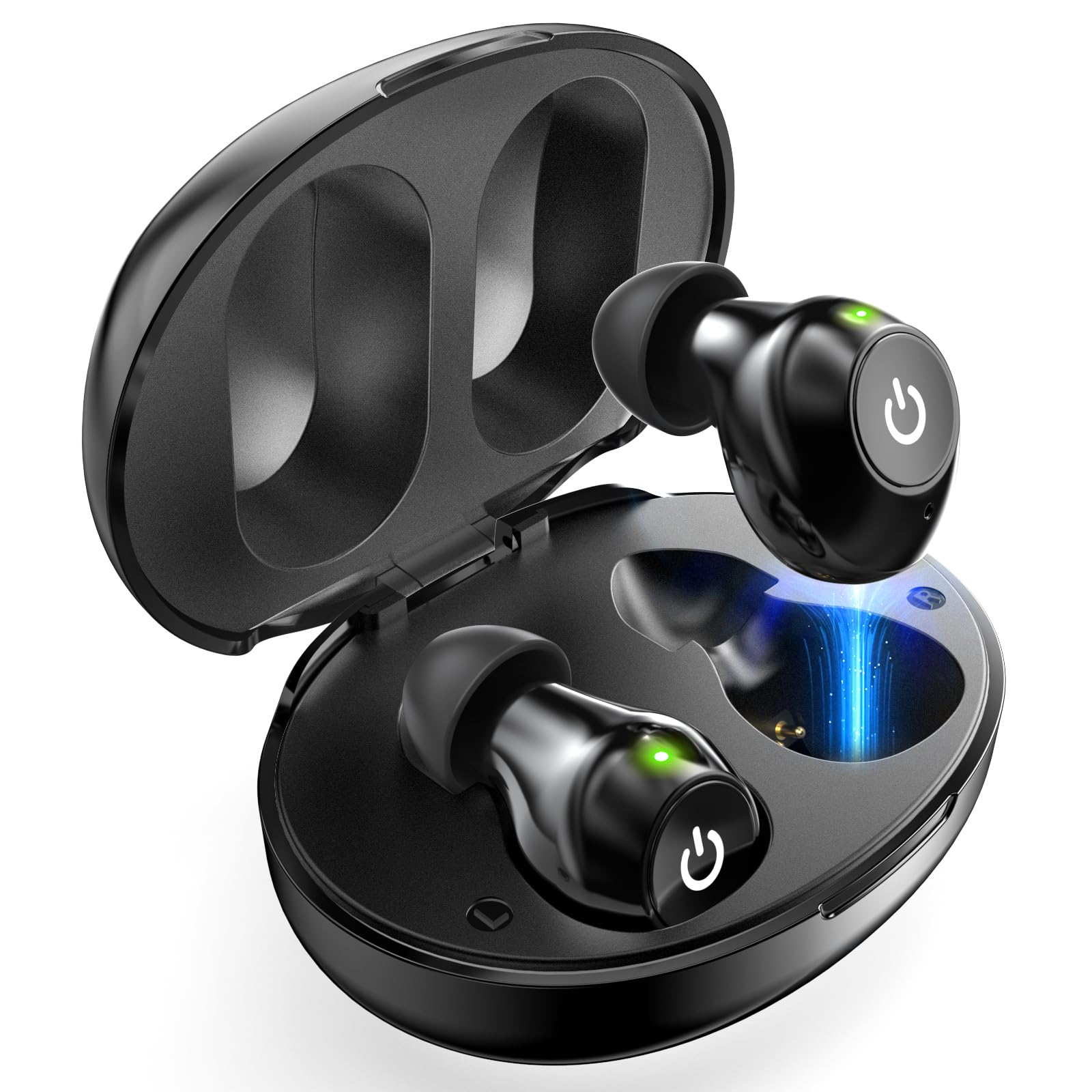
The Cloud Around JC301 proves that entry-level pricing no longer means sacrificing essential modern features. This in-the-ear model uses noise reduction technology that focuses on speech while attenuating traffic, wind, and household background noise — making it suitable for daily indoor and outdoor communication. The lightweight ergonomic body, paired with three sizes of soft silicone ear tips, ensures a stable fit that reduces ear fatigue during extended wear. It’s a design philosophy centered on simplicity and practicality rather than premium frills.
Battery performance is respectable for the tier: up to 30 hours per charge, with the charging case extending total usage to 80+ hours. The one-button volume control cycles through amplification levels without complicated settings, a deliberate design choice that serves seniors and first-time hearing aid users who may feel overwhelmed by multi-button remotes or smartphone apps. Setup is truly plug-and-play — remove from the case, insert, adjust volume, and go. The durable build quality and rigorous testing for consistent sound performance inspire confidence for daily use.
Customer feedback highlights dramatic improvements in hearing clarity and the discreet, barely-noticeable fit. Users consistently remark that the device “hears good,” delivers “clear, well-balanced sound,” and ranks as a “great option” for those testing the waters of hearing support. The main limitation is that the noise reduction, while effective for everyday environments, cannot match the adaptive multi-channel processing of higher-tier models in complex soundscapes. For budget-conscious users needing reliable baseline support, the JC301 delivers exceptional value.
Why it’s great
- Simple one-button operation ideal for first-time users
- 80+ hours total battery with charging case
- Lightweight, discreet fit with three ear tip sizes
Good to know
- Noise reduction struggles in very loud or complex acoustic environments
- No advanced features like directional mics or multi-mode tuning
7. SuperEar SE9000HP
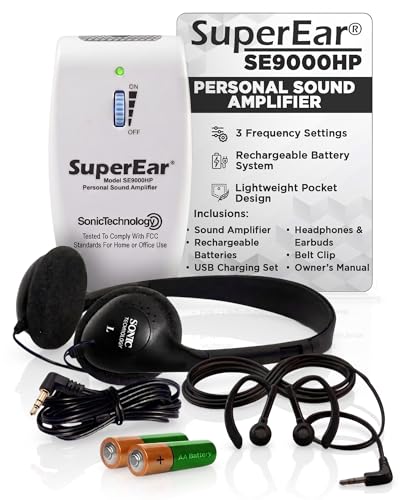
Unlike the discreet in-ear models above, the SuperEar SE9000HP is a pocket-sized personal sound amplification product that uses over-ear headphones to deliver up to 50 dB of ambient sound amplification. This headphone-based approach makes it fundamentally different from in-ear hearing aids: it’s not designed for daily hidden wear but for targeted use during conversations, television watching, or medical appointments where maximum amplification is needed. The 3-position frequency selector (Hi-Med-Low) lets you isolate the frequency range that matches your specific hearing profile — a manual approach to tuning that digital DSP chips handle automatically in pricier devices.
The system includes rechargeable Ni-MH AA batteries, a charging cube, a USB cable, ergonomic hook-style earbuds, a belt clip, and the control unit itself. The belt clip enables hands-free carry, making it practical for use during walks, doctor visits, or family gatherings. Because it’s a PSAP rather than a dedicated hearing aid, it amplifies all ambient sound equally — which helps users with severe loss hear again but also means background noise like rustling papers or passing cars gets amplified alongside speech. The tactile frequency selector switches are easy to operate by feel, an important consideration for users with vision challenges.
Reviews from users with severe hearing loss are consistently enthusiastic, with one describing it as “life-saving” for communicating during hospital stays where understanding the doctor was critical. A 92-year-old with severe loss in one ear achieved normal voice conversation using this device. The trade-offs are the cumbersome headgear and wiring — this is not the device for discreet daily wear — and the fact that the headphones may be too large for smaller head sizes. For those whose hearing loss is significant and whose priority is maximum amplification over discretion, the SuperEar SE9000HP is a proven workhorse.
Why it’s great
- 50 dB gain handles severe hearing loss that smaller devices cannot
- 3-position frequency selector for customized tonal response
- Rechargeable with belt clip for hands-free portability
Good to know
- Bulky headphone design and wiring are not discreet for daily wear
- Amplifies background noise equally alongside speech
FAQ
What’s the difference between a PSAP and an OTC hearing aid?
How do I choose between in-the-ear (ITE) and behind-the-ear (BTE) designs?
Why does feedback whistling happen and how do I stop it?
Can I use affordable auditory support gear for tinnitus relief?
Final Thoughts: The Verdict
For most users, the affordable auditory support gear winner is the Vivtone Lucid508 because its combination of 125-hour total battery life, tinnitus masking, and auto-on/off convenience covers the widest range of real-world needs. If you want 16-channel DSP precision for challenging sound environments, grab the Karthus CN223-E. And for maximum gain targeting severe hearing loss, nothing beats the SuperEar SE9000HP.