
Indoor carbon dioxide buildup is the invisible culprit behind foggy thinking, afternoon slumps, and restless sleep. Most homes and offices recirculate stale air, pushing CO₂ levels well above the 1,000 ppm threshold where cognitive performance measurably drops. A dedicated carbon dioxide detector puts a number on the air you breathe, telling you exactly when to crack a window and let the room breathe again.
I’m Min — the co-founder and writer behind Gadgets Feed. I’ve spent hundreds of hours cross-referencing NDIR sensor accuracy, alarm response times, and smart-home integration compatibility across every major CO₂ detector on the market to build this guide.
Whether you work from a home office, manage a greenhouse, or simply want to optimize your sleeping environment, this guide breaks down the most accurate and reliable carbon dioxide detectors available today so you can breathe easier with real data.
How To Choose The Best Carbon Dioxide Detectors
Not all air quality monitors are created equal. Some measure CO₂ using cheap sensors that drift after a few months, while others use precision NDIR technology that stays accurate for years. Understanding the key specs will help you pick the right detector for your specific space and use case.
Sensor Technology — NDIR vs. Electrochemical
The sensor is the heart of any CO₂ detector. NDIR (Non-Dispersive Infrared) sensors use infrared light to measure CO₂ concentration and are considered the industry standard for accuracy and long-term stability. They don’t wear out over time and maintain calibration for years. Electrochemical sensors, while cheaper, can degrade and lose accuracy, especially in humid environments. For any serious indoor air quality monitoring, look for a detector that explicitly states it uses NDIR or Swiss-made Sensirion sensor technology.
Measurement Range and Accuracy
Most consumer CO₂ detectors measure from 400 ppm (fresh outdoor air) up to 5,000 or even 9,000 ppm. The critical zone for health and comfort is between 400 and 2,000 ppm. Accuracy is typically stated as ±50 ppm or ±5% of the reading — the lower the error margin, the more reliable your data. Detectors that auto-calibrate to 400 ppm when exposed to fresh air are preferable because they self-correct over time without manual intervention.
Alerts and Smart Features
Some detectors simply show a number and color-coded display; others integrate with smart home ecosystems like Ring, Alexa, or proprietary apps. Smart detectors can push notifications to your phone when CO₂ levels cross your threshold, which is invaluable if you want to monitor a baby’s room or a home office while you’re away. For life-safety CO (carbon monoxide, not CO₂), hardwired or plug-in detectors with battery backup are the standard — these units must meet UL safety certifications and sound a loud 85-decibel alarm.
Quick Comparison
On smaller screens, swipe sideways to see the full table.
| Model | Category | Best For | Key Spec | Amazon |
|---|---|---|---|---|
| Newentor C1 | CO₂ Monitor | All-around home CO₂ tracking | Sensirion NDIR sensor, ±50 ppm accuracy | Amazon |
| SwitchBot Meter Pro CO2 | Smart CO₂ Monitor | App-connected air quality tracking | Swiss NDIR sensor, 400-9,000 ppm range | Amazon |
| Kidde Smart Smoke & CO | Smart Alarm | Whole-home smart safety integration | Ring app alerts, 25% faster smoke detection | Amazon |
| KDWKD AK23CA | All-in-One Monitor | Multi-parameter air quality analysis | PM2.5 + HCHO + TVOC + CO₂ sensor suite | Amazon |
| Kidde KN-COPP-3 | Plug-In CO Alarm | Reliable wall outlet CO protection | 85 dB alarm, 9V battery backup | Amazon |
| TOPTES CT-580 | Handheld CO Detector | Diagnostic CO leak investigation | DDS sensor, 0.3 sec response, 0-1,000 ppm | Amazon |
| First Alert SMCO100 | Basic Combo Alarm | Affordable smoke & CO protection | Battery-operated, test/silence button | Amazon |
In‑Depth Reviews
1. Newentor C1 CO2 Monitor

The Newentor C1 packs a Swiss-made Sensirion PASens NDIR sensor into a compact, desk-friendly chassis — the same sensor tech used in devices costing twice as much. Its CO₂ reading drops to ~400 ppm within minutes of opening a window and climbs predictably in a closed room, giving you immediate, actionable feedback on ventilation quality.
The large color display shows CO₂, temperature, humidity, and time simultaneously, and a touch sensor lets you cycle through three brightness levels (including off for bedrooms). It even doubles as an alarm clock with programmable alerts. Setup is truly plug-and-play: power via USB-C or 3 AAA batteries, and the unit auto-calibrates using fresh air baselines.
Customer reviews consistently highlight the vibrant display, responsive sensor, and exceptional warranty support — one reviewer reported a replacement unit shipped immediately after a display issue in high humidity. The lack of Wi-Fi or smart-home integration is the only notable omission, but for pure standalone CO₂ monitoring accuracy, this is the benchmark.
Why it’s great
- Swiss Sensirion NDIR sensor delivers ±50 ppm accuracy
- Voice alerts and customizable CO₂ threshold alarms
- Multi-function display includes clock, temp, and humidity
Good to know
- No Wi-Fi, Bluetooth, or app connectivity
- Battery life is short in battery mode without USB power
2. SwitchBot Meter Pro CO2

The SwitchBot Meter Pro CO2 brings smart-home smarts to CO₂ monitoring with a sleek 92 mm display that simultaneously shows CO₂, temperature, humidity, time, date, and a comfort-level indicator. Its Swiss-made NDIR sensor samples every second with ±50 ppm accuracy across a 400–9,000 ppm range, making it one of the most responsive monitors on the market.
Three alert methods — audible buzzer, visual screen flash, and optional app notifications (requires SwitchBot Hub) — ensure you never miss a ventilation warning. The battery is rated for up to 12 months of typical use on a single charge, and the unit includes wall-mount holes and an adjustable stand for flexible placement in any room.
Real-world accuracy is impressive: one reviewer cross-checked it against a high-end air purifier and found a deviation of only 7 ppm. The app shows trend graphs over time, though some users report the scrolling interface can lag. For anyone who wants historical data and remote alerts, this is the most polished smart CO₂ detector available.
Why it’s great
- Swiss NDIR sensor with 1-second refresh rate
- Bluetooth app connectivity with trend graphs
- 12-month battery life on a single charge
Good to know
- App notifications require separate SwitchBot Hub
- Some units shipped with calibration variance of ~50 ppm
3. Kidde Smart Smoke & CO Detector
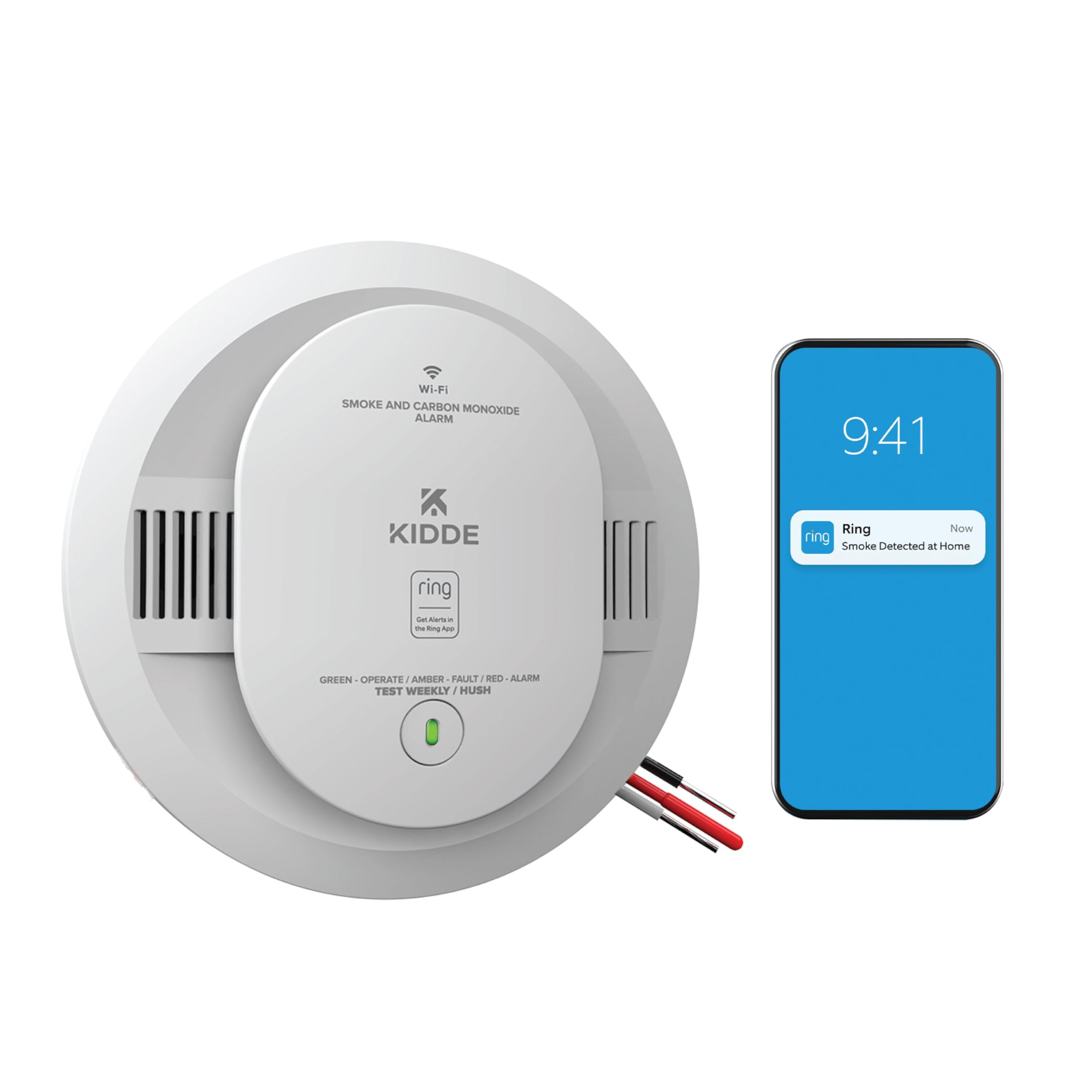
The Kidde Smart Smoke and CO Detector is the first alarm that integrates directly into the Ring app ecosystem — no separate hub or subscription required for real-time push notifications. It detects both smoke and CO simultaneously, with internal testing claiming 25% faster smoke detection than a leading competitor.
Installation is straightforward for anyone familiar with hardwired alarms: wire into existing 120V connections, snap on the AA battery backup, and the Ring app auto-discovers the device. You can optionally add Ring’s 24/7 professional monitoring for /month, but the free tier already gives you instant alerts for smoke, CO, and low battery — even when you’re away from home.
Reviews praise it as a worthy replacement for the discontinued Nest Protect, noting the seamless Ring integration and reduced nuisance alarms from cooking. A few users report firmware update chirps that can’t be silenced, and the lack of a battery-only version limits placement to rooms with existing hardwired wiring.
Why it’s great
- Direct Ring app integration with free push notifications
- 25% faster smoke detection vs. leading competitor
- Hardwired with AA battery backup for power outages
Good to know
- Requires hardwired installation; no battery-only model
- Firmware updates trigger brief chirping with no mute option
4. KDWKD AK23CA Indoor Air Quality Monitor
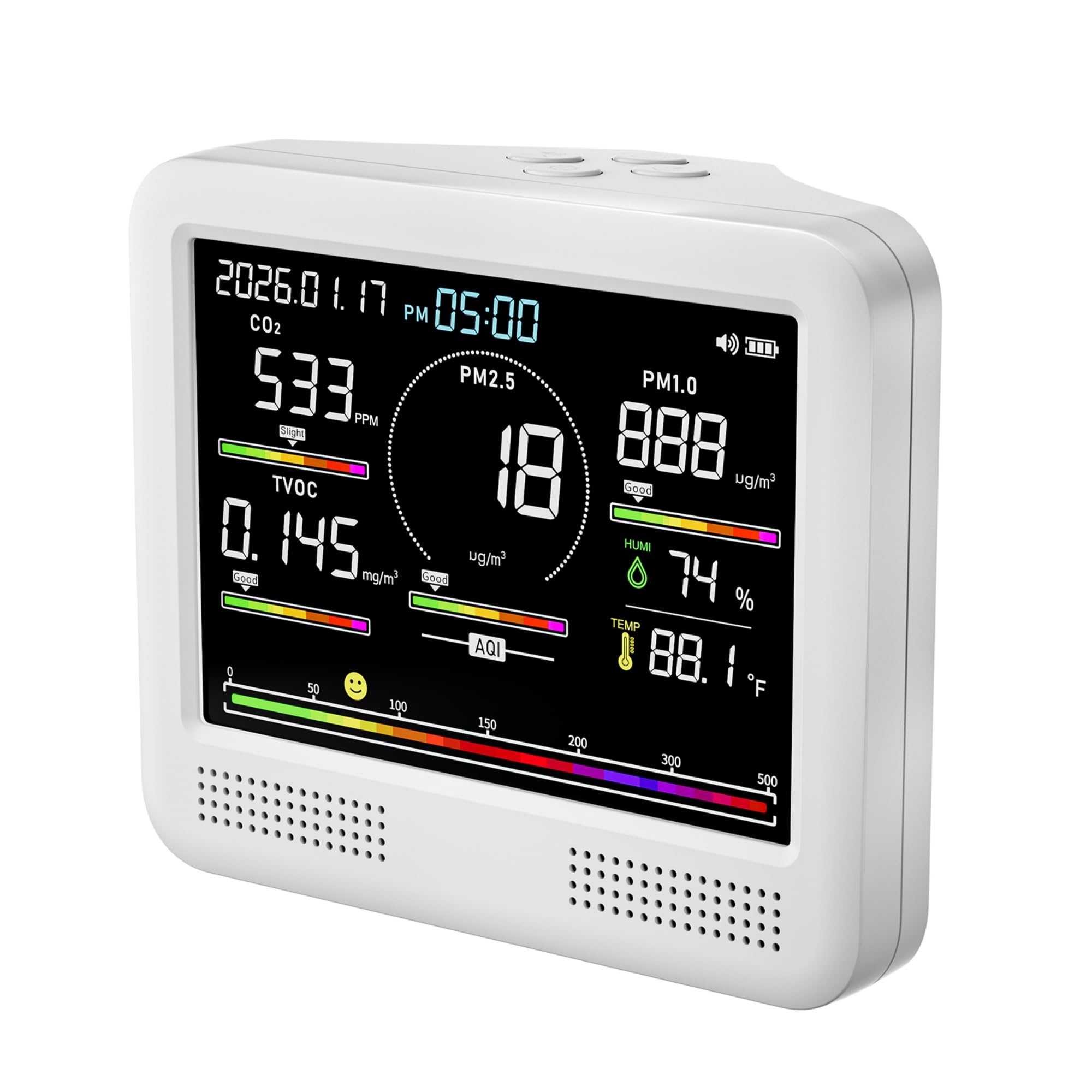
The KDWKD AK23CA goes beyond CO₂ to give you a full respiratory-health dashboard: it simultaneously tracks CO₂, PM0.3 through PM10 particulate matter, formaldehyde (HCHO), total volatile organic compounds (TVOC), temperature, and humidity. This makes it ideal for new construction, recent renovations, or wildfire season when multiple pollutants are a concern.
The large color screen presents all data in an easy-to-scan AQI layout with color-coded indicators. Its built-in rechargeable battery delivers up to 9 hours of run time, so you can carry it room to room without hunting for an outlet. The compact ABS body weighs almost nothing and fits comfortably on a desk, nightstand, or bookshelf.
While the CO₂ sensor uses an accurate NDIR element, the unit’s strength is its holistic approach. It’s the only device in this roundup that can tell you whether your headache is from CO₂ buildup, formaldehyde off-gassing, or particulate pollution — a powerful tool for diagnosing chronic air quality issues.
Why it’s great
- Measures CO₂ plus PM2.5, HCHO, TVOC, temp, and humidity
- 9-hour rechargeable battery for portable use
- Large color AQI display with intuitive indicators
Good to know
- CO₂ accuracy is secondary to particulate and VOC focus
- Brand KDWKD has limited long-term reliability data
5. Kidde KN-COPP-3 Plug-In CO Detector (2-Pack)

This Kidde plug-in CO detector is a traditional, UL-certified life-safety device that prioritizes reliability over smart features. It plugs directly into a standard 120V outlet, with a 9-volt battery backup ensuring continued protection during power outages — a critical feature for CO alarms since CO leaks often accompany storms and grid failures.
The digital LED display shows real-time CO concentration in ppm, and the 85-decibel alarm activates when levels become dangerous. Peak Level Memory records the highest CO reading since the last test, which is invaluable for tracking intermittent leaks. Users report it accurately detecting CO levels as low as 30 ppm and sounding unmistakably loud alerts that wake even deep sleepers.
One reviewer credits this unit with saving their family from 463 ppm CO readings caused by a loose boiler connection. The two-pack makes it easy to cover both upstairs and downstairs levels. The only recurring complaint is tech support responsiveness, but the 10-year limited warranty provides substantial peace of mind.
Why it’s great
- 85 dB alarm with digital ppm display for real-time awareness
- 9V battery backup ensures 24/7 protection without power
- Peak Level Memory tracks intermittent CO events
Good to know
- No smart-home or Wi-Fi connectivity
- Some users report unhelpful tech support experiences
6. TOPTES CT-580 Handheld CO Detector

The TOPTES CT-580 is a diagnostic-grade handheld CO detector designed for leak investigation, not static wall mounting. Its DDS electrochemical sensor responds in just 0.3 seconds with a range of 0–1,000 ppm, making it the fastest-reacting device in this lineup — essential for pinpointing the exact source of a CO leak in an RV, boat, or around a furnace.
Three simultaneous alarm modes — visual indicator light, 85+ dB audible alarm, and vibration — ensure you’re alerted in any environment, whether you’re wearing ear protection in a workshop or sleeping in a camper. The bright TFT color display shows real-time ppm with adjustable brightness and auto-off, and the built-in flashlight helps you inspect dark crawl spaces or engine compartments.
Users report exceptional results: one boat owner traced a cabin CO leak to a specific engine, and an RV owner pinpointed a propane water heater leak. The USB-C rechargeable battery and included protective case make it truly portable. It’s not a replacement for a wall-mounted safety alarm, but for active leak detection, nothing else here matches its diagnostic speed.
Why it’s great
- 0.3-second response time with DDS electrochemical sensor
- Three alert modes: light, sound, and vibration
- USB-C rechargeable with flashlight and protective case
Good to know
- Designed for portable/investigative use, not permanent monitoring
- Measures CO only, not CO₂ or other air quality parameters
7. First Alert SMCO100 Combination Smoke & CO Alarm

The First Alert SMCO100 is the no-fuss entry point for basic smoke and CO protection. It combines both sensors in one compact, battery-operated unit that installs without any wiring — just twist it onto the mounting bracket and pull the battery tab. The Precision Detection technology reduces false alarms from cooking while maintaining fast response to real fires and CO buildup.
A single test/silence button lets you verify operation or hush nuisance alarms, and the end-of-life chirp tells you when the unit needs replacement after 10 years. It runs on two included AA batteries, so there’s no hardwiring required — perfect for apartments, rental properties, or rooms without existing wiring.
Customer reviews are overwhelmingly positive, with long-time First Alert buyers calling it their go-to brand for four decades. The trade-off is clear: you get reliable protection without any smart features, digital display, or CO₂ measurement. If you need life-safety monitoring at the lowest possible cost per square foot, this is the sensible choice.
Why it’s great
- Combines smoke and CO detection in one battery-powered unit
- Precision Detection reduces cooking nuisance alarms
- Ultra-simple installation — no hardwiring required
Good to know
- No digital display, CO₂ measurement, or smart features
- Batteries need periodic replacement (10-year unit lifespan)
FAQ
What is the difference between a CO2 detector and a CO detector?
How often does a CO2 detector need to be calibrated?
Can I use a carbon dioxide detector in a greenhouse or grow tent?
Final Thoughts: The Verdict
For most users, the carbon dioxide detectors winner is the Newentor C1 because it combines a premium Swiss Sensirion NDIR sensor with a clear, multi-function display and voice alerts at an accessible mid-range price. If you want smart-home connectivity with trend tracking and app notifications, grab the SwitchBot Meter Pro CO2. And for life-safety CO protection with seamless Ring integration, nothing beats the Kidde Smart Smoke & CO Detector.