
Moving from a 61‑key controller to a 76‑key board is the single biggest upgrade a composer or performer can make — you gain two full octaves of range without jumping to the bulky, couch‑like footprint of an 88‑key slab. The extra keys unlock left‑hand bass lines while keeping your right hand in melodic territory, and they give electronic producers enough real estate to play orchestral splits without constantly re‑mapping zones. But the market is crowded with synth‑action toys, flimsy keybeds, and controllers that promise deep DAW integration but deliver frustration instead of flow.
I’m Min — the co‑founder and writer behind Gadgets Feed. I’ve spent hundreds of hours cross‑referencing keybed actions, polyphony limits, software bundles, and connectivity specs to separate the serious instruments from the plastic disappointments in this specific size class.
Whether you are building a home studio, teaching yourself piano, or looking for a stage‑ready board that won’t overpower your back, this guide cuts through the hype to find the best 76 key midi keyboard for your actual playing style and budget.
How To Choose The Best 76 Key MIDI Keyboard
A 76‑key controller sits in a sweet spot that fewer manufacturers serve well than the ubiquitous 61‑key or 88‑key formats. The extra 15 keys over a standard 61‑key board allow you to play two‑handed piano parts and orchestral splits without running out of room, yet the chassis remains light enough for regular transport. Nailing the right choice means understanding three critical pillars: keybed feel, sound engine or software ecosystem, and the physical connectivity that matches your studio rig.
Keybed Feel — From Synth Action to Progressive Hammer
The keybed is the single most important component of any keyboard controller. Synth‑action keys are spring‑loaded and lightweight — perfect for fast organ runs, synth leads, and trance arpeggios, but they offer zero resistance for piano dynamics. Semi‑weighted keys add mass to the lever, providing a middle ground that responds to finger velocity with enough tactile feedback to shape expression. Fully weighted or hammer‑action keys simulate the heft of an acoustic grand piano, which is essential for building proper finger strength and controlling soft/loud passages. If you primarily produce electronic music and play chords and riffs rather than classical pieces, semi‑weighted with velocity sensitivity is the pragmatic choice — it keeps the board portable without sacrificing musicality.
Polyphony, Sound Engines, and Software Integration
Polyphony determines how many notes you can sustain simultaneously before the board cuts off earlier notes. 64‑note polyphony is the entry point for decent piano work, but 128‑note polyphony is far safer when you use the sustain pedal and layer multiple patches. Many keyboards in this category come with built‑in sound engines — General MIDI tone generators with hundreds of presets. For producers who work exclusively in a DAW, a controller without any internal sounds (a “dumb” controller) paired with virtual instruments like Kontakt or Analog Lab is often a better value because you are paying for keybed quality and integration rather than redundant sound ROM. The best of both worlds are hybrid boards that include a capable sound engine for standalone practice and full MIDI control for studio use.
Connectivity — Ports That Future‑Proof Your Studio
USB‑MIDI is table stakes, but look for boards that also offer traditional 5‑pin MIDI in/out jacks so you can control hardware synthesizers or older gear. A dedicated 3.5 mm or 1/4 inch headphone jack with its own volume control is critical for late‑night practice sessions without firing up speakers. Expression pedal and sustain pedal inputs are non‑negotiable for any serious piano work — a board with only one pedal jack limits your ability to use a triple‑pedal unit or a continuous expression pedal for synth parameter control. If you plan to perform live, check whether the keyboard can run on battery power or has a standard IEC power connector rather than a wall‑wart that can be easily lost.
Quick Comparison
On smaller screens, swipe sideways to see the full table.
| Model | Category | Best For | Key Spec | Amazon |
|---|---|---|---|---|
| Yamaha YPT‑W320 | Portable Arranger | Beginners & learning | 76 touch‑sensitive keys, 64‑note polyphony | Amazon |
| Yamaha NP‑32 | Ultra‑Portable | Gigging & practice | Graded Soft Touch, 64‑note polyphony | Amazon |
| Arturia KeyLab 61 MkII | Premium Controller | Studio production | 61 semi‑weighted keys w/ aftertouch | Amazon |
| Arturia KeyLab Essential mk3 | Value Controller | DAW workflow | 61 synth‑action keys, 2,000+ presets | Amazon |
| Native Instruments S‑Series MK3 | Flagship | Komplete integration | Fatar TP/80SK, polyphonic aftertouch | Amazon |
| STRICH SDP‑120 (Stand Bundle) | Home Piano | Home piano practice | 88 fully‑weighted keys, 128‑note polyphony | Amazon |
| STRICH SDP‑120 (Keyboard Only) | Budget Weighted | Weighted feel on a budget | 88 fully‑weighted keys, 128 tones | Amazon |
| UISCOM 88‑Key Weighted | Furniture Piano | Decor‑conscious players | 88 progressive hammer‑action keys | Amazon |
| UISCOM 88‑Key Digital Piano | Complete Bundle | Absolute beginners | 88 semi‑weighted keys, 600 tones | Amazon |
In‑Depth Reviews
1. Yamaha YPT‑W320

The Yamaha YPT‑W320 is the rare board that nails the 76‑key sweet spot — it is wide enough for two‑handed piano parts yet light enough to carry to lessons or band practice. Its touch‑sensitive keys respond to finger velocity, letting you shape volume and timbre from whisper‑soft pianissimo to aggressive fortissimo. The built‑in sound engine delivers realistic acoustic piano tones alongside electric pianos, organs, and woodwind voices that sound convincing enough for casual performance and practice.
Yamaha’s Smart Chord feature automatically generates full chords from single‑finger input, which is a genuine teaching aid for beginners still learning harmony. The on‑board learning suite includes step‑by‑step song tutorials and a Touch Tutor that teaches dynamic control. With 64‑note polyphony, you can hold the sustain pedal through complex passages without notes dropping out — essential for classical and ballad styles where overlapping resonance is part of the sound.
The speaker system is adequate for bedroom and classroom use but lacks the headroom for outdoor or ensemble playing. Connectivity is limited to a single 6.35 mm headphone jack and a 3.5 mm auxiliary input, so you will need an adapter for standard studio headphones. For the price, however, the YPT‑W320 delivers a complete learning and performance package that outclasses 61‑key alternatives in every meaningful way.
Why it’s great
- Full‑size 76 touch‑sensitive keys with realistic velocity response
- Comprehensive learning suite with Smart Chord and Touch Tutor
- Strong piano and electric piano sounds from Yamaha’s AWM engine
Good to know
- Built‑in speaker lacks volume for outdoor or large‑room use
- Limited audio connectivity — no stereo line outputs
- Power adapter is hidden inside the box styrofoam (easy to miss)
2. Yamaha NP‑32

The Yamaha NP‑32 Piaggero is the benchmark for ultra‑lightweight 76‑key portability. Weighing under 12 pounds and capable of running on batteries, it can be tossed into the back of a car for a gig, carried to a friend’s house for a jam session, or used as a compact practice board that doesn’t dominate your living space. The Graded Soft Touch action means the keys are lighter in the upper register and heavier in the lower register, mimicking the progressive resistance of an acoustic grand piano without the full weight of hammer mechanisms.
Advanced Wave Memory stereo sampling gives the NP‑32 a surprisingly rich acoustic piano sound that punches above its weight class. The stereo samples respond to velocity with natural timbral changes rather than simple volume scaling, so a hard strike on middle C produces the bright, percussive attack of felt hitting string rather than just a louder version of a soft sample. The USB‑to‑Host port connects directly to iOS and computer apps for educational and music‑creation software, and the dedicated controller app adds a graphical interface for navigating sounds and settings.
The speaker system is loud enough for small rooms and intimate gigs, but the raw audio output through the headphone jack is noticeably better than the internal speakers, revealing the full depth of the AWM samples. Some users report that the middle C key is slightly off‑center, which can feel awkward during seated practice. The 64‑note polyphony is sufficient for most repertoire, but fast pedal‑heavy pieces may hit the ceiling. The NP‑32 remains the best choice for the musician who genuinely needs to move their keyboard regularly.
Why it’s great
- Ultra‑lightweight design — under 12 lbs, battery‑powerable
- Graded Soft Touch action provides authentic grand piano feel
- AWM stereo samples produce rich, velocity‑sensitive piano tones
Good to know
- Middle C key placement is off‑center for some users
- No standard 1/4 inch stereo audio outputs for direct recording
- Polyphony ceiling of 64 notes may cut off in dense, pedal‑heavy passages
3. Arturia KeyLab 61 MkII

The Arturia KeyLab 61 MkII is the gold standard for deep studio integration, packing a semi‑weighted keybed with aftertouch, nine faders, nine encoders, and eight velocity‑sensitive pads into a chassis reinforced with aluminum and real wood side panels. The aftertouch‑enabled keybed responds to additional pressure after the initial strike, allowing you to shape synth parameters like filter cutoff or vibrato by leaning into the keys — a feature that synth players and sound designers rely on for expressive leads and pads.
Beyond its tactile hardware, the MkII ships with Analog Lab 3, providing access to over 6,000 presets drawn from Arturia’s V Collection of virtual analog, digital, and electro‑acoustic instruments. The package also includes Arturia Piano V for physically modeled grand pianos and Ableton Live Lite for recording and arranging. The three‑mode control system — Analog Lab, DAW, and User — lets you flip between browsing sounds, mixing your DAW, or controlling any MIDI‑assignable parameter without re‑mapping.
Connectivity is where the KeyLab 61 MkII separates itself from the competition: full‑sized 5‑pin MIDI in/out, four CV outputs and one CV input for modular synthesizer control, plus five expression pedal inputs. This makes it the bridge between a traditional MIDI controller and a modular performance hub. The downside is weight — at over 12 pounds it is not a casual transport board — and the price puts it firmly in premium territory. For producers who want a single controller that integrates DAW, software instruments, and hardware synths, the MkII is unmatched.
Why it’s great
- Aftertouch‑enabled semi‑weighted keybed for expressive synth playing
- CV in/out for modular synthesizer integration
- Bundled Analog Lab 3, Piano V, and Ableton Live Lite
Good to know
- Heavy — not ideal for frequent transport
- Keybed feel is semi‑weighted, not fully weighted
- No built‑in sound engine — requires computer or module for audio
4. Arturia KeyLab Essential mk3

The Arturia KeyLab Essential mk3 is the budget‑conscious producer’s gateway to the Arturia ecosystem without sacrificing the features that make the brand famous. At 61 keys with synth‑action, it is not a weighted piano replacement, but its eight RGB‑backlit velocity pads, nine faders, and nine encoders provide real‑time hands‑on control that typical entry‑level controllers lack. The new 2.5‑inch LCD screen with contextual buttons gives you instant feedback when browsing presets or tweaking parameters, eliminating the guesswork of unlabeled knobs.
The mk3 ships with an expanded Analog Lab V package that now includes over 2,000 presets spanning vintage keyboards, modern polysynths, orchestral instruments, and hybrid textures. The software bundle also adds two high‑quality piano instruments — UVI Model D and Native Instruments’ The Gentleman — along with subscriptions to Loopcloud and Melodics for sample discovery and skill building. The custom DAW integration scripts for Ableton Live, Logic Pro X, FL Studio, and others work out of the box, so you spend less time mapping controls and more time making music.
The built‑in Scale Mode, Chord Mode, and Arpeggiator are genuine workflow accelerators — you can lock the keyboard to a specific scale so every key sounds correct, trigger pre‑defined chords from single notes, or generate evolving arpeggio patterns in real time. The keybed is synth‑action, which means it is lightweight and springy; piano players looking for weighted resistance will need to look at the KeyLab 61 MkII instead. For electronic producers and beatmakers on a budget, the KeyLab Essential mk3 offers extraordinary value per dollar.
Why it’s great
- Comprehensive DAW integration scripts work out of the box
- Expanded Analog Lab V with 2,000+ high‑quality presets
- Scale, Chord, and Arpeggiator modes accelerate composition
Good to know
- Synth‑action keybed lacks the resistance of semi‑weighted or weighted
- No CV connections for modular gear
- Plastic chassis feels less premium than the MkII line
5. Native Instruments S‑Series Komplete Kontrol S88 MK3

The Native Instruments S‑Series Komplete Kontrol S88 MK3 is a purpose‑built instrument for producers who live inside the Native Instruments ecosystem. Its Fatar TP/80SK semi‑weighted keybed is widely regarded as one of the best semi‑weighted actions available, offering a springy initial zone that transitions into a firm, controlled secondary zone — ideal for both expressive piano playing and rapid synth passages. The inclusion of polyphonic aftertouch as standard means each individual key can apply independent pressure to modulate parameters, a feature that synth sound designers and cinematic composers rely on for evolving textures.
The high‑resolution full‑color screen provides a visual interface for browsing, tweaking, and mixing Kontakt and Komplete Kontrol instruments directly from the keyboard. The integration is deep: Light Guide LEDs show key ranges, scales, and chord voicings, while the touch‑capacitive volume slider and infinite‑rotation selection wheel let you navigate libraries with precision. The bundled Komplete 14 Select gives you a strong starter library of synths, pianos, and sampled instruments, though serious users will want to upgrade to the full Kontakt 7 for the complete sonic palette.
The S88 MK3 ships with outdated firmware that requires a mandatory update via Native Access, and the setup process is notably more involved than competing controllers. A small percentage of units have experienced firmware recognition issues that could not be resolved through troubleshooting, leading to returns. At a premium price point, every detail must be flawless, and the occasional hardware/firmware hiccup is a legitimate concern. When it works, however, the integration with Kontakt and Komplete is seamless and inspiring.
Why it’s great
- Fatar TP/80SK semi‑weighted keybed with polyphonic aftertouch
- Deep NKS integration with Kontakt and Komplete instruments
- High‑resolution color screen and Light Guide LED system
Good to know
- Firmware update process is non‑trivial and occasionally fails
- Premium price with no built‑in sound engine
- Requires dedicated 20W USB‑C PSU for standalone operation
6. STRICH SDP‑120 Bundle (Stand + Pedal)

The STRICH SDP‑120 bundle delivers fully‑weighted hammer‑action keys at a price point where most competitors offer only semi‑weighted or synth‑action. The weighted keybed provides the graded resistance of an acoustic grand piano, building proper finger strength and dynamic control for classical and jazz players. The bundle includes a high‑density board stand and a sustain pedal, so you get a complete home practice setup out of the box without hunting for accessories.
The sound engine offers 200 tones, 700 rhythms, and 110 demo songs, all driven through dual 15‑watt speakers that fill a small to medium‑sized room with authority. The 128‑note polyphony ensures that complex pedal‑heavy passages never cut off prematurely, a significant upgrade over the 64‑note limit found on cheaper weighted boards. Wireless MIDI connectivity is built in, letting you control iOS and computer DAWs without a cable — a feature that is rare at this price tier.
The instruction manual is sparse, and advanced functions like keyboard splits and layer adjustments require trial and error to figure out. The internal speakers are functional for practice but lack the clarity and headroom of dedicated studio monitors or a keyboard amplifier — the sound improves markedly when using headphones. For the beginner or intermediate player who wants a weighted 88‑key experience with a stand included, the SDP‑120 bundle is a compelling value proposition.
Why it’s great
- Fully‑weighted hammer‑action keys at an accessible price point
- 128‑note polyphony eliminates note cutoff in dense passages
- Includes stand, sustain pedal, and wireless MIDI connectivity
Good to know
- Instruction manual is sparse — advanced functions require experimentation
- Internal speakers are adequate for practice but lack studio‑grade clarity
- Weighted action is lighter than premium brands, which may not suit purists
7. STRICH SDP‑120 (Keyboard Only)

The keyboard‑only version of the STRICH SDP‑120 strips away the stand and pedal to offer the same fully‑weighted hammer‑action keybed at an even lower entry point. This is the board to pick if you already own a Z‑stand or an X‑stand and only need the instrument itself. The weighted action is lighter than premium brands like Roland or Yamaha, which many players actually prefer — it reduces finger fatigue during long practice sessions while still providing the momentum and resistance necessary to develop proper technique.
The sound engine includes 128 tones, 200 rhythms, and 110 demo songs, with dual 15‑watt speakers that deliver passable sound quality for practice. The USB‑MIDI and wireless MIDI connectivity allow you to connect the board to DAWs and music apps without proprietary cables. The sustain pedal included in the box is a basic switch‑type pedal that works for on/off sustain but does not support half‑pedaling — an upgrade to a continuous pedal is recommended for serious piano work.
The build quality feels robust for the price, but the plastic chassis does not have the premium heft of a slab like the Yamaha P‑series. The default piano sound is decent for practice but lacks the depth and resonance of higher‑end digital pianos — the sound improves significantly when routed through a DAW piano VST. For learners on a tight budget who refuse to compromise on weighted keys, the SDP‑120 is the most honest option at this tier.
Why it’s great
- Fully‑weighted hammer‑action keys at the lowest price point available
- Lighter action reduces fatigue, ideal for long practice sessions
- Wireless MIDI included — no USB cable required for DAW connection
Good to know
- No stand or sustain pedal included — must purchase separately
- Default piano sound is average; best used with VST instruments
- Basic sustain pedal does not support half‑pedaling articulation
8. UISCOM 88‑Key Weighted Digital Piano (Desk/Vanity)

The UISCOM 88‑Key Weighted Digital Piano solves a unique problem: it looks like a piece of furniture rather than a musical instrument, with a wooden desk chassis that can double as a vanity or writing desk when the keyboard lid is closed. The progressive hammer‑action keybed uses graded weighting — heavier in the bass, lighter in the treble — which closely mirrors the touch of an acoustic upright piano. The French Dream5704 sound chip delivers sampled piano tones that are warm and dynamic, with layered resonance that responds to finger velocity.
The board includes eight distinct tones, 40 demo songs, reverb, chorus, and tempo controls, plus a dual‑tone mode that layers two sounds simultaneously. The custom triple‑pedal unit provides sustain, sostenuto, and soft pedal functionality — a rare inclusion at this price point that gives pianists the full expressive palette needed for classical repertoire. The MIDI functionality allows connection to computers and external MIDI gear, and the USB port supports MP3 playback directly from a thumb drive.
The keybed action is lighter than a true acoustic grand, which some experienced pianists will notice, but for casual players and beginners the feel is perfectly adequate. The painted/ lacquered finish is attractive but can show fingerprints and dust. At nearly 20 kg, this is not a board you move around — it is designed as a permanent piece of furniture. For the player who values aesthetics and wants a piano that blends into a living room, the UISCOM desk piano is a thoughtful and well‑executed solution.
Why it’s great
- Furniture‑grade wooden chassis doubles as desk or vanity
- Triple‑pedal unit provides full sustain, sostenuto, and soft control
- French Dream5704 chip delivers warm, dynamic sampled piano tones
Good to know
- Keybed action is lighter than acoustic grand — purists may notice
- Heavy and permanent — not designed for transport or moving
- Finish shows fingerprints and requires regular dusting
9. UISCOM 88‑Key Digital Piano Bundle
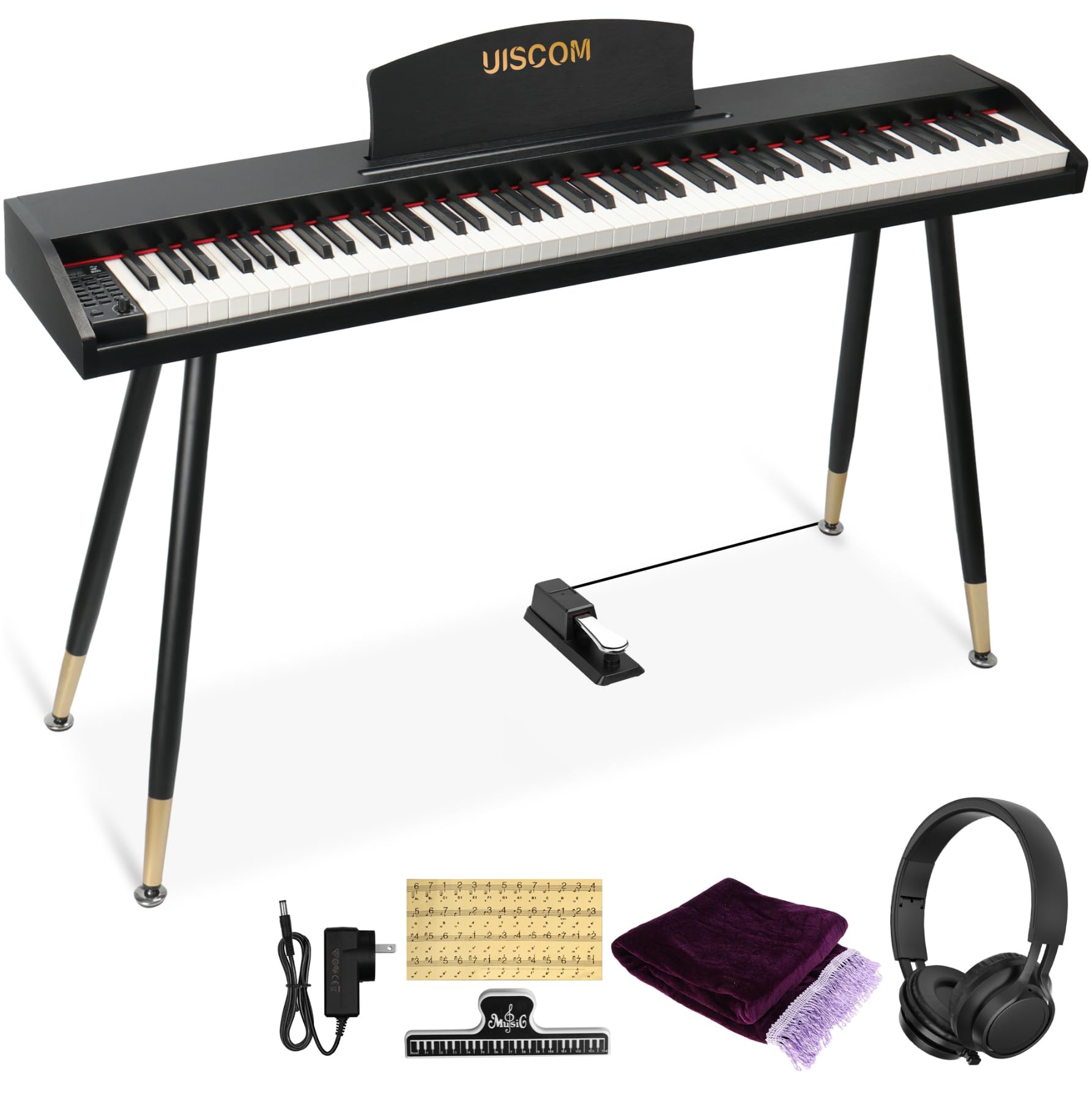
The UISCOM 88‑Key Digital Piano Bundle is the complete starter package for the absolute beginner who needs everything in one box: a full 88‑key keyboard, an X‑style stand, a triple‑pedal unit, headphones, a sheet music stand, a piano cover, and even key‑learning stickers. The semi‑weighted keys are lighter and springier than fully weighted boards, making them appropriate for young children and absolute beginners who would struggle with the heavy resistance of hammer‑action keys. The key size is slightly reduced, which can be an advantage for players with smaller hands.
The sound engine is absurdly generous for the price — 600 tones, 800 rhythms, and 80 demo songs — plus split, layer, transposition, recording, and playback functions. The USB‑MIDI connection works with learning apps like POP Piano and Perfect Piano on tablets and phones, and the Bluetooth function lets the built‑in speakers double as a wireless speaker for external audio. The wood grain finish on the chassis is more convincing than expected at this price bracket.
The semi‑weighted keys have a clacky, plastic feel that experienced players will find unsatisfying, and the default piano sound is thin compared to even entry‑level Yamaha or Casio boards. The sustain pedal is a basic switch unit that only offers on/off control. This bundle is not for the serious pianist or the professional producer — it is for the family that wants to see if their child will stick with lessons before investing in a higher‑end instrument. For that specific purpose, the UISCOM bundle is an honest, fully‑featured starting point.
Why it’s great
- Complete all‑in‑one starter bundle — stand, pedal, headphones, stickers included
- 600 tones, 800 rhythms, and recording functions for creative exploration
- USB‑MIDI and Bluetooth connectivity for app‑based learning
Good to know
- Semi‑weighted keys feel clacky and plastic — not for serious pianists
- Default piano sound is thin and lacks dynamic depth
- Slightly reduced key size may feel cramped to adult players
FAQ
Why choose a 76‑key keyboard instead of a 61‑key or 88‑key board?
Can I use a 76‑key MIDI keyboard without a computer?
What does aftertouch do and who needs it?
Final Thoughts: The Verdict
For most users, the best 76 key midi keyboard winner is the Yamaha YPT‑W320 because it delivers 76 touch‑sensitive keys, a proven sound engine from Yamaha, and a complete learning suite at a price that does not punish beginners. If you need ultra‑portability for regular gigging and travel, grab the Yamaha NP‑32 — its Graded Soft Touch action and battery power make it the most practical board for the mobile musician. And for studio producers who demand aftertouch, deep DAW integration, and the ability to control modular hardware, nothing on this list beats the Arturia KeyLab 61 MkII.