
The hunt for a capable stereo amplifier on a tight budget often leads to a frustrating choice: noisy units that hiss at idle or fragile boxes that clip at the first sign of bass. The real trick isn’t just finding the lowest price tag — it’s identifying which affordable designs deliver clean, stable power without the distortion that ruins the listening experience. A great budget amp must balance the amplifier chipset, the quality of the power supply, and the thermal management that keeps the circuitry stable during long sessions.
I’m Min — the co-founder and writer behind Gadgets Feed. I’ve spent hundreds of hours cross-referencing the technical specifications, customer performance reports, and component quality of the most popular budget amplifiers to separate the genuinely capable units from the flashy disappointments.
This commercial-intent guide isolates the absolute best performers in the budget stereo amplifier category, focusing on real-world wattage, input flexibility, and the build details that matter most for a reliable home audio setup.
How To Choose The Best Budget Stereo Amplifier
Picking the right budget-friendly amplifier is about knowing which corners the manufacturer cut and which they didn’t. The best units focus their component budget on the amplifier chip, the power supply, and the output stage — not on flashy screens or plastic enclosures.
Amplifier Chipset: TPA3116 vs. TPA3255
The amplifier chip is the heart of any Class D budget amplifier. The older TPA3116 chip found in many entry-level models delivers around 50W per channel into 4 ohms with acceptable distortion. The newer TPA3255 chip, used in higher-performing budget units, can push over 100W per channel into 4 ohms with significantly lower total harmonic distortion (THD). If you have speakers with sensitivity below 88dB, the extra headroom of the TPA3255 is essential for clean listening.
Power Supply Voltage and Current
An amplifier is only as good as its power supply. A 24V/4.5A adapter (roughly 108W total) limits the amplifier to modest volumes with higher distortion. A 48V/5A adapter (240W total) provides the voltage swing necessary for dynamic peaks and bass transients without clipping. Many budget amplifiers ship with a lower-voltage adapter but accept a higher-voltage unit as an upgrade — check the maximum supply voltage rating before swapping.
Input Connectivity and Pre-Out Features
Evaluate which sources you need. A unit with Bluetooth 5.0 or 5.2 is essential for wireless streaming. A phono input is mandatory if you have a turntable without a built-in preamp. A subwoofer pre-out (especially one that is volume-controlled) allows you to integrate a powered subwoofer for a true 2.1 system. Dual RCA inputs are sufficient for most desktop setups, while optical and coaxial inputs let you connect a TV or game console directly.
Quick Comparison
On smaller screens, swipe sideways to see the full table.
| Model | Category | Best For | Key Spec | Amazon |
|---|---|---|---|---|
| Fosi Audio V3 | Premium Budget | Audiophile-grade near-field listening | TPA3255 chip, 48V PSU | Amazon |
| AIYIMA A07 MAX | Mid-Range | High-power stereo or mono setups | 600W peak, bridgeable mono | Amazon |
| Ampapa D1 | Premium Budget | VU meter display and balanced inputs | Digital VU meter, TRS balanced | Amazon |
| Donner MAMP2 | Mid-Range | Versatile system with phono and optical | Bluetooth 5.3, phono input | Amazon |
| Fosi Audio BL20A | Entry-Level | Simple 2.1 system with bass/treble controls | 2x TPA3116 chips, pre-out | Amazon |
| Donner 1000W | Mid-Range | Multi-room and karaoke setups | 4 channels, dual mic inputs | Amazon |
| Pyle PDA77BU | Budget-Friendly | All-in-one home receiver with FM | 800W peak, FM radio | Amazon |
In‑Depth Reviews
1. Fosi Audio V3 Stereo Amplifier

At the top of the budget performance stack sits the Fosi Audio V3, a mini amplifier that punches far above its price point by using the TPA3255 chip paired with a genuine 48V/5A power supply. This combination delivers roughly 100W per channel into 4 ohms with a measured SINAD of 88dB, meaning you get clean, detailed sound without the background hiss or graininess common in cheaper units. The V3 drives demanding 86dB efficient speakers like the ELAC B6 to satisfying levels, a feat that most amplifiers in this price tier simply cannot match.
The build is intentionally minimal — no Bluetooth, no tone controls, just a single volume knob, RCA input, and a pre-out that is now controlled by the volume knob for seamless subwoofer integration. The whole-body aluminum heatsink and top/bottom venting keep the chassis cool even during extended sessions. Swapping the stock NE5532 op-amps for Sparkos or MUSES02 chips is a trivial DIY upgrade that further tightens the soundstage and smooths the high-frequency response.
Where the V3 falls short is connectivity. There is only one pair of RCA inputs, so you will need a separate input switcher if you have multiple source devices. The lack of Bluetooth also means you need an external receiver for wireless streaming. For a pure, high-fidelity wired setup on a desktop or near-field bookshelf system, however, the Fosi V3 offers sound quality that rivals amplifiers costing several times more.
Why it’s great
- Exceptional SINAD of 88dB for a budget amplifier
- 48V power supply provides genuine headroom
- Socketed op-amps for easy tonal upgrades
Good to know
- Only one RCA input limits multi-source setups
- No Bluetooth or tone controls included
2. AIYIMA A07 MAX Stereo Amplifier

The AIYIMA A07 MAX takes the proven TPA3255 platform and adds a genuinely useful twist: a bottom switch that flips the amplifier from stereo mode (300W per channel into 4 ohms) to mono bridge mode (600W single channel). This dual-mode flexibility means you can use one unit for a normal stereo bookshelf setup, then buy a second unit and run both in mono for a properly powerful dual-mono system — each A07 MAX handling one channel with vastly improved channel separation and midrange definition.
Internal component selection is a step above the basic TPA3255 reference design. The A07 MAX uses Japanese Nichicon and ELNA capacitors alongside German WIMA film capacitors, plus an NE5532 op-amp that can be swapped for higher-end alternatives. The massive heatsink and side/bottom venting keep the chassis temperature around 100°F even under moderate load, which is well within safe operating range. The 36V/6A included power supply is sufficient for most bedroom and living room setups, though a 48V upgrade unlocks additional headroom.
The main drawback is the lack of Bluetooth, which keeps the circuit simpler and reduces cost but forces a wired connection. The volume knob has a logarithmic taper that can feel a little abrupt past the 3 o’clock position. For listeners who want the option of extreme power per channel and a clear upgrade path into a dual-mono configuration, the A07 MAX represents the best raw power value in the category.
Why it’s great
- Innovative stereo/mono switchable design
- High-quality Nichicon, ELNA, and WIMA capacitors
- Massive heatsink for stable thermal performance
Good to know
- No Bluetooth or wireless connectivity
- Volume taper is abrupt at higher settings
3. Ampapa D1 Stereo Amplifier
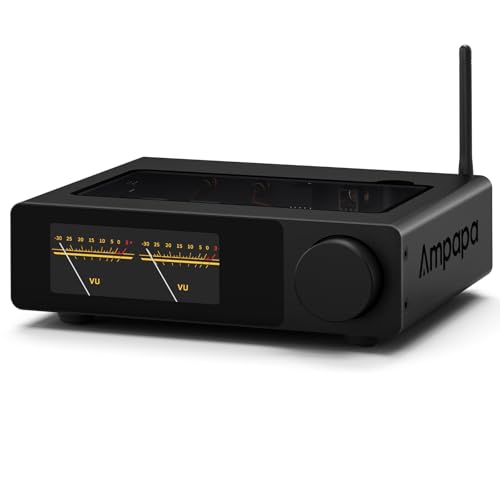
The Ampapa D1, built on the Douk Audio A5 platform, marries retro visual appeal with genuinely modern performance. The standout feature is the vibrant OLED digital VU meter with seven style options in yellow, blue, or black — it provides real-time level feedback and adds a welcome aesthetic touch to a desktop system. Under the hood, it uses the TPA3255 chip with PFFB (Post-Filter Feedback) technology that eliminates load dependency, meaning the amplifier’s tonal balance stays consistent regardless of the speaker impedance you connect.
Input flexibility is generous for a compact unit: RCA, TRS balanced (1/4-inch), and Bluetooth 5.2 are all present, alongside a subwoofer pre-out and a 30-200Hz adjustable high-pass filter that protects small bookshelf speakers from damaging bass frequencies. The 48V/5A GaN power adapter is compact and efficient, and the socketed NE5532 op-amps can be swapped for MUSES02 or Sparkos units to refine the soundstage. The glass top panel provides easy access to the op-amps and internal RGB lighting.
The auto-standby feature engages after 5 minutes of inactivity and cannot be disabled, which may frustrate users who leave their system paused for extended periods. The Bluetooth output level is slightly lower than the wired inputs, requiring a volume adjustment when switching sources. For the enthusiast who values a visual centerpiece and balanced connectivity in a budget amplifier, the D1 is a unique and capable choice.
Why it’s great
- Digital VU meter with 7 customizable styles
- TRS balanced input for pro audio gear
- Adjustable HPF protects bookshelf speakers
Good to know
- Auto-standby cannot be disabled
- Bluetooth level is lower than wired inputs
4. Donner MAMP2 Stereo Audio Amplifier
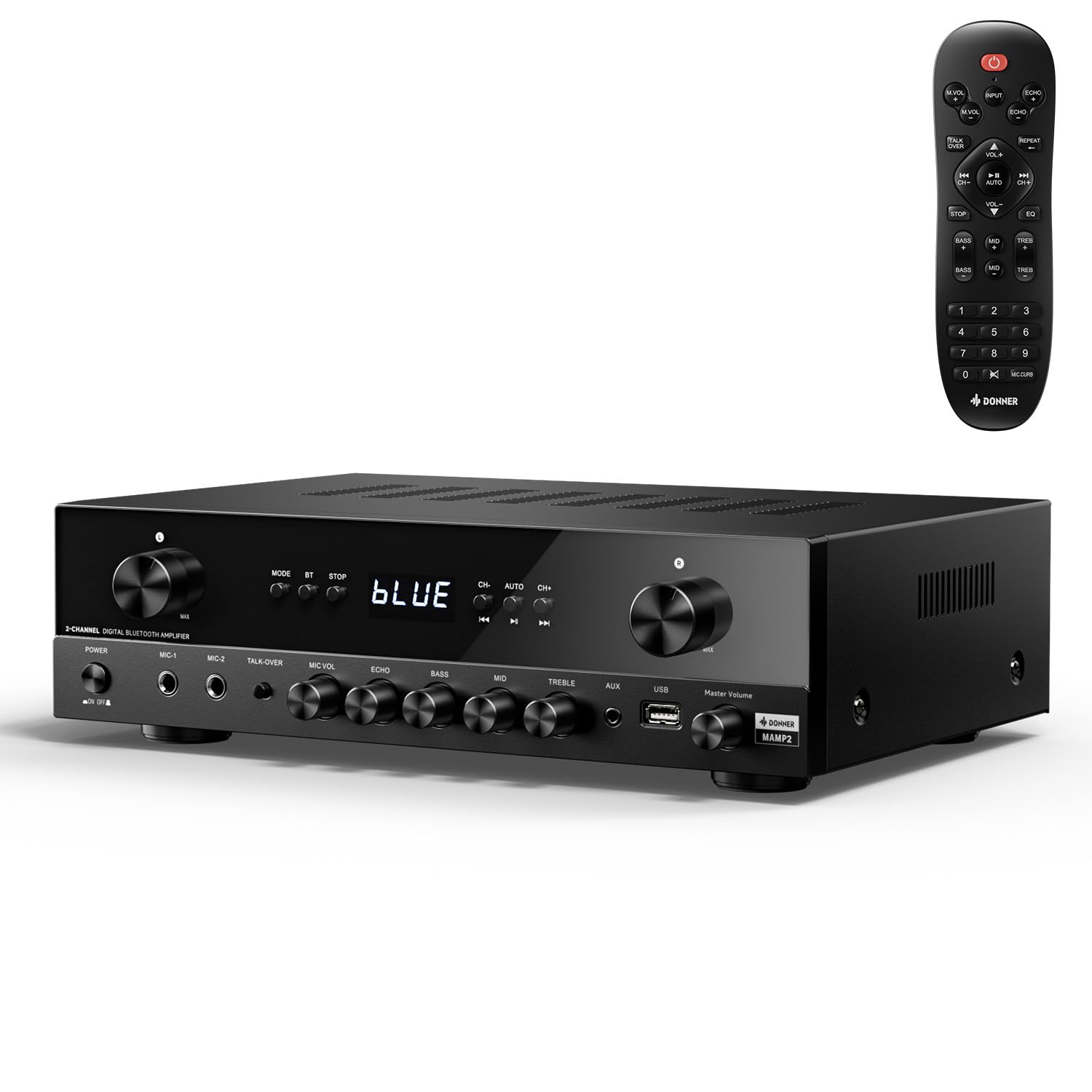
The Donner MAMP2 is the most feature-rich amplifier in this roundup, packing a phono input, optical and coaxial digital inputs, Bluetooth 5.3, USB playback, FM radio, and dual microphone inputs with echo and talkover functions — all at a price that undercuts traditional receiver brands. The toroidal transformer inside provides clean power delivery to the 60W RMS per channel output stage (600W peak), and the independent treble, midrange, and bass controls with a full-function remote give you complete tonal flexibility without menu diving.
Phono input is a critical inclusion for vinyl listeners, saving the cost and clutter of an external preamp. The digital optical input connects directly to a TV, making this a viable hub for a 2.1-channel home theater setup. The dual mic inputs with independent volume controls and reverb effect turn the system into a capable karaoke machine. The amplifier automatically saves your EQ and volume settings between power cycles, eliminating the need to readjust after each use.
The peak power rating of 600W is inflated relative to the real RMS output of 60W per channel, so expectations for loudness with low-sensitivity speakers should be tempered. The Bluetooth implementation, while version 5.3, uses a basic codec (SBC) rather than aptX or LDAC. For a user building a complete budget system around a turntable, TV, and occasional karaoke sessions, the MAMP2 is the most practical single-box solution.
Why it’s great
- Built-in phono input for turntable users
- Optical and coaxial inputs for TV connection
- Dual mic inputs with echo for karaoke
Good to know
- RMS power is 60W per channel despite 600W peak claim
- Bluetooth supports SBC codec only
5. Fosi Audio BL20A Stereo Amplifier

The Fosi Audio BL20A is an entry-level 2.1-channel amplifier that uses dual Texas Instruments TPA3116 chips for a genuine 200W peak output. The dedicated subwoofer pre-out with adjustable low-pass crossover and independent subwoofer volume control makes this one of the few cheap amplifiers that can properly manage a 2.1 system without external processing. The bass and treble knobs provide meaningful tonal adjustment, and the included remote control handles source switching and volume from across the room.
Bluetooth 5.0 provides reliable streaming up to 50 feet, and the three input modes (RCA, 3.5mm AUX, and U-Disk) cover the basics well. The aluminum alloy chassis is compact at 5.2 x 3.54 x 1.42 inches, fitting easily into tight desktop spaces. Multiple customer reports confirm the BL20A drives older Yamaha and Bose passive speakers with authority, delivering clean sound and responsive bass control that rivals the original amplifiers in those vintage systems.
The 24V/4.5A power supply limits the total power envelope compared to the 48V-based competitors in this list, so the BL20A is best suited for efficient speakers (90dB sensitivity or higher) and near-field listening. The binding posts accept bare wire but do not accommodate banana plugs, which limits speaker cable options. For a cost-effective path into a 2.1-channel system with genuine subwoofer management, the BL20A remains a solid entry point.
Why it’s great
- Dedicated subwoofer pre-out with adjustable crossover
- Independent bass and treble tone controls
- Compact aluminum chassis fits any desktop
Good to know
- 24V power supply limits total headroom
- Speaker terminals do not accept banana plugs
6. Donner 1000W 4-Channel Amplifier

The Donner 1000W 4-channel amplifier is designed for users who need to power multiple pairs of speakers across different rooms or zones. The four channels are independently controlled via individual volume knobs, allowing you to adjust the level in each listening area separately. The RMS rating of 25W per channel (1000W peak) is modest, but the amplifier handles 4 to 8 ohm speakers and can support up to eight speakers total when using the parallel binding posts.
Input selection is comprehensive for a receiver in this tier: Bluetooth 5.0, USB (up to 64GB), two pairs of RCA inputs, optical and coaxial digital inputs, and dual 1/4-inch microphone jacks with echo and talkover functions. The full-function remote controls treble, midrange, bass, echo, and talkover in any input mode, and the EQ settings are saved automatically between power cycles. The toroidal transformer provides a stable power foundation that helps keep the noise floor reasonably low.
There are caveats regarding the power rating. Customer reports indicate the amplifier struggled to drive low-sensitivity tower speakers like Jamo or Sony reference models, producing thin bass even with EQ maxed out. The “4 channels” are actually two stereo pairs with parallel wiring, not four independent amplifier channels. For a budget multi-room system using efficient bookshelf speakers or in-ceiling units, the Donner 1000W works well; for power-hungry floor-standing speakers, it is underpowered.
Why it’s great
- Four independently controlled speaker channels
- Optical, coaxial, and phono inputs included
- Full-function remote with EQ and echo control
Good to know
- 25W RMS per channel is insufficient for tower speakers
- Channel labeling is misleading — it is parallel stereo, not true quad
7. Pyle PDA77BU Home Stereo Receiver

The Pyle PDA77BU is the most affordable full-featured receiver in this guide, offering 800W peak power across 4 channels with Bluetooth 5.0, USB and SD card playback, FM radio, and dual microphone inputs. The front panel digital LED display provides clear feedback on input selection and volume level, and the included remote control handles all major functions. This unit is engineered for simplicity — plug in your speakers, select a source, and the system works without any configuration.
The amplifier supports up to 4 speakers (8 ohms each) and includes independent microphone volume controls with reverb and delay effects for voice amplification. The Bluetooth 5.0 connection is stable up to 30 feet and pairs reliably with phones and tablets. The multifunction control center on the front panel gives you quick access to EQ adjustments and source switching. Customer reviews consistently highlight the ease of setup and the surprising loudness when paired with efficient bookshelf speakers.
The peak power rating of 800W does not translate to real RMS output — expect around 20-25W per channel for continuous listening, which limits dynamic range with music. The Bluetooth codec is basic SBC, and there is no aptX or LDAC support. The build quality uses plastic for the front panel and controls, which feels less durable than the aluminum chassis of the Fosi or AIYIMA units. For a first-time buyer building a simple garage, patio, or bedroom system on a minimal budget, the Pyle PDA77BU delivers functional sound for the lowest entry cost.
Why it’s great
- Four speaker outputs with individual control
- FM radio and USB/SD playback included
- Very budget-friendly entry point for beginners
Good to know
- Continuous RMS output is roughly 20W per channel
- Bluetooth codec is limited to basic SBC
- Plastic front panel feels less premium
FAQ
Can a budget amplifier damage my speakers?
What speakers work best with a budget stereo amplifier?
Does a 48V power supply really make a difference in sound quality?
Can I use a budget amplifier for a home theater system?
Final Thoughts: The Verdict
For most users, the budget stereo amplifier winner is the Fosi Audio V3 because it delivers genuinely high-fidelity sound with the TPA3255 chip and a proper 48V power supply in a compact, upgrade-friendly chassis. If you want a full-featured system with phono input, optical connectivity, and karaoke capabilities, grab the Donner MAMP2. And for extreme power flexibility and the option to build a dual-mono setup, nothing beats the AIYIMA A07 MAX.