
Moving beyond a simple two-input interface is a serious step in any home studio. The jump to a 4 channel audio interface means you can record a stereo pair of room mics alongside a vocalist, track a guitarist and a podcaster simultaneously, or keep a hardware synth permanently connected without repatching cables. The key metric that separates a capable unit from a frustrating one is the preamp noise floor, measured in dBu, and the round-trip latency at a 32-sample buffer. A few extra decibels of self-noise or a handful of milliseconds of delay can mean the difference between a clean mix and a constant battle with hiss or timing drift.
I’m Min — the co-founder and writer behind Gadgets Feed. For this guide, I’ve analyzed the technical specifications, customer feedback, and real-world performance data across nine models to isolate which preamp topologies, converter chips, and driver architectures actually deliver on their promises for multi-track recording.
Whether you are a songwriter capturing a live band, a podcaster managing multiple microphones, or a streamer routing game audio and voice, this breakdown of the best 4 channel audio interface will help you match your workflow to the right hardware without overspending on features you cannot use.
How To Choose The Best 4 Channel Audio Interface
Four inputs open up recording possibilities, but the hardware inside each box dictates how cleanly those signals translate to your DAW. Focus on preamp quality, monitoring flexibility, and driver stability rather than brand familiarity.
Preamp Quality and Phantom Power Routing
The preamps are the heart of any interface. Look for an Equivalent Input Noise (EIN) rating of -129 dBu or lower for genuinely quiet recordings. Pay attention to how the +48V phantom power is switched. Some budget interfaces apply phantom power to all channels at once, which can damage ribbon mics or cause noise when only one channel needs it. Units with independent phantom switches for channel pairs offer safer flexibility.
Monitoring Architecture and Latency
Direct monitoring is non-negotiable for tracking. The best implementations allow you to blend the direct input signal with the DAW playback in hardware, keeping latency below 2ms. Premium interfaces offer dedicated mixer software that lets you create separate monitor mixes for each headphone output, which is essential when recording a vocalist who needs a different blend than the producer.
Quick Comparison
On smaller screens, swipe sideways to see the full table.
| Model | Category | Best For | Key Spec | Amazon |
|---|---|---|---|---|
| Focusrite Scarlett 4i4 4th Gen | Premium | Pro-level tracking with Air mode | 120 dB dynamic range | Amazon |
| MOTU M4 | Premium | Low-latency ASIO and LCD metering | Hardware direct monitoring mix | Amazon |
| SSL 2 Plus MKII | Premium | Analog 4K enhancement and dual headphone | 32-bit / 192 kHz converters | Amazon |
| Universal Audio Volt 476p | Premium | Vintage preamp emulation and built-in compressor | UA 610 preamp and 1176 compressor | Amazon |
| Arturia MiniFuse 4 | Mid-range | Software bundle and USB hub | 5-year warranty | Amazon |
| Zoom AMS-44 | Mid-range | Portable bus-powered streaming | AA battery operation option | Amazon |
| ESI Amber i4 | Mid-range | Flexible monitoring with LCD display | ADM independent direct monitoring | Amazon |
| Pyle PMXU46BT | Budget | Live mixing and Bluetooth streaming | Analog EQ per channel | Amazon |
| CIXUN B-004 | Budget | Entry-level 4-track recording on a budget | Built-in FX reverb/delay engine | Amazon |
In‑Depth Reviews
1. Focusrite Scarlett 4i4 4th Gen
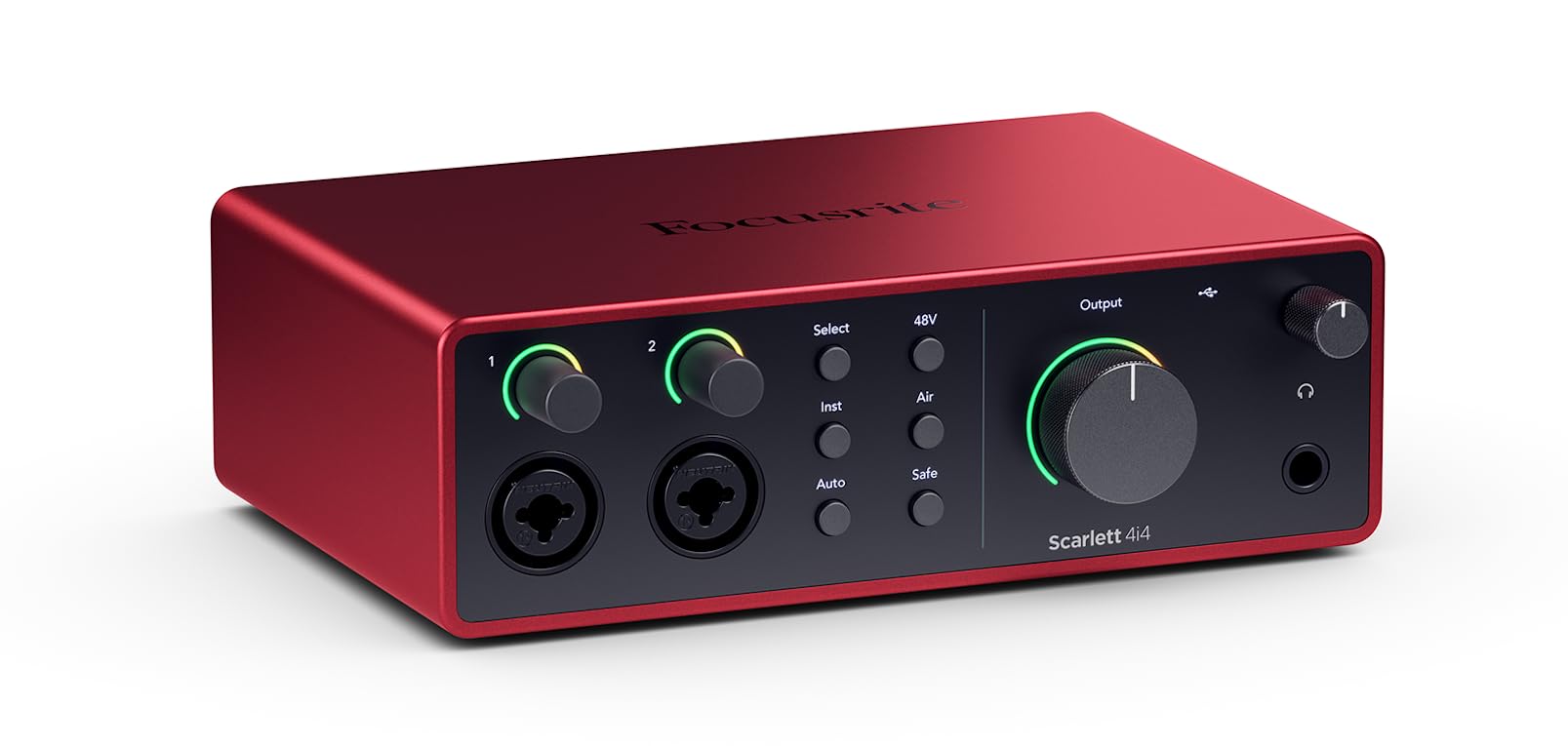
The Scarlett 4i4 4th Gen pushes a 120 dB dynamic range across its AD/DA path, putting it on par with Focusrite’s flagship RedNet converters found in major commercial studios. The two Scarlett preamps deliver a clean EIN of -127 dBu, and the Air mode engages an analog EQ shelf that adds a musical presence boost to vocals and acoustic guitars without requiring post-processing plugins.
Auto Gain and Clip Safe are genuinely useful tools for fast-paced sessions. Auto Gain sets input level by playing a reference signal, and Clip Safe automatically reduces gain by 3 dB if a transient threatens to clip. This lets you focus on performance rather than meter watching. The four balanced line outputs give you stereo monitoring plus two extra sends for external hardware or re-amping.
Loopback is built in via the Focusrite Control software, allowing you to route DAW audio and microphone input together for streaming. Users report rock-solid ASIO drivers with sub-2ms round-trip latency at 32 samples, though occasional driver conflicts appear with certain gaming audio stacks. The bundled Hitmaker Expansion includes Auto-Tune Access, Antares Vocal Doubler, and Arcade, which sweetens the deal for content creators.
Why it’s great
- 120 dB dynamic range equals flagship converter quality
- Auto Gain and Clip Safe prevent clipped takes during tracking
- Air mode adds analog harmonic richness to vocals
Good to know
- Only two XLR inputs; remaining inputs require 1/4″ TRS
- Occasional driver issues with specific Windows game titles
2. MOTU M4

The MOTU M4 is widely regarded as the low-latency champion in the 4×4 category, with custom drivers that deliver reliable sub-2ms round-trip performance at a 32-sample buffer. The ESS Sabre32 Ultra DAC, the same chip used in many high-end consumer audio devices, provides a clean, transparent output with a 120 dB dynamic range. The two mic preamps are exceptionally quiet, with an EIN of -129 dBu, making them viable for capturing quiet acoustic sources without excessive noise floor.
The front-panel full-color LCD shows metering for all four inputs and the main output, which is a rare convenience at this price tier. The hardware direct monitoring section includes a physical knob to blend input and playback, and a separate button to toggle loopback. This means you can set up a zero-latency monitor mix for a vocalist while streaming without ever opening a software mixer.
Users consistently praise the preamp clarity and the rock-solid driver stability under Windows and macOS. The main complaint is that the headphone amplifier is relatively weak due to the USB bus-power limitation, struggling to drive high-impedance headphones like the Beyerdynamic DT 990 Pro 250-ohm to satisfying levels. For studio headphone monitoring with high-impedance cans, an external amp is recommended.
Why it’s great
- ESS Sabre32 DAC provides transparent, clean audio conversion
- Full-color LCD metering for precise level monitoring
- Physical hardware monitoring and loopback controls
Good to know
- Headphone amp is underpowered for high-impedance headphones
- Windows fast startup can cause occasional clock sync errors
3. Solid State Logic SSL 2 Plus MKII
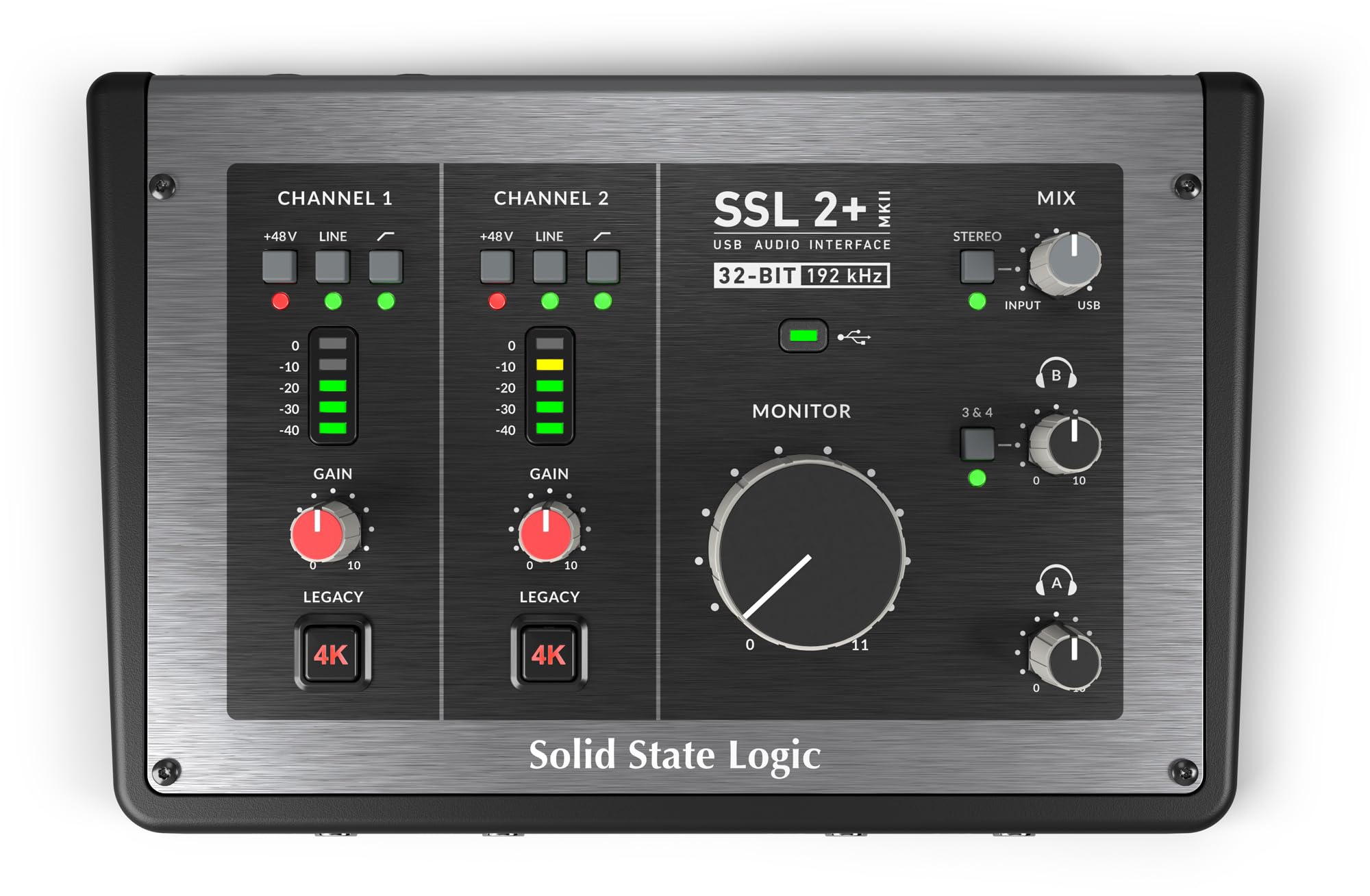
The SSL 2 Plus MKII brings the legendary British console sound to the desktop with its Legacy 4K analog enhancement circuit. Engaging the 4K button adds a high-frequency shelf and subtle harmonic distortion that mimics the SSL 4000 series console preamps, delivering a polished, airy top end that vocals and acoustic guitars benefit from immediately. The two preamps are based on the SSL preamp topology and offer an EIN of -127 dBu with substantial headroom.
The MKII version includes a dedicated stereo loopback channel, allowing you to route your DAW output and microphone input into a single stream for podcasting and game streaming without routing headaches. The dual headphone outputs each have independent volume controls, which is a must for in-person collaboration where the engineer and the talent need different monitor blends. The four balanced outputs provide flexibility for sending signals to multiple pairs of monitors or outboard gear.
Build quality is solid with a metal chassis that feels substantial on the desk. The 32-bit / 192 kHz converters deliver a clean path with low jitter. The main volume knob is plastic rather than metal, which some users note feels slightly less premium than the rest of the unit. The SSL Production Pack includes software instruments and effects from Native Instruments, Ableton, and Auto-Tune, giving a strong starter bundle.
Why it’s great
- Legacy 4K circuit adds authentic SSL console character
- Two independent headphone outputs with separate volume controls
- 32-bit/192 kHz converters and built-in loopback
Good to know
- Plastic main volume knob feels less premium than metal chassis
- Outputs 3+4 have no level control on macOS core-audio driver
4. Universal Audio Volt 476p
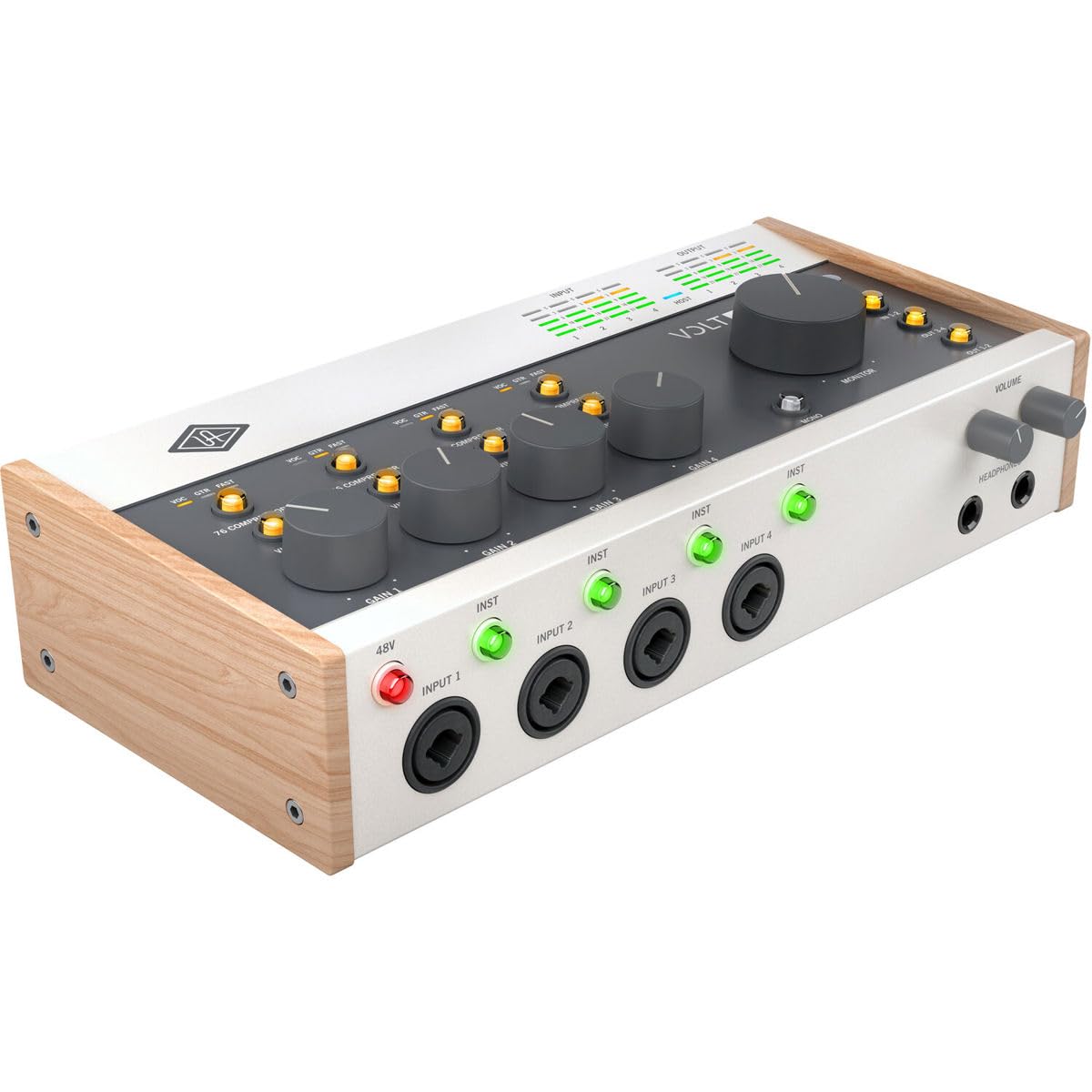
The Volt 476p is the only interface in this roundup that includes a built-in analog compressor based on the Universal Audio 1176, along with a Vintage mode that emulates the UA 610 tube preamp. The four preamps are clean on their own, but engaging the Vintage mode adds a warm, harmonically rich character that many users find preferable to using plugin emulations later. The 1176-style compressor operates in preamp mode, giving you control over compression before the signal hits your converters.
The Volt 476p offers two independent headphone outputs with dedicated volume controls, and the front-panel instrument inputs include the same High-Z circuit for guitar DI recording. The phantom power is a single switch for all four channels, which is a notable limitation — powered mics and dynamic mics cannot coexist on different channels without careful external patching. The unit requires an external power supply; it cannot be bus-powered, which is a consideration for portable setups.
Bundled with the LUNA DAW, which provides an analog-style workflow with tape emulation and console summing, and a selection of UAD plugins, the Volt 476p is a strong choice for users who want to capture a polished sound at the source rather than relying entirely on post-processing. Users report excellent integration with Logic Pro on M-series Macs, with low latency and stable drivers.
Why it’s great
- Built-in 1176-style analog compressor shapes tone before conversion
- Vintage mode adds warm UA 610 tube preamp character
- LUNA DAW included with tape emulation workflow
Good to know
- Phantom power is a single switch for all four channels
- Requires external power supply, not bus-powered
5. Arturia MiniFuse 4

The MiniFuse 4 differentiates itself with two built-in USB-A hub ports on the front panel, delivering 250 mA each. This means you can plug in a MIDI controller and a flash drive directly into the interface rather than reaching around your computer, streamlining your desk setup. The preamps are clean with an EIN of -129 dBu, and the interface supports up to 24-bit/192 kHz conversion. The two combo inputs handle mic and instrument signals, while the two rear TRS line inputs are dedicated for line-level gear.
Arturia includes the strongest software bundle in this category: Ableton Live Lite, Analog Lab Intro (hundreds of synth sounds), NI Guitar Rig 6 LE, and Auto-Tune Unlimited. The 5-year warranty is the longest of any interface in this comparison, signaling confidence in build quality. The loopback feature is implemented at the driver level and works reliably for streaming game audio alongside microphone input.
The MiniFuse 4 is USB-C bus-powered from a computer but requires a powered USB hub when used with an iPad because it cannot provide enough power to the hub ports and the interface simultaneously. The chassis is metal and compact, making it travel-friendly. Users report driver performance is excellent on both Windows and macOS, with stable low-latency operation in Ableton Live and Logic Pro.
Why it’s great
- Integrated USB-A hub ports for controllers and drives
- 5-year warranty, longest in the category
- Exceptional software bundle including Ableton Live Lite and Guitar Rig
Good to know
- Cannot power iPad and hub ports without external power
- Some users report faulty output channels after extended use
6. ESI Amber i4

The Amber i4 uses ESI’s Advanced Direct Monitoring (ADM) system, allowing hardware-level control over the level of each input signal mixed with the DAW playback. This is controlled via physical knobs on the unit, bypassing the need for a software mixer, which is a tangible advantage for latency-sensitive tracking. The interface features an LCD screen that displays volume levels and settings, a rarity at this tier.
The Amber i4 includes two combo XLR/TRS inputs on the front, plus two rear RCA line inputs for a total of four, and four balanced TRS outputs. It also features 5-pin MIDI I/O, which is useful for connecting older synths and controllers without resorting to USB adapters. The unit is USB-C bus-powered and includes a 2-year warranty with support teams based in the US and Germany. Users report excellent ASIO driver performance on Windows 11 with Ableton Live 12, achieving low latency without dropout.
The overall build is solid, with a metal chassis and an amber-colored volume knob that is distinctive. The preamps are quiet enough for home studio work, with adequate headroom for common dynamic mics. The headphone output is capable of driving moderate-impedance headphones, but high-impedance models may require an external amp for optimal volume.
Why it’s great
- ADM provides hardware-level direct monitoring without software
- Integrated LCD display for visual feedback of levels
- MIDI I/O and RCA line inputs for expanded connectivity
Good to know
- RCA inputs are unbalanced line-level only
- Headphone output is modest for high-impedance headphones
7. Zoom AMS-44

The AMS-44 is designed for mobility, capable of running on two AA batteries in addition to USB-C bus power. This makes it a viable option for field recording or mobile streaming setups where AC power is unavailable. The four XLR/TRS combo inputs are powered by four low-noise preamps with 48V phantom power, switchable in two groups. The unit is extremely compact, measuring about the size of a hardcover book, and is mostly plastic to keep weight down.
A unique feature is the Music/Streaming mode switch. In Music mode, the interface routes inputs directly to their respective DAW tracks for multi-track recording. In Streaming mode, it sums all inputs into a single stereo feed that can be sent directly to streaming software like OBS, with built-in loopback for combining computer audio with the microphone signal. The Direct Monitor switch provides zero-latency monitoring without additional software.
Users generally praise the clean preamps and the lack of floor noise, even at higher gain settings. Some users report that the loopback and monitoring routing can be confusing to set up initially, and those needing fully independent multi-track outputs for complex DAW routing may find the implementation limited. The lack of a tripod mount is a minor inconvenience for certain mounting setups.
Why it’s great
- AA battery power enables true portable field recording
- Dedicated Music/Streaming mode switch simplifies setup
- Extremely compact and lightweight design
Good to know
- Plastic build may feel less durable than metal competitors
- Multi-track routing in Music mode can be non-intuitive
8. Pyle PMXU46BT

The PMXU46BT is not a standard USB audio interface; it is a full analog mixer with a built-in USB interface and Bluetooth input. This makes it distinctly suitable for live sound reinforcement, church PA systems, or podcast setups where you want physical EQ control per channel rather than relying on DAW plugins. The four channels each have a 3-band EQ with high, mid, and low frequency adjustment, plus a dedicated FX send for external effects.
Bluetooth input allows you to wirelessly stream audio from a smartphone or tablet as an additional input source, which is useful for playing backing tracks or accepting calls during a live stream. The USB interface records a stereo mix of all inputs, not individual tracks, which limits its usefulness for multi-track production. The +48V phantom power is a single global switch, which is typical for budget mixer interfaces.
Users report that the preamps are serviceable for live use and sound good with dynamic and condenser microphones. The build is rugged with a metal chassis, making it road-worthy. The main limitation for studio use is the stereo-only USB recording: you cannot capture each channel as a separate track in your DAW. For users who need a mixer and a basic recording interface in one unit, this is a solid option.
Why it’s great
- Analog 3-band EQ per channel for live sound shaping
- Bluetooth input for wireless music streaming
- Rugged metal chassis suitable for transport
Good to know
- USB interface records stereo mix only, not individual channels
- Single global phantom power switch for all channels
9. CIXUN B-004
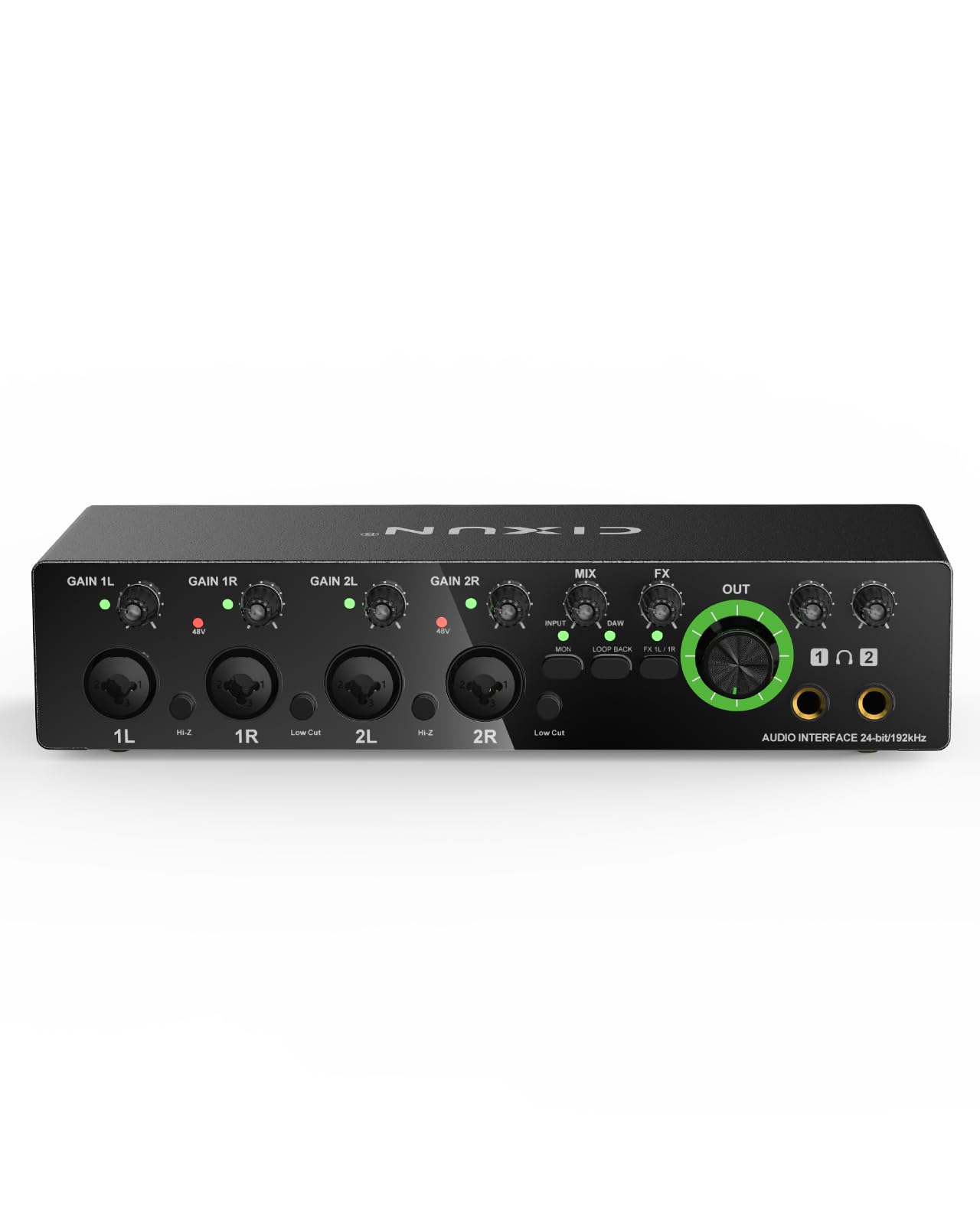
The CIXUN B-004 is a budget-conscious 4-in/4-out interface that includes a built-in FX reverb/delay processor, a feature typically absent from even much more expensive interfaces. The FX engine applies reverb to the monitoring signal, allowing vocalists to track with a polished, “radio-ready” effect in their headphones without introducing latency or using CPU-heavy plugin processing. The preamps are Class A and provide adequate clean gain for common microphones.
A standout feature at this tier is the dual-group +48V phantom power switching. Channels 1-2 and 3-4 are independently controlled, allowing you to run condenser microphones on one pair while keeping dynamic mics or instruments on the other pair without risk of damage or noise. The interface is plug-and-play on macOS and Windows, requiring no additional driver downloads according to most user reports. The two headphone jacks have independent volume controls, enabling basic collaborative monitoring.
Build quality is adequate for a stationary home studio, with a metal chassis and illuminated gain knobs that are easy to see in low light. Some users report issues with Mac recognition and reliability after extended use. The overall output level is lower than premium interfaces, requiring the system volume to be maxed out to achieve comparable loudness. This unit is best suited for beginners recording a podcast or a small band on a strict budget.
Why it’s great
- Built-in FX reverb/delay for polished monitoring
- Dual-group phantom power adds safety for ribbon/dynamic mics
- Plug-and-play operation on Windows and macOS
Good to know
- Lower output level than pricier interfaces
- Some reliability concerns reported after 30 days of use
FAQ
Can a 4 channel audio interface record four microphones simultaneously on separate tracks?
What is loopback and do I need it for podcasting or streaming?
Final Thoughts: The Verdict
For most users, the best 4 channel audio interface winner is the Focusrite Scarlett 4i4 4th Gen because it combines clean 120 dB dynamic range converters with the smartest feature set for tracking: Auto Gain, Clip Safe, and Air mode. If you prioritize the lowest possible latency and hardware monitoring, grab the MOTU M4. And for analog character and built-in compression, nothing beats the Universal Audio Volt 476p.