
Your PC gaming streams, podcast episodes, and music recordings live or die by the audio interface you choose. A subpar mixer introduces latency, noise, and a flat soundstage that immediately signals “amateur” to your audience. The right unit, however, gives you pristine preamps, zero-latency monitoring, and the routing flexibility to handle multiple sources without a hiccup.
I’m Min — the co-founder and writer behind Gadgets Feed. I spend hundreds of hours analyzing audio interface spec sheets, comparing preamp performance, and cross-referencing user-reported latency figures to separate the true studio-grade performers from the noise boxes that share a shelf with them.
After digging through sample rates, bit depths, phantom power stability, and driver-level compatibility across dozens of models, I’ve built a tight list of standouts for the best audio mixer for pc use — covering everything from a solo podcaster to a multi-instrument home studio.
How To Choose The Best Audio Mixer For PC
Picking the right audio mixer for your PC setup isn’t about grabbing the one with the most knobs. It’s about matching the interface’s core specs — preamp quality, sample rate, channel count, and connectivity — to your specific workflow. A podcaster needs different routing than a guitarist, and a streamer needs loopback while a musician needs zero-latency monitoring. Here’s what separates the real tools from the toys.
Preamps: The Heart of Your Sound
The preamp is the first electronic stage your microphone signal hits. A high-quality preamp with low Equivalent Input Noise (EIN) delivers a clean, detailed signal without adding hiss. The Focusrite Scarlett Solo and Universal Audio Volt 176 are famous for their preamp performance — the Volt even includes a Vintage mode based on the classic UA 610 tube preamp. Avoid units with noisy preamps that force you to boost gain later in your DAW, bringing up all that unwanted noise floor.
Sample Rate, Bit Depth, and Latency
Sample rate (measured in kHz) determines the frequency range captured, while bit depth (16-bit vs 24-bit) defines the dynamic range. For PC recording, 24-bit/48kHz is the standard minimum for professional quality, with 24-bit/192kHz available on premium models like the Mackie ProFX6v3+. Latency — the delay between speaking and hearing yourself in headphones — is the real enemy. Look for models with direct hardware monitoring or low round-trip latency figures (sub-10ms) to keep your performance natural.
Connectivity and Routing
Count the inputs you genuinely need: how many XLR microphones, how many 1/4-inch instruments, and do you need MIDI I/O? The Arturia MiniFuse 1 includes 5-pin MIDI in/out plus a USB hub, a rare combo. For streaming, loopback functionality (found on the Mackie ProFX6v3+ and MAONO AME2) is non-negotiable — it lets your audience hear both your mic and your PC audio simultaneously without cable gymnastics. USB-C is now the standard for reliable, bus-powered operation.
Quick Comparison
On smaller screens, swipe sideways to see the full table.
| Model | Category | Best For | Key Spec | Amazon |
|---|---|---|---|---|
| Focusrite Scarlett Solo 3rd Gen | Audio Interface | Guitarists & Vocalists | 24-bit/192kHz, Air Mode | Amazon |
| Mackie ProFX6v3+ | Analog Mixer | Streamers & Live Performers | 24-bit/192kHz, Loopback | Amazon |
| Universal Audio Volt 176 | Audio Interface | Vocalists Seeking Analog Warmth | Built-in 1176 Compressor | Amazon |
| MAONO MaonoCaster AME2 | Podcast Mixer | Podcasters & Content Creators | 10-Channel, 11 Sound Pads | Amazon |
| Pyle PMXU46BT | Analog Mixer | Multi-Input Live Streaming | 4 Channels, Bluetooth | Amazon |
| Arturia MiniFuse 1 | Audio Interface | Home Studio Beginners | 192kHz, 5-Year Warranty | Amazon |
| FIFINE AmpliGame KS5 | Gaming Bundle | PC Gamers on a Budget | XLR/USB Mic + Mixer | Amazon |
In‑Depth Reviews
1. Focusrite Scarlett Solo 3rd Gen

The Scarlett Solo 3rd Gen is the benchmark USB audio interface for a reason — its mic preamp delivers a clean, bright signal with switchable Air mode that emulates the classic Focusrite ISA transformer, adding clarity to quiet vocals and acoustic guitars. The Gain Halos ring turns green for a good signal and red for clipping, making level-setting effortless even for beginners.
At 24-bit/192kHz, this unit captures ultrasonic detail for high-resolution mixing, and the two low-noise balanced outputs drive studio monitors with zero audible hiss. The metal chassis feels dense and roadworthy, surviving moves and cold storage according to long-term users. Bus-powered operation via USB means no wall wart cluttering your desk.
For the guitarist, the high-headroom instrument input accommodates hot humbuckers without distortion. The included software bundle — Pro Tools Intro, Ableton Live Lite, and the Hitmaker Expansion — gives you a complete recording starter pack. The three-year worldwide warranty provides peace of mind that budget interfaces rarely match.
Why it’s great
- Air mode adds genuine high-frequency presence to vocals
- Gain Halo ring simplifies input leveling
- Solid metal build with 3-year warranty
Good to know
- Only one instrument input limits multi-mic setups
- AFX2DAW plugin suite requires additional purchase
2. Mackie ProFX6v3+
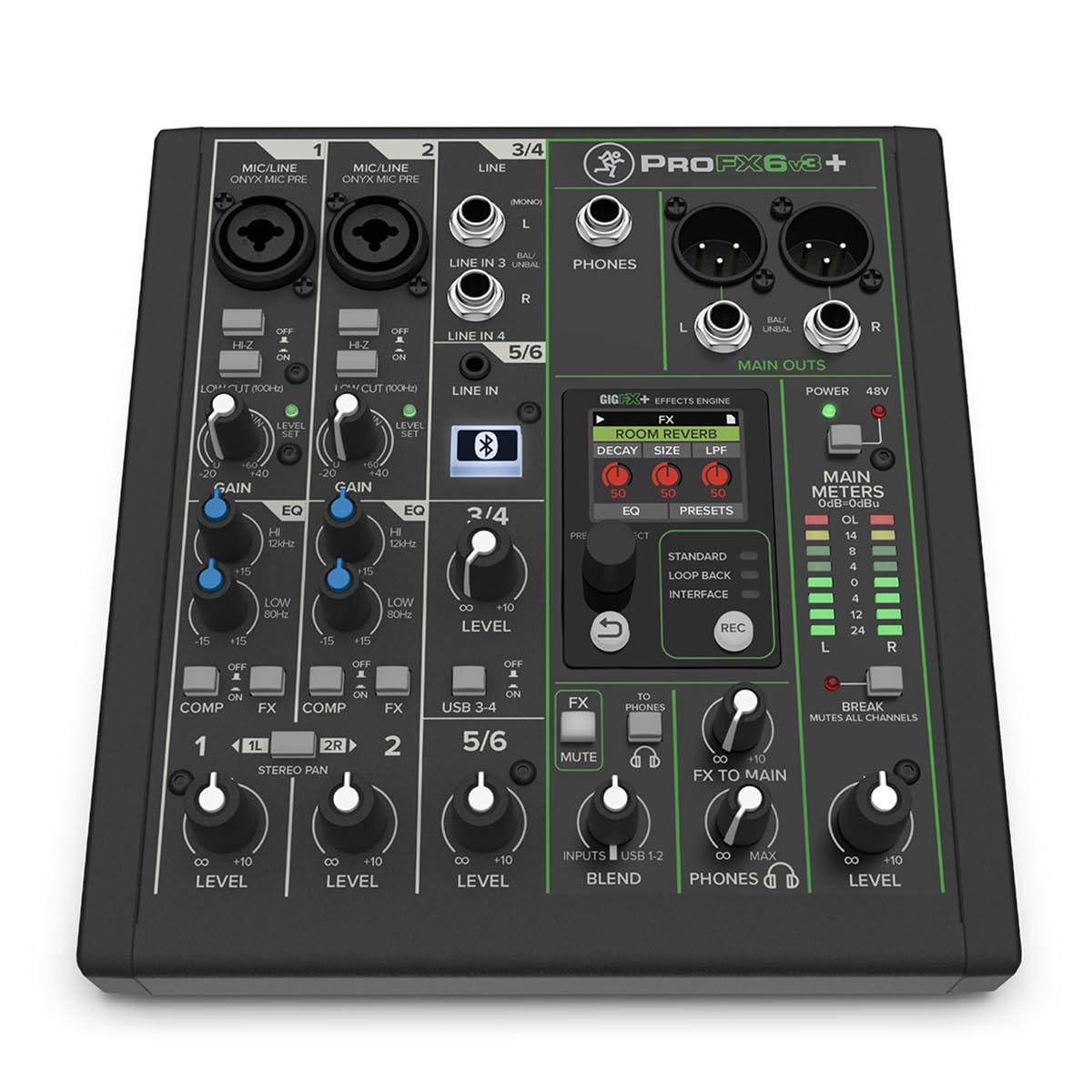
This is a true analog mixer with a built-in 2×4 USB-C audio interface — not a stripped-down interface pretending to be a mixer. The ProFX6v3+ gives you six channels with four Onyx preamps, a dedicated Bluetooth channel, and a 12-preset GigFX+ effects engine controlled via the color LCD screen. The effects are genuinely usable: reverb the vocals, delay the guitar, and tweak the parameters live.
Switchable USB recording modes make this a streamer’s dream. Standard mode captures the full mix with effects for a single stereo feed. Loopback mode blends your microphone with computer audio (game sounds, music, browser) so your audience hears everything. Interface mode sends channels 1-2 to the DAW pre-effects for clean tracking.
ProFX6v3+ is a 24-bit/192kHz machine with 100Hz low-cut filters on every channel, one-button compression on channels 1-2, and Hi-Z switches for direct guitar input. The bidirectional Bluetooth with Mix Minus allows you to bring phone calls into a podcast without feedback loops. At 2.6 pounds, it’s compact enough for a desk or a live streaming rig.
Why it’s great
- Loopback mode is essential for streaming workflow
- Onyx preamps are clean and musical
- GigFX+ effects with editable parameters on LCD
Good to know
- Lacks a second independent output bus for separate monitor mixes
- Power failure reported in rare cases after limited use
3. Universal Audio Volt 176

The Volt 176 is the only interface in this roundup with an honest-to-goodness analog compressor circuit — modeled after the legendary UA 1176. This isn’t a software emulation; it’s hardware that shapes your signal before it hits the AD converter. Engage the compressor and your vocals gain presence and punch without needing post-processing plugins. The adjustable ratio lets you dial in subtle glue or heavy limiting.
Vintage mode activates a preamp circuit based on the UA 610 tube console, adding subtle harmonic saturation that gives vocals and instruments a finished, “album-ready” character. At 24-bit/192kHz with 96kHz frequency response, the detail retrieval is exceptional. The unit comes bundled with LUNA — UA’s own DAW that mimics analog tape workflow — plus a suite of UAD plugins.
Bus-powered via USB-C, the Volt 176 supports Mac, Windows, iPad, and iPhone. The studio-grade headphone amplifier drives high-impedance monitoring cans with authority. Some users report that the volume knob can develop scratchiness over time, but the overall build quality is robust. For vocalists seeking that analog mojo without outboard gear, this is the pick.
Why it’s great
- Hardware 1176 compressor is genuinely useful and musical
- Vintage mode adds rich harmonic saturation
- Includes LUNA DAW and UAD plugin bundle
Good to know
- Phantom power resets on power cycle
- Volume knob scratchiness reported after extended use
4. MAONO MaonoCaster AME2

The AME2 packs an absurd amount of features for the price: a 10-channel mixer, two XLR inputs with 48V phantom power and 60dB of gain, 11 customizable sound pads, six reverb modes, 12-step auto-tune, and Bluetooth connectivity. The DENOISE function cleans up background hum from less-than-ideal room acoustics. This is a dedicated podcast mixer, not a general audio interface, and it nails that use case.
The 11 sound pads are the star for content creators — three pads hold up to 60 seconds of audio each with one-key looping, while eight pads hold 20-second clips. Load your intro music, laugh tracks, and sound effects via smartphone, PC, or microphone. The pitch changer and three-band EQ on each mic channel give you fine control over your vocal tone without touching a DAW.
Connectivity is comprehensive: USB-C to PC, LIVE-OUTPUT 1/2 to a second streaming device, AUX-IN for a phone, and a 6.35mm instrument input for guitar or bass. The loopback switch routes PC audio alongside your mic for streaming. Some users report USB-C power port failure after extended use, but for the feature density, the AME2 is a compelling option for podcasters starting out.
Why it’s great
- 11 customizable sound pads perfect for live streaming
- 60dB preamp gain with DENOISE function
- Bluetooth input and multi-device routing
Good to know
- USB-C power port vulnerability reported over time
- Mid-range build quality compared to premium interfaces
5. Pyle PMXU46BT

If your PC setup needs to handle two mics, a guitar, and a phone simultaneously for live streaming or small events, the Pyle PMXU46BT is a sturdy four-channel analog mixer that gets the job done without a complex setup. Each channel has independent volume, pan, and three-band EQ (high, mid, low), plus a 12-segment stereo output meter for visual level monitoring.
The USB soundcard interface lets you record the master mix directly to your PC, while Bluetooth input allows wireless streaming from a phone or tablet as an additional audio source. +48V phantom power powers condenser mics for clear vocal reproduction. The send/return loop lets you integrate external effects processors, and the headphone output with independent level control is useful for live monitoring.
At 6.84 pounds, it’s the heaviest unit here, but that weight reflects its analog transformer design and robust connectors. Users report that the preamps sound clean with FetHeads, though the USB connection sometimes needs reinsertion. It lacks multitrack recording — all inputs are summed to a stereo USB feed — so it’s best for scenarios where you mix live rather than edit individual tracks later.
Why it’s great
- Four analog channels with 3-band EQ per channel
- Bluetooth input for wireless device mixing
- Send/return loop for external effects gear
Good to know
- USB recording sums all channels to stereo — no multitrack
- USB connection occasionally requires re-seating
6. Arturia MiniFuse 1

The MiniFuse 1 is a deceptive little unit — it’s compact and bus-powered, yet it includes 5-pin MIDI input and output, a feat many larger interfaces omit. For synth enthusiasts or producers using hardware controllers, that alone justifies the space on the desk. The combo XLR/inst/line input handles mics, guitars, and line-level sources with 48V phantom power for condenser microphones.
At 14.4 ounces, it’s travel-friendly and fits in a laptop bag. The built-in USB-A hub provides 250mA of power, letting you plug a dongle or a flash drive directly into the interface. Loopback functionality routes PC audio alongside your mic — useful for streaming or recording gameplay commentary. The 192kHz maximum sample rate ensures future-proof fidelity.
Arturia backs the MiniFuse with a 5-year warranty, the longest in this comparison, after subjecting each unit to over 200 reliability tests. The included software suite — Ableton Live Lite, Analog Lab Intro, Arturia FX, NI Guitar Rig 6 LE, and Auto-Tune Unlimited — is generous for beginners. Transparent sound quality and low latency make it a strong alternative to the Scarlett Solo at a lower investment.
Why it’s great
- 5-pin MIDI I/O included in a tiny footprint
- 192kHz sample rate with loopback for streaming
- Generous 5-year warranty and reliable build
Good to know
- Single input limits simultaneous mic + instrument recording
- Requires a reboot after driver installation for recognition
7. FIFINE AmpliGame KS5

The KS5 bundle solves a specific problem for PC gamers: it packages a dynamic XLR microphone, a 4-channel mixer, and all necessary cables into one kit, eliminating the guesswork of matching components. The dynamic mic rejects background noise well, focusing on your voice for crisp game chat and streaming. The mixer gives you individual mute controls, headphone monitoring, and volume faders for each channel.
Five RGB lighting effects on the mixer add gaming aesthetic, with static and flowing modes that sync with your desktop color scheme. The mixer includes fun voice changer effects — elder, baby, robot, and girl — that can add interactivity during streams, though the robot and girl modes sound less refined. The unit supports both XLR connection for the mic and USB connection for easy plug-and-play setup.
A notable limitation: the mixer’s function keys (RGB, mute, monitoring, volume knob) work only in USB mode, not XLR mode. Some users report the mixer sporadically shuts off and reboots during long sessions. However, at this entry-level price point, the kit delivers a functional XLR workflow that leaps over USB-only desktop mics in audio quality.
Why it’s great
- Complete XLR microphone and mixer kit out of the box
- Dynamic mic rejects room echo and keyboard noises
- RGB lighting and voice changer effects for streaming
Good to know
- Mixer function keys limited to USB connection only
- Intermittent power cycling reported on some units
FAQ
Do I need a separate mixer if I already have an audio interface?
What is loopback and do I need it for streaming?
Can I use an analog mixer like the Pyle PMXU46BT for podcasting?
Final Thoughts: The Verdict
For most users, the best audio mixer for pc winner is the Focusrite Scarlett Solo 3rd Gen because it delivers pristine preamp quality, reliable build, and zero-latency monitoring at a price that doesn’t break the bank — the perfect balance for vocalists, guitarists, and solo podcasters. If you want an all-in-one analog mixer with loopback for streaming and live effects, grab the Mackie ProFX6v3+. And for analog warmth with hardware compression that sounds great right out of the box, nothing beats the Universal Audio Volt 176.