
Forgetting to match your 1000-watt inverter’s output waveform to your equipment is the fastest way to shorten its life. A 1000-watt inverter converts 12V DC battery power into standard household AC power, but the quality of that AC signal—modified sine wave versus pure sine wave—determines whether your refrigerator hums quietly or your laptop charger buzzes with coil whine. Choosing the wrong waveform for sensitive electronics like CPAP machines, variable-speed drills, or modern TV sets can cause erratic operation, overheating, or even permanent damage.
I’m Min — the co-founder and writer behind Gadgets Feed. I’ve spent countless hours poring over thermal performance curves, efficiency ratings, and real-world user load tests to identify which 1000-watt inverters deliver stable voltage under sustained draw and which ones trip unexpectedly under a refrigerator’s startup surge.
This guide covers the critical differences between modified and pure sine wave units, the real-world implications of peak versus continuous power ratings, and the specific protection circuits that separate a durable unit from a disposable one, all to help you pick the best 1000 watt inverter for your RV, job site, or emergency backup system.
How To Choose The Best 1000 Watt Inverter
A 1000-watt inverter sits at the sweet spot for powering a mini-fridge, a TV, a few lights, and charging laptops simultaneously, but the spec sheet you need to read is not just about the wattage number. The distinction between continuous and surge rating, the output waveform, and the quality of the cooling fan all determine whether the unit survives a decade or blows a fuse on day three. Below are the specific factors that matter most for this exact capacity class.
Continuous vs. Peak Surge Power
A 1000-watt continuous inverter can sustain that load indefinitely, but the peak surge—typically 2000 watts—is a brief burst meant to start motor-driven devices like refrigerators or pumps. The real test is whether the inverter’s surge can catch that compressor inrush current without dropping voltage below 105V. If a unit’s peak figure looks inflated relative to its continuous rating, the voltage sag under load may cause a connected fridge to stall. For sensitive electronics, a pure sine wave unit with a surge-to-continuous ratio of at least 2:1 is the safe zone.
Waveform: Modified Sine vs. Pure Sine
Modified sine wave inverters produce a stepped approximation of AC power that works fine for resistive loads like incandescent bulbs and simple heaters. Pure sine wave inverters generate a smooth, utility-grade waveform that eliminates harmonic heating in inductive motor windings and prevents digital clock circuits from operating erratically. If you plan to run a CPAP machine, a variable-frequency tool, or a modern television, the extra cost of a pure sine wave unit prevents operational failures and extends device lifespan. The total harmonic distortion (THD) figure on a quality pure sine wave inverter should be below 3%.
Protection Circuits and Low-Voltage Cutoff
An inverter without undervoltage protection will drain a lead-acid or lithium battery past its safe discharge floor, permanently reducing battery capacity. Look for a unit that includes automatic low-voltage shutdown—typically around 10.5V for a 12V system—and an overload alarm that alerts before the internal fuse blows. Reverse polarity protection is non-negotiable: it saves the inverter if you accidentally swap the battery leads. The best inverters also include thermal sensors that trigger the cooling fan progressively rather than all-or-nothing, keeping noise low under partial loads.
Idle Power Draw and Fan Noise
When an inverter is powered on but not driving a load, it still consumes battery power. Low idle draw—anything under 1 amp for a 1000W unit—means your battery lasts longer during non-use periods. Fan noise matters especially in RV sleeping areas or home backup scenarios: units with temperature-controlled fans remain silent until the internal heatsink reaches roughly 40°C, while cheaper models blast a fan constantly even at 50W load. The combination of low no-load current and a silent thermal fan directly impacts real-world satisfaction over the unit’s service life.
Quick Comparison
On smaller screens, swipe sideways to see the full table.
| Model | Category | Best For | Key Spec | Amazon |
|---|---|---|---|---|
| BESTEK 1000W | Modified Sine Wave | Heavy duty appliances, fridge, chainsaw | 2400W peak surge | Amazon |
| NDDI POWER 1000W | Modified Sine Wave | Budget-friendly, basic electronics | 4 x 30A replaceable fuses | Amazon |
| VEVOR 1000W PSW | Pure Sine Wave | Small home devices, sensitive loads | 88% full load efficiency | Amazon |
| BELTTT 1000W PSW | Pure Sine Wave | Off-grid solar, RV, sensitive gear | 90% conversion efficiency | Amazon |
| JARXIOKE 1100W PSW | Pure Sine Wave | True 1100W continuous, long-term use | 100m wireless remote control | Amazon |
| VOLTWORKS 1000W PSW | Pure Sine Wave | Safety-certified, RV, marine | ETL UL458 certified | Amazon |
| GoWISE Power PS1002 | Pure Sine Wave | Premium, sensitive electronics, 24/7 use | THD < 3% | Amazon |
In‑Depth Reviews
1. BESTEK 1000W Car Power Inverter

The BESTEK 1000W inverter offers a standout 2400W peak surge, which is 400W higher than most competitors’ 2000W peaks. This extra headroom means it handles the inrush current of a standard mini-fridge compressor without the voltage sag that causes premature shutdown—a feature confirmed by users running 800W startup loads from Haier fridges and 8-amp chainsaws on single 35Ah batteries. The dual intelligent fans ramp speed with temperature only under load, keeping noise low when powering small electronics below 400W.
Its ETL certification and AI smart chip provide undershoot protection that cuts power before overload, and the built-in fuse adds a redundant layer. The PD30W USB-C and QC18W USB-A ports deliver fast charging for modern phones and laptops directly from the inverter face, reducing the need for separate adapters. The package includes battery clamps for direct 12V battery connection, which is essential since the cigarette lighter adapter limits draw to only 120W. For a modified sine wave unit, its performance with universal motors and resistive loads is excellent, though users note the fan is audible under sustained heavy loads.
In real-world use, this inverter sustained 1000W continuous without overheating during multiple simultaneous fridge and blender tests. The form factor—9.1 x 4.7 x 2.7 inches—fits easily in a truck cab or RV compartment. BESTEK backs it with an 18-month replacement warranty and 180-day refund guarantee. If you need to power a mix of heavy appliances and sensitive electronics occasionally, this is the most versatile 1000-watt inverter at its price tier.
Why it’s great
- Highest peak surge (2400W) in its class, handles motor inrush reliably
- PD30W USB-C and QC18W USB-A for fast device charging
- Intelligent fan ramps only when needed, quiet at low loads
Good to know
- Modified sine wave not ideal for sensitive electronics like CPAP
- Cigarette lighter adapter limited to 120W; full power requires battery clamps
- Fan becomes audible under sustained loads above 600W
2. VEVOR 1000W Pure Sine Wave Inverter

The VEVOR 1000W pure sine wave inverter delivers stable 120V AC output at 60 Hz with total harmonic distortion low enough to power a 13,500 BTU RV air conditioner or a 97,000 BTU/hr furnace blower consistently. The CE/FCC certification and six-layer protection system—overvoltage, undervoltage, overload, overtemp, short circuit, and reverse polarity—make this a safe choice for stationary solar setups and home transfer switch installations. The included remote control allows power toggling from up to 100 meters, useful for controlling the inverter without accessing a cramped battery compartment.
A key technical detail is the intelligent temperature-controlled fan: it activates only when the internal heatsink exceeds 40°C, remaining completely silent at partial loads. This makes it far better for bedroom-side backup than units with always-on fans. The package includes four 40A spare fuses and 100% pure copper battery cables that minimize voltage drop. Note that the LCD display shows DC input wattage, not AC output wattage—users report roughly a 75-80% efficiency, meaning a 150W display reading corresponds to about 120W of AC output. Factor this into your load planning.
In user reports, this inverter runs 24/7 in off-grid homes connected to 2200W solar arrays and two 400Ah batteries, replacing a larger 3000W unit that failed from heat. The aluminum-alloy body dissipates heat effectively, and the high-temp cutoff threshold is 175°F, generous enough to handle sustained summer loads. For users who need pure sine wave for laptop adapters, gaming consoles, and mixers without electrical noise, this VEVOR unit offers the best blend of certification, features, and price.
Why it’s great
- Clean pure sine wave with six-layer protection for sensitive gear
- Temperature-controlled fan stays silent unless needed
- Includes remote control and 4 spare 40A fuses
Good to know
- LCD displays DC input wattage, not AC output
- Efficiency around 75-80% under full load
- No USB-C port, only standard USB and Type-C
3. BELTTT 1000W Pure Sine Wave Inverter
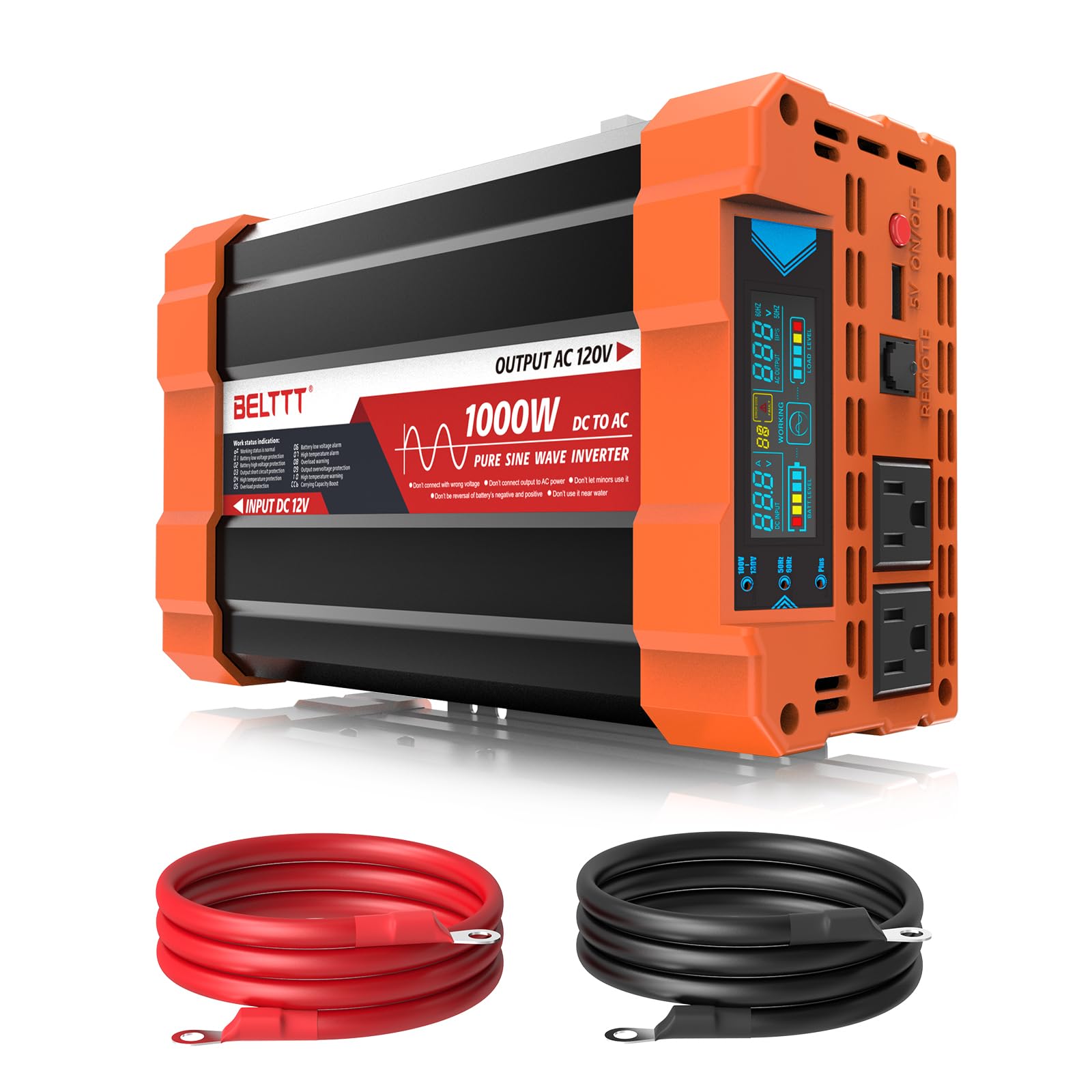
The BELTTT 1000W steps into the pure sine wave arena with a conversion efficiency of 90% or better during normal operation, along with low no-load losses that extend battery runtime when the inverter is idle. Its intelligent LCD displays both input voltage and output wattage simultaneously, giving real-time feedback on battery health and load draw. The unit supports a 2000W peak surge, sufficient for kicking on small pumps and compressor fridges, and its frequency-locked 60 Hz output is stable enough for sensitive audio equipment and television sets.
The 3-foot 5AWG battery cables and included thimble spanner make installation straightforward for DIY solar setups and truck campers. The fan is notably quiet—users report it remains off below 100-150W loads and only ramps up audibly under high demand, a critical advantage for bedside or living-area placement. Reverse polarity and short circuit protections are built in, and the aluminum housings with sturdy plastic end caps resist corrosion in humid environments. Some users note the included cables are rated for a maximum safe continuous load of roughly 800W; for full 1000W continuous use, upgrading to 2AWG or 1AWG cables is recommended.
In field use, the unit has powered work lights, drills, laptops, and shop vacuums drawing 860W without voltage sag. The high-contrast LCD makes troubleshooting obvious—low battery, over-temp, and overload warnings are clearly displayed. For users who want pure sine wave output at a price typically associated with modified sine wave units, the BELTTT offers exceptional value without sacrificing the waveform quality needed for modern electronics.
Why it’s great
- Over 90% conversion efficiency reduces battery drain
- LCD shows input voltage and output wattage simultaneously
- Very quiet fan; stays off below 100W load
Good to know
- Included 5AWG cables are undersized for sustained 1000W draw
- Only one 5V 2.1A USB port, no USB-C
- No remote control included
4. JARXIOKE 1100W Pure Sine Wave Inverter
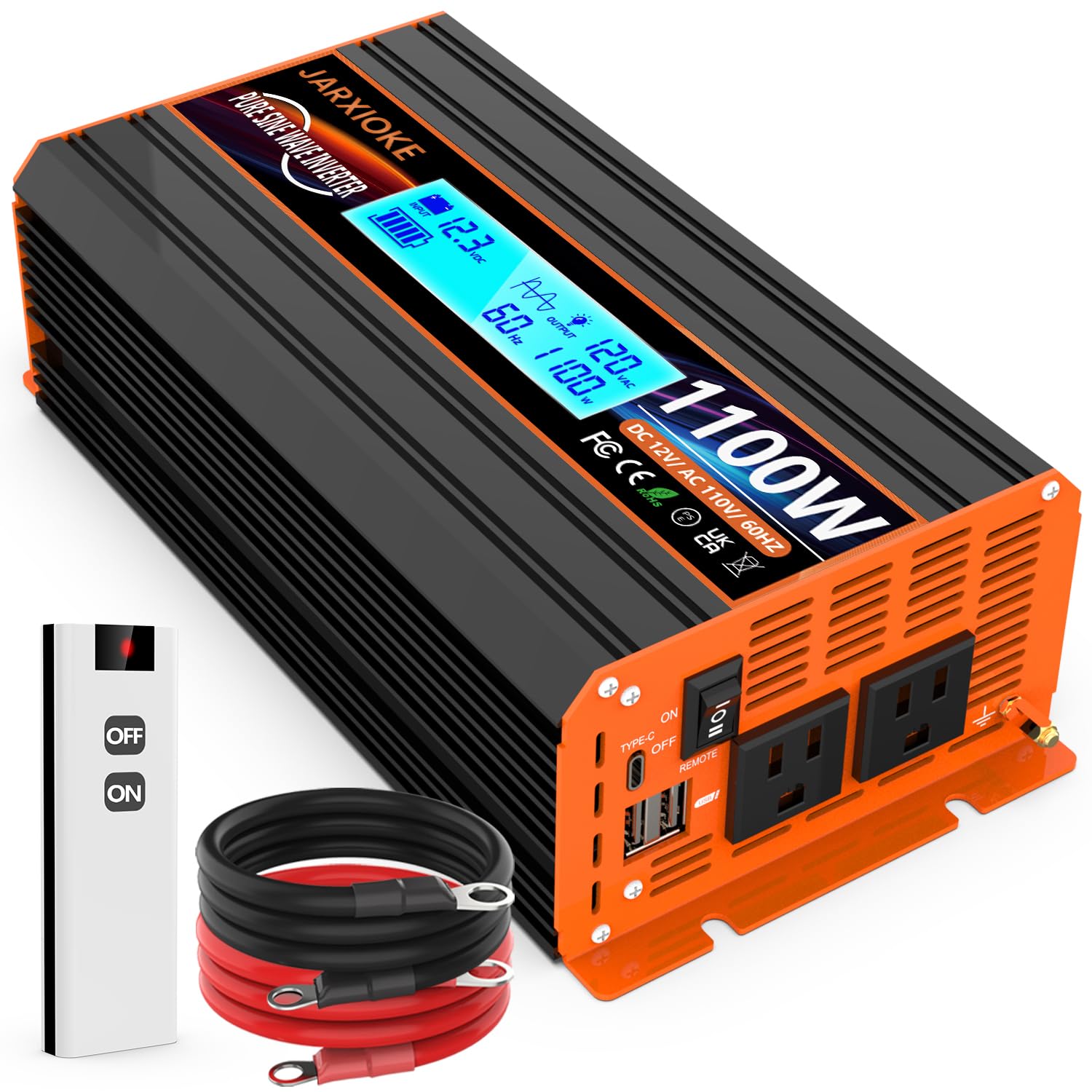
Its isolated input/output design and soft-start technology reduce stress on both the inverter and connected loads, and the smart cooling fan only activates under high thermal load, maintaining silent operation when powering refrigerators, Starlink terminals, Xbox consoles, and TVs 24/7 in off-grid setups. UL, ETL, FCC, and RoHS certifications confirm robust safety engineering.
A standout feature is the wireless remote control with a 100-meter range, allowing you to power down the inverter from inside a house while the unit is parked in a garage or RV bay. The remote works only when the inverter unit itself is in the off position—a deliberate design that prevents accidental activation. The large aluminum housing provides excellent drop and impact protection, and the included battery cables are heavier than those bundled with many competitors. However, some users report that the DC input studs use thumb nuts that can loosen under vibration; adding lock washers during installation is recommended. The fuses are soldered to the board, meaning a blown fuse requires soldering to replace—something to know before relying on this for remote travel.
User reports confirm this inverter ran a 30-quart fridge on two 100Ah batteries for 48 hours without issue, and fans only kicked on for 10-second bursts every 15-20 minutes. The fan is audible but brief, acceptable in a truck cab. The 24-month warranty adds peace of mind for long-term use. For buyers who need that extra 100W of continuous headroom and prioritize remote control convenience, this JARXIOKE unit is the smartest premium choice.
Why it’s great
- True 1100W continuous rating provides overhead over standard 1000W units
- Wireless remote control with 100-meter range
- Multiple certifications (UL, ETL, FCC, RoHS) for safety
Good to know
- Fuses are soldered to the board, not easily field-replaceable
- Thumb nuts on DC terminals can vibrate loose; lock washers needed
- Fan is moderately loud when active under sustained load
5. VOLTWORKS 1000W Pure Sine Wave Inverter

The VOLTWORKS 1000W pure sine wave inverter holds the ETL UL458 certification—the same safety standard required for marine and RV vehicles—making it one of the most rigorously tested inverters in this capacity class. It delivers 1000W continuous and 2000W peak surge across three AC outlets and two 2.4A USB ports, enough to simultaneously power a TV, laptop, phone, and small fridge. The smart LCD displays current DC voltage, frequency, output power in watts, battery level, and active protection mode, giving you a complete system dashboard at a glance.
The idle power draw is remarkably low in this unit—around 3W compared to the 30-40W common among lesser units—which significantly extends battery runtime during non-use periods. The built-in cooling fan is described as barely audible by most users, and it only activates under sustained high load. The aluminum housing is durable and provides effective heat dissipation. However, the DC input studs are M6, where M8 would be preferable for the current levels involved, and the included 2-foot cables are only 2AWG, which some users replace with 2/0 cable for heavy installations. The low-voltage cutoff is accurate and works well with lithium batteries, preventing deep discharge damage.
Owners report this unit runs refrigerators, power tools, and sensitive electronics without shutdowns or voltage quality complaints. The 36-month warranty is the longest in this roundup, and AIG product liability insurance covers the unit. For anyone installing an inverter in a vehicle that must meet regulatory codes or who simply wants the strongest consumer protection, the VOLTWORKS is the gold standard in safety certification.
Why it’s great
- ETL UL458 certified for RV and marine compliance
- Extremely low idle draw (3W) saves battery
- 36-month warranty and AIG liability insurance
Good to know
- DC input studs are M6; M8 would be better for high current
- Power switch is black on black panel, hard to see in dim light
- Included cables are marginal for sustained 1000W loads
6. GoWISE Power PS1002 1000W Pure Sine Wave Inverter

The GoWISE Power PS1002 produces a pure sine wave with total harmonic distortion below 3%, which matches utility-grade power quality and ensures no LED flicker, no transformer hum, and clean operation for sensitive electronics like laptops, variable-speed fans, and modern TVs. The 1000W continuous/2000W peak rating is paired with soft-start technology that reduces inrush current stress on both the inverter and connected devices. Five protection systems—thermal, overload, over/under voltage, and low-voltage alarm—create multiple safety layers, and the included remote switch allows convenient on/off control from a distance.
The aluminum housing is robust, and the temperature-controlled cooling fan stays silent until the case temperature exceeds roughly 100°F, making this unit appropriate for always-on installations in RVs or home backup. The unit weighs 6 pounds and measures 11.5 x 8.25 x 3.5 inches, larger than some competitors but with more internal copper for heat dissipation. Users report it has run for 4+ years 24/7 in off-grid settings, drawing about 1 amp at idle. One common improvement users make is upgrading the battery cables to 2AWG or 1AWG—the included cables are too thin for sustained 1000W draws. Some users also add lock washers to the rear terminal posts, which are too close together and risk shorting if the unit rotates.
The PS1002 does not auto-restart after a power loss, which is a deliberate safety feature, and the soft power button always draws current even when off. A small number of units have exhibited fan pulsing or USB port failure over extended use, but the overall track record across thousands of units is strong. For buyers seeking a premium pure sine wave unit with proven longevity and a remote switch for convenience, the GoWISE PS1002 is a dependable heavy lifter.
Why it’s great
- THD below 3% for clean, utility-like power
- Proven 4+ year lifespan in 24/7 off-grid use
- Remote switch included for convenient control
Good to know
- Rear DC terminals too close together; risk of shorting if unit rotates
- Included cables insufficient for full 1000W draw; upgrade needed
- Does not auto-restart after power loss
7. NDDI POWER 1000W Car Power Inverter

The NDDI POWER 1000W inverter is the most budget-friendly entry in this roundup, offering 1000W continuous/2000W peak in a modified sine wave format for users who primarily power resistive loads like incandescent bulbs, fans, and simple power tools. The metal housing over ABS fire-resistant material provides adequate protection, and the four replaceable 30A fuses mean you can clear a fault without needing to solder or buy a new unit. Two AC outlets and two 3.1A USB ports give enough connectivity for basic device charging.
Its silent automatic cooling fan is a plus for a unit at this price point—it stays quiet under light loads and ramps only as needed. The 4.4-pound, 9.8 x 6.5 x 3.1-inch footprint is compact enough for under-seat storage. Some users report that the included battery cable connections can come loose during vibration, so periodic retightening with a screwdriver is advisable. A subset of units showed early failure within the first month, but the seller’s replacement policy resolved most cases. Long-term users report running this inverter with solar batteries for years, powering fans, swamp coolers, TV, and device charging during nighttime hours.
Performance is solid for the price: it powers a 1/2-inch drill and a 400W blender without issue. The low-power alarm and fuse alert provide useful feedback. If your loads are all resistive and you need the lowest entry cost to get 1000W of AC power out of a 12V battery, the NDDI POWER unit delivers acceptable performance with replaceable fuses that keep it serviceable over the long haul.
Why it’s great
- Very low entry cost for 1000W continuous power
- Four replaceable 30A fuses for easy troubleshooting
- Silent cooling fan under normal loads
Good to know
- Modified sine wave unsuitable for sensitive electronics
- Cable connections can loosen with vibration
- Some units reported early failure; check seller’s replacement policy
FAQ
Can a 1000W inverter run a refrigerator?
Is pure sine wave really necessary for a 1000W inverter?
What size battery do I need for a 1000W inverter?
Why does my inverter shut off when I plug in a device?
Can I use a 1000W inverter with a solar system?
Final Thoughts: The Verdict
For most users, the 1000 watt inverter winner is the BESTEK 1000W because its 2400W peak surge provides unmatched headroom for heavy appliances while the PD30W USB-C port eliminates the need for separate fast chargers. If you need pure sine wave output for sensitive electronics, the BELTTT 1000W PSW delivers 90% efficiency and quiet operation at a fantastic value. And for the longest warranty and best safety certification, nothing beats the VOLTWORKS 1000W with its 3-year coverage and ETL UL458 rating.