
The gap between dedicated handhelds and full console-quality gaming has collapsed, leaving buyers with a dizzying choice between retro-focused portables and modern powerhouses that run PS2, GameCube, and even current-gen titles on the go. The real challenge is matching raw emulation capability, screen quality, and battery endurance to your specific gaming habits — not just picking a familiar brand.
I’m Min — the co-founder and writer behind Gadgets Feed. I’ve spent hundreds of hours analyzing chipset benchmarks, display panels, and software ecosystems across this category, mapping out which handhelds can actually deliver on their performance promises without demanding hours of tinkering.
Whether you want a dedicated retro machine with a cartridge slot or a Linux-powered beast that replaces your laptop, this guide to the absolute best handheld consoles breaks down every meaningful trade-off between price, power, and portability.
How To Choose The Best Handheld Consoles
Not every handheld is built to handle the same library. The one that runs PS2 flawlessly may feel overkill for 8‑bit NES titles. Your choice starts with identifying the console generations you actually want to play and the tinkering you’re willing to accept.
Matched Your Emulation Target
The single most important decision is the chipset. A MediaTek Dimensity 1100 or Snapdragon 865 can push GameCube and PS2 at full speed, while simpler ARM chips are best capped at 16‑bit systems. Check clock speeds — 2.0 GHz and above with a modern GPU like the Adreno 650 gives you the headroom for demanding titles like God of War or Rogue Leader.
Display Matters More Than Spec Sheets Suggest
A 4.7‑inch IPS display at 480p is fine for pixel‑art games, but a 5.5‑inch OLED with 1080p resolution transforms PS2 and Wii titles into something you’d happily play on a TV. Pay attention to refresh rate — 60 Hz is standard, but 90 Hz on premium panels like the Steam Deck OLED delivers noticeably smoother motion in fast‑paced shooters and racers.
Battery Life Is Workload‑Dependent
Manufacturers quote 4‑12 hours, but those numbers assume lightweight emulation (NES, Game Boy). Running PSP or PS2 on a high‑performance chipset at full brightness will cut runtime to 2‑4 hours. Look for 5000 mAh as the baseline for any device aimed at Dreamcast‑era or newer emulation. Fast USB‑C charging is essential — you don’t want a device tethered to an outlet for hours.
Quick Comparison
On smaller screens, swipe sideways to see the full table.
| Model | Category | Best For | Key Spec | Amazon |
|---|---|---|---|---|
| Steam Deck OLED 1TB | Premium | Full PC library on the go | 7.4″ HDR OLED, 90Hz, 50Whr battery | Amazon |
| Nintendo Switch OLED | Premium | First-party Nintendo titles & co-op | 7″ OLED, 64 GB internal storage | Amazon |
| Retroid Pocket 5 | Premium | PS2/GameCube emulation on an OLED | 5.5″ 1080p OLED, Snapdragon 865 | Amazon |
| Retroid Pocket 4 Pro | Mid-Range | GameCube/PS2 with budget sensibility | 4.7″ IPS, Dimensity 1100, 5000mAh | Amazon |
| Nintendo Switch Lite | Mid-Range | True pocketable Switch gaming | Compact, 32 GB internal, 3.6″ x 8.2″ | Amazon |
| My Arcade Atari Gamestation Go | Budget | Atari 2600/5200/7800 fans with Wi-Fi | 7″ display, 200+ built-in games, Wi-Fi | Amazon |
| Evercade EXP-R | Budget | Collectors who want physical cartridges | 800×480 IPS, USB-C, 4‑5h battery | Amazon |
In‑Depth Reviews
1. Valve Steam Deck OLED 1TB

The Steam Deck OLED represents the ceiling of handheld gaming power in 2025. Its 7.4‑inch HDR OLED panel runs at 90 Hz with an anti‑glare etched glass finish, and the 50 Whr battery delivers 3‑12 hours depending on workload — a 30‑50% improvement over the original LCD model. The custom AMD APU handles AAA titles natively, not just through emulation.
Wi‑Fi 6E means lag‑free streaming from your desktop via Steam Remote Play or Moonlight, and the 1 TB NVMe SSD leaves no room anxiety. The carrying case with a removable liner and exclusive startup movie are nice touches, but the real story is the sheer library: your entire Steam backlog, plus emulation for every system up to PS3 through RetroArch and EmuDeck.
The controls feel genuinely premium — with hall‑effect joysticks, responsive triggers, and a quiet fan that keeps thermals cool even during sustained 90 Hz gaming. It is heavy, yes, but the ergonomic shaping handles that weight better than any competitor. This is the device that replaces both a laptop and a dedicated retro machine.
Why it’s great
- HDR OLED at 90Hz transforms visual clarity in every title
- Battery life gains 30-50% over the original LCD Deck
- Runs Steam library natively plus full retro emulation
- Wi-Fi 6E for low-latency streaming
Good to know
- Large footprint; not pocketable for most users
- Premium tier investment for casual players
2. Nintendo Switch – OLED Model

The Switch OLED is the definitive version of Nintendo’s hybrid console, and that 7‑inch OLED panel is the headline — deeper blacks, richer colors, and noticeably better contrast than the IPS LCD on the standard model. It supports local co-op, online multiplayer, and a staggering library of first‑party exclusives from Zelda to Mario that simply aren’t available anywhere else.
With 64 GB of internal storage and microSDXC expandability, you can hold a solid digital library. The wide adjustable kickstand makes tabletop mode genuinely useful, and the enhanced audio in handheld mode adds weight to games like Metroid Dread. The dock also has a wired Ethernet port, solving the slow Wi‑Fi download speeds that plague the handheld mode.
Battery life runs around 4.5‑9 hours depending on brightness and workload — enough for cross‑country flights. The Joy‑Cons detach for instant multiplayer, a feature no other handheld matches. It lacks the raw power for AAA titles, but for Nintendo’s ecosystem and OLED clarity, it remains a top pick for anyone who values game library over raw specs.
Why it’s great
- Vivid 7‑inch OLED screen with wide color gamut
- Exclusive Nintendo library unmatched by any competitor
- Detachable Joy‑Cons enable instant local multiplayer
- Wired Ethernet in dock for fast downloads
Good to know
- Joy‑Cons can feel small for larger hands
- Internal storage is tight at 64 GB without expansion
3. Retroid Pocket 5

The Retroid Pocket 5 punches far above its price point with a Snapdragon 865 and Adreno 650 GPU — the same silicon that powered flagship phones — paired with a 5.5‑inch 1080p OLED touchscreen. This combination runs PS2, GameCube, and even some Switch titles at playable frame rates. It also streams Xbox Game Pass and Steam Link smoothly over Wi‑Fi 6 and Bluetooth 5.1.
Setup requires sourcing your own ROMs; no games come preloaded. The Android 13 OS gives you access to Google Play for native Android games plus emulators for every retro system. The 5000 mAh battery delivers solid all‑day use for 8‑ and 16‑bit titles, though PS2 emulation will drain it in about 3‑4 hours. Hall‑effect joysticks and responsive face buttons give it a build quality that rivals devices twice its price.
Active cooling with a fan keeps thermals in check during heavy workloads, but large hands may find the chassis cramped — a grip case is a worthwhile accessory. The OLED panel makes colors pop in a way IPS screens can’t match, and the 1080p resolution means you get crisp text and UI elements even when scaling lower‑resolution games.
Why it’s great
- Snapdragon 865 handles PS2 and GameCube emulation
- 5.5‑inch 1080p OLED display is gorgeous
- Hall‑effect sticks resist drift and feel precise
- Wi‑Fi 6 and Bluetooth 5.1 for streaming
Good to know
- No preloaded games; full DIY setup required
- Ergonomic grip recommended for extended sessions
4. Retroid Pocket 4 Pro

The Retroid Pocket 4 Pro is the most balanced option for PS2 and GameCube emulation without jumping to the premium tier. Its MediaTek Dimensity 1100 with 8 GB of LPDDR4X RAM handles most of those libraries at playable frame rates — minor dips on the most demanding titles, but a huge leap over anything with a Dimensity 700 or lower. The 4.7‑inch 720p IPS display is dense enough for crisp pixel art.
Storage starts at 128 GB UFS 3.1, so you can store a solid library immediately. The 5000 mAh battery supports fast charging over USB‑C, and the active cooling fan keeps performance consistent during long sessions. Android 13 with optional launchers like Daijisho gives you a console‑like UI after a bit of tinkering. The form factor is genuinely pocketable at 7.27 x 3.25 x 0.62 inches and 251 grams.
Reviewers praise the solid build and responsive buttons, though the SD card slot can be finicky on certain units — test yours immediately. The speakers are adequate for handheld use, and the thumbsticks are clicky but precise. For anyone who wants PS2 and GameCube on a budget, this is the sweet spot between performance and price.
Why it’s great
- Dimensity 1100 handles most PS2/GameCube titles
- 128 GB UFS 3.1 storage out of the box
- Pocketable size at 251 grams
- Active cooling fan prevents thermal throttling
Good to know
- SD card slot reliability may vary between units
- Requires launcher and ROM setup for full experience
5. Nintendo Switch Lite

The Nintendo Switch Lite is the purest handheld in Nintendo’s lineup — no detachable Joy‑Cons, no dock, no kickstand. It is a single, unibody device designed exclusively for handheld play, and it’s significantly smaller and lighter than the standard Switch. The integrated D‑Pad on the left side is a genuine upgrade for 2D platformers and fighting games, offering precise diagonal inputs the separate buttons never could.
With 32 GB of internal storage and microSDXC support, you can expand to 2 TB. It supports all Switch games that are compatible with handheld mode, which is the vast majority. The battery lasts 3‑7 hours depending on the title — enough for trips but not quite the endurance of the OLED model. The 5.5‑inch LCD is still good, though it lacks the pop of an OLED panel.
The biggest trade‑off is the lack of TV output — this is strictly a portable device. That said, for ‑230, it offers the full Switch library in a pocketable form factor that fits kids’ hands perfectly. Online multiplayer works via Wi‑Fi, and local wireless multiplayer is supported with other Switch consoles. It’s the budget way into Nintendo’s ecosystem without sacrificing game quality.
Why it’s great
- True pocketable size with integrated D‑Pad
- Full access to Nintendo’s exclusive library
- microSD expansion up to 2 TB
- Online and local wireless multiplayer
Good to know
- No TV output; handheld‑only
- No detachable controllers for local co‑op
6. My Arcade Atari Gamestation Go
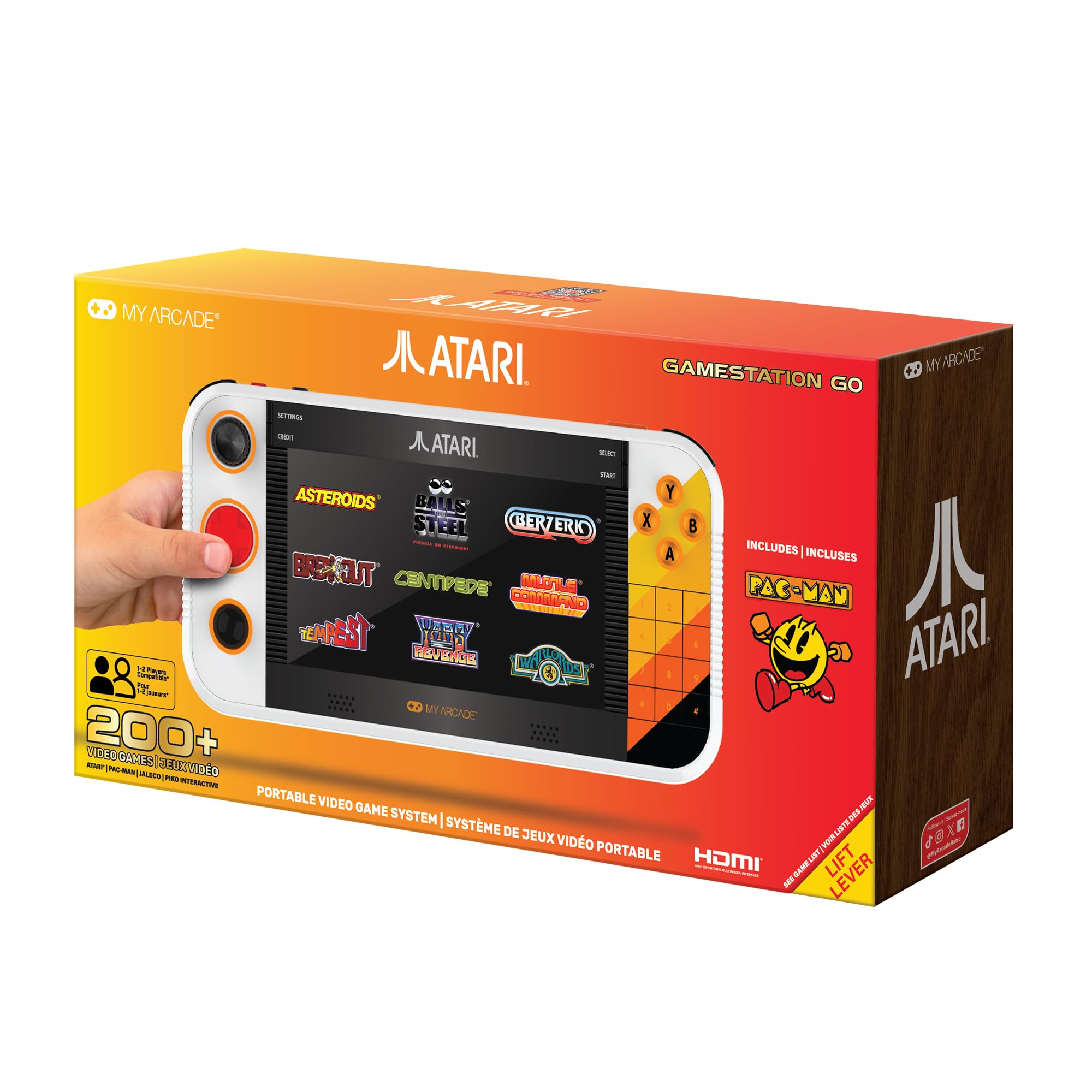
The Atari Gamestation Go is a love letter to the 2600, 5200, and 7800 eras, packing 200+ licensed titles including Pac‑Man, Asteroids, Centipede, and Tempest. Its standout feature is the integrated paddle, trak‑ball, D‑pad, and numeric keypad — you can play every game with the controller it was designed for, and SmartGlow technology lights up the relevant controls per title.
The 7‑inch color display is the biggest in this budget segment, and HDMI output lets you play on a TV. Wi‑Fi enables firmware updates, and the microSD slot allows expansion with custom ROMs — but switching requires a boot‑time selection. The build feels light and ergonomic with a fold‑out stand, though early firmware had screen ratio and sound bugs that updates have largely resolved.
Battery life is decent for this class, and the included HDMI cable and charge cable make setup immediate. It’s not a PS2 emulator — this is purely for 8‑bit and early 16‑bit fans. The missing classics (Pitfall, Frogger, Space Invaders) are noticeable, but the library is still deep. For Boomers or collectors wanting an all‑in‑one Atari museum, it’s unmatched.
Why it’s great
- 200+ licensed Atari 2600/5200/7800 games built in
- SmartGlow lights up controls per game
- Integrated paddle, trak‑ball, and numeric keypad
- HDMI out for TV play
Good to know
- Missing some iconic Atari titles
- microSD switching requires boot‑time selection
7. Evercade EXP-R

The Evercade EXP-R is the only handheld in this guide that uses physical game cartridges, giving it a genuine collector appeal. It comes bundled with the Tomb Raider Collection 1 cartridge, and you can buy additional official cartridges covering dozens of retro platforms. The 800×480 IPS screen is sharp and bright, with TATE mode for vertical shoot‑’em‑ups.
The unit is lightweight at 3.2 ounces and extremely pocketable. Built‑in Wi‑Fi enables firmware updates and online leaderboards. Battery life is 4‑5 hours via USB‑C charging — fine for daily commutes. The charcoal grey with turquoise accents looks premium, and the build feels solid despite the low weight.
The hidden game unlocks on cartridges reward exploration, and the growing library (over 400 licensed games across 50+ cartridges) means you can slowly expand your collection. The biggest catch: no two‑player mode unless you buy the separate controller, which adds cost. The EXP‑R is built for solo retro enthusiasts who love the ritual of swapping cartridges and reading physical manuals.
Why it’s great
- Physical cartridge support for collectors
- TATE mode with dedicated buttons for vertical shooters
- Lightweight and portable at 3.2 ounces
- Hidden game unlocks add replay value
Good to know
- No two‑player mode without separate controller
- Cartridge library requires ongoing purchases
FAQ
Can a Retroid Pocket 5 really play all PS2 games at full speed?
Why does the Nintendo Switch Lite not connect to my TV?
How do I set up emulators on an Android‑based handheld like the Retroid Pocket?
Is the Steam Deck OLED worth upgrading from the original LCD model?
Final Thoughts: The Verdict
For most users, the best handheld consoles winner is the Valve Steam Deck OLED 1TB because it runs your entire Steam library natively while offering the best display and battery life in the premium segment. If you want a dedicated Nintendo library with an OLED screen, grab the Nintendo Switch OLED. And for high‑end PS2 and GameCube emulation at a mid‑range price, nothing beats the Retroid Pocket 5.