
Power outages don’t announce themselves. They strike during the worst possible moment — a summer heatwave, a winter storm, or a grid failure that lingers for days. Your lights flicker, the fridge goes silent, and suddenly you’re digging through drawers for candles. An all home generator changes that equation entirely, turning a powerless house into a functioning one with running appliances, lights, and climate control.
I’m Min — the co-founder and writer behind Gadgets Feed. I’ve spent countless hours parsing through engine displacements, running wattage ratings, fuel types, transfer switch compatibility, and real-world runtime figures to separate the generators that actually deliver from the ones that sound good on paper but fall flat under load.
Whether you need backup for a weekend storm or a permanent solution for frequent outages, this guide breaks down the options that matter. The single best resource for finding the right all home generators starts right here with hard specs and real user experience.
How To Choose The Best All Home Generators
Selecting a home generator is a multi-year investment decision. The key is matching your power requirements to the right fuel type, output capacity, and form factor. Most buyers overestimate peak wattage needs while underestimating the importance of running wattage and fuel logistics.
Match Your Running Wattage, Not Just Peak
Peak wattage handles startup surges — the moment your AC compressor or well pump kicks on. But running wattage is what keeps everything humming for hours or days. Calculate the running watts of your essential appliances: refrigerator (600-800W), sump pump (800-1200W), furnace blower (800-1500W), lights (300-500W), and well pump (1000-2500W). A 5,000-7,000 running watt generator typically covers critical circuits for most homes, while a 12,000+ running watt unit can handle whole-house loads including central AC with a soft start.
Fuel Type Dictates Your Runtime Strategy
Gasoline offers the highest power density but degrades over months of storage. Propane burns cleaner and stores indefinitely but delivers slightly lower wattage. Natural gas provides unlimited runtime via your home’s gas line but requires professional installation and a tri-fuel generator. Dual fuel units give you flexibility between gas and propane, while tri-fuel models like the Champion 201161 add natural gas for permanent standby capability.
Quick Comparison
On smaller screens, swipe sideways to see the full table.
| Model | Category | Best For | Key Spec | Amazon |
|---|---|---|---|---|
| DuroStar DS13000MX | Dual Fuel | Whole-house backup on propane or gas | 13,000 peak watts / 500cc engine | Amazon |
| Westinghouse WGen5300c | Gasoline | Mid-size home backup with remote start | 6,600 peak watts / 274cc engine | Amazon |
| Westinghouse 12500W Dual Fuel | Dual Fuel | Heavy-duty gas or propane backup | 12,500 peak watts / 457cc engine | Amazon |
| BLUETTI AC200L | Solar/ Battery | Clean, silent home backup | 2,048Wh / 2,400W output | Amazon |
| Anker SOLIX C2000 Gen 2 | Solar/ Battery | Compact, fast-recharging backup | 2,048Wh / 2,400W rated output | Amazon |
| Champion 4000W Dual Fuel Inverter | Inverter | Quiet, clean power for RV and small homes | 4,000 starting watts / 64 dBA | Amazon |
| Champion 15000W Tri-Fuel | Tri-Fuel | Natural gas standby for whole house | 15,000 starting watts / 717cc V-Twin | Amazon |
| Honda EU3200i | Inverter | Premium quiet portable power | 3,200 starting watts / 208cc engine | Amazon |
| EF ECOFLOW DELTA Pro Ultra | Solar/ Battery | Massive whole-home battery backup | 6,144Wh / 7,200W output | Amazon |
| Honda EU7000iS | Inverter | Super quiet whole-home inverter backup | 7,000 starting watts / 52-58 dBA | Amazon |
| Generac Guardian 26kW | Standby | Automatic whole-house power | 26,000W / 999cc G-Force engine | Amazon |
In‑Depth Reviews
1. DuroStar DS13000MX 13,000-Watt Dual Fuel Portable Generator

The DuroStar DS13000MX delivers serious punch with its 500cc engine pushing 13,000 peak watts on gasoline. That’s enough to run two air conditioners, a refrigerator, stove, microwave, water heater, and multiple TVs simultaneously without breaking a sweat. Real owners report powering their entire home with ease, noting only a slight strain when the AC compressor kicks on. The dual fuel capability means you can run on propane for cleaner, longer storage or switch to gasoline for maximum output.
Push-button electric start with a remote key fob makes cold mornings or stressful outages less painful — no wrestling with a pull cord. The CO alert system adds a genuine safety layer, automatically shutting the unit down if carbon monoxide accumulates. Assembly is straightforward: bolt on the wheel kit, add oil, connect the battery, and you’re ready. At 220 pounds, it’s not a solo carry, but the fold-out handles make wheeling it around manageable.
Owners consistently praise the instant start on propane and the smart circuitry that simplifies shutdown. The included tool kit, oil funnel, and propane regulator mean you’re not hunting for extras. For a mid-range price that undercuts many competitors with similar output, the DuroStar DS13000MX is a rock-solid choice for homeowners who want whole-house backup without stepping into standby generator territory.
Why it’s great
- Powers entire home including AC and well pump without strain
- Dual fuel flexibility with propane for long-term storage
- Electric start with remote fob for convenient operation
Good to know
- Weighs 220 pounds — requires two people or a hand truck to move
- Open frame design is loud compared to inverter models
- Needs 50-amp inlet and transfer switch for whole-house connection
2. Westinghouse 12500 Peak Watt Dual Fuel Portable Generator

The Westinghouse 12500W Dual Fuel generator brings 12,500 peak watts on gasoline and 11,200 on propane via its 457cc cast iron sleeve engine. That’s enough to run a well pump and water heater simultaneously — a task many generators in this class struggle with. The 6.6-gallon fuel tank delivers up to 12 hours of run time, meaning you can sleep through the night without a refuel stop. Remote start via key fob, electric push-button, and recoil backup give you three ways to fire it up.
This unit is transfer switch ready with a 14-50R 50-amp outlet, making it easy to connect to a home inlet. The outlets feature rubber covers for safety, and the digital hour meter helps track maintenance intervals. Owners report easy assembly under five minutes and praise the electric start reliability. It’s been rated highly by publications like Consumer Reports and Popular Mechanics for its build quality and power delivery.
The downsides are mostly physical — at 212 pounds, it’s heavy, though the wheel kit makes rolling it manageable. Noise is expected with an open frame generator, but owners say it’s tolerable and inaudible indoors. Some users note the lack of an Eco switch for idle control and recommend ethanol-free fuel for best performance. It’s a seriously capable backup generator that won’t break the bank compared to inverter or standby options.
Why it’s great
- Dual fuel with remote start and three ignition methods
- 50-amp outlet ready for whole-house transfer switch connection
- 12-hour runtime at half load on a single tank
Good to know
- Requires high-altitude kit for operation above 2,000 feet
- No Eco throttle switch for fuel conservation at low loads
- Heavy at 212 pounds; wheels must be attached after delivery
3. Westinghouse 6600 Watt Home Backup Portable Generator

The Westinghouse WGen5300c delivers 6,600 peak watts and 5,300 running watts from its 274cc engine — a sweet spot for mid-size home backup. Owners report running two refrigerators, space heaters, and electronics simultaneously without issue. The 4.7-gallon fuel tank provides up to 14.5 hours of runtime, and the fuel gauge makes it easy to track consumption. The real standout feature here is the remote start key fob plus electric push-button start at a price point where most competitors offer only recoil start.
The outlets include a TT-30R RV-ready 30-amp receptacle and an L14-30R 30-amp transfer switch ready outlet, giving you flexibility for both RV camping and home backup. The automatic low oil shutdown and CO sensor add critical safety layers. At 136.6 pounds, it’s one of the lighter units in its power class, though still heavy enough to require two people for loading.
Real-world users love the electric start reliability, with many noting it fired up on the first try even in 28-degree weather. The noise level measures around 87 dB at the unit and 76 dB at 30 feet — loud but within expectations for an open frame generator. Some owners recommend keeping the battery charged weekly to prevent dead battery issues in cold weather. For budget-conscious buyers who still want remote start convenience, this generator punches above its weight.
Why it’s great
- Remote start with key fob at a budget-friendly price point
- 14.5-hour runtime covers overnight without refueling
- Includes oil, funnel, tool kit, and wheel kit out of the box
Good to know
- Open frame produces 87 dB noise level — ear protection recommended
- Battery may drain in cold weather; needs weekly charging to maintain remote start
- Gasoline only — no dual fuel capability
4. Champion Power Equipment 4000-Watt Dual Fuel Inverter

The Champion 4000-watt dual fuel inverter generator brings the quiet efficiency of inverter technology to the mid-power segment. With just 64 dBA from 23 feet — quieter than a normal conversation — this unit won’t have your neighbors filing complaints during an outage. It delivers 4,000 starting watts and 3,000 running watts on gasoline, shifting to 2,700 running watts on propane with up to 25 hours of runtime. The 149cc engine sips fuel on propane, making it ideal for extended backup scenarios.
Clean electricity with less than 3% total harmonic distortion means it’s safe for sensitive electronics like laptops, TVs, and medical devices. The CO Shield auto shutoff system provides carbon monoxide protection, and the parallel-ready outlets let you link a second unit for more power. The TT-30R RV outlet and household duplex outlets make it versatile for camping, tailgating, or home backup.
Owners praise the propane operation for eliminating carburetor maintenance and starting reliably even after months of storage. The 53-pound weight and built-in handle make it far more portable than traditional open-frame generators. Some users report quality control issues with defective units, though Champion’s customer service and 3-year warranty provide a safety net. For quiet, clean power in a portable package, this inverter is a strong mid-range contender.
Why it’s great
- Ultra-quiet 64 dBA operation — quieter than normal conversation
- Dual fuel with propane delivering up to 25 hours runtime
- Clean power below 3% THD safe for sensitive electronics
Good to know
- Only 4,000 starting watts limits heavy appliance use
- Recoil start only — no electric or remote start
- Some units have quality control issues per owner reports
5. BLUETTI AC200L Portable Power Station

The BLUETTI AC200L is a battery-powered alternative to gas generators, offering 2,048Wh of LiFePO4 storage with 2,400W AC output and 3,600W power lifting capability. That’s enough to run a refrigerator, freezer, TV, modem, and lamps for around 10 hours. The real magic is expandability — add up to 8,192Wh with external battery packs, giving you days of backup without a drop of gasoline. The 30A RV port and 48V DC port make it ideal for RV owners looking to charge batteries directly.
Fast charging is a standout feature: AC input at 2,400W pushes 0-80% in just 45 minutes, and solar input up to 1,200W gives a full charge in under 2.2 hours with adequate panels. The 11-port array covers AC, USB, 100W PD, car port, and RV outlet. The app with Wi-Fi and Bluetooth lets you monitor usage and adjust settings remotely. Owners with 5-year warranty peace of mind report 10+ year battery life expectancy.
The trade-off is weight — 61.4 pounds is heavy for a power station, though still far lighter than any gas generator with similar capability. The proprietary power cord for expansion batteries is a minor inconvenience. For homeowners who want silent, emission-free backup that pairs with solar panels, the AC200L is a compelling entry into the battery backup world without the astronomical cost of whole-home systems.
Why it’s great
- Silent, emission-free operation with zero fuel storage needed
- Expandable to 8,192Wh for multi-day backup
- 45-minute fast recharge via AC input
Good to know
- 61.4 pounds is heavy to move despite being “portable”
- Proprietary expansion cables required for battery packs
- Limited to 2,400W continuous — won’t run large AC units without soft start
6. Anker SOLIX C2000 Gen 2 Portable Power Station

The Anker SOLIX C2000 Gen 2 packs 2,048Wh of LiFePO4 power into a chassis that’s 25% lighter and 29% smaller than comparable units at just 41.7 pounds. The 2,400W rated output with 4,000W peak means it can handle startup surges from most window and RV air conditioners. The headline feature is 58-minute full recharge from AC — absurdly fast for a 2kWh battery. The 800W alternator charging via your car’s 12V outlet fills the battery in 3 hours versus the typical 24+ hours with a standard socket.
Standby power consumption is just 9W, so a dual-door fridge runs for up to 32 hours on a single charge. Expandable to 4kWh with an additional battery, that runtime doubles. The six recharge methods — AC, solar, car, generator, EV pile, and dual AC — give you maximum flexibility during extended outages. The companion app provides Bluetooth control and usage tracking, though some users wish for Wi-Fi remote access.
Owner reports highlight its ability to power a car fridge for 5-7 days on a single charge during road trips, and a TV, fridge, and WiFi router for over 10 hours during blackouts. The compact size fits easily in a corner of the garage or RV. For buyers who want a battery backup that’s genuinely portable, charges faster than any competitor, and doesn’t require fuel storage, the C2000 Gen 2 is hard to beat.
Why it’s great
- 58-minute full recharge — fastest in its class
- 41.7 pounds is genuinely portable for a 2kWh battery
- Car alternator charging in 3 hours for off-grid flexibility
Good to know
- Expandable only to 4kWh — less than some competitors
- No printed manual included; relies on digital documentation
- Proprietary expansion battery connector limits third-party options
7. Champion Power Equipment 15,000-Watt Tri-Fuel Generator

The Champion 201161 is a tri-fuel powerhouse with 15,000 starting watts and 12,000 running watts driven by a 717cc Milwaukee Series V-Twin engine. The ability to run on natural gas, propane, or gasoline without any conversion kit is a genuine differentiator. Both natural gas and propane hoses are included, so you’re ready to connect to your home’s gas line or a propane tank out of the box. That flexibility means you can use natural gas for unlimited runtime during extended outages while keeping gasoline as a backup.
The electric start with a reliable toggle switch fires the engine instantly, and the Intelligauge tracks voltage, hertz, and runtime hours for easy maintenance monitoring. The CO Shield auto shutoff adds a critical safety layer. At 331 pounds with wheel kit, it’s heavy enough to stay put once positioned. Owners report powering their entire house including 3.5-ton HVAC systems with a soft start during Hurricane Beryl for 90 hours straight on natural gas.
The price difference versus a permanently installed standby generator is significant — owners note this unit costs a fraction of a comparable Generac or Kohler standby system. The trade-off is that the CO sensor can be too sensitive for some outdoor placements, shutting down after 1-2 hours of operation if exhaust recirculates. Noise at 78 dBA is moderate for its size. For budget-conscious homeowners who want permanent natural gas backup without the standby generator price tag, this tri-fuel Champion is a brilliant compromise.
Why it’s great
- Tri-fuel operation from natural gas, propane, or gasoline with included hoses
- 717cc V-Twin engine delivers 12,000 running watts for whole-house loads
- Cost-effective alternative to permanent standby generators
Good to know
- CO sensor may trip prematurely in some outdoor placements
- 331 pounds requires permanent or semi-permanent placement
- Requires professional electrician for natural gas line connection
8. Honda EU3200i 3200 Watt Inverter Generator
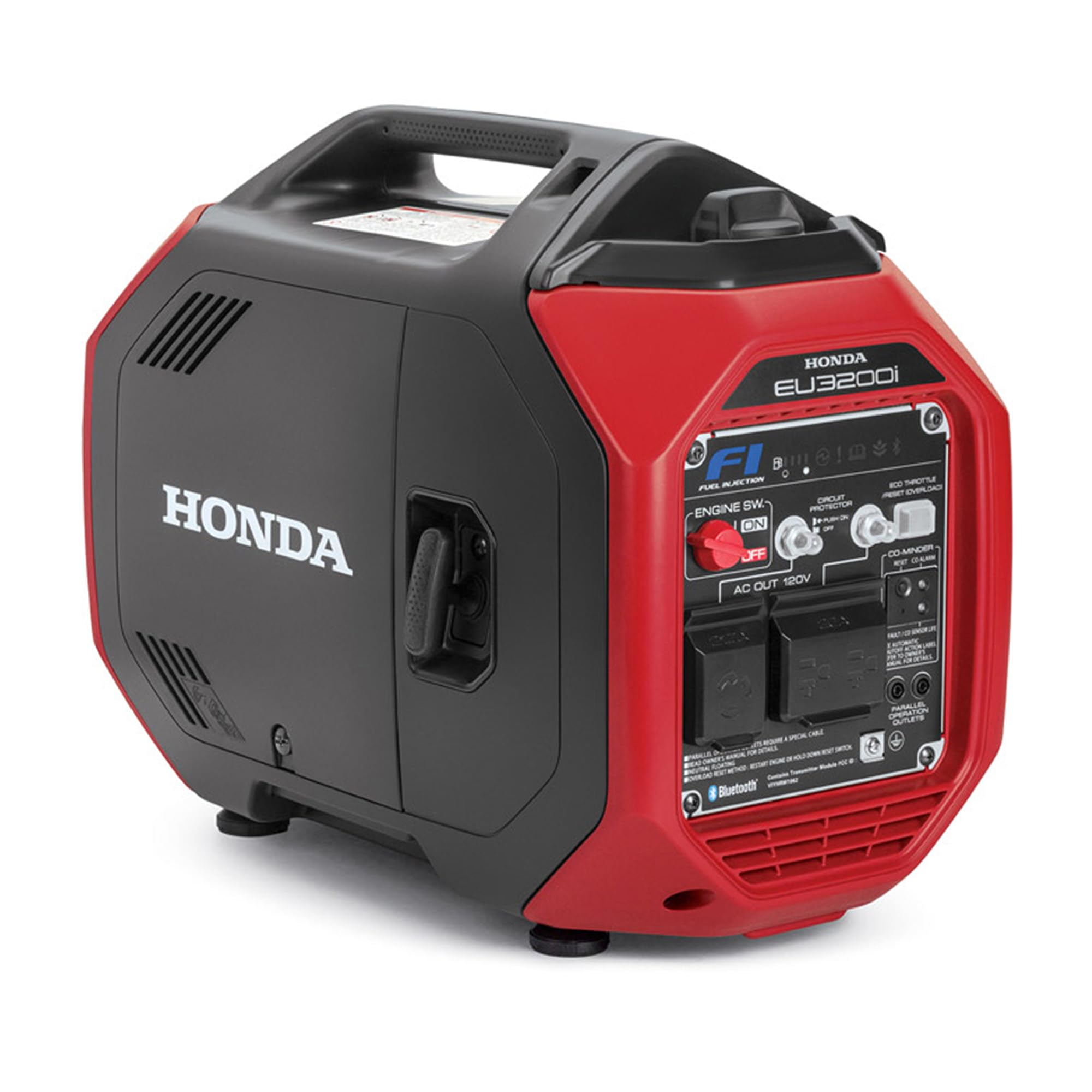
The Honda EU3200i is the gold standard for portable inverter generators, delivering 3,200 starting watts of ultra-clean, stable power from its 208cc engine. Honda’s inverter technology produces household-quality electricity that’s safe for the most sensitive electronics — laptops, CPAP machines, and medical devices. The 65-pound weight makes it one of the lightest generators in its power class, and the built-in handle means one person can easily move it. The Eco Throttle system adjusts engine speed to match the load, extending runtime up to 8.6 hours on a single tank.
The CO-MINDER system continuously monitors carbon monoxide levels and shuts the generator down before unsafe levels accumulate. Front-panel LED indicators give you instant feedback on fuel level, Eco Throttle status, and output. The parallel capability lets you pair two EU3200i units for up to 6,400 starting watts using a compatible parallel kit. Owners consistently report starting on the first or second pull, even after months of storage.
This is the quietest generator in its class — owners compare it favorably to louder open-frame units from other brands. The build quality is unmistakably Honda: cast iron sleeve, Oil Alert protection, and decades of reliability engineering. The premium price reflects that reputation, and long-term owners confirm it’s money well spent. For RV owners, campers, and homeowners who want the most reliable portable power money can buy, the EU3200i is the definitive choice.
Why it’s great
- Ultra-quiet operation — quieter than normal conversation
- Clean inverter power safe for all sensitive electronics
- 65 pounds is genuinely portable and easy to carry
Good to know
- Limited to 3,200 watts — won’t power large appliances or well pumps
- Gasoline only — no dual fuel option
- Premium price reflects Honda’s brand and reliability reputation
9. EF ECOFLOW DELTA Pro Ultra 6144Wh Power Station

The EF ECOFLOW DELTA Pro Ultra is a modular whole-home battery backup system that starts at 6,144Wh and expands to a staggering 90kWh — enough to power a standard North American home for over 30 days on essential circuits. The inverter delivers 120V and 240V at 7,200W output, capable of running a 3-ton central air conditioner without a soft start. Triple the inverters for 21.6kW output and you’ve got a system that rivals a small commercial installation. The 2-hour full recharge via AC input is blazingly fast for a battery of this size.
The EcoFlow app lets you prioritize specific circuits, offset peak electricity rates, and monitor solar input in real time. Online UPS with 0ms transfer time means your devices never flicker during a grid failure. The unit operates in near-silence for the first 30 minutes at 2,000W output, with all fans off — a welcome feature for nighttime use. Owners report pairing it with 8x195W solar panels for multi-day off-grid capability, and the modular design allows gradual investment over time.
The biggest value proposition is cost: at roughly half the price of a Tesla Powerwall with similar usable capacity, the DELTA Pro Ultra offers compelling economics for solar-equipped homes. The 5-year warranty and expandable architecture make it future-proof. The catch is the premium upfront investment, and some buyers report inconsistent customer support and the lack of a printed manual for a product at this price point. For homeowners serious about energy independence, this is the battery backup to beat.
Why it’s great
- Expandable to 90kWh for over 30 days of essential home backup
- 7,200W 120/240V output runs central AC and well pumps
- 0ms UPS transfer for uninterrupted power to sensitive devices
Good to know
- Significant upfront investment for the full system
- No printed manual — all documentation is digital
- Some reports of inconsistent customer support experiences
10. Honda EU7000iS 7000 Watt Inverter Generator
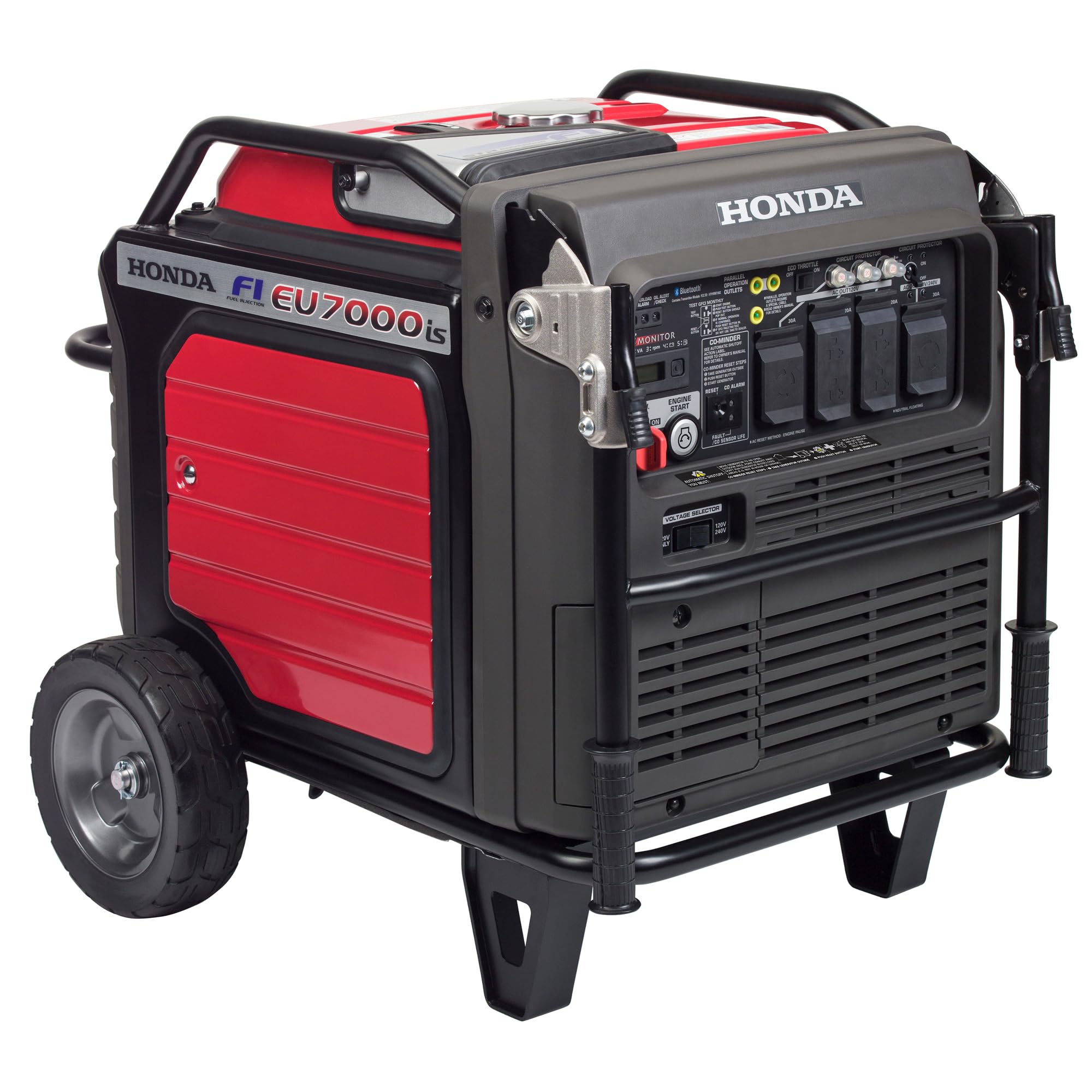
The Honda EU7000iS is the quietest 7,000-watt generator money can buy, operating at just 52-58 dBA — quieter than a normal conversation. That’s remarkable for a generator that can power a 3-ton central AC unit, water heater, and essential circuits simultaneously. The advanced inverter technology produces clean, stable 120/240V power that rivals grid quality, and the 5.1-gallon fuel tank delivers 6.4 to 16 hours of runtime depending on load. The Eco Throttle system automatically adjusts engine RPM to match demand, drastically improving fuel efficiency at partial loads.
The Bluetooth-enabled My Generator app lets you start, stop, and monitor the generator remotely from your phone. The CO-MINDER system provides automatic shutdown if carbon monoxide reaches unsafe levels. Electric start with a pre-charged battery means one-button power even in the worst weather. At 263 pounds with wheels, it’s not truly portable for off-road use, but the wheel kit makes garage-to-driveway movement manageable. Owners pair it with Generlink transfer switches for whole-house backup with breaker management.
This generator is expensive — there’s no way around it. But owners consistently describe it as the most reliable power purchase they’ve ever made, especially after experiencing a hurricane event. The build quality, parts availability, and Honda’s dealer support network are unmatched in the portable generator space. For homeowners who want premium inverter quality, whisper-quiet operation, and the ability to power a whole house on a gas generator, the EU7000iS is the definitive top-tier choice.
Why it’s great
- Ultra-quiet 52-58 dBA — neighbors won’t hear it running
- Bluetooth app for remote start, stop, and monitoring
- Clean inverter power for sensitive electronics with 7,000 watts
Good to know
- Premium price is the highest among portable generators
- 263 pounds with wheels — not truly portable for rough terrain
- Gasoline only — needs auxiliary fuel tank for extended runtime
11. Generac Guardian 26kW Home Standby Generator
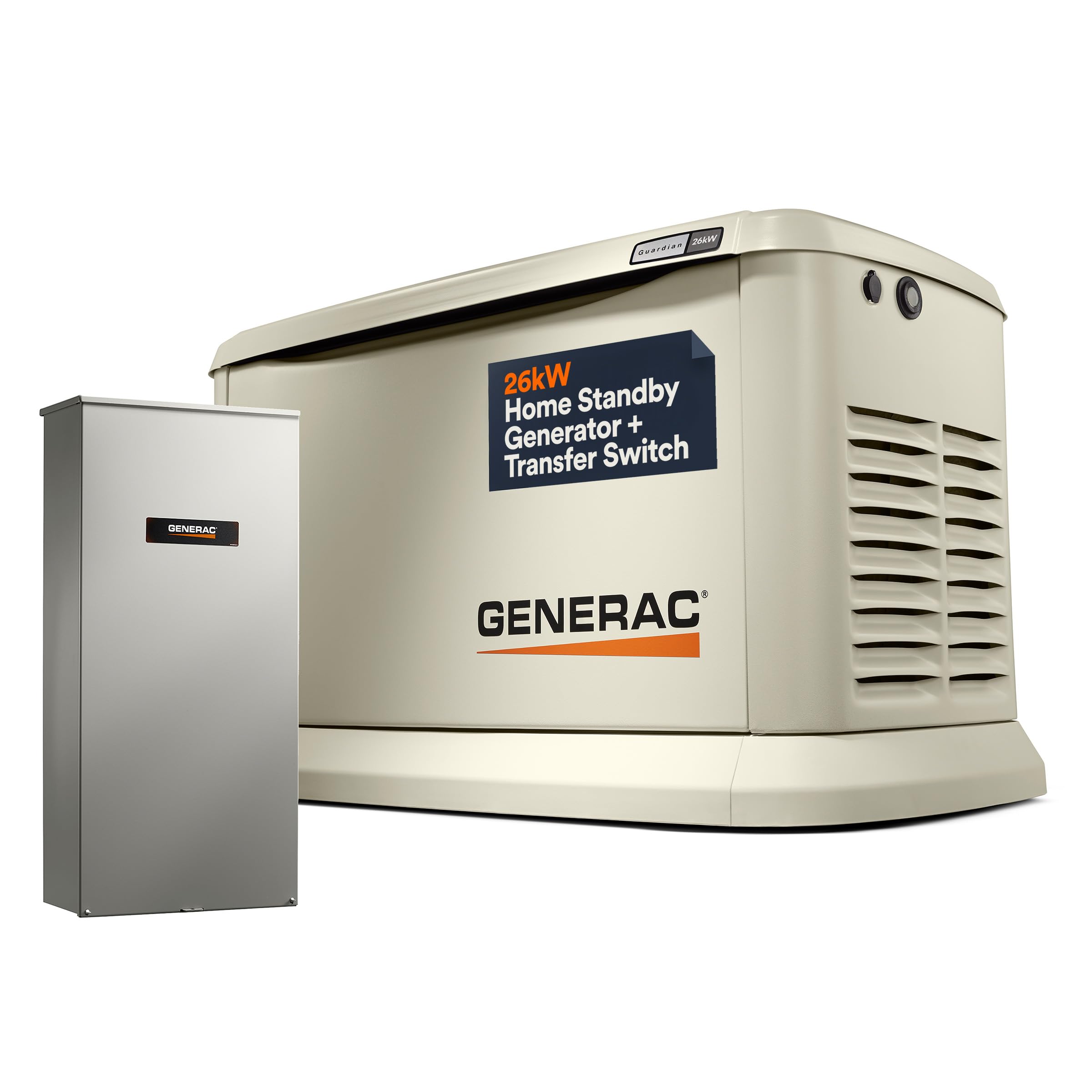
The Generac Guardian 26kW is the ultimate all home generator — a permanently installed standby unit that automatically detects power loss and restores electricity within seconds, whether you’re home or away. The 999cc G-Force engine delivers 26,000 watts of True Power Technology with less than 5% harmonic distortion, powering your entire house including central AC, well pump, electric water heater, and kitchen appliances simultaneously. The included 200-amp transfer switch replaces your main panel and automatically isolates your home from the grid during an outage.
Mobile Link Wi-Fi connectivity lets you monitor generator status, runtime, and maintenance alerts from anywhere via smartphone app. The unit runs on natural gas or liquid propane, with automatic fuel switching. The 5-year limited warranty provides long-term peace of mind. At 518 pounds, it’s not portable — it’s designed for permanent outdoor installation on a concrete pad by a licensed electrician. Owners consistently call it the best investment for homes in storm-prone areas, with one noting it ran flawlessly for 90 hours during Hurricane Beryl.
The price is substantial, but it includes the transfer switch and eliminates the need for manual generator setup, extension cords, fuel storage, and break-in procedures. The noise level is loud but tolerable for a standby unit, and the automatic weekly test run keeps the engine lubricated and ready. Some buyers report delivery and warranty issues when purchasing from Amazon versus a local dealer. For homeowners who want absolute power security with zero daily involvement, the Generac Guardian 26kW is the final answer.
Why it’s great
- Automatic operation — powers up in seconds after grid failure
- 26,000 watts with 200-amp transfer switch for whole-house coverage
- Wi-Fi monitoring and 5-year warranty for peace of mind
Good to know
- Requires professional installation by licensed electrician
- Premium price is the highest in this comparison
- Warranty and support better through local dealer than Amazon
FAQ
What size generator do I need to power my whole house?
Can I plug a generator directly into a wall outlet?
How long can a generator run continuously?
What’s the difference between a portable generator and a standby generator?
Do I need an inverter generator or a conventional generator?
Final Thoughts: The Verdict
For most users, the all home generators winner is the DuroStar DS13000MX because it delivers 13,000 peak watts, dual fuel flexibility, and electric start at a price that undercuts most competitors with similar output. If you want whisper-quiet operation and premium build quality, grab the Honda EU3200i. And for automatic whole-house backup with zero daily involvement, nothing beats the Generac Guardian 26kW.