
A seven-year-old’s brain craves rules that make sense, rounds that wrap up before attention fades, and just enough unpredictability to keep every hand fresh. The best card games for this age nail that balance — simple to teach in under three minutes, quick to finish, and packed with moments where strategy and luck collide in a way that feels fair whether you’re in first grade or forty-first grade.
I’m Min — the co-founder and writer behind Gadgets Feed. I have spent countless hours analyzing game mechanics, real customer feedback, and age-appropriateness to identify the card games that genuinely work for a seven-year-old’s developing attention span and social skills.
After cross-referencing playtime length, rule complexity, and replay value across dozens of options, one clear set of winners emerged. This guide breaks down the very card games for 7 year olds that parents and kids actually agree on night after night.
How To Choose The Best Card Games For 7 Year Olds
Not every deck of cards works for this age. A standard 52-card set demands reading, counting, and a patience level most seven-year-olds haven’t built yet. The best options use custom cards with clear symbols, a theme that hooks attention, and a round structure that finishes before anyone drifts off.
Round Length and Attention Span
Games that run 10 to 15 minutes let a seven-year-old stay focused from start to finish. Any longer and the last few hands become a chore. Look for published playtimes around 15 minutes — that signals the designer tuned the pacing for younger tabletop attention spans.
Player Count Flexibility
Family game night rarely lands on the same number of players twice. A game that works for 2 to 6 or even 2 to 8 players means nobody gets left out when grandparents visit or a friend sleeps over. Games with rigid player counts (like exactly 4) get shelved more often.
Rule Depth vs. Strategic Room
The best card games for 7 year olds teach in under three minutes but leave space for tactical decisions. Pure luck games bore quickly. Games that demand too much reading or multi-step planning frustrate. The sweet spot is a game where a seven-year-old can make meaningful choices — which card to play, who to target — without needing to calculate probabilities.
Quick Comparison
On smaller screens, swipe sideways to see the full table.
| Model | Category | Best For | Key Spec | Amazon |
|---|---|---|---|---|
| Taco vs Burrito | Strategy | Best Overall Pick | 56 cards, 15 min rounds | Amazon |
| Elimino | Classic Twist | Portable Family Fun | 2-5 players, ages 7+ | Amazon |
| Hasty Baker | Themed/Educational | Baking Theme Lovers | 2-6 players, ages 7+ | Amazon |
| SWOOP | Social Strategy | Large Groups | 162 cards, 3-8 players | Amazon |
| SKYJO | Educational | Math Skill Building | 150 cards, 30 min rounds | Amazon |
| Slapburger | Action/Fast | High-Energy Players | 2-6 players, ages 4+ | Amazon |
| Taco Cat Goat Cheese Pizza Pool | Waterproof | Pool & Outdoor Use | Waterproof cards, 7+ | Amazon |
In‑Depth Reviews
1. Taco vs Burrito

This is the rare card game actually conceived by a seven-year-old — Alex designed the original concept at age seven, and the result is a game that thinks like a kid plays. The 56-card deck splits into ingredient and action cards, and the goal is to build the wildest meal possible before your opponent does. Rounds clock in at exactly 15 minutes, and the learn-to-play time is under 3 minutes, which makes it the easiest table flip of the night.
What surprises most adults is the strategic depth hiding under the silly food-fight theme. Action cards let you steal ingredients, swap hands, or force a discard, which means a seven-year-old who pays attention can absolutely beat a parent who’s not taking it seriously. The 4 taco and burrito card holders keep little hands organized, and the box dimensions (7 x 5 x 2 inches) slide into any backpack or travel bag without a second thought.
Customer feedback consistently mentions that siblings aged 6 to 10 fight over who gets to shuffle next, and parents appreciate that nobody gets eliminated mid-game — everyone plays until the final hand. The only catch is the player count tops out at 4, so larger family gatherings require a second deck or a rotation system.
Why it’s great
- Designed by an actual 7-year-old — the mechanics match how kids think
- 15-minute rounds fit perfectly before attention wanders
- Action cards add enough strategy that adults stay engaged
Good to know
- Max 4 players — not ideal for larger groups without extra decks
- Cards are standard thickness, not waterproof or spill-resistant
2. Elimino Family Card Game
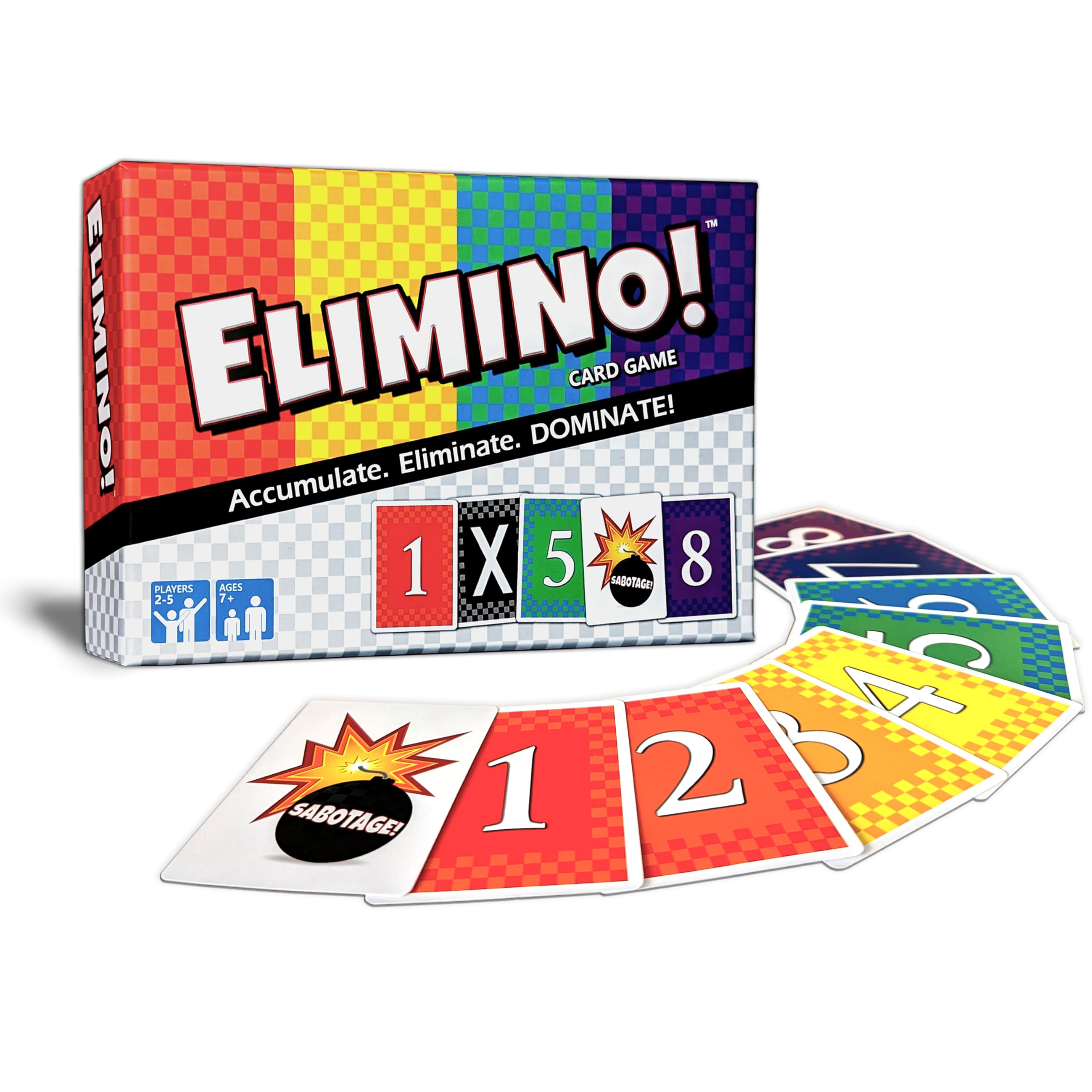
Elimino takes the classic “Garbage” or “Trash” card game framework and injects interactive cards that let players steal opportunities and sabotage opponents. The core loop is familiar enough that a seven-year-old who has ever played a matching game can jump in immediately, but the twist cards add a layer of tactical thinking that keeps the game from feeling repetitive after ten rounds.
The box measures 6.25 x 4.5 x 1.5 inches and weighs 0.23 kilograms — small enough to toss into a glove compartment or a carry-on without sacrificing card quality. Parents report that grandparents pick it up just as fast as the kids, and the sabotage mechanic creates the kind of table talk that turns a quiet evening into a laughing fit. The designer is a sister-owned company called Wishing Well Games, which also donates to charitable causes with each purchase.
Some younger seven-year-olds may need a round or two of coaching on when to play blocking cards versus saving them, but the rulebook is illustrated and approachable. The game is designed for ages 7 through adult, and the 84-month minimum age rating (7 years) is accurate — a mature 6-year-old could play with light guidance.
Why it’s great
- Familiar “Garbage/Trash” mechanics with fresh interactive twists
- Ultra-portable size fits any travel bag
- Family-run brand with a charitable mission
Good to know
- Younger players may need a few rounds to grasp sabotage timing
- Box is compact — cards can be tricky for small hands to shuffle
3. Hasty Baker Family Card Game
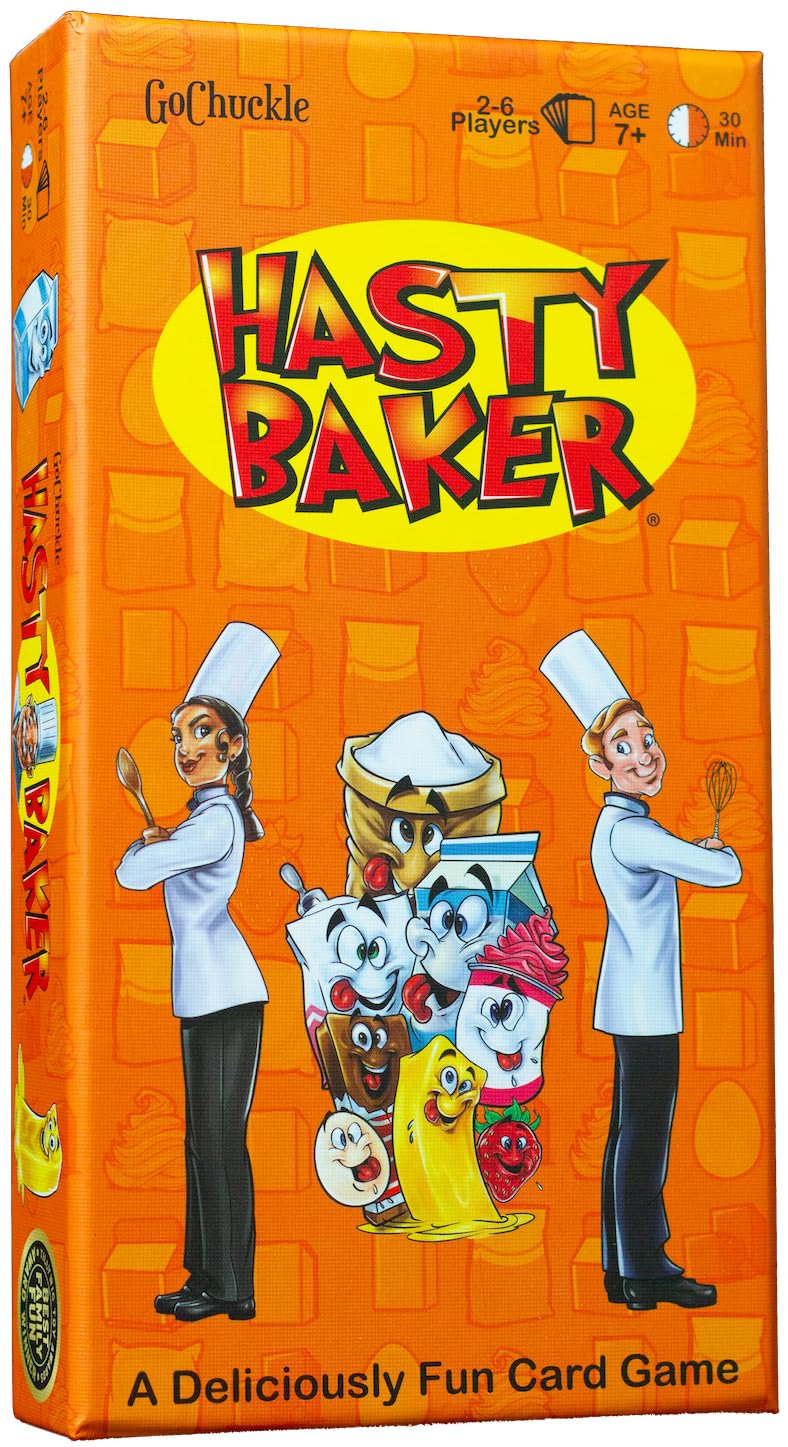
Hasty Baker wraps a cooking metaphor around a card-collection race: each player needs to gather four specific ingredient cards (flour, eggs, butter, sugar) to complete a recipe before their opponents do. The twist is that you can steal ingredient cards from other players’ hands, which introduces a delicious tension that keeps every turn interesting. The artwork is bright and cartoonish — each ingredient card is visually distinct, so pre-readers can identify what they need by picture alone.
The award list is impressive: Tillywig Best Family Fun, Creative Child’s Game of the Year for four consecutive years, and the Autism Live Best Card/Board Game award. Food Network’s Kids Baking Champion Season 9 winner Keaton Ashton also endorsed it, which speaks to how well the baking theme connects with the target age. The game teaches critical thinking and good sportsmanship by design — when you steal someone’s sugar card, you have to do it with a smile.
Playtime is flexible because rounds can be adjusted by changing the target recipe count. The box includes a clear instruction card, and most families report being fully operational within two minutes of opening the seal. The only note from experienced board game families is that the “steal” mechanic can lead to tears if younger players take the theft personally — but that’s also where the sportsmanship lesson lives.
Why it’s great
- Award-winning design with multiple family-focused accolades
- Baking theme is universally appealing and visually clear for pre-readers
- Steal mechanic teaches strategic thinking and graceful competition
Good to know
- Young children may struggle emotionally with having ingredients taken
- Card stock is decent but not premium — sleeve them if played daily
4. SWOOP Card Game

SWOOP supports up to 8 players out of the box (and up to 12 with the sold-separately Purple Expansion), making it the highest-capacity game on this list. The 162-card deck splits into three color-coded 54-card decks (Blue, Red, Green), and the core mechanic is a race to discard all your cards while using attack and block cards to stall opponents. It’s essentially a strategic shedding game with a social twist — table talk and targeted sabotage are not just allowed, they’re encouraged.
Seven-year-olds pick up the discard mechanic immediately, and the attacking cards add a layer of unpredictability that prevents any single player from dominating. The box is a 2-piece rigid design with internal dividers that keep the three decks separated, which is a thoughtful touch for organization. Customer reviews highlight that groups of 5 to 8 players create the most dynamic rounds, and the game travels easily for camping trips or picnics.
The age rating is 7+, and the minimum manufacturer age in months is 96 (8 years), but playtest reports indicate that a sharp 7-year-old handles the rules without hesitation. The only friction point is that the game works best with odd-numbered groups — with an even number, alliances can stall the pace. Still, for large sleepovers or multi-family gatherings, SWOOP is the strongest option in this list.
Why it’s great
- Handles up to 8 players — highest capacity on this list
- Three color-coded decks with built-in dividers for easy setup
- Attack and block cards create dynamic, social gameplay
Good to know
- Best with odd-numbered player groups to keep pace moving
- Expansion deck required for the full 12-player experience
5. magilano SKYJO

SKYJO takes the classic card game “Golf” and adds a colorful, kid-friendly makeover. The goal is to collect as few points as possible by uncovering, exchanging, and discarding cards over multiple rounds. The deck includes negative-number cards (from -1 to -2), which introduces basic arithmetic practice in a context that feels like a game secret, not a math worksheet — kids naturally learn to add two-digit numbers and estimate probabilities as they play.
The 150-card deck supports 2 to 8 players, and rounds average 30 minutes, which is slightly longer than the 15-minute sweet spot but manageable because the turn structure keeps everyone engaged between plays. The included game pad helps track scores across multiple rounds, and the illustrated rulebook is available in English, German, French, Spanish, and Italian. The cards are slightly thicker than standard playing cards, which holds up well to repeated shuffling by small hands.
Customer feedback consistently notes that children who struggle with math in school eagerly calculate their scores in SKYJO because the competitive context changes the motivation. The manufacturer age recommendation starts at 8 years, but the edge-case of a strong 7-year-old can handle it with minimal adult coaching. The only real drawback is the 30-minute round time — if your seven-year-old is tired or hungry, the last 10 minutes may drag.
Why it’s great
- Teaches addition, estimation, and concentration through natural gameplay
- Negative-number cards add a strategic depth that rewards careful play
- High card quality with thicker stock for repetitive handling
Good to know
- 30-minute rounds are longer than the 15-minute sweet spot for 7-year-olds
- Manufacturer age starts at 8 — a mature 7-year-old will be fine
6. Slapburger Card Game

Slapburger takes the classic slapjack mechanic and layers in burger-themed cards that create more slapping opportunities. Players take turns laying cards on a central pile — when a Slapburger Card, Double Decker, or Sandwich appears, the first person to slap the pile gets rid of their stack. The last player holding cards loses. It’s pure physical reflex meets visual recognition, and seven-year-olds with high energy levels absolutely love the physicality.
The deck measures 3.5 x 2.5 x 0.75 inches — smaller than a standard card deck, which makes it easy to slip into a pocket or a purse for restaurant waiting-room battles. The age range starts at 4, so a seven-year-old will feel like an expert compared to younger siblings. Rounds are variable — some end in under 5 minutes, others stretch to 15 if players are evenly matched. The manufacturer is a veteran-owned family company, and the focus is deliberately on unplugged connection.
The main consideration is that slapping creates noise and potential for collisions, so families with strict indoor play rules may want to set a “soft slap” house rule. Some review notes mention that the game can end abruptly if a player gets eliminated early, but since rounds are so short, the eliminated player just reshuffles and starts the next round within seconds. It’s the best option for high-energy kids who need to move while they play.
Why it’s great
- High-energy physical gameplay perfect for active kids
- Ultra-compact deck size fits in any pocket or small bag
- Age range starts at 4 — great for mixed-age sibling play
Good to know
- Slapping mechanic can be noisy and may need house rules for indoor use
- Rounds can end abruptly if one player slaps faster consistently
7. Taco Cat Goat Cheese Pizza Pool Edition

This Pool Edition of the popular Taco Cat Goat Cheese Pizza series swaps standard card stock for genuinely waterproof, floatable cards. You can drop the entire deck in a pool, fish it out, and keep playing without a single card warping. That alone makes it the best option for poolside birthdays, beach vacations, or any setting where drinks and snacks are within splashing distance of the game table.
The gameplay is a chanting-and-slapping race: players take turns saying the words “Taco, Cat, Goat, Cheese, Pizza” in sequence while laying down a card each turn. When the spoken word matches the played card, everyone slaps the pile. The last slapper takes the stack. Surprise action cards add chaos, and rounds average 10 minutes — even shorter than the 15-minute standard, which works well for attention spans that are competing with swimming and snacks. A free travel clip is included to attach the box to a beach bag or backpack.
The age rating is 7+, and the visual cues are strong enough that a younger child can participate with minimal help. Customer reviews consistently call it the “summer game” that gets played daily during warm months. The only limitation is that the waterproof material makes the cards slightly thicker and more prone to slipping during shuffling, but that’s a fair trade for a deck that survives a full dunk in chlorinated water.
Why it’s great
- Genuinely waterproof cards that float — survives pool accidents
- 10-minute rounds are the shortest on this list for quick sessions
- Includes a travel clip for attaching to beach bags or backpacks
Good to know
- Waterproof cards are slightly thicker and harder to shuffle
- Best suited for warm-weather settings — less relevant for indoor winter play
FAQ
What makes a card game appropriate for a 7-year-old specifically rather than a 5-year-old or a 10-year-old?
How many cards is too many for a 7-year-old to handle during shuffling and setup?
Should I avoid games with elimination mechanics for this age group?
Final Thoughts: The Verdict
For most users, the card games for 7 year olds winner is the Taco vs Burrito because it was literally designed by a seven-year-old, plays in exactly 15 minutes, and balances silly food-fight energy with genuine strategic decisions that keep adults interested too. If you want a portable game that fits in any bag and works across three generations at once, grab the Elimino Family Card Game. And for poolside play or outdoor summer settings where standard cards would be destroyed in minutes, nothing beats the Taco Cat Goat Cheese Pizza Pool Edition.