
The difference between a 1/8 scale buggy that hooks through a sweeper and one that swaps ends on corner exit isn’t luck—it’s the differential oil weight in the center diff and the roll-center geometry of the suspension arms. A millimeter of toe change or a single centigram of rotor imbalance at 60+ MPH turns a race-winning chassis into a frustrating, tractionless slide. This buying guide breaks down the exact drivetrain, electronics, and tuning details that separate track-ready platforms from backyard bashers that merely look the part.
I’m Min — the co-founder and writer behind Gadgets Feed. I’ve spent hundreds of hours cross-referencing motor KV ratings, ESC current limits, shock oil viscosities, gear mesh tolerances, and differential designs across the 1/8 off-road category to isolate the true performance indicators that matter at speed.
The market is flooded with scaled-up toys wearing buggy bodies, but locating a proper 1/8 scale buggy with a genuine race-bred chassis, sensored power delivery, and replaceable drivetrain components requires understanding what the spec sheet actually tells you—and what it hides.
How To Choose The Best 1/8 Scale Buggy
A true 1/8 scale buggy is defined by its wheelbase (roughly 320-340mm), its ability to accept full-house 4S or 6S LiPo power without shredding a differential, and a suspension geometry designed for track-speed cornering, not just parking-lot doughnuts. Beginners often mistake a 1/10 chassis with a long wheelbase sticker for a genuine 1/8 platform—check the official scale designation on the manufacturer spec sheet, not the marketing description.
Motor and ESC Match: KV Ratings and Current Capacity
For 1/8 scale, a 3660-sized can at 2850-3100KV paired with a 100A or 150A ESC is the sweet spot for 3S to 4S operation. Dropping to a 2050KV motor on 6S sacrifices low-end torque for insane top-end—you need a 150A+ ESC and a motor fan to survive sustained 70+ MPH runs. Sensorless systems cog at low throttle, making technical sections harder to negotiate; sensored setups (Hall-effect feedback) deliver smooth power from zero RPM, critical for competition-grade corner exits.
Differential Configuration and Oil Weight
Three differentials (front, center, rear) are standard on race-grade 1/8 buggies. The center diff splits torque and prevents driveline binding—its oil weight dictates corner-entry rotation. Heavier oil (10,000-20,000 cSt) reduces center slip, keeping power pinned longer; lighter oil (<7,000 cSt) lets the chassis pivot easier for tight tracks. Factory oil fills are often inconsistent across RTR units—plan to rebuild and tune all three diffs before your first competitive session.
Quick Comparison
On smaller screens, swipe sideways to see the full table.
| Model | Category | Best For | Key Spec | Amazon |
|---|---|---|---|---|
| ARRMA Typhon 6S V5 | Premium | Speed runs & extreme bashing | 2050KV sensored, 150A ESC, 6S capable | Amazon |
| Losi 8IGHT-XE RTR | Premium | Track racing & competition | TLR race-bred chassis, sensored 2200KV | Amazon |
| Losi 8IGHT-XTE 4S | Premium | Amateur racing & truggy bashing | 4S sensored, ROAR-championship platform | Amazon |
| ARRMA Typhon 223S BLX | Mid-Range | Entry-level racing & bashing | 3100KV brushless, DSC, center diff | Amazon |
| Axial AXP8 Gilamon | Premium | Rock crawling & trail buggy | ASD rear-wheel lock, portal axles, 550 brushed | Amazon |
| Hosim MAZEK M23 | Mid-Range | Speed runs on a budget | 3670 2850KV, 100A ESC, 62+ MPH 3S | Amazon |
| Hosim VEXARO MAX | Mid-Range | Bashing & all-terrain use | 3660 3100KV, all-metal chassis, 3-diff | Amazon |
| STEDMZ Nitro RC Truck | Budget | Nitro-engine tinkering & learning | Nitro gas engine, RTR, 80KM/H | Amazon |
| TAMIYA Dark Impact DF03 | Budget | Kit building & retro fun | DF03 shaft-drive 4WD, kit, 1/10 scale | Amazon |
In‑Depth Reviews
1. ARRMA Typhon 6S V5

The Typhon 6S V5 is the closest you can get to a pro-spec race buggy in ready-to-run form without spending twice as much. The Spektrum Firma 4074 2050KV sensored motor paired with a 150A Smart ESC delivers linear power from zero RPM through to 70+ MPH on 6S—the sensored feedback eliminates the low-speed cogging that plagues sensorless systems during technical corner exits. The chassis inherits EXB (Extreme Bash) front brace reinforcement from the Kraton line, meaning the bulkhead and shock tower assembly can survive 25-foot flat drops onto concrete without snapping the hinge-pin mounts—a common failure point on lesser 1/8 platforms.
The drivetrain uses three metal-gear differentials with large planetary gears that handle sustained 6S torque without stripping. The factory oil fill in the center diff is on the lighter side for track rotation, so competitive racers will want to rebuild all three diffs with their preferred weight (7K front, 10K center, 3K rear is a common starting point for medium-grip tracks). The large-volume waterproof receiver box keeps the Spektrum SR315 safe from mud and water crossings, and the S652 metal-geared servo offers 15kg of torque at 6V—adequate for the buggy’s light front end at speed.
Where this chassis demands attention is cooling: the 4074 can motor can crest 190°F on extended 6S runs without an aftermarket fan shroud. The included heatsink is thin and the stock fan moves marginal air. Buyers should budget for a dual-fan aluminum motor mount and a high-C 6200mAh 6S pack to hit the advertised 35-45 minute runtime. The tires are also soft-compound track tires—they will disintegrate in five packs on abrasive asphalt. Belted road tires or dBoots Hoons are a must for pavement running.
Why it’s great
- True 1/8 scale race geometry with EXB-strength shock towers
- Sensored 2050KV/150A combo eliminates cogging and delivers 70+ MPH headroom
- Three full-metal diffs with replaceable planetary gears survive 6S torque
Good to know
- Stock motor cooling is inadequate for extended 6S runs—budget for a fan upgrade
- Factory shock and diff oils need re-tuning for specific track conditions
2. Losi 8IGHT-XE RTR

The Losi 8IGHT-XE RTR is the only ready-to-run buggy on this list based directly on a ROAR National Championship-winning platform—the TLR 8IGHT-XE kit. That pedigree shows in the suspension geometry: the front arm length, caster block angle, and rear toe-link positioning are identical to the race-kit version, meaning you can run any TLR-optional suspension arm, sway bar, or pivot ball without modification. The Spektrum Firma 130A sensored ESC and 2200KV motor deliver smooth, phase-timed power that feels linear from walking speed to full chat, and the motor rotor is sensored—when you back off the throttle, regenerative braking recovers energy into the battery, helping the ESC run cooler on long straights.
The drivetrain uses TLR’s 8IGHT-X diff cups with 42-tooth ring gears and 13-tooth pinions—a proven ratio that balances acceleration top speed without requiring a pinion change for most indoor tracks. The factory oils from Losi are set conservatively (5K front, 5K center, 2K rear) for medium-grip clay, so for high-bite loam or outdoor turf you will need to swap the center diff to 12.5K or 15K. The S665 servo delivers 30kg of torque at 7.4V, which is more than enough to snap the front wheels into a rut without noticeable servo saver slop.
Parts availability is the critical drawback. Losi has a limited dealer network compared to Arrma, and specific drivetrain pins, diff bearings, and turnbuckle ends can be backordered for weeks. Owners report that the factory diff shims are too thin, causing occasional ring-gear howl under load—a shim washers kit () fixes it, but the problem shouldn’t exist on a RTR. The battery tray is also sized for hard-case 2S packs in series; a single tall 4S hard case may not fit without trimming the foam.
Why it’s great
- TLR 8IGHT-XE race-kit geometry in an RTR—track-legal out of the box
- Sensored 2200KV with 130A regenerative braking for cooler ESC temps
- 30kg S665 metal-gear servo provides sharp steering response
Good to know
- Parts availability is inconsistent—budget spares are recommended for competition use
- Factory diff shimming may cause ring-gear noise; plan a shim kit for the break-in
3. Losi 8IGHT-XTE 4S

The 8IGHT-XTE takes the same TLR 8IGHT-X platform architecture and stretches it into a truggy layout—longer wheelbase, larger tires, and a center-diff brace that handles the extra rotational mass of 1/8 truggy wheels. The Spektrum Firma sensored system in this chassis is tuned for 4S operation, with a 1900KV motor that prioritizes torque over top speed—you get explosive out-of-corner traction without the wheel-speed that makes 6S buggies hard to control on damp tracks. The 130A ESC is the same unit found in the XE buggy, so it runs cool even when pushing the heavier truggy through thick grass or loam.
Factory oil recommendations from competitive owners settle on 10K front, 10K center, 7K rear with 35wt shock oil front and 32.5wt rear—a setup that eliminates the stock understeer on high-bite tracks. The chassis features TLR’s signature mid-motor layout with the battery positioned longitudinally for optimal weight distribution during jump flight. The included Spektrum SR315 receiver and DX3 transmitter are adequate for amateur racing, but the DX3 lacks the telemetry display and lap-timing features of the higher-end DX5C—serious racers will upgrade within a few months.
Quality control on the assembly line is inconsistent. Multiple verified reports indicate rear center driveshafts snapping within the first pack on straight-line acceleration—Losi’s press-fit pin design on the diff output cup has too much play. Factory wheel hexes are also drilled shallow, making wheel removal borderline impossible without a hex driver and a heat gun the first time. Check and re-torque every driveline screw before the first run, and keep a spare set of CVD pins on hand.
Why it’s great
- Sensored 1900KV/130A combo delivers tire-hooking torque without 6S complexity
- Mid-motor battery placement for predictable jump and landing attitude
- TLR suspension geometry with adjustable camber links standard
Good to know
- Driveshaft pin play can cause early driveline failure—inspect before first run
- Factory wheel hex holes may be too shallow for easy wheel removal
4. ARRMA Typhon 223S BLX

The 223S BLX is ARRMA’s bridge between the 3S line and the 6S line—a genuine 1/8 buggy chassis with a 100A 2-in-1 ESC/receiver unit that includes Spektrum Dynamic Stability Control. DSC monitors yaw rate in real-time and cuts power to the inside wheels when the buggy starts to swap ends under power, which is a genuinely useful tool for beginners learning to feather the throttle on loose surfaces. The 3100KV brushless motor is sensorless, so you will feel some cogging at <10% throttle, but the 80A ESC’s smooth initial ramp compensates once you’re past the startup zone.
The drivetrain includes a full center differential, which is rare at this price point—many sub- buggies skip the center diff entirely and use a slipper clutch, which binds up the driveline on high-traction surfaces. The 223S uses metal-geared diffs front and rear with a steel center diff cup that’s compatible with ARRMA’s optional 4S conversion spur gears. The chassis tub is ARRMA’s composite-reinforced nylon, not aluminum, so the flex point under heavy landings is the chassis plate—this prevents shock tower fractures but means the buggy feels less planted in high-speed sweepers compared to the 6S V5’s 7075 chassis.
The included Spektrum SLT3 transmitter has adjustable steering and throttle endpoints, but the steering servo (S662) is only a 7kg metal-geared unit—adequate for bashing but slow to center when the buggy is pushed through tight technical sections. The tires are ARRMA’s dBoots Fortress, which work on grass and hard-packed dirt but balloon noticeably above 45 MPH, reducing rear grip mid-corner. The biggest upgrade path is a S665 30kg servo and belted tires, which transforms the buggy into a legit track-capable machine for under total.
Why it’s great
- True center differential at a budget price—eliminates driveline binding
- Spektrum DSC provides real-time stability intervention for new drivers
- Compatible with ARRMA 4S conversion parts for easy upgrade path
Good to know
- Sensorless motor cogs at low throttle; a sensored upgrade costs ~
- 7kg servo is too slow for competitive track use—plan a servo swap
5. Axial AXP8 Gilamon 2.2

The Gilamon is not a speed buggy—it is a purpose-built trail and rock crawler that uses 1/8 scale wheelbase (about 340mm) and 2.2-inch tires to roll over obstacles that stop 1/10 crawlers cold. The defining tech here is Axial Selectable Drive (ASD): a Spektrum micro servo inside the rear axle that individually blocks each rear wheel from rotating via a locking pin mechanism. This bypasses the open-differential limitation—when ASD is engaged, both rear wheels drive 100%, letting the rear end climb vertical ledges while the front steers. The AF16P portal axles raise the chassis by 16mm relative to the wheel centers, giving the sliders and skid plate an extra 0.6 inches of clearance without lifting the center of gravity.
The power system is brushed—an Axial Boulder 550 21T motor paired with a Spektrum Firma 70A Brushed Smart ESC. This is a deliberate choice: brushed motors deliver instant torque at zero-RPM with no cogging, and the 70A ESC includes drag brake adjustment and LiPo cutoff. On 3S, the 550 can push the 7-pound Gilamon up a 60-degree incline without stalling, but the brush RPM is limited—don’t expect to clear a jump or race across a parking lot. The transmission uses a 30% overdrive gear set in the transfer case, which reduces wheel speed but multiplies torque to the axles for low-speed creeps.
The chassis cage is a molded nylon exoskeleton that protects the Spektrum battery telemetry receiver and DX3 radio from rollovers—and it comes pre-drilled for optional LED light bars. The 20kg S682 steering servo is adequate, but the ASD micro servo (SX117AX) is plastic-geared and vulnerable to stripping if you engage the locks while the wheels are spinning. The stock Mickey Thompson Baja Boss tires have softer-than-expected sidewalls; many owners swap to Pro-Line Racing tires for better sidewall rigidity on sharp rocks. This is the most capable 1/8 trail buggy available RTR, but it is a crawler, not a speed machine.
Why it’s great
- ASD rear-lock system provides unmatched technical rock-crawling grip
- Portal axles increase ground clearance without raising CG
- Brushed 550 motor delivers smooth zero-RPM torque with no cogging
Good to know
- ASD micro servo is plastic-geared—shifting under load can strip gears
- Stock tires are optimized for loose terrain; sidewalls flex on sharp rocks
6. Hosim MAZEK M23
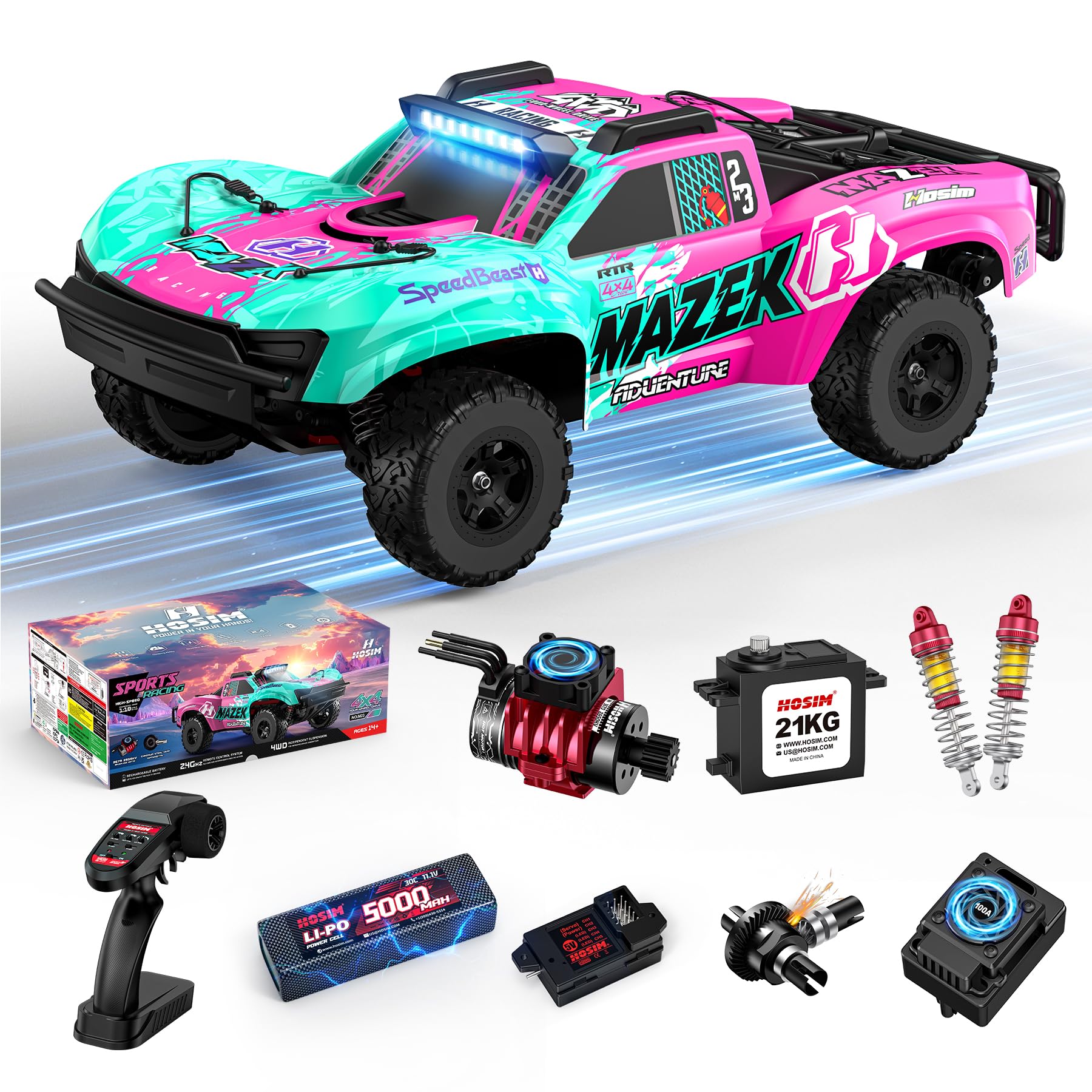
The MAZEK M23 is a short-course truck chassis that uses a 3670 can motor—a 550-size variant—coupled to a 100A ESC that can handle 3S and 4S LiPo. On the included 5000mAh 3S pack, verified GPS runs hit 62 MPH, which is competitive with mid-tier Arrma 3S platforms. The metal drivetrain includes a central steel differential and chromium-steel spiral gears in the front and rear diffs—these handle the torque without stripping, but the oil fill from the factory is inconsistent (some units arrive with near-dry center diffs, causing driveline binding). The chassis is nylon composite with CNC 6061 steering links, which provides a reasonable stiffness-to-weight ratio for the price.
The suspension uses aluminum oil-filled shocks with threaded collars for preload adjustment—unusual at the price point. The 21kg metal-gear servo provides precise steering command, though the included 2.4GHz transmitter lacks endpoint adjustment, meaning the servo can bind at full lock on some units unless you physically adjust the steering turnbuckles. The buggy runs 1/10 scale wheels and tires, which limits tire selection if you want to run dedicated track rubber—most aftermarket 1/10 short-course tires fit, but 1/8 buggy tires (larger diameter) will rub the body mounts.
Durability is a split story: the chassis and drivetrain have survived 10-foot flat drops and wall impacts in testing, but the body shell mounting tabs are fragile and break on rollovers. The ESC is not programmable without a separate Spektrum programmer, and the 5-channel receiver is paired to a 2-channel radio, meaning auxiliary lighting cannot be toggled without a receiver swap. The included charging cable is USB-based and takes over four hours to charge the 5000mAh 3S pack—budget for a standalone balance charger to reduce downtime between runs.
Why it’s great
- 3670 motor and 100A ESC deliver verified 62+ MPH on 3S LiPo
- Chromium-steel spiral diffs handle torque without stripping under normal use
- 21kg metal-gear servo and oil-filled shocks with threaded collars at this price point
Good to know
- Body shell mounting tabs are brittle and break during rollovers
- ESC is not programmable without a separate Spektrum interface
7. Hosim VEXARO MAX
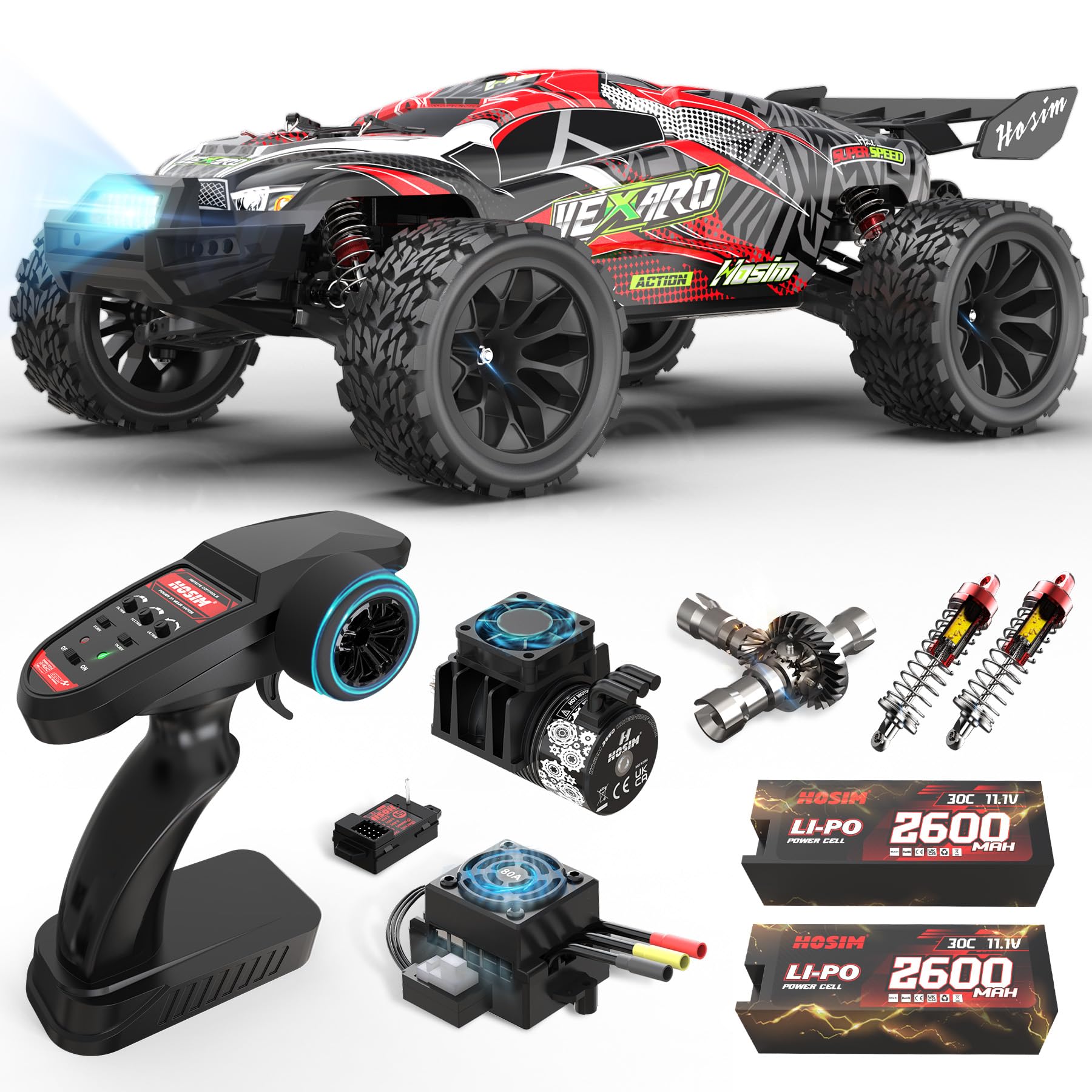
The VEXARO MAX uses a 3660 3100KV brushless motor with an 80A ESC, which on 3S delivers an advertised 50+ MPH—verified by owners in the 45-50 MPH range. The chassis is an all-metal construction: 6061 aluminum suspension arms, medium-carbon steel driveshafts, and a stamped aluminum chassis plate. This makes the buggy heavy (about 7.5 pounds with battery), which helps it track through rough grass and gravel without bouncing, but also means the diff housing screws are prone to backing out under heavy vibration. The three-differential system includes a central sealed differential that splits torque front to rear—most budget buggies in this tier skip the center diff, so the VEXARO’s driveline stays free of binding during tight turns.
The shock absorbers are hydraulic oil-filled units with threaded preload collars, but the included oil viscosity is thin (roughly 10wt), causing the buggy to bottom out on jumps over 3 feet unless you refill with 30wt-40wt. The 9kg steering servo is the weakest point—it lacks the torque to hold a line at speed in tall grass, and the plastic servo saver slips under heavy cornering loads. A 20kg metal-gear servo and aluminum servo horn are the first recommended upgrades.
Customer reports note that the included 2S 2600mAh battery provides about 20 minutes of runtime, but the buggy’s weight and 3100KV motor drain the pack quickly under full throttle—buyers should budget for spare 4000mAh 3S packs. The tires rub the body shell at full steering lock, causing sidewall cuts on hard surfaces. The radio range is rated at 390 feet, but real-world range testing shows signal loss past 250 feet in RF-noisy environments. This is a capable all-terrain basher for the price, but the electronics need incremental upgrades to reach true “hobby grade” reliability.
Why it’s great
- Metal chassis and full drivetrain hold up to hard bashing off-road
- Three-differential drivetrain prevents steering bind on high-traction surfaces
- Hydraulic oil-filled shocks with threaded collars allow tuning
Good to know
- 9kg servo lacks torque—upgrade to 20kg+ for reliable cornering
- Tires rub fenders at full lock; trimming or offset wheels may be needed
8. STEDMZ Nitro RC Truck

The STEDMZ is a 1/10 scale chassis with a nitro engine—its 80KM/H rating is optimistic, with real-world runs typically hitting 50-55 KM/H (31-34 MPH) after proper break-in. The 2.5mm anodized 6061 aluminum chassis plate provides a stable base, but the pull-start assembly is notoriously fragile—many units fail within the first two tanks, requiring replacement with an aluminum aftermarket unit. The three-differential 4WD system uses sealed gears, but the diff housings are plastic and prone to cracking if you land a jump on the skid plate.
The disc brake system uses a plastic caliper and resin pads—adequate for stopping at 30 MPH but fading quickly after repeated hard braking. The 75cc fuel tank is genuinely large, giving 15-20 minutes of runtime per fill on 20% nitromethane fuel. The included radio and servo are entry-level: the steering servo is a 6kg plastic-gear unit that fails under load. Enthusiasts planning to run the truck regularly should budget for a metal-gear servo, aluminum diff housings, and an aftermarket pipe and carburetor for reliable tuning. This is not a plug-and-play RC—it requires understanding needle valve tuning, glow plug temperature, and after-run maintenance like any combustion engine.
The buyer must provide fuel (10-30% nitro), glow igniter, and AA batteries for the transmitter separately. Factory carburetor settings are deliberately rich, requiring several tanks of break-in runs before the engine reaches operating temperature. The 4.79kg weight makes the truck feel planted on dirt, but the hard-compound tires have minimal sidewall flex, causing the truck to skate wide on loose corners. This is a genuine nitro RTR for those who want the sound and smell of a combustion engine, but it demands mechanical patience well beyond electric counterparts.
Why it’s great
- Anodized 6061 aluminum chassis provides a stiff base for off-road use
- 75cc fuel tank provides extended runtime per fill compared to electric packs
- Four-wheel disc brake system allows independent braking force adjustment
Good to know
- Plastic-gear steering servo and pull-start are failure-prone—budget for upgrades
- Carburetor tuning and glow-plug management require mechanical hobbyist skills
9. TAMIYA Dark Impact DF03

The DF03 Dark Impact is a 1/10 scale buggy kit—not a 1/8 scale—but it is listed here because many budget guides conflate scale and it remains a popular build entry point. The DF03 shaft-drive 4WD system uses a center shaft that directly drives the front bevel gear, reducing power loss compared to belt-drive layouts from the same era. The cab-forward design places the battery longitudinally in the chassis tunnel, with the weight concentrated low for stable jump landings. The oil dampers (CVA units) are mounted inside the wheelbase for progressive compression damping, though they lack bleed holes and can foam under hard use.
As a kit, the DF03 requires the builder to supply a 540 or 550-size motor, ESC, servo, receiver, 2-channel transmitter, and battery. Tamiya includes ball differentials in the sealed gearboxes—a welcome upgrade over the standard gear diffs in their entry kits—though the diff balls can slip under brushless power above 10.5T turn motors. The polycarbonate body is clear and requires painting from the inside, which adds 2-3 days to the build schedule. The included CVA shocks have plastic lower caps that crack if over-tightened; many owners swap to aluminum shock bodies from the TA05 or TRF415 series.
Assembly is a genuine mechanical education—the instruction manual walks through every gear mesh, bearing press, and suspension pivot sequence. The DF03 platform is not competitive on modern track surfaces due to its narrow arm geometry and limited camber adjustment (only two settings via the A-arm pivot pins), but it is an excellent kit for someone who wants to understand how planetary diffs and shock oil circuits function before moving into a true 1/8 race buggy. Spare parts availability from Tamiya USA is limited; many parts ship from Japan with 2-6 week lead times.
Why it’s great
- Teaches full drivetrain and suspension assembly—ideal learning kit for beginners
- Ball differentials in sealed boxes provide smoother power transmission
- Shaft-drive system minimizes power loss compared to belt-drive alternatives
Good to know
- 1/10 scale, not 1/8—measurements and aftermarket parts differ from true 1/8 buggies
- Narrow suspension geometry and limited camber adjustment reduce track competitiveness
FAQ
What makes a buggy true 1/8 scale instead of 1/10 scale?
Should I start with a kit or a ready-to-run (RTR) 1/8 buggy?
How often do I need to change differential oil in a 1/8 buggy?
Can I run a 6S LiPo in a 1/8 buggy rated for 4S?
Final Thoughts: The Verdict
For most users, the 1/8 scale buggy winner is the ARRMA Typhon 6S V5 because it combines sensored 2050KV/150A power, EXB-strength chassis durability, and genuine 1/8 three-diff drivetrain that survives 70+ MPH runs without fatigue. If you want track-proven geometry for competitive racing, grab the Losi 8IGHT-XE RTR. And for budget-minded speed that punches above its weight class, nothing beats the Hosim MAZEK M23 on the all-important power-to-dollar ratio.