
The difference between a print that snaps on the build plate and one that survives a drop test comes down to a single variable: the polymer in your hot end. PLA is easy, but it creeps under load and embrittles in sunlight. ABS stinks and warps. The real workhorses — PETG, carbon-fiber composites, and toughened blends — demand specific nozzle temperatures, bed adhesion routines, and moisture control that most beginners ignore until a failed 15-hour print forces the lesson.
I’m Min — the co-founder and writer behind Gadgets Feed. I’ve spent hundreds of hours cross-referencing tensile strength data, thermal deflection points, and real-world print logs from five different printer platforms to isolate which spools deliver consistent extrusion without the waste.
The picks below cover PLA for decorative work, PETG for functional brackets, ABS for heat-exposed parts, and carbon-fiber-reinforced options for tooling. This guide is built to help you find the absolute best 3d printer filament for your specific project demands, from beginner-friendly spools to engineering-grade composites.
How To Choose The Best 3D Printer Filament
Picking a spool is not just about color. The material type, tolerance grade, and spool size determine whether your print succeeds or fails halfway through. Start by matching the polymer to the mechanical demands of your project — decorative models tolerate PLA, while load-bearing or outdoor parts need PETG or ABS. Then check the diameter tolerance: ±0.03 mm is standard, but ±0.02 mm delivers more consistent extrusion on long prints. Finally, consider moisture sensitivity — PETG and nylon require dry storage, while PLA is more forgiving in humid environments.
Material Type vs. Mechanical Demands
PLA is stiff, low-odor, and prints at low temperatures, but it embrittles under UV and creeps under sustained load. PETG adds impact resistance and moisture stability for functional parts like brackets and enclosures. ABS offers higher heat deflection (around 100°C) but requires an enclosure to prevent warping. Carbon-fiber-reinforced filaments (PLA-CF or PET-CF) boost rigidity and reduce layer lines, but they demand hardened steel nozzles due to abrasive fibers.
Dimensional Accuracy and Tolerance Grades
The industry standard for 1.75 mm filament is ±0.03 mm, but premium spools advertise ±0.02 mm or even ±0.01 mm. Tighter tolerances reduce under-extrusion spots and improve interlayer fusion across long prints. A spool with ±0.05 mm variance can cause inconsistent line widths, leading to visible artifacts or weak spots. For functional parts requiring press-fit tolerances, aim for ±0.02 mm or better.
Spool Size, AMS Compatibility, and Storage
Most standard spools hold 1 kg (2.2 lbs) and fit external holders without issue. Larger 2 kg spools or bundles (like 4 kg multipacks) offer better per-gram value but may be too wide for enclosed printers or AMS units — the PINBALL 250 g spools, for example, require a printed adapter to work in Bambu Lab AMS systems. Regardless of size, always store filament in vacuum-sealed bags with desiccant or a dry box; PETG left in humid air absorbs enough moisture within 24 hours to cause bubbling and stringing during extrusion.
Quick Comparison
On smaller screens, swipe sideways to see the full table.
| Model | Category | Best For | Key Spec | Amazon |
|---|---|---|---|---|
| FLASHFORGE PETG Pro | PETG | Waterproof & functional parts | ±0.02 mm tolerance | Amazon |
| SUNLU PETG 2-Pack | PETG | Bulk functional printing | 2 kg bundle | Amazon |
| ANYCUBIC PLA-CF | PLA-CF | Rigid matte prototypes | Carbon-fiber infused | Amazon |
| Kingroon Silk PLA | Silk PLA | Gradient decorative art | ±0.03 mm tolerance | Amazon |
| Creality ABS 2-Pack | ABS | Heat-resistant engineering | 2 kg bundle | Amazon |
| Polymaker Fiberon PET-CF17 | PET-CF | High-stiffness jigs & fixtures | Carbon-fiber reinforced PET | Amazon |
| PINBALL PETG 16-Color Bundle | PETG | Multicolor project variety | 250 g × 16 spools | Amazon |
In‑Depth Reviews
1. FLASHFORGE PETG Pro Filament 1.75mm Black

Flashforge’s PETG Pro bridges the gap between PLA’s ease and ABS’s toughness by blending low shrinkage with hydrophobic chemistry that eliminates the need for a sealed dry box. At 245°C nozzle and 80°C bed, it produces strong, semi-transparent parts with minimal stringing — reviewers using Bambu X1C and Flashforge Adventurer 5M report clean bridging and solid bed adhesion even on large footprints. The ±0.02 mm diameter tolerance keeps extrusion consistent across the full 1 kg spool, and the vacuum-sealed packaging includes a 24-hour pre-dry cycle before shipping.
The hydrophobic nature means you can leave this spool on the printer between jobs without the overnight bubbling that plagues standard PETG. Layer adhesion is robust enough for mechanical parts like brackets and housings, and the weather resistance makes it viable for outdoor signage and enclosures that see UV exposure. Some users note a color mismatch between product photos and the actual metallic turquoise shade, but the black spool sidesteps that concern entirely.
For a material that prints as easily as PLA yet delivers ABS-grade impact resistance, the Flashforge PETG Pro represents the most versatile single-spool option in this lineup. The 1 kg net weight and 1-year warranty provide solid assurance for both hobbyists and small production runs.
Why it’s great
- Hydrophobic blend eliminates need for sealed storage between prints
- Low shrinkage reduces warping risk on large-format parts
- Vacuum-sealed with 24-hour pre-dry for clog-free first layers
Good to know
- Color accuracy on some shades may differ from product marketing photos
2. SUNLU PETG Filament 2KG, Black + White
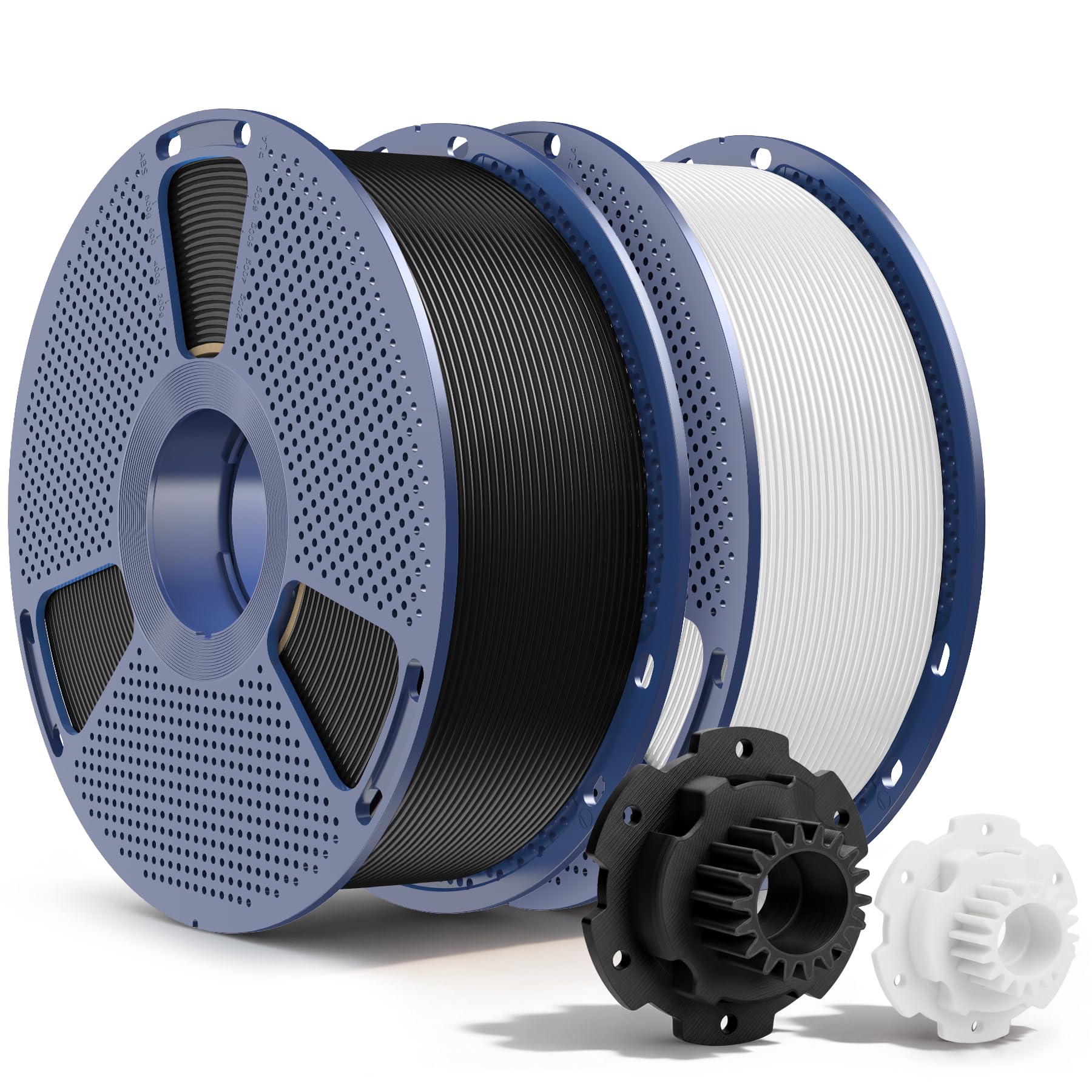
SUNLU delivers two 1 kg spools (black and white) at a per-gram cost that undercuts most single-spool PETG options, making it the smart choice for functional prints that consume filament quickly. The fully automated winding process and manual inspection minimize tangles and kinks — a critical advantage for unattended overnight prints. At 245°C nozzle and 80% speed, reviewers report excellent layer adhesion for mounting brackets, fridge clips, and stands, with manageable stringing that cleans up with a quick heat-gun pass.
The ±0.02 mm dimensional accuracy ensures consistent flow across the full spool, and the glossy finish gives functional parts a clean appearance without post-processing. Users who have ordered multiple times confirm consistent quality across batches, a sign of stable manufacturing controls. The 30-day warranty is shorter than some competitors, but the low price per kilogram makes this a low-risk proposition for high-volume printing.
If you need PETG for structural parts that demand fit precision — like interlocking enclosures or threaded fittings — the SUNLU 2-pack offers the tolerance and reliability of premium spools at roughly half the cost per gram. The black-and-white combo covers the two most common functional colors, letting you print both prototypes and production runs from the same order.
Why it’s great
- Low per-gram cost for high-volume functional printing
- Consistent ±0.02 mm tolerance across multiple reorders
- Strong layer adhesion for load-bearing brackets and enclosures
Good to know
- 30-day warranty is shorter than industry average
3. ANYCUBIC Carbon Fiber PLA Filament 1.75mm Black
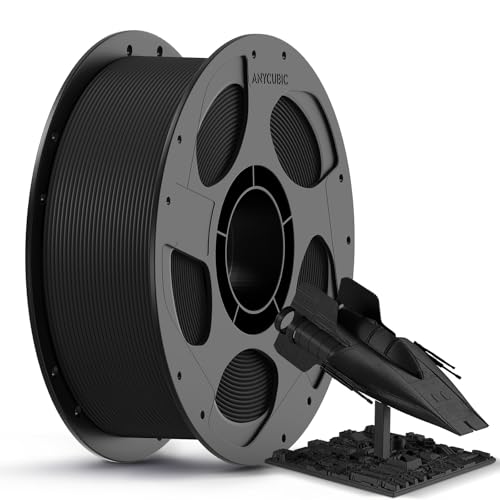
Anycubic’s PLA-CF infuses chopped carbon fiber into a PLA base, producing a matte texture that mimics injection-molded nylon without requiring a heated chamber or specialized enclosure. The carbon fibers reduce visible layer lines and boost rigidity by roughly 30% compared to standard matte PLA, making it a strong candidate for architectural prototypes, mechanical brackets, and figurines that need a premium feel. The intelligent identification chip communicates material parameters automatically when used with the ACE Pro system, eliminating manual profile selection.
Printing requires a hardened steel nozzle — the abrasive fibers will wear down brass nozzles within a single spool. At 210-230°C nozzle and 60°C bed, the material shows minimal warping and excellent warp resistance on large flat surfaces. Reviewers note consistent extrusion and vibrant color saturation, though the black shade is the most practical for hiding layer lines. The reusable spool reduces waste, and the vacuum-sealed bag with desiccant keeps the filament dry out of the box.
For users who want the visual and tactile quality of carbon fiber without jumping to a full engineering-grade composite like PET-CF, the Anycubic PLA-CF offers an accessible midpoint. The matte finish eliminates the need for sanding or coating on display pieces, saving post-processing time on every print.
Why it’s great
- Carbon-fiber infusion reduces visible layer lines for a premium matte finish
- Intelligent chip auto-configures printer settings on compatible systems
- Low warp risk even on large flat surfaces without enclosure
Good to know
- Requires hardened steel nozzle due to abrasive carbon fibers
4. Kingroon Silk PLA Filament 1.75mm Rainbow (Candy)
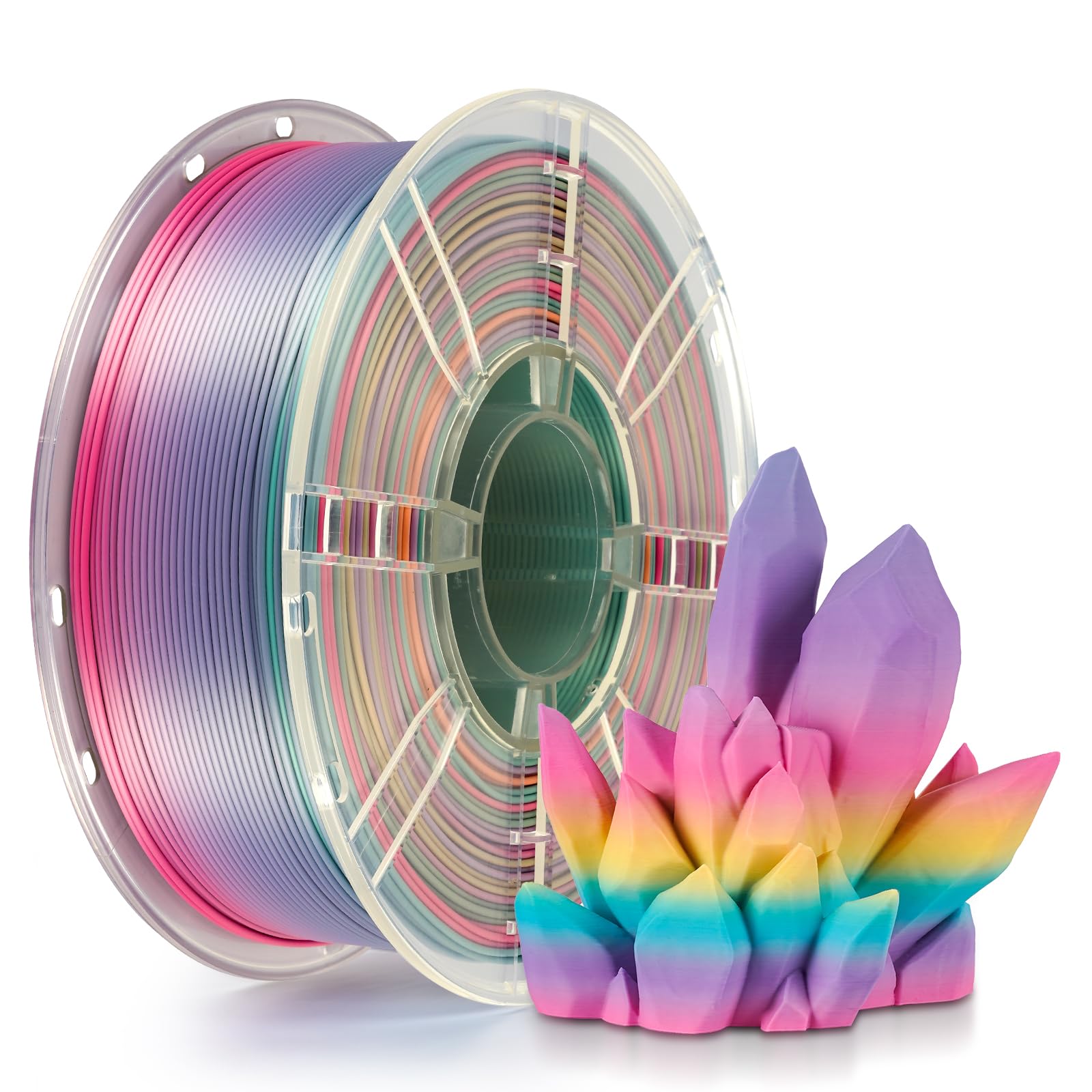
The Kingroon Candy Rainbow filament uses a rapid color gradient that shifts every 4-8 meters, producing smooth transitions across Mint Light Blue, Lemon Yellow, Rose Pink, and Rose Light Purple without abrupt color banding. The silk PLA formulation delivers a high-gloss surface finish straight off the build plate, eliminating the need for vapor smoothing or clear coating on decorative pieces. At 210-230°C nozzle and 50-60°C bed, the material exhibits strong layer adhesion and anti-bending properties that prevent cracking during assembly of articulated figures.
The ±0.03 mm tolerance is standard for silk PLA, but the completely mechanical winding process and manual inspection keep tangles and snags to a minimum — a critical factor for gradient prints where a jam mid-spool would ruin the color progression. The vacuum-sealed packaging with desiccant ensures the silk additives remain moisture-free, preventing the stringing and bubbling that can dull the glossy finish. One caveat: the filament end is tightly clipped into the spool, preventing use of the last meter without manual cutting.
For prints where aesthetics matter more than tensile strength — dragon sculptures, holiday ornaments, cosplay props — the Kingroon Candy Rainbow delivers the most seamless color transitions available at this price point. The UV-reactive gold tone in some gradient variations adds an extra layer of visual interest under blacklight.
Why it’s great
- Rapid 4-8m color gradient produces smooth transitions without banding
- High-gloss silk finish eliminates post-processing on decorative prints
- Mechanical winding and manual inspection prevent tangles during long prints
Good to know
- Filament end is tightly clipped to spool, wasting roughly the last meter unless cut manually
5. Creality 2 kg Black & White ABS Filament 1.75mm
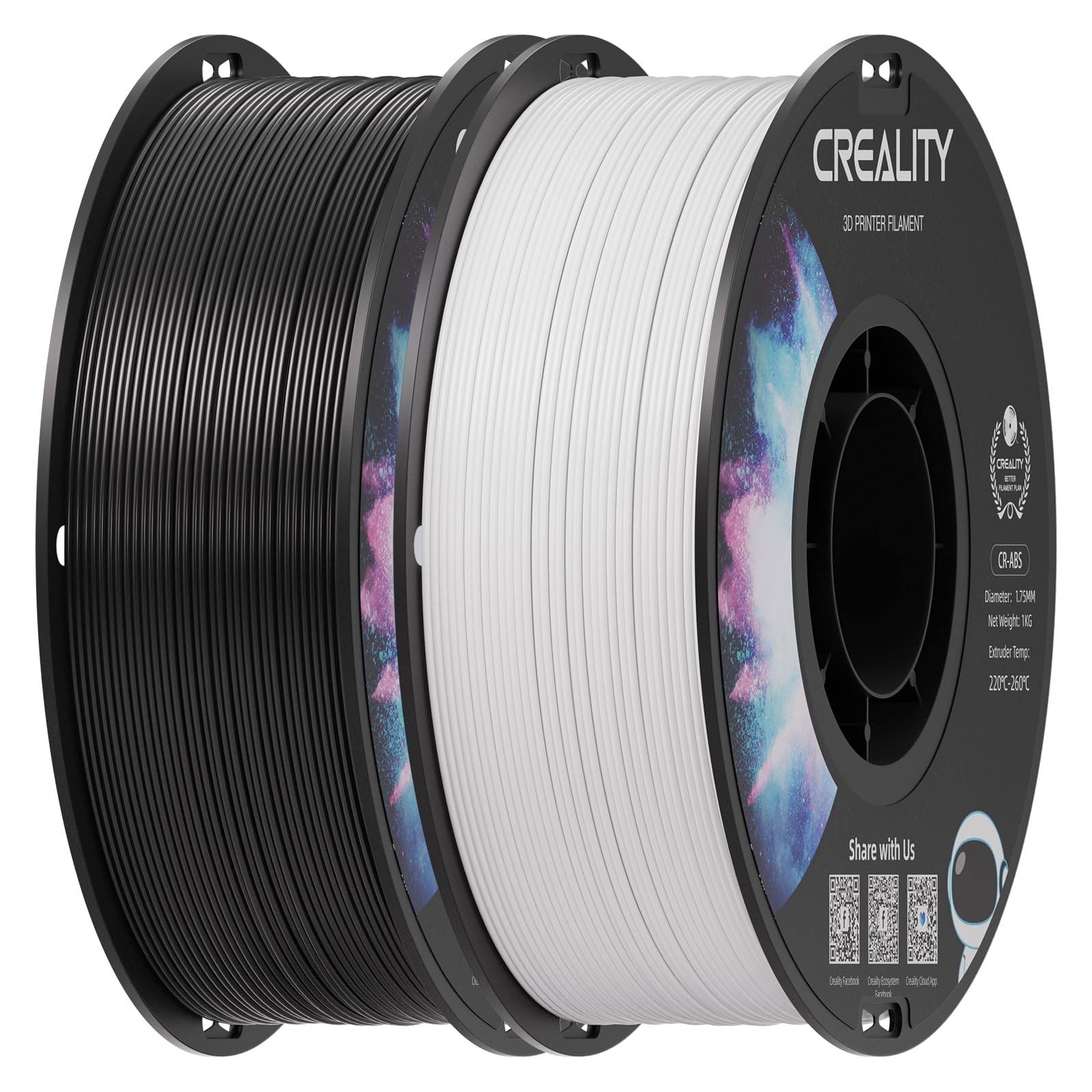
Creality’s CR-ABS formulation directly addresses the two biggest frustrations with standard ABS: warping and layer separation. The improved fluidity reduces edge curling on large rectangular prints, and the plastic spools feed cleanly in Bambu X1C AMS systems without the edge-dust issues that plague cardboard spools. At a nominal extrusion temperature around 240-260°C with an enclosed chamber, the material produces tough, rigid parts with excellent impact resistance and heat deflection up to 100°C — suitable for automotive interior components and functional jigs that sit near motors.
The 2 kg bundle (two 1 kg spools in black and white) covers the most common functional colors, and each spool is individually vacuum-sealed to prevent moisture uptake during storage. Reviewers note consistent print quality across rolls, though some report mild color variation between different spool batches — a cosmetic issue that does not affect mechanical performance. The non-toxic emission claim makes it safer for home workshops than traditional ABS, though an enclosure and ventilation are still recommended for large prints.
If your project demands heat resistance beyond what PETG can offer — enclosures near electronics, outdoor parts in direct sunlight, or structural components that undergo friction — this Creality ABS 2-pack provides the thermal stability and impact toughness at a compelling per-gram price.
Why it’s great
- Improved fluidity reduces warping and layer separation common with standard ABS
- Plastic spools feed reliably in AMS systems without dust issues
- Impact and heat resistance suitable for automotive and engineering applications
Good to know
- Minor color variation may occur between different spool batches
6. Polymaker Fiberon PET-CF17 Carbon Fiber PET 1.75mm Black
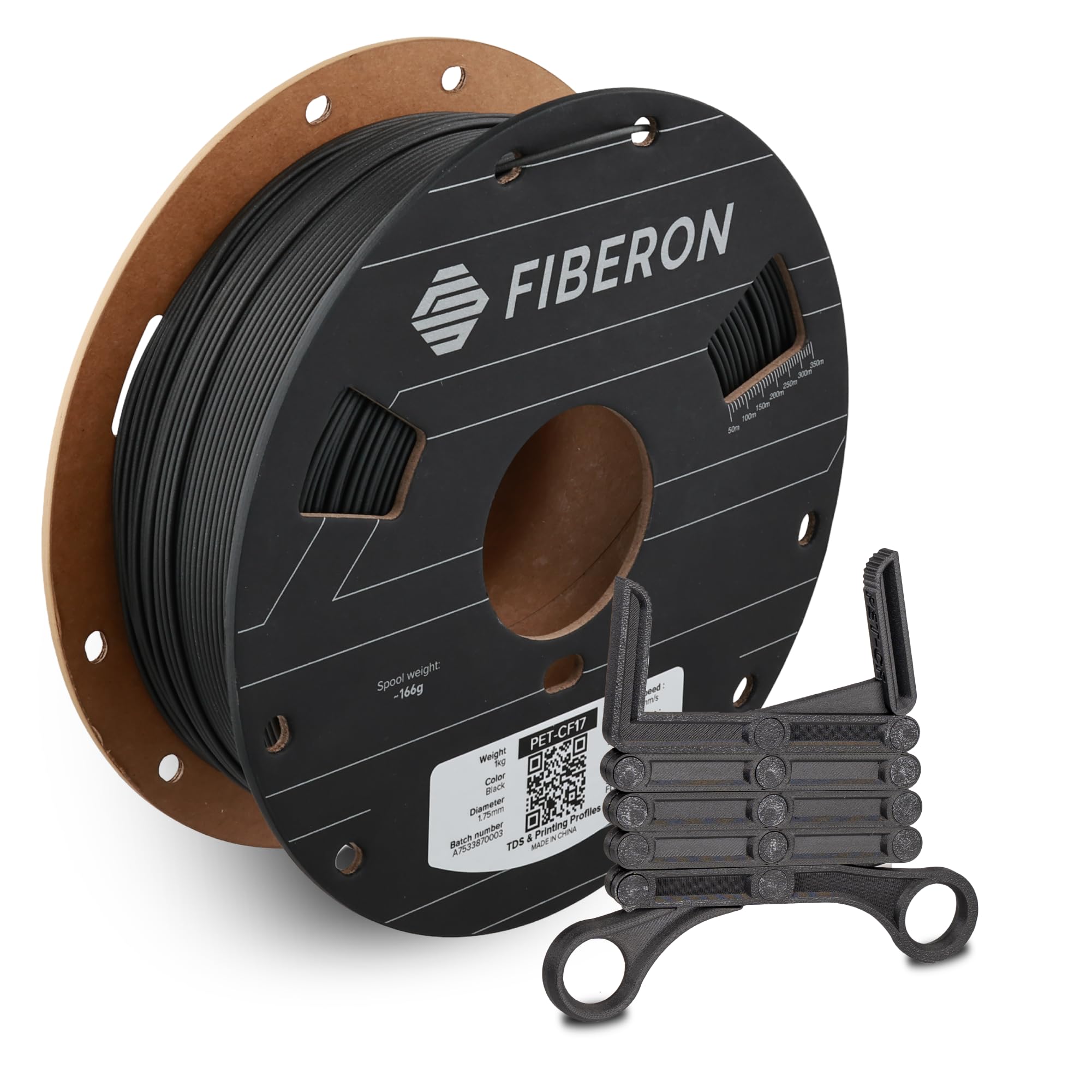
Fiberon PET-CF17 is a carbon-fiber-reinforced PET compound engineered for stiffness that remains stable across varying moisture levels — a critical property for jigs, fixtures, and tooling in automotive and composite manufacturing environments. The 17% carbon fiber loading produces a rough, sandpaper-like surface finish (approximately 1000 grit) that provides excellent grip surface without post-processing. Printers as standard as the Bambu P1S without a heated chamber can handle it at 40°C chamber temperature, and reviewers consistently report near-invisible layer lines and zero warping.
The material requires a hardened steel nozzle — standard brass will wear within a single print. The upgraded cardboard spool features a reinforced edge coating that prevents dust contamination and spool deformation during storage. Annealing post-print raises the heat deflection to 100°C, making these parts suitable for engine-bay applications. The resealable ziplock bag with desiccant plus fixed hole for filament pass-through allows dry storage even during multi-day print sessions.
At a higher price point, the PET-CF17 is not for everyday hobby prints — it is for engineers and production shops who need repeatable dimensional stability and stiffness where every 0.1 mm of deflection matters. The near-invisible layer lines and excellent bed adhesion without glue make it the most reliable carbon-fiber composite tested in this price tier.
Why it’s great
- Stiffness remains consistent across varying humidity levels for repeatable parts
- Near-invisible layer lines and zero warping even without heated chamber
- Annealing raises heat deflection to 100°C for engineering applications
Good to know
- Requires hardened steel nozzle due to abrasive carbon fiber content
7. PINBALL PETG Filament Bundle 1.75mm, 16 Colors × 250g
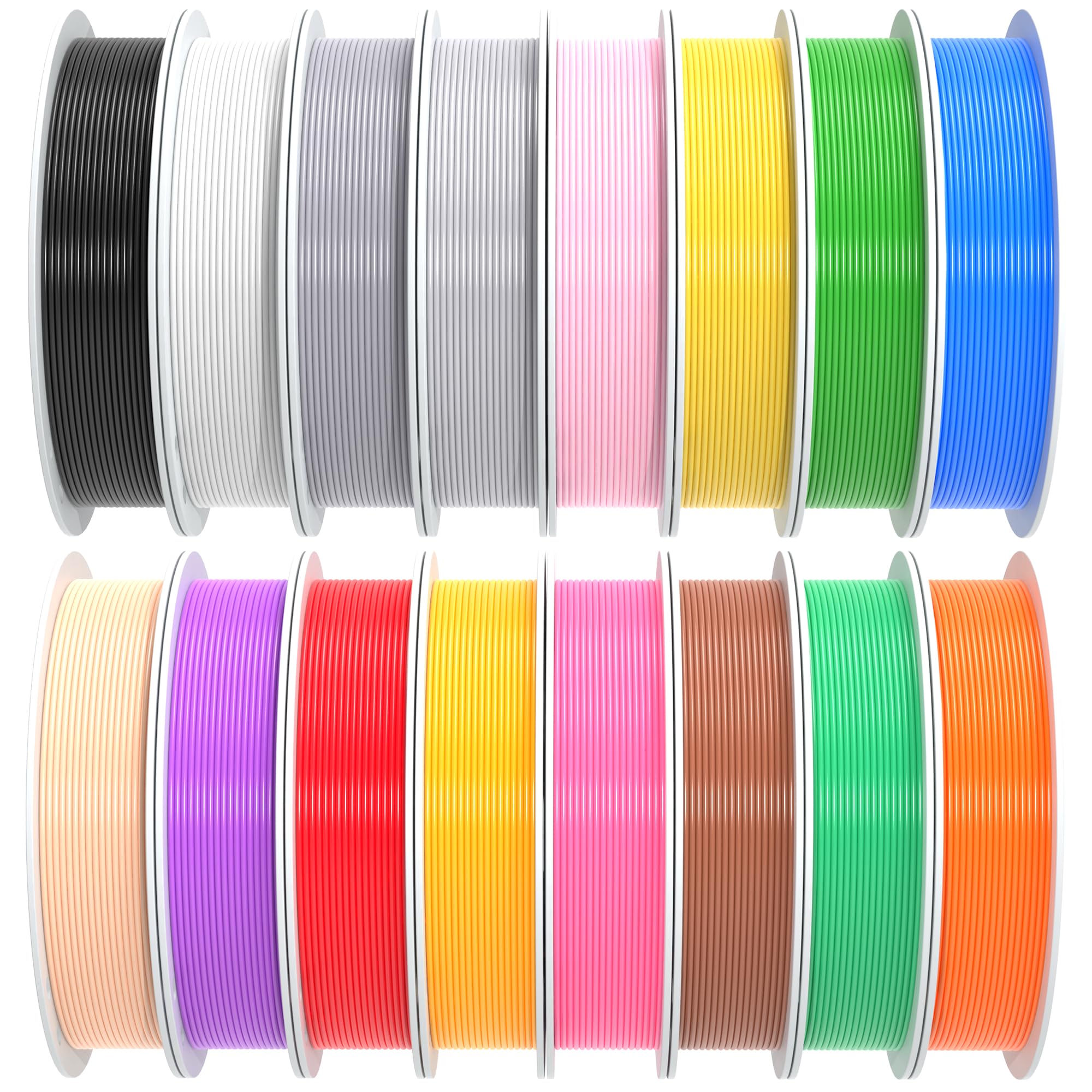
The PINBALL 16-color bundle packs 4 kg of PETG across 250 g spools, offering the widest color variety in this lineup for projects that demand multiple hues without buying full 1 kg spools of each. The ±0.02 mm diameter tolerance matches premium single-spool PETG, and the wide spool design ensures smooth feeding on most FDM printers. At 245°C nozzle and 80°C bed with minimal fan (20% max), the filament flows consistently with interlayer bonding strong enough for functional parts like outdoor enclosures and weather-resistant housings.
The 250 g spools are not natively compatible with AMS systems — a printed adapter is required — but the trade-off is the ability to sample 16 colors for roughly the same cost as four 1 kg spools. Reviewers note that thorough drying at 65°C for 10-12 hours is mandatory before printing to eliminate stringing and popping, a common trait with budget PETG bundles that may have absorbed moisture during transit. Once dried, the filament produces strong, impact-resistant parts with uniform pigment saturation.
For makers who frequently switch colors for small-batch production, prototyping with varied aesthetics, or multicolor signage, the PINBALL bundle provides the most economical entry point to a full PETG palette. The 4 kg total weight and reusable spools make it a practical stock-up option for shops that go through filament quickly.
Why it’s great
- 16 colors in 250 g spools offer unmatched variety without buying full-size rolls
- ±0.02 mm tolerance keeps extrusion quality consistent across all colors
- Strong interlayer bonding suitable for weather-resistant functional parts
Good to know
- Requires thorough drying (65°C for 10-12 hours) before printing to reduce stringing
- 250 g spools need a printed adapter for AMS compatibility
FAQ
Can PETG be printed on a printer that only supports PLA?
Why does my PETG filament produce bubbles and stringing even when it’s new?
What is the difference between PLA-CF and PET-CF for structural parts?
How do I know if my 3D printer can use carbon fiber filament?
Final Thoughts: The Verdict
For most users, the best 3D printer filament winner is the FLASHFORGE PETG Pro because it combines the printability of PLA with the impact resistance and chemical stability of ABS, all while being hydrophobic enough to leave on the printer between jobs. If you want the best per-gram value for bulk functional printing, grab the SUNLU PETG 2-Pack. And for engineering-grade stiffness where every 0.1 mm of deflection matters — jigs, fixtures, or automotive tooling — nothing beats the Polymaker Fiberon PET-CF17.