
When the slope fractures beneath your skis or board, the difference between a survival story and a recovery operation comes down to the gear clipped to your torso and packed in your bag. The chaotic seconds after a slide are no time to discover your beacon has a finicky interface or your shovel blade is too flimsy to break through hard debris.
I’m Min — the co-founder and writer behind Gadgets Feed. I spend hundreds of hours cross-referencing 457 kHz frequency response graphs, burial search algorithms, antenna configurations, and pack weight distributions to identify which avalanche safety tools actually perform when your life depends on them.
This guide distills months of spec analysis and real-world user feedback into a clear comparison of the best avalanche protection gear available today, helping you build a rescue system you can trust without bypassing critical safety benchmarks.
How To Choose The Best Avalanche Protection Gear
Every piece of avalanche safety equipment must pass the “will this work under extreme cold, impact, and time pressure” test. You are not buying a gadget — you are buying a potential second chance. The three pillars of any rescue system are a beacon, a shovel, and a probe. Beyond those, airbag backpacks and personal locator beacons add layers of prevention and communication. Prioritize devices that use the 457 kHz international search frequency, offer intuitive controls that work with gloved hands, and come from manufacturers with a track record in backcountry safety.
Beacon Antenna Count and Search Range
A three-antenna beacon is non-negotiable for anyone venturing into terrain with potential for multiple burials. Single-antenna units are obsolete — they force you to align the device perfectly to detect a signal, costing precious minutes. Look for a digital receiving range of at least 50 meters and a search strip width of 50 meters or more. The wider the strip, the fewer passes you need to cover the debris field. Every ten seconds shaved off your search time improves the victim’s survival odds dramatically.
Airbag Pack vs. Standard Pack: The Deployment Factor
An avalanche airbag increases your odds of staying on top of the debris by reducing burial depth, but only if you can deploy it instantly. Electronic systems like the Alpride E2 use supercapacitors rather than compressed gas cartridges, allowing unlimited practice deployments and easier air travel. Canister-based systems are lighter on the wallet but require pre-flight disassembly and replacement after each discharge. Consider how often you will train with the system — familiarity under stress is everything.
Probe and Shovel Build Quality
A probe that bends or a shovel handle that snaps during excavation can turn a rescue into a body recovery. Aluminum probes between 240 cm and 320 cm offer the best balance of packed length and reach. Look for probes with rapid-locking mechanisms that don’t freeze up. Shovels should have a D-grip or T-grip handle and a blade made from aircraft-grade aluminum or reinforced polymer. Blade serrations help cut through ice layers, and telescoping handles should lock securely without wiggling.
Quick Comparison
On smaller screens, swipe sideways to see the full table.
| Model | Category | Best For | Key Spec | Amazon |
|---|---|---|---|---|
| Mammut Barryvox S | Beacon | Experienced backcountry travelers | 70m digital range, 100m analog | Amazon |
| BCA Tracker 3 | Beacon | All-around backcountry use | 50m range, 3 antennas | Amazon |
| BCA Tracker S | Beacon | Beginners and budget-minded | 55m range, 3 antennas | Amazon |
| BCA TS Rescue Package | Kit | First-time buyers building a system | 3-piece kit: beacon, probe, shovel | Amazon |
| BCA Tracker 3 + Probe | Kit | Bundle value seekers | Beacon + 305cm aluminum probe | Amazon |
| Deuter Freescape Pro 40+ | Pack | Multi-day ski tours | 40L capacity, avalanche compartment | Amazon |
| Osprey Soelden Pro 32L E2 | Airbag Pack | Electronic airbag reliability | Alpride E2 supercapacitor system | Amazon |
| Deuter Alproof 30L SL E2 | Airbag Pack | Women’s specific carry | Alpride E2, 30L, SL women’s fit | Amazon |
| ACR ResQLink View + Flare Kit | PLB Kit | Remote expedition safety net | PLB + electronic flare + strobe | Amazon |
In‑Depth Reviews
1. Mammut Barryvox S Avalanche Beacon

The Mammut Barryvox S delivers a 70-meter digital search range — a full 20 meters more than many competitors — and an extended analog mode reaching up to 95 meters. This wider detection window means fewer passes across the debris field, which translates directly to faster rescue times. The circular receiving field ensures near-identical sensitivity on both the X and Y antennas, so signal dropout during the pinpoint phase is minimized.
Its lithium battery compatibility is a standout feature for cold-weather reliability. Standard alkaline cells lose voltage when temperatures drop below freezing, but lithium batteries maintain stable output, giving you up to 350 hours in SEND mode. The display is crisp and the directional arrows update quickly as you move, reducing the cognitive load when seconds count.
Some units were affected by a voluntary recall regarding switch misalignment on the Barryvox S2 variant — check serial numbers before purchase. But for experienced backcountry travelers who want the widest search strip and most forgiving antenna pattern available at this price tier, the Barryvox S sets the benchmark.
Why it’s great
- 70-meter digital range and 100-meter analog strip width provide class-leading search coverage
- Circular receiving field eliminates directional blind spots during fine search
- Compatible with lithium batteries for stable performance in subzero temperatures
Good to know
- Recall history on newer S2 variant requires serial number verification
- Premium price reflects the advanced feature set but may exceed the needs of casual riders
2. BCA Tracker 3 Avalanche Beacon

The BCA Tracker 3 shaved 20 percent of the weight and volume from its predecessor while retaining the three-antenna architecture necessary for reliable multiple burial searches. At just 215 grams with batteries, it sits unobtrusively on your chest harness and doesn’t bounce during aggressive downhill riding. The 50-meter range covers the standard debris field size recommended in AIARE training.
User feedback consistently highlights how intuitive the interface is under stress. The bright red LEDs are clearly visible in full daylight, and the motion-activated feature extends battery life by automatically switching to power-saving mode when the beacon is stationary for a period. The search mode provides clear directional arrows and distance readouts that don’t require squinting or interpreting complex graphics.
Battery life is rated at a minimum of one hour in search mode after 200 hours in transmit — enough for a full season of regular touring with typical battery changes. The lack of Bluetooth connectivity means no smartphone pairing, but for many backcountry users, that simplicity is a feature, not a drawback.
Why it’s great
- Ultra-light 215-gram design reduces fatigue during long tours
- Three-antenna system provides reliable signal detection in multiple burial scenarios
- Motion-activated power management extends battery life between seasons
Good to know
- 50-meter range is standard but narrower than premium beacons like the Barryvox S
- No Bluetooth or firmware update capability limits future-proofing
3. BCA Backcountry Access Tracker S Avalanche Beacon Transceiver

The BCA Tracker S is the entry point into the BCA beacon family without sacrificing the core safety features that matter most. It offers a 55-meter maximum range and a 50-meter search strip width, matching the performance of more expensive beacons for single-burial scenarios. Weighing only 100 grams, it is one of the lightest 457 kHz transceivers on the market, making it barely noticeable on a harness.
Customer reviews consistently praise its simplicity. New backcountry riders report that the straightforward interface — a single button for switching between transmit and search modes — reduces the learning curve significantly. The device comes pre-configured out of the box, so you can put in batteries, perform a quick group check, and hit the skin track without digging through a manual.
The trade-off for the low weight and price is the lack of advanced features like motion-activated standby or a full-color display. It uses three AAA batteries and offers a minimum of one hour of search time after 200 hours in transmit mode. For riders who want a reliable, no-frills beacon that meets all international standards, the Tracker S is a sensible starting point.
Why it’s great
- Ultra-light 100-gram weight makes it easy to wear all day without fatigue
- 55-meter range and 50-meter strip width provide solid coverage for single burials
- Simple one-button interface is ideal for beginners and reduces error under stress
Good to know
- No motion-activated standby mode means manual power management
- Single-button design lacks the feedback granularity of more expensive beacons
4. Backcountry Access T S Rescue Package

The BCA TS Rescue Package bundles the Tracker S beacon with BCA’s Stealth 270 probe and B-1 EXT shovel into one purchase, which simplifies the gear acquisition process for first-time backcountry travelers. The Stealth 270 probe extends to 270 centimeters and is made from aircraft-grade 7075 aluminum, offering a good balance between packed length and reach. The B-1 EXT shovel features a telescoping handle and a blade large enough to move significant debris volume quickly.
Package pricing undercuts buying each item separately by a noticeable margin, making this the most cost-effective way to assemble a complete rescue system from a single trusted brand. The bundled harness for the Tracker S is included, so there are no hidden accessories to buy. The shovel blade’s serrated edge cuts through icy avalanche debris effectively, and the D-grip handle provides solid leverage.
The probe locking mechanism can occasionally feel stiff when new, and some users report the shovel handle extension can be tricky to collapse with cold hands. But as a cohesive system where all components are designed to work together, the TS Rescue Package takes the guesswork out of pairing mismatched brands and ensures compatibility across the whole rescue workflow.
Why it’s great
- Complete three-piece system eliminates compatibility concerns between components
- Stealth 270 probe offers 270cm reach in a packable form factor
- Shovel blade with serrated edge cuts through ice and hard debris efficiently
Good to know
- Probe locking mechanism can be stiff when new, especially in cold conditions
- Shovel handle collapse action may require deliberate force with thick gloves on
5. BCA Tracker 3 Avalanche Beacon + SBD 10 Foot American Probe
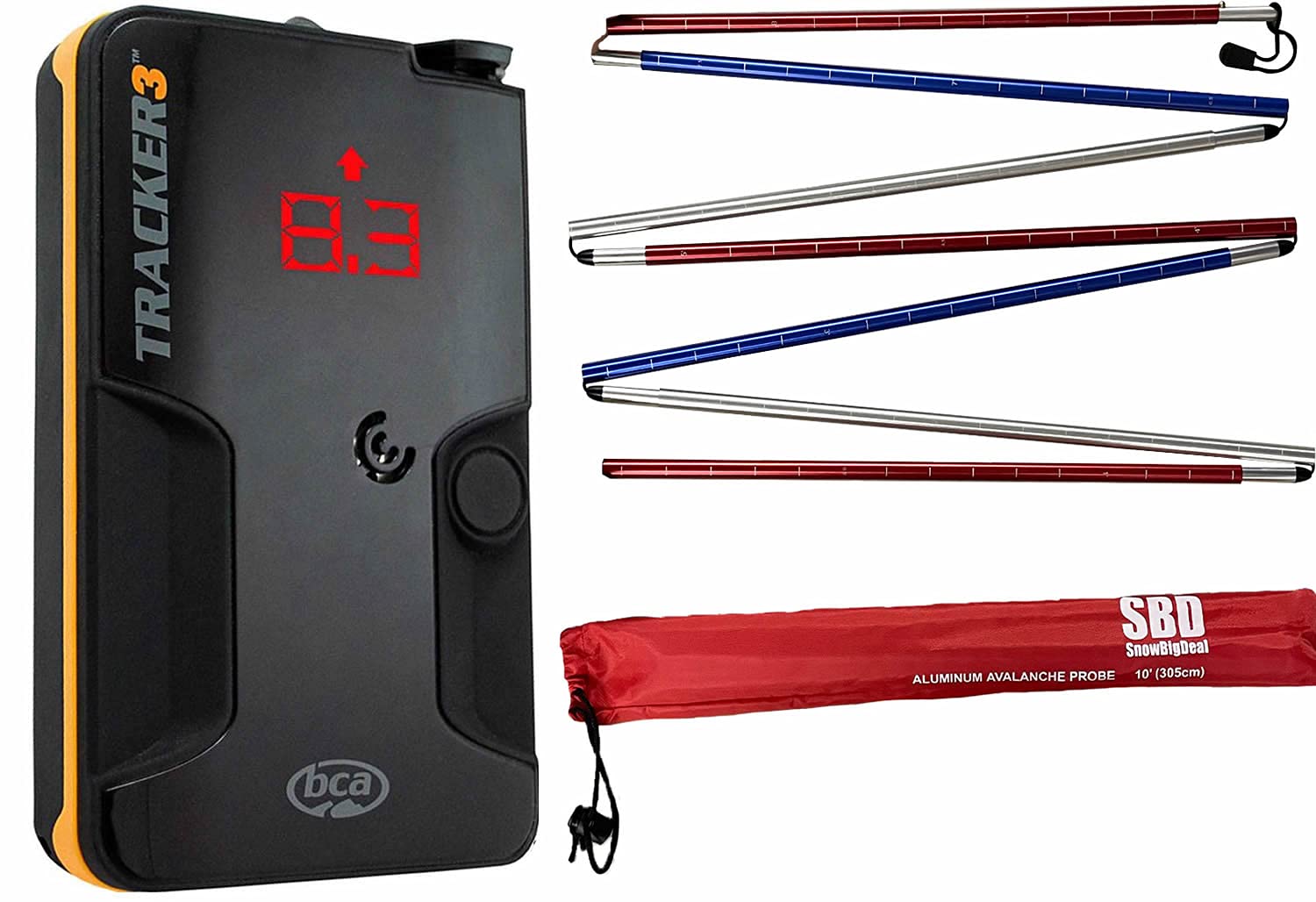
This SnowBigDeal bundle pairs the proven BCA Tracker 3 beacon with a 10-foot (305 centimeter) American aluminum avalanche probe, giving you a longer probe than most standard kits. The extra length is useful in deep debris piles where a 240cm probe might not reach the victim. The beacon ships with a body harness and batteries, so it is ready to go out of the box.
The Tracker 3’s 50-meter range and three-antenna design perform well for single and multiple burial scenarios, and the bundle pricing keeps the overall investment lower than buying a Tracker 3 and a premium probe separately. The aluminum probe sections lock together with a cable-based system that is fast to assemble once you are familiar with the mechanism.
Multiple user reports flag issues with probe section stiffness — the joints can be hard to expand and collapse, especially with cold hands or gloves. A few reviews also note that the beacon’s range calibration seemed off compared to other Tracker 3 units, though BCA’s warranty support addresses such defects. This bundle works best for riders who prioritize having a long probe at a bundled discount and are willing to practice the probe assembly before a real rescue.
Why it’s great
- 305cm probe provides superior reach in deep avalanche debris
- Bundle includes harness and batteries, ready for immediate field use
- Trailer 3 beacon offers proven three-antenna performance at a bundled discount
Good to know
- Probe sections can be stiff to extend and collapse, especially in cold weather
- Range calibration inconsistencies reported by some users
6. Deuter Freescape Pro 40+ Ski Tour Backpack
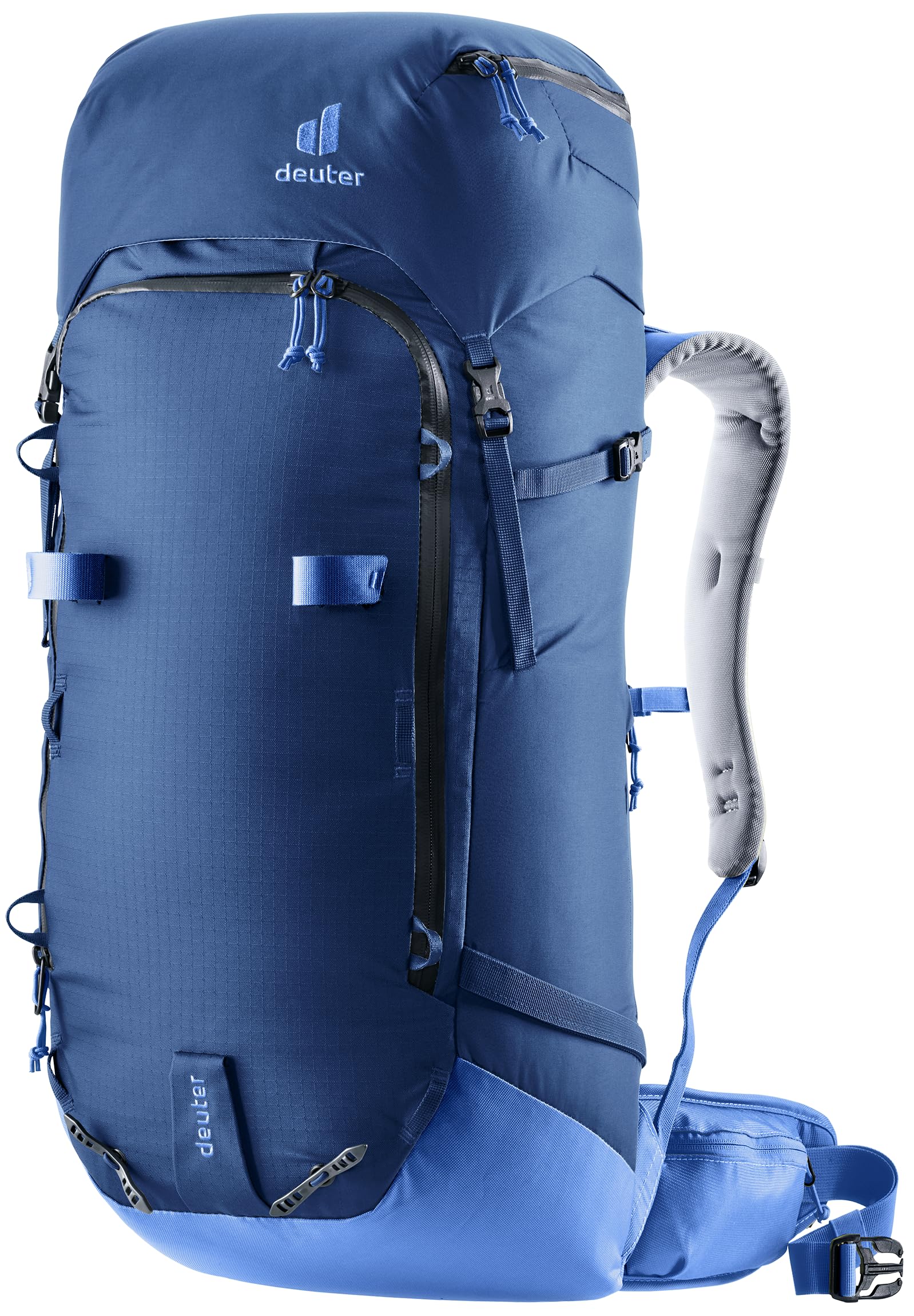
The Deuter Freescape Pro 40+ is a ski-specific backpack designed for multi-day tours where gear organization directly impacts safety. The dedicated avalanche rescue compartment includes a reinforced shovel sleeve, probe pockets, and organizer slots that keep your rescue tools accessible without digging through clothing layers. The pack features a zip-around rear opening that lets you access the main compartment without unstrapping skis — a time-saver when transitioning between skinning and descending.
The Delrin U-frame and stabilizer straps distribute the load effectively, even when the pack is loaded with 40 liters of gear plus skis, snowboard, or crampons. Detachable fear straps accommodate diagonal ski carry, and the fleece-lined goggle pocket prevents lens scratches. The main fabric is 100 percent recycled and bluesign-certified, which appeals to environmentally conscious users without compromising abrasion resistance.
Some users note that the pack lacks a built-in rain cover, and the hip belt pockets are smaller than those on competing models. The back panel is not hydration-compatible out of the box unless you purchase an accessory sleeve. But as a non-airbag avalanche pack with top-tier organization, the Freescape Pro 40+ is a robust choice for committed ski tourers.
Why it’s great
- Dedicated avalanche rescue compartment with reinforced shovel sleeve and probe pockets
- Zip-around rear opening allows full main compartment access without removing skis
- 100 percent recycled fabric with bluesign certification for sustainable construction
Good to know
- No integrated rain cover; water resistance limited to fabric DWR treatment
- Not hydration-compatible without purchasing the optional reservoir sleeve
7. Osprey Soelden Pro 32L Men’s Ski and Snowboard Backpack with E2 Airbag System

The Osprey Soelden Pro 32L integrates the Alpride E2 electronic airbag system, which uses supercapacitors instead of compressed gas canisters. This design eliminates the need to disarm the system for air travel and allows unlimited dry-fire practice deployments — critical for building muscle memory. The airbag inflates in under three seconds and produces high internal pressure to keep the user as close to the debris surface as possible during a slide.
The pack itself follows Osprey’s signature build quality, with a large front J-zip access to the avalanche safety kit pocket and a U-zip main compartment opening. A-frame and diagonal ski carry options accommodate different ski shapes, and the stow-away helmet carry works in both front and top positions. The hip belt includes a single zippered pocket and a gear loop for essentials.
A few users report that the hydration bladder compatibility is absent — there is no dedicated sleeve or tube port, which feels like an oversight for a touring-specific pack. One review noted a clip failure on the waist belt after limited use, though Osprey’s All Mighty Guarantee covers such defects. For sidecountry and inbounds-plus touring where the airbag provides an extra layer of security, the Soelden Pro with the Alpride E2 system delivers premium performance.
Why it’s great
- Alpride E2 supercapacitor airbag allows unlimited practice deployments and airline travel
- J-zip and U-zip access provide fast, organized gear retrieval without removing the pack
- Dual-position helmet carry keeps the pack streamlined on lift rides and skin tracks
Good to know
- No hydration bladder sleeve or tube port despite touring-focused design
- Waist belt clip durability has been questioned by a small number of owners
8. Deuter Women’s Alproof 30L SL Avalanche Backpack
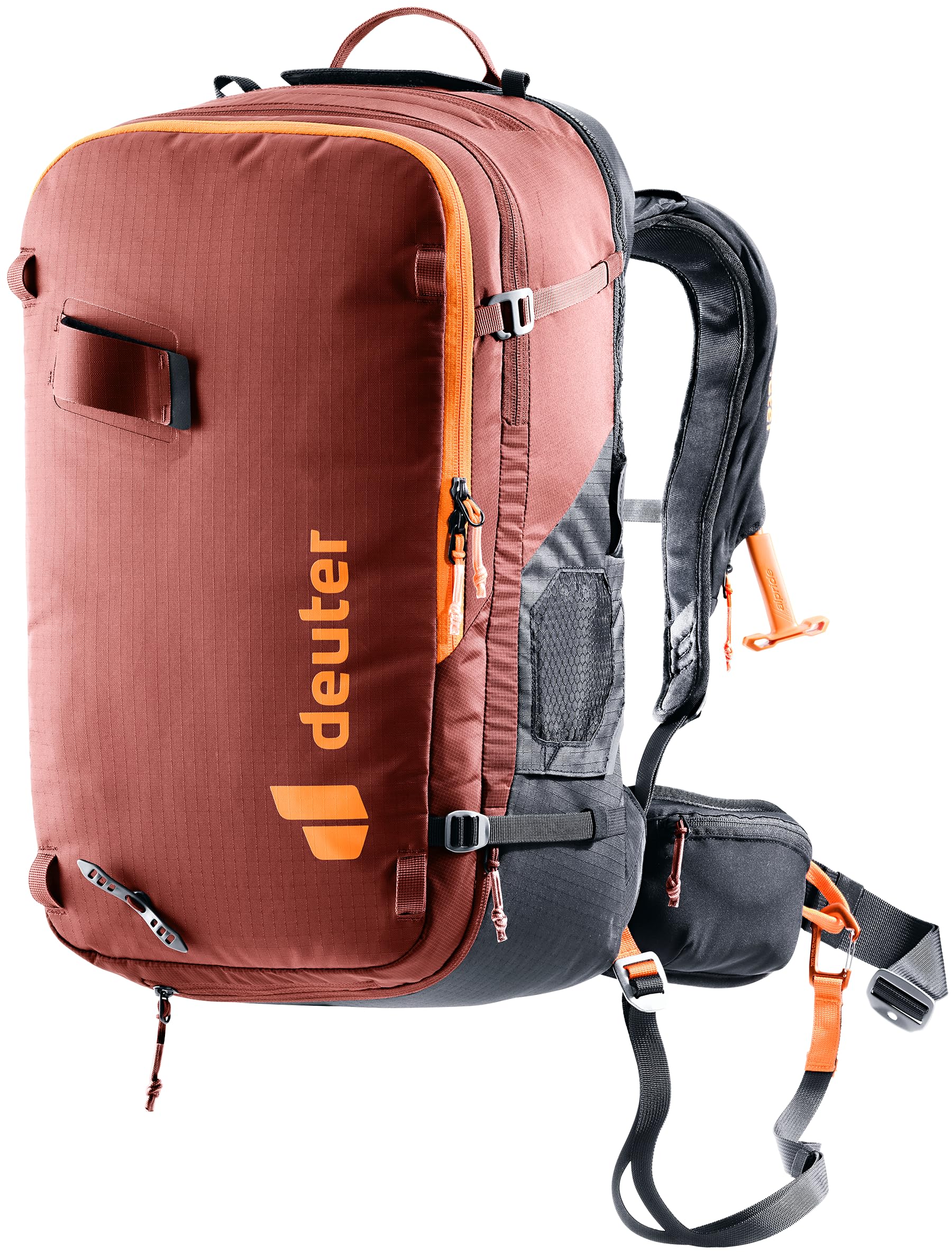
The Deuter Alproof 30L SL is built around the same Alpride E2 supercapacitor airbag system found in premium packs like the Osprey Soelden, but with a women’s-specific SL fit. The shoulder straps and hip fins are contoured for a narrower frame, reducing load shift and increasing comfort during long ascents. The 30-liter capacity is appropriate for day tours where you need a shovel, probe, extra layers, food, and water without going overkill on volume.
The safety compartment includes a zippered valuables pocket with a key clip and fleece-lined goggle storage that prevents lens fogging and scratching. Diagonal ski and snowboard attachment is handled by two modular gear straps, and the body fabric is PFC-free, water-repellent, and highly abrasion-resistant. Hydration compatibility with Deuter’s 3.0-liter Streamer reservoir is also supported — a feature the Osprey Soelden notably lacks.
Customer reviews for this specific variant are sparse, which makes long-term reliability data harder to assess. The premium price places it in the top tier of avalanche packs, but the combination of electronic airbag technology and a tailored women’s fit makes it a compelling option for female backcountry skiers who want top-tier deployment reliability without having to adapt a men’s pack design.
Why it’s great
- Women’s SL fit with contoured shoulder straps and hip fins for reduced load shift
- Alpride E2 electronic airbag offers unlimited practice deployments and travel convenience
- Hydration compatible with Deuter 3.0-liter reservoir and insulated tube routing
Good to know
- Limited user reviews available for long-term durability assessment
- Premium pricing positions it as a high-investment piece of safety equipment
9. ResQLink View GPS PLB & ResQFlare USCG Approved Electronic Distress Flare Premium Safety Kit
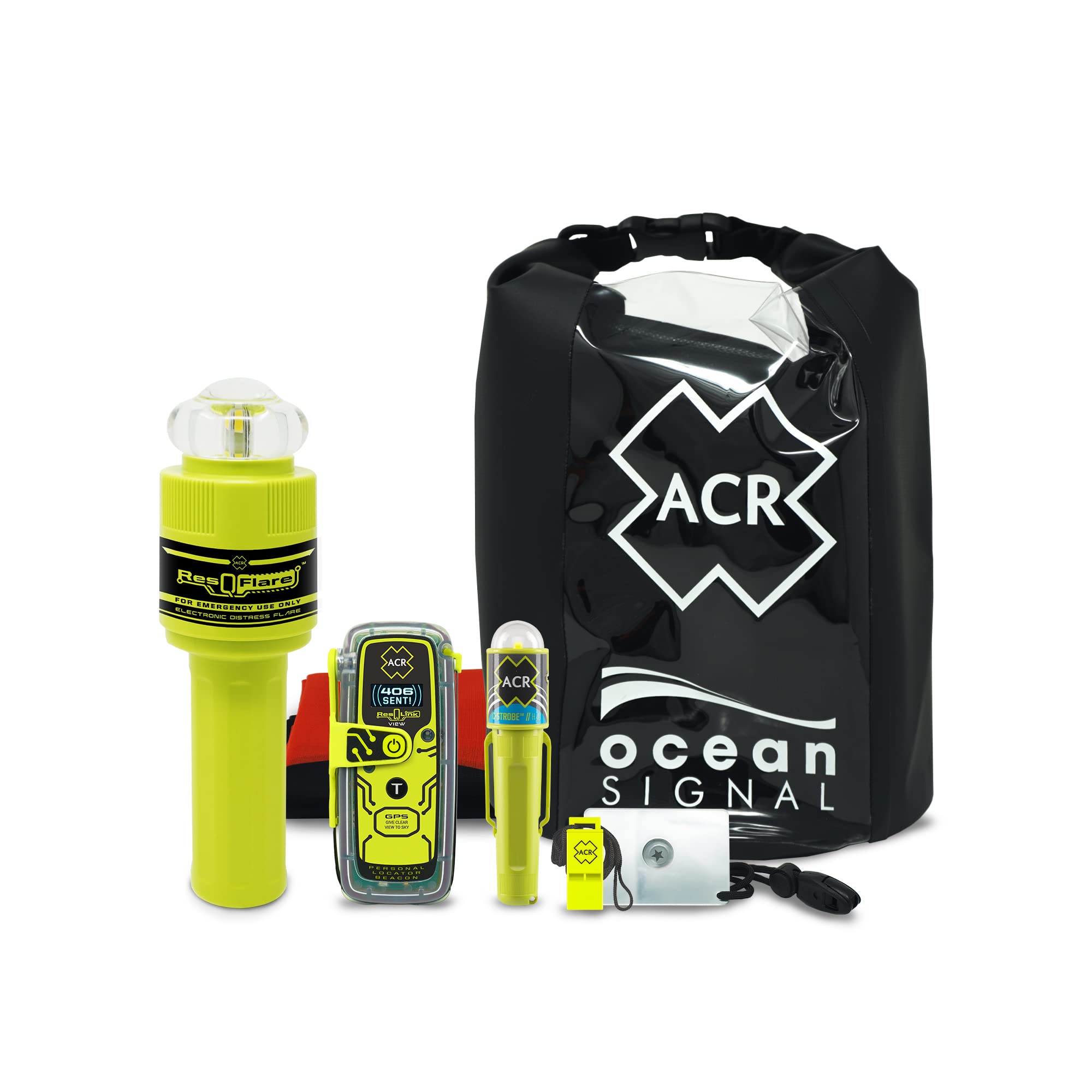
While not a traditional avalanche beacon, the ACR ResQLink View PLB is a critical piece of the wider avalanche safety puzzle for remote expeditions where cellular coverage does not exist. The 406 MHz signal is relayed through the global COSPAS-SARSAT satellite network, providing rescue authorities with your GPS coordinates. The built-in strobe light and included ResQFlare electronic distress flare add visual signaling redundancy that works in whiteout conditions.
The kit includes a C-Strobe H2O rescue light, a signal mirror with a USCG-approved whistle, a daytime distress flag, and a RapidDitch dry bag. All components pack into a compact bundle that fits into the lid pocket of a touring pack. The PLB itself is buoyant, waterproof to 10 meters, and has a 7-year battery life in standby — it only needs to be registered with NOAA once and then forgotten until the emergency arises.
This is not a replacement for a beacon, shovel, and probe — but for multi-day expeditions where you cannot rely on cell service, the ResQLink View provides a literal button to call for help from anywhere on the planet. The kit pricing is considerable, but the peace of mind that comes from knowing search and rescue has your exact coordinates within minutes of activation is hard to quantify in dollars.
Why it’s great
- 406 MHz satellite signal with GPS coordinates reaches rescue authorities anywhere globally
- All-in-one kit includes PLB, electronic flare, strobe, mirror, whistle, and flag
- Buoyant and waterproof to 10 meters with a 7-year standby battery life
Good to know
- This is a communication tool, not a substitute for a beacon, probe, and shovel
- Requires NOAA registration before use, and the 7-year battery must be tracked
FAQ
What is the difference between a 457 kHz beacon and a 2.4 GHz beacon?
Can I practice deploying an avalanche airbag system at home?
How often should I replace the batteries in my avalanche beacon?
What probe length do I need for backcountry skiing?
Final Thoughts: The Verdict
For most users, the avalanche protection gear winner is the BCA Tracker 3 because it delivers three-antenna performance, a 50-meter range, and an ultra-light 215-gram body at a price that makes it accessible without compromising on core safety features. If you want the widest search coverage and premium cold-weather battery performance, grab the Mammut Barryvox S. And for building a complete rescue system from scratch with guaranteed compatibility, nothing beats the BCA TS Rescue Package.